Jimmy Reid (1932–2010)
Contents
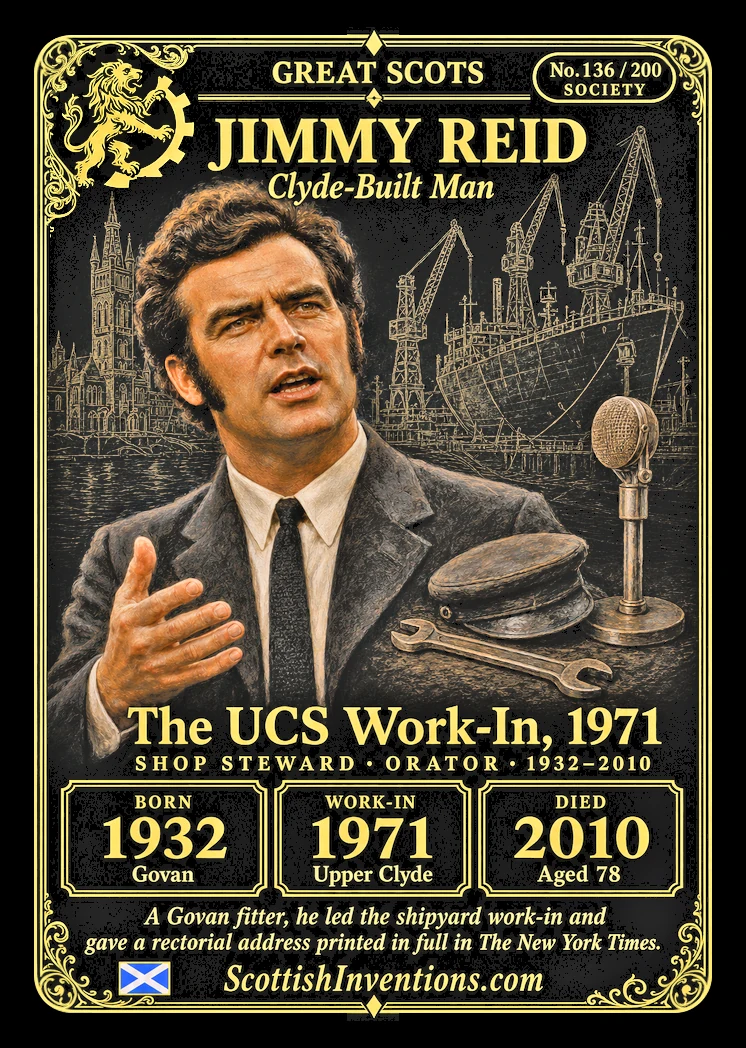
Jimmy Reid was the Govan shipyard engineer who led the Upper Clyde Shipbuilders work-in of 1971–72, forcing a government U-turn, and then gave a rectorial address at Glasgow University that was reprinted around the world. His words on alienation and the "rat race" are still quoted more than fifty years later.
TL;DR
- established Born in Govan in 1932, he left school at 14, trained as an engineer and became a Communist trade unionist and shop steward.
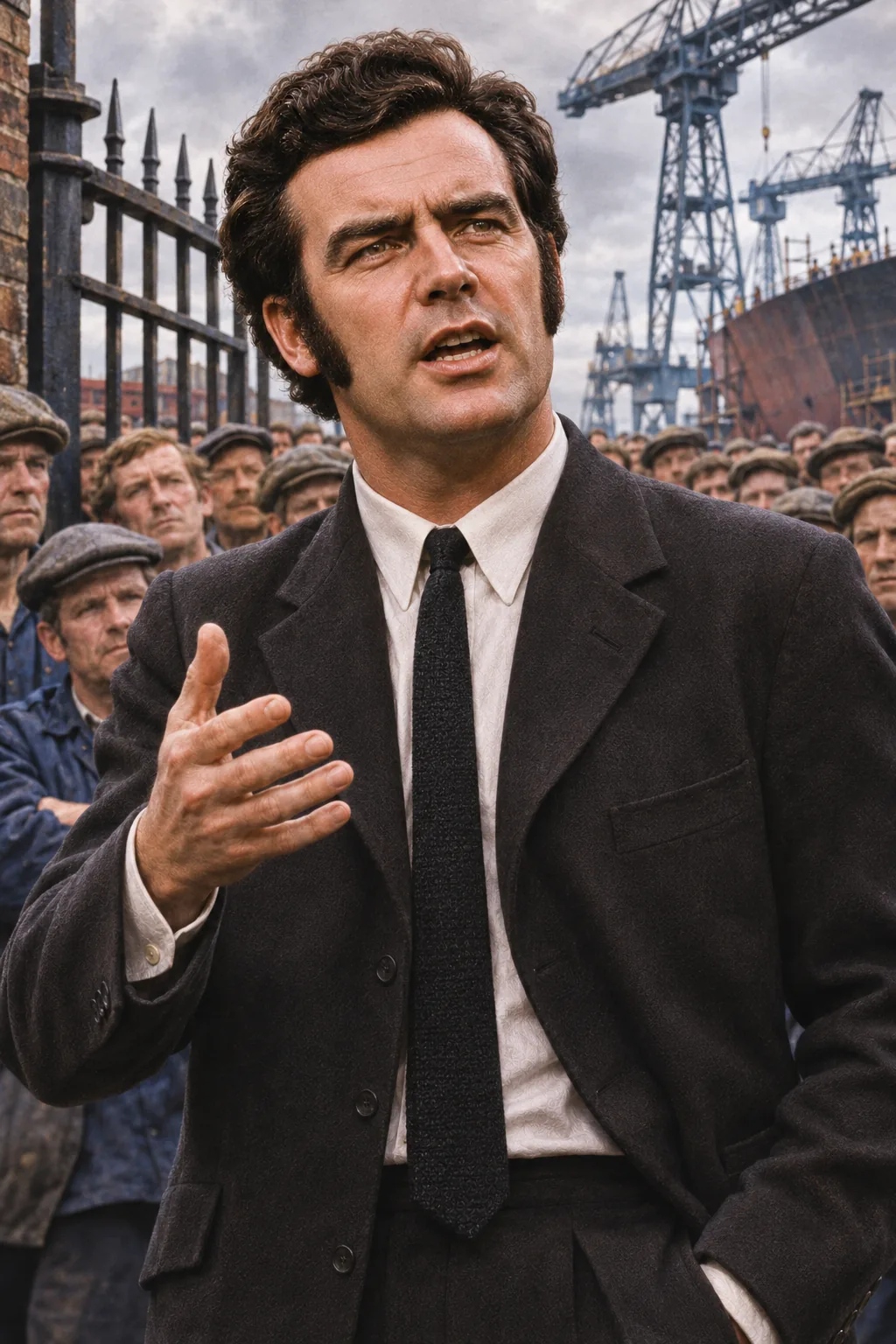
- established In July 1971, when the Heath government let Upper Clyde Shipbuilders go into liquidation, Reid, Jimmy Airlie and other shop stewards led a "work-in" rather than a strike, finishing ships to prove the yards were viable.
- established The work-in won wide public support and the government reversed course in 1972, keeping open two of the four yards.
- established Elected Rector of Glasgow University in 1971, he gave his famous rectorial address on alienation in April 1972; it was printed in full in The New York Times.
- established He later left the Communist Party, stood for Labour, and became a respected journalist and broadcaster, finally joining the SNP.
Key Facts
- Born
- 9 July 1932, Govan, Glasgow
- Died
- 10 August 2010 (aged 78)
- Trade
- Engineer; fitter with Upper Clyde Shipbuilders
- Union
- Amalgamated Union of Engineering Workers (shop steward)
- Parties
- Communist Party (to 1976); Labour; Scottish Socialist Party; SNP (from 2005)
- Rector
- University of Glasgow, 1971–74
- Famous speeches
- Work-in announcement, 30 July 1971; rectorial address "Alienation", 28 April 1972
- Book
- Reflections of a Clyde-Built Man (1976)
A Note on Claims and Evidence
Each major claim carries one of three labels. established means supported by primary records, official bodies or several independent reliable sources. shared means the core fact is sound but sources disagree on details, dates or interpretation. traditional means widely repeated but not traceable to a primary or independent source.
The work-in is extensively documented, including in John Foster and Charles Woolfson's The Politics of the UCS Work-In (1986), which drew on the minutes of the shop stewards' committee. The claim that The New York Times called his rectorial address the greatest since the Gettysburg Address is widely repeated, including by Glasgow University's archive; that the paper printed the speech in full is established, while the exact Gettysburg comparison is traditional.
Timeline
Born in Govan on 9 July, into a poor working-class family.
Leaves school at 14; works as a delivery boy and clerk.
Active in the Young Communist League; national service in the RAF.
Works for the Communist Party, then returns to the yards as a fitter.
Upper Clyde Shipbuilders is formed from five yards.
UCS goes into receivership.
Reid announces the work-in to the workforce.
Elected Rector of Glasgow University.
The government agrees to save two yards.
Delivers his rectorial address on alienation.
Stands as Communist candidate for Central Dunbartonshire.
Leaves the Communist Party; publishes Reflections of a Clyde-Built Man.
Stands for Labour in Dundee East, losing to the SNP leader Gordon Wilson.
Columnist and broadcaster.
Joins the SNP.
Dies on 10 August; humanist funeral at Govan Old Parish Church.
Details
Govan
established Jimmy Reid was born in Govan in 1932 into a family hit hard by the Depression. He left school at 14 but read hungrily in Govan Library, and later spoke of the library as the place his education really began. He joined the Young Communist League as a teenager, worked as a delivery boy and a clerk, served in the RAF, trained as an engineer with Bristol Polar Engines in Govan and became a shop steward in the engineering union. As a Communist he was elected a councillor in Clydebank.
The yards in crisis
established Upper Clyde Shipbuilders was formed in 1968 by merging five Clyde yards with government support. By 1971 it was deep in debt. The Conservative government of Edward Heath, which had pledged not to prop up "lame duck" industries, refused further credit and the company went into receivership in June 1971. A government plan would have closed most of the yards, putting thousands out of work.
The work-in
established Rather than strike, which would have let the yards close, Reid, Jimmy Airlie, Sammy Gilmore, Sammy Barr and the other shop stewards organised a "work-in": the workforce would take control of the yards and carry on finishing the ships on order. On 30 July 1971 Reid addressed the workforce and insisted on self-discipline, famously promising "no hooliganism, no vandalism, no bevvying". The point was to show the world that Clyde workers were not work-shy and that the yards could be viable.
Support from everywhere
established The work-in drew support far beyond the trade unions: churches, councils, students, small businesses and celebrities. John Lennon sent a donation of £5,000. Huge rallies were held on Glasgow Green. established In February 1972 the government changed course, and the Oxford Handbook of Modern Scottish History records that two of the UCS yards were retained as Govan Shipbuilders. The Clydebank yard was later sold to an American company.
"A rat race is for rats"
established In 1971 Glasgow's students elected Reid as their Rector, defeating two well-known politicians. His installation address on 28 April 1972 was on alienation: the sense of powerlessness among people shut out from the decisions that shape their lives. He urged students to reject the "rat race", declaring that a rat race is for rats and that human beings are not rats. established The New York Times reprinted the speech in full. At his funeral in 2010 the First Minister, Alex Salmond, promised that copies would be made available to every secondary school pupil in Scotland.
Later politics
established Reid stood as a Communist in Central Dunbartonshire in 1974 and won a substantial vote, but in 1976 he left the party, disillusioned with the Soviet Union. He joined Labour and contested Dundee East in 1979, losing to Gordon Wilson of the SNP. He was openly critical of Arthur Scargill's leadership of the 1984–85 miners' strike. established He drifted from Labour in the 1990s, supported the Scottish Socialist Party for a time, and in 2005 joined the SNP, backing Scottish independence.
Journalist and broadcaster
established From the 1980s Reid was a columnist for newspapers including the Glasgow Herald and The Scotsman, and presented television documentaries. He retired to Rothesay on Bute and died in August 2010. At his humanist funeral at Govan Old Parish Church, mourners included the First Minister, Gordon Brown and Billy Connolly. established His papers are held by Glasgow University Archives.
Did You Know?
- He left school at 14 and educated himself in Govan Library.
- He told the work-in there would be "no bevvying".
- John Lennon sent £5,000 to support the work-in.
- Glasgow University students elected him Rector in 1971.
- The New York Times printed his rectorial address in full.
- He stood for Parliament as a Communist and later as a Labour candidate.
- He ended his political journey in the SNP.
FAQ
1Who was Jimmy Reid?
A Glasgow trade unionist (1932–2010) who led the Upper Clyde Shipbuilders work-in and became a famous orator and journalist.
2What was the UCS work-in?
A 1971–72 occupation in which shipyard workers kept working to finish ships and show the yards were viable, instead of striking.
3Did the work-in succeed?
Largely. The government reversed its policy and two of the four yards stayed open.
4What was his famous speech?
His 1972 rectorial address at Glasgow University on alienation, with its line about the rat race.
5What does "no bevvying" mean?
No drinking. He insisted the workforce stay sober and disciplined.
6Was he a Communist?
Yes, until 1976, when he left the party.
7Did he become an MP?
No. He stood several times but was never elected.
8Who was Jimmy Airlie?
His fellow Communist shop steward and co-leader of the work-in.
9Where are his papers?
At the University of Glasgow Archives.
10Is his speech still read?
Yes. It is widely studied, and the First Minister promised copies to Scottish schools in 2010.
Sources and Further Reading
Primary/Institutional
- University of Glasgow Archives, Papers of James Reid (GB 248 DC 455), catalogue description on Archives Hub.
- James Reid, "Alienation", rectorial address, University of Glasgow, 28 April 1972.
- Jimmy Reid, Reflections of a Clyde-Built Man (1976).
Scholarly/Critical
- John Foster and Charles Woolfson, The Politics of the UCS Work-In (1986), and its review in the Scottish Labour History Society Journal.
- T. M. Devine and Jenny Wormald (eds), The Oxford Handbook of Modern Scottish History (2012), chapter on the Scottish economy.
- Elizabeth Ewan, Rose Pipes et al. (eds), The New Biographical Dictionary of Scottish Women (2018), entry on Betty Brown, who marched with Reid in 1971.
Caveats: Myths and Disputed Claims
- Traditional: the Gettysburg comparison. Often attributed to The New York Times; the paper's printing of the speech is secure, the exact phrase less so.
- Myth: the work-in saved all the yards. Two of the four were kept open; Clydebank was sold off.
- Disputed: credit for the work-in. Reid was its public face, but Airlie and others were equally central.
Finished reading? Try the Fact Machine: three reels, one surprising Scottish connection →
Card 136 · Great Scots