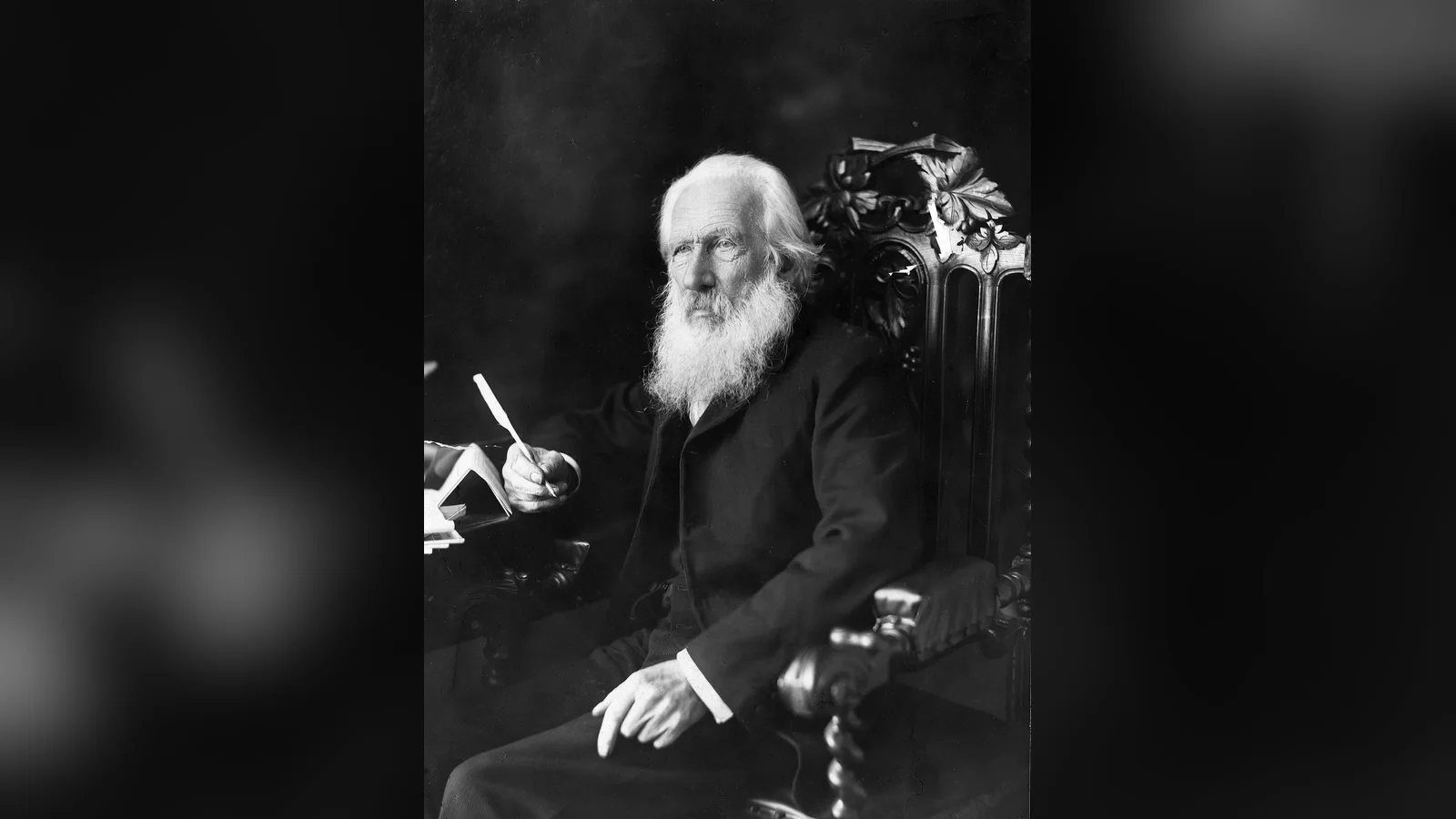

John Logan Campbell: The Edinburgh Doctor Called the Father of Auckland
Contents
John Logan Campbell was an Edinburgh-trained doctor who went to Australia in 1839 to be a sheep farmer and changed his mind. Early in 1840 he crossed to New Zealand, lived for a time with Ngāti Tamaterā on the Hauraki shore, and with his partner Brown bought the island of Motukorea in the Waitematā Harbour. When the government chose the shore opposite for its new capital, Campbell paddled over in a canoe with the firm's stock in a tent. The firm of Brown and Campbell grew rich with Auckland. In 1901 Campbell gave the city the park on Maungakiekie, One Tree Hill, now Cornwall Park, and he is buried on its summit.
TL;DR
- established Born in Edinburgh in 1817, the son of an army surgeon from an old Perthshire baronetcy. He qualified in medicine at Edinburgh and was made a doctor before he was 21.
- established He sailed from Greenock in 1839 as surgeon of the Palmyra, bound for Sydney, meaning to become a squatter. He saw in the New Year of 1840 at Bathurst.
- established Disliking the convict colony and the cost of stock, he crossed to New Zealand in 1840. He and his partner were taken in by Ngāti Tamaterā at Waiōmu and bought Motukorea from the chief Kanini.
- established When the new capital was laid out across the harbour, Campbell set up the firm's business there in a tent. Brown and Campbell became one of the town's leading merchant houses.
- established In 1901 he gave the Maungakiekie estate to the city as a park, renamed Cornwall Park; he was knighted the next year and died in 1912, aged ninety-four.
Key Facts
- Born
- 1817, Edinburgh
- Family
- Son of an army surgeon; the family seat was Kilbryde Castle, Perthshire
- Training
- M.D., Edinburgh; Fellow of the Royal College of Surgeons
- Emigrated
- 1839, surgeon of the Palmyra, Greenock to Sydney
- New Zealand
- 1840; Waiōmu, then Motukorea (Brown's Island), then Auckland
- Business
- Brown and Campbell, merchants, Auckland
- Gift
- Maungakiekie (One Tree Hill) estate, 1901, renamed Cornwall Park
- Knighted
- 1902
- Died
- 1912, aged 94; buried on the summit of One Tree Hill
- Related cards
- Diaspora 56, Scots in New Zealand; Diaspora 55, Scots in Australia
- Main sources
- John Logan Campbell, Poenamo: Sketches of the Early Days of New Zealand (1881); James Cowan, "Sir John Logan Campbell", N.Z. Railways Magazine; both online at Electric Scotland
Scottish Impact Index (SI Score)
- Global Influence
- 3/10
- Enduring Relevance
- 4/10
- Material Contribution
- 4/10
- Exceptional Achievement
- 4/10
- Lasting Legacy
- 4/10
- Recognition
- 3/10
22/60
Ranked =153rd of 179 in Great Scots
A Note on Claims and Evidence
Each major claim carries one of three labels. established means supported by primary records, official bodies or several independent reliable sources. shared means the core fact is sound but sources disagree on details, dates or interpretation. traditional means widely repeated but not traceable to a primary or independent source.
Poenamo is Campbell's own account of his first year in New Zealand, written at the end of the 1870s while he was living on Deeside in Scotland, and first meant for his children. Campbell calls it a "plain unvarnished tale" with "no word of fiction", but it is written as a romance: it gives few dates, never names Auckland, and refers to his partner only as "the senior partner". The firm's name, the dates and the later life come from Cowan's article.
Poenamo treats Māori with more warmth and interest than many settler books of its time, but within the assumptions of its day. Māori names are given here in modern spelling; the book uses Ngatitamatera, Waiomu, Motu Korea and Waitemata.
Timeline
Born in Edinburgh.
Qualifies in medicine; turns down the idea of the East India Company and decides on Australia.
Sails from Greenock as surgeon of the Palmyra, bound for Sydney.
Arrives at Bathurst, New South Wales.
Sails to New Zealand in the Lady Lilford, which reaches Wellington in March; lands in the north in April.
Lives with Ngāti Tamaterā at Waiōmu; with his partner, buys Motukorea from the chief Kanini.
The capital is laid out across the harbour; Campbell moves the firm there just before Christmas.
His journal records the first days of the new capital.
Gives the Maungakiekie estate to the city as Cornwall Park.
Knighted.
Dies, aged 94.
Details
Edinburgh
established Campbell's father was the youngest of fourteen children of a Perthshire baronet's family that had fallen into debt. He served as an army surgeon until his regiment was disbanded after Napoleon's exile, and then practised in Edinburgh, where his son was born in 1817. Cowan gives the family's ancestral home as Kilbryde Castle in Perthshire. Campbell followed his father into medicine and took his doctorate so young that, he says, the Senatus would not let him be capped in person before he was 21.
established He thought of a post with the East India Company but chose Australia, where relatives had settled, intending to become a squatter. Before leaving he taught himself carpentry and learned what he could about livestock. His father raised £1,000 and gave him half of it.
Australia
established Cowan says Campbell sailed from Greenock in 1839 as surgeon of the Palmyra, bound for Sydney. He saw in the New Year of 1840 at an inn in Bathurst and spent about three months touring the sheep country. He decided against squatting: cattle cost eight or nine pounds a head, the end of convict assignment had made labour dear, and he wanted a colony where, as he put it, "the taint of convictism was unknown". New Zealand had just been proclaimed British, and he decided to go there with his £500.
The Hauraki and Motukorea
established Campbell crossed to New Zealand in the Lady Lilford in 1840. On the Hauraki Gulf he met a runaway American whaler who traded with Māori and ran his own settlement, whom Campbell calls the "King of Waiou". With a companion he went to live with Ngāti Tamaterā at Waiōmu, where the chiefs Kanini, Katikati and Ngatai received them as chiefly Pākehā and asked them to stay as traders, on condition they were neither bad-tempered nor fond of rum.
established Campbell and his partner bought the island of Motukorea, an old volcano in the Waitematā Harbour, from Kanini. It became known as Brown's Island. When a Deputy-Governor came to claim it for the Crown, his men dug a hole for a flagstaff on the summit, but the spar was never raised; a sailor tied the flag to an oar and stuck it in the sand during lunch.
Auckland
established In 1840 Ngāti Whātua sold the government the site for a new capital on the southern shore of the Waitematā. Campbell made his first trade with their chief, Kawau, at Onehunga, coming away with thirty gold sovereigns and sixty pigs. Just before Christmas he paddled across from Motukorea in a canoe with the firm's whole stock: a couple of pots, a little tea and sugar, potatoes and some salt pork. The firm's premises were a tent. Its first deal was in bedding fern.
established His journal for 1 January 1841 shows a town of "a handful of houses and a handful of people", with "parsons without churches and magistrates without courts". Campbell worked as "master, clerk, and foreman", doing the accounts until two in the morning. According to Cowan the partners bought a section in Shortland Street and became wealthy merchants as Brown and Campbell.
Cornwall Park
established Cowan says Campbell was "not a politician, except for short periods in the early years of the province". In 1901 he gave the city the Maungakiekie estate, around One Tree Hill, by deed of gift; it was named Cornwall Park after that year's royal visit, and he was knighted in 1902. Aucklanders still called him "the Doctor". He died in 1912, aged ninety-four, and was buried on the summit of the hill.
Did You Know?
- Campbell qualified as a doctor so young that he had to be capped by proxy.
- His firm's first premises in Auckland were a tent.
- The Crown's flag on Motukorea was flown from an oar.
- Poenamo never names Auckland.
- He is buried on the summit of One Tree Hill.
FAQ
1Who was John Logan Campbell?
An Edinburgh doctor who settled in New Zealand in 1840, became one of Auckland's first merchants, and gave the city Cornwall Park.
2Why is he called the Father of Auckland?
Because he was among the first settlers on the site, traded there from the town's first weeks, and lived to be its grand old man and benefactor.
3What is Poenamo?
His memoir of his first year in New Zealand, published in 1881. "Poenamo" is his name for New Zealand, from the Māori for greenstone.
4What is Cornwall Park?
The park around One Tree Hill (Maungakiekie) that Campbell gave to Auckland in 1901.
Sources and Further Reading
Primary
- John Logan Campbell, Poenamo: Sketches of the Early Days of New Zealand (London, 1881). Online at Electric Scotland.
Secondary
- James Cowan, "Sir John Logan Campbell", N.Z. Railways Magazine, reproduced at Electric Scotland with Poenamo.
Further reading (not consulted directly)
- R. C. J. Stone, Young Logan Campbell (Auckland University Press, 1982) and The Father and His Gift: John Logan Campbell's Later Years (Auckland University Press, 1987).
Caveats: Myths and Disputed Claims
- "Father of Auckland". An affectionate title, not an office. The capital was chosen and laid out by the government.
- The partner. Poenamo never names him; Cowan gives only "Brown". He was William Brown (general knowledge; Diaspora 56).
- Motukorea. Campbell's account of buying the island is his own; its legal standing under the Crown's purchase rules is not discussed here.
Finished reading? Try the Fact Machine: three reels, one surprising Scottish connection →
Card 191 · Great Scots