Mary Brooksbank (1897–1978)
Contents
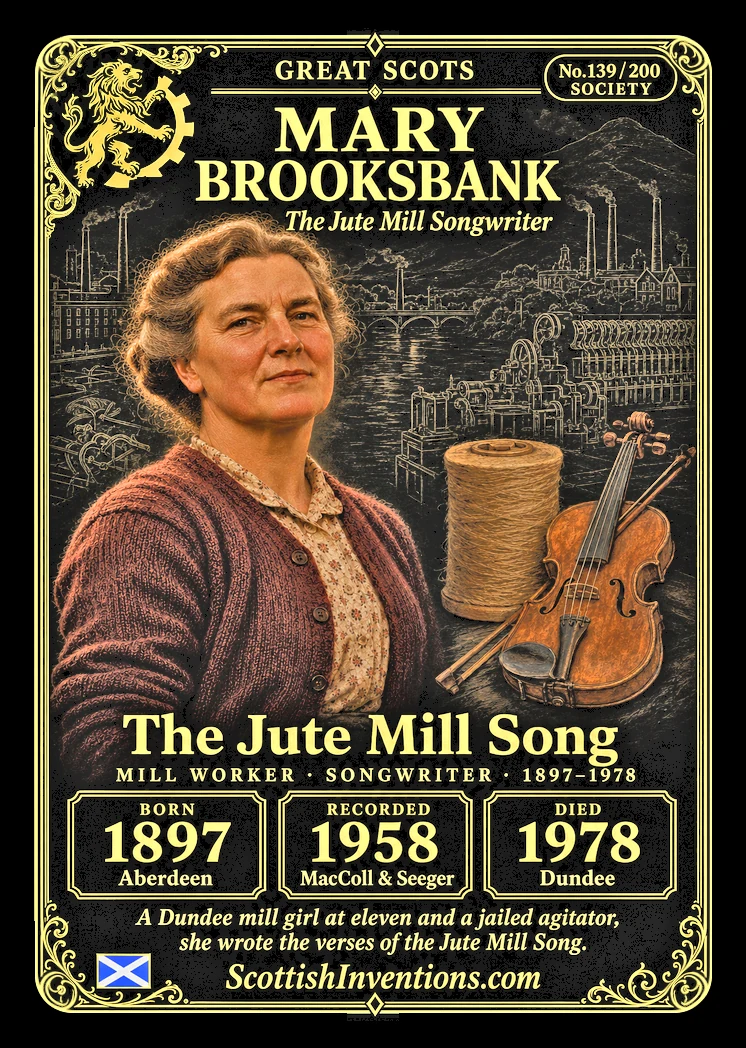
Mary Brooksbank went into a Dundee jute mill at eleven, was jailed three times for her politics, and in later life wrote the best-known song of the Scottish industrial folk tradition. Her words now appear on the walls of the Scottish Parliament.
TL;DR
- established Born Mary Soutar in Aberdeen in 1897, she moved to Dundee as a child and started work as a "shifter" in a jute spinning mill at about eleven, a job she later wrote about in her most famous song.
- established A Communist Party organiser from 1920, she led unemployed workers' demonstrations in Dundee, was arrested for incitement to riot in 1931 and served three prison sentences; the party expelled her in 1933.
- established "Oh Dear Me", also known as "The Jute Mill Song", took a chorus sung by mill girls and added verses of her own. Ewan MacColl and Peggy Seeger recorded it in 1958, and it became a standard of the folk revival.
- established Her two books, Nae Sae Lang Syne (1966) and Sidlaw Breezes (verse), record Dundee working life from the inside.
- shared She is now seen as one of the clearest voices of Dundee's women workers, in a city where women and children made up most of the jute workforce.
Key Facts
- Born
- 15 December 1897, Aberdeen
- Died
- 16 March 1978, Dundee (aged 80)
- Parents
- Alexander Soutar, dock labourer and trade unionist; Roseann Gillan, domestic servant, fish gutter and mill worker
- Married
- Ernest Brooksbank (c. 1891–1943), journeyman tailor, in 1924
- Occupation
- Jute mill worker, political organiser, poet and songwriter
- Best-known song
- "Oh Dear Me" ("The Jute Mill Song")
- Books
- Nae Sae Lang Syne: A Tale of This City (1966); Sidlaw Breezes (poems)
A Note on Claims and Evidence
Each major claim carries one of three labels. established means supported by primary records, official bodies or several independent reliable sources. shared means the core fact is sound but sources disagree on details, dates or interpretation. traditional means widely repeated but not traceable to a primary or independent source.
Brooksbank's life is documented in her own writings, police and court records, and in interviews recorded by the folklorist Hamish Henderson in the 1960s, now held by the School of Scottish Studies at the University of Edinburgh. Dates and events are established unless marked otherwise. Her own account of how she wrote "Oh Dear Me" comes from those interviews and is reported in her words.
Timeline
Born Mary Soutar in Aberdeen on 15 December, one of five children.
The family moves to Dundee, where she attends St Andrew's School.
Starts work as a shifter in a jute spinning mill, aged about eleven.
Working in the same mill as her mother; takes part in her first industrial dispute.
Joins the Communist Party of Great Britain.
Organises lobbies and demonstrations for unemployment benefit that end in riots in Dundee in September.
Marries Ernest Brooksbank on 3 October.
Arrested at a Dundee unemployment rally charged by mounted police; charged with incitement to riot.
Expelled from the Communist Party.
Her husband dies.
Caring for her mother and out of paid work, begins writing song lyrics.
Ewan MacColl and Peggy Seeger record "Oh Dear Me" on the Topic album Second Shift.
Recorded by Hamish Henderson for the School of Scottish Studies; appears on Scottish radio and television.
Publishes Nae Sae Lang Syne.
Dies in Dundee on 16 March.
Details
A child in the mills
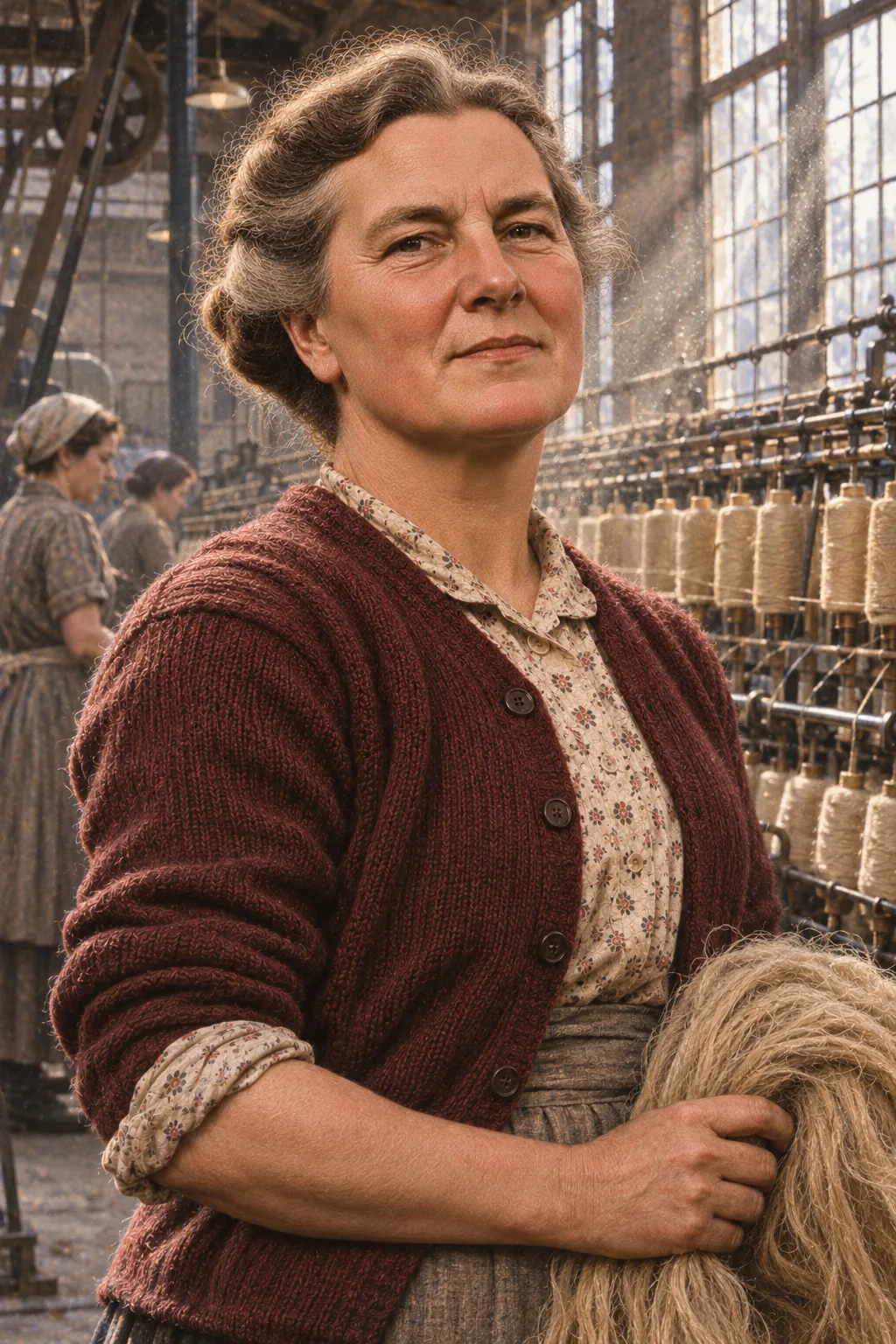
established Dundee in the early twentieth century was a "women's town": its jute mills ran largely on the labour of women and children, while many men were out of work. Mary Soutar's mother worked in the mills, and her father was a dock labourer and trade-union activist. The family moved from Aberdeen to Dundee around 1907, and at about eleven Mary went into a spinning mill as a shifter. Shifters were the youngest workers on the mill floor; they took full bobbins off the spinning frames and replaced them with empty ones, at speed. established By 1912 she was working in the same mill as her mother and took part in her first strike. Over the next three decades she moved from mill to mill, as Dundee women did, and filled the gaps with fruit picking and office cleaning.
Communist organiser
established She joined the Communist Party in 1920 and threw herself into the campaigns of the unemployed. She organised the lobbies and demonstrations for unemployment benefit that ended in rioting in Dundee in September 1921, fought evictions of tenants behind with their rent, and represented unemployed workers at Labour Exchange tribunals. established In 1931 she helped organise demonstrations against mass unemployment that stood out for the number of working women taking part. When mounted police charged a city-centre rally where she was speaking, she was arrested and charged with incitement to riot. Altogether she served three prison sentences for her political activity, and it was during the last of them that she began to write poetry.
Expulsion
shared The Communist Party expelled her in 1933. She said she had come to doubt the leadership after hearing reports from women members who had visited the Soviet Union. Her biographer in the New Biographical Dictionary of Scottish Women notes that local tensions also arose from her work with the party's very successful women's section.
"Oh Dear Me"
established Brooksbank's husband died in 1943, and by the late 1940s she was nursing her mother and no longer in paid work. She had played the violin since childhood, appearing in benefit concerts during the First World War, and now she began to write songs. Her best known is "Oh Dear Me", also called "The Jute Mill Song". She explained its origin to Hamish Henderson: the mill girls already sang a short refrain at work, and as an adult she wrote the verses to go with it. "The verses are all mine," she told him, adding that one verse came from a young mill worker who had confided in her about bringing up a child on a pittance. The song's title phrase "ten and nine" refers to the weekly wage of a mill girl around 1900: ten shillings and ninepence.
established The folk singer Ewan MacColl took up her songs. He and Peggy Seeger recorded "Oh Dear Me" on their 1958 Topic album of industrial ballads, Second Shift, and it has since been recorded by dozens of artists, from the Ian Campbell Folk Group in the 1960s to Karine Polwart and Sarah Hayes in the 2010s. In the 1960s and 1970s Brooksbank herself appeared in folk clubs and on Scottish radio and television.
Writer of Dundee
established Her memoir Nae Sae Lang Syne: A Tale of This City (1966) and her collected verse Sidlaw Breezes give a first-hand picture of Dundee's mills, tenements and politics. In Sidlaw Breezes she wrote that while politicians and rulers are richly rewarded, history is recorded "in one woman's life".
Legacy
shared A Dundee library was named after her, and when it closed the Brooksbank Centre took her name. shared A verse of "Oh Dear Me", about a world where those who work hardest are given least, is quoted on the walls of the Scottish Parliament at Holyrood. The labour historian Graham Stevenson describes her as the first woman, and the first Communist, quoted there. Theatre events, exhibitions at the Verdant Works jute museum and new recordings continue to celebrate her.
Did You Know?
- She started work in a jute mill at about eleven.
- A mill girl's weekly wage of "ten and nine" (ten shillings and ninepence) gives the song one of its best-known lines.
- She began writing poetry in prison.
- She played the violin from childhood and performed at First World War benefit concerts.
- Ewan MacColl and Peggy Seeger recorded her song in 1958.
- She was expelled from the Communist Party in 1933.
- A verse of her song is quoted on the walls of the Scottish Parliament at Holyrood.
FAQ
1Who was Mary Brooksbank?
A Dundee jute-mill worker, Communist organiser, poet and songwriter (1897–1978), best known for "The Jute Mill Song".
2Did she write "The Jute Mill Song"?
She wrote the verses. The short chorus was already sung by mill girls, as she explained to Hamish Henderson.
3What is a shifter?
A young mill worker who changed the full bobbins on spinning frames for empty ones.
4What does "ten and nine" mean?
Ten shillings and ninepence, a mill girl's weekly wage around 1900.
5Was she really imprisoned?
Yes, three times, for her political activity, including after a 1931 unemployment rally.
6Why was she expelled from the Communist Party?
She said she doubted the leadership after hearing reports from women who had visited the Soviet Union; local tensions over the party's women's section also played a part.
7Was she born in Dundee?
No. She was born in Aberdeen in 1897 and moved to Dundee as a child.
8Who made her songs famous?
The folk revival, especially Ewan MacColl and Peggy Seeger, who recorded "Oh Dear Me" in 1958.
9Did she write books?
Yes: the memoir Nae Sae Lang Syne (1966) and the poetry collection Sidlaw Breezes.
10Where is she commemorated?
On the walls of the Scottish Parliament at Holyrood, and in Dundee, where a library and then a community centre were named after her.
Sources and Further Reading
Primary/Institutional
- Mary Brooksbank, interviewed by Hamish Henderson, School of Scottish Studies, University of Edinburgh (SA1964.074–075; SA1965.162; SA1968.317).
- Mary Brooksbank, Nae Sae Lang Syne: A Tale of This City (1966); Sidlaw Breezes (1982 edition).
- Dundee Central Library, Lamb Collection; University of Dundee Archives, MS 103/38.
Scholarly/Critical
- Elizabeth Ewan, Rose Pipes et al. (eds), The New Biographical Dictionary of Scottish Women (Edinburgh University Press, 2018), entry "Brooksbank, Mary Watson".
- Eleanor Gordon, Women and the Labour Movement in Scotland 1850–1914 (1991).
- W. W. J. Knox, The Lives of Scottish Women (2006).
General
Caveats: Myths and Disputed Claims
- Myth: she wrote the whole of "The Jute Mill Song". By her own account, the chorus was a traditional mill-floor refrain; she wrote the verses.
- Disputed: her age on starting work. Her dictionary entry says eleven; other accounts say twelve. Either way, she started below the legal age.
Finished reading? Try the Fact Machine: three reels, one surprising Scottish connection →
Card 139 · Great Scots