Stanley Baxter (1926–2025)
Contents
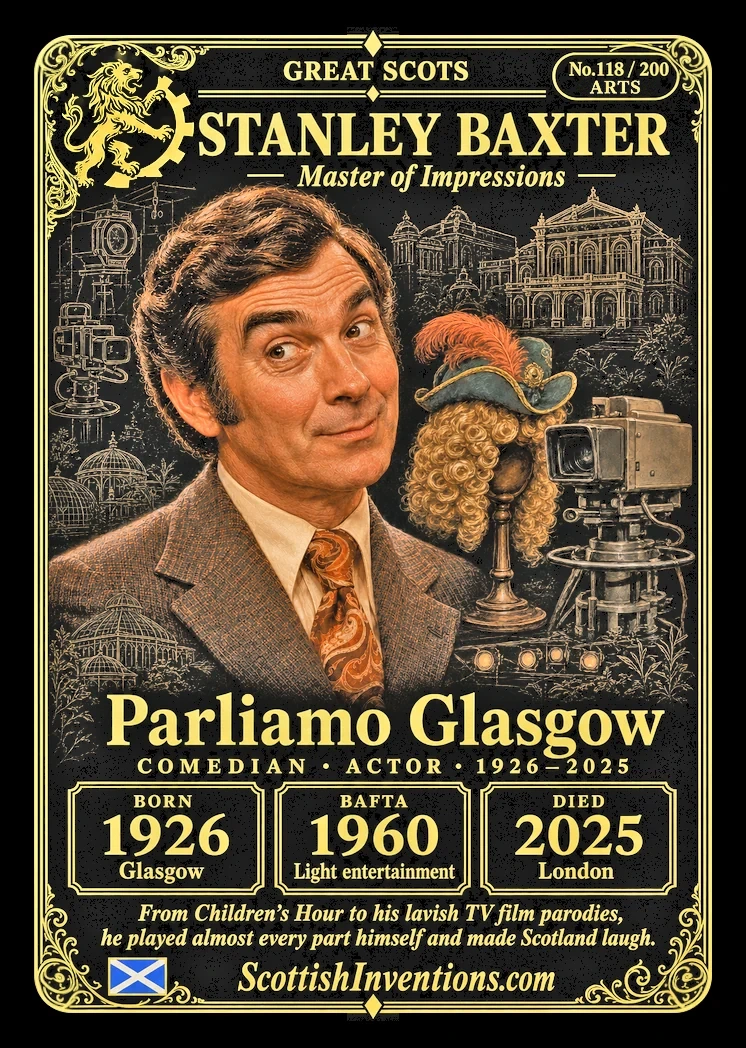
Stanley Baxter was the Glasgow comic and impressionist whose lavish television specials of the 1960s and 1970s were among the most elaborate comedy ever made for British TV, and whose "Parliamo Glasgow" sketches turned the city's speech into a mock foreign language.
TL;DR
- established Born in Glasgow in 1926 and educated at Hillhead High School, he began as a child performer on BBC Scotland's Children's Hour.
- established During national service in the Combined Services Entertainment unit he worked alongside Kenneth Williams and Peter Nichols, whose play Privates on Parade drew on that experience.
- established His BBC and ITV shows, including The Stanley Baxter Show (1963–71) and The Stanley Baxter Picture Show (1972–75), were famous for elaborate film parodies and won BAFTAs.
- established His "Parliamo Glasgow" sketches parodied language lessons by treating Glaswegian as a foreign tongue.
- established He was a pantomime star at Glasgow's King's Theatre for many years until 1992, and died in London in December 2025, aged 99.
Key Facts
- Born
- 24 May 1926, Glasgow
- Died
- 11 December 2025, Denville Hall, London (aged 99)
- Education
- Hillhead High School, Glasgow
- Married
- Moira Robertson, actress, in 1951 (she died in 1997)
- Early career
- BBC Scotland Children's Hour; Citizens Theatre, Glasgow
- Television
- The Stanley Baxter Show; The Stanley Baxter Picture Show; Mr Majeika
- Awards
- BAFTAs 1960 and 1975; British Comedy Awards Lifetime Achievement 1997; BAFTA Scotland Outstanding Contribution 2020
- Known for
- Impressions, film parodies, "Parliamo Glasgow", pantomime dames
A Note on Claims and Evidence
Each major claim carries one of three labels. established means supported by primary records, official bodies or several independent reliable sources. shared means the core fact is sound but sources disagree on details, dates or interpretation. traditional means widely repeated but not traceable to a primary or independent source.
Baxter's career is well documented through broadcast archives and an authorised biography published in 2020. His death in December 2025 was widely reported. The New Biographical Dictionary of Scottish Women, in its entry on the BBC broadcaster Kathleen Garscadden, records him among the young talents she brought to Children's Hour.
Timeline
Born in Glasgow on 24 May.
Performs as a child on BBC Scotland's Children's Hour.
Wartime service as a Bevin Boy in the coal mines; national service with Combined Services Entertainment in the Far East.
Spends about three years with the Citizens Theatre, Glasgow; appears in The Tintock Cup (1949).
Marries the actress Moira Robertson.
Film role in Geordie.
BAFTA for light entertainment.
Films including Very Important Person, The Fast Lady and Father Came Too!.
The Stanley Baxter Show on the BBC.
Appears in Joe Orton's What the Butler Saw in London.
The Stanley Baxter Picture Show on ITV.
Second BAFTA.
Plays the title role in children's series Mr Majeika.
Retires from pantomime.
Returns to radio with Stanley Baxter and Friends on BBC Radio 4.
Authorised biography published; receives BAFTA Scotland award.
Dies at Denville Hall, London, on 11 December.
Details
A Glasgow childhood
established Stanley Baxter was born in Glasgow, the son of an insurance manager, and grew up in the West End, attending Hillhead High School. His mother was determined he would perform and coached him for the stage. As a boy he took part in BBC Scotland's Children's Hour, run by Kathleen Garscadden, who later remembered him with Gordon Jackson among her young discoveries.
Mines, mess halls and Kenneth Williams
established During the Second World War he was sent down the coal mines as a Bevin Boy. Then, on national service, he joined the Combined Services Entertainment unit in the Far East, performing for troops with Kenneth Williams, Peter Vaughan, John Schlesinger and Peter Nichols. Nichols later drew on the unit for his play Privates on Parade. Baxter and Williams remained close friends for life.
Citizens Theatre and revue
established After the war he spent about three years with the Citizens Theatre in Glasgow, and appeared in its revue The Tintock Cup in 1949, which helped establish him as a comic. He became a fixture of Scottish variety and pantomime at the Glasgow Alhambra and Theatre Royal, and later at the King's Theatre, where his dames were famous. He retired from pantomime in 1992.
Film and stage
established In the 1950s and 1960s he appeared in British comedies including Geordie (1955), Very Important Person (1961), The Fast Lady (1962), Crooks Anonymous (1962) and Father Came Too! (1963). In 1969 he starred in the first production of Joe Orton's What the Butler Saw in the West End.
The television specials
established Baxter's greatest fame came on television. The Stanley Baxter Show ran on the BBC from 1963 to 1971, followed by The Stanley Baxter Picture Show and later specials for London Weekend Television. They were known for meticulous parodies of Hollywood musicals and other films, with Baxter playing almost every part, male and female, in elaborate costume and make-up. His impressions of figures including the Queen became famous. shared The specials were among the most expensive light-entertainment programmes of their day and were seen as event television at Christmas. He won BAFTAs in 1960 and 1975.
Parliamo Glasgow
established In his "Parliamo Glasgow" sketches, Baxter presented the Glasgow dialect as if it were a foreign language, in the style of a television language course, breaking down everyday phrases into unfamiliar-looking "words". The sketches became so popular that they were published as books, including the Parliamo Glasgow Omnibus, alongside his Bedside Book of Glasgow Humour.
Later work and radio
established From 1988 to 1990 he played the title role in the children's series Mr Majeika, about a wizard turned schoolteacher. He also voiced characters in Richard Williams's long-delayed animated film The Thief and the Cobbler (1993). In 2004 he returned to BBC Radio 4 with Stanley Baxter and Friends, followed by The Stanley Baxter Playhouse and Sherlock Holmes spoofs.
Private life and last years
established In 1951 he married the actress Moira Robertson, who died in 1997. In 2020, with the publication of an authorised biography by Brian Beacom, he spoke publicly for the first time about being gay, at the age of 94. He received a lifetime achievement award at the British Comedy Awards in 1997 and BAFTA Scotland's award for outstanding contribution in 2020. He lived his last years at Denville Hall, the actors' retirement home in London, where he died on 11 December 2025, aged 99. His ashes were scattered at Glasgow Botanic Gardens.
Did You Know?
- He started performing on BBC Scotland's Children's Hour.
- He was a Bevin Boy, working in the mines during the war.
- He did national service entertaining troops alongside Kenneth Williams.
- Privates on Parade was inspired by the army entertainment unit he served in.
- He played most of the parts himself in his TV film parodies.
- "Parliamo Glasgow" treated Glaswegian as a foreign language.
- He lived to 99.
FAQ
1Who was Stanley Baxter?
A Glasgow-born comedian, impressionist and actor (1926–2025), famous for lavish TV specials and pantomime.
2What was "Parliamo Glasgow"?
A sketch series parodying language lessons, presenting Glaswegian speech as if it were a foreign language.
3What were his TV shows?
The Stanley Baxter Show (BBC, 1963–71), The Stanley Baxter Picture Show (ITV, 1972–75) and later specials.
4Did he work with Kenneth Williams?
Yes, in the Combined Services Entertainment unit, and they remained friends.
5Was he in films?
Yes, including Geordie, Very Important Person and The Fast Lady.
6Did he play pantomime dames?
Yes, for decades, especially at the King's Theatre, Glasgow.
7What was Mr Majeika?
A children's TV series (1988–90) in which he played a wizard working as a teacher.
8When did he die?
On 11 December 2025, aged 99.
9Was he married?
Yes, to the actress Moira Robertson from 1951 until her death in 1997.
10Where are his ashes?
Scattered at Glasgow Botanic Gardens.
Sources and Further Reading
Primary/Institutional
- BBC Genome: The Stanley Baxter Show listings.
- BAFTA awards database.
Scholarly/Critical
- Elizabeth Ewan, Rose Pipes et al. (eds), The New Biographical Dictionary of Scottish Women (Edinburgh University Press, 2018), entry "Garscadden, Kathleen".
- Brian Beacom, The Real Stanley Baxter (Luath Press, 2020).
- Stanley Baxter, Parliamo Glasgow Omnibus and Bedside Book of Glasgow Humour.
General
- Wikipedia, "Stanley Baxter" (opened November 2026).
Caveats: Myths and Disputed Claims
- Caution: pantomime retirement. Sources give 1991 or 1992 for his last pantomime.
- Caution: show titles. His series and specials had several similar names; check dates for each.
- Caution: "Parliamo Glasgow". Do not reproduce the sketches; describe them.
Finished reading? Try the Fact Machine: three reels, one surprising Scottish connection →
Card 118 · Great Scots