
Sir Eduardo Paolozzi (1924–2005)
Contents
TL;DR
- established Sir Eduardo Paolozzi was an Edinburgh-born sculptor and artist, the son of Italian immigrants, widely credited as a founding figure of pop art: his 1947 collage "I was a Rich Man's Plaything" is regarded by art historians as among the earliest works of the movement, predating its better-known American manifestations by years.
- established His father, grandfather, and uncle died together in one of the Second World War's worst maritime disasters: all three were among 446 Italian internees killed when the SS Arandora Star was torpedoed by a German U-boat on 2 July 1940, while Paolozzi himself, aged sixteen, was separately interned as an enemy alien in Edinburgh at the same time.
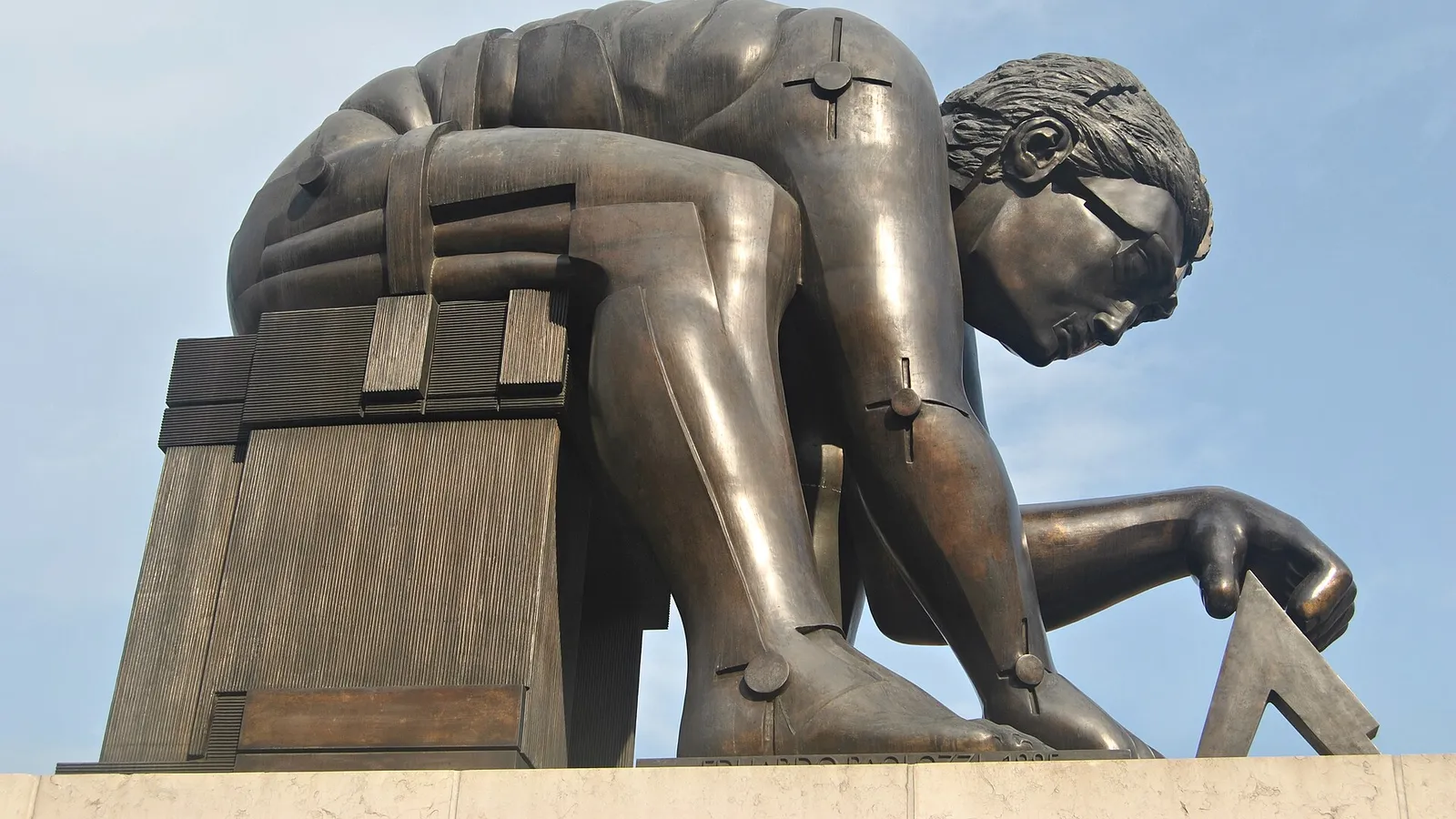
- established He became a central figure of London's Independent Group in the 1950s, a precursor to the broader Pop Art movement, and went on to produce major public works across Britain, including the extensive mosaic murals at Tottenham Court Road Underground station and the bronze sculpture "Newton After Blake" outside the British Library.
- established He held significant teaching positions internationally, including in Hamburg, Cologne, and at the Royal College of Art, and was appointed Her Majesty's Sculptor in Ordinary for Scotland in 1986.
- established In 1994 he donated a major body of his work and his entire studio contents to the Scottish National Gallery of Modern Art, leading to the creation of Edinburgh's Dean Gallery in 1999, which includes a physical recreation of his working studio.
Key Facts
- Born
- 7 March 1924, Leith, Edinburgh
- Died
- 22 April 2005 (aged 81), London
- Category
- Culture / Art
- Known for
- Pioneering pop art; public sculpture and mosaics; "I was a Rich Man's Plaything" (1947)
- Family
- Son of Italian immigrants Rodolfo and Carmela Paolozzi, from Viticuso, Lazio
- Education
- Edinburgh College of Art; Slade School of Fine Art, London
- Honours
- CBE (1968); Royal Academician (1979); Her Majesty's Sculptor in Ordinary for Scotland (1986); Knighted (1989)
Scottish Impact Index (SI Score)
- Global Influence
- 5/10
- Enduring Relevance
- 6/10
- Material Contribution
- 2/10
- Exceptional Achievement
- 7/10
- Lasting Legacy
- 4/10
- Recognition
- 3/10
27/60
Ranked =118th of 200 in Great Scots
A Note on Claims and Evidence
Paolozzi's biography, the Arandora Star disaster and his family's documented deaths aboard it, his career, major works, and honours are extensively recorded through institutional sources (National Galleries of Scotland, Royal Academy) and historical records of the Arandora Star sinking, and are treated here as established.
Timeline
Born in Leith, Edinburgh, to Italian immigrant parents who ran an ice cream shop.
Following Italy's declaration of war on Britain, Paolozzi, aged sixteen, is interned as an enemy alien and held for three months at HM Prison Edinburgh.
His father Rodolfo, grandfather, and uncle, also interned, are killed when the SS Arandora Star is torpedoed by a German U-boat while transporting Italian internees to Canada; 446 Italian internees die.
Begins studies at Edinburgh College of Art.
Briefly attends Saint Martin's School of Art before enrolling at the Slade School of Fine Art, University College London.
Studies at the Slade School of Fine Art.
Creates the collage "I was a Rich Man's Plaything," later regarded as a founding work of pop art.
Lives in Paris, encountering major modernist artists including Alberto Giacometti, Jean Arp, Constantin Brâncuși, Georges Braque, and Fernand Léger.
Marries textile designer Freda Elliot.
Becomes a founding figure of London's Independent Group.
Teaches at the Hochschule für bildende Künste Hamburg.
Produces the silkscreen series "As Is When," exploring the philosophy of Ludwig Wittgenstein.
Produces the silkscreen series "Moonstrips Empire News."
Appointed CBE.
Holds a professorship in Cologne.
Elected to the Royal Academy.
Unveils twelve monumental mosaic panels in Redditch celebrating the town's industrial heritage.
Appointed Her Majesty's Sculptor in Ordinary for Scotland.
Awarded an honorary doctorate from Heriot-Watt University.
Divorces Freda Elliot after producing three daughters.
Knighted by Queen Elizabeth II.
Donates a major body of work and his entire studio contents to the Scottish National Gallery of Modern Art.
Completes "Newton After Blake," bronze sculpture for the British Library forecourt.
The Dean Gallery opens in Edinburgh, including a recreation of Paolozzi's studio.
Suffers a near-fatal stroke, becoming a wheelchair user.
Dies in a London hospital, aged 81.
Details
A Leith childhood shadowed by wartime tragedy
Eduardo Luigi Paolozzi was born in 1924 in Leith, Edinburgh's port district, to Italian immigrant parents Rodolfo and Carmela, who ran an ice cream shop — part of a well-established Italian-Scottish community tradition. The family's roots lay in Viticuso, in Italy's Lazio region, and young Eduardo grew up bilingual, spending childhood summers with grandparents near Monte Cassino, giving him a genuinely dual cultural upbringing that would later surface in his wide-ranging, internationally engaged artistic practice.
That ordinary immigrant childhood was devastated by one of the war's most painful ironies for Britain's Italian community. Following Italy's declaration of war on Britain in June 1940, Paolozzi, then just sixteen, was interned as an enemy alien and held for three months at HM Prison Edinburgh — a wrenching experience for a British-born teenager whose only connection to an enemy state was his parents' birthplace. During his own internment, his father Rodolfo, his grandfather, and his uncle, who had also been interned, were among 446 Italian internees killed on 2 July 1940 when the SS Arandora Star, a ship transporting Italian and German internees to Canada, was torpedoed by the German U-boat U-47 — one of the deadliest single losses suffered by Britain's wartime Italian community, and a formative, genuinely traumatic loss at the very start of Paolozzi's adult life. This article states plainly that three members of his immediate family died together in this disaster while Paolozzi himself was imprisoned by the same state that would, within years, celebrate him as one of its leading artists.
Training in Edinburgh, London, and Paris
Despite this devastating start, Paolozzi pursued his education with real determination, studying at Edinburgh College of Art from 1943, briefly at Saint Martin's School of Art in 1944, and then at the Slade School of Fine Art at University College London from 1944 to 1947. A formative two years in Paris from 1947 to 1949 brought him into direct personal contact with major figures of European modernism, including the sculptor Alberto Giacometti, Jean Arp, Constantin Brâncuși, Georges Braque, and Fernand Léger — an unusually rich firsthand apprenticeship to the leading edge of European art, gained through direct encounter rather than secondhand study.
A founding figure of pop art, years ahead of its American boom
Returning to London, Paolozzi established a Chelsea studio famously filled with found objects, models, materials, tools, toys, and books — raw material that fed directly into his artistic practice of combining found objects and machine parts with human forms, often deconstructing the figure in a distinctly cubist-influenced manner. He became a central figure in the Independent Group, founded in London in 1952, now recognised as a direct precursor to the broader British Pop Art movement of the mid-1950s and the American Pop Art boom that followed in the late 1950s and 1960s. His 1947 collage "I was a Rich Man's Plaything" is considered by art historians to be among the earliest works representing pop art's visual language — meaning Paolozzi's foundational contribution to one of the 20th century's most significant art movements substantially predates the work of artists more commonly associated with Pop Art in popular memory, such as Andy Warhol and Roy Lichtenstein.
A prolific public and graphic artist
Paolozzi's later career produced a substantial body of major public commissions across Britain. His most extensive single work is the mosaic murals covering platforms and passages at Tottenham Court Road Underground station in London; though some of the original escalator-entrance panels were later removed (with some donated to the University of Edinburgh), most of the mosaics remain restored in their original location today. "Newton After Blake" (1995), a bronze sculpture sited in the forecourt of the British Library, reinterprets the English poet and artist William Blake's 1795 print of the same scientific subject, exploring themes of mathematical determinism. In Redditch, he produced twelve monumental mosaic panels, each roughly 21 by 10 feet, unveiled in 1983 to celebrate the town's industrial heritage, particularly its historic needle-manufacturing trade. He also completed commissions at Euston Station, Kew Gardens, the Design Museum, and multiple universities. Alongside sculpture, his graphic work of the 1960s proved genuinely innovative, particularly his exploration of silkscreen printing in series including "As Is When" (1965), examining the philosophy of Ludwig Wittgenstein, and "Moonstrips Empire News" (1967), drawing on popular culture and technological imagery.
An international teaching career
Paolozzi taught sculpture and ceramics at institutions across Europe and the United States, including the Hochschule für bildende Künste Hamburg (1960–1962), the University of California, Berkeley (1968), and London's Royal College of Art. He maintained an extended professional presence in Germany through the Berlin Artist Programme and professorships in Cologne (1977–1981) and Munich, a period during which he developed significant works including his Tottenham Court Road mosaic designs — demonstrating that his major British public works were often conceived and developed during periods of sustained international engagement rather than purely domestic production.
Honours, a major gift to Scotland, and final years
Paolozzi's institutional recognition built steadily across his career: he was appointed CBE in the 1968 New Year Honours, elected to the Royal Academy in 1979, appointed Her Majesty's Sculptor in Ordinary for Scotland in 1986, awarded an honorary doctorate from Heriot-Watt University in 1987, and knighted by Queen Elizabeth II in the 1989 New Year Honours. In a major act of cultural generosity toward his home country, he donated in 1994 a substantial body of his work and his entire studio's contents to the Scottish National Gallery of Modern Art; this gift led directly to the 1999 opening of Edinburgh's Dean Gallery (later renamed), which includes a physical recreation of Paolozzi's actual working studio, offering visitors a direct view into his creative process rather than simply his finished output.
Paolozzi married the textile designer Freda Elliot in 1951; the couple had three daughters, Louise, Anna, and Emma, before divorcing in 1988. In 2001 he suffered a near-fatal stroke that left him using a wheelchair for the remainder of his life. He died in a London hospital on 22 April 2005, at the age of 81.
Did You Know?
- Eduardo Paolozzi's father, grandfather, and uncle all died together when the SS Arandora Star was torpedoed in 1940 — while Paolozzi himself, aged sixteen, was separately interned in Edinburgh at the time.
- His 1947 collage "I was a Rich Man's Plaything" is regarded by art historians as one of the earliest works of pop art, predating the movement's better-known American figures by years.
- He personally knew major modernist artists including Alberto Giacometti and Georges Braque, having lived in Paris in the late 1940s.
- His most extensive single work is the mosaic mural scheme at Tottenham Court Road Underground station in London.
- He created a series of silkscreen prints exploring the philosophy of Ludwig Wittgenstein.
- He donated his entire studio's contents to Scotland in 1994, leading to a full recreation of his working studio at Edinburgh's Dean Gallery.
- He was appointed Her Majesty's Sculptor in Ordinary for Scotland in 1986.
- He continued working as an artist even after a near-fatal stroke in 2001 left him in a wheelchair.
FAQ
1What is Eduardo Paolozzi best known for?
Being a founding figure of pop art and for major public sculpture and mosaic works, including the Tottenham Court Road Underground mosaics and "Newton After Blake" outside the British Library.
2What happened to Eduardo Paolozzi's family during World War II?
His father, grandfather, and uncle were killed together when the SS Arandora Star was torpedoed in 1940 while transporting Italian internees; Paolozzi himself, aged sixteen, was separately interned in Edinburgh at the same time.
3Is Eduardo Paolozzi considered the first pop artist?
He is widely credited as a founding figure of the movement; his 1947 collage "I was a Rich Man's Plaything" is regarded by many art historians as among the earliest works representing pop art's visual language.
4Was Eduardo Paolozzi Scottish or Italian?
Both — he was born in Leith, Edinburgh, to Italian immigrant parents, and maintained a strong connection to his family's Italian heritage throughout his life.
5What is Eduardo Paolozzi's most visible public work?
The extensive mosaic murals covering platforms and passages at Tottenham Court Road Underground station in London.
6Did Eduardo Paolozzi teach?
Yes — he held significant teaching positions in Hamburg, Cologne, Munich, Berkeley, and at London's Royal College of Art.
7What did Eduardo Paolozzi donate to Scotland?
In 1994 he gave a major body of his work and his entire studio's contents to the Scottish National Gallery of Modern Art, leading to the creation of a recreated studio space at Edinburgh's Dean Gallery.
8Was Eduardo Paolozzi knighted?
Yes, in the 1989 New Year Honours, having earlier been appointed CBE in 1968.
9How did Eduardo Paolozzi die?
He died in a London hospital in 2005, aged 81, having suffered a near-fatal stroke in 2001 that left him using a wheelchair.
Sources and Further Reading
Institutional
- National Galleries of Scotland, artist records and Dean Gallery collection materials
- Royal Academy of Arts, "Sir Eduardo Paolozzi" biographical records
- Art UK, "Master of the universe: 100 years of Eduardo Paolozzi"
Scholarly / Historical
- Historical records of the SS Arandora Star sinking, 2 July 1940
- Art-historical scholarship on the Independent Group and the origins of pop art
General
- Wikipedia, "Eduardo Paolozzi" (overview, cross-checked against institutional sources above)
- Art UK, "Paolozzi, Eduardo Luigi, 1924–2005"
- Undiscovered Scotland, biography of Eduardo Paolozzi
Caveats: Myths and Disputed Claims
- Clarify: Paolozzi himself described his own practice at various points as surrealist rather than strictly "pop art"; his status as a pop art pioneer is a widely accepted later critical categorisation rather than a label he necessarily applied to himself throughout his career.
- Myth: Paolozzi's Italian heritage was incidental to his life and work. Reality: It shaped his upbringing directly and was also the source of profound wartime tragedy, with three family members killed in the Arandora Star disaster while he himself was interned.
- Clarify: While "I was a Rich Man's Plaything" (1947) is widely cited as an early pop art work, pop art as a defined movement is generally dated to the 1950s onward; Paolozzi's work is best understood as a direct precursor and founding influence rather than part of the movement's later, more widely known American phase.
Card 114 · Great Scots