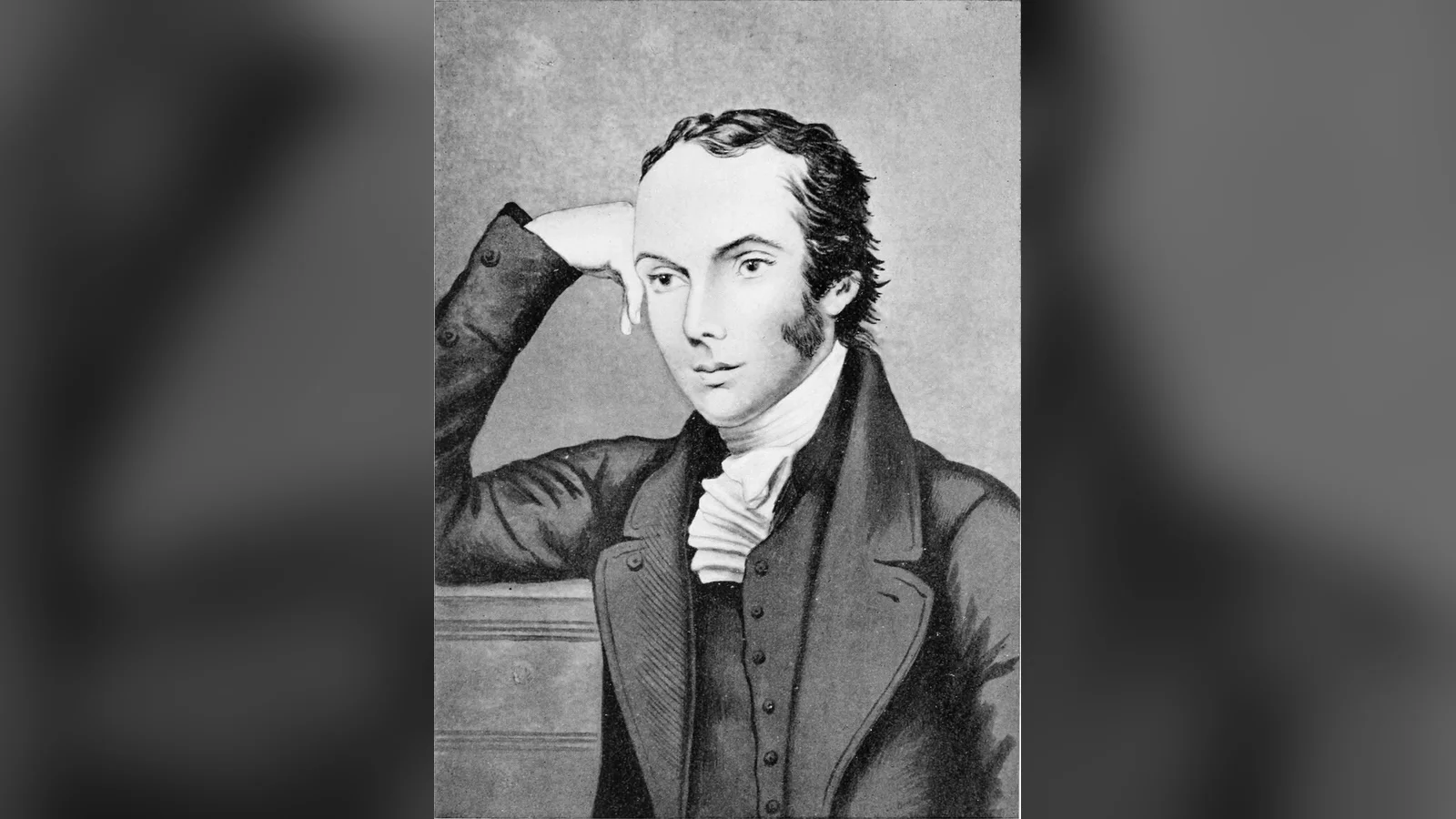

Thomas Pringle: The Borders Poet Who Fought for a Free Press at the Cape
Contents
Thomas Pringle was a lame farmer's son from the Borders who became a poet and edited the magazine that turned into Blackwood's. In 1820 he led a party of Scottish settlers to the Eastern Cape, where they named their valley Glen Lynden. In Cape Town he and his friend John Fairbairn ran a journal and a newspaper, and in 1824 they shut the newspaper rather than publish it under the Governor's censorship. Ruined, he went home and became secretary of the Anti-Slavery Society, holding the post until slavery in the British colonies was abolished. He died in London in December 1834, four months after abolition took effect.
TL;DR
- established Born on 5 January 1789 at Blaiklaw, near Kelso, the son of a tenant farmer. A childhood accident left him lame for life, and he walked on crutches.
- established He studied at Edinburgh, worked as a clerk copying public records, and in 1817 co-edited the Edinburgh Monthly Magazine, which became Blackwood's Magazine.
- established In 1820 he led a party of 24 Scots, mostly his own family, to the Cape as part of the government's settler scheme. They settled on the Baviaans River and called it Glen Lynden, a name the government later made official.
- established In Cape Town he edited the South African Journal and co-edited George Greig's South African Commercial Advertiser. When the Governor, Lord Charles Somerset, imposed a censor in May 1824, the editors stopped publishing rather than accept it.
- established From 1827 he was secretary of the Anti-Slavery Society in London, until slavery in the British colonies was abolished. He died on 5 December 1834 and is buried in Bunhill Fields.
Key Facts
- Born
- 5 January 1789, Blaiklaw (Easterstead), parish of Linton, near Kelso
- Family
- Son of Robert Pringle, farmer; mother a daughter of Thomas Haitlie, farmer, of Berwickshire
- Education
- Kelso Grammar School (1802); University of Edinburgh (from 1805)
- Married
- Margaret Brown, of Papple, East Lothian, 19 July 1817
- Emigrated
- Sailed February 1820; Simon's Bay, 30 April 1820; Glen Lynden, 29 June 1820
- Cape Town
- Government librarian (1822); South African Journal and South African Commercial Advertiser (1824)
- London
- Secretary of the Anti-Slavery Society, from 1827
- Died
- 5 December 1834, London; buried in Bunhill Fields
- Related cards
- Diaspora 52, Scots in South Africa; Diaspora 85, Tiyo Soga
- Main source
- Thomas Pringle, Narrative of a Residence in South Africa, new edition with a biographical sketch by Josiah Conder (Edward Moxon, London, 1835)
Scottish Impact Index (SI Score)
- Global Influence
- 3/10
- Enduring Relevance
- 4/10
- Material Contribution
- 3/10
- Exceptional Achievement
- 5/10
- Lasting Legacy
- 4/10
- Recognition
- 3/10
22/60
Ranked =153rd of 179 in Great Scots
A Note on Claims and Evidence
Each major claim carries one of three labels. established means supported by primary records, official bodies or several independent reliable sources. shared means the core fact is sound but sources disagree on details, dates or interpretation. traditional means widely repeated but not traceable to a primary or independent source.
The Narrative is Pringle's own account, revised just before his death from the prose half of his African Sketches (1834). It is a partisan book: it was written by a man who had been ruined by Lord Charles Somerset and who spent his last years campaigning against slavery and the treatment of the Khoikhoi and San. Its account of the Governor should be read in that light.
Conder's memoir, written within months of Pringle's death, quotes his letters and friends and is wholly admiring. Both use the colonial names of the time for the peoples of the Cape.
Timeline
Born at Blaiklaw, near Kelso.
Enters Kelso Grammar School.
Goes to the University of Edinburgh.
Becomes a clerk transcribing the public records of Scotland.
Co-edits the Edinburgh Monthly Magazine, soon Blackwood's; moves to Constable's Edinburgh Magazine in October.
Marries Margaret Brown.
Publishes The Autumnal Excursion, and other Poems.
Sails from Gravesend in the brig Brilliant.
The party reaches its land on the Baviaans River, named Glen Lynden.
Moves to Cape Town as government librarian.
The Commercial Advertiser and the South African Journal begin.
The Fiscal imposes censorship; the editors stop the newspaper.
Sails for England.
Becomes secretary of the Anti-Slavery Society.
Mary Prince comes to the Society's office for help; from December 1829 she works in Pringle's household.
Publishes The History of Mary Prince, with his preface and supplement.
Emancipation in the British colonies takes effect.
Dies in London.
Details
The Borders
established Pringle came from a long line of Borders tenant farmers; his grandfather took the lease of Blaiklaw in 1759. As a baby he was dropped by his nurse, and his hip was dislocated without anyone realising until it was too late to set it. He went to the village school at Morebattle, riding to it with two brothers on one pony with his crutches slung from the saddle. His mother died when he was about six.
established He went to Kelso Grammar School in 1802 and to the University of Edinburgh in November 1805. His college friend, later the Rev. Robert Story of Rosneath, remembered him quoting Mungo Park's Travels and Thomas Campbell's line "And Freedom shrieked as Kosciusko fell" on their first evening together. Unable to settle on a profession, he became a clerk copying old records for the Commissioners on the Public Records of Scotland in 1808.
established In 1817 he and James Cleghorn became the editors of a new Edinburgh Monthly Magazine. When the publisher, William Blackwood, turned it into the fiercely political Blackwood's Magazine, Pringle left for Constable's rival Edinburgh Magazine. A friend later said he could have kept the editorship if he had agreed to drop Cleghorn, and refused. His first book of poems, The Autumnal Excursion, came out in 1819.
Glen Lynden
established In 1819 Parliament voted £50,000 to settle about five thousand British emigrants on the eastern frontier of the Cape. Pringle, hoping to re-establish his father's scattered family on the land, led a party of twelve men, six women and six children. Walter Scott helped him get a letter of recommendation to the Governor. They sailed from Gravesend on 15 February 1820 in the brig Brilliant and anchored in Simon's Bay on 30 April. MacKenzie's The Scots in South Africa (2007) adds that the family had lost the farm they had held as tenants for half a century, that one of Thomas's brothers had already gone to the United States, and that their father Robert came too, aged sixty-five. They went from Leith to the Thames before sailing; MacKenzie suggests the Brilliant was probably the brig that had carried Benjamin Moodie's Scottish settlers to the Cape three years earlier. When Thomas left the frontier for Cape Town in 1822, his brother William took over as leader of the party.
established The government placed the Scots in the mountains by the eastern branches of the Great Fish River, near the Xhosa frontier, and planned a town for them called New Edinburgh. Pringle's party reached the upper valley of the Baviaans River on 29 June 1820 and named it Glen Lynden. The name was later adopted by the government for the whole valley and district. Fourteen years later Pringle recorded that the settlement had lost only one person, in a gun accident, and had more than doubled its numbers by births alone.
The free press
established In September 1822 Pringle became librarian of the government library in Cape Town. With John Fairbairn he opened a school, and in 1824 he started the South African Journal, with a Dutch counterpart edited by the Rev. Mr Faure. The two friends also edited George Greig's weekly South African Commercial Advertiser, whose first number appeared on 7 January 1824. Pringle notes that every earlier attempt at a newspaper had been quashed by the authorities.
established In May 1824 the Governor, Lord Charles Somerset, was suing a man named Edwards for libel. To stop the newspaper reporting Edwards's charges, the Fiscal was told to act as censor on the evening of 4 May. Pringle and Fairbairn refused to edit "any publication under a censorship", and Greig stopped the paper. Somerset denounced Pringle's school as "a seminary of sedition", Pringle resigned his post, and he reckoned he had lost about £1,000. He sailed for England on 16 April 1826.
The Anti-Slavery Society
established An article on slavery that Pringle wrote for Thomas Campbell's New Monthly Magazine brought him to the notice of the Anti-Slavery Society, which made him its secretary in March 1827. He held the post for more than seven years. The Society's committee called him "one of the most meritorious, efficient, and disinterested" of its workers. He also edited the annual Friendship's Offering and helped Dr John Philip with his history of the Cape.
established On 27 June 1834 he went to the Society's office, for what was probably the last time, to send out a circular on celebrating 1 August, the day colonial slavery was to end. That evening he began coughing blood. A planned voyage to the Cape for his health was put off until he was too ill to go, and he died at Highgate on 5 December 1834, aged forty-five. His gravestone in Bunhill Fields records that he lived "to witness the cause in which he had ardently and energetically laboured, triumph".
The History of Mary Prince (1831)
established Pringle edited and published The History of Mary Prince, a West Indian Slave, Related by Herself (London: F. Westley and A. H. Davis; Edinburgh: Waugh and Innes, 1831), the first account by a Black woman of slavery in the British Caribbean. Mary Prince, born in Bermuda, had come to London with her owners, the Wood family of Antigua. In late November 1828 she came to the Anti-Slavery Society's office in Aldermanbury, carrying a paper dated 18 August 1828 in which her owner, Mr Wood, told her to leave or go back to Antigua. Pringle had the solicitor George Stephen draw up her case. Dr Lushington and Serjeant Stephen advised that the law could not force Wood to free her, and Wood refused every approach, including one through the Governor of Antigua in 1830. From December 1829 Pringle employed her as a servant in his own household.
established In his preface, dated 25 January 1831, Pringle says the idea of the book was hers. A lady staying with his family took down the story from Prince's own words, and Pringle pruned it, keeping her phrasing where he could. "No fact of importance has been omitted," he wrote, "and not a single circumstance or sentiment has been added." He published it privately, not for the Society, with the profits going to Prince. His supplement prints Wood's letter and answers it point by point. He records that after fourteen months in his house she had proved "perfectly honest and trustworthy in all respects", though "her constitution appears to be a good deal broken". He ends by calling for a law to make permanent the freedom that a slave gained on reaching England.
Did You Know?
- Pringle walked on crutches all his life, yet loved climbing hills.
- He was the first editor of the magazine that became Blackwood's.
- Glen Lynden, the name his party gave their valley, became its official name.
- He gave up his Cape newspaper rather than accept a censor.
- He died four months after the slavery he campaigned against was abolished.
FAQ
1Who was Thomas Pringle?
A Scottish poet who led settlers to South Africa in 1820, fought for a free press at the Cape, and was secretary of the Anti-Slavery Society from 1827 until abolition.
2What was Glen Lynden?
The name Pringle's party gave to their land on the Baviaans River in the Eastern Cape, later adopted officially.
3Why did he leave the Cape?
After he and his colleagues stopped their newspaper rather than accept censorship in 1824, Lord Charles Somerset's government made his position impossible.
4Is he the father of South African poetry?
He is often called that. The claim is not tested here, as the edition used here leaves out his poems.
Sources and Further Reading
Historical
- Mary Prince, The History of Mary Prince, a West Indian Slave, Related by Herself, ed. Thomas Pringle (London, 1831). Project Gutenberg 17851.
Scholarly/Critical
-
Thomas Pringle, Narrative of a Residence in South Africa, new edition, with a biographical sketch by Josiah Conder (Edward Moxon, London, 1835). Free scan at the Internet Archive. Main source.
-
John M. MacKenzie with Nigel R. Dalziel, The Scots in South Africa: Ethnicity, Identity, Gender and Race, 1772–1914 (Manchester University Press, 2007). Used for the family party and the Brilliant.
Further reading (not consulted directly)
- Thomas Pringle, African Sketches (Edward Moxon, London, 1834), which includes the poems.
- Randolph Vigne, Thomas Pringle: South African Pioneer, Poet and Abolitionist (James Currey, 2012).
Caveats: Myths and Disputed Claims
- The Governor's side. The account of Lord Charles Somerset comes from his opponents.
- "Father of South African poetry". A common description, not tested here.
- Abolition. The Act of 1833 freed slaves in the British colonies from 1 August 1834 but kept most of them as "apprentices" for several more years; Pringle's gravestone simplifies this. (General knowledge; check before print.)
Finished reading? Try the Fact Machine: three reels, one surprising Scottish connection →
Card 200 · Great Scots