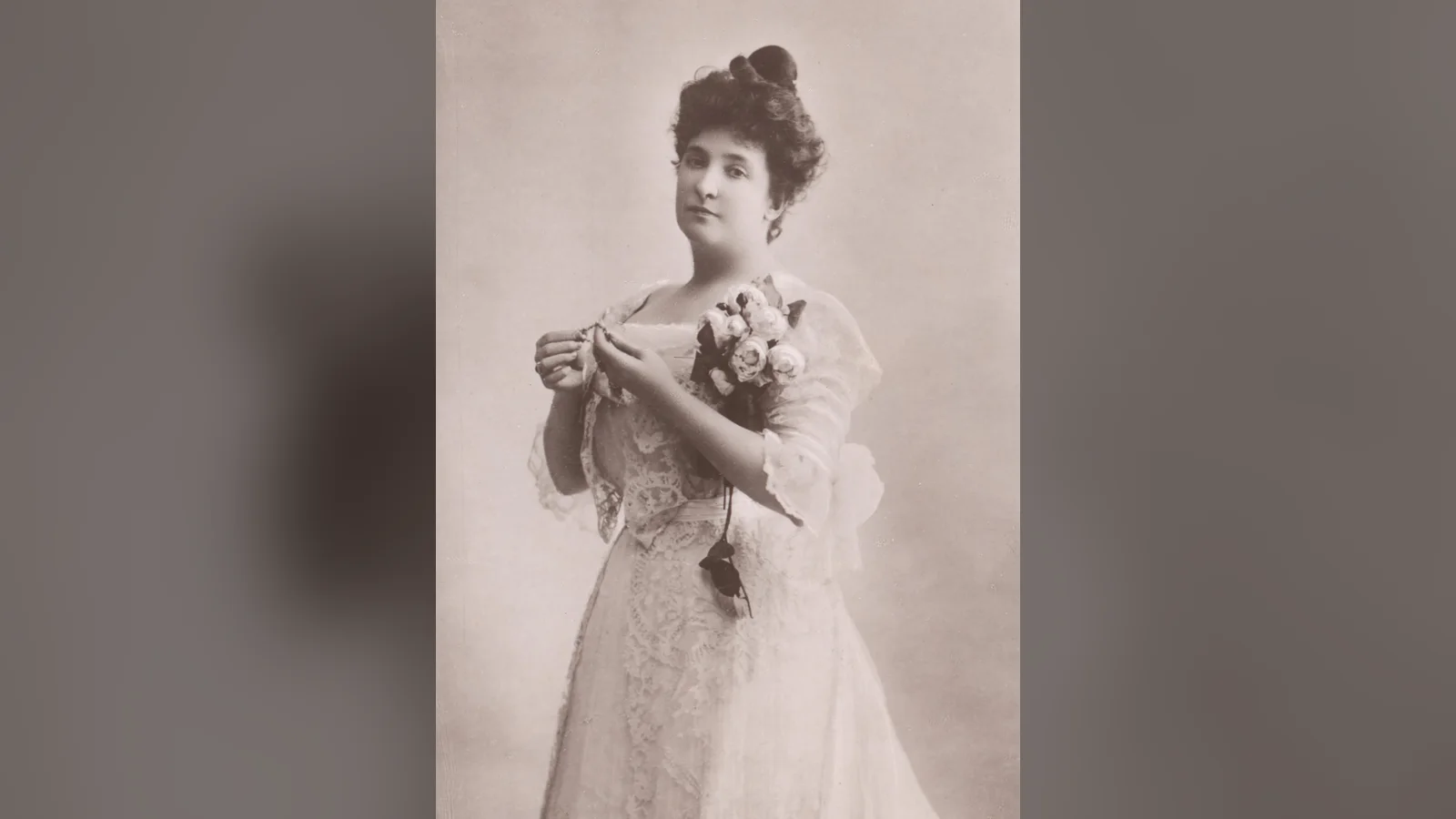

Dame Nellie Melba (1861–1931): The Forfar Mason's Daughter Who Conquered Opera
Contents
The most famous soprano of her age took her stage name from Melbourne, but she was brought up as the daughter of a Scottish stonemason in a house he named after a Scottish river. David Mitchell left his home near Forfar in 1852 with, it was said, a single sovereign, built much of Victorian Melbourne, and raised his eldest surviving child in the Scots' Church on Collins Street. Nellie Mitchell became Melba, sang at Covent Garden for nearly forty years, gave her name to a pudding and a toast, and when she died was laid in state in the same Presbyterian church and buried beside her father.
TL;DR
- established Melba was born Helen Porter Mitchell in Richmond, Melbourne, on 19 May 1861. Her father, David Mitchell, was a stonemason from near Forfar who reached Melbourne in 1852; her mother, Isabella Dow, was the daughter of a Scottish engineer.
- established Her father became one of Melbourne's leading builders. He built the Royal Exhibition Building, opened in 1880 and now a World Heritage Site, rebuilt Scots' Church and built the Presbyterian Ladies' College, where she was a pupil.
- established After studying in Paris with Mathilde Marchesi, she made her operatic debut as Gilda in Rigoletto at the Théâtre de la Monnaie, Brussels, in October 1887, under the name Marchesi chose for her.
- established She was the leading soprano at Covent Garden from 1888 until her farewell in 1926, and sang in Paris, Milan, St Petersburg and New York.
- established Auguste Escoffier named Pêches Melba and Melba toast after her at the Savoy.
- established She was made a Dame of the British Empire in 1918 for her war charity work. She died in Sydney on 23 February 1931, lay in state in Scots' Church, Melbourne, and was buried beside her father at Lilydale.
Key Facts
- Born
- 19 May 1861, Richmond, Melbourne, as Helen Porter Mitchell
- Died
- 23 February 1931, St Vincent's Hospital, Sydney, of septicaemia
- Father
- David Mitchell (c. 1829–1916), stonemason and building contractor, from near Forfar
- Mother
- Isabella Ann Dow, daughter of the Scottish engineer James Dow
- Childhood home
- Doonside, Burnley Street, Richmond, named after the river Doon
- School
- Presbyterian Ladies' College, Melbourne
- Married
- Charles Armstrong, Brisbane, 22 December 1882; later divorced
- Son
- George Nesbitt Armstrong, born 16 October 1883
- Debut
- Gilda in Rigoletto, Théâtre de la Monnaie, Brussels, October 1887
- Honours
- Dame of the British Empire, 1918; Dame Grand Cross, 1927
- Buried
- Lilydale cemetery, Victoria
- Main source
- Ann Blainey, I Am Melba (Black Inc., 2008)
Scottish Impact Index (SI Score)
- Global Influence
- 8/10
- Enduring Connection
- 5/10
- Material Contribution
- 6/10
- Scottish Diaspora Distinctiveness
- 5/10
- Diaspora Legacy
- 5/10
- Recognition
- 8/10
37/60
Ranked =85th of 93 in Diaspora
A Note on Claims and Evidence
Each major claim carries one of three labels. established means supported by primary records, official bodies or several independent reliable sources. shared means the core fact is sound but sources disagree on details, dates or interpretation. traditional means widely repeated but not traceable to a primary or independent source.
Blainey's biography draws on Melba's letters, family papers, contemporary newspapers and the divorce records, and corrects Melba's own memoir, Melodies and Memories (1925), in a number of places. Where Melba's account and the record differ, Blainey is followed here.
The Scottish material comes almost entirely from Blainey's opening chapters on the family and from her account of the funeral. She cites a family history by Melba's granddaughter, Pamela Vestey, David Mitchell: A Forfar Man (1992), which was not consulted. Blainey gives no birthplace for David Mitchell more exact than "near Forfar", and no birthplace for James Dow beyond calling him Scottish.
This is a Diaspora card. Melba was Australian-born, and her importance to Scotland lies in her parentage, her upbringing and how she presented herself, not in any work done in Scotland.
Timeline
David Mitchell, aged twenty-three, arrives in Melbourne from near Forfar.
A rising contractor, he supports the Melbourne stonemasons' successful campaign for an eight-hour day.
Marries Isabella Dow at the Scots' Church congregation.
Helen Porter Mitchell is born, after two siblings have died in infancy.
Aged eight, she is "the gem" of a concert at Richmond town hall.
Her father rebuilds Scots' Church and wins the contract for the Presbyterian Ladies' College, which she attends.
Mitchell buys Cave Hill Farm near Lilydale and begins quarrying limestone.
He builds the Royal Exhibition Building.
Her mother dies.
Marries Charles Armstrong at the Ann Street Presbyterian Church, Brisbane.
Her son George is born in Queensland.
Sails for London with her father, then goes to Paris to study with Mathilde Marchesi.
Debut at the Monnaie in Brussels as "Madame Melba".
Covent Garden debut, in Lucia di Lammermoor.
Affair with Philippe, Duke of Orléans. Her husband begins divorce proceedings.
First tour of the British provinces, including Edinburgh and Glasgow.
First return to Australia as a star.
Begins teaching at the conservatorium in Albert Street, East Melbourne.
Her father dies, aged eighty-seven.
Made a Dame of the British Empire.
Farewell tour of the British Isles opens in Glasgow. Farewell at Covent Garden.
Dame Grand Cross.
Dies in Sydney.
Funeral from Scots' Church, Melbourne. Buried at Lilydale.
Details
A mason from Forfar
established David Mitchell was twenty-three when he landed in Melbourne in 1852, a stonemason just out of his apprenticeship, and family tradition said he had a single gold sovereign in his pocket. He tried the goldfields without success, then bought land on the Yarra at Richmond and set up a builder's yard. When he saw that Melbourne was changing from a town of wood to a city of brick and stone, he added a brickworks. By 1856 he was a large employer.
established Blainey calls him Scottish to the core. His life revolved around his work and the Scots' Presbyterian Church in Collins Street, and he chose his wife from its congregation: Isabella Dow, an olive-skinned, musical woman who played the piano, harp and organ. Observers remembered him as broad, thick-set, "very reserved, very Scotch", a man who said more with his eyes than most men with their lips. He thought the Yarra looked like the Doon and called his house Doonside, and unlike other men who made money he never moved away from his works.
established His firm built on a large scale. He rebuilt Scots' Church, won the contract for the new Presbyterian Ladies' College, and in 1879–80 built the Royal Exhibition Building, the largest building yet put up in Australia. In 1878 he bought a farm near Lilydale for its limestone and began burning lime there. Later he planted a vineyard in the Yarra Valley.
Nellie Mitchell
established Two children born before her died in infancy, and Helen Porter Mitchell, born in 1861, was raised with great care and little success at keeping her still. Her first public song, at about six, was "Comin' thro' the Rye", sung in the broad Scots of her Dow grandmother. At eight she was the star of a concert at Richmond town hall. Family stories had her playing "Can't You Dance the Polka" when told to play a hymn for a visiting Scottish preacher.
established Her father, who disapproved of the stage, sent her to the Presbyterian Ladies' College, partly because it was a church school. She would skip lunch, and once a Latin lesson, to practise on the organ at the new Scots' Church. Blainey says she was brought up to meet bad fortune with Scottish stoicism, and the phrase recurs in her account of Melba's later troubles.
Marriage and Marchesi
established In 1882, on a visit to Queensland, where her father was building a sugar mill, she married Charles Armstrong, youngest of the thirteen children of the late Sir Andrew Armstrong of Gallen Priory in King's County, Ireland, in a hurried ceremony at the Ann Street Presbyterian Church in Brisbane. It was an unhappy marriage. In 1886 she went to London with her father and sisters, failed to find a teacher who would take her seriously, and went on to Paris, where Mathilde Marchesi agreed to hear her and took her on.
established Marchesi gave her the name Melba, from Melbourne, because it was easy to remember. She made her debut as Gilda at the Monnaie in Brussels in October 1887, wearing her own hair in plaits because she refused the blonde wig, and the Paris papers called her a revelation. A Sydney newspaper hoped she would soon drop the foreign alias. Melba gloried in it, because it brought fame to her own city.
Covent Garden and the world
established She sang at Covent Garden from 1888, as Lucia and Gilda first and later in a long list of French and Italian roles, and became its reigning soprano for a generation. Her affair with the Duke of Orléans, heir to the French throne, became a scandal when her husband named him in divorce proceedings. Her recordings, from the early 1900s, reached an audience far beyond the opera house.
established At the Savoy Hotel Escoffier served her peaches with vanilla ice cream on a swan carved from ice, a reference to Lohengrin, and named the dish Pêches Melba. He later replaced the strawberries with raspberries. Melba toast began as dried bread he made for Madame Ritz, the manager's wife, who was dieting; Melba took to it and it took her name.
Scotland on tour
established She sang in Edinburgh and Glasgow on her first provincial tour in 1893, and many times afterwards. After one Scottish tour she stayed at Duart Castle on Mull. While she was singing in Edinburgh in November 1920 news came that her grandson had been born, and he lived less than a day. Her farewell tour of the British Isles opened in Glasgow in January 1926. In Toronto in 1915 her wartime Red Cross concert opened with kilted pipers playing the national anthem.
shared She never lost the accent of home in private. A Melbourne journalist in 1902 watched her father, by then in his seventies, tell her in broad Scots that she had not improved and was still the larrikin, and Melba answered him in a comic imitation of his accent.
Australia again
established She came home repeatedly from 1902 and settled more and more at Coombe Cottage, a property at Coldstream in the Yarra Valley near her father's vineyard and her brother's farm. During the First World War she raised large sums for war charities, which brought her damehood in 1918, and from 1915 she taught at the conservatorium in Albert Street, East Melbourne, which now bears her name. Her father died in March 1916 while she was at sea. She wrote that her heart broke.
Death and the Scots' Church
established She fell ill on the voyage home from Europe in 1930 and died of septicaemia at St Vincent's Hospital in Sydney on 23 February 1931. Her body was brought to Melbourne by train, with crowds at every station. It lay overnight in Scots' Church, the church her father had rebuilt, where 5,000 people filed past. After a service taken by the head of the Presbyterian Church, the cortège passed the conservatorium, the Presbyterian Ladies' College and the site of Doonside on its way to Lilydale, where she was buried beside her father.
Did You Know?
- Melba's first public song was "Comin' thro' the Rye", sung in her Scottish grandmother's dialect.
- Her father named their Melbourne house after the river Doon.
- The Royal Exhibition Building in Melbourne, now a World Heritage Site, was built by her Forfar-born father.
- She refused to wear a blonde wig at her debut and sang Gilda in her own plaited hair.
- Her farewell tour of the British Isles began in Glasgow.
- She lay in state in the Scots' Church her father had rebuilt.
FAQ
1Was Nellie Melba Scottish?
She was Australian, born in Melbourne. Her father was a stonemason from near Forfar and her mother the daughter of a Scottish engineer, and she was raised in the Presbyterian church.
2Where does the name Melba come from?
From Melbourne. Her teacher, Mathilde Marchesi, chose it in 1887.
3What did her father build?
Among much else, the Royal Exhibition Building in Melbourne (1880), Scots' Church and the Presbyterian Ladies' College.
4What are Peach Melba and Melba toast?
Two dishes created by the chef Auguste Escoffier at the Savoy in London and named after her.
5When did she sing in Scotland?
On tour from 1893 onward. Her farewell tour of the British Isles opened in Glasgow in 1926.
6Where is she buried?
In Lilydale cemetery, Victoria, beside her father.
Sources and Further Reading
Scholarly/Critical
- Ann Blainey, I Am Melba: A Biography (Black Inc., 2008).
General
- Pamela Vestey, David Mitchell: A Forfar Man (privately published, Coldstream, 1992). Cited by Blainey; not consulted.
- Nellie Melba, Melodies and Memories (Thornton Butterworth, 1925). Her own account, which Blainey corrects in places.
Caveats: Myths and Disputed Claims
- Myth: Melba was Scottish-born. She was born in Melbourne. The Scottish connection is her parents and upbringing.
- Traditional: her father arrived with a single sovereign. It is family tradition, not documented.
- Disputed: her account of her marriage. Her memoir says she married quietly in Brisbane because the family was in mourning. Blainey points out that the mourning periods had already passed.
- Disputed: the cause of her final illness. A nun's recollection, written thirty years later, connected it to a face-lift in Europe. Blainey finds the account confused on the sequence of events and not entirely persuasive.
Finished reading? Try the Fact Machine: three reels, one surprising Scottish connection →
Card 057 · Diaspora