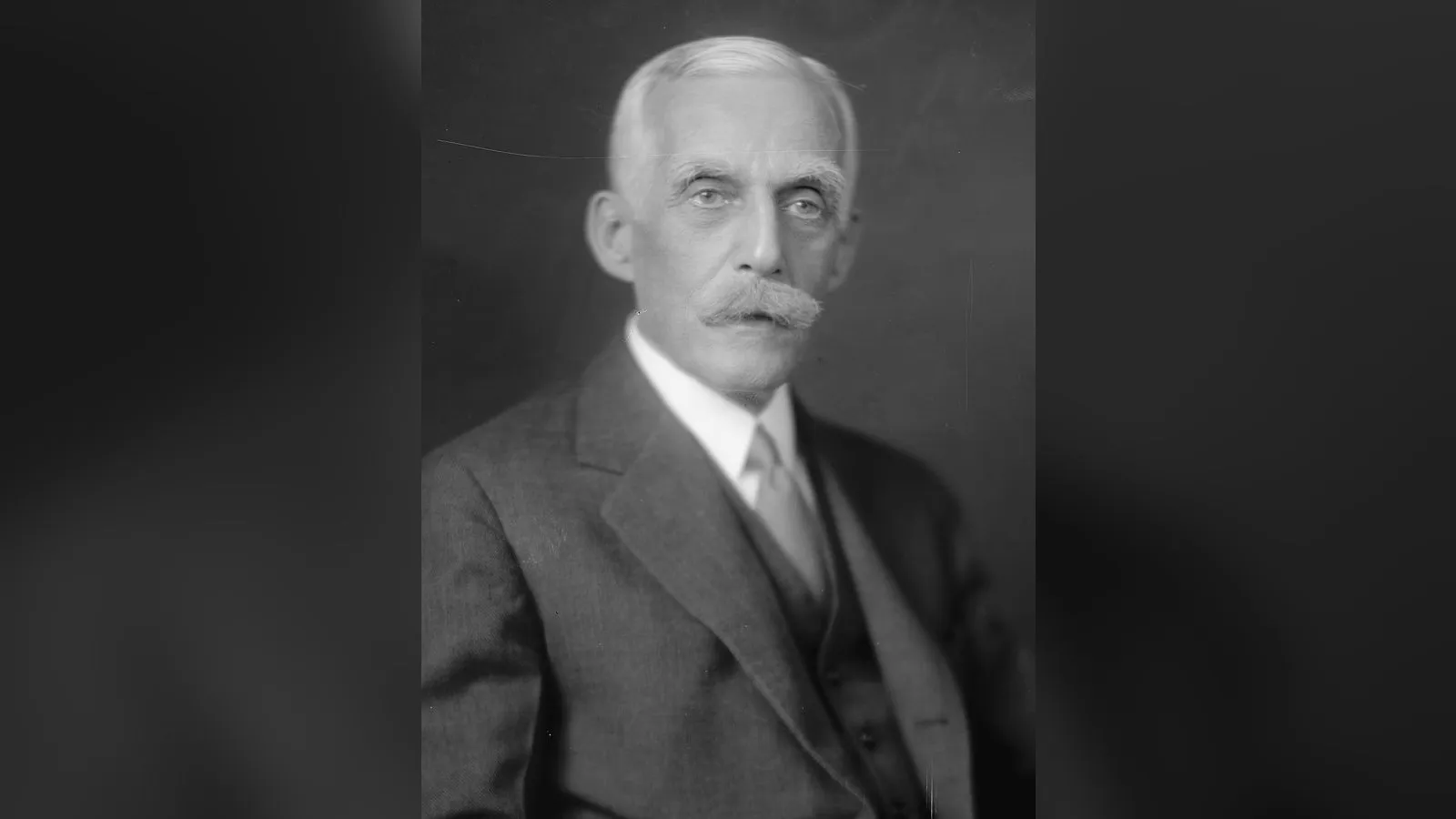

Andrew Mellon (1855–1937)
Contents
TL;DR
- established Andrew Mellon's Scots-Irish ancestry is documented with real specificity across several generations: his great-grandfather Archibald Mellon emigrated from Lower Castletown, parish of Omagh, County Tyrone, Ulster, to Westmoreland County, Pennsylvania, in 1816, followed two years later by his son Andrew Mellon (the elder) and the rest of the family — this article names this dated, place-specific line directly rather than a vague general claim of Scottish heritage.
- established The family's own documented tradition holds that their ancestors had come into Ulster from Scotland and Holland around the middle of the seventeenth century, before the Tyrone branch's 19th-century emigration to America — this article states this further, documented layer of the family's origin directly.
- established As US Treasury Secretary from 1921 to 1932, Mellon championed deep cuts to top-bracket tax rates, culminating in the Revenue Act of 1926, which reduced the top marginal rate to 25 percent, a specific, documented policy achievement this article names directly.
- disputed Mellon faced impeachment proceedings in 1932 over alleged conflicts of interest between his Treasury role and his vast private business holdings, and was separately investigated for tax fraud by the Roosevelt administration beginning in 1933 — the Board of Tax Appeals eventually exonerated him, but not until after his death in 1937 — this article states this full, documented controversy directly rather than presenting Mellon's later reputation as settled in his own lifetime.
- established In 1936, Mellon offered his personal art collection and an endowment to the US government to found a national art museum, leading to the opening of the National Gallery of Art in Washington, DC, in 1941 — a specific, documented philanthropic legacy this article names directly.
Key Facts
- Born
- 24 March 1855, Pittsburgh, Pennsylvania, USA
- Died
- 26 August 1937, Southampton, New York, USA
- Category
- Scottish Diaspora & Business / Government
- Scots-Irish ancestry
- Documented, specific — great-grandfather Archibald Mellon emigrated from Lower Castletown, Omagh, County Tyrone, 1816
- Key role
- US Secretary of the Treasury, 1921–1932
- Key achievement
- Revenue Act of 1926 (reduced top tax rate to 25%); founded the National Gallery of Art
- Documented controversy
- 1932 impeachment proceedings; later tax fraud investigation
A Note on Claims and Evidence
Family background and the documented, specific Scots-Irish ancestral connection — Archibald Mellon's 1816 emigration from Lower Castletown, parish of Omagh, County Tyrone, and the family's own tradition of still-earlier origins in Scotland and Holland before settling in Ulster — are drawn from Wikipedia's published biographical record of Thomas Mellon, Andrew's father. Andrew Mellon's own early life, banking career, tenure as Treasury Secretary, tax policy, industrial investments, the 1932 impeachment proceedings and later tax fraud investigation, his art collection, and the founding of the National Gallery of Art are drawn from Wikipedia's published research record.
Timeline
According to the Mellon family's own documented tradition, ancestors come into Ulster from Scotland and Holland, settling in what becomes County Tyrone.
Archibald Mellon, Andrew's great-grandfather, emigrates from Lower Castletown, parish of Omagh, County Tyrone, to Westmoreland County, Pennsylvania.
Archibald's son Andrew Mellon (the elder) and the rest of the family follow him to Pennsylvania.
Thomas Mellon, Andrew's father, marries Sarah Jane Negley, a descendant of some of Pittsburgh's first settlers.
Andrew William Mellon is born in Pittsburgh, the fourth son and sixth child of Thomas and Sarah Jane Mellon.
Mellon joins his father's Pittsburgh bank, T. Mellon & Sons.
Mellon renames the family bank Mellon National Bank and establishes the Union Trust Company.
Mellon National Bank holds more deposits than any other bank in Pittsburgh; Mellon finances the founding of the Mellon Institute, later part of Carnegie Mellon University.
Mellon serves as US Secretary of the Treasury under Presidents Harding, Coolidge, and Hoover.
The Revenue Act of 1926, reflecting Mellon's tax policy, reduces the top marginal income tax rate to 25 percent.
Facing impeachment proceedings over alleged conflicts of interest between his Treasury role and his private business empire, Mellon is appointed US Ambassador to the United Kingdom by President Hoover, removing him from Washington.
The Roosevelt administration launches a tax fraud investigation against Mellon.
Mellon offers his art collection and an endowment to the US government to found a national art museum.
Mellon dies at age 82, before the Board of Tax Appeals formally exonerates him of the tax fraud allegations.
The National Gallery of Art opens in Washington, DC, built on Mellon's donated collection and endowment.
Details
A Scots-Irish origin documented across generations and named with precision
This article names Andrew Mellon's ancestry with real specificity rather than a vague general claim: his great-grandfather, Archibald Mellon, emigrated from Lower Castletown, in the parish of Omagh, County Tyrone, Ulster, to Pennsylvania in 1816, followed by the rest of the family in 1818. This article also states the family's own documented tradition of a still-earlier origin in Scotland and Holland before their Ulster settlement in the mid-17th century. This article names both layers because they represent the documented record at the level of specificity the evidence actually supports, consistent with the standard this series applies throughout.
A specific, consequential tax policy named with its real effect
This article states precisely the documented substance of Mellon's central policy achievement as Treasury Secretary: the Revenue Act of 1926, which reduced the top marginal income tax rate to 25 percent, reflecting his stated belief that lower surtaxes on high earners would maximise federal revenue while minimising harm to business. This article names this specific legislative outcome because it represents a concrete, verifiable policy achievement, not a vague claim of fiscal conservatism.
A documented fall from grace given full and direct weight
This article states directly and without minimisation the serious, documented controversies that overtook Mellon's later career: the 1932 impeachment proceedings over alleged conflicts between his vast private business holdings and his Treasury role, his removal to a diplomatic post in London to avoid those proceedings, and the subsequent federal tax fraud investigation that was not resolved in his favour until after his death. This article names these because minimising or omitting them would misrepresent a serious and well-documented complication of Mellon's legacy, consistent with this series' standard of giving uncomfortable findings full weight regardless of a figure's prominence.
A lasting cultural legacy named with its specific origin
This article states the precise, documented origin of one of Mellon's most enduring legacies: his 1936 offer of his personal art collection and a funding endowment to the US government, which led directly to the 1941 opening of the National Gallery of Art. This article names this because it represents a concrete, traceable philanthropic act, not a general reputation for wealth or taste.
Did You Know?
- Andrew Mellon's great-grandfather, Archibald Mellon, emigrated from Lower Castletown, County Tyrone, Ulster, to Pennsylvania in 1816.
- The Mellon family's own tradition holds that their ancestors had come into Ulster from Scotland and Holland around the mid-17th century, generations before the family's emigration to America.
- Mellon served as US Treasury Secretary under three consecutive presidents: Harding, Coolidge, and Hoover.
- The Revenue Act of 1926, shaped by Mellon's tax policy, cut the top marginal income tax rate to 25 percent.
- Mellon faced impeachment proceedings in 1932 over alleged conflicts of interest, and was appointed ambassador to the UK partly to remove him from Washington during the controversy.
- A federal tax fraud investigation against Mellon was not resolved in his favour until after his death in 1937.
- Mellon's 1936 gift of his art collection and an endowment led directly to the founding of the National Gallery of Art in Washington, DC.
FAQ
1Was Andrew Mellon actually of Scottish descent?
Yes, documented with real specificity — his great-grandfather, Archibald Mellon, emigrated from County Tyrone, Ulster, in 1816, and the family's own tradition traces still earlier origins to Scotland.
2What is Andrew Mellon best known for?
Serving as US Secretary of the Treasury for over a decade, shaping major tax-cutting policy, and founding the National Gallery of Art with his personal collection.
3Did Andrew Mellon get into legal trouble?
Yes — he faced 1932 impeachment proceedings over alleged conflicts of interest and a later federal tax fraud investigation, though he was ultimately exonerated after his death.
4Why was Mellon sent to be ambassador to the UK?
His 1932 appointment is widely understood as a way for President Hoover to remove him from Washington amid impeachment proceedings over his business conflicts.
5How did the National Gallery of Art come to exist?
Mellon offered his personal art collection and a funding endowment to the US government in 1936; the museum opened in 1941, after his death.
6What businesses did Mellon help build?
Beyond his family's banking empire, he financed major companies including Alcoa, Westinghouse Electric, and Gulf Oil.
7When did Andrew Mellon die?
26 August 1937, in Southampton, New York, at age 82.
Sources and Further Reading
Primary/Institutional
Scholarly/Critical
General
Caveats: Myths and Disputed Claims
- Clarification: This article names both the documented 19th-century Tyrone emigration and the family's own less formally documented tradition of still-earlier Scottish and Dutch origins, distinguishing the two levels of evidence rather than presenting the deeper tradition with the same certainty as the dated 1816–1818 emigration.
- Content note: This article states Mellon's 1932 impeachment proceedings and subsequent tax fraud investigation directly and in full, rather than presenting his Treasury tenure and later reputation as free of serious controversy.
Card 020 · Diaspora