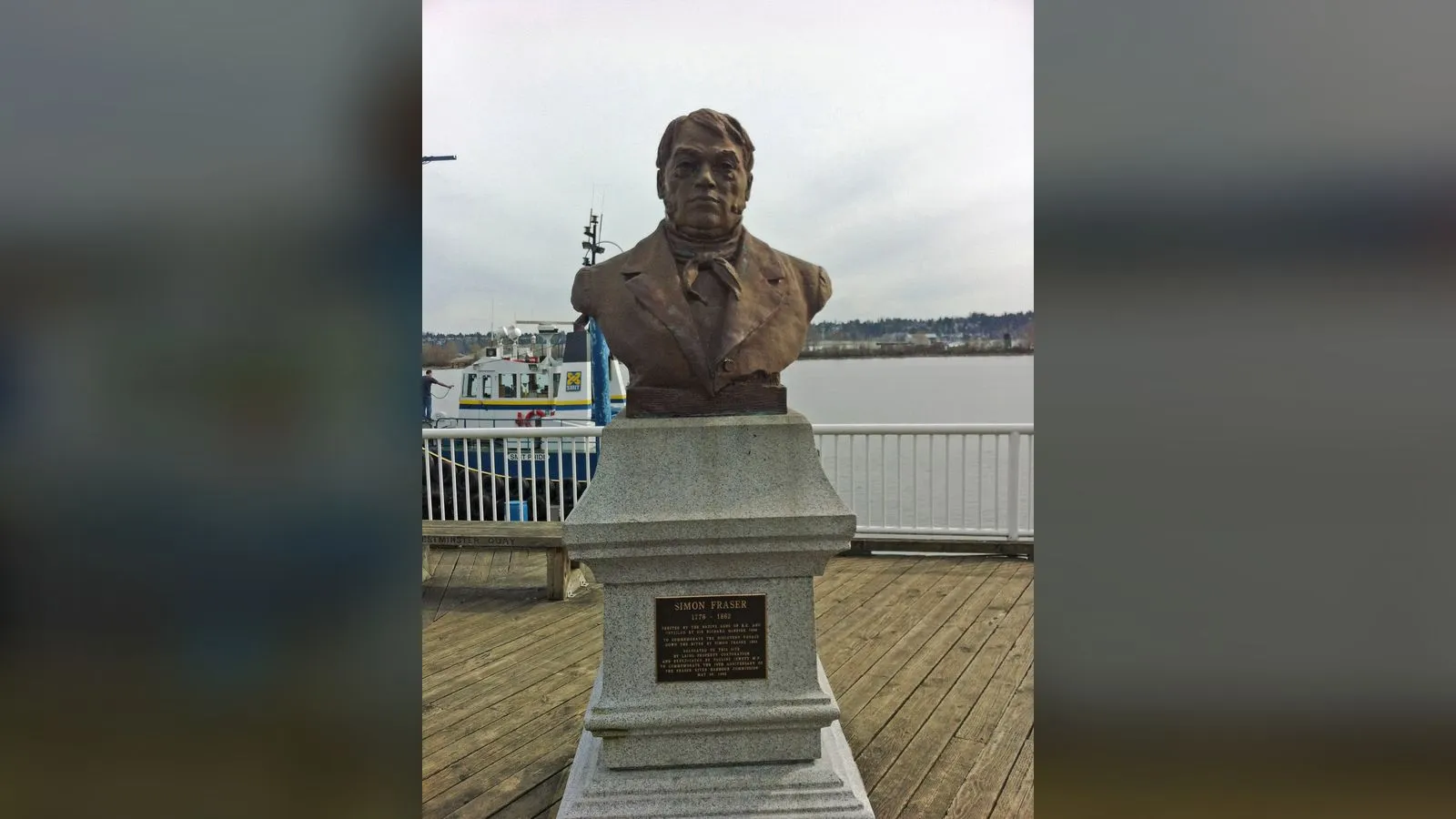

Simon Fraser (1776–1862)
Contents
TL;DR
- established Simon Fraser was born in 1776 at Mapletown, near Bennington in present-day Vermont, the youngest of eight children of two Highland Scots. His father descended from the Frasers of Culbokie and Guisachan, a branch of the Frasers of Lovat; his mother, Isabella Grant, was the daughter of the laird of Daldregan. They had come to New York in 1773 on the Pearl, with a party of mostly Roman Catholic Highlanders.
- established His father, a loyalist, joined Burgoyne's army in 1777, fought at Bennington, was captured and died in prison at Albany a little over a year later. His mother took the younger children to Canada in 1784.
- established Apprenticed to the North West Company in 1792, Fraser was made a partner at 25. From 1805 he built the first trading posts west of the Rockies in what is now Canada, and named the country New Caledonia, it is believed because it reminded him of his mother's descriptions of the Highlands.
- established In 1808 he led 24 people down the river now named after him, hoping it was the Columbia. At its mouth he found the latitude was about 49°: "This River, therefore, is not the Columbia."
- established Arrested by Lord Selkirk after the killings at Seven Oaks in 1816, which he had kept clear of, he was tried at York in 1818 with five other partners and acquitted.
Key Facts
- Born
- 1776, Mapletown, near Bennington, present-day Vermont
- Died
- 18 August 1862, on his farm near St Andrews, Stormont County, Canada West
- Parents
- Simon Fraser, of the Frasers of Culbokie and Guisachan, and Isabella Grant, daughter of the laird of Daldregan; Highland emigrants of 1773
- Known for
- The 1808 journey down the Fraser River; the first permanent trading posts west of the Rockies in what is now Canada
- Employer
- North West Company (apprentice 1792, partner from 1802)
- Spouse
- Catherine Macdonell (m. 7 June 1820)
Scottish Impact Index (SI Score)
- Global Influence
- 6/10
- Enduring Connection
- 8/10
- Material Contribution
- 7/10
- Scottish Diaspora Distinctiveness
- 7/10
- Diaspora Legacy
- 7/10
- Recognition
- 6/10
41/60
Ranked =60th of 93 in Diaspora
A Note on Claims and Evidence
Each major claim carries one of three labels. established means supported by primary records, official bodies or several independent reliable sources. shared means the core fact is sound but sources disagree on details, dates or interpretation. traditional means widely repeated but not traceable to a primary or independent source.
The life comes from W. Kaye Lamb's entry in the Dictionary of Canadian Biography (volume 9, 1976). Lamb edited The Letters and Journals of Simon Fraser, 1806–1808 (1960), and his entry rests on Fraser's three surviving journals and eleven letters. The background on Scottish loyalists and the fur trade comes from T. M. Devine's To the Ends of the Earth (2011).
An earlier version of this story, drawn from Wikipedia, gave a different birthplace (Hoosick, New York) and birth date (20 May 1776), and said his father was a captain in the 84th Highland Regiment. Lamb gives Mapletown and the year only, and says his father enlisted in 1777, as a volunteer with his eldest son; it was two of his father's brothers who had been officers, in the 78th, Fraser's Highlanders. The earlier version also said he was acquitted in 1817, that the Musqueam and Kwantlen attacked his party, that David Thompson named the river and that Fraser declined a knighthood. Lamb dates the trial to 1818, names the Cowichans as the people who pursued the party, and mentions neither of the last two, so they have been removed.
Timeline
Simon Fraser and Isabella Grant come to New York on the Pearl with a party of Highland emigrants.
Their eighth child, Simon, is born at Mapletown, near Bennington.
His father and eldest brother, William, fight on the British side at Bennington. His father is captured and dies in prison at Albany a little over a year later.
Isabella Fraser takes the younger children to Coteau-du-Lac, west of Montreal.
At 14 he goes to Montreal, in the care of his uncle, Judge John Fraser.
Apprenticed to the North West Company.
The partners at Grand Portage resolve to make him a partner from 1802.
Given charge of extending the company west of the Rockies. Builds Rocky Mountain Portage House and Trout Lake Post (Fort McLeod).
Reaches Stuart Lake, where he builds the post that became Fort St James. Names the country New Caledonia.
Leaves Fort George with 23 others in four canoes.
On the way back, his crew swear an oath not to separate.
Back at Fort George. The trip down took 36 days and the return 37.
In the Athabasca Department, for much of the time in charge of the Mackenzie River District.
Arrested by Lord Selkirk at Fort William after the killings at Seven Oaks on 19 June. Released on bail in Montreal.
Tried at York (Toronto) for treason, conspiracy and being accessory to murder. Acquitted.
Marries Catherine Macdonell, daughter of Captain Allan Macdonell of Matilda Township.
Captain in the 1st Regiment of the Stormont militia during the rebellion. A severe knee injury leaves him in straitened circumstances.
Dies on his farm near St Andrews. His wife dies the next day.
Details
A loyalist Highland family
established Both of Fraser's parents were Highland Scots. His father came from the Frasers of Culbokie and Guisachan, a cadet branch of the Frasers of Lovat, and from a military family: two of his brothers had served as officers in the 78th Regiment, Fraser's Highlanders, under Wolfe at Quebec. His mother, Isabella Grant, was a daughter of the laird of Daldregan. In 1773 they joined the noted migration of Highlanders, mostly Roman Catholics like themselves, who came to New York on the Pearl. After about a year at Albany they settled on a 160-acre farm at Mapletown, where Simon was born.
established The Revolution made Mapletown dangerous for them. Lamb records that the community sided strongly with the rebels, while the Frasers stayed loyal to the Crown. When Burgoyne's expedition reached the area in 1777, Simon Fraser senior and his eldest son William enlisted in July and fought at Bennington on 17 August, where the British were heavily defeated. The father was taken by the Americans to Albany and held in conditions so harsh that he died within little more than a year. After the war Isabella moved the family to Canada with the help of her brother-in-law John Fraser, a former officer in Fraser's Highlanders who had become a judge in Montreal.
established The family's flight to Canada was part of a wider Scottish loyalist exodus. The historian T. M. Devine, in To the Ends of the Earth (2011), notes that more loyalists were born in Scotland than in any other country outside America, and that Scots made nearly 37 per cent of the loyalist compensation claims lodged by people born outside America. Recent Highland emigrants in New York and North Carolina, led by their own gentry and dependent on Crown land grants, were especially loyal, and many fled from upper New York to Canada as the war turned against Britain. In Montreal the young Fraser joined a company dominated by men of the same background: Devine counts Fraser and Alexander Mackenzie as the North West Company's two great explorers, both from the Gaelic world of its leaders Simon McTavish and William McGillivray.
Building New Caledonia
established Fraser was apprenticed to the North West Company in 1792. The fur trade ran in the family: two of his mother's brothers were in it, and the Frasers were related to Simon McTavish, the company's dominant partner. In 1801 the partners voted to make him a partner from 1802, at 25.
established In 1805 he was given charge of extending the company's trade west of the Rocky Mountains, with orders to build posts and take possession of the country as well as to explore. That autumn he built Rocky Mountain Portage House at the eastern end of the Peace River Canyon, and Trout Lake Post (Fort McLeod), which Lamb calls the first permanent white settlement west of the Rockies in what is now Canada. In 1806 he reached Stuart Lake and built the post that became Fort St James, among the Carrier people. Lamb writes that he named the whole country New Caledonia because, it is believed, it reminded him of his mother's descriptions of the Scottish Highlands.
Down the river
established The party that left Fort George in four canoes on 28 May 1808 numbered 24: Fraser, his lieutenant John Stuart, the clerk Jules-Maurice Quesnel, 19 other company men and two Indigenous guides. They were warned from the start that the river below was "but a succession of falls and cascades". By 10 June Fraser accepted that the river could not be run, stored the canoes above the site of Lillooet, and went on largely on foot along the canyon walls. "We had to pass where no human being should venture," he wrote.
established Lamb credits Fraser with great skill in dealing with the peoples along the river. He used the two guides to make sure each nation ahead knew he was coming and meant no harm, though his journal shows he trusted none of them. Things went reasonably well until he reached the mouth, where the Cowichans were first suspicious and then openly hostile. They pursued the party back up the river as far as the area of Hope, trying again and again to overturn Fraser's canoe, though no one was killed on either side. Worn out, many of his men wanted to strike out overland on their own. On 6 July Fraser persuaded them to stay together, and the crew swore an oath that they would sooner perish than abandon any of their number.
established Fraser did reach the mouth. He visited the Musqueam village there and paddled some way towards Point Grey. But the latitude, about 49°, told him this was not the Columbia, and the river was useless as a trade route. Lamb calls the expedition, from the company's point of view, a useless enterprise, and one of the great feats of exploration all the same.
shared Devine cautions against explaining Scots' frontier diplomacy by an imagined kinship between clan society and Indigenous peoples, a claim made by some popular writers. Quoting the historian Colin G. Calloway, he argues that Highland traders were as likely as any other Europeans to exploit and cheat Indians, and that the fur trade's epidemics, over-hunting and rum did lasting harm to many of the peoples it reached. Fraser's posts in New Caledonia were part of that commercial system.
Seven Oaks and after
established Fraser was in charge of the Mackenzie River District for much of 1810 to 1814, and was drawn into the company's fight with Lord Selkirk's Red River colony. In 1815 he was one of the partners who escorted the colony's governor, Miles Macdonell, to Fort William as a prisoner. He disliked the violence and tried to retire. In 1816 he arrived "judiciously late" at Red River, Lamb writes, and so kept clear of the killings at Seven Oaks on 19 June, when Governor Robert Semple and 19 of his men died. Selkirk arrested him anyway at Fort William. Fraser was tried at York in 1818, with five other partners, for treason, conspiracy and being accessory to murder, and all were acquitted.
A hard retirement
established He settled on the Raisin River near St Andrews, in what is now eastern Ontario, and married Catherine Macdonell in 1820; five sons and three daughters grew up. His sawmill and grist mill did not prosper, and a severe knee injury suffered as a militia captain in 1837–38 left him, in his own words to the governor general, reduced "to penuery". He died on 18 August 1862, one of the last surviving partners of the North West Company. His wife died the next day, and they were buried in a single grave in the Roman Catholic cemetery at St Andrews. Recognition came late: British Columbia marked the centenary of the journey in 1908 with a memorial column at New Westminster.
Did You Know?
- Both of Fraser's parents were Highland Scots who emigrated to New York in 1773, three years before he was born.
- He was born near Bennington, in present-day Vermont, where his father fought for the Crown in 1777.
- His father died in an American prison when Simon was about two.
- He named New Caledonia, it is believed, because the country reminded him of his mother's descriptions of the Highlands.
- He reached the mouth of the Fraser in 1808 and worked out from the latitude that it was not the Columbia.
- His crew swore an oath in July 1808 that they would sooner perish than abandon one another.
- He and his wife died a day apart in 1862 and share a single grave.
FAQ
1Was Simon Fraser Scottish?
He was American-born, the son of two Highland Scots. His parents came to New York from the Highlands in 1773, and he was born at Mapletown, near Bennington, in 1776.
2What is Simon Fraser best known for?
His 1808 journey down the river now named after him, made in the hope that it was the Columbia.
3Did Fraser reach the sea?
He reached the mouth of the river and the Musqueam village there, and paddled some way towards Point Grey. Hostility from the Cowichans stopped him going further into the Strait of Georgia.
4Were his relations with Indigenous peoples peaceful?
Mostly. He sent word ahead to each nation and relied heavily on Indigenous guides and canoes. The exception was at the river's mouth, where the Cowichans pursued his party up the river, though no one was killed.
5Was Fraser involved in the Battle of Seven Oaks?
No. He arrived late on purpose and kept clear of it, but was arrested by Lord Selkirk, tried at York in 1818 and acquitted.
6What territory did he name New Caledonia?
The fur country west of the Rockies, in what is now central British Columbia, where he built the company's first posts from 1805.
7How did he die?
On his farm near St Andrews, Canada West, on 18 August 1862. His wife died the next day.
Related
Sources and Further Reading
Primary/Institutional
- W. Kaye Lamb, "Fraser, Simon", Dictionary of Canadian Biography, vol. 9 (University of Toronto/Université Laval, 1976)
Scholarly/Critical
- T. M. Devine, To the Ends of the Earth: Scotland's Global Diaspora, 1750–2010 (Allen Lane, 2011)
- W. Kaye Lamb, ed., The Letters and Journals of Simon Fraser, 1806–1808 (Macmillan, 1960), cited by Lamb's entry and not opened here
Caveats: Myths and Disputed Claims
- Myth: Fraser's father was a captain in the 84th Highland Regiment. Lamb says he enlisted with his eldest son in 1777; the officers in the family were his brothers, in the 78th.
- Disputed: where Fraser was born. Online sources give Hoosick, New York. Lamb gives Mapletown, near Bennington, in present-day Vermont, on land then disputed between New York and New Hampshire.
- Myth: the Musqueam attacked Fraser's party. He visited the Musqueam village at the mouth. It was the Cowichans who pursued the party up the river.
- Myth: Fraser was acquitted in 1817. The trial at York was in 1818.
Finished reading? Try the Fact Machine: three reels, one surprising Scottish connection →
Card 093 · Diaspora