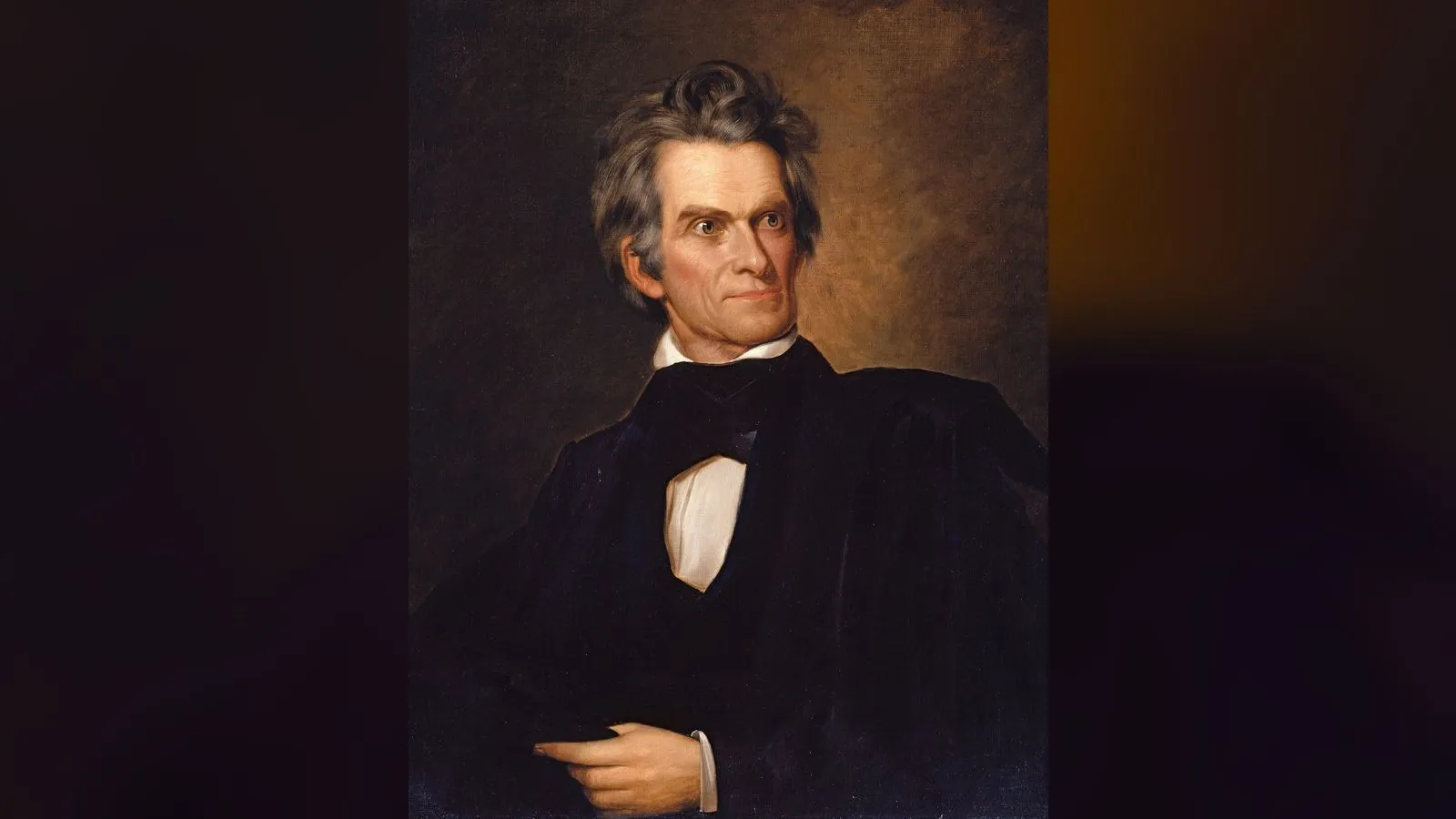

John C. Calhoun (1782–1850)
Contents
TL;DR
- established John C. Calhoun's ancestry is documented with real specificity: his father, Patrick Calhoun, was born in County Donegal, Ireland, in 1727 and emigrated with his parents in 1733, part of the Scots-Irish settlement tradition, settling first in Lancaster County, Pennsylvania, then in Augusta County, Virginia, before the family moved to the Long Cane settlement in South Carolina by 1756 — this article states this specific, documented place and date directly.
- established On 1 February 1760, during the Anglo-Cherokee War, a Cherokee attack on the Long Cane settlers killed John C. Calhoun's grandmother, Catherine Calhoun, aged 76, with 22 others, according to the gravestone her son Patrick placed at the site.
- established As Vice President, Calhoun served under two different presidents, John Quincy Adams and Andrew Jackson, and remains the most recent US vice president to have done so, casting 31 tie-breaking Senate votes, a record that stood until 2023 — this article names these specific, documented political distinctions directly.
- established Calhoun developed and anonymously authored the theory of nullification, published in the South Carolina Exposition and Protest, asserting that individual states could invalidate federal laws deemed unconstitutional — a specific, documented constitutional doctrine this article states directly as central to Calhoun's political legacy, distinct from a vague claim of "states' rights advocacy."
- disputed Calhoun's most consequential and uncomfortable legacy is his documented defence of slavery as a "positive good," a position he argued explicitly in an 1837 Senate speech, going further than many contemporaries who called slavery merely a "necessary evil" — this article states this directly and in full, including Calhoun's own documented harsh treatment of an enslaved man who attempted to escape punishment, rather than minimising this record in favour of his constitutional theorising.
- established Calhoun's doctrines of nullification and states' rights became direct intellectual foundations for Southern secessionism and the Confederacy, a specific, documented historical consequence this article names directly rather than presenting his constitutional theorising as politically neutral.
Key Facts
- Born
- 18 March 1782, Abbeville, South Carolina, USA
- Died
- 31 March 1850, Washington, D.C., USA
- Category
- Statesmen, Politicians & Public Figures
- Scots-Irish ancestry
- Documented, specific — father Patrick Calhoun, born County Donegal, 1727, emigrated 1733 (Pennsylvania, then Virginia, then Long Cane, South Carolina)
- Key achievement
- Vice President under two presidents (Adams and Jackson); developer of nullification doctrine
- Documented controversy
- Defended slavery as a "positive good"; personally subjected an enslaved man to harsh punishment
- Historical consequence
- His doctrines became intellectual foundations for Southern secession
Scottish Impact Index (SI Score)
- Global Influence
- 9/10
- Enduring Connection
- 9/10
- Material Contribution
- 9/10
- Scottish Diaspora Distinctiveness
- 10/10
- Diaspora Legacy
- 10/10
- Recognition
- 9/10
56/60
Ranked =8th of 45 in Diaspora
A Note on Claims and Evidence
Family background and the specific, documented Scots-Irish ancestral connection — Patrick Calhoun's birth in County Donegal and 1733 emigration — are drawn from Wikipedia's published biographical record. An earlier version of this article said the family emigrated to Virginia in 1733; Lancaster County, Pennsylvania, estate papers show that Patrick's father died there in 1740 or 1741, and the family appears in Augusta County, Virginia, records from 1745. The Long Cane killings of 1760 and the gravestone inscription are taken from the 1982 National Register of Historic Places nomination for the Long Cane Massacre Site. Material on the wider Calhoun clan comes from David Hackett Fischer's Albion's Seed (1989), which draws on A. S. Salley's early twentieth-century studies of the family. Education, political career across multiple high offices, the nullification doctrine and the Nullification Crisis, his documented pro-slavery ideology and personal conduct toward an enslaved man, and his later opposition to the Mexican-American War and the Wilmot Proviso are drawn from Wikipedia's published research record.
Timeline
Patrick Calhoun, John C. Calhoun's father, is born in County Donegal, Ireland.
Patrick Calhoun emigrates with his parents, Patrick and Catherine Calhoun, and his brothers, settling first in Lancaster County, Pennsylvania, part of the Scots-Irish settlement tradition.
Patrick Calhoun's father dies in Lancaster County, Pennsylvania.
The widowed Catherine Calhoun and her children appear in the records of Augusta County, Virginia.
The Calhouns settle at Long Cane Creek in the South Carolina upcountry; Patrick Calhoun eventually becomes a surveyor, farmer, slaveholder, and member of the South Carolina Legislature.
A Cherokee attack on the Long Cane settlers kills Catherine Calhoun, aged 76, and 22 others, according to the memorial stone Patrick Calhoun erected at the site.
John Caldwell Calhoun is born in Abbeville, South Carolina.
Calhoun attends Yale College, graduating as valedictorian.
Calhoun is admitted to the South Carolina bar, having studied law at Tapping Reeve Law School in Connecticut.
Calhoun serves in the US House of Representatives, becoming a leading "War Hawk" advocating for the War of 1812.
Calhoun serves as Secretary of War under President James Monroe, modernising the War Department and overseeing 40 Indian treaty negotiations.
Calhoun serves as Vice President under both John Quincy Adams and Andrew Jackson, casting 31 tie-breaking Senate votes.
Calhoun anonymously authors the South Carolina Exposition and Protest, developing the theory of nullification in opposition to federal tariffs.
Calhoun orders an enslaved man, Alick, jailed and subjected to thirty lashes after he attempted to escape a whipping.
Calhoun resigns as Vice President amid the Nullification Crisis, returning to the Senate.
The Compromise Tariff resolves the immediate crisis, though underlying tensions remain.
Calhoun delivers his famous Senate speech declaring slavery a "positive good."
Calhoun serves as Secretary of State under President John Tyler, negotiating the Texas annexation treaty and helping resolve the Oregon boundary dispute.
Calhoun vigorously opposes the Mexican-American War and attacks the Wilmot Proviso, fearing both would affect the balance of slavery's expansion.
Calhoun's final speech, warning of Northern subjugation and predicting the Union might dissolve within twelve years, is delivered by proxy as he lies dying.
Calhoun dies in Washington, D.C., from tuberculosis, at age 68.
Details
A specific, documented ancestral origin and emigration date stated precisely
This article names John C. Calhoun's Scots-Irish ancestry with real specificity rather than a vague general claim: his father, Patrick Calhoun, was born in County Donegal, Ireland, in 1727, and emigrated with his parents in 1733, first to Pennsylvania and then to Virginia. This article states this specific documented place and date directly because it represents a precise, traceable Scots-Irish lineage.
The Calhouns of Long Cane
established The Calhouns moved by stages down the backcountry: Lancaster County, Pennsylvania, in the 1730s; Augusta County, Virginia, by 1745; and Long Cane Creek, in what is now McCormick County, South Carolina, by 1756. On 1 February 1760, during the Anglo-Cherokee War, Cherokee warriors attacked the Long Cane settlers. Patrick Calhoun found and buried the dead. Early reports of the loss varied; the memorial stone he set up at the site reads, in part: "Patk. Calhoun, Esq.: In memory of Mrs. Cathrine Calhoun aged 76 years who with 22 others was here murdered by the Indians." Catherine, born a Montgomery, was Patrick's mother and John C. Calhoun's grandmother.
shared The historian David Hackett Fischer, in Albion's Seed (1989), uses the "Calhouns of Long Cane" as an example of a backcountry elite descended from families of standing in Ulster. He records that the four brothers, James, William, Ezekiel and Patrick, worked closely together, held thousands of acres and many enslaved people by the mid-eighteenth century, and married into allied families such as the Montgomerys, Nobles and Pickenses. He also reports that in 1746 all four were named in a single indictment as "divulgers of false information". By the end of the century there were hundreds of Calhouns in the Carolina upcountry, and John C. Calhoun himself married his cousin Floride Bonneau Colhoun in 1811.
shared Fischer reads the gravestone as evidence that a backcountry woman's identity was submerged in a man's, because Patrick's name stands above hers. But he describes Catherine as Patrick's wife, which is a slip: she was his mother. The point about the inscription survives, but it concerns a son's memorial to his mother, not a husband's to his wife. Fischer's wider argument, that the Calhouns carried a "borderland" culture from North Britain, is interpretation, and the family's origins lay in Donegal, not on the Anglo-Scottish Border.
A specific constitutional doctrine named rather than a vague states'-rights label
This article names Calhoun's theory of nullification directly and specifically, rather than a generalised claim of "states' rights advocacy": his anonymous authorship of the South Carolina Exposition and Protest, and its assertion that individual states could invalidate federal laws they deemed unconstitutional. This article states this because it reflects the real, specific, and historically consequential doctrine Calhoun developed, distinct from a vague ideological label.
A full, unminimised accounting of Calhoun's defence of and personal conduct toward slavery
This article states Calhoun's documented pro-slavery ideology and personal conduct directly and in full: his explicit 1837 Senate declaration that slavery was a "positive good," going further than contemporaries who called it a necessary evil, and his own 1831 order subjecting an enslaved man to jailing and thirty lashes. This article names both because minimising either in favour of Calhoun's constitutional theorising would misrepresent a serious, well-documented, and central part of his historical record.
A doctrine's real historical consequence named directly
This article states that Calhoun's nullification and states'-rights doctrines became direct intellectual foundations for Southern secessionism and the Confederacy, rather than presenting his constitutional theorising as politically neutral or purely academic. This article names this consequence because it reflects the real, documented historical trajectory of Calhoun's ideas beyond his own lifetime.
Did You Know?
- John C. Calhoun's father, Patrick Calhoun, was born in County Donegal, Ireland, in 1727 and emigrated as a young child in 1733, reaching Virginia by way of Pennsylvania.
- Calhoun's grandmother Catherine was killed in a Cherokee attack at Long Cane in 1760; the stone her son set up at the site still names "22 others" who died with her.
- Calhoun married his cousin Floride Bonneau Colhoun, a branch of the family that kept the older spelling of the name.
- Calhoun remains the most recent US vice president to have served under two different presidents, Adams and Jackson.
- Calhoun cast 31 tie-breaking Senate votes as vice president, a record that stood until 2023.
- Calhoun anonymously authored the doctrine of nullification, the theory that individual states could invalidate federal laws they considered unconstitutional.
- In an 1837 Senate speech, Calhoun explicitly defended slavery as a "positive good," a more extreme position than many contemporaries who called it merely a "necessary evil."
- In 1831, Calhoun personally ordered an enslaved man jailed and given thirty lashes after he tried to escape a whipping.
- Calhoun's constitutional doctrines later became direct intellectual foundations for Southern secession and the Confederacy.
FAQ
1Was John C. Calhoun actually of Scottish descent?
Scots-Irish, documented with real specificity — his father was born in County Donegal, Ireland, in 1727 and emigrated with his family in 1733, first to Pennsylvania and then to Virginia.
2What was the Long Cane massacre?
A Cherokee attack on 1 February 1760 on settlers from the Long Cane settlement in the South Carolina upcountry. Calhoun's grandmother Catherine and, by the count on her memorial stone, 22 others were killed. Contemporary reports of the toll varied.
3What does Albion's Seed say about the Calhouns?
David Hackett Fischer treats the "Calhouns of Long Cane" as a backcountry elite clan: kin who settled together, intermarried with allied families and held land, enslaved people and office. It is a useful picture of the family, but his wider claim that they carried a single "borderland" culture is contested.
4What is John C. Calhoun best known for politically?
Developing the doctrine of nullification, serving as Vice President under two different presidents, and his strident defence of slavery.
5Did Calhoun really call slavery a "positive good"?
Yes — in an 1837 Senate speech, he explicitly argued slavery was a positive good, going further than many Southern contemporaries who called it a necessary evil.
6How did Calhoun personally treat enslaved people?
Harshly and documented as such — in 1831, he ordered an enslaved man jailed and given thirty lashes after an escape attempt.
7What was the Nullification Crisis?
A constitutional confrontation in which South Carolina, following Calhoun's doctrine, threatened to invalidate federal tariffs and potentially secede, resolved by the Compromise Tariff of 1833.
8Did Calhoun's ideas outlive him?
Yes — his nullification and states'-rights doctrines became direct intellectual foundations for Southern secession and the Confederacy.
9When did John C. Calhoun die?
31 March 1850, from tuberculosis, in Washington, D.C., at age 68.
Sources and Further Reading
Primary/Institutional
Scholarly/Critical
- John C. Calhoun — New World Encyclopedia
- David Hackett Fischer, Albion's Seed: Four British Folkways in America (Oxford University Press, 1989)
- Long Cane Massacre Site — National Register of Historic Places nomination (1982)
Specialist
- Patrick Colhoun of County Donegal, died 1740/1, Lancaster County, Pennsylvania — Begats and Bequeathals
- John C. Calhoun, Vice President, Politician, States Rights Advocate — American History Central
General
Caveats: Myths and Disputed Claims
- Content note: This article states John C. Calhoun's documented defence of slavery as a "positive good" and his personal harsh treatment of an enslaved man directly and in full, consistent with this series' standard of giving uncomfortable findings full weight rather than minimising them.
- Context note: This article names the direct, documented historical consequence of Calhoun's constitutional doctrines, which became intellectual foundations for Southern secession, rather than presenting his nullification theory as politically neutral.
- Do not describe Catherine Calhoun as Patrick Calhoun's wife, as Albion's Seed does; she was his mother.
- Do not say the Calhouns emigrated directly to Virginia in 1733; they settled first in Pennsylvania.
- Do not present Fischer's borderland thesis as settled; it is a contested interpretation.
Card 027 · Diaspora