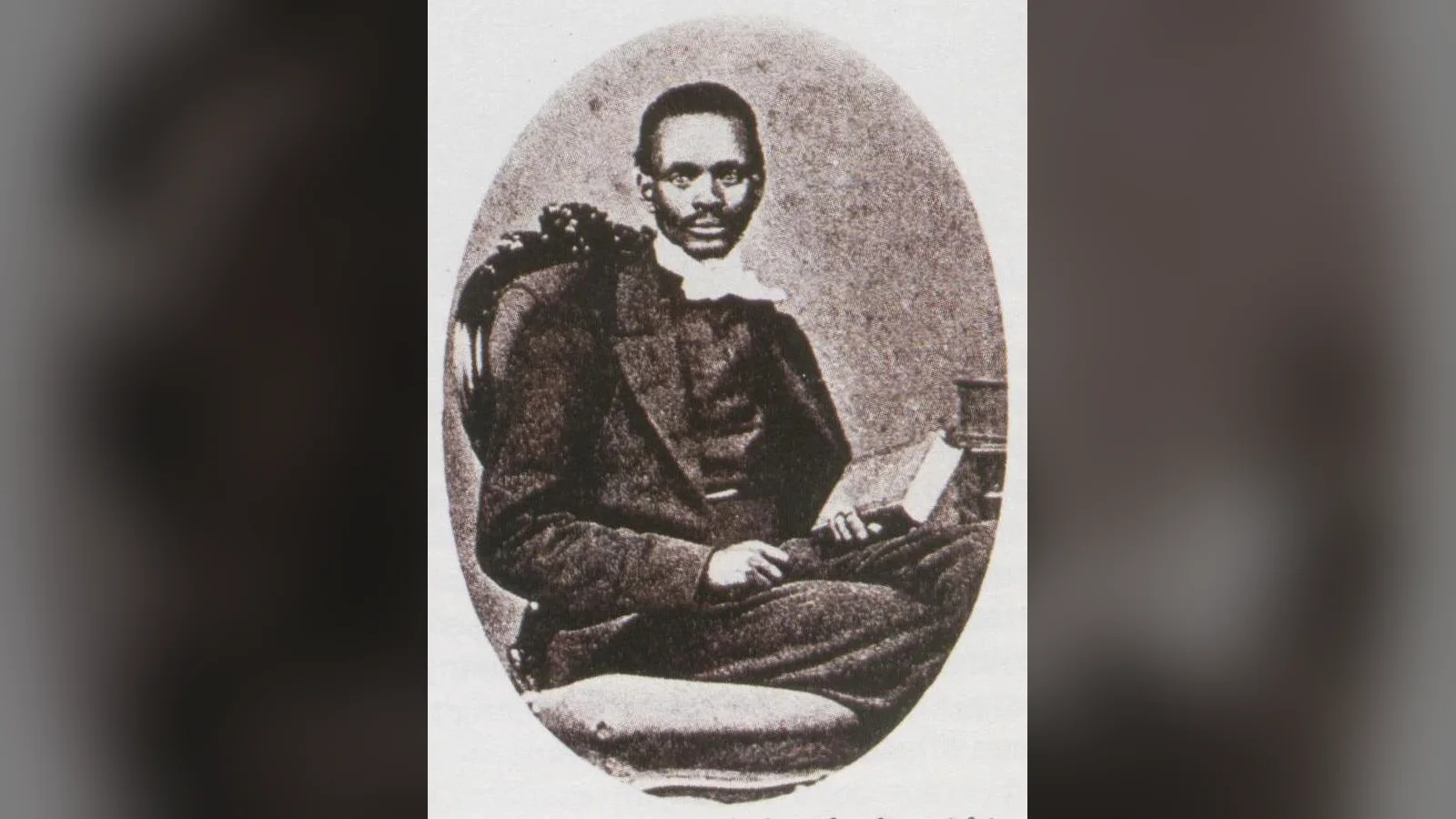

Tiyo Soga: The Xhosa Minister Made in Glasgow
Contents
Tiyo Soga was born in 1829 near the Tyhume River, the son of a councillor to the Xhosa chief Ngqika. Missionaries sent out from Glasgow taught him to read. He went on to study at Lovedale, at a Glasgow school and at the University of Glasgow. In December 1856 the United Presbyterian Presbytery of Glasgow ordained him in John Street Church, and two months later he married a Scotswoman, Janet Burnside. He went home to a country ruined by the cattle-killing, built two mission churches, translated The Pilgrim's Progress into Xhosa, wrote hymns and worked on the Xhosa Bible. He died in 1871, aged forty-two.
TL;DR
- established Born in 1829 by his own reckoning. He was taught at the Tyhume (Chumie) mission of the Glasgow Missionary Society, then at Lovedale from 1844.
- established He first went to Scotland in 1846 with Lovedale's principal, William Govan. He studied at Inchinnan and Glasgow and was baptised in John Street Church, Glasgow, on 7 May 1848.
- established On a second stay from 1851 he studied at the University of Glasgow and the United Presbyterian Theological Hall in Edinburgh. He was licensed on 10 December 1856 and ordained on 23 December. Chalmers calls him the first ordained preacher of his race.
- established He landed at Algoa Bay on 2 July 1857, just after the cattle-killing, and spent eleven years at the Mgwali mission. In 1868 he moved to the Tutuka, among the Gcaleka.
- established He translated the first part of The Pilgrim's Progress into Xhosa, finishing on 21 November 1866. He also wrote hymns and sat on the board translating the Bible. He died at the Tutuka on 12 August 1871.
Key Facts
- Born
- 1829, by his own reckoning, near the Tyhume River, Eastern Cape
- Father
- Soga, a councillor of the chief Ngqika
- Education
- Tyhume mission; Lovedale (1844); Inchinnan and the Glasgow Free Church Normal Seminary (1846–48); University of Glasgow and the UP Theological Hall, Edinburgh (1851–56)
- Ordained
- 23 December 1856, John Street Church, Glasgow, by the United Presbyterian Presbytery of Glasgow
- Married
- Janet Burnside, 27 February 1857
- Missions
- Mgwali (1857–68); the Tutuka (1868–71)
- Writing
- Xhosa Pilgrim's Progress; hymns; Bible translation
- Died
- 12 August 1871, at the Tutuka, aged 42
- Related cards
- Diaspora 52, Scots in South Africa; Diaspora 53, Scotland and Malawi
- Main source
- John A. Chalmers, Tiyo Soga: A Page of South African Mission Work (1877; 2nd edn, Andrew Elliot, Edinburgh, and David Bryce, Glasgow, 1878)
Scottish Impact Index (SI Score)
- Global Influence
- 6/10
- Enduring Connection
- 6/10
- Material Contribution
- 6/10
- Scottish Diaspora Distinctiveness
- 7/10
- Diaspora Legacy
- 7/10
- Recognition
- 5/10
37/60
Ranked =85th of 93 in Diaspora
A Note on Claims and Evidence
Each major claim carries one of three labels. established means supported by primary records, official bodies or several independent reliable sources. shared means the core fact is sound but sources disagree on details, dates or interpretation. traditional means widely repeated but not traceable to a primary or independent source.
Chalmers was the son of Soga's first teacher, William Chalmers, and a fellow missionary of the same church. He wrote within six years of Soga's death and quotes at length from Soga's letters and journal, and from church records. That makes the memoir the closest source there is, but it is a missionary's tribute, and it sees Xhosa life almost entirely as heathenism to be overcome.
It also uses "Kafir" throughout for the Xhosa people and their language. That was the ordinary missionary term in 1877; it is now a racial slur in South Africa. The text uses Xhosa and the modern spellings of names: Tyhume for Chumie, Ngqika for Gaika, Gcaleka for Galeka and Sarhili for Kreli.
Timeline
Born, by his own reckoning, in the year the chief Maqoma was expelled from the Kat River.
Goes to Lovedale.
Sails for Scotland with William Govan.
Baptised by Dr William Anderson in John Street Church, Glasgow.
Lands back at Port Elizabeth.
Leaves for Scotland again, after the war of 1850 breaks up the missions; matriculates at the University of Glasgow that November.
Licensed to preach by the United Presbyterian Presbytery of Glasgow.
Ordained in John Street Church.
Marries Janet Burnside.
Lands at Algoa Bay, after the cattle-killing.
Opens the new church at Mgwali.
Finishes translating the first part of The Pilgrim's Progress.
Moves to the Tutuka, as missionary to Sarhili's people.
The new church at the Tutuka is due to open.
Dies at the Tutuka.
Details
Tyhume and Lovedale
established Soga grew up in a polygamous household; his father, Soga, was one of the chief Ngqika's councillors. He did not know his birth year until, reading a history of the Cape Colony, he matched his mother's account, that he was born in the year Maqoma was expelled from the Kat River, to 1829.
established He was taught at the Tyhume mission, founded by the Glasgow Missionary Society, by William Chalmers. In 1844 Lovedale, the Free Church seminary run by William Govan, offered two free places to boys from other missions. Chalmers chose Soga after asking his pupils which was the greatest work of God. The others said the creation; Soga said the salvation of mankind, "because it shows God's love". He did poorly in the competition itself, but Chalmers found another way to get him into Lovedale.
Glasgow
established War broke out in 1846, and Govan took Soga with him to Scotland in July that year. John Henderson of Park paid his expenses and his education. He went to school at Inchinnan, where Govan had become minister, and then at the Glasgow Free Church Normal Seminary. On 7 May 1848 he was baptised in John Street Church by Dr William Anderson, who preached on the Ethiopian eunuch. He sailed home in October 1848.
established The war of 1850 scattered the missions again, and in June 1851 he left for Scotland a second time with the missionary Robert Niven. That November he matriculated at the University of Glasgow, taking Latin and Greek, and he then trained at the United Presbyterian Theological Hall, which met in Edinburgh each autumn. The John Street congregation gave £202 towards his education and support.
established On 10 December 1856 the United Presbyterian Presbytery of Glasgow licensed him to preach, and on 23 December it ordained him in John Street Church. After his trial sermon Anderson wrote that it showed "the gift of a fine mind is not the monopoly of climate or colour".
shared On 27 February 1857 he married Janet Burnside. Chalmers says some colonists saw the marriage as Soga trying to make himself an Englishman, and that this hurt him deeply.
Mgwali and the Tutuka
established Soga landed at Algoa Bay on 2 July 1857 to find his people destroyed by the cattle-killing. In 1856 the seer Mhlakaza and his daughter Nongquase (Nongqawuse) had prophesied that the dead chiefs would return and sweep away the English, if the people killed all their cattle and got rid of their grain. The Gcaleka and Ngqika obeyed, and Chalmers reports that more than 40,000 cattle had been killed by the end of January 1857 alone. Soga began work at Mgwali, buying corn for the starving and building a church with his own hands. A larger church there was opened in June 1862.
established In June 1868 he moved to the Tutuka, a site in Sarhili's country chosen by the chief and his councillors, to start a new mission among the Gcaleka. The new church was due to open on 2 April 1871. He died there at a quarter to three on 12 August 1871, and six of his own people carried his coffin from the church to the grave.
Writing and translation
established Soga had carried The Pilgrim's Progress with him since his student days. On 21 November 1866 he noted in his journal that he had finished translating its first part, "my fingers aching with writing". It was printed on the Free Church missionaries' press. He also wrote hymns, and he was appointed to the joint board translating the Bible into Xhosa.
The Inheritance of My Children
shared Soga sent his three eldest sons, William Anderson, John Henderson and Kirkland Allan, to school in Scotland. He gave them a notebook, The Inheritance of My Children, of sixty-two maxims. The first warned them of white prejudice against colour and told them: "never appear ashamed that your father was a Kafir, and that you inherit some African blood."
Did You Know?
- Soga worked out his own birth year from a history book.
- He was baptised in Glasgow, by the minister who later presided at his ordination.
- He glazed most of the windows of his first church himself.
- His first son was named William Anderson Soga, after the minister who baptised him in Glasgow.
- John Street Church in Glasgow gave £202 towards his training.
FAQ
1Who was Tiyo Soga?
A Xhosa minister, trained in Glasgow and Edinburgh, who was ordained in 1856 and worked as a missionary in the Eastern Cape until his death in 1871.
2What is his Scottish connection?
He was the product of Scotland's missions and universities, married a Scot, and sent his sons to Scotland. He is one of the clearest cases of Scotland's influence abroad running both ways.
3What did he write?
A Xhosa translation of The Pilgrim's Progress, hymns, and part of the Xhosa Bible.
4Was he the first black minister in South Africa?
Chalmers calls him the first ordained preacher of his race. Wider claims should be checked against modern scholarship.
Sources and Further Reading
Scholarly/Critical
-
John A. Chalmers, Tiyo Soga: A Page of South African Mission Work (2nd edn, Andrew Elliot, Edinburgh, and David Bryce, Glasgow, 1878). Free scan at the Internet Archive. Main source.
-
John M. MacKenzie with Nigel R. Dalziel, The Scots in South Africa: Ethnicity, Identity, Gender and Race, 1772–1914 (Manchester University Press, 2007). Used for his travelling companions in 1846.
Further reading (not consulted directly)
- Donovan Williams, Umfundisi: A Biography of Tiyo Soga, 1829–1871 (Lovedale Press, 1978).
Caveats: Myths and Disputed Claims
-
Shared: who took him to Scotland in 1846. Chalmers has Govan taking him. MacKenzie (2007) says he travelled with the Ross brothers and the son of William Ritchie Thomson, with John Henderson of Park paying. The two accounts may describe the same voyage from different sides.
-
"First". Chalmers's "first ordained preacher of his race" is a missionary's claim. The usual modern phrasing, first black South African to be ordained, should be checked before print.
-
The cattle-killing. Only Chalmers's account is given here, which calls it a delusion and Nongquase Mhlakaza's daughter. Modern histories usually make her his niece and explain the movement differently.
-
His marriage. Chalmers's remarks on it are coloured by the racial ideas of his time.
Finished reading? Try the Fact Machine: three reels, one surprising Scottish connection →
Card 085 · Diaspora