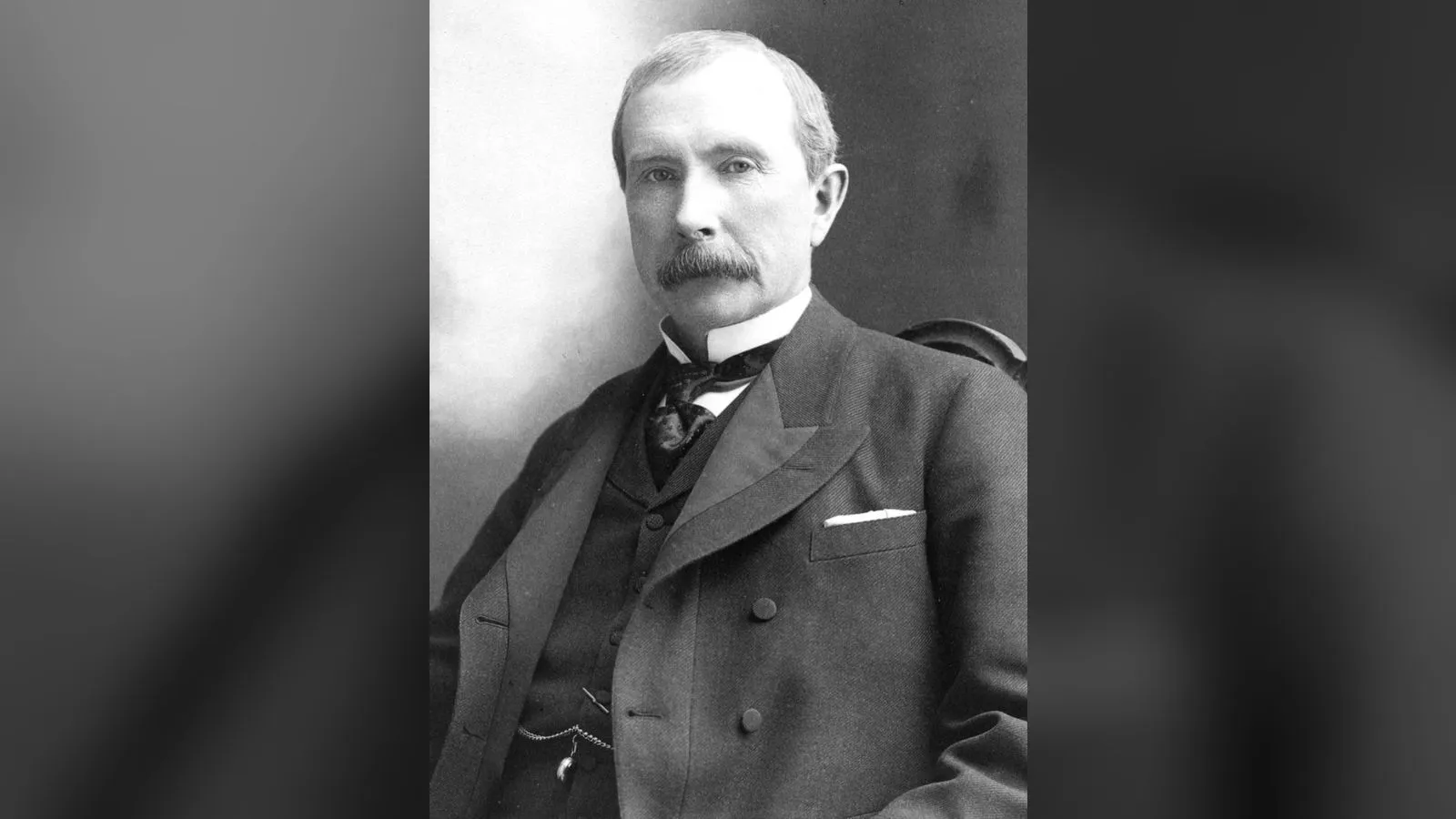

John D. Rockefeller: Oil, Monopoly and the Science of Giving
Contents
TL;DR
John Davison Rockefeller (1839–1937) built Standard Oil into the most powerful company of the industrial age. He then gave away about $530 million, most of it to medicine, and in doing so invented the modern foundation. He was American born and bred, and his father's line was German. His place in a Scottish diaspora series rests on his mother's side: his maternal grandfather, John Davison, whose name he carried, was a Baptist of Scotch-Irish descent. That is a real but distant link, and this card says so plainly.
What makes the Scottish thread worth following is not his family tree. It is the Scots who kept turning up at the turning points of his life: the Scottish headmaster who taught him to write, the Scottish-born deacon who brought him into the church that shaped him, the "bearded Scot" whose Pittsburgh refinery joined Standard Oil, and above all Andrew Carnegie of Dunfermline. Carnegie was his great rival in business and his model in giving.
Key Findings
- The Scottish link is maternal and indirect. His mother, Eliza Davison, was the daughter of John Davison, described by Rockefeller's biographer Ron Chernow as "a prudent, straitlaced Baptist of Scotch-Irish descent". The Rockefeller line itself came from the Rhine valley in Germany. Its family records go back to the early 1600s, and the first Rockefeller emigrant, Johann Peter, reached Philadelphia around 1723.
- He started as a $50 clerk. On 26 September 1855, aged sixteen, he was taken on as an assistant bookkeeper by Hewitt & Tuttle, produce merchants in Cleveland. He was paid $50 for his first three months.
- He bought his way into oil at an auction. In February 1865 he won control of Cleveland's largest refinery with a bid of $72,500, at the age of twenty-five.
- Standard Oil was founded on 10 January 1870 with $1 million of capital. Within about seven years Rockefeller controlled nearly 90 per cent of the oil refined in the United States.
- It was broken up in 1911. On 15 May 1911 the US Supreme Court ordered the Standard Oil trust dissolved, after a federal antitrust suit and years of public anger fuelled by Ida Tarbell's exposé.
- He reinvented philanthropy. He funded the University of Chicago, the Rockefeller Institute for Medical Research (1901), the General Education Board (1902–03), the campaign against hookworm in the American South (1909) and the Rockefeller Foundation (1913). Of the roughly $530 million he gave away, about $450 million went directly or indirectly to medicine.
- Carnegie was rival and model. Rockefeller praised Andrew Carnegie's gospel of giving, and the two clashed over the Mesabi iron-ore range before striking a deal in 1896.
Key Facts
- Born
- 8 July 1839, Richford, New York
- Died
- 23 May 1937, Ormond Beach, Florida, six weeks short of his 98th birthday
- Buried
- Lake View Cemetery, Cleveland, Ohio
- Parents
- William Avery Rockefeller ("Big Bill"); Eliza Davison
- Scottish connection
- Maternal grandfather John Davison, of Scotch-Irish descent
- Married
- Laura Celestia "Cettie" Spelman, 8 September 1864
- First job
- Assistant bookkeeper, Hewitt & Tuttle, Cleveland, 26 September 1855
- Company
- Standard Oil Company (Ohio), incorporated 10 January 1870
- Peak market share
- Nearly 90 per cent of US refining by the late 1870s
- Trust dissolved
- 15 May 1911, US Supreme Court
- Lifetime giving
- About $530 million, of which about $450 million went to medicine
- Estate at death
- $26.4 million
- Memoir
- Random Reminiscences of Men and Events (serialised 1908; book 1909)
Scottish Impact Index (SI Score)
- Global Influence
- 10/10
- Enduring Connection
- 6/10
- Material Contribution
- 10/10
- Scottish Diaspora Distinctiveness
- 7/10
- Diaspora Legacy
- 10/10
- Recognition
- 10/10
53/60
Ranked =18th of 45 in Diaspora
Claim Status
established
- his business career, the founding and dissolution of Standard Oil, and his philanthropic foundations and gifts, all documented in his papers and in Chernow's biography;
- his maternal descent from John Davison, described as of Scotch-Irish descent;
- the Scottish birth or origins of William Smythe, Alexander Sked and Charles Lockhart, as given by Chernow;
- his dealings with Andrew Carnegie.
shared
- the meaning of "Scotch-Irish". In American usage it usually means the descendants of Lowland Scots who settled in Ulster and then emigrated to America. The Davison family's precise origins are not documented in the sources used here.
disputed
- whether Rockefeller belongs in a Scottish diaspora series at all. His Scottish ancestry is one strand among German, English and Scotch-Irish forebears, and he himself dismissed the hunt for exotic roots. Asked about genealogists offering him a noble pedigree, he said: "I am satisfied with my good old American stock." We include him for the maternal line and for the Scottish figures woven through his story, and we flag the thinness of the claim openly.
Traditional (and false):
- the story that the Rockefellers descended from a French noble family, the Roquefeuilles. Chernow notes that it has been refuted. The family's German origins are well established.
A Peddler's Son
Rockefeller's father, William Avery Rockefeller, was a charming, restless travelling salesman who sold patent medicines and called himself "Doc". He was also a fraud and, later, a bigamist. From 1855 he lived a second life as "Dr William Levingston" with a younger wife, Margaret Allen. He courted Eliza Davison at her father's farmhouse near Moravia, New York, sometimes pretending to be deaf and dumb as part of his sales act. Her father strongly opposed the match, but Eliza married him on 18 February 1837.
John Davison, the Scotch-Irish Baptist grandfather, is a quiet but important figure in the story. He was comfortably off by country standards; his grandson later recalled that "my grandfather was a rich man — that is, for his time he was counted rich." When Big Bill's behaviour grew scandalous, Davison sued him to recover loans and placed Eliza's inheritance in the hands of trustees to keep it from her husband. John, the eldest son, was named after this sober grandfather. Chernow argues that his temperament was a Davison inheritance. He had his mother's narrow face, her slow and even metabolism and her refusal to raise her voice. From Eliza he took the habits of thrift, order and caution that would define Standard Oil, and one of her sayings stayed with him for life: "We will let it simmer."
The family moved around upstate New York, from Richford to Moravia to Owego. At Owego Academy, which John and his brother William entered in August 1852, the principal was, in Chernow's words, "an able Scot, Dr William Smythe". Smythe made his pupils write essays every fortnight and give speeches on set subjects, and Chernow credits him with the concise, controlled style of Rockefeller's business letters.
Cleveland and the Scottish Deacon
In 1853 the family moved to the Cleveland area. John boarded in the city, studied briefly at E. G. Folsom's commercial college, and in the summer of 1855 walked the streets looking for work. His own account, written half a century later, captures the moment he was hired:
"We will give you a chance," he said, but not a word passed between us about pay. This was September 26, 1855. I joyfully went to work. The name of the firm was Hewitt & Tuttle.
Rockefeller celebrated 26 September as "Job Day" for the rest of his life. In January 1856, he recalled, "Mr. Tuttle presented me with $50 for my three months' work, which was no doubt all that I was worth."
The other great influence of these years was the Erie Street Baptist Mission Church, a poor congregation he joined as a teenager and served for decades as clerk, Sunday school teacher and trustee. The man who drew him in was Deacon Alexander Sked, a florist born in Scotland in 1780. Sked had emigrated in 1831 and settled in Cleveland in 1835. Chernow describes him as "a poetical Scot who loved to spout psalms and prophecies and seemed to know the whole Bible by heart". Sked became an early mentor. The church, later renamed the Euclid Avenue Baptist Church, gave the fatherless boy a community, and its teaching on stewardship of wealth shaped his later giving. On the day before he died in 1937, Rockefeller paid off the church's mortgage.
From Produce to Oil
On 1 April 1858, with $1,000 borrowed from his father at 10 per cent interest, Rockefeller left Hewitt & Tuttle and went into partnership with Maurice B. Clark, a young Englishman, as produce merchants. The Civil War brought them large profits. In 1863 the partners backed a refinery run by Samuel Andrews, a chemist convinced that kerosene would outsell every other lamp oil.
The partnership became strained, and in February 1865 the partners agreed to sell the business to the highest bidder among themselves. Rockefeller told the story in his memoir. The bidding rose to $70,000, then his rivals bid $72,000. "Without hesitation I said $72,500." Clark gave up. At twenty-five, Rockefeller owned Cleveland's largest refinery, able to treat 500 barrels of crude a day, which made it one of the biggest in the world. "It was the day that determined my career," he later told his interviewer William O. Inglis.
Standard Oil
On 10 January 1870 the partnership of Rockefeller, Andrews and Flagler became the Standard Oil Company (Ohio). It had $1 million in capital, with Rockefeller as president, his brother William as vice-president and Henry Flagler as secretary and treasurer. The name promised kerosene of a uniform, standard quality at a time when badly refined oil could explode.
What followed made Rockefeller both the most admired and the most hated businessman in America. Rockefeller made his refineries brutally efficient. His men made their own barrels, used every by-product, and drove down costs. He also negotiated secret rebates from the railways, so that Standard paid less to ship oil than its rivals did. In 1871–72 he joined a railway-backed cartel, the South Improvement Company. The scheme collapsed amid public outrage, but in the same few weeks of early 1872 Standard Oil absorbed twenty-two of its Cleveland competitors, an episode later known as the "Cleveland Massacre". Many rivals sold because they believed they could not survive otherwise.
Standard then moved on Pittsburgh and Philadelphia. In the autumn of 1874 Rockefeller and Flagler met the leading refiners of those cities at Saratoga Springs. One of them was Charles Lockhart of Pittsburgh, described by Chernow as "a bearded Scot with a frosty, taciturn manner". Rockefeller was especially pleased to win him over, calling him "one of the most experienced, self-contained, and self-controlled men in business". Lockhart joined the Standard alliance and became one of its leading figures.
By 1877, after defeating the Pennsylvania Railroad's attempt to break into refining, Rockefeller controlled nearly 90 per cent of the oil refined in the United States. To manage this sprawling empire across state lines, his lawyers created the Standard Oil Trust on 2 January 1882, a $70 million enterprise run by nine trustees who met daily for lunch at 26 Broadway in New York. It was one of the first great business trusts, and its name entered the language: laws against such combinations are still called "antitrust" laws.
The Reckoning
Public hostility grew through the 1880s and 1890s. Congress passed the Sherman Antitrust Act in 1890, and the Ohio Supreme Court ruled against the trust in March 1892, which Standard evaded by reorganising. The decisive blow came from journalism. Ida Tarbell, who had grown up in the Pennsylvania oil region and watched her father's business suffer, published The History of the Standard Oil Company in McClure's Magazine from 1902 to 1904. Its patient, documented account of rebates and coercion turned Rockefeller into a national villain.
On 18 November 1906 the federal government sued Standard Oil under the Sherman Act. On 15 May 1911 the Supreme Court upheld the order to break it up into separate companies. The irony was that the break-up made Rockefeller richer still. Shares in the successor companies, which include the ancestors of Exxon, Mobil and Chevron, soared, and by about 1913 his fortune was by far the largest in the world.
The Difficult Art of Giving
Rockefeller gave to his church and to charity from his very first wages, as the entries in his teenage account book, Ledger A, show, and his giving grew with his fortune. By the late 1880s requests for money were overwhelming him. In 1891 he hired Frederick T. Gates, a Baptist minister, to manage his philanthropy on business principles: give to institutions, not individuals; fund causes, not symptoms; and require others to share the cost.
The first great result was the University of Chicago. In May 1889 Rockefeller pledged $600,000 on condition that another $400,000 be raised elsewhere, and the university opened in 1892. He went on to give tens of millions more. In 1901 he founded the Rockefeller Institute for Medical Research in New York, now Rockefeller University, one of the first American institutions devoted purely to biomedical research. The General Education Board followed in 1902–03 to support schools and colleges, particularly in the South. In 1909 the Rockefeller Sanitary Commission began a campaign against hookworm, a parasite that sapped the health of millions of poor Southerners. It became a model for public health campaigns worldwide.
In 1913, after Congress declined to grant a national charter, New York State chartered the Rockefeller Foundation. He gave it $100 million in its first year and another $82.8 million by 1919. By the 1920s it was the largest grant-making foundation on earth, funding medical schools, public health and campaigns against diseases such as yellow fever.
He explained his philosophy in his 1909 memoir:
The best philanthropy is constantly in search of the finalities — a search for cause, an attempt to cure evils at their source.
Not everything went well. In 1914, at the Colorado Fuel and Iron Company, in which the family held a controlling stake, a long coal strike ended in the Ludlow Massacre, in which strikers' wives and children died when militia attacked their tent colony. The disaster, handled at the time by his son John D. Rockefeller Jr., damaged the family name for years.
Carnegie: The Scot Who Set the Standard
The most important Scot in Rockefeller's story was Andrew Carnegie, born in Dunfermline in 1835. The two men were the richest Americans of their age, and in many ways mirror images. Both were relentless cost-cutters, both struggled with their own acquisitiveness, and both pioneered large-scale philanthropy. They never warmed to each other. Chernow records that each Christmas they exchanged gifts: Rockefeller sent Carnegie a paper vest, and Carnegie sent the teetotal Rockefeller fine whiskey.
In giving, Carnegie led the way. His 1889 essay "Wealth", later known as "The Gospel of Wealth", argued that "the man who dies thus rich dies disgraced". Rockefeller admired it. When the Carnegie Library opened in Pittsburgh in 1896, he wrote to him: "I would that more men of wealth were doing as you are doing with your money; but, be assured, your example will bear fruits." Rockefeller was struck by the systematic nature of Carnegie's library programme, which created about 2,800 public libraries. In private, though, Rockefeller and Gates thought Carnegie too fond of seeing his name carved in stone. Rockefeller chose instead to fund research, foundations and institutions that would outlive him without bearing his name on every building.
In business, the two collided over iron ore. In the 1890s Rockefeller took control of huge deposits on Minnesota's Mesabi Range, which Carnegie had dismissed. Carnegie privately mocked him as "Rockafellow" and later "Wreckafellow", but in December 1896 he had to strike a deal. Carnegie Steel would buy ore from Rockefeller's mines at a low royalty and ship it on Rockefeller's railways and lake boats, while Rockefeller agreed to stay out of steel. Years later Carnegie boasted to a Senate committee that he had got ahead of Rockefeller on a bargain. Chernow judges that the deal was really Carnegie repairing his own mistake. In 1901 both men sold out to J. P. Morgan's new United States Steel. Their last recorded meeting was cordial: in 1912 Carnegie visited Rockefeller's estate at Kykuit and found him "tall and spare and smiling, beaming".
By 1919 Rockefeller had already given away roughly as much as the $350 million Carnegie gave in his whole lifetime, and he went on giving.
Old Age and Legend
In his last decades Rockefeller remade his public image. He played golf daily and wintered at The Casements, his house at Ormond Beach, Florida. He handed out shiny new dimes to adults and nickels to children; between 20,000 and 30,000 coins are thought to have been given away. He died at Ormond Beach on 23 May 1937, aged ninety-seven. Having given away most of his fortune, he left an estate of $26.4 million. He was buried in Lake View Cemetery, Cleveland, beside his wife and his mother.
Timeline
Johann Peter Rockefeller emigrates from Germany to Philadelphia — Paternal line
William Avery Rockefeller marries Eliza Davison — Against her father's wishes
John D. Rockefeller born, Richford, New York — Named after grandfather John Davison
Enters Owego Academy — Principal: the Scot Dr William Smythe
Family moves to the Cleveland area — Joins Erie Street Baptist Mission Church
Hired by Hewitt & Tuttle — "Job Day"
Clark & Rockefeller founded —
Enters oil refining with Samuel Andrews —
Marries Laura Celestia Spelman —
Buys out partners at auction for $72,500 — "The day that determined my career"
Standard Oil Company (Ohio) incorporated — $1 million capital
"Cleveland Massacre": 22 rivals absorbed —
Saratoga meeting; Charles Lockhart joins —
Controls nearly 90% of US refining —
Standard Oil Trust created —
$600,000 pledge for the University of Chicago —
Mesabi ore deal with Andrew Carnegie —
Rockefeller Institute for Medical Research —
Ida Tarbell's exposé in McClure's —
Random Reminiscences; hookworm campaign begins —
Supreme Court dissolves Standard Oil —
Rockefeller Foundation chartered —
Ludlow Massacre —
Dies at Ormond Beach, Florida —
Did You Know?
- Rockefeller kept a small ledger, "Ledger A", recording every cent he earned and spent as a young clerk, including his gifts to church and charity. He treasured it all his life.
- The name "Standard Oil" was a promise of safety: badly refined kerosene could explode, and "standard" meant reliable.
- Rockefeller and Andrew Carnegie swapped Christmas presents for years: a paper vest one way, fine whiskey the other.
- His memoir, Random Reminiscences of Men and Events, grew out of conversations on the golf course at Augusta with the publisher Frank N. Doubleday.
Honest Caveats
- The diaspora link is thin. It rests on one maternal grandfather described as Scotch-Irish. We do not know where in Scotland or Ulster the Davisons came from.
- The Scottish figures are secondary. Smythe, Sked and Lockhart mattered in his life, but they do not make him Scottish. The card tells their stories because they are real and well sourced, not to inflate the claim.
- His own memoir is self-serving. Random Reminiscences was written partly to answer his critics, and we quote it for his voice, not as neutral evidence. The business record comes chiefly from Chernow's archival biography.
- Money values. Dollar figures are as given at the time. Conversions into modern money vary widely depending on the method, so we have avoided them.
FAQ
1Was John D. Rockefeller Scottish?
No. He was American. His father's family was German. His mother's father, John Davison, was of Scotch-Irish descent, which gives him a distant Scottish ancestry.
2Why is he in a Scottish diaspora series?
For his maternal line and for the Scots who shaped his life, especially Andrew Carnegie. We flag that the link is indirect.
3How did Rockefeller make his money?
By building Standard Oil into a near-monopoly of American oil refining through efficiency, scale, secret railway rebates and the absorption of competitors.
4When was Standard Oil broken up?
On 15 May 1911, by order of the US Supreme Court.
5How much did he give away?
About $530 million in his lifetime, of which about $450 million went to medicine, including the Rockefeller Institute and the Rockefeller Foundation.
6How did he relate to Andrew Carnegie?
As a rival in business, notably over Mesabi iron ore, and as an admirer of Carnegie's gospel of giving, though he thought Carnegie too keen to put his name on buildings.
Related
- Andrew Carnegie
- Andrew Mellon
- Carnegie Public Libraries
- The Scottish Diaspora
Sources
Primary/Institutional
- Rockefeller Archive Center, "John D. Rockefeller". https://rockarch.org/
- Standard Oil Co. of New Jersey v. United States, 221 U.S. 1 (1911).
Scholarly/Critical
- Andrew Carnegie, "Wealth", North American Review, June 1889.
Further reading
- Ron Chernow, Titan: The Life of John D. Rockefeller, Sr., 2nd edn (Vintage, 2004). The main source for the family background, Davison and Rockefeller ancestry, Smythe, Sked, Lockhart, the Carnegie relationship, the philanthropic figures and the estate.
- John D. Rockefeller, Random Reminiscences of Men and Events (Doubleday, Page & Co., 1909). First job, the 1865 auction and his philosophy of giving.
- Ida M. Tarbell, The History of the Standard Oil Company (McClure, Phillips & Co., 1904).
Card 048 · Diaspora