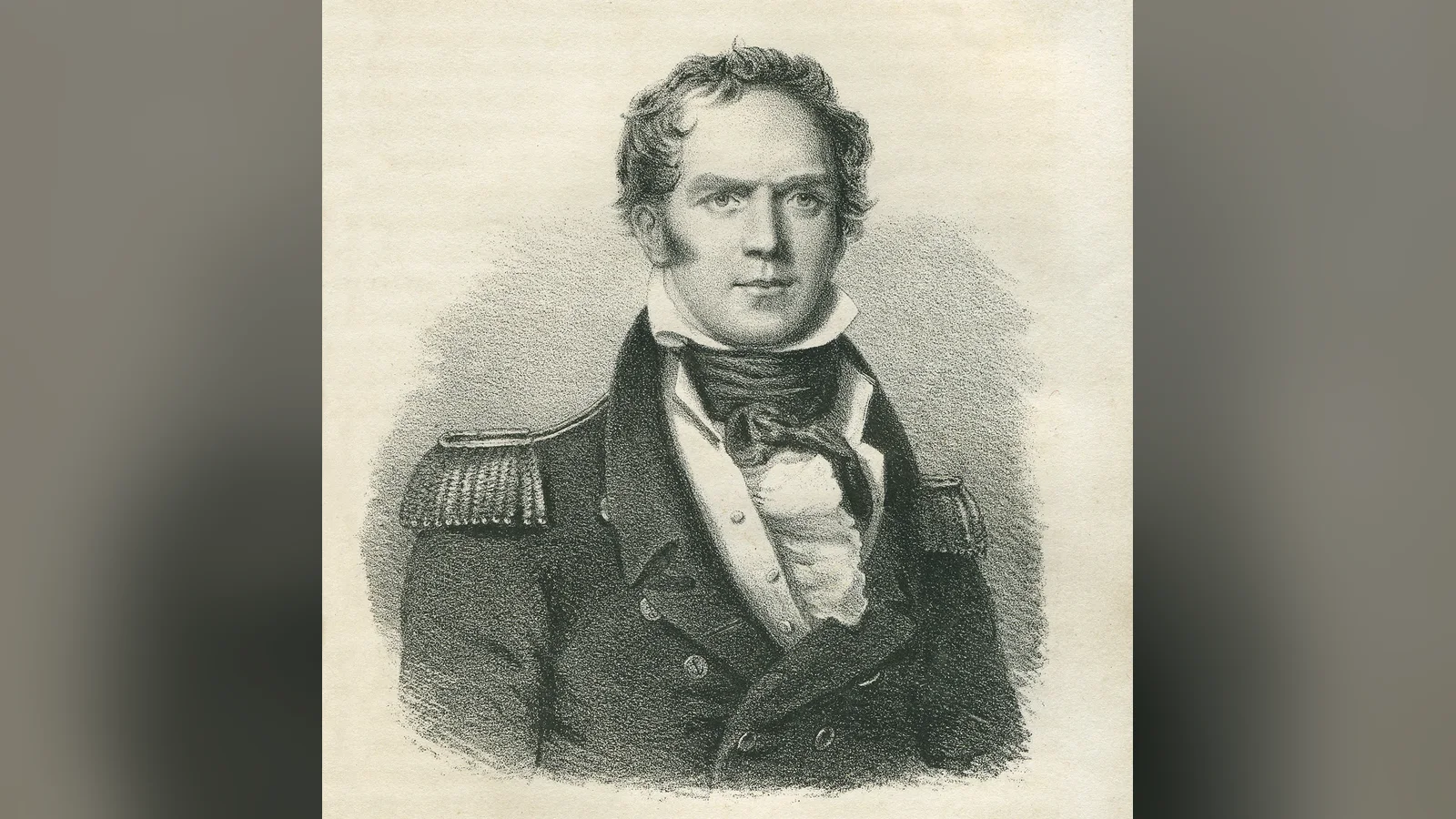

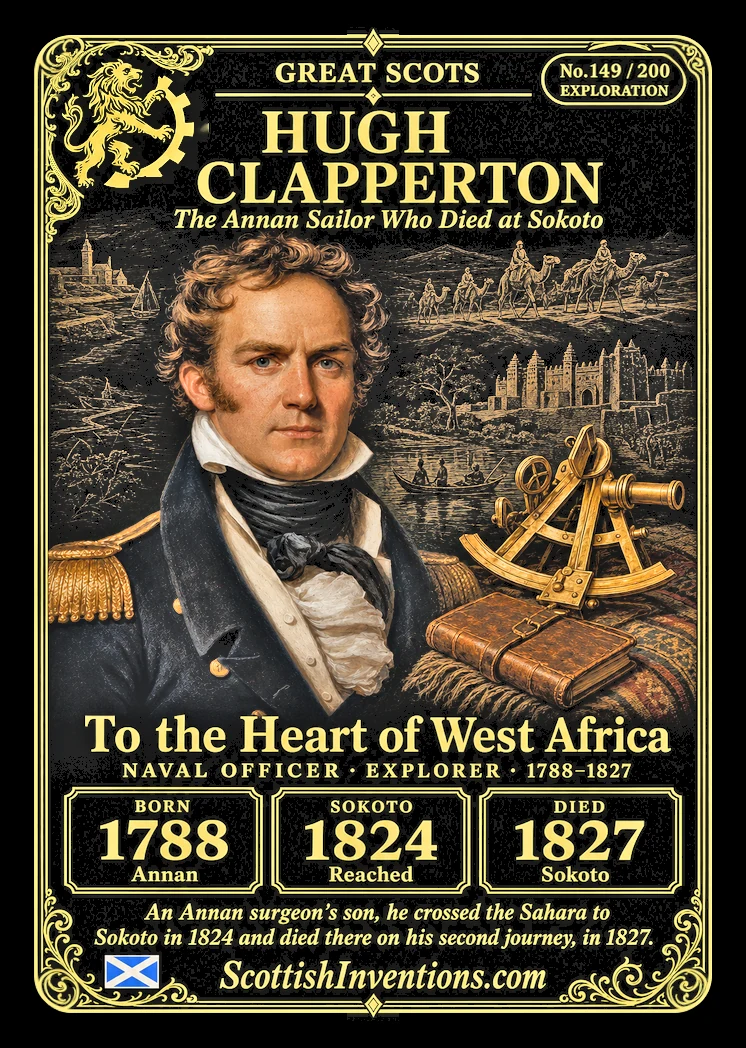
Hugh Clapperton (1788–1827): The Annan Sailor Who Died at Sokoto
Contents
Hugh Clapperton was the youngest son of an Annan surgeon. He went to sea at thirteen, was pressed into the Navy, survived a swamped boat in a gale and, in a Canadian winter, carried a dying boy across a frozen lake until he lost part of his thumb to frost. In 1824, on his first expedition, he became the first British visitor to Sokoto, capital of the Sultan Muhammad Bello. The next year he was sent back from the Guinea coast to open trade with Bello and end the slave trade from his lands. He walked north from Badagry through Oyo, reached Bussa, where Mungo Park had died, and recovered an eyewitness account of Park's death. At Sokoto the welcome turned to suspicion. Clapperton died there on 13 April 1827, and was buried by his servant, Richard Lander.
TL;DR
- established Born at Annan in 1788, the youngest of six sons of George Clapperton, surgeon, by his first marriage. He was taught navigation by a local mathematics master and apprenticed to a ship in the Liverpool–North America trade at about thirteen.
- established Pressed into the Royal Navy, he became a midshipman on the Renommée in 1806 and served in the East Indies and, from 1814, on the Canadian lakes, where his lieutenant's commission was confirmed in 1816.
- established In 1820 he joined Dr Walter Oudney's mission to the interior of Africa. On that journey he reached Sokoto in 1824, where Sultan Bello asked for trade and a British consul.
- established On his second expedition he landed at Badagry on 29 November 1825 and set out on 7 December. His companions Captain Pearce and Dr Morrison died within weeks. He reached Kano on 20 July 1826 and Sokoto later that year.
- established Bello, at war with Bornu, treated him as a spy and seized the presents meant for its ruler. Clapperton died of dysentery and fever on 13 April 1827; Lander buried him near Sokoto and brought his journal home.
Key Facts
- Born
- 1788, Annan, Dumfriesshire
- Family
- Son of George Clapperton, surgeon, of Annan; grandson of Robert Clapperton, M.D., of Lochmaben
- Navy
- Midshipman from 1806; lieutenant, confirmed 1816; commander, 22 June 1825
- First expedition
- With Dr Walter Oudney and Dixon Denham, 1822–25; Sokoto, 1824
- Second expedition
- Badagry to Sokoto, December 1825 to April 1827
- Died
- 13 April 1827, Sokoto, aged about 38
- Servant
- Richard Lander, who buried him and brought the journal home
- Related cards
- Great Scots 79, Mungo Park
- Main source
- Hugh Clapperton, Journal of a Second Expedition into the Interior of Africa, from the Bight of Benin to Soccatoo, with Lander's journal and a life by Lieut.-Col. Clapperton (John Murray, London, 1829)
Scottish Impact Index (SI Score)
- Global Influence
- 4/10
- Enduring Relevance
- 6/10
- Material Contribution
- 3/10
- Exceptional Achievement
- 6/10
- Lasting Legacy
- 4/10
- Recognition
- 2/10
25/60
Ranked =132nd of 179 in Great Scots
A Note on Claims and Evidence
Each major claim carries one of three labels. established means supported by primary records, official bodies or several independent reliable sources. shared means the core fact is sound but sources disagree on details, dates or interpretation. traditional means widely repeated but not traceable to a primary or independent source.
The book has three parts. The short life is by Clapperton's uncle, a retired officer of marines, and is affectionate and anecdotal. The unsigned introduction was written by the editors for the Colonial Office. The journal is Clapperton's own day-to-day record, sent home by Lander, and is followed by Lander's account of his master's death and his own journey back to the coast.
The journal sees West Africa through the eyes of a British naval officer of the 1820s, and its spellings are those of the time: Soccatoo for Sokoto, Eyeo or Katunga for Oyo, Boussa for Bussa, the Quorra for the Niger, Fellatas for the Fulani.
Timeline
Born at Annan.
Apprenticed to a Liverpool ship trading to North America.
Made a midshipman on the frigate Renommée.
Joins the Clorinde in the East Indies.
Serves on the Canadian lakes.
Returns to Britain on half-pay; lives at Lochmaben from 1818.
Meets Dr Walter Oudney in Edinburgh and joins the mission to Africa.
Reaches Sokoto on the first expedition.
Promoted commander.
Sails from Portsmouth in HMS Brazen.
Lands at Badagry.
Begins the journey inland.
Reaches Oyo, then Bussa on the Niger.
Arrives at Kano.
Dies at Sokoto.
The Journal is published.
Details
Annan and the sea
established Clapperton's grandfather was a doctor at Lochmaben, and his father, George, was for a long time the only surgeon of note in Annan; he fathered twenty-one children by two wives. Hugh, the youngest son of the first marriage, had no classical education. A local mathematician, Bryce Downie, taught him navigation and trigonometry, and at about thirteen he was apprenticed to a ship trading between Liverpool and North America.
established Pressed into the Navy at Liverpool, he was at Gibraltar in 1806 when his uncle, a captain of marines, persuaded Sir Thomas Livingston of the Renommée to make him a midshipman. On the voyage to the East Indies he was one of only two men to survive when a boat sent to a ship in distress was swamped in a gale; his uncle records him telling the other survivor, "Thank God, I am not the Jonah!" In Bombay in 1812 he nursed his friend the Hon. F. Mackenzie, son of Lord Seaforth, until Mackenzie died.
The lakes
shared From 1814 Clapperton served on the Canadian lakes. His uncle tells how, his blockhouse destroyed by an American schooner, he led his men across the ice in midwinter rather than surrender, carrying a boy on his back until the boy died of cold; the frost cost Clapperton the first joint of his thumb. He grew fond of the forest and its Indigenous people, and for a time thought of leaving the Navy to live there. His commission as lieutenant was confirmed in 1816, and in 1817 he came home on half-pay.
To Africa
established Living at Lochmaben, he met Dr Walter Oudney in Edinburgh in 1820 and asked to go with him on a government mission to the interior of Africa. Before leaving he was introduced by Lady Seaforth to Henry Mackenzie, the author of The Man of Feeling. On that first expedition Clapperton reached Sokoto in 1824. The Sultan, Muhammad Bello, son of the jihad leader Usman dan Fodio, welcomed him and, according to the introduction, asked for British goods, a consul and a physician, and agreed to stop his subjects selling slaves to foreigners. He sent a letter in Arabic to the King.
The second expedition
established Lord Bathurst sent Clapperton back by the Guinea coast to make the agreement work. With Captain Pearce, Dr Morrison and Dr Dickson, he sailed in HMS Brazen on 27 August 1825. Nobody on the coast had heard of the ports Bello had named, so on the advice of a trader, Houtson, they landed at Badagry on 29 November and set off inland on 7 December. Pearce and Morrison died of fever within weeks; Dickson, who went alone by Dahomey, was never heard of again.
established Clapperton and Lander went on through the Yoruba kingdom to its capital, Oyo (Katunga), and then to Bussa on the Niger. There a man who had seen it told him how Park's boat had come down the river at the time the Fulani first rose in arms, and how the ruler of Bussa, taking the white men for the advance guard of Usman dan Fodio's army, had them attacked and killed. Clapperton tried to buy Park's books, one of which, he heard, had been carried off as a charm against musket balls.
Sokoto
established Clapperton reached Kano on 20 July 1826 and went on to Bello's camp and Sokoto, leaving Lander at Kano with the presents for the Sheikh of Bornu. Bello was at war with Bornu. When Clapperton asked to go there, Bello had Lander brought to Sokoto with all the baggage, demanded the Sheikh's letters, and said he had been told the British were spies. When his men seized the presents and spare arms, Clapperton told them, "If I do lose it, it is for the rights of my country."
established Clapperton fell ill with dysentery on about 12 March 1827 and died on 13 April, after thirty-six days. Lander buried him the same afternoon at a village near Sokoto "according to the rites of the church of England", with only five local men to help dig the grave. Lander then made his way back to the coast with the journal.
Did You Know?
- Clapperton's father had twenty-one children.
- He lost part of his thumb to frostbite in Canada carrying a dying boy across the ice.
- He swam back to his ship after dinner parties ashore, until the night he nearly drowned.
- He heard an eyewitness account of Mungo Park's death at Bussa.
- His servant, Richard Lander, went on to trace the Niger to the sea.
FAQ
1Who was Hugh Clapperton?
A Scottish naval officer and explorer from Annan who reached Sokoto in 1824 and died there in 1827 on a second expedition.
2What was his first expedition?
The Bornu mission of 1822–25, with Dr Walter Oudney and Dixon Denham, during which he reached Sokoto.
3How did he die?
Of dysentery and fever, at Sokoto, on 13 April 1827.
4What is his connection to Mungo Park?
At Bussa he collected an eyewitness account of how Park and his companions were killed there.
Sources and Further Reading
Primary
- Hugh Clapperton, Journal of a Second Expedition into the Interior of Africa, from the Bight of Benin to Soccatoo, with the journal of Richard Lander and a short life by Lieut.-Col. Clapperton (John Murray, London, 1829). Free scan at the Internet Archive. The source for this story.
Further reading (not consulted directly)
- Dixon Denham, Hugh Clapperton and Walter Oudney, Narrative of Travels and Discoveries in Northern and Central Africa (John Murray, 1826), on the first expedition.
- Jamie Bruce Lockhart and Paul E. Lovejoy (eds), Hugh Clapperton into the Interior of Africa: Records of the Second Expedition, 1825–1827 (Brill, 2005).
Caveats: Myths and Disputed Claims
- The ice crossing. The uncle's story names Lake Huron, Lake Michigan and York in a way that does not fit the geography; the details are family tradition.
- Bello's promises. The editors suspected Clapperton had misunderstood Bello, though Bello's own letter supports Clapperton's account.
- The grave. The uncle places it four miles south-east of Sokoto at "Chungary"; Lander's letter says five miles east, at "Jungavie".
Finished reading? Try the Fact Machine: three reels, one surprising Scottish connection →
Card 149 · Great Scots