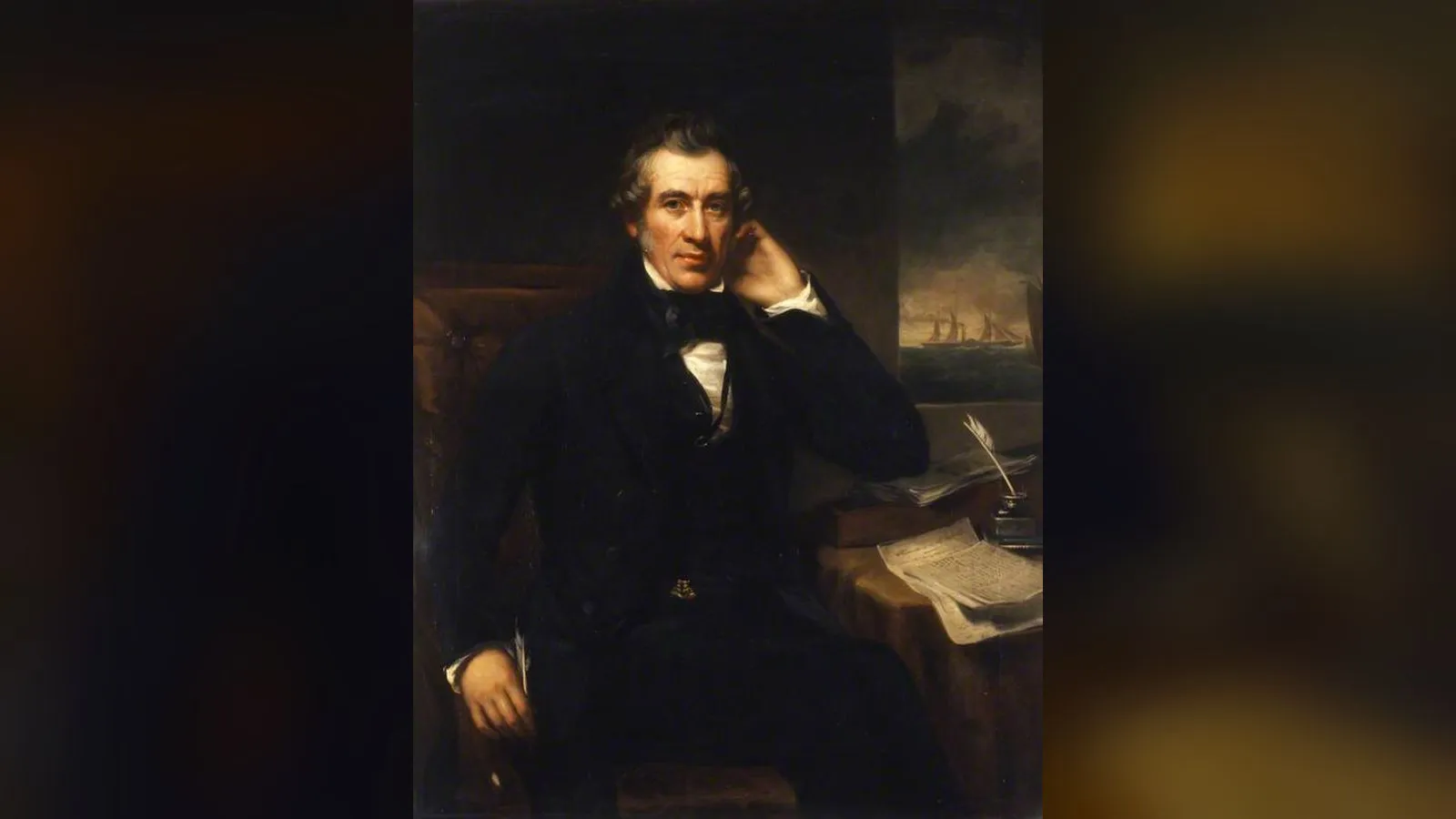

Sir William Fairbairn (1789–1874): The Engineer Who Tested Everything
Contents
TL;DR
- Established/Documented: William Fairbairn built one of the most varied and substantial engineering careers of the Victorian era, spanning mill construction, structural iron design, shipbuilding, locomotive manufacture, and pioneering boiler safety and metal fatigue research, and was honoured with a baronetcy, a Royal Society Gold Medal, and the presidency of the Institution of Mechanical Engineers.
- Documented/Disputed: Fairbairn is credited by some modern accounts, and claimed for himself in an 1849 publication, as the true originator of the rectangular box-girder ("tube") design used for Robert Stephenson's celebrated Britannia and Conwy bridges — a claim that led to a real and documented rift between the two men, after Stephenson and his associate Edwin Clark's own official, more widely circulated account gave Fairbairn only minimal credit.
- Established/Documented: Fairbairn advised Robert Stephenson directly against using cast-iron trussed girders for the River Dee railway bridge at Chester; Stephenson did not follow this advice, and the bridge collapsed in May 1847, killing five people — a documented case in which Fairbairn's engineering judgment was vindicated by a fatal disaster involving one of the era's most celebrated engineers.
- Established/Documented: Fairbairn's later career was defined by genuinely pioneering, methodical safety research rather than single inventions — including his 1854 founding of the Manchester Steam Users' Association to establish national boiler safety standards, and his landmark 1861 experiments demonstrating metal fatigue by mechanically loading and unloading a wrought-iron cylinder three million times.
- Established/Documented: Despite being offered a knighthood in 1861, which he declined, Fairbairn eventually accepted a baronetcy in 1869, and his funeral in 1874 was attended by an estimated 50,000 to 70,000 people — a scale of public mourning reflecting his status as one of the most respected engineers of his generation.
Key Facts
- Born
- 19 February 1789, Kelso, Roxburghshire, Scotland
- Died
- 18 August 1874, Moor Park, Farnham, Surrey, England (aged 85)
- Occupation
- Mechanical and structural engineer, shipbuilder, manufacturer
- Known for
- Structural iron engineering, the Britannia and Conwy tubular bridges, boiler safety research, pioneering metal fatigue testing
- Key achievement
- Establishing systematic, experimentally grounded engineering safety practice — testing structures and materials to destruction rather than relying on theory or precedent alone
- Notable relationships
- Business partner James Lillie; collaborators Robert Stephenson and Eaton Hodgkinson (Britannia Bridge); childhood friend George Stephenson
- Honours
- Fellow of the Royal Society (1850; Royal Medal 1860); President, Institution of Mechanical Engineers (1854–55); Baronet of Ardwick (1869)
- Legacy
- Statue in Manchester Town Hall; founder of the Manchester Steam Users' Association; inducted into the Scottish Engineering Hall of Fame (2017)
Scottish Impact Index (SI Score)
- Global Influence
- 6/10
- Enduring Relevance
- 8/10
- Material Contribution
- 6/10
- Exceptional Achievement
- 7/10
- Lasting Legacy
- 6/10
- Recognition
- 2/10
35/60
Ranked =62nd of 200 in Great Scots
A Note on Claims and Evidence
This article tiers claims by evidential strength. Established/Documented claims rest on multiple independent, well-corroborated sources. disputed claims involve genuine historical disagreement, often between contemporaries with competing interests in how credit was assigned. William Fairbairn's career offers a particularly clean example of a recurring theme in this series: a credit dispute between a celebrated "name" engineer (Stephenson) and the practical, experimentally-minded collaborator whose testing work actually solved the underlying engineering problem. This article treats Fairbairn's own claims with the same scrutiny it would apply to anyone else's, while also correcting the popular record's tendency to omit his role entirely.
Timeline
Born 19 February in Kelso, Roxburghshire, to a farming family.
Apprenticed as a millwright in Newcastle upon Tyne, where he befriends the young George Stephenson, father of Robert Stephenson.
Relocates to Manchester, working initially for Adam Parkinson and Thomas Hewes.
Establishes Fairbairn and Lillie, an engine and mill-machinery manufacturing business, with partner James Lillie.
Conducts systematic research with mathematician Eaton Hodgkinson into the optimal cross-sectional design of cast- and wrought-iron beams, producing the Water Street bridge for the Liverpool and Manchester Railway (1830).
Builds the iron paddle-steamer Lord Dundas in Manchester, an early venture into iron shipbuilding.
Relocates shipbuilding operations to Millwall, London, for better maritime access; over the following years constructs more than eighty vessels there, including the P&O steamer Pottinger and HMS Megaera, helping introduce iron shipbuilding to the River Thames.
Begins locomotive manufacturing with a 0-4-0 design for the Manchester & Bolton Railway.
Robert Stephenson engages Fairbairn and Hodgkinson as consultants on crossing the Menai Strait for the Chester and Holyhead Railway; Fairbairn conducts extensive prototype testing at his Millwall shipyard, developing the rectangular box-girder ("tube") concept and testing a 75-foot model.
Fairbairn advises Robert Stephenson against using trussed cast-iron girders for the River Dee railway bridge at Chester; Stephenson does not follow this advice.
The Conwy tubular bridge opens, the first practical application of the tube design. In May, the River Dee bridge collapses, killing five people, vindicating Fairbairn's earlier warning.
Fairbairn publishes An Account of the Construction of the Britannia and Conway Tubular Bridges, asserting his own central role in developing the tube design and reproducing correspondence with Stephenson to support his claim.
The Britannia Bridge opens across the Menai Strait, completed by Stephenson on 5 March. Stephenson's associate Edwin Clark subsequently publishes a lavish, officially sanctioned account of the bridge's construction that gives Fairbairn only minimal credit.
Develops the Lancashire boiler design (noted here out of strict chronological sequence as a defining technical contribution).
Retires from active shipbuilding operations.
Elected a Fellow of the Royal Society.
Founds the Manchester Steam Users' Association to establish standards for the safe operation of high-pressure boilers, following a series of fatal boiler explosions. Elected the third President of the Institution of Mechanical Engineers (1854–55).
Awarded the Royal Society's Royal Medal.
Declines an offered knighthood. Conducts landmark experiments, at the request of Parliament, on metal fatigue, subjecting a wrought-iron cylinder to three million loading and unloading cycles. Serves as President of the British Association.
Accepts a baronetcy, becoming Sir William Fairbairn, Baronet of Ardwick.
Dies at Moor Park, Farnham, Surrey, aged 85; buried at St Mary's Church, Prestwich, Manchester, with a funeral reportedly attended by 50,000 to 70,000 people.
Inducted into the Scottish Engineering Hall of Fame.
Details
From Kelso Farm Boy to Manchester Millwright
William Fairbairn's origins were modest and entirely Scottish: born in 1789 in Kelso, Roxburghshire, to a farming family, he showed early mechanical aptitude and was apprenticed as a millwright in Newcastle upon Tyne, where a formative friendship with the young George Stephenson began — a connection that would later place Fairbairn directly in the orbit of George's son Robert, with consequences for both men's reputations. Fairbairn moved to Manchester in 1813, initially working for established mill-engineering firms before establishing his own business, Fairbairn and Lillie, with partner James Lillie in 1817. This partnership built the technical and commercial foundation for what would become one of the most diversified engineering enterprises of the Victorian era.
A Career Built on Testing, Not Assumption
What distinguishes Fairbairn from many contemporaries celebrated for a single invention is the consistency of his underlying method across an unusually wide range of engineering domains: he tested things experimentally rather than relying primarily on established theory, precedent, or reputation. His extended collaboration with the mathematician Eaton Hodgkinson through the 1820s and 1830s into the optimal cross-sectional design of iron beams was genuinely systematic research, producing practical results such as the 1830 Water Street bridge for the Liverpool and Manchester Railway. This same experimental instinct would later define his most historically significant work.
Shipbuilding and Locomotives: The Breadth of a Working Engineer
Before the bridge work that made him most famous, Fairbairn had already built substantial, independent engineering credentials in entirely different fields. He constructed the iron paddle-steamer Lord Dundas in Manchester in 1830, then relocated his shipbuilding operations to Millwall on the Thames in 1834–35 to access better maritime facilities, where his yard built more than eighty vessels over the following years, including the P&O steamer Pottinger and the Royal Navy's HMS Megaera — work that meaningfully helped establish iron shipbuilding on the Thames. From 1839 he also built locomotives, and by 1862 his company had constructed over 400 for major railway companies including the Great Western and London & North Western Railways. This breadth matters for assessing his later, better-known bridge work: Fairbairn arrived at the Menai Strait problem not as a theorist but as a manufacturer with direct, extensive practical experience in exactly the kind of large-scale wrought-iron fabrication the tubular bridge design would require.
The Britannia Bridge and a Genuine Credit Dispute
In the mid-1840s, Robert Stephenson — already one of Britain's most celebrated engineers, son of the railway pioneer George Stephenson — engaged Fairbairn and Eaton Hodgkinson as consultants on the formidable problem of crossing the Menai Strait for the Chester and Holyhead Railway, where Admiralty requirements for shipping clearance ruled out conventional low-arch designs. The solution that emerged — massive rectangular wrought-iron box girders, or "tubes," through which trains would run, rather than over a structure supported from below or above — is popularly remembered as Stephenson's conception.
The documented historical record is more contested than that popular memory suggests. Fairbairn conducted extensive, hands-on prototype testing at his own Millwall shipyard, building and testing a 75-foot model that became the practical basis for the final design, and it was substantially his experimental work — including his development of cellular-top construction and side-panel stiffening — that resolved a genuine technical dispute with Hodgkinson, whose purely theoretical calculations suggested impractically thick top plates and recommended auxiliary support chains. Fairbairn's practical results demonstrated the tube could meet the required strength "with perfect security" without chains, and after observing these experiments, Stephenson agreed; no chains were ultimately fitted to either bridge. This is, on the documented record, a case where Fairbairn's applied testing work directly overturned the more theoretically prestigious calculation and shaped the bridge's final, historically celebrated form.
Fairbairn, evidently aware that his contribution risked being erased from the public record, published his own account in 1849 — An Account of the Construction of the Britannia and Conway Tubular Bridges — reproducing correspondence between himself and Stephenson intended to document how the tube concept had actually developed, "mostly as a result of Fairbairn's tests and calculations," in the words of one modern assessment. The following year, Stephenson's associate Edwin Clark published a far more lavish, officially sanctioned account, illustrated with tinted lithographs, that gave Fairbairn only minimal mention. The dispute appears to have had an earlier root as well: Fairbairn had directly advised Stephenson against a separate design choice — cast-iron trussed girders for the River Dee bridge at Chester — advice Stephenson did not take, with fatal consequences discussed below, a disagreement some historians suggest may have further soured what had already become a contested professional relationship. This article treats Fairbairn's priority claim as genuinely disputed rather than settled in his favour, while noting plainly that the documented balance of experimental contribution does not support the popular version in which Stephenson is sole author of the tube concept.
Vindicated by Disaster: The Dee Bridge Collapse
One of the more striking, and less comfortable, episodes in Fairbairn's career is his direct, documented warning to Robert Stephenson against using trussed cast-iron girders for the River Dee railway bridge at Chester, given in 1846. Stephenson did not follow this advice. In May 1847, the Dee Bridge collapsed as a train crossed it, killing five people — a disaster that vindicated Fairbairn's engineering judgment in the starkest possible terms, and one that this series treats with the same seriousness given to comparable structural failures elsewhere (see the entries on Thomas Telford and Sir William Arrol). It reflects well on Fairbairn's professional rigor that his objection was specific and, in hindsight, correct; it says something less flattering about the era's engineering culture that a celebrated engineer's design proceeded despite a documented warning from a credible colleague, and that it took five deaths to force the wider profession to reconsider cast-iron girder practice.
Boiler Safety and the Birth of Systematic Failure Investigation
Fairbairn became one of the first engineers to conduct genuinely systematic investigations of structural and mechanical failures, rather than treating each disaster as an isolated, unrelated event. He investigated the collapse of a textile mill at Oldham, tracing it to poor cast-iron girder design practices, and turned similarly rigorous attention to the recurring problem of boiler explosions, a significant cause of industrial death and injury in mid-19th-century Britain. In 1854, in direct response to this ongoing hazard, he founded the Manchester Steam Users' Association, an organisation explicitly dedicated to establishing inspection standards and safety practice for high-pressure boilers — an early and genuinely influential model for what would become modern industrial safety regulation. His technical contributions in this area were substantial in their own right: he developed the Lancashire boiler in 1844, and later, working with Beeley, designed multi-tube boiler configurations that replaced earlier single large-diameter shells, informed by his own experimental work — including glass-cylinder experiments demonstrating that hoop stress in a pressurised cylinder wall was twice the longitudinal stress, a finding with direct practical implications for boiler design safety margins.
The 1861 Metal Fatigue Experiments
Among Fairbairn's most historically significant contributions, conducted late in his career at the direct request of Parliament, was his 1861 research into metal fatigue — the tendency of metal structures to fail under repeated stress cycling well below the load that would cause immediate failure. His method was characteristically direct and experimental: he mechanically raised and lowered a three-tonne mass onto a wrought-iron cylinder some three million times, systematically documenting the point and manner of eventual failure. This was genuinely pioneering work in a field — metal fatigue — that would go on to have enormous practical significance for railway, bridge, and later aviation engineering, and it exemplifies the consistent thread running through Fairbairn's entire career: a preference for exhaustive empirical testing over assumption, applied with equal rigor to mill beams, boiler cylinders, and bridge girders alike.
Honours and Public Standing
Fairbairn's professional standing was formally and substantially recognised during his lifetime. He was elected a Fellow of the Royal Society in 1850 and received its Royal Medal in 1860; he served as the third President of the Institution of Mechanical Engineers (1854–55), succeeding the Stephensons in that role — a detail worth noting given the earlier credit dispute — and later served as President of the British Association in 1861. He was offered a knighthood in 1861 but declined it, before eventually accepting a baronetcy in 1869, becoming Sir William Fairbairn, Baronet of Ardwick.
Death and Legacy
Fairbairn died on 18 August 1874 at Moor Park, Farnham, Surrey, at the age of 85, and was buried at St Mary's Church, Prestwich, Manchester. His funeral reportedly drew between 50,000 and 70,000 attendees, a scale of public mourning that reflects the genuine breadth of his standing across Manchester's industrial and civic life — recognition for a career that touched textile mills, ships, locomotives, bridges, and boiler safety alike. A statue commemorates him in Manchester Town Hall, and he was posthumously inducted into the Scottish Engineering Hall of Fame in 2017, formally reclaiming him for the country of his birth more than 140 years after his death. His most lasting legacy may be less any single structure than the method he consistently applied to all of them: the conviction that an engineer's confidence in a design should rest on what testing actually demonstrated, not on theory, precedent, or reputation alone — a conviction that, in the case of the River Dee bridge, he held even when a far more famous contemporary chose not to listen.
Did You Know?
- William Fairbairn was a childhood friend of George Stephenson, father of Robert Stephenson, with whom Fairbairn would later have a significant and disputed professional collaboration on the Britannia Bridge.
- Fairbairn's shipyard at Millwall built more than eighty vessels and helped establish iron shipbuilding on the River Thames, entirely separate from the bridge work for which he is now best remembered.
- Fairbairn directly warned Robert Stephenson against the cast-iron girder design used for the River Dee bridge at Chester; Stephenson proceeded anyway, and the bridge collapsed in 1847, killing five people.
- Fairbairn published his own 1849 account of the Britannia and Conwy bridges specifically to document his role in developing the tube design, after sensing his contribution was being minimised — a rare case of a Victorian engineer publicly contesting credit with a more famous collaborator.
- His 1861 metal fatigue experiments involved mechanically loading and unloading a wrought-iron cylinder three million times — a genuinely pioneering and labour-intensive piece of empirical research, conducted at Parliament's request.
- Fairbairn turned down a knighthood in 1861 but accepted a baronetcy eight years later in 1869.
- His funeral in 1874 was attended by an estimated 50,000 to 70,000 people — a scale of public mourning reflecting his standing across Manchester's industrial community.
- Despite his deep roots in Manchester's industrial life, Fairbairn was only inducted into the Scottish Engineering Hall of Fame in 2017, formally recognising his Scottish origins more than a century after his death.
Frequently Asked Questions
1Did William Fairbairn design the Britannia Bridge?
Not solely, and the credit is genuinely disputed. Robert Stephenson is popularly and officially credited as the bridge's designer, but Fairbairn conducted the extensive experimental testing — including a full 75-foot working model — that developed and validated the rectangular tube design actually used, overturning more pessimistic theoretical calculations by Eaton Hodgkinson. Fairbairn himself argued in an 1849 publication that his contribution had been understated in Stephenson's own official account.
2What was the dispute between Fairbairn and Stephenson about?
Primarily credit for developing the tubular ("box girder") bridge design. Fairbairn's practical testing work was central to the design's final form, but the officially sanctioned 1850 account of the bridges' construction, published by Stephenson's associate Edwin Clark, gave Fairbairn only minimal mention, prompting Fairbairn's own earlier 1849 account asserting his role more fully.
3Was Fairbairn right to warn against the Dee Bridge design?
Yes, and tragically so. He advised Robert Stephenson against using trussed cast-iron girders for the River Dee bridge at Chester in 1846; Stephenson did not follow this advice, and the bridge collapsed in May 1847, killing five people.
4What did Fairbairn actually invent or develop, beyond the bridge testing work?
A genuinely wide range of contributions: the Lancashire boiler design (1844), significant advances in multi-tube boiler design informed by his own pressure experiments, and landmark 1861 research into metal fatigue using repeated mechanical load cycling — alongside a substantial earlier career in shipbuilding and locomotive manufacture.
5Why did Fairbairn found the Manchester Steam Users' Association?
In response to the serious and recurring hazard of boiler explosions in mid-19th-century industrial Britain. Founded in 1854, it established inspection standards and safety practices for high-pressure boilers, representing an early and influential model of systematic industrial safety regulation.
6Was Fairbairn Scottish or English?
Scottish by birth — he was born in Kelso, Roxburghshire, in 1789 — though he built his entire working career in England, primarily in Manchester and London, which may explain why his Scottish origins have sometimes been overlooked in popular accounts of his career.
7What were Fairbairn's metal fatigue experiments, and why do they matter?
In 1861, at Parliament's request, Fairbairn subjected a wrought-iron cylinder to three million cycles of mechanical loading and unloading to study how metal fails under repeated stress well below its immediate breaking point. This research was genuinely pioneering in a field — metal fatigue — that would later prove critically important to railway, bridge, and aviation engineering safety.
8Did Fairbairn accept any honours for his work?
Yes. He was elected a Fellow of the Royal Society in 1850, received its Royal Medal in 1860, served as President of both the Institution of Mechanical Engineers and the British Association, declined a knighthood in 1861, and accepted a baronetcy in 1869.
9Where is William Fairbairn buried?
At St Mary's Church, Prestwich, Manchester, following his death at Moor Park, Farnham, Surrey, on 18 August 1874.
10How is William Fairbairn remembered today?
Through a statue in Manchester Town Hall, his 2017 induction into the Scottish Engineering Hall of Fame, and his lasting technical legacy in boiler safety standards, structural failure investigation methodology, and metal fatigue research — a body of work whose practical influence on engineering safety arguably exceeds that of any single named structure associated with him.
Sources and Further Reading
Primary / Institutional
- William Fairbairn, An Account of the Construction of the Britannia and Conway Tubular Bridges (1849)
- Edwin Clark, official account of the Britannia and Conwy bridges' construction (1850)
- Institution of Mechanical Engineers: presidential records
- Records of the Manchester Steam Users' Association, founded 1854
Scholarly / Reference
- Wikipedia: "William Fairbairn"
- Wikipedia: "Britannia Bridge"
- Wikipedia: "Tubular bridge"
- Wikipedia: "Conwy Railway Bridge"
- Britannica: "William Fairbairn"
- Linda Hall Library: "William Fairbairn" (Scientist of the Day)
- Dictionary of National Biography (1885–1900): "Fairbairn, William"
General / Popular
Caveats: Myths and Disputed Claims
- "Robert Stephenson alone designed the tubular bridge concept." This is the popularly and officially credited version, but the documented record shows Fairbairn's experimental testing work was central to developing and validating the actual design used, and that Fairbairn himself directly and publicly contested being sidelined from that credit in his own 1849 publication. This article treats the question as genuinely disputed rather than settling it in either direction.
- "Fairbairn and Stephenson had a straightforward, harmonious collaboration." The documented correspondence and the existence of competing published accounts (Fairbairn's 1849 book versus Clark's more lavish, officially sanctioned 1850 account) indicate real tension over credit, compounded by an earlier disagreement over the Dee Bridge design.
- Fairbairn's Scottish origins are often overlooked. Because his entire working career was based in England, Fairbairn is sometimes treated in popular accounts as a purely English engineer, despite being born and raised in Kelso, Scotland — a gap only formally corrected by his 2017 induction into the Scottish Engineering Hall of Fame, well over a century after his death.
- The Dee Bridge disaster should not be read as diminishing Robert Stephenson's overall reputation without qualification, nor should it be read as proof that Fairbairn was infallible; it is presented here as a specific, well-documented instance in which Fairbairn's engineering judgment was borne out by events, not as a comprehensive verdict on either man's broader career.
Card 077 · Great Scots