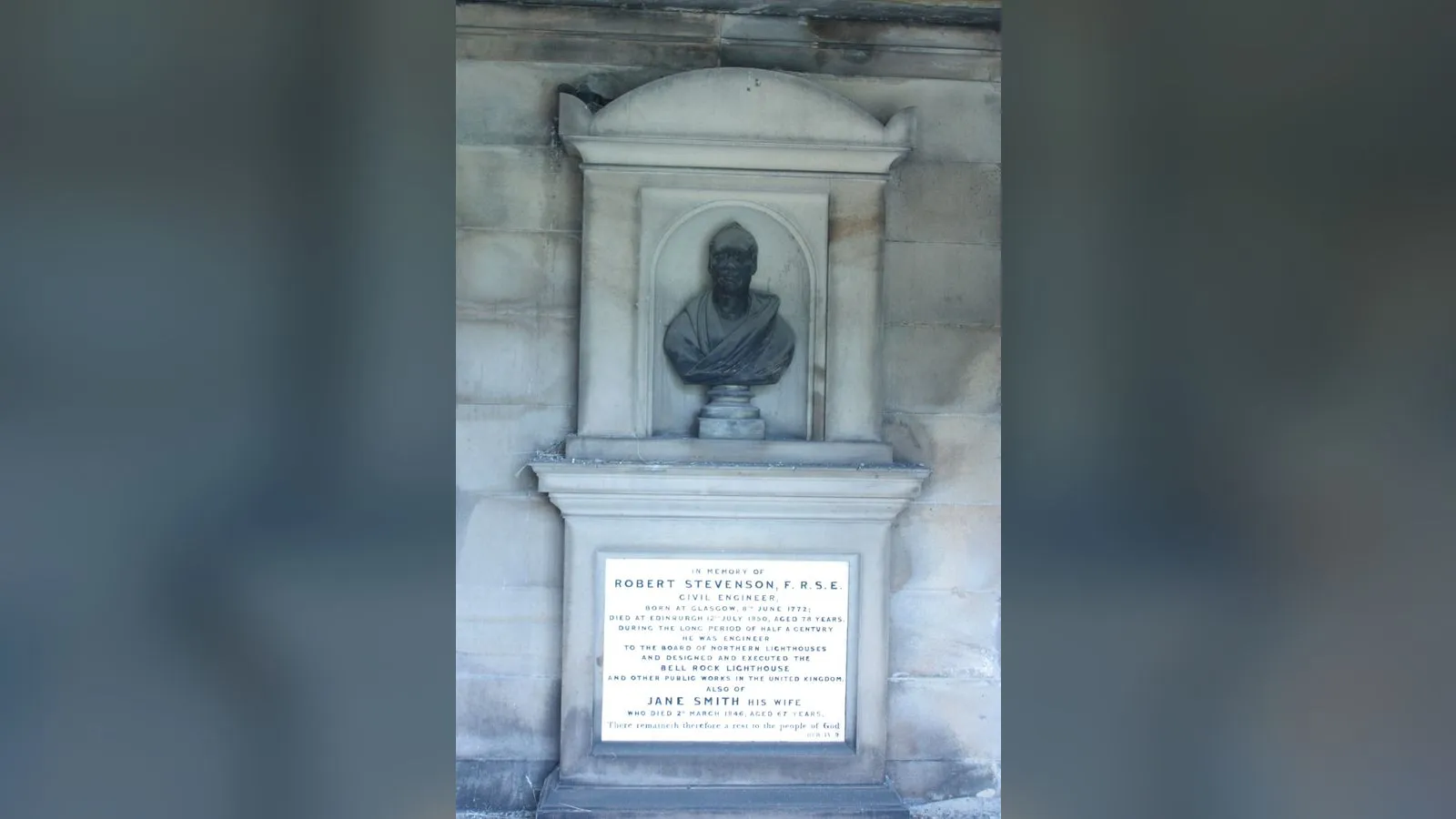

Robert Stevenson (1772–1850)
Contents
TL;DR
- Established/Documented: Stevenson designed and built the Bell Rock Lighthouse (1807–1810), constructed on a reef submerged under several metres of water twice daily some 18 kilometres off Arbroath — widely regarded as one of the greatest engineering achievements of its age, and still the world's oldest standing rock lighthouse today.
- Disputed/Documented — a genuine, careful credit question: The precise division of credit between Stevenson and the more senior engineer John Rennie, who was formally engaged as chief engineer to the Bell Rock project while Stevenson served as resident engineer overseeing construction on site, has been a point of real historical dispute — an account favourable to Rennie gained wide circulation through Victorian engineering writer Samuel Smiles's popular publications, but the Northern Lighthouse Board's own contemporary records gave full credit to Stevenson, a position most subsequent historians have accepted; this card presents both men's documented roles rather than resolving the question with false simplicity in either direction.
- Established/Documented: Stevenson personally escaped near-certain death on at least two separate occasions during his lighthouse career — once in 1794, when he disembarked a sloop shortly before it was wrecked in a gale that drowned everyone left aboard, and again during Bell Rock's construction itself, when his work party's boats drifted away and rising water threatened to submerge the rock before a passing mail boat happened to arrive and rescue the stranded men.
- Established/Documented: Stevenson founded a genuine multi-generational engineering dynasty — his sons Alan, David, and Thomas all became lighthouse engineers in their own right, continuing the family's work for the Northern Lighthouse Board for decades — and his grandson, Thomas's son, was Robert Louis Stevenson, the novelist behind Treasure Island and Strange Case of Dr Jekyll and Mr Hyde, who grew up steeped in the family's engineering world before choosing literature instead.
- Established/Documented: Three of Stevenson's own children died during the period of the Bell Rock Lighthouse's construction — a personal cost to the project's principal engineer that is rarely mentioned alongside the structure's celebrated engineering triumph, and one this card states directly rather than leaving out.
Key Facts
- Born
- 8 June 1772, Glasgow, Scotland
- Died
- 12 July 1850, Edinburgh, Scotland (aged 78)
- Education
- Andersonian Institute, Glasgow (mathematics and physics); University of Edinburgh (philosophy, mathematics, chemistry, natural history — no formal degree completed)
- Known for
- Chief engineer, Bell Rock Lighthouse (1807–1810); Engineer to the Northern Lighthouse Board for nearly 50 years; founder of the Stevenson lighthouse engineering dynasty
- Key positions
- Engineer, Northern Lighthouse Board (1797–1842)
- Honours
- Fellow of the Royal Society of Edinburgh (1815); gold medal from King William I of the Netherlands
- Family
- Stepson and later business partner of engineer Thomas Smith; sons Alan, David, and Thomas Stevenson all became lighthouse engineers; grandfather of author Robert Louis Stevenson
Scottish Impact Index (SI Score)
- Global Influence
- 7/10
- Enduring Relevance
- 9/10
- Material Contribution
- 7/10
- Exceptional Achievement
- 7/10
- Lasting Legacy
- 8/10
- Recognition
- 4/10
42/60
Ranked =33rd of 200 in Great Scots
Claim-Status and Evidence Note
Claims are evidence-tiered as Established/Documented (settled by primary institutional records or broad scholarly consensus), Shared/Traditional (widely told and broadly accurate), disputed (credible sources genuinely differ), or Legend/Myth (unsupported and actively corrected here). The central point requiring careful, evidence-tiered treatment in Stevenson's story is the Bell Rock credit question: this card presents the documented roles of both Stevenson and John Rennie honestly, noting where a popular nineteenth-century account favoured Rennie while the primary institutional record and most subsequent historical scholarship support Stevenson as the project's true principal engineer.
Timeline
Born in Glasgow, son of Alan Stevenson, a merchant in the West Indies sugar trade.
His father dies of fever on the island of St Christopher (St Kitts) when Robert is not yet two, leaving his mother, Jean Lillie Stevenson, in reduced financial circumstances; Robert attends charity school as a child.
Aged fifteen, his mother remarries Thomas Smith, a tinsmith, lamp maker, and civil engineer recently appointed to the newly formed Northern Lighthouse Board — a decisive turning point that redirects Robert from an intended path toward the ministry into engineering apprenticeship under his stepfather.
Aged nineteen, supervises his first lighthouse construction project, on Little Cumbrae in the River Clyde, followed by further projects in Orkney.
Escapes death when he disembarks the sloop Elizabeth off Kinnaird Head shortly before it is wrecked in a gale, drowning all those who remained aboard.
Succeeds his stepfather Thomas Smith as engineer to the Northern Lighthouse Board.
Marries Jean Smith, his stepsister and Thomas Smith's eldest daughter; the same year, the warship HMS York strikes the Bell Rock reef, with the loss of all 491 crew — a disaster that intensifies pressure for a lighthouse on the rock.
Becomes a formal business partner of his stepfather Thomas Smith.
Parliament approves plans for the Bell Rock Lighthouse, following endorsement of the scheme by senior engineer John Rennie, who is engaged as chief engineer to the project.
Bell Rock Lighthouse constructed, with Stevenson serving as resident engineer overseeing on-site construction; during this period, three of Stevenson's own children die.
Bell Rock Lighthouse completed and lit.
Stevenson designs and builds numerous further lighthouses around the Scottish coast, including Toward Point (1812), Isle of May (1816), Corsewall (1817), Point of Ayre and Calf of Man (1818), and Sumburgh Head (1821), alongside broader civil engineering work on roads, bridges, harbours, and early railways.
Elected Fellow of the Royal Society of Edinburgh.
While inspecting lighthouses in the Outer Hebrides, receives a live Great Auk — among the last specimens of the species ever recorded in Britain before its extinction in the 1840s.
Publishes Account of the Bell Rock Lighthouse, which includes evidence of North Sea erosion of Britain's eastern coastline.
Retires as engineer to the Northern Lighthouse Board after nearly fifty years of service.
Dies in Edinburgh, aged 78; buried in the New Calton Burial Ground.
Details
From a fatherless childhood to a stepfather's engineering trade
Robert Stevenson's path into engineering began with genuine hardship. Born in Glasgow in 1772, he lost his father — a merchant in the West Indies sugar trade — to fever when he was not yet two years old, leaving his mother to raise him in reduced financial circumstances that required him to attend charity school. His mother initially hoped he would enter the ministry, and arranged for him to study under a notable Glasgow linguist accordingly. The decisive change in his life's direction came when Robert was fifteen: his mother remarried Thomas Smith, a tinsmith, lamp maker, and civil engineer who had recently been appointed to the newly formed Northern Lighthouse Board. This new stepfather redirected Robert entirely away from the ministry and into engineering apprenticeship, a career shift that would ultimately define not just Robert's own life but four subsequent generations of his family.
Stevenson's professional formation was unconventional but genuinely rigorous: during construction seasons he practised surveying and architectural drawing while attending mathematics and physics lectures at Glasgow's Andersonian Institute, and in winter he studied philosophy, mathematics, chemistry, natural history, moral philosophy, logic, and agriculture at the University of Edinburgh — though he never completed a formal degree, reportedly due to insufficient proficiency in classical languages, a requirement of the period's degree structure that had little bearing on his actual practical engineering competence. By nineteen he was already supervising lighthouse construction on his own, at Little Cumbrae in the River Clyde, followed by further Orkney projects, and in 1797 he succeeded his own stepfather as engineer to the Northern Lighthouse Board. In 1799 he married Jean Smith, Thomas Smith's eldest daughter and his own stepsister — a marriage that further cemented the family and business partnership that had already reshaped his career, and in 1800 Smith formally made him a business partner.
Two brushes with death before his greatest project
Stevenson's career as a lighthouse engineer necessarily involved real physical danger, and this card records two specific, documented episodes rather than treating his survival as incidental. In 1794, while working off Kinnaird Head, Stevenson disembarked the sloop Elizabeth shortly before it became becalmed and was subsequently wrecked in a gale — everyone who remained aboard drowned. He was, quite simply, fortunate to have left the vessel when he did. A second, even more dramatic brush with death occurred during the Bell Rock construction itself: his work party's boats drifted away from the rock while the men were still working on it, and with the tide rising and the reef itself entirely submerged twice daily, the stranded crew faced near-certain drowning before a pilot boat, arriving purely by chance to deliver mail, happened upon them and effected a rescue. These were not abstract occupational hazards; they were specific, documented near-misses that could easily have ended Stevenson's career, and his family's subsequent engineering dynasty, before the Bell Rock Lighthouse itself was ever built.
Bell Rock: a masterwork, and a credit question worth handling carefully
The Bell Rock Lighthouse, constructed between 1807 and 1810 on a reef roughly 18 kilometres off Arbroath that had claimed thousands of lives over the centuries and lay submerged under several metres of water twice every day, stands as Stevenson's defining achievement and one of the genuinely great feats of early nineteenth-century civil engineering. The structure required around 2,800 individually shaped blocks of sandstone and granite, quarried near Dundee and Aberdeen, positioned using an ingenious interlocking dovetail technique and secured with expanding oak trenails; construction could only take place during summer months, and initially only within a two-hour window at each low tide, until the team built a temporary beacon-house on stilts, connected by a timber bridge, that allowed work to continue through the tidal cycle. A single horse, remembered by name as "Bassey," hauled some 2,000 tons of materials from the ships to the shore work yard. The completed 36-metre lighthouse has survived storms, fire, and wartime damage largely unchanged since 1810, remaining the oldest standing rock lighthouse in the world; it was automated only in 1988.
The credit question surrounding this achievement deserves precise, careful treatment rather than a simple assertion in either direction. Following the catastrophic 1799 wreck of HMS York on the Bell Rock, with the loss of all 491 crew aboard, pressure mounted for a lighthouse to be built there. Stevenson himself had visited the rock and developed early plans, but the project's high projected cost and Stevenson's relative inexperience at that stage reportedly slowed initial progress; Parliament's eventual 1806 approval of the scheme followed the formal endorsement of the senior, already well-established engineer John Rennie, who was engaged as the project's chief engineer, with Stevenson serving in the distinct role of resident engineer overseeing the practical, day-to-day construction work on site. This is a genuine division of formal titles and responsibilities, not a later invention.
What makes this a documented historical controversy rather than a simple, settled division of labour is what happened to the story afterward: an account of the Bell Rock project favourable to Rennie's primacy gained considerable popular circulation through the widely read Victorian engineering writer Samuel Smiles, whose biographical works on great engineers shaped much of the Victorian public's understanding of the era's achievements. Against this, the Northern Lighthouse Board's own contemporary institutional records gave full credit for the project to Stevenson, and the great majority of subsequent professional and historical assessment has supported that institutional judgment — recognising that while Rennie's senior endorsement and design consultation were real and formally documented, the actual engineering execution, on-site problem-solving, and sustained leadership through years of genuinely hazardous construction were substantially Stevenson's own achievement. This card presents both documented sides rather than erasing Rennie's genuine, formal involvement, while noting clearly that the weight of institutional and subsequent historical evidence favours Stevenson as the project's true principal engineer.
A human cost rarely mentioned alongside the engineering triumph
One aspect of the Bell Rock story deserves to be stated plainly rather than left out of an otherwise celebratory account: three of Robert Stevenson's own children died during the years of the lighthouse's construction, 1807–1810. This detail sits uncomfortably alongside the narrative of engineering triumph that dominates most popular accounts of Bell Rock, and it belongs in any honest, complete account of what that period of Stevenson's life and career actually cost him personally, even as he was simultaneously engaged in one of the era's most celebrated engineering achievements.
A near-fifty-year career beyond Bell Rock
Bell Rock, however celebrated, was only the centrepiece of a lighthouse-building career that spanned nearly fifty years of service to the Northern Lighthouse Board, from 1797 until his retirement in 1842. Stevenson went on to design and build numerous further lighthouses around the Scottish coast — including Toward Point, the Isle of May, Corsewall, Point of Ayre, Calf of Man, and Sumburgh Head — and introduced significant technical innovations along the way: improved light source designs, sophisticated reflector systems, the adoption of Fresnel lenses, and rotation and shuttering mechanisms that gave each lighthouse its own distinctive flashing "character," allowing sailors to identify precisely which lighthouse they were observing at night — a genuinely important navigational safety innovation, recognised at the time with a gold medal from King William I of the Netherlands. He also invented the movable jib and balance crane used in lighthouse construction, and contributed to broader national infrastructure projects following the Battle of Waterloo, collaborating with major contemporaries including Thomas Telford (see our Great Scots card on Thomas Telford), Alexander Nimmo, and John Rennie on roads, bridges, harbours, canals, and early railway work; the pioneering railway engineer George Stephenson specifically credited Stevenson's early advocacy of malleable rather than cast-iron rails.
Stevenson's intellectual interests extended into natural history and science more broadly. In 1821, while inspecting lighthouses in the Outer Hebrides, he received a live Great Auk — a species that would become extinct within the following two decades, making the encounter a small but genuine footnote in the natural history of a vanished bird. His 1824 publication Account of the Bell Rock Lighthouse included observations providing early evidence of coastal erosion along Britain's eastern coast, work that anticipated later scientific study of the phenomenon. He was elected Fellow of the Royal Society of Edinburgh in 1815 and contributed articles to both the Encyclopædia Britannica and the Edinburgh Encyclopædia.
A dynasty that produced an engineer in every generation — and then a novelist
Robert Stevenson's most enduring legacy, beyond any individual structure, is the multi-generational engineering dynasty he founded. Three of his sons — Alan, David, and Thomas — all became lighthouse engineers in their own right, continuing the family's service to the Northern Lighthouse Board across further decades, a genuinely remarkable pattern of sustained family professional continuity in a single, highly specialised engineering discipline. His daughter Jane served as his personal secretary and illustrated his own published account of the Bell Rock Lighthouse, a direct and underappreciated contribution to the documentary record of her father's most famous achievement.
The family's most widely recognised name today, however, belongs not to an engineer but to a writer: Robert's son Thomas fathered Robert Louis Stevenson, the celebrated author of Treasure Island, Strange Case of Dr Jekyll and Mr Hyde, and Kidnapped. The younger Stevenson grew up steeped in his family's engineering world and was for a time expected to follow the family profession himself, before choosing literature instead — a divergence from four generations of lighthouse engineers that his own family reportedly found difficult to fully accept, though it produced one of Scotland's most globally celebrated literary figures in its place. The family's engineering achievements and this literary divergence are chronicled in Bella Bathurst's 1999 book The Lighthouse Stevensons, and in Robert Louis Stevenson's own posthumously published 1896 family history, Records of a Family of Engineers.
Later years, death, and a legacy built into Scotland's coastline
Stevenson lived out his final decades at Baxter's Place on Edinburgh's Leith Walk, remaining active in engineering consultation well into his later years even after his formal 1842 retirement from the Northern Lighthouse Board. He died in Edinburgh on 12 July 1850, aged 78, and was buried in the New Calton Burial Ground. His legacy is commemorated in numerous ways, including Stevenson College Edinburgh (founded 1970) and his 2016 induction into the Scottish Engineering Hall of Fame — but his most enduring and functional legacy remains the string of lighthouses, Bell Rock chief among them, that still guide ships along the Scottish coastline today, largely unchanged in their fundamental engineering from the structures he and his family built across the first half of the nineteenth century.
Did You Know
- Robert Stevenson escaped death twice during his lighthouse career: once in 1794, when he disembarked a sloop shortly before it was wrecked in a gale that drowned everyone left aboard, and again during Bell Rock's construction, when a chance-arriving mail boat rescued his stranded work party from rising tidal water.
- Three of Stevenson's own children died during the years of the Bell Rock Lighthouse's construction (1807–1810) — a personal cost rarely mentioned alongside the project's celebrated engineering success.
- The popular account crediting senior engineer John Rennie as the primary figure behind Bell Rock gained wide circulation through Victorian writer Samuel Smiles's publications — but the Northern Lighthouse Board's own contemporary records, and most subsequent historians, have credited Stevenson as the project's true principal engineer.
- A single horse, remembered by name as "Bassey," hauled roughly 2,000 tons of construction material for the Bell Rock Lighthouse from ships to the shore work yard.
- In 1821, while inspecting Outer Hebridean lighthouses, Stevenson received a live Great Auk — a species that would become extinct within roughly two decades.
- Stevenson founded a genuine multi-generational engineering dynasty: three of his sons all became lighthouse engineers, continuing the family's work for the Northern Lighthouse Board across further decades.
- His grandson was Robert Louis Stevenson, author of Treasure Island and Strange Case of Dr Jekyll and Mr Hyde — a literary career that broke with four generations of family engineering tradition.
- The Bell Rock Lighthouse, completed in 1811, remains the world's oldest standing rock lighthouse and was only automated in 1988, nearly 180 years after its construction.
FAQ
1Who actually gets credit for the Bell Rock Lighthouse — Robert Stevenson or John Rennie?
This is a genuine point of documented historical dispute. Rennie, as the more senior, formally engaged chief engineer, provided design endorsement and consultation; Stevenson, as resident engineer, led the actual on-site construction over several hazardous years. A popular nineteenth-century account favoured Rennie, but the Northern Lighthouse Board's own contemporary records credited Stevenson, and most subsequent historians have agreed with that institutional judgment.
2Why was the Bell Rock Lighthouse such a difficult engineering challenge?
The reef it stands on is submerged under several metres of water twice daily, meaning construction could only occur during brief low-tide windows in summer months, until Stevenson's team built a temporary beacon-house on stilts to allow continued work through the tidal cycle.
3Was Robert Stevenson related to the author Robert Louis Stevenson?
Yes — Robert Stevenson was Robert Louis Stevenson's grandfather. Robert's son Thomas, himself a lighthouse engineer, was the novelist's father.
4Did all of Robert Stevenson's children follow him into engineering?
Three of his sons — Alan, David, and Thomas — became lighthouse engineers, continuing the family's work for the Northern Lighthouse Board. His daughter Jane worked directly alongside him as his secretary and illustrated his published account of Bell Rock.
5What happened to Robert Stevenson's children during the Bell Rock construction?
Three of his children died during the years the lighthouse was being built (1807–1810) — a personal tragedy that occurred alongside, but is rarely mentioned in connection with, the project's celebrated engineering success.
6What other lighthouses did Stevenson build besides Bell Rock?
Many more across the Scottish coast, including Toward Point, the Isle of May, Corsewall, Point of Ayre, Calf of Man, and Sumburgh Head, among others, over his nearly fifty-year career with the Northern Lighthouse Board.
7What engineering innovations is Stevenson credited with beyond lighthouse construction itself?
Improved light and reflector systems, adoption of Fresnel lenses, rotating/shuttering mechanisms giving each lighthouse a distinctive identifying light pattern, the movable jib and balance crane for construction work, and early advocacy for malleable rather than cast-iron railway rails.
8How long did Stevenson work for the Northern Lighthouse Board?
Nearly fifty years, from 1797, when he succeeded his stepfather Thomas Smith, until his retirement in 1842.
9Where is Robert Stevenson buried?
In the New Calton Burial Ground, Edinburgh.
10Is there a book specifically about the Stevenson family's engineering legacy?
Yes — Bella Bathurst's 1999 book The Lighthouse Stevensons chronicles the family's multi-generational engineering achievements, and Robert Louis Stevenson himself wrote a posthumously published family history, Records of a Family of Engineers (1896).
Sources and Further Reading
Primary/Institutional
- Historic Environment Scotland, commemorative plaque record, "Robert Stevenson"
- National Library of Scotland, "Robert Stevenson and the Building of Bell Rock Lighthouse"
- Robert Stevenson, Account of the Bell Rock Lighthouse (1824)
Scholarly
- Bella Bathurst, The Lighthouse Stevensons (1999)
- Robert Louis Stevenson, Records of a Family of Engineers (1896, posthumous)
- Linda Hall Library, "Scientist of the Day: Robert Stevenson"
General
- Encyclopaedia Britannica, "Robert Stevenson"
- The Courier, "Robert Stevenson: Father of Scottish Lighthouses Had 'Obsession' with the Bell Rock"
- Wikipedia, "Robert Stevenson (civil engineer)" and "Bell Rock Lighthouse"
Caveats: Myths and Disputed Claims
The central point of care in this card is the Bell Rock credit question between Stevenson and John Rennie. This card does not simply assert Stevenson's sole credit, nor does it repeat the Rennie-favouring account popularised by Samuel Smiles without qualification — it presents both men's genuinely documented formal roles (Rennie as consulting/chief engineer providing design endorsement, Stevenson as resident engineer leading on-site construction) and notes that the primary institutional record (the Northern Lighthouse Board's own contemporary documentation) and the weight of subsequent historical scholarship support Stevenson as the project's true principal engineer. Readers should understand this as a genuine historiographical dispute with a reasonably clear documentary answer, rather than either an uncomplicated Stevenson triumph or an open, unresolved question.
Card 062 · Great Scots