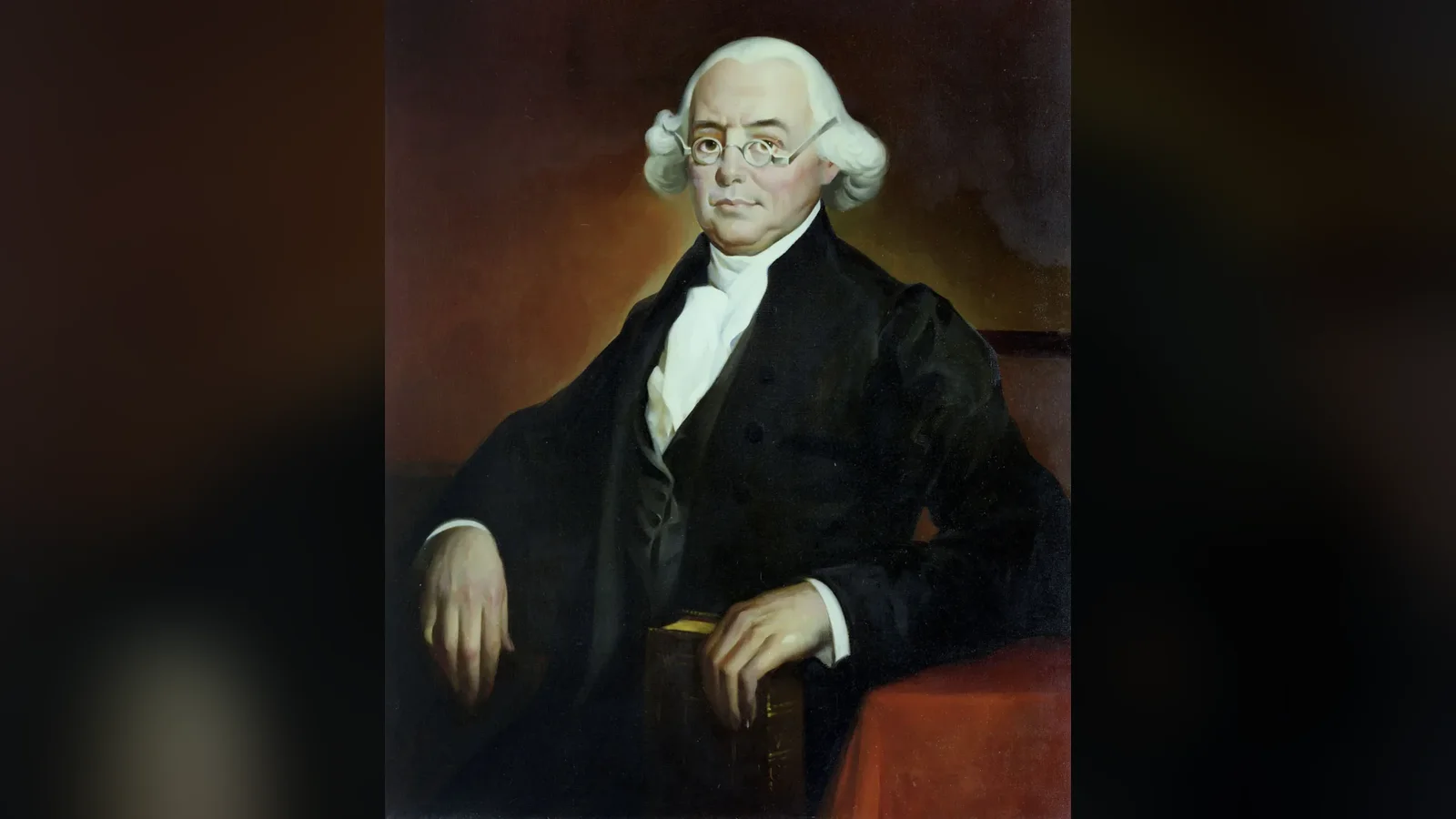

James Wilson (1742–1798)
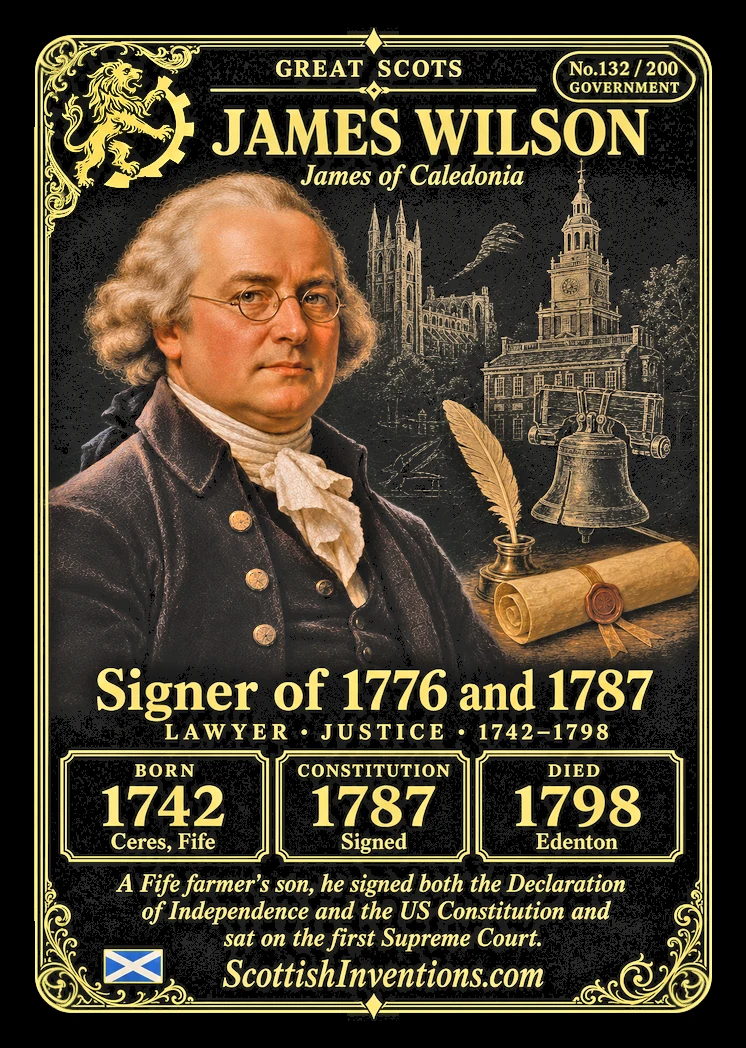
Contents
James Wilson, a farmer's son from Fife, was one of only six men to sign both the American Declaration of Independence and the United States Constitution. At the Constitutional Convention of 1787 he argued that all power comes from the people and helped shape the presidency and the federal courts, and he became one of the first justices of the US Supreme Court. Historians call him one of the most underrated of the founding fathers, and his life ended in debt and disgrace.
TL;DR
- established Born at Carskerdo, near Ceres in Fife, in 1742, he studied at the University of St Andrews before emigrating to Pennsylvania in 1765.
- established He trained as a lawyer under John Dickinson and in 1774 published an influential pamphlet denying that the British Parliament had any authority over the colonies.
- established He signed the Declaration of Independence in 1776 and the US Constitution in 1787; he and John Witherspoon were the only Scots-born signers of the Declaration.
- established At the 1787 Convention he championed a single, strong president chosen by the people, and the principle that sovereignty lies with the people rather than the states.
- established Appointed by George Washington as one of the first justices of the Supreme Court in 1789, he was later ruined by land speculation, twice jailed for debt and died in North Carolina in 1798.
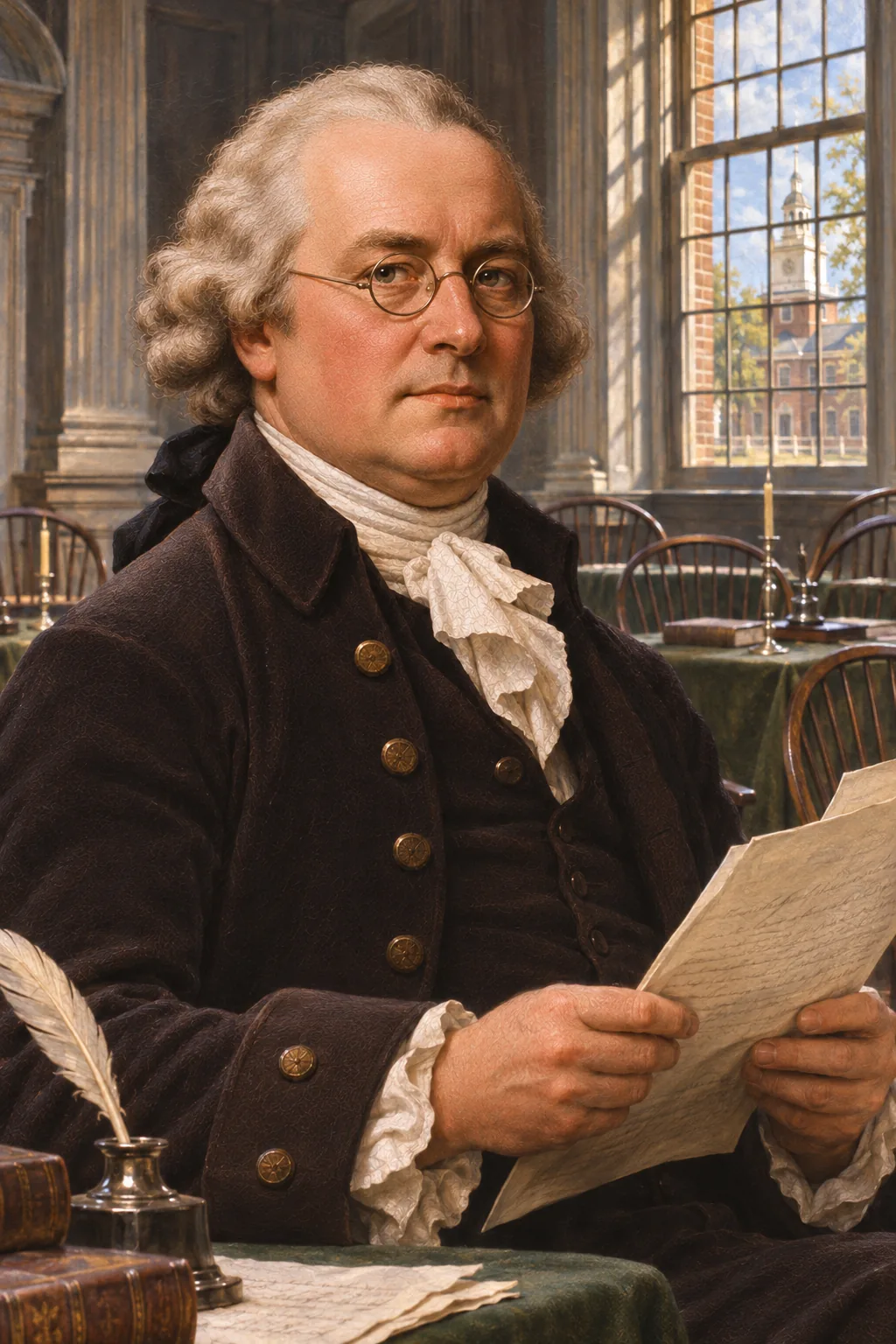
Key Facts
- Born
- 14 September 1742, Carskerdo, near Ceres, Fife
- Died
- 21 August 1798, Edenton, North Carolina (aged 55)
- Education
- University of St Andrews; probably also Glasgow and Edinburgh
- Emigrated
- To Philadelphia, 1765
- Signed
- Declaration of Independence (1776); US Constitution (1787)
- Office
- Associate Justice of the US Supreme Court, 1789–98
- Nickname
- "James of Caledonia"
- Buried
- Christ Church, Philadelphia (reinterred 1906)
A Note on Claims and Evidence
Each major claim carries one of three labels. established means supported by primary records, official bodies or several independent reliable sources. shared means the core fact is sound but sources disagree on details, dates or interpretation. traditional means widely repeated but not traceable to a primary or independent source.
Wilson's public career is fully documented in the records of Congress and the Constitutional Convention. His education in Scotland is less clear: St Andrews is established; attendance at Glasgow and Edinburgh is shared. Popular claims that the Declaration of Arbroath directly influenced the American Declaration through Scots like Wilson are, as Edward Cowan argues in Transatlantic Scots, unproven.
Timeline
Born at Carskerdo, Fife, on 14 September.
Enters the University of St Andrews.
Emigrates to America; tutors at the College of Philadelphia.
Studies law with John Dickinson; admitted to the bar.
Practises law at Carlisle, Pennsylvania.
Publishes Considerations on the Nature and Extent of the Legislative Authority of the British Parliament.
Elected to the Continental Congress.
Votes for and signs the Declaration of Independence.
His Philadelphia house is attacked in the "Fort Wilson" riot.
Leading delegate at the Constitutional Convention; signs the Constitution.
Appointed to the Supreme Court by George Washington.
Gives the first law lectures at the College of Philadelphia.
Jailed twice for debt.
Dies at Edenton, North Carolina, on 21 August.
Remains moved to Christ Church, Philadelphia.
Details
Fife and St Andrews
established James Wilson was born in 1742 at Carskerdo, a farm near Ceres in Fife, the son of a farmer. His family hoped he would enter the Church of Scotland, and in 1757 he went to the University of St Andrews on a scholarship. shared He may also have attended classes at Glasgow and Edinburgh, where he would have met the ideas of the Scottish Enlightenment, especially the "common sense" philosophy of Thomas Reid.
To America
established In 1765 he emigrated to Philadelphia, where he taught Latin at the College of Philadelphia. He then studied law under John Dickinson, one of the colonies' leading lawyers, and was admitted to the bar in 1767. He built a busy practice in Carlisle and later in Philadelphia.
A case for independence
established In 1774 he published Considerations on the Nature and Extent of the Legislative Authority of the British Parliament, arguing that Parliament had no right to legislate for the colonies, which were bound to Britain only through the Crown. It was one of the most important constitutional arguments of the revolutionary years. established Elected to the Continental Congress, he voted for independence in July 1776 and signed the Declaration. Andrew Hook's Scotland and America lists him with John Witherspoon, John Paul Jones and others as the best-known Scots patriots of the Revolution.
The Constitutional Convention
established At the Philadelphia Convention in 1787 Wilson spoke more often than almost anyone except Gouverneur Morris. He argued that all power originally resides in the people, and pressed for both houses of Congress and the president to be elected by the people. He was one of the strongest voices for a single executive rather than a council, and served on the Committee of Detail, which wrote the first full draft of the Constitution. established He also proposed the compromise by which three-fifths of enslaved people were counted for representation, one of the Convention's most notorious bargains. shared Many scholars argue that the American constitutional system is closer to his vision than to that of any other founder.
Ratification and the Supreme Court
established Wilson led the campaign to ratify the Constitution in Pennsylvania, and his "State House Yard" speech of October 1787 was one of the most widely reprinted defences of the new system. In 1789 George Washington appointed him one of the first associate justices of the Supreme Court. In 1790 he gave the first lectures on law at the College of Philadelphia, setting out an American theory of law based on popular sovereignty. established In Chisholm v. Georgia (1793) he argued that the sovereign was the people of the United States, not the individual states.
Ruin
established Wilson speculated heavily in western land, borrowing vast sums. When the speculative bubble burst in the 1790s he was ruined. While still a sitting justice of the Supreme Court he was jailed twice for debt, once in New Jersey and once in North Carolina. established He died in 1798 at Edenton, North Carolina, at the home of his fellow justice James Iredell, and was buried there. In 1906 his remains were moved with ceremony to Christ Church, Philadelphia.
Reputation
shared Wilson was long overlooked, partly because of his disgraceful end and partly because his papers were scattered. Modern scholars have revived his reputation as one of the most original legal thinkers of the founding era, and he is credited as a main architect of the Supreme Court and of the idea of a president answerable to the people. shared His role in the three-fifths compromise is part of that record and is rightly scrutinised.
Did You Know?
- He was born on a farm near Ceres in Fife.
- He studied at the University of St Andrews.
- He was one of only six men to sign both the Declaration and the Constitution.
- He and John Witherspoon were the only Scots-born signers of the Declaration.
- He was jailed for debt while serving on the Supreme Court.
- His remains were moved to Philadelphia more than a century after his death.
- He was nicknamed "James of Caledonia".
From the archive
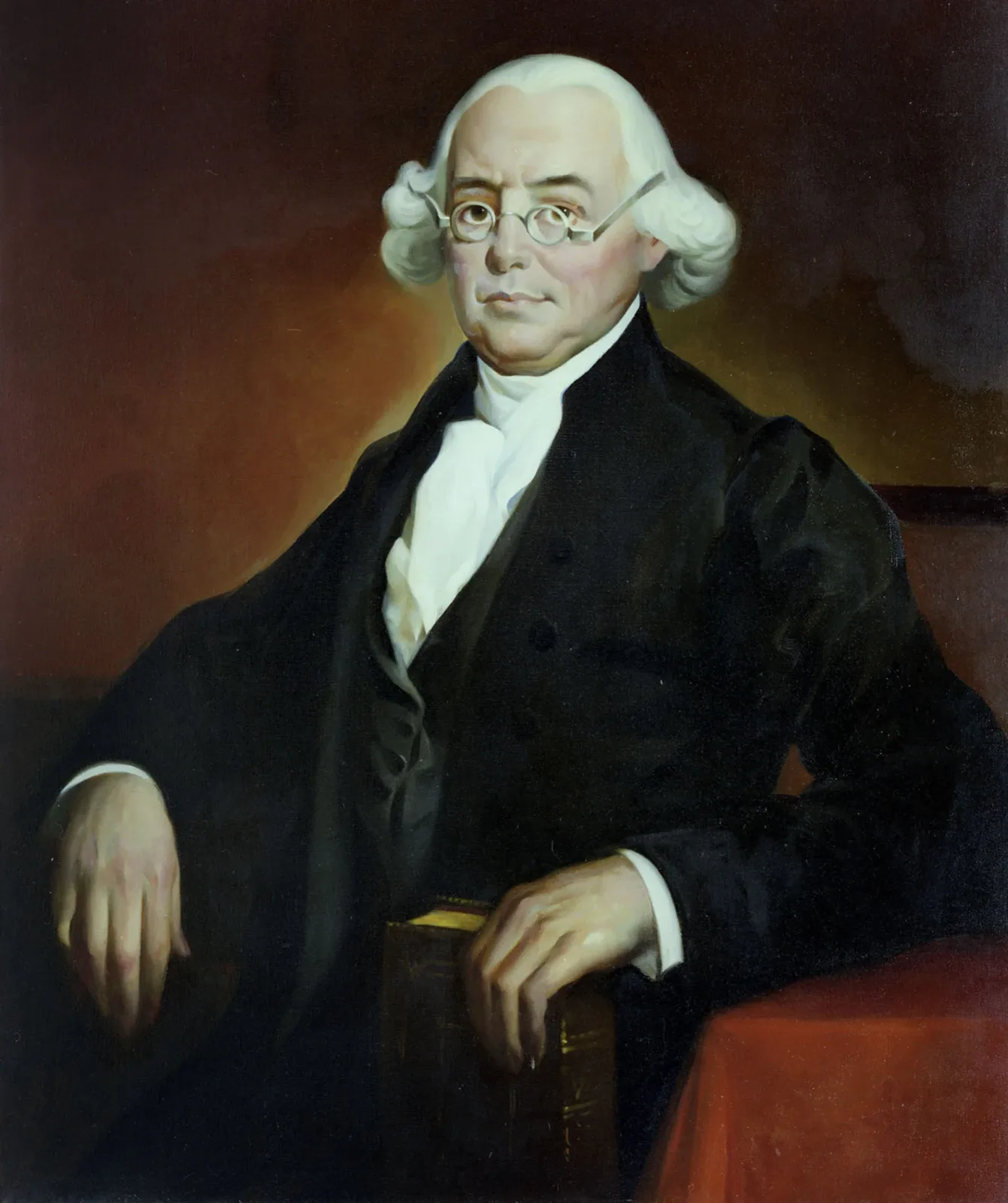
Original documents and images from the period.
FAQ
1Who was James Wilson?
A Fife-born lawyer (1742–1798) who signed the US Declaration of Independence and Constitution and served on the first Supreme Court.
2Where was he born?
At Carskerdo, near Ceres, Fife.
3Did he sign the Declaration of Independence?
Yes, in 1776.
4Did he help write the US Constitution?
Yes. He was a leading delegate and served on the committee that wrote its first draft.
5What were his main ideas?
That all power comes from the people, and that the president should be a single person chosen by the people.
6Was he on the Supreme Court?
Yes, from 1789 until his death in 1798.
7Why did he die in debt?
He lost a fortune speculating in land.
8Where is he buried?
At Christ Church, Philadelphia, since 1906.
9Did the Declaration of Arbroath influence him?
There is no direct evidence that it did.
10What was the three-fifths compromise?
A rule counting three-fifths of enslaved people for representation; Wilson proposed it at the 1787 Convention.
Sources and Further Reading
Primary/Institutional
- Max Farrand (ed.), The Records of the Federal Convention of 1787 (1911).
- Kermit L. Hall and Mark David Hall (eds), Collected Works of James Wilson (2007).
- National Archives (US): Declaration of Independence and Constitution signatories.
Scholarly/Critical
- Celeste Ray (ed.), Transatlantic Scots (2005), chapter by Edward J. Cowan on Tartan Day and the Declaration of Arbroath.
- Andrew Hook, Scotland and America: A Study of Cultural Relations, 1750–1835 (1975).
- Charles Page Smith, James Wilson, Founding Father, 1742–1798 (1956).
- Mark David Hall, The Political and Legal Philosophy of James Wilson, 1742–1798 (1997).
Caveats: Myths and Disputed Claims
- Myth: the Declaration of Arbroath was a direct model for 1776. No direct link through Wilson or Witherspoon has been shown.
- Disputed: education. St Andrews is certain; Glasgow and Edinburgh are probable.
- Caution: "father of the presidency". He was a key advocate, but many delegates shaped the office.
Finished reading? Try the Fact Machine: three reels, one surprising Scottish connection →
Card 132 · Great Scots