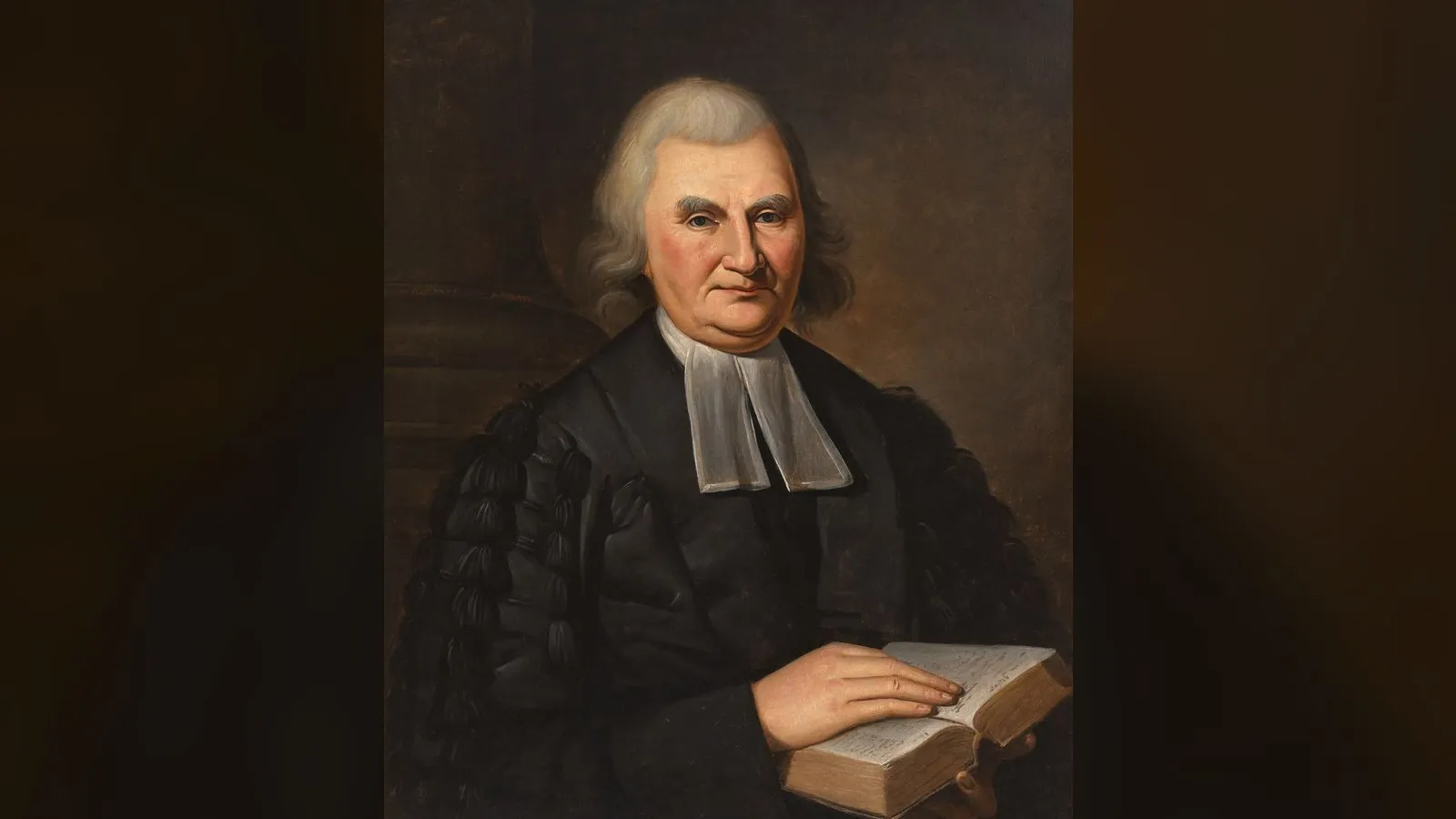

John Witherspoon (1723–1794)
Contents
John Witherspoon was a Church of Scotland minister from East Lothian who became president of the College of New Jersey (now Princeton University) in 1768, sat in the Continental Congress and signed the Declaration of Independence. He is usually remembered for that signature and for teaching James Madison. This card tests a wider claim: that he was the main channel through which Scottish learning, above all moral philosophy and rhetoric, entered American higher education. It also records his ownership of enslaved people and his defence of his fellow Scots when they were the most unpopular group in revolutionary America.
TL;DR
- established Born at Gifford, East Lothian, on 5 February 1723 and educated at Edinburgh, Witherspoon was minister of Beith (1745) and the Laigh Kirk, Paisley (1757), and a leader of the Kirk's evangelical Popular party. He sailed for America in May 1768 to become the sixth president of the College of New Jersey, a post he held until his death at Tusculum, near Princeton, on 15 November 1794.
- established He was the only active clergyman, and the only sitting college president, to sign the Declaration of Independence, and he served in the Continental Congress from 1776 to 1782 with a break in 1779–80.
- shared He brought the Scottish university curriculum to Princeton: moral philosophy in the Scottish manner and a formal course on rhetoric and eloquence. Contemporaries such as Benjamin Rush and Samuel Miller credited him with changing American college education. The literary historian Andrew Hook, in Scotland and America (1975), treats him as the main channel for Scottish philosophy in America, while showing that Scottish books were already read there before he arrived.
- established In 1776 he published an Address to the Natives of Scotland residing in America, defending his countrymen when "Scotch" had become a term of abuse. Most Scots in America were in fact loyalists, as his own Address half admits.
- established He enslaved people. His estate inventory of 1794 lists two enslaved persons, and he condemned British offers of freedom to the enslaved as an incitement to rebellion. His record on slavery is part of his legacy, not a footnote to it.
Key Facts
- Born
- 5 February 1723, Gifford, Yester parish, East Lothian
- Died
- 15 November 1794, Tusculum, near Princeton, New Jersey, aged 71
- Education
- Haddington grammar school; University of Edinburgh (MA 1739; divinity to 1743)
- Scottish charges
- Beith, Ayrshire (ordained 1745); Laigh Kirk, Paisley (1757–68)
- Church party
- Popular (evangelical) party; opponent of the Moderates
- American post
- Sixth president, College of New Jersey (Princeton), 1768–94
- Congress service
- Continental Congress, 1776–79 and 1780–82
- Known for
- Only active clergyman to sign the Declaration of Independence; Scottish-style curriculum in moral philosophy and rhetoric at Princeton; coining the word "Americanism" (1781)
- Notable students
- James Madison, Aaron Burr, Philip Freneau, Hugh Henry Brackenridge
- Slavery
- Enslaved people at Tusculum; two enslaved persons listed in his 1794 estate inventory
Scottish Impact Index (SI Score)
- Global Influence
- 6/10
- Enduring Relevance
- 7/10
- Material Contribution
- 3/10
- Exceptional Achievement
- 5/10
- Lasting Legacy
- 6/10
- Recognition
- 3/10
30/60
Ranked =93rd of 200 in Great Scots
A Note on Claims and Evidence
Claims carry one of three labels. established means supported by primary records, official bodies or several independent reliable sources. shared means the core fact is sound but sources disagree on details, dates or interpretation. traditional means widely repeated but not traceable to a primary or independent source.
Witherspoon's career is unusually well recorded: his own Works (Philadelphia, 1800–01), Varnum Lansing Collins's two-volume President Witherspoon (1925), Lyman H. Butterfield's documentary John Witherspoon Comes to America (1953), Congressional records and the letters and diaries of Benjamin Rush and Ezra Stiles. The weak points are interpretive. How far he personally "introduced" Scottish philosophy to America, rather than speeding a process already under way, is a matter of scholarly argument; Andrew Hook (1975) and Douglas Sloan (The Scottish Enlightenment and the American College Ideal, 1971) give him a central role, while later work by Henry May (The Enlightenment in America, 1976) and others places him within a broader American Enlightenment. Counts of his famous pupils vary between sources. His ownership of enslaved people and his public statements about slavery are documented and are reported directly.
Timeline
Born at Gifford, Yester parish, East Lothian, son of the parish minister.
Graduates MA at the University of Edinburgh; continues in divinity until 1743.
Licensed to preach by the Presbytery of Haddington.
Ordained minister of Beith, Ayrshire.
Publishes Ecclesiastical Characteristics, an anonymous satire on the Moderate party.
Translated to the Laigh Kirk, Paisley; publishes A Serious Inquiry into the Nature and Effects of the Stage, attacking John Home's play Douglas.
Elected president of the College of New Jersey; declines, chiefly because his wife will not go.
Accepts after Benjamin Rush and Richard Stockton press the case in Scotland.
Sails for Philadelphia with his family and a library of books.
Begins teaching at Princeton, including the first formal course on eloquence.
Answers "E.R.", a Scots Magazine correspondent who had confused a Boston minister with the Presbyterian synods of New York and Philadelphia.
Publishes Considerations on the Nature and Extent of the Legislative Authority of the British Parliament; sits in New Jersey's provincial gatherings.
Preaches The Dominion of Providence over the Passions of Men at Princeton, with the appended Address to the Natives of Scotland residing in America.
Elected to the Continental Congress; signs the Declaration of Independence.
Nassau Hall occupied by British and American troops in turn; much of the college library is lost.
The Address is reprinted at Glasgow and in the Scots Magazine; London edition follows in 1778.
Out of Congress for a year; returns and serves until 1782.
In the Pennsylvania Journal coins "Americanism" on the model of "Scotticism".
Sits with James Madison and John Lowell on the congressional committee that lists books for the use of Congress.
Visits Britain to raise money for the college; Scottish friends tell him none will come.
Writes to the Earl of Buchan asking Scottish authors to give their works to the Princeton library.
Marries Ann Dill, a young widow; by now almost blind.
Dies at Tusculum; his estate inventory lists two enslaved people.
His Works, including the Lectures on Moral Philosophy and Lectures on Eloquence, published at Philadelphia.
Details
From East Lothian to the Paisley pulpit
established Witherspoon was born at Gifford, in the parish of Yester, East Lothian, on 5 February 1723, the son of the parish minister, James Witherspoon. He was schooled at Haddington, graduated MA at Edinburgh in 1739 and studied divinity there until 1743, when the Presbytery of Haddington licensed him to preach. He was ordained to Beith in Ayrshire in 1745 and moved to the Laigh Kirk in Paisley in 1757. In 1748 he married Elizabeth Montgomery; she bore him ten children, several of whom died young.
established His Edinburgh years fell in the decade when the university's teaching of logic and rhetoric was changing. John Stevenson, professor of logic from 1730 to 1775, lectured on taste and style in composition, and Witherspoon later built his own Princeton teaching on that kind of course. Andrew Hook stresses that he was trained "at the University of Edinburgh near the middle of the eighteenth century", in the same setting as the Moderate clergy he would later attack.
established In the Kirk he belonged to the Popular, or evangelical, party, the opponents of William Robertson's Moderates. His anonymous satire Ecclesiastical Characteristics (1753) mocked the Moderates' polite theology and their enforcement of patronage, and made his name across Scotland. In 1757 he published A Serious Inquiry into the Nature and Effects of the Stage, an attack on the staging of John Home's tragedy Douglas by a Kirk minister. Hook calls it the best of the anti-theatre pamphlets of that quarrel, and notes the irony that a copy of Douglas was among the books Witherspoon later carried to America.
shared He was not an enemy of Enlightenment learning as such. Hook's reading, which follows Sloan, is that Witherspoon stayed a strict Calvinist in theology, refused to leave the Church of Scotland when the Moderates controlled it, and as a moral philosopher tried to show that the rational ideals of the Enlightenment could be reconciled with Presbyterian belief. That reconciliation, Hook argues, was one of his main gifts to American intellectual life. This is an interpretation, but it is the standard one.
Why Princeton wanted a Scot
established The College of New Jersey was founded by the New Light Synod of New York in 1746 and opened in 1747. Its first five presidents, Jonathan Dickinson, Aaron Burr senior, Jonathan Edwards, Samuel Davies and Samuel Finley, all died in office within twenty years. Scotland had already helped keep it alive: in May 1754 the General Assembly authorised a collection at every church door in Scotland for the college, after an appeal by Gilbert Tennent and Samuel Davies, and Hook gives the Scottish total as over £3,200, much of it spent on Nassau Hall and the president's house.
established By 1766 the college was again caught in the old split in American Presbyterianism. The Old Side party offered money in return for control of the presidency and of professorships. The New Light trustees answered by electing Witherspoon. Hook points to a reversal of labels: in Scotland Witherspoon's Popular party was the one friendly to revival preaching, which matched the American New Light rather than the Old Side. Sloan went further and argued that Witherspoon was chosen because he could satisfy both American parties; that reading is shared.
established He did not accept at once. His wife was firmly against going, and for a time Witherspoon proposed others in his place, the Perthshire minister Thomas Randall or his friend Charles Nisbet of Montrose. Richard Stockton and the young medical student Benjamin Rush pressed the college's case in Scotland. Mrs Witherspoon changed her mind, and the family sailed for Philadelphia in May 1768. Benjamin Franklin played an indirect part in the negotiations. Butterfield's John Witherspoon Comes to America (1953) prints the documents; Hook calls the episode a microcosm of the ties that bound Scotland and America before the Revolution.
established With him came Hugh Simm, a young Scot who became a schoolteacher at Freehold, New Jersey, and wrote home that books were "very scarce" in that part of the world. Witherspoon brought his own library. A surviving list in Princeton University Library shows it included Colin Maclaurin's Account of Sir Isaac Newton's Philosophical Discoveries, James Watson's Choice Collection of Comic and Serious Scots Poems and, oddly, Home's Douglas.
Rebuilding the college on a Scottish pattern
established Witherspoon took over a small, poor college and made it one of the most influential in America. He raised money, recruited students from every colony, extended mathematics and natural philosophy, and bought scientific apparatus, including David Rittenhouse's orrery. He taught much of the senior course himself.
established Samuel Miller's Brief Retrospect of the Eighteenth Century (New York, 1803) summed up the change. In Miller's words he "produced an important revolution in the system of education adopted in this seminary", placed moral philosophy "on a new and improved basis" and paid more attention than before "to the principles of taste and composition". Miller was a Presbyterian minister who knew the college well, so his account is near-contemporary testimony, not neutral assessment.
shared Hook argues that what Witherspoon brought did not differ in kind from what any Scottish graduate schoolmaster had to offer: a training in the traditions of the Scottish Enlightenment, seen most clearly in two subjects, philosophy and rhetoric. Witherspoon's position at the head of a leading college is what made it count.
Rhetoric and eloquence: teaching Americans to write "correctly"
shared Scottish universities had made the study of rhetoric and belles-lettres a speciality. Stevenson lectured on it at Edinburgh; Adam Smith gave public lectures on it in Edinburgh from 1748 to 1751; Lord Kames's Elements of Criticism appeared in 1762; Hugh Blair lectured on it for more than twenty years before his Lectures on Rhetoric and Belles Lettres were printed in 1783. Hook explains the speciality by the Scots' anxiety to write English that English readers would accept. He argues that Witherspoon saw America's position in relation to English cultural standards as much like Scotland's, and that the tools for teaching "correctness" had "been developed almost exclusively in Scotland". Witherspoon carried them to Princeton.
shared L. T. Chapin (1961) states that in his first year as president Witherspoon gave the first formal course in rhetoric in the American colonies, sixteen lectures on eloquence. Hook notes that this conflicts with Thomas Jefferson's Autobiography, which says that William Small, Jefferson's Aberdeen-trained teacher at William and Mary, was the first there to give regular lectures in ethics, rhetoric and belles-lettres, in about 1760–61. Either way, Hook's point stands: the teaching of rhetoric in America's colleges began in the Scottish tradition. Witherspoon's lectures were published in his Works (1800–01).
established Contemporaries saw the results. Benjamin Rush wrote that he "gave a new turn to education, and spread taste and correctness in literature throughout the United States", and that his pupils could be recognised whenever they spoke or wrote in public (as quoted by Hook). A Port Folio article of 1825 said he caused "an important revolution in the system of education".
established In a series of essays in the Pennsylvania Journal in 1781, signed "The Druid", Witherspoon criticised the English then written and spoken in America and coined the word "Americanism", on the model of "Scotticism". He wrote that education must be "very imperfect in any seminary where no care is taken to form the scholars to taste, propriety, and accuracy" in English. Hook reads this as the instinct of a Scot who knew from home what it was to write in a standard set elsewhere.
shared Hook goes further. He argues that the Scottish rhetorical tradition that Witherspoon, Charles Nisbet at Dickinson College and the textbooks of Blair and Kames spread through American schools lay behind the "genteel tradition" in American writing: smoothness and correctness, distrust of the vernacular, and perhaps a slower growth of a native literary voice. This is Hook's own judgement and is contested; Bernard Spencer (The Quest for Nationality, 1957), whom Hook cites, saw Witherspoon, Blair and Kames as loosening rather than tightening the neo-classical hold on American writing.
Moral philosophy and common sense
shared Witherspoon is the person most often credited with introducing Scottish philosophy to America. Samuel Miller wrote in 1803 that he was "the first man who taught, in America, the substance of those doctrines of the philosophy of the Human Mind, which Dr. Reid afterwards developed". Frederick Beasley, a Princeton student of the 1790s, recalled that the principles of Reid and the "Scottish metaphysicians" had replaced Berkeley's idealism there and "acquired and maintained undisputed sway" (both as quoted by Hook). Witherspoon's own Lectures on Moral Philosophy lean heavily on Francis Hutcheson and refer to Reid, Kames and other Scots.
established He was not the first to bring Scottish thinkers to American readers. The philosopher I. Woodbridge Riley (1907), quoted by Hook, found that Jefferson read Kames in 1764, that Hutcheson's Inquiry into Beauty and Virtue was in the Princeton library by 1760, and that a work of Hutcheson's was a textbook at the Philadelphia Academy in 1756. Jonathan Edwards had read Kames's and Hume's moral essays by 1755. Hook's conclusion is that Scottish common-sense philosophy would have reached America without Witherspoon, but that Witherspoon gave it "the ideal channel", first into his own pupils' minds and then into the schools, colleges and churches they went on to lead.
shared That conclusion has been both supported and qualified since 1975. Sloan (1971) had already given Witherspoon a central place in the "American college ideal". Henry May (1976) placed him within a "didactic Enlightenment" that drew on several sources, not Scotland alone. Garry Wills's Inventing America (1978) pushed the Scottish case into Jefferson's own thinking and was strongly criticised by Ronald Hamowy. The safe statement is that Witherspoon was the most important single carrier of Scottish moral philosophy into American colleges, not its only source.
Pupils and the "Princeton network"
established James Madison graduated in 1771 and stayed on for a further year of study under Witherspoon. Aaron Burr, the poet Philip Freneau and the writer Hugh Henry Brackenridge were among his other pupils. Graduates of his era filled the pulpits and teaching posts of new colleges in the south and west; Hook, following Richard Beale Davis, notes that Washington College and Hampden-Sydney College in Virginia owed much of their curriculum to the Princeton example.
shared Lists of his pupils' later offices are often quoted: a president, a vice-president, dozens of members of Congress, governors and judges. The totals differ between sources depending on who is counted as a pupil, so they should be given as approximate.
established Hook cites a hostile witness. In November 1774 a Scottish loyalist in Norfolk, Virginia, wrote to the customs official Charles Steuart that a friend had heard "forty boys repeat orations at the Princetown Commencement, every one of them full of the Old Cameronian resisting sentiments" (Steuart Papers, National Library of Scotland). The comparison was with the Covenanters of the 1680s.
A clergyman in Congress
established Witherspoon supported the American cause from the early 1770s. In 1774 he published Considerations on the Nature and Extent of the Legislative Authority of the British Parliament and sat in New Jersey's provincial gatherings. The New Jersey Provincial Congress elected him to the Continental Congress in June 1776, in time to vote for independence and sign the Declaration. He served on more than a hundred committees, including the Board of War and committees on finance and foreign affairs, and stayed in Congress until 1782, with a break in 1779–80.
shared Hook records a tradition, from Richard Henry Lee's Memoir (1825), that Witherspoon was responsible for removing a phrase from Jefferson's draft of the Declaration that accused the King of sending "Scotch and foreign mercenaries" against America. The phrase was certainly deleted; Witherspoon's part rests on that later source.
established In 1782 Congress named Madison, Witherspoon and John Lowell of Massachusetts to draw up a list of books to be bought for its use. Madison wrote the report, a list of about 550 titles. Only a dozen or so were by Scottish authors: Hutcheson's System of Moral Philosophy, Ferguson's Institutes and Essay on Civil Society, three of Robertson's histories, Hume's History of England and Essays, Millar's Origin of the Distinction of Ranks and Smith's Wealth of Nations, among others. Hook reads the list not as Scottish bias but as a measure of how far well-informed Americans knew the Scottish Enlightenment by the end of the war, and of how hard those books still were to obtain.
Defending the Scots in a time of discord
established During the Revolution the Scots were the most unpopular national group in America. Many were loyalists, especially in Virginia, North Carolina and among the Glasgow tobacco merchants' factors. Lord Bute and Lord Mansfield were blamed for the government's American policy. Jefferson's draft of the Declaration complained of "Scotch and foreign mercenaries", and in 1782 Georgia barred Scots from settling or trading in the state unless they had supported independence.
established On 17 May 1776, a day of general fasting, Witherspoon preached at Princeton and published with the sermon an Address to the Natives of Scotland residing in America. It opens: "It has given me no little uneasiness, to hear the word Scotch used as a term of reproach in the American controversy." He insisted that many Scots in America had opposed British claims as firmly as anyone, but he also admitted that in some provinces Scots had been "too much inclined to support the usurpations of the parent state". He blamed John Wilkes, whose attacks on Scotland had made American patriots' alliance with him repellent to Scots. The Address was reprinted at Glasgow and in the Scots Magazine in 1777, and at London in 1778.
shared Hook thinks the Wilkes argument deserves more weight than it has usually been given, but agrees that its chief value as evidence is that it confirms how widespread Scottish loyalism was. Economic ties and the absence of any organised Scottish opposition to the war mattered more.
established Not everyone was persuaded. Ezra Stiles, president of Yale, wrote in his diary on 15 August 1776: "Too much Scoticism! He wants to save his Countrymen". In July 1777 Stiles noted that Witherspoon had tried to defend the Scots in Congress, and blamed the whole war on "Scotch Councils". Hook suggests Witherspoon's defence there drew on A North Briton Extraordinary, a reply to Wilkes probably by James Boswell, reprinted at Philadelphia in 1769.
Keeping the Scottish link alive after the war
established Nassau Hall was occupied by both armies in 1776–77 and the library suffered. In 1784 Witherspoon went to Britain to raise funds, but his friends Charles Nisbet and John Erskine told him plainly that no Scottish money would come. On 24 May 1788 he wrote to the Earl of Buchan that he meant to ask the many Scottish authors he had known "in early Life" to give their works to the college, since those bought before the war had been carried off. When Nassau Hall burned in 1802, Scottish donors, among them John Erskine, William Creech, Archibald Alison and Dugald Stewart, sent books, and two Bostonians gave copies of Kames's Elements of Criticism.
established He kept up a long correspondence with Scottish friends. Nisbet wrote to him in 1784 that ordinary people in Scotland rejoiced in American liberty, and in 1793 about Scottish reformers arriving in America. When Nisbet accepted the presidency of Dickinson College in 1785, William Creech attacked him in the Edinburgh press for his letter to "Dr. Wotherspoon" about the loyalists. Benjamin Silliman, visiting Edinburgh in 1805–06, met the friend to whom Witherspoon had addressed his Letters on Education.
Rhetoric beyond Princeton: Hugh Blair's American career
established Witherspoon's course on eloquence was the first stage of a much larger change. Hugh Blair's Lectures on Rhetoric and Belles Lettres (1783) were printed at Philadelphia in 1784, and abridged at Albany in 1788. Hook counts fifty-six American editions, full and abridged, between 1805 and 1823 alone, many from small-town presses. Yale adopted Blair in 1785 and Harvard in 1788; by 1835 he was taught at Columbia, Pennsylvania, North Carolina, Union, Brown, Middlebury, Williams, Amherst, Hamilton, Wesleyan and William and Mary. Charles Nisbet's belles-lettres course at Dickinson almost certainly used him. Hook sees Blair's popularity as the spread to every level of educated America of the preoccupation with taste and style that Witherspoon and Nisbet first taught.
Slavery: a documented, serious contradiction
established Witherspoon's Revolutionary-era rhetoric and his personal conduct regarding slavery sit in sharp, well-documented tension, and this article states that tension plainly rather than allowing his Declaration signature to stand as the whole of his legacy. He personally enslaved people at his New Jersey estate from 1779 onward, and the inventory of his estate taken at his death in 1794 lists two enslaved individuals among his possessions. Despite having argued publicly that American colonists risked becoming "slaves to Britain" without independence, Witherspoon showed no corresponding commitment to freedom for enslaved Africans in America: he explicitly condemned British wartime efforts to offer freedom to enslaved people as an attempt to stir them "up to rebel against their masters," a contradiction noted even by some of his own contemporaries, including the British abolitionist Granville Sharp, who sent him anti-slavery literature directly. His family's involvement in slavery extended beyond his own household: his daughter became a slaveholder through marriage, and his son David went on to claim ownership of more than 100 enslaved people on a North Carolina estate. Witherspoon's time as Princeton's president was also marked by an active financial strategy of recruiting the sons of wealthy Southern slaveholding planters to the college, which historians have connected to the institution's unusually high proportion of alumni who later fought for the Confederacy — Southern students made up roughly two-thirds of Princeton's Class of 1790 alone during his tenure.
A contested modern legacy
established Witherspoon's documented ownership of enslaved people and his role in building Princeton's financial ties to Southern slaveholding families have become the subject of genuine, ongoing institutional debate in recent years, including petitions calling for the removal or recontextualisation of a bronze statue of him on Princeton's campus, and a 2020 decision by a Princeton-area middle school to drop his name. This article records that debate as part of an honest account of his full legacy, consistent with its commitment to giving morally serious material full weight rather than presenting him solely through the lens of his Revolutionary-era achievements.
Last years and reputation
established Witherspoon lost the sight of one eye in 1784 and was almost blind by 1791, when, a widower of 68, he married Ann Dill, a widow in her twenties. He kept preaching and presiding at commencement until shortly before his death at Tusculum on 15 November 1794. His son-in-law Samuel Stanhope Smith succeeded him as president. His Works, edited by Ashbel Green, appeared in Philadelphia in 1800–01.
shared In the century after his death American writers treated him as the founder of a Scottish tradition at Princeton, a tradition renewed when another Scot, James McCosh, became president in 1868. Hook, who did most of the research for Scotland and America at Princeton, wrote in the shadow of both men. Modern assessments are more mixed: they give him credit for the curriculum and for his pupils, and weigh that against his slaveholding and his college's dependence on slaveholding families.
Did You Know?
- He coined the word "Americanism" in 1781, on the model of "Scotticism", the Scots' own word for a Scottish turn of phrase to be avoided in polite English.
- Before he would agree to go to America, he suggested two other Scottish ministers for the Princeton post, one of them Charles Nisbet, who later became first president of Dickinson College.
- Among the books he took to Princeton was a copy of Douglas, the play he had attacked in print in 1757.
- Ezra Stiles of Yale dismissed his 1776 defence of the Scots in America with the words "Too much Scoticism!"
- He was the only active clergyman, and the only sitting college president, to sign the Declaration of Independence.
- Benjamin Franklin played an indirect part in bringing him to America, and Franklin's friend Benjamin Rush helped persuade his reluctant wife.
- He sat on the 1782 committee that drew up the first list of books for the use of Congress, alongside his former pupil James Madison.
- His son David later claimed ownership of more than 100 enslaved people in North Carolina.
FAQ
1What is John Witherspoon best known for?
Signing the Declaration of Independence as the only active clergyman to do so, and his presidency of the College of New Jersey, now Princeton University, from 1768 to 1794.
2Was he Scottish?
Yes. He was born at Gifford in East Lothian in 1723, educated at Edinburgh, and served as a Church of Scotland minister at Beith and Paisley until he left for America at the age of 45.
3Did he bring Scottish philosophy to America?
He was the most important single carrier of it into American colleges. Samuel Miller in 1803 called him the first in America to teach the substance of what Thomas Reid developed. But Scottish authors such as Hutcheson and Kames were already read in America before 1768, so he sped up and organised a process rather than starting it.
4What did he teach at Princeton?
Moral philosophy in the Scottish style, which joined ethics, politics and the study of the mind, and a course on eloquence and composition modelled on the rhetoric teaching he had known in Edinburgh. He also strengthened mathematics and natural philosophy.
5Did he give the first course on rhetoric in America?
Possibly. One modern historian says his lectures of 1768–69 were the first formal course in the colonies, but Jefferson credited William Small at William and Mary with regular lectures on rhetoric and belles-lettres in about 1760–61. Both men were Scots trained in the same tradition.
6Who were his notable students?
James Madison, Aaron Burr, Philip Freneau and Hugh Henry Brackenridge, along with many future ministers, judges, governors and members of Congress.
7Why did he write an address to the Scots in America?
Because during the Revolution "Scotch" had become a term of abuse. Many Scots were loyalists, and Scottish ministers were blamed for British policy. In 1776 he defended Scots who supported independence and urged the rest to join them.
8Did he own enslaved people?
Yes. His 1794 estate inventory lists two enslaved people, and he condemned British wartime offers of freedom to the enslaved as attempts to stir them up against their masters.
9Did Scotland help fund Princeton?
Yes, before the Revolution. A collection authorised by the General Assembly in 1754 raised over £3,200, which helped build Nassau Hall. When Witherspoon came back for more money in 1784, his Scottish friends told him none would be given.
10How long did he serve in the Continental Congress?
From 1776 to 1782, with a break in 1779–80. He served on more than a hundred committees.
11Why did a Princeton-area school remove his name?
In 2020, amid growing scrutiny of his record as a slaveholder and his recruitment of Southern slaveholding families to Princeton, a local middle school dropped his name.
12Where can I read his own work?
His Works were published in Philadelphia in 1800–01 and include the Lectures on Moral Philosophy and Lectures on Eloquence. Lyman H. Butterfield's John Witherspoon Comes to America (1953) prints the letters about his appointment.
Sources and Further Reading
Primary/Institutional
- John Witherspoon, The Works of the Rev. John Witherspoon, ed. Ashbel Green (Philadelphia, 1800–01), including An Address to the Natives of Scotland residing in America (1776) and the Pennsylvania Journal essays of 1781
- Samuel Miller, A Brief Retrospect of the Eighteenth Century (New York, 1803)
- Lyman H. Butterfield (ed.), John Witherspoon Comes to America: A Documentary Account (Princeton, 1953)
- Franklin Bowditch Dexter (ed.), The Literary Diary of Ezra Stiles (New York, 1901)
- John Witherspoon — Encyclopaedia Britannica
- Witherspoon, John — 1911 Encyclopædia Britannica (Wikisource)
Scholarly/Critical
- Andrew Hook, Scotland and America: A Study of Cultural Relations, 1750–1835 (Blackie, 1975)
- Varnum Lansing Collins, President Witherspoon: A Biography, 2 vols (Princeton, 1925)
- Douglas Sloan, The Scottish Enlightenment and the American College Ideal (New York, 1971)
- Henry F. May, The Enlightenment in America (New York, 1976)
- 5 facts about John Witherspoon, a slaveholder and the only university president to sign the Declaration of Independence — The Conversation
- Princeton University's Witherspoon Statue Is Focus of Discussion on Legacy of Racism — Town Topics
Specialist
- L. T. Chapin, "American Interest in the Chair of Rhetoric and English Literature in the University of Edinburgh", University of Edinburgh Journal 20 (1961)
- Richard Beale Davis, Intellectual Life in Jefferson's Virginia, 1790–1830 (Chapel Hill, 1964)
General
Further reading
- Jeffry H. Morrison, John Witherspoon and the Founding of the American Republic (Notre Dame, 2005)
- Richard B. Sher and Jeffrey R. Smitten (eds), Scotland and America in the Age of the Enlightenment (Edinburgh, 1990)
Caveats: Myths and Disputed Claims
- Do not give his birth date as 15 February 1723; it was 5 February 1723.
- Do not say he single-handedly introduced Scottish philosophy to America; Hutcheson and Kames were read there before 1768, and Hook himself argues the ideas would have arrived without him.
- Do not say he taught Dugald Stewart's books at Princeton as founding texts; Stewart's Elements appeared only in 1792, two years before Witherspoon died.
- Do not state as fact that his was the first rhetoric course in America; Jefferson gave that credit to William Small at William and Mary.
- Do not assume the Scots in America backed the Revolution as a group; Witherspoon was a prominent exception, and his own Address admits many Scots sided with Britain.
- Do not present his part in deleting the "Scotch and foreign mercenaries" phrase from the Declaration as certain; it rests on a memoir of 1825.
- Do not call him the only clergyman ever to sit in Congress or sign a founding document; say the only active clergyman to sign the Declaration.
- Do not omit his slaveholding. This article gives direct weight to it and to his recruitment of Southern slaveholding families to Princeton. The link between that recruitment and Princeton's later Confederate alumni is a pattern noted by historians, not a claim that he was personally responsible for choices made decades after his death.
Card 142 · Great Scots