Jessie M. King (1875–1949)
Contents
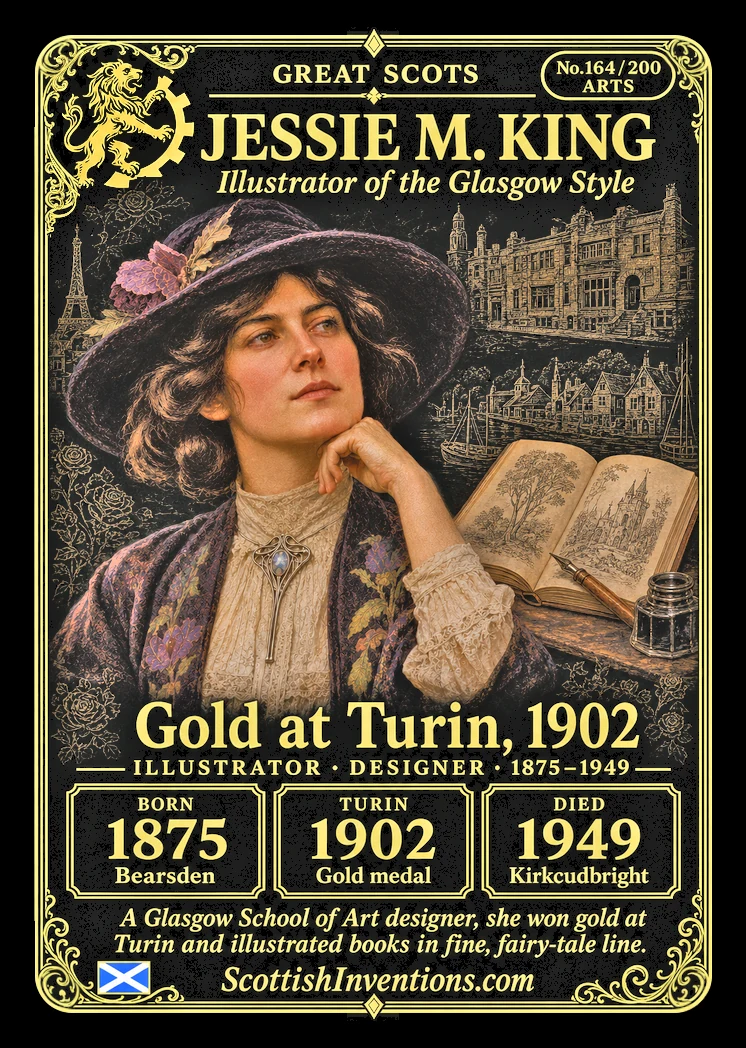
Jessie M. King was the most commercially successful designer of the Glasgow Style, an illustrator whose fine, spidery line turned fairy tales and legends into some of the most distinctive book art of the early twentieth century.
TL;DR
- established Born in Bearsden in 1875, she trained at Glasgow School of Art and became one of the leading "Glasgow Girls" of the Glasgow Style.
- established Her delicate, rhythmic pen line, often drawn from legends and fairy tales, featured regularly in The Studio magazine and won a gold medal at the Turin International Exhibition of 1902.
- established She designed far beyond books: jewellery, silver, textiles, wallpapers, posters, bookplates, ceramics and costumes, some of it sold by Liberty & Co.
- established She married the designer E. A. Taylor in 1908 but kept her own name, which was unusual at the time.
- established After a spell in Paris, where she took up batik, she settled in Kirkcudbright, which became a centre for artists around her.
Key Facts
- Born
- 20 March 1875, Bearsden, near Glasgow
- Died
- 3 August 1949, Kirkcudbright (aged 74)
- Parents
- Rev. James W. King, Church of Scotland minister; Mary Ann Anderson
- Trained
- Queen Margaret College; Glasgow School of Art
- Married
- Ernest Archibald Taylor (1874–1951), designer, in 1908
- Children
- One daughter, Merle
- Major award
- Gold medal, Turin International Exhibition of Modern Decorative Art, 1902
- Known for
- Book illustration, Glasgow Style design, batik, decorated ceramics
A Note on Claims and Evidence
Each major claim carries one of three labels. established means supported by primary records, official bodies or several independent reliable sources. shared means the core fact is sound but sources disagree on details, dates or interpretation. traditional means widely repeated but not traceable to a primary or independent source.
Her career is well recorded in exhibition catalogues, in The Studio and in the Jessie M. King collection at the University of Glasgow. Stories about her personal belief in fairies, and that she was punished as a child for drawing, come from family memories and early profiles. They are labelled traditional here.
Timeline
Born in Bearsden on 20 March, daughter of a Church of Scotland minister.
Studies at Queen Margaret College and Glasgow School of Art.
Begins teaching book decoration and design for bookbinding at Glasgow School of Art.
Wins a gold medal at the Turin International Exhibition of Modern Decorative Art.
Illustrates William Morris's The Defence of Guenevere; takes temporary charge of the School's embroidery department.
Teaches ceramic design.
Marries E. A. Taylor and moves to Manchester.
Moves to Paris, where the couple run a studio and teaching atelier.
War forces their return; they settle at Greengate, Kirkcudbright.
Works on batik, ceramics, painting and illustration; holds summer sketching classes on Arran.
Dies at Kirkcudbright on 3 August.
Details
A minister's daughter
established Jessie Marion King was born in Bearsden, the daughter of the Rev. James W. King and Mary Ann Anderson. traditional According to family tradition, her strict Presbyterian parents disapproved of her drawing, and she hid her sketches. She went on to study at Queen Margaret College, the women's college of Glasgow University, and at Glasgow School of Art.
The Glasgow Girls
established Glasgow School of Art under its headmaster Fra Newbery was unusually open to women, and its students and staff included the group now called the "Glasgow Girls", among them Margaret and Frances Macdonald and Jessie Newbery. Newbery encouraged design and craft as much as painting. King quickly made her name through book illustration, and from 1899 she taught design for bookbinding at the School. In 1904 she ran the embroidery department for a time, and in 1907 taught ceramic design.
The line
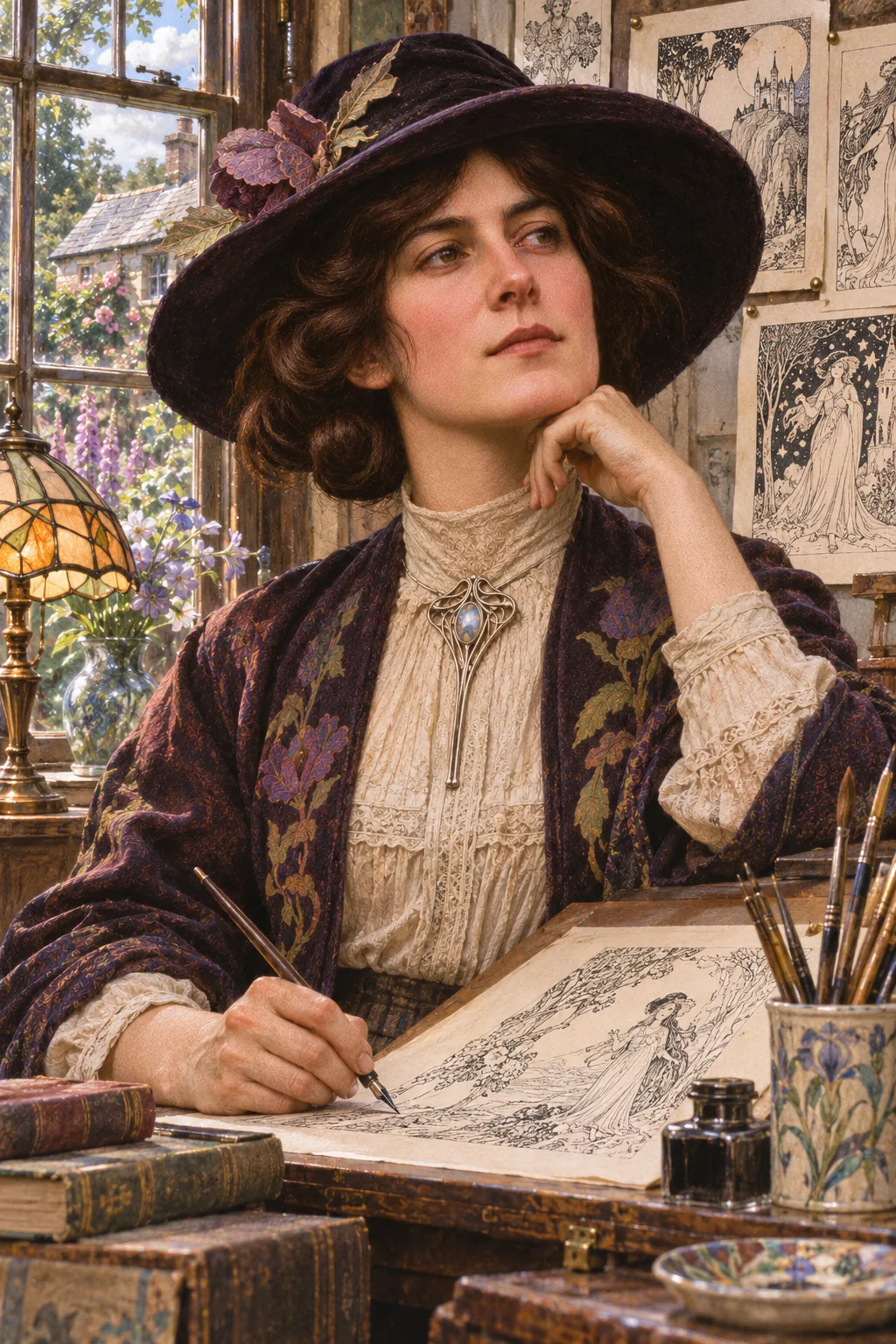
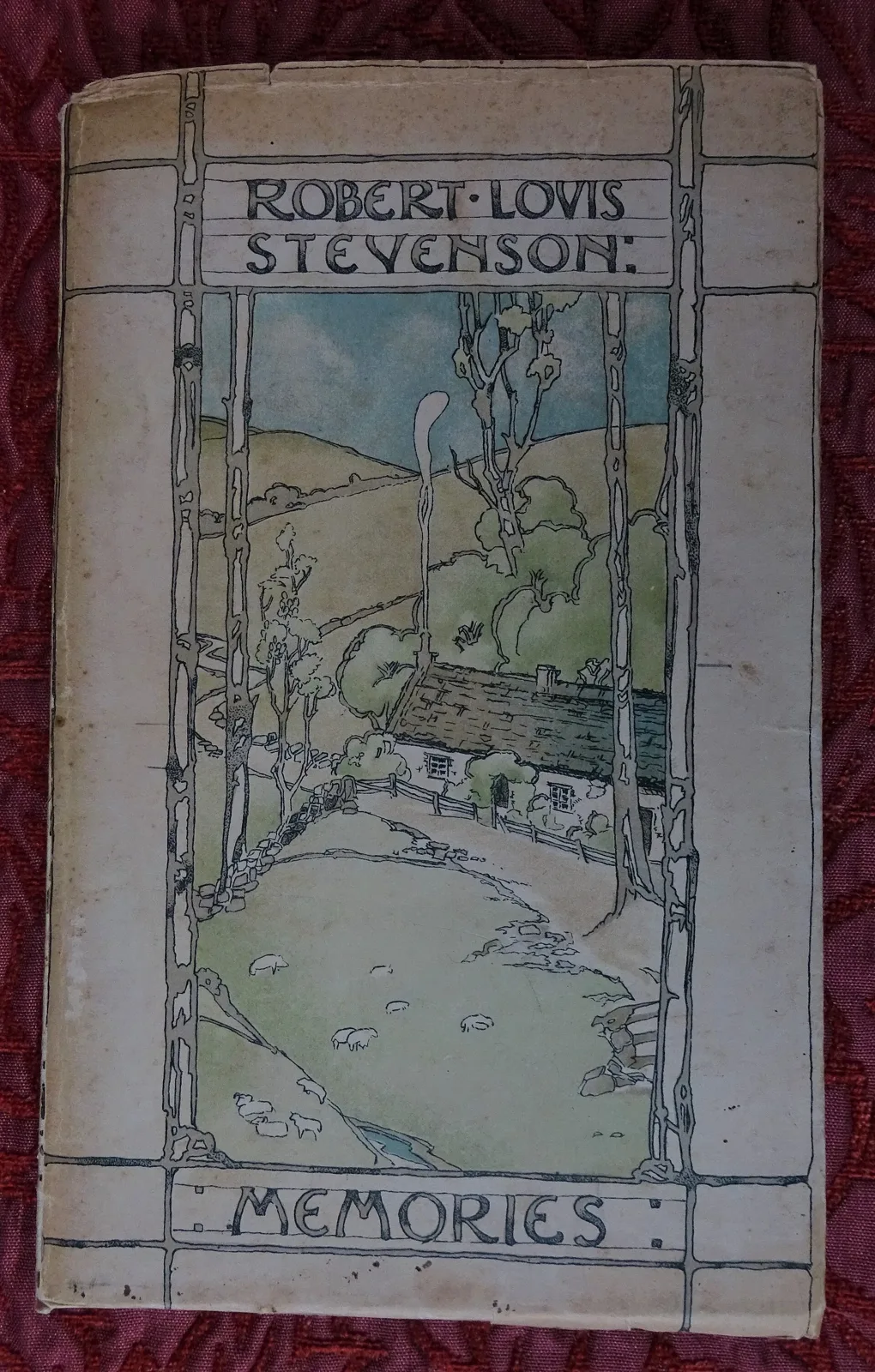
established Her style is instantly recognisable: fine, flowing pen lines; tall, slender figures; tiny dots and stars; flowers, castles and forests drawn with delicate precision. Her subjects came from legend, romance and fairy tale. She illustrated works including William Morris's The Defence of Guenevere (1904) and later produced picture books of her own. Her drawings appeared regularly in The Studio, the leading art magazine of the day. established At the 1902 Turin International Exhibition of Modern Decorative Art she won a gold medal for a book design, and her work was shown in Berlin, Calcutta and Cork.
Designer for Liberty's
established King's output was very varied. She designed silver, jewellery and textiles, some sold by Liberty & Co. of London, as well as gesso panels, wallpapers, posters, bookplates and costumes for masques and pageants. Later she designed interiors and murals. Her biographers call her the most commercially successful of all the designers associated with the Glasgow Style.
Marriage, Paris and batik
established In 1908 she married Ernest Archibald Taylor, a furniture and interior designer, but kept her own name, which was unusual at the time. They had one daughter. Taylor's work took them to Manchester and, in 1911, to Paris, where they ran a small studio and gallery. There King discovered batik, the wax-resist method of dyeing cloth. She went on developing it after the First World War forced them home in 1915.
Kirkcudbright
established The Taylors settled at Greengate Close in Kirkcudbright, where they became the heart of an artists' colony. King produced decorated ceramics and watercolours there, and in the summers she and her husband ran sketching classes on Arran. traditional Neighbours remembered her as a vivid, eccentric figure who spoke of fairies as if they were real. Her reputation faded after her death but has risen steadily since the 1970s.
Did You Know?
- She won a gold medal at the 1902 Turin exhibition.
- She kept her own name after marrying, unusual in 1908.
- Liberty & Co. sold some of her designs.
- She learned batik in Paris.
- She lived in Kirkcudbright, an artists' town in Galloway.
- Her collection of work and papers is held by the University of Glasgow.
- She and her husband ran summer sketching classes on Arran.
From the archive
Original documents and images from the period.
FAQ
1Who was Jessie M. King?
A Scottish illustrator and designer (1875–1949), one of the leading figures of the Glasgow Style.
2What are the Glasgow Girls?
A group of women artists and designers linked to Glasgow School of Art around 1890–1920.
3What is she best known for?
Her finely drawn book illustrations based on legends and fairy tales.
4Did she work with Charles Rennie Mackintosh?
She belonged to the same Glasgow School of Art circle but worked independently.
5What did she design besides books?
Jewellery, silver, textiles, wallpaper, posters, ceramics, bookplates and costumes.
6Why did she keep her own name?
She was independently minded and already known professionally as Jessie M. King.
7What is batik?
A method of dyeing cloth using wax to resist the dye. She took it up in Paris.
8Where did she live?
In Glasgow, Manchester, Paris and, from 1915, Kirkcudbright.
9Where can I see her work?
The University of Glasgow, Glasgow Museums, the National Galleries of Scotland and Kirkcudbright Galleries hold examples.
10Did she really believe in fairies?
Friends said she spoke as if she did, but this is anecdote rather than record.
Sources and Further Reading
Primary/Institutional
- University of Glasgow Library, Special Collections: Jessie M. King Collection.
- The Studio magazine, 1898–1910s, for contemporary reproductions of her work.
Scholarly/Critical
- Elizabeth Ewan, Rose Pipes et al. (eds), The New Biographical Dictionary of Scottish Women (Edinburgh University Press, 2018), entries "King, Jessie Marion" and "Glasgow Girls".
- Jude Burkhauser (ed.), Glasgow Girls: Women in Art and Design 1880–1920 (1990).
- Colin White, The Enchanted World of Jessie M. King (1989).
- Elizabeth Cumming, Hand, Heart and Soul: The Arts and Crafts Movement in Scotland (2006).
Caveats: Myths and Disputed Claims
- Caution: fairy belief. Stories of her belief in fairies are anecdotes from friends and neighbours.
- Caution: childhood disapproval. The tale that her parents punished her for drawing is family tradition.
- Myth: she was part of "The Four". "The Four" were Mackintosh, Herbert MacNair and the Macdonald sisters; King was not one of them.
Finished reading? Try the Fact Machine: three reels, one surprising Scottish connection →
Card 164 · Great Scots