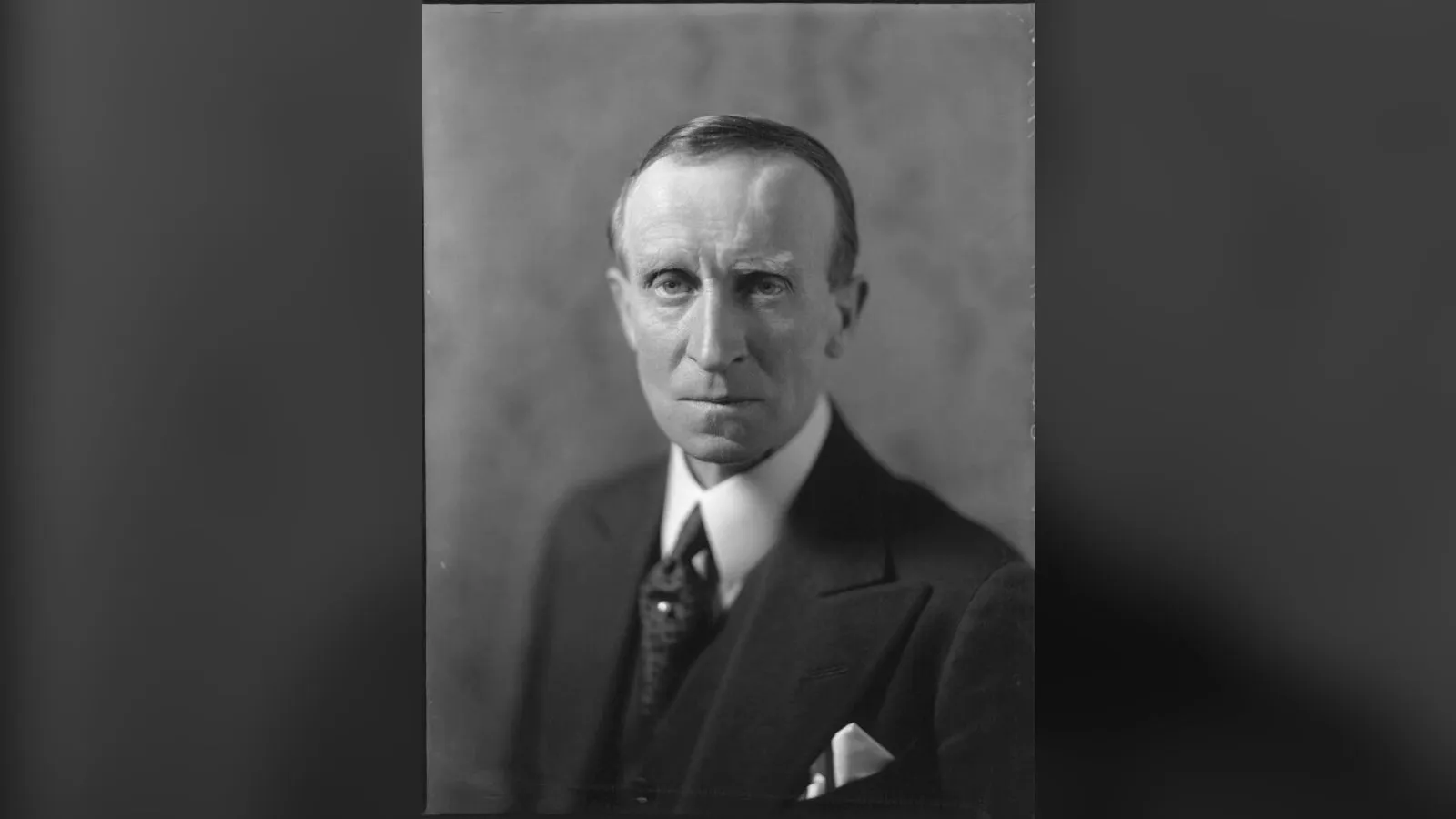

John Buchan, 1st Baron Tweedsmuir (1875–1940)
Contents
TL;DR
- established John Buchan was a Scottish novelist, historian, barrister, wartime intelligence official and politician who became Governor General of Canada (1935–1940) — one of the few people in modern history to combine a major literary career with senior statecraft.
- established His 1915 spy thriller The Thirty-Nine Steps, featuring Richard Hannay, essentially created the modern chase thriller; it has never been out of print and was adapted by Alfred Hitchcock in 1935.
- established As Governor General of Canada he founded the Governor General's Literary Awards (1936), which remain the country's premier literary prizes, and worked to strengthen Canadian constitutional identity and national unity during the Depression and the approach of the Second World War.
- disputed Buchan's novels contain passages of casual antisemitic and racial stereotyping that are genuinely unpleasant to modern readers; whether these reflect his own settled views or the voices of flawed characters he wrote critically is a real, ongoing scholarly disagreement — complicated by his simultaneous, well-documented public support for Zionism and for Jewish refugees from Nazism.
- established He died in Ottawa in February 1940 after a fall and stroke, while still in office, and was given a state funeral — the first Governor General to die in post since Confederation-era precedent made such funerals customary.
Key Facts
- Born
- 26 August 1875, Perth, Scotland
- Died
- 11 February 1940 (aged 64), Montreal, Canada
- Category
- Culture / Public Life
- Known for
- The Thirty-Nine Steps; Governor General of Canada; founder of the Governor General's Literary Awards
- Key works
- The Thirty-Nine Steps (1915), Greenmantle (1916), Prester John (1910), Sick Heart River (1941), biographies of Montrose, Scott, Caesar Augustus, Cromwell
- Titles
- 1st Baron Tweedsmuir (created 1935)
- Roles
- Barrister; Director of Information (WWI); Conservative/Unionist MP for the Scottish Universities (1927–1935); Governor General of Canada (1935–1940)
Scottish Impact Index (SI Score)
- Global Influence
- 6/10
- Enduring Relevance
- 7/10
- Material Contribution
- 4/10
- Exceptional Achievement
- 6/10
- Lasting Legacy
- 5/10
- Recognition
- 4/10
32/60
Ranked =80th of 200 in Great Scots
A Note on Claims and Evidence
Buchan's public career — barrister, publisher, wartime propaganda chief, MP, and Governor General — is extensively documented in official and institutional records and is treated here as established. His literary career and its reception are similarly well documented. The genuinely contested area concerns his personal attitudes toward Jewish people, where the textual evidence from his novels (some of it uncomfortable) sits alongside an equally well-documented record of pro-Zionist public advocacy; this article presents both bodies of evidence rather than resolving the dispute for the reader, and marks it clearly as disputed.
Timeline
Born in Perth, son of a Free Church of Scotland minister; raised partly in Kirkcaldy and the Scottish Borders.
Enters the University of Glasgow at 17; publishes while still a student.
First novel published.
Wins the Newdigate Prize for poetry at Brasenose College, Oxford; elected President of the Oxford Union.
Called to the Bar; travels to South Africa as private secretary to Alfred Milner during the final stages of the Boer War.
Joins the publisher Thomas Nelson & Sons.
Publishes Prester John.
Publishes The Thirty-Nine Steps; serves briefly as a war correspondent for The Times.
Commissioned into the Intelligence Corps on the Western Front; publishes Greenmantle.
Appointed Director of Information under the War Cabinet.
Heads the Department of Intelligence within the new Ministry of Information.
Elected MP for the Combined Scottish Universities.
Wins the James Tait Black Memorial Prize for his biography of the Marquess of Montrose.
Appointed Governor General of Canada and created 1st Baron Tweedsmuir — the first Governor General appointed under the Statute of Westminster on the advice of Canada's own prime minister alone.
Establishes the Governor General's Literary Awards.
Delivers his "first loyalty is to Canada" speech in Montreal; sworn of the Privy Council.
Helps conceive the royal tour of Canada by King George VI and Queen Elizabeth; Canada declares war on Germany on 10 September, a week after Britain, partly on timing Buchan helped manage.
Suffers a fall and stroke at Rideau Hall.
Dies in Montreal, aged 64, after surgery by neurologist Wilder Penfield; given a state funeral in Ottawa.
Details
A writer before he was anything else
Buchan was extraordinarily prolific and extraordinarily fast: over a working life of some 45 years he wrote more than 100 books, including nearly 30 novels, seven collections of short stories, and substantial biographies of Sir Walter Scott, Julius Caesar's heir Augustus, Oliver Cromwell, and the Marquess of Montrose — the last of which won the James Tait Black Memorial Prize in 1928. He did almost all of this while holding full-time jobs: as a practising barrister, as a senior figure at the publisher Thomas Nelson & Sons, as a wartime civil servant, and eventually as a sitting Member of Parliament and head of state's representative in Canada. Friends and biographers alike struggled to explain how he managed the output; much of it was written at speed, in the early morning or late at night, around a punishing day job.
His most famous book by far is The Thirty-Nine Steps (1915), written while recovering from a duodenal ulcer and conceived explicitly as "a shocker" — a pulse of pure plot rather than literary ambition. Its hero, Richard Hannay, drawn partly from Buchan's South African friend Edmund Ironside, is chased across Scotland by German agents in the days before the First World War. The book essentially invented the modern man-on-the-run thriller: critic and novelist Graham Greene credited it with setting "a pattern for adventure-writers ever since," and it has influenced writers from Eric Ambler to Ian Fleming. Alfred Hitchcock's 1935 film adaptation, though it departs substantially from the novel's plot, cemented the story in popular culture; The Guardian ranked the novel 42nd in its 2015 list of the 100 best English-language novels.
Empire, intelligence, and the machinery of wartime propaganda
Buchan's career was shaped early by the British Empire at its most confident and most troubled. In 1901 he went to South Africa as private secretary to Alfred Milner, the High Commissioner, serving through the final phase of the Boer War as part of the group of young administrators known as "Milner's Kindergarten." The experience gave him firsthand knowledge of colonial administration and of the African landscapes that recur throughout his fiction, including Prester John (1910).
During the First World War, Buchan moved from writing about intelligence to practising it. He worked in the Foreign Office, reported briefly from France for The Times, and in 1916 received a field commission into the Intelligence Corps attached to British Army General Headquarters on the Western Front. His organisational talent was noticed at the highest level: in 1917 the War Cabinet under David Lloyd George appointed him Director of Information, putting him in charge of Britain's wartime propaganda effort, and in 1918 he became head of intelligence within the newly formed Ministry of Information under Lord Beaverbrook. Throughout the war he also continued writing a vast, 24-volume History of the War for Nelson's, published in near-real time as the conflict unfolded — an extraordinary feat of sustained, pressured narrative history written while he was simultaneously running part of the state's propaganda apparatus.
Governor General of Canada: constitutional firsts and national unity
In 1935, on the advice of Canadian Prime Minister R. B. Bennett, King George V appointed Buchan Governor General of Canada, raising him to the peerage as 1st Baron Tweedsmuir in the same year. The appointment was constitutionally significant: he was the first Governor General named under the Statute of Westminster on the advice of Canada's own government alone, rather than through the British government, formally reflecting Canada's status as a fully self-governing dominion.
Buchan took Canadian unity as his central mission. He had written admiringly about Canada as a Spectator journalist, followed Canadian troops during the First World War while compiling his war history, and visited the country in 1924; as Governor General he travelled extensively, including into the Arctic, at a time when the Depression had strained the country's regional and economic cohesion. He deliberately championed ethnic pluralism rather than assimilation, arguing publicly that Canada's different communities "should retain their individuality and each make its contribution to the national character" and that "the strongest nations are those that are made up of different racial elements" — a notably progressive position for a senior imperial official to take in the 1930s. A 1937 speech in Montreal, in which he said a Canadian's "first loyalty is not to the British Commonwealth of Nations, but to Canada, and to Canada's King," was initially reported by the Montreal Gazette as disloyal to Britain before it emerged Buchan had personally added the words "and to Canada's King" to the typed draft by hand.
His most lasting Canadian legacy is cultural: in 1936, after discussions with the Canadian Authors Association, he established the Governor General's Literary Awards, which remain Canada's most prestigious national literary prizes, awarded annually across English- and French-language categories. He and his wife, Susan Buchan, Lady Tweedsmuir, also established the first proper library at the Governor General's official residence, Rideau Hall.
Buchan also found himself at the centre of constitutional history during the 1936 abdication crisis. Following the death of King George V and the accession of Edward VIII, he relayed Canadian government concerns about the king's proposed marriage to Wallis Simpson to Buckingham Palace and the British prime minister, and as Governor-in-Council formally approved Canada's abdication legislation, later granting royal assent to the Succession to the Throne Act of 1937. He later remarked, with some dry humour, that in a single year as Governor General he had represented three different monarchs.
As war approached, Buchan worked to strengthen ties between Canada and the United States, meeting President Franklin D. Roosevelt twice, and helped conceive the hugely successful 1939 royal tour of Canada by King George VI and Queen Elizabeth, intended to visibly demonstrate Canada's status as an independent kingdom rather than a colonial dependency. His experience of the First World War had left him strongly averse to another conflict, and in the late 1930s he attempted, without success, to help coordinate an international effort with Mackenzie King and Roosevelt aimed at avoiding war. When Canada did declare war on Germany on 10 September 1939 — deliberately a week after Britain — the delay, which Buchan helped manage, allowed American military supplies to reach Canada before United States neutrality laws would otherwise have restricted them.
The antisemitism question: a genuinely contested record
No honest account of Buchan can set this aside. Several of his early novels, The Thirty-Nine Steps chief among them, contain passages of casual antisemitic and racial stereotyping that read as plainly offensive to a modern audience, and this has produced a real, long-running critical argument rather than a settled verdict.
The most frequently cited passage is spoken by the character Scudder, a paranoid American journalist in The Thirty-Nine Steps who claims a vast Jewish-led conspiracy is manipulating world finance. Critics — including the writer Anthony Storr, who called Buchan "overtly antisemitic," and a 1996 Herald (Glasgow) piece that described an unpublished Buchan satirical poem, The Semitic Spirit Speaks, as "poisoned by prejudice" — have treated such passages as evidence of the author's own views. The Penguin Companion to English Literature called Buchan "a convinced imperialist" whose underlying political assumptions were "less admirable" than his surface charm.
Other scholars argue the picture is more complicated and point to textual and biographical evidence cutting the other way. Within The Thirty-Nine Steps itself, Hannay treats Scudder's claims sceptically from the start, and a senior British intelligence officer later in the book explicitly dismisses Scudder as unreliable and prejudiced, noting that "Jews, for example, made him see red" — in other words, the novel frames the antisemitic conspiracy theory as the paranoid delusion of a specific, flawed character rather than endorsing it as fact. Buchan's granddaughter, the writer and biographer Ursula Buchan, has made this case at length, while also cautioning against reading 1915 fiction through a wholly anachronistic lens, noting that "racial and national stereotyping, favourable and unfavourable, was commonplace throughout all society" at the time — a genuine historical point, though not one that fully answers why Buchan chose to write the stereotypes he did.
Set against the fictional evidence is a substantial and specific real-world record. Buchan was close friends with Hermann Eckstein, a South African Jewish mining magnate who hosted his engagement party in 1907, and with Lionel Phillips, at whose home he honeymooned. From 1930 he was a public and increasingly prominent supporter of Zionism, telling a Jewish National Fund demonstration in 1934 that the Zionist project represented "a great act of justice… a reparation for the centuries of cruelty and wrong which have stained the record of nearly every Gentile people." He was a personal friend of the Zionist leader (and future first President of Israel) Chaim Weizmann, condemned Nazi persecution of German Jews from the floor of Parliament, and as Governor General he and Lady Tweedsmuir continued to speak publicly in favour of Zionism, lending what one historian of Canadian Jewish life called "the cachet of the Crown" to the cause; the same history describes Buchan as the "most visible supporter" of Jewish Canadians during his tenure. Both Buchan and his wife had their names entered in the Golden Book of the Jewish National Fund of Israel, and a 1938 Nazi reference publication, Who's Who in Britain (Frankfurt), listed him under "pro-Jewish activity" — intended as a hostile label, but a striking piece of contemporary evidence about how Buchan was actually perceived by the regime whose antisemitism he had publicly opposed.
Critic Roger Kimball, reviewing this record, concluded that it was "likely" Buchan held some of the casual prejudices common to his class and era, at least into the 1930s, but that "by the time the Nazis came along, Buchan had abandoned any aspersions against Jews in his novels" and had become, in practice, a committed philo-Semite. This article presents the evidence on both sides rather than adjudicating it: the uncomfortable passages in the fiction are real and are not explained away, and the record of sustained public advocacy for Jewish refugees and Zionism in the 1930s is equally real and documented. Readers should weigh both.
Death in office
On 6 February 1940, Buchan suffered a fall and a stroke at Rideau Hall. Despite two operations performed by the pioneering neurologist Wilder Penfield, he did not recover, and died in Montreal on 11 February 1940 at the age of 64, while still serving as Governor General. He lay in state in the Senate chamber of the Canadian Parliament and was given a state funeral at St Andrew's Presbyterian Church in Ottawa; Canadian Prime Minister Mackenzie King eulogised him as one of "the greatest and most revered" of Canada's Governors General. His ashes were returned to Britain aboard HMS Orion for burial at Elsfield, Oxfordshire, with memorial services held at Westminster Abbey and St Giles' Cathedral in Edinburgh.
A lasting, complicated legacy
Buchan's influence reaches well beyond his own books. J. R. R. Tolkien admired and was influenced by his adventure fiction; the military historian John Keegan called him "a writer touched by genius" with a rare gift for conveying "moral atmosphere." In Canada, his memory is kept alive institutionally through the Governor General's Literary Awards he founded, and several of his viceregal successors — including Vincent Massey, Georges Vanier, Adrienne Clarkson, and David Johnston — have cited his approach to the office as a model. Canada's Historic Sites and Monuments Board formally designated him a person of national historic significance in 2010. Tweedsmuir South and North Provincial Parks in British Columbia, created in 1938, carry his title, as do streets, schools, and other landmarks across the country he served.
Did You Know?
- Buchan published six books before he had even graduated from Oxford.
- He wrote The Thirty-Nine Steps while recovering from a duodenal ulcer, deliberately calling it "a shocker" rather than serious literature.
- He headed Britain's wartime propaganda ministry during the First World War while simultaneously writing a 24-volume history of the war in near-real time.
- His 1937 "first loyalty to Canada" speech was briefly denounced as disloyal to Britain by a newspaper that hadn't seen his handwritten addition of "and to Canada's King."
- The Governor General's Literary Awards he founded in 1936 are still Canada's top literary honour today.
- A 1938 Nazi reference work listed him, as a hostile label, under "pro-Jewish activity."
- He joked that in one year as Governor General he had formally represented three different kings: George V, Edward VIII, and George VI.
- His final novel, Sick Heart River, published after his death, follows a dying man confronting mortality in the Canadian wilderness — widely read as reflecting Buchan's own final illness.
FAQ
1Was John Buchan primarily a writer or a politician?
Both, genuinely. He sustained a major literary career across more than 100 books while simultaneously working as a barrister, publisher, wartime intelligence official, Member of Parliament, and ultimately Governor General of Canada.
2What is John Buchan best known for today?
The Thirty-Nine Steps (1915), a spy thriller that helped establish the modern chase-thriller genre and was adapted by Alfred Hitchcock in 1935.
3Was John Buchan Scottish or Canadian?
Scottish by birth and upbringing; he served as Canada's Governor General from 1935 until his death in 1940 and is honoured in both countries.
4Did John Buchan actually hold government intelligence roles, or is that exaggerated by his thriller-writer reputation?
It's real. He served in the Intelligence Corps on the Western Front and was appointed Director of Information by the War Cabinet in 1917, effectively running Britain's wartime propaganda effort.
5Was John Buchan antisemitic?
This is genuinely disputed. Some of his early fiction contains antisemitic and racial stereotyping that is offensive to modern readers. He was also a prominent, documented supporter of Zionism and Jewish refugees from Nazi Germany from the 1930s onward, and was personally close to Jewish friends throughout his life. Scholars disagree on how to weigh these facts against each other.
6What did John Buchan do as Governor General of Canada?
He worked to strengthen Canadian national unity and constitutional identity, founded the Governor General's Literary Awards, helped manage the 1939 royal tour of Canada, and played a role in the constitutional handling of the 1936 abdication crisis and Canada's 1939 declaration of war.
7How did John Buchan die?
He suffered a fall and a stroke at Rideau Hall in Ottawa on 6 February 1940 and died five days later in Montreal, aged 64, still in office.
8What is the Governor General's Literary Award?
Canada's most prestigious national literary prize, established by Buchan in 1936 and still awarded annually.
9Did Buchan write anything other than thrillers?
Yes — substantial biographies of Sir Walter Scott, the Roman emperor Augustus, Oliver Cromwell, and the Marquess of Montrose (which won the James Tait Black Memorial Prize), plus a 24-volume history of the First World War.
10Is Richard Hannay based on a real person?
Partly. Buchan drew on his South African friend Edmund Ironside, a British Army officer, in creating the character.
Sources and Further Reading
Primary / Institutional
- Library and Archives Canada / Governor General of Canada, official biographical materials on John Buchan, 1st Baron Tweedsmuir
- National Library of Scotland, "John Buchan and 'The Thirty-Nine Steps'"
- Historic Sites and Monuments Board of Canada, designation of John Buchan as a person of national historic significance (2010)
Scholarly / Critical
- The Penguin Companion to English Literature, entry on John Buchan
- Roger Kimball, essay on Buchan and the antisemitism question (The New Criterion / republished discussion)
- Jordan M. Poss, "Was John Buchan an anti-Semite?" (2023), weighing textual and biographical evidence
- Christopher Tayler, "The Manners of a Hog: Buchan's Banter," London Review of Books
General
- Wikipedia, "John Buchan" (overview, cross-checked against institutional sources above)
- Ursula Buchan, biographical and family commentary on her grandfather's reputation
- The Guardian, 100 best English-language novels list (2015), entry on The Thirty-Nine Steps
Caveats: Myths and Disputed Claims
- Myth: Buchan was simply an unreflective imperial propagandist with no literary merit. Reality: Critics across the political spectrum, including Graham Greene and John Keegan, have credited him with genuine and lasting literary influence, particularly in establishing the modern thriller.
- disputed Whether the antisemitic and racist content in Buchan's early fiction reflects his personal views or is a (clumsy, dated) narrative device distancing those views from flawed characters is not resolved by the evidence and should not be presented as settled in either direction.
- Myth: Buchan's "first loyalty to Canada" remark was a calculated snub to Britain. Reality: Contemporary reporting mischaracterised an incomplete version of the speech; Buchan had added "and to Canada's King" by hand, a detail that changes its meaning considerably.
- Clarify: Buchan did not invent the spy thriller genre outright, but The Thirty-Nine Steps is widely credited with setting its modern template, particularly the "innocent man on the run" structure used by countless later writers and filmmakers.
Card 099 · Great Scots