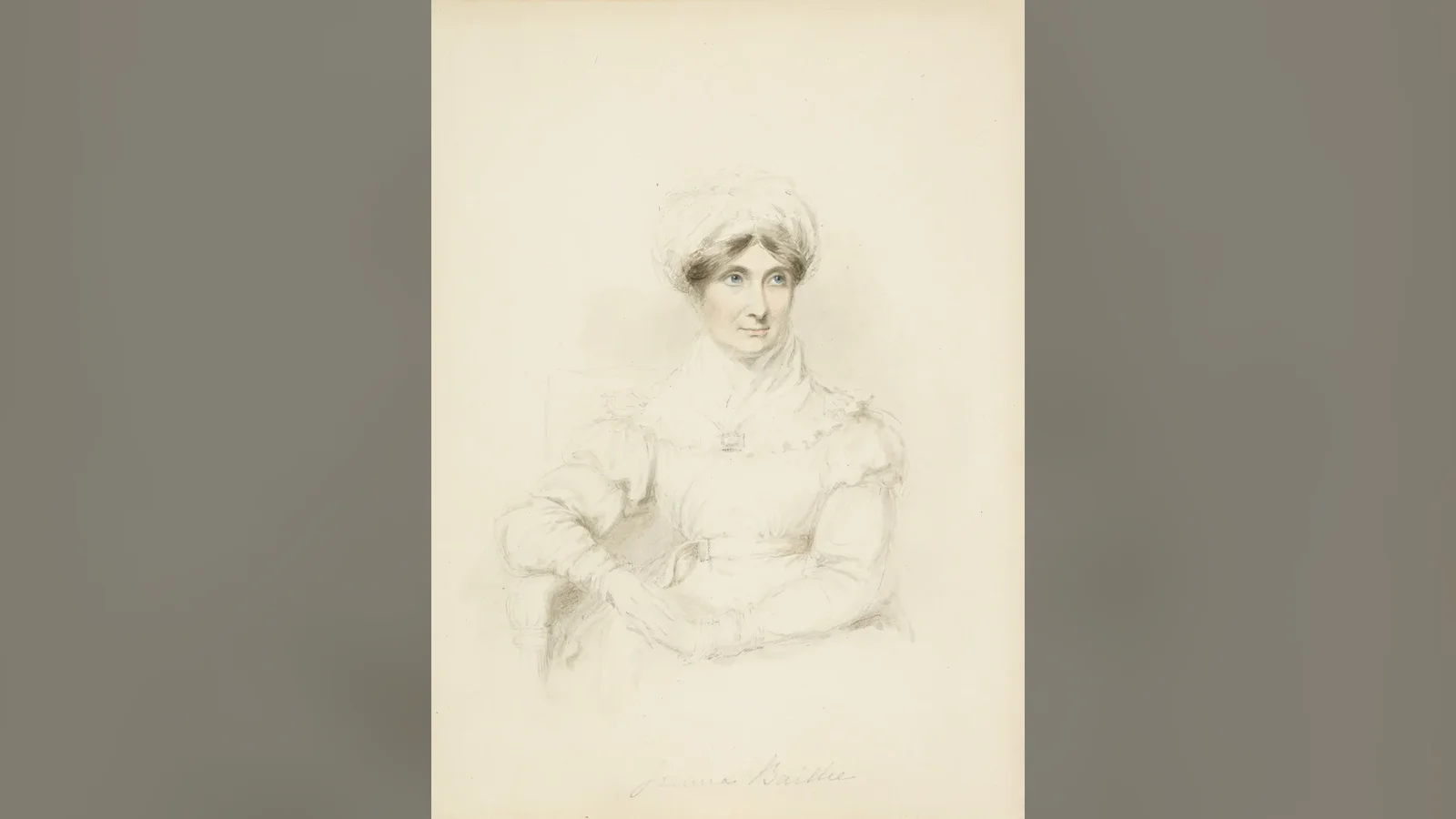

Joanna Baillie (1762–1851)
Contents
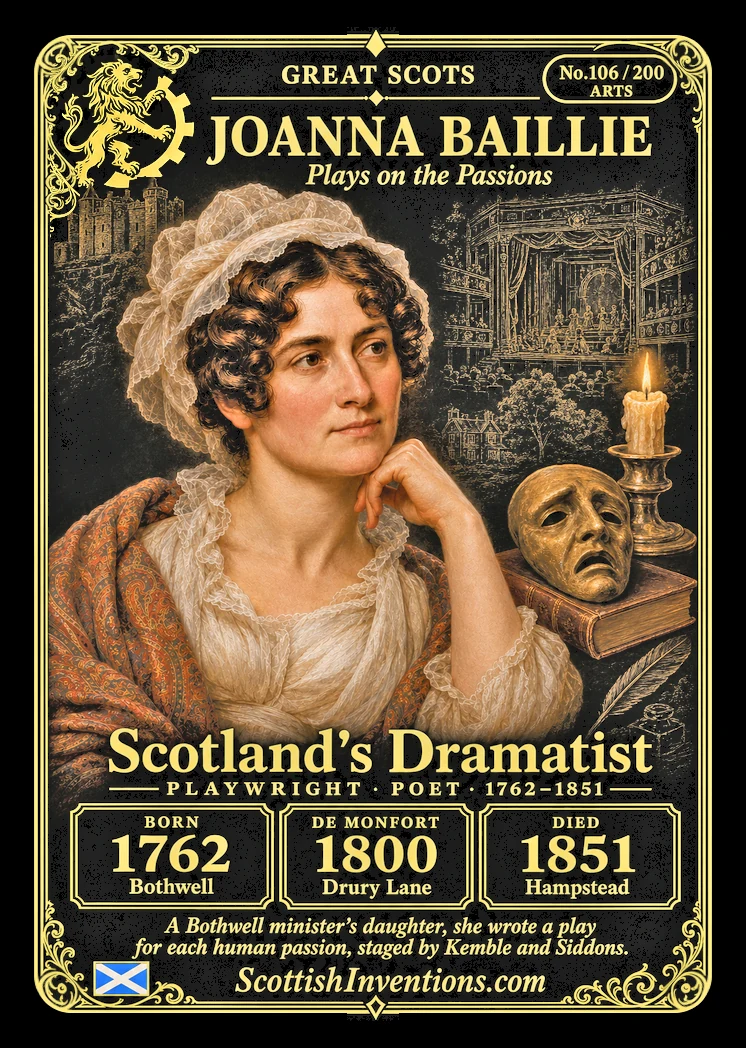
Joanna Baillie was the most admired British playwright of her generation, and a Scottish woman, at a time when serious drama was assumed to be a man's work.
TL;DR
- established Born at Bothwell manse in Lanarkshire in 1762, Baillie moved to London in 1783 and lived in Hampstead from the early 1790s until her death in 1851.
- established Her A Series of Plays (1798), better known as the Plays on the Passions, set out to give each strong human passion its own tragedy and comedy, with a preface that became an important piece of Romantic theatre theory.
- established De Monfort was staged at Drury Lane in April 1800 with John Philip Kemble and Sarah Siddons, and The Family Legend, a Highland tragedy, was a hit at Edinburgh's Theatre Royal in 1810, produced at Walter Scott's insistence.
- shared She was celebrated as the leading dramatist of her day, but few of her many plays were ever performed, and her stage success was modest compared with her reputation in print.
- shared She believed hostile reviews, notably from Francis Jeffrey, hardened once it emerged that the anonymous author was a woman.
Key Facts
- Born
- 11 September 1762, Bothwell, Lanarkshire
- Died
- 23 February 1851, Hampstead, London (aged 88)
- Parents
- Rev. James Baillie, Church of Scotland minister and later Professor of Divinity at Glasgow; Dorothea Hunter
- Family
- Niece of the surgeons William and John Hunter; sister of the physician Matthew Baillie
- Occupation
- Playwright and poet
- Best-known works
- A Series of Plays (1798), De Monfort (staged 1800), The Family Legend (1810), Witchcraft (1836)
- Lifelong companion
- Her sister Agnes Baillie (1760–1861)
A Note on Claims and Evidence
Each major claim carries one of three labels. established means supported by primary records, official bodies or several independent reliable sources. shared means the core fact is sound but sources disagree on details, dates or interpretation. traditional means widely repeated but not traceable to a primary or independent source.
Baillie's life is well documented: her own memoranda, two volumes of collected letters and the records of the London and Edinburgh theatres. Dates of publication and first performances are therefore treated as established. Judgements about her standing, and about why critics turned on her, are shared: her contemporaries agreed she was important, but they disagreed sharply about whether her plays worked on stage. Where secondary sources give different dates (one modern handbook dates the Edinburgh Family Legend to 1812), the 1810 date given by the theatre record and the first edition is used here.
Timeline
Born on 11 September at Bothwell, Lanarkshire, the younger daughter of the parish minister.
Her father becomes Professor of Divinity at the University of Glasgow; she is at boarding school in the city, where she sees her first play.
Her father dies; the family moves to Long Calderwood, the Hunter estate near Glasgow.
Moves to London when her brother Matthew inherits William Hunter's anatomy school in Windmill Street.
Publishes Poems anonymously.
Settles in Hampstead with her mother and sister Agnes.
A Series of Plays, the first volume of the Plays on the Passions, appears anonymously.
De Monfort opens at Drury Lane with John Philip Kemble and Sarah Siddons.
Further volumes of plays, including Miscellaneous Plays (1804).
Tours the north with Agnes and stays with Walter Scott in Edinburgh.
The Family Legend is a success at the Theatre Royal, Edinburgh.
Publishes Metrical Legends, including a verse life of William Wallace.
Her last new plays reach the stage, The Homicide at Drury Lane and The Separation at Covent Garden; she publishes three volumes of Dramas, including the Scots-language Witchcraft.
Fugitive Verses, her last original volume.
Dies at Hampstead on 23 February, shortly after completing a one-volume edition of her collected works.
Details
A minister's daughter in a family of surgeons
established Baillie's mother was a sister of William and John Hunter, the anatomists whose collections became the core of the Hunterian Museum in Glasgow and the Hunterian at the Royal College of Surgeons in London. Her brother Matthew Baillie became a leading London physician. The young Joanna was, by her own account, slow to learn to read and write, though "quick in apprehending or learning anything else", and she remained a poor speller all her life. established She saw her first play while at boarding school in Glasgow and re-enacted scenes with her schoolfellows. When Matthew inherited William Hunter's anatomy school in 1783, the Baillie women moved south with him, and after his marriage they set up home in Hampstead. Her aunt, the poet Anne Home Hunter, encouraged her to write.
The Plays on the Passions
established In 1798 Baillie published, without her name, A Series of Plays: in which it is attempted to delineate the stronger passions of the mind, each passion being the subject of a tragedy and a comedy. The plan was ambitious and new. Rather than building a drama around plot or spectacle, each play would trace one passion, love, hatred or ambition, from its first stirrings to its full force. The volume included Count Basil (love), De Monfort (hatred) and the comedy The Trial. Its long "Introductory Discourse" argued that the theatre should show the growth of passion in ordinary human nature, and modern scholars treat it as one of the key statements of Romantic dramatic theory.
shared The anonymous volume attracted wide attention and speculation about its author. Once Baillie's identity became known, the tone of some reviews changed. She herself thought this was because the "hitherto concealed Dramatist" had turned out to be "a private Gentlewoman of no mark or likelihood". The Edinburgh reviewer Francis Jeffrey was the most damaging critic.
On stage: Drury Lane and Edinburgh
established De Monfort opened at Drury Lane on 29 April 1800, with the leading actors of the age, John Philip Kemble and his sister Sarah Siddons. It was respectfully received but not a popular hit: modern critics describe it as a somewhat stilted heroic verse tragedy. Kemble kept it in his repertoire, and it did especially well in Edinburgh during his farewell tour of 1817.
established Her greatest stage success came in Scotland. After touring the Highlands in 1808, she wrote The Family Legend, a tragedy drawn from a sixteenth-century feud between the Campbells and the Macleans. Walter Scott, a shareholder and acting trustee of the Theatre Royal in Edinburgh, insisted it be staged there, and it opened in 1810 with Harriet Siddons in the lead. Scott wrote the prologue, and Henry Mackenzie, author of The Man of Feeling, the epilogue. The audience applauded it rapturously, and Scott described it in a letter as "entirely of Scotch manufacture". It was revived in Newcastle, Bath and at Drury Lane.
A Scottish voice in London
shared Baillie spent almost all her adult life in London, but she was claimed in Edinburgh as a Scottish woman of letters, and she wrote some of her most distinctive work about Scotland. Witchcraft (1836), set in Scotland, is notable for its sustained attempt to put believable Scots speech on stage. Her Metrical Legends (1821) included a long poem on William Wallace which, in the critic Nigel Leask's account, was made to praise the 1707 Union, an example of how Scottish writers of the period turned national heroes into ancestors of British liberty. Like James Thomson before her, she wrote for a British readership but kept a noticeable Scottish accent in daily speech.
Friend of Scott, and a great letter-writer
established Her friendship with Walter Scott, which began about 1806, was one of the closest literary friendships of the period. He promoted her work in Edinburgh and London, worked hard on the Edinburgh productions of her plays and advised her, in long letters, on how to deal with publishers. Her letters, now published in two volumes, are a rich record of early Romantic literary society; one history of Scottish literature lists her among the great Scottish letter-writers of the nineteenth century, alongside Scott, Byron and the Carlyles.
Fame and forgetting
shared By the 1810s Baillie was widely regarded as the leading dramatist of her day, and her plays were translated into German and French. Yet only a handful were ever produced, and none became a lasting stage favourite. After her death her reputation faded quickly. Since the 1990s, scholars of Romantic drama and women's writing have restored her to the canon, through new editions of her plays, her collected letters and a 2002 literary biography by Judith Bailey Slagle. She worked to the end, finishing a one-volume edition of her collected Dramatic and Poetical Works shortly before she died in 1851, aged 88.
Did You Know?
- Baillie's uncles were the famous surgeon-anatomists William and John Hunter.
- She said she was unusually slow to learn to read and write, and she misspelled words all her life.
- Her first play, Arnold (1790), is lost.
- Her surviving letters are numerous enough to fill two published volumes.
- Her biggest stage hit, The Family Legend, had a prologue by Walter Scott and an epilogue by Henry Mackenzie.
- She lived with her sister Agnes for almost her whole life; Agnes outlived her by ten years and died aged about 100.
- Her plays were translated into German and French during the Napoleonic Wars, when little else of Scottish literature crossed the Channel.
From the archive
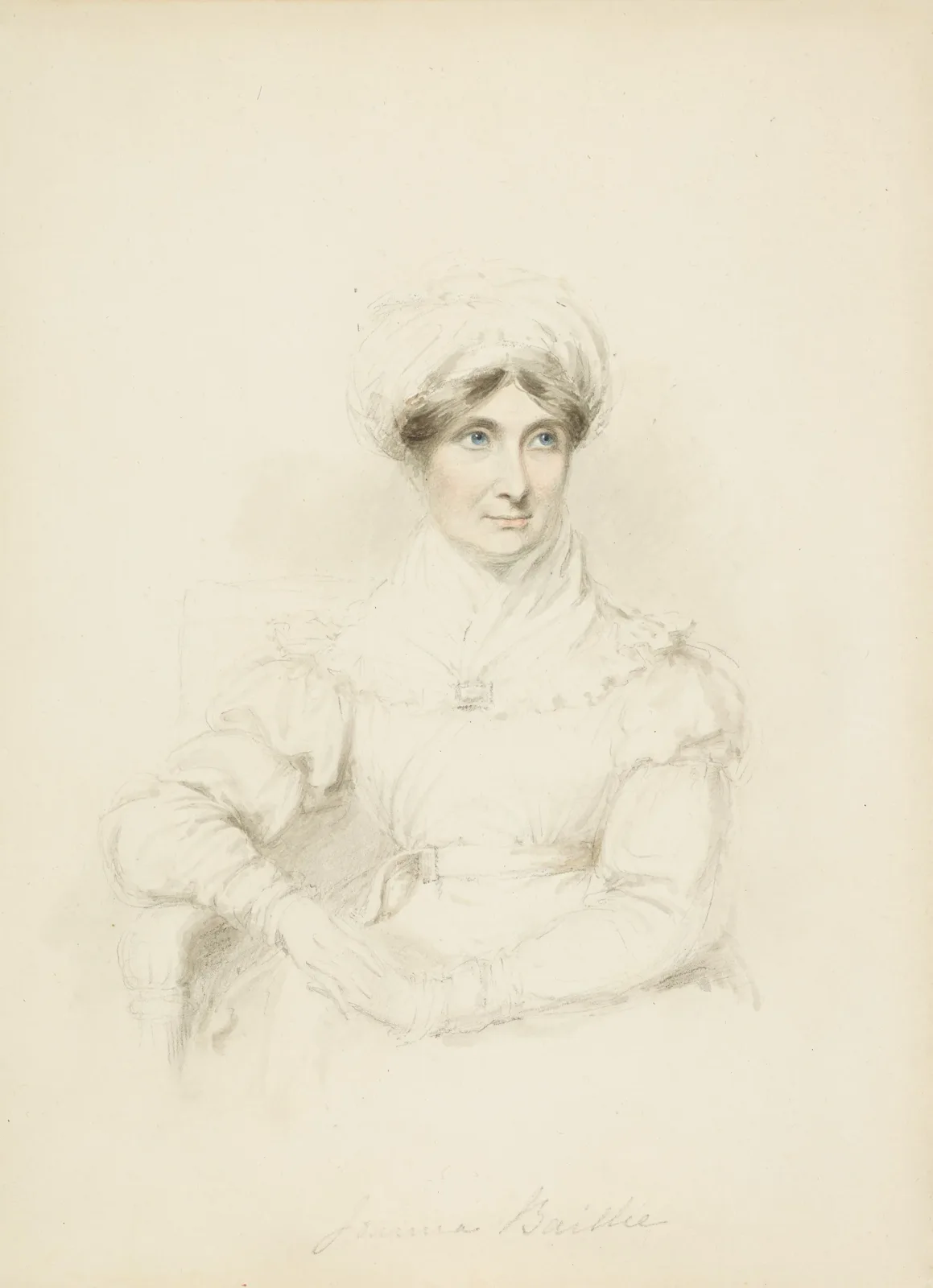
Original documents and images from the period.
FAQ
1Who was Joanna Baillie?
A Scottish playwright and poet, born at Bothwell in 1762, who became the most celebrated British dramatist of the early nineteenth century.
2What are the Plays on the Passions?
The popular name for her A Series of Plays (1798 and later volumes), in which each play traces a single passion, such as hatred in De Monfort or love in Count Basil.
3Were her plays performed?
Some were. De Monfort opened at Drury Lane in 1800 with Kemble and Siddons, and The Family Legend was a hit in Edinburgh in 1810. But most of her plays were read rather than staged.
4Why did she publish anonymously?
It was common for women writers of the period. Baillie believed critics became harsher once they discovered the author was a woman.
5Was she friends with Walter Scott?
Yes, closely. Scott championed her work, arranged the Edinburgh production of The Family Legend and corresponded with her for decades.
6Did she write in Scots?
Mostly she wrote in English verse, but Witchcraft (1836) makes a sustained attempt at realistic Scots dialogue, and The Family Legend is set in the Highlands.
7Where did she live?
In Hampstead, then a village outside London, from the early 1790s until her death in 1851.
8Why is she less well known today?
Her plays did not hold the stage, and Victorian taste moved away from verse tragedy. Interest revived from the 1990s with new editions and scholarship.
9Did she marry?
No. She lived with her sister Agnes.
10What was her connection to medicine?
Her uncles William and John Hunter and her brother Matthew Baillie were among the leading anatomists and physicians of their time.
Sources and Further Reading
Primary/Institutional
- Joanna Baillie, A Series of Plays (1798); The Dramatic and Poetical Works of Joanna Baillie (1851).
- Judith Bailey Slagle (ed.), The Collected Letters of Joanna Baillie, 2 vols (1999).
- Royal College of Surgeons of England: Hunter-Baillie papers.
Scholarly/Critical
- Elizabeth Ewan, Rose Pipes et al. (eds), The New Biographical Dictionary of Scottish Women (Edinburgh University Press, 2018), entry "Baillie, Joanna".
- Barbara Bell, "The National Drama, Joanna Baillie and the National Theatre", in The Edinburgh History of Scottish Literature, vol. 2 (2007).
- Nigel Leask and others, The Edinburgh History of Scottish Literature, vol. 2: Enlightenment, Britain and Empire (1707–1918) (2007).
- Bill Bell (ed.), The Edinburgh History of the Book in Scotland, vol. 3: Ambition and Industry 1800–1880 (2007).
- Judith Bailey Slagle, Joanna Baillie: A Literary Life (2002).
General
- T. M. Devine and Jenny Wormald (eds), The Oxford Handbook of Modern Scottish History (2012).
Caveats: Myths and Disputed Claims
- Disputed: when The Family Legend was staged in Edinburgh. The first edition and the theatre record give 1810; one modern handbook says 1812. The 1810 date is the better attested.
- Myth: she was a stage failure. Several of her plays were produced with leading actors, and The Family Legend was a genuine success. What is true is that her stage record never matched her reputation in print.
- Disputed: why reviewers turned against her. Baillie thought it was because she was revealed to be a woman. That is her own explanation; critics also objected to her theory of drama on its merits.
Finished reading? Try the Fact Machine: three reels, one surprising Scottish connection →
Card 106 · Great Scots