
Robert Burns (1759–1796): Scotland's National Poet, Examined Without Flattery
Contents
TL;DR
- Established (Documented): Burns rose from a hardscrabble Ayrshire tenant-farming childhood to become, through the 1786 Kilmarnock edition of his poems and their sensational Edinburgh reception, the most celebrated poet in Scotland within a single year — a genuine and extraordinary achievement of talent overcoming circumstance.
- Established, and uncomfortable: In 1786, facing debt and an unwed pregnancy, Burns seriously planned to emigrate to Jamaica to work as a bookkeeper on a slave plantation — a role that directly involved overseeing enslaved labour, and which he himself described, in his own words, as becoming "a poor Negro driver." He was saved from this path by his sudden literary success, not by a change of principle.
- Established (Documented): Burns fathered at least twelve children by at least four different women, only three of whom he formally married (Jean Armour); this pattern of repeated, often exploitative relationships with servants and other women of lower social standing has been directly and critically re-examined by contemporary Scottish writers, including poet Liz Lochhead, who has called him a "sex pest."
- Established (Documented): His genuine political radicalism — open sympathy for the American and French Revolutions, support for parliamentary reform, and poetry with real democratic bite such as "A Man's a Man for A' That" — created real professional risk for him as a government excise officer, and he was obliged to publicly demonstrate loyalty to the Crown to protect his livelihood.
- Shared/Traditional, corrected by modern research: Burns's death at 37 has long been popularly attributed to alcoholism, a characterization substantially originating with a hostile early biographer. Modern medical analysis instead points to a long-standing rheumatic heart condition, likely dating from a bout of rheumatic fever at 21, fatally compounded by a dental infection.
- Established (Documented): For more than a century Burns was a favourite author of self-educated working people and a model for would-be writers among them. When the first large group of Labour MPs was asked in 1906 which authors had most influenced them, 8 of the 45 who replied named Burns, and Keir Hardie counted him among his three formative influences.
Key Facts
- Born
- 25 January 1759, Alloway, Ayrshire, Scotland
- Died
- 21 July 1796, Dumfries, aged 37
- Parents
- William Burnes, tenant farmer; Agnes Broun
- Occupation
- Farmer, poet, songwriter, excise officer
- Major work
- Poems, Chiefly in the Scottish Dialect (the "Kilmarnock edition"), 1786
- Wife
- Jean Armour, married 1788
- Children
- At least 12, by at least 4 different women; only 3 survived to adulthood with Jean
- Notable poems/songs
- "Auld Lang Syne," "Tam o' Shanter," "A Man's a Man for A' That," "To a Mouse," "Scots Wha Hae," "Ae Fond Kiss"
- Political stance
- Open sympathiser with American and French revolutionary ideals; advocate of parliamentary reform
- Career from 1789
- Excise (customs) officer, Dumfries
- National standing
- Voted "The Greatest Scot" in a 2009 public poll
Scottish Impact Index (SI Score)
- Global Influence
- 10/10
- Enduring Relevance
- 10/10
- Material Contribution
- 8/10
- Exceptional Achievement
- 9/10
- Lasting Legacy
- 9/10
- Recognition
- 10/10
56/60
Ranked =5th of 200 in Great Scots
A Note on Claim Status
This article follows ScottishInventions.co.uk's standard evidence tiers: Established/Documented (supported by primary sources or strong scholarly consensus), Shared/Traditional (widely repeated but resting on thinner evidence), disputed (credible sources disagree), and Legend/Myth (popular but unsupported or contradicted by the record). Burns is Scotland's most mythologised literary figure, and this article deliberately sets aside the sentimentalised "heaven-taught ploughman" and romantic-rogue framings in favour of the documented record — including the genuinely uncomfortable Jamaica episode and the pattern of relationships with women that recent scholarship and criticism have rightly re-examined.
Timeline
Born in Alloway, Ayrshire, the eldest of seven children.
Tutored by John Murdoch in reading, Latin, French, and mathematics, alongside irregular farm schooling.
Family moves to Lochlea farm near Tarbolton.
Meets Richard Brown, who encourages his literary ambitions.
Father William dies; Robert and brother Gilbert take on farm management, with continued financial struggle.
First child, Elizabeth "Bess," born to Elizabeth Paton, his mother's servant.
Jean Armour becomes pregnant with twins; Burns signs an informal marriage attestation, but her father rejects the match and sends her away.
Facing debt, Burns accepts a position as a plantation bookkeeper in Jamaica; begins preparations to emigrate.
Publishes Poems, Chiefly in the Scottish Dialect (Kilmarnock edition); immediate and widespread success.
Postpones, and ultimately abandons, his planned emigration to Jamaica after receiving encouragement to pursue an expanded Edinburgh edition.
Mary Campbell ("Highland Mary"), with whom Burns had a serious romantic attachment, dies of typhus.
Travels to Edinburgh; received into the city's literary establishment.
Henry Mackenzie's review in The Lounger calls Burns a "Heaven-taught ploughman".
William Creech publishes the Edinburgh edition; Burns sells his copyright for 100 guineas, ultimately earning around £400.
Conducts a passionate correspondence and affair with Agnes "Nancy" McLehose ("Clarinda") in Edinburgh; also has a relationship with her servant, Jenny Clow, who bears him a son.
The first American editions of his poems appear at Philadelphia and, a few months later, at New York, the New York edition with a selection of poems chiefly by Robert Fergusson.
Resumes and formalises his relationship with Jean Armour; they marry.
Takes up training as an excise officer while farming Ellisland.
Acts as librarian of a small subscription library for tenants and farmers in Dunscore parish, set up by his neighbour Robert Riddell of Glenriddell (the Monkland Friendly Society); the scheme is recorded in the Statistical Account of Scotland.
Writes "Tam o' Shanter" at Ellisland.
Abandons farming to focus on excise duties and songwriting from Dumfries.
Writes "Scots Wha Hae," later treated as an unofficial Scottish national anthem.
Enlists in the Royal Dumfries Volunteers to demonstrate loyalty to the Crown and protect his excise career amid suspicion over his radical sympathies.
Writes "A Man's a Man for A' That."
Dies in Dumfries, aged 37.
Given a military-style funeral; his son Maxwell is born the same day.
The first Burns Supper, a memorial dinner held by friends at Burns Cottage, Alloway; the first Burns Club, "The Mother Club," is founded in Greenock the same year.
The Greenock club holds the first supper on (as it believed) Burns's birthday.
The American writer Washington Irving ends a Scottish tour in Ayrshire, where he meets a stonemason who had known and drunk with Burns.
The New York journalist Nathaniel Carter visits Alloway and calls on Burns's widow, Jean Armour, in Dumfries.
Jean Armour dies and is buried with Burns; his body is exhumed for phrenological examination around this time.
The Fife labourer John Bethune, who hoped to write his way out of poverty like Burns, sees his stories in print in the brothers' Tales and Sketches of the Scottish Peasantry.
Asked by the Review of Reviews to name their most influential authors, 8 of 45 responding Labour MPs cite Burns.
Voted "The Greatest Scot" in a Scottish television public poll.
Details
A hard childhood, mythologised as simpler than it was
Robert Burns was born in 1759 in Alloway, Ayrshire, the eldest of seven children of William Burnes, a tenant farmer whose repeated moves between struggling farms — Mount Oliphant, then Lochlea — never brought the family lasting financial security. Robert's own labour on these farms from a young age is widely credited with permanently weakening his constitution, a detail worth holding alongside the romanticised image of the poet later constructed by Edinburgh's literary establishment. That establishment, while celebrating him, also worked to sentimentalise him as a "heaven-taught ploughman" — a label that flattered urban sensibilities about rustic genius but misrepresented a young man who had in fact received a reasonably substantial informal education, tutored directly in Latin, French, and mathematics by John Murdoch between 1765 and 1768. The myth of pure untutored genius says more about how Edinburgh wanted to see Burns than about how he was actually formed. The phrase itself came from Henry Mackenzie, who reviewed the Kilmarnock poems in his Edinburgh periodical The Lounger in December 1786 and called Burns "this Heaven-taught ploughman". The label travelled: The Lounger was reprinted entire at Philadelphia in 1789, and the literary historian Andrew Hook, in Scotland and America (1975), judges Mackenzie's essay probably the first critical appraisal of Burns that Americans read.
The Jamaica plantation: an uncomfortable fact, not a footnote
By 1786, Burns faced a genuine crisis. Jean Armour, with whom he had signed an informal marriage attestation, was pregnant with twins, her furious father had rejected the match and sent her away, and Burns himself was in real financial difficulty. His response was to accept a position as a bookkeeper on a Jamaican sugar plantation, working under the absentee owner Patrick Douglas, at a salary of £30 a year. The role he was preparing to take was not a distant or abstract connection to slavery — a plantation bookkeeper in this period worked directly alongside overseers managing enslaved labour, and Burns himself, in his own words, described what he was signing up to become as being "a poor Negro driver."
This is not a claim that requires interpretation or softening: Burns actively made preparations to depart, and was only diverted from doing so by the sudden and unexpected success of his Kilmarnock poems, which opened, in his own later recollection, "new prospects to my poetic ambition." He did not decline the Jamaica position out of moral objection to slavery — he was saved from it by an unrelated stroke of literary fortune. Scholars have noted a related, telling silence: unlike several contemporary poets who wrote directly and critically about the slave trade, Burns's own poetic engagement with the subject — most notably in "The Slave's Lament" — came later and remains comparatively muted set against his outspoken radicalism on other political questions. Some historians note in his defence that organised Scottish abolitionism was only just beginning to mobilise in 1786, and that his later government employment as an excise officer placed formal restrictions on his public speech; both points provide context without erasing the basic fact of what he was prepared to do, and very nearly did.
From Kilmarnock to Edinburgh: a genuine, rapid triumph
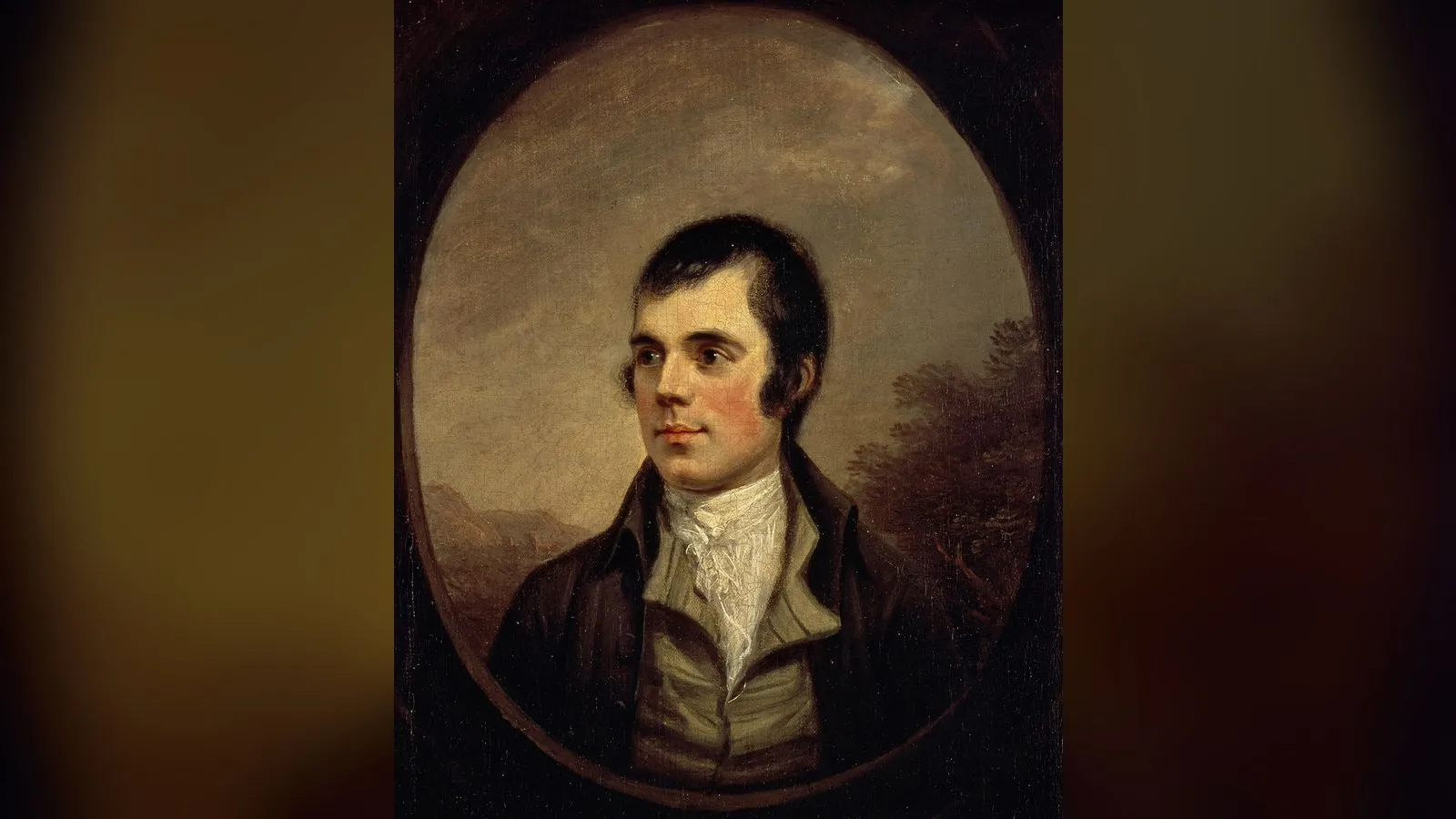
Set against this troubling episode is an entirely genuine and remarkable literary rise. The July 1786 Kilmarnock edition of Poems, Chiefly in the Scottish Dialect — containing "To a Mouse," "The Cotter's Saturday Night," "Address to the Deil," and other now-canonical works — found immediate and widespread success. By November, Burns was in Edinburgh pursuing an expanded edition, and the city's literary elite, including figures such as Dugald Stewart and Hugh Blair, received him as a genuine equal rather than a curiosity. The Edinburgh edition, published in April 1787, brought him some £400 — substantial money for the period — though Burns had sold his copyright outright to publisher William Creech for a flat 100 guineas, a transaction that meant he did not share proportionally in the edition's full commercial success. The Alexander Nasmyth portrait commissioned around this time remains, to this day, the basis for nearly every subsequent visual representation of the poet.
A pattern of relationships that deserves direct examination
Burns's romantic life was not merely colourful — it followed a consistent and, by modern standards, troubling pattern. His first child, Elizabeth, was born in 1785 to Elizabeth Paton, a servant in his own mother's household, conceived while his relationship with Jean Armour was already underway. During his time in Edinburgh, while conducting an intense literary courtship-by-letter with the married, separated Agnes "Nancy" McLehose (writing to her as "Sylvander" to her "Clarinda") and finding her resistant to physical involvement, Burns had an affair with her own domestic servant, Jenny Clow, who subsequently bore him a son. He also had a documented affair with another servant, Margaret "May" Cameron, and further relationships that produced additional children outside his eventual marriage.
In total, Burns fathered at least twelve children by at least four different women across his adult life, formally marrying only one, Jean Armour, with whom he ultimately had nine children, of whom only three survived to adulthood. This pattern — repeated relationships with women in positions of economic and social vulnerability relative to him, several of them domestic servants with limited power to refuse or resist his attentions — has drawn sharp and warranted reassessment from contemporary critics. The Scottish poet Liz Lochhead has directly characterised Burns as a "sex pest," explicitly drawing comparisons to modern understandings of sexual misconduct and the power imbalances it typically involves. This article does not treat that characterisation as an unfair modern imposition on a man of his time; Burns's own contemporaries already regarded his "libertine behaviour" as a genuine source of controversy and social disapproval, not simply a matter later generations chose retrospectively to judge.
Genuine political courage, genuine political risk
Set against the troubling aspects of his personal conduct, Burns's political convictions were sincerely held and came at real professional cost. He openly expressed sympathy for the American and French Revolutions and for domestic democratic reform movements such as the Society of the Friends of the People, associating with radicals at Dumfries's Globe Inn and writing poetry — most notably "A Man's a Man for A' That" (1795), echoing Thomas Paine's Rights of Man — that articulated a genuinely egalitarian political vision well ahead of mainstream opinion in his own time. "Scots Wha Hae" (1793) functioned, for generations afterward, as an unofficial Scottish national anthem, carrying covert radical meaning beneath its historical framing.
These sympathies were not without consequence. As a government excise officer, Burns's radical associations came to official notice and genuinely threatened his livelihood; his enlistment in the Royal Dumfries Volunteers in March 1795 — a demonstrably loyal, publicly visible act of service in which he was, notably, never once fined for absenteeism — reads less as patriotic enthusiasm and more as a calculated act of professional self-preservation under real political pressure. This tension between his genuine convictions and the practical need to protect his family's livelihood is a more honest picture of his politics than either an uncomplicated radical-hero or dutiful-civil-servant framing would suggest.
Death: correcting the alcoholism myth
Burns died in Dumfries on 21 July 1796, aged just 37, and was given a striking military-style funeral — his Volunteer Corps uniform laid upon his coffin — on the same day his son Maxwell was born. For generations afterward, popular memory attributed his early death substantially to alcoholism, a characterization traceable in large part to the moralising influence of his early biographer James Currie, a committed temperance campaigner with a clear interpretive agenda of his own. Modern medical analysis of the surviving record instead points to a long-standing rheumatic heart condition, likely originating in a bout of acute rheumatic fever Burns suffered around age 21, which progressively weakened his heart over the following years; a subsequent, dangerous dental infection that allowed bacteria to spread into his bloodstream appears to have been the final, fatal precipitating event. This is a meaningful correction, not a trivial one — it shifts the cause of Burns's death from a moralised narrative of personal weakness and excess to a genuine, undramatic medical tragedy compounded by the limits of eighteenth-century medicine.
A body disturbed, and a myth of mental illness
Burns's posthumous treatment included one more uncomfortable episode: following Jean Armour's death in 1834, a group led by a local surgeon and journalist exhumed his remains specifically to conduct phrenological measurements — the now-discredited pseudoscience holding that personality and character could be read from skull shape. Plaster casts were made and circulated to phrenologists for published analysis, an episode reflecting the era's genuine scientific confusions rather than any special disrespect reserved for Burns alone, though it remains a striking fact about how his body was treated even in death. Separately, some biographers, including Robert Crawford, have proposed — based partly on handwriting analysis and the emotional range of his poetry — that Burns may have experienced what would now be termed bipolar disorder; the National Trust for Scotland has explicitly downplayed this claim, judging the surviving evidence insufficient to support a retrospective diagnosis, and this article treats it accordingly as an interesting but unproven hypothesis rather than established fact.
A model for self-taught readers
Librarian at Dunscore. established Burns was not only a product of Scotland's reading culture but a small part of its machinery. While farming Ellisland he served as librarian of a parish library that his neighbour Robert Riddell had set up for tenants and nearby farmers in Dunscore, a scheme recorded in the Statistical Account of Scotland of the 1790s. The historian Jonathan Rose, in The Intellectual Life of the British Working Classes (2001), places this in a wider picture: a belt of Lowland Scotland with one of the highest literacy rates in the world, weavers who read at the loom, shepherds who were known as great readers, and working-class subscription libraries such as Leadhills (1741) and Wanlockhead (1756) that had few equivalents in England.
Read in cottages and workshops. established Rose works from hundreds of working-class autobiographies, and Burns runs through them. Janet Hamilton, who grew up among weavers in Langloan, Lanarkshire, in the 1790s and 1800s, borrowed Burns and Robert Fergusson from neighbours when the village library held no poetry at all. Ramsay MacDonald was introduced to Burns, Shakespeare and Pickwick by a watchmaker in Lossiemouth. Around 1920 the Greenock shipyard apprentice John Macadam remembered relatives and neighbours arguing "whether Burns was a greater poet than Shakespeare" (as quoted by Rose).
A model for writers. established For working men who wanted to write, Burns proved it could be done. John Bethune, a Fife labourer whose earnings rarely topped £19 a year, hoped to write his way out of poverty as Burns had; he wrote in secret by the fire, hiding his papers under an old newspaper whenever anyone came to the door. The stonemason and geologist Hugh Miller complained in 1849 that novelists could not imagine a thinking working man, and held up Burns and Benjamin Franklin as writers who had. The Lancashire dialect poet Ben Brierley said that only when he "joined the companionship of Burns and Byron" did he feel "the 'god within me'" (as quoted by Rose).
Labour's poet. established In 1906 the Review of Reviews asked the newly elected Labour MPs which books and authors had most influenced them. Of the 45 who replied, 8 named Burns. That placed him ninth, behind Ruskin (17), Dickens (16), the Bible (14), Carlyle (13), Henry George (12), Walter Scott (11), John Stuart Mill (10) and Shakespeare (9). Rose, following Kenneth O. Morgan, names Burns, Carlyle's Sartor Resartus and Ruskin's Unto This Last as the formative influences on Keir Hardie, who read almost no economics or Marx in his early years. The ILP leader John Bruce Glasier listed Burns among the writers who roused his "hatred of oppression", and the Fife Labour MP James Clunie credited "the prophetic works of Robert Burns" with turning him against the factory system (both as quoted by Rose).
shared Rose argues that working people read the classics on their own terms rather than having them imposed from above, and that Scotland enjoyed an early edge in self-education. Both are interpretations built on autobiographies, which over-represent the bookish and the successful. The 1906 survey records the tastes of 45 MPs, not of the working class as a whole.
Burns in early America
Two American poems. established For all his sympathy with the American cause, Burns wrote only two poems directly about America: the "Ballad on the American War" (1784), which shows a close knowledge of the war and of British party politics, and the "Ode for General Washington's Birthday" (1794), which pictures Liberty driven out of England and Scotland and at home in America. Hook found no evidence that either was noticed in America at the time.
Reprinted at once. established The American appetite was for the Scots poems themselves. Two years after Kilmarnock, in 1788, the poems were published at Philadelphia and then at New York. Hook lists further editions of Poems, Chiefly in the Scottish Dialect at Philadelphia (1798), Boston (1801), Wilmington, Delaware (1804) and Baltimore (1812, 1815), and of The Works of Robert Burns at Philadelphia (eight editions between 1801 and 1823), New York, Baltimore, Alexandria in Virginia and Salem, New York. Reliques of Robert Burns (Philadelphia, 1809), the Clarinda letters (Philadelphia, 1809) and a volume of his letters (Boston, 1820) followed.
Read as a poet of place. established American magazines followed British criticism at first. The New York Magazine in 1797 repeated the British view that he had been wrong to write in Scots. But in 1804 Charles Brockden Brown's Literary Magazine noted, with approval, that his poems were full of Ayrshire places and words and had no Chloes or Phyllises. In 1811 the Philadelphia editor Robert Walsh claimed that Burns, Beattie and Scott were more widely read in the United States than in England, and that Scots was "more familiar and more grateful" to American ears than to English ones (as quoted by Hook). James M'Conochie, a Dumfries-born doctor who trained in Philadelphia under Benjamin Rush, recalled having seen Americans weep when Burns was talked of.
Imitated in Scots. established Burns had American imitators who wrote in his own stanza and his own language. Hook traces verses to Burns in the New York Magazine in 1790 by "a lady in Gorham", Maine; Scots poems in the Philadelphia Port Folio by Henry Clow, an Ayrshire man who was baker at Nassau Hall in Princeton; David Bruce, a Caithness emigrant whose Poems Chiefly in the Scottish Dialect appeared at Washington, Pennsylvania, in 1801, and who traded Scots verse epistles about whiskey with the judge and novelist Hugh Henry Brackenridge; and the New Hampshire farmer Robert Dinsmoor, the "Rustic Bard", whose collected poems came out in 1828. The young John Greenleaf Whittier, a friend of Dinsmoor, saw Burns as the strongest early influence on his own poetry.
Pilgrims to Ayrshire. established By the 1820s Americans were travelling to Scotland partly to see Burns's country. Washington Irving ended his 1817 tour in Ayr, and Nathaniel Carter of the New York Statesman in 1825 met Burns's old friends Dr John Mackenzie and the poet David Sillar, walked the banks of the Ayr and the Doon, and spent half an hour with Jean Armour in Dumfries, having introduced himself and a friend as transatlantic admirers of the poet.
shared Hook argues that Burns mattered to America beyond his popularity: a poet who wrote in a non-English tongue about his own district, and was still acclaimed as a genius, pointed the way to a national American literature. That is his interpretation of the evidence, not a measured effect; Hook himself calls the Scots verse of Bruce, Dinsmoor and the rest no more than "a rather bizarre footnote" to American literary history.
Legacy
Burns's literary and cultural legacy is genuinely vast and largely uncontested on its own terms: profound influence on major Romantic poets including Wordsworth, Coleridge, and Shelley; a line from "To a Mouse" supplying the title of John Steinbeck's Of Mice and Men; Bob Dylan naming "A Red, Red Rose" as the single lyric with the greatest effect on his own life; and an enduring, still-celebrated status as "the people's poet" across both Imperial Russian and Soviet literary culture, with a 1924 Russian translation selling over 600,000 copies. Burns Night, celebrated every 25 January, functions today as something close to Scotland's genuine second national day, more widely and enthusiastically marked than the official St Andrew's Day. In a 2009 Scottish public poll, he was voted "The Greatest Scot," narrowly ahead of William Wallace — a testament to the enduring power of his work, even as the fuller, more complicated record of the man behind it deserves to be told alongside it rather than smoothed away.
Did You Know?
- Burns was actively preparing to emigrate to Jamaica to work on a slave plantation in 1786 — a job he himself described as becoming "a poor Negro driver" — and was diverted from this path only by the sudden success of his poetry, not by any change in principle.
- He fathered at least twelve children by at least four different women, and formally married only one of them, Jean Armour.
- The popular image of Burns as an uneducated "heaven-taught ploughman" was substantially a construction of Edinburgh's literary establishment; he had, in fact, received solid tutoring in Latin, French, and mathematics as a boy.
- His famous political anthem "Scots Wha Hae" doubled as a piece of covert radical messaging, echoing contemporary sympathy for revolutionary democratic ideals under cover of historical Scottish patriotism.
- Burns joined a Volunteer militia in 1795 substantially to protect his government job as an excise officer, after his openly radical political sympathies drew official suspicion.
- The long-standing popular belief that alcoholism killed Burns traces largely to a hostile early biographer with a temperance agenda; modern medical analysis instead points to rheumatic heart disease compounded by a dental infection.
- While farming Ellisland, Burns served as librarian of a small parish library for tenants and farmers in Dunscore.
- In 1906, 8 of the 45 Labour MPs who answered a survey of their favourite authors named Burns; Keir Hardie counted him among his three formative influences.
- Burns's poems were reprinted in Philadelphia and New York in 1788, only two years after the Kilmarnock edition.
- Around 1830, according to the Scottish traveller James Stuart, a Scotswoman, Mrs Mackay, hung a half-length picture of Burns, with two lines from "Tam o' Shanter", as the sign of her tavern in Nassau Street, New York.
- His body was exhumed in the 1830s specifically so phrenologists could take plaster casts of his skull for pseudoscientific character analysis.
- "Auld Lang Syne," sung around the world every New Year, is one of the traditional Scottish songs Burns collected, adapted, and helped preserve rather than composed entirely from scratch — a detail that applies to several of his most famous songs.
Frequently Asked Questions
1Who was Robert Burns?
Scotland's national poet (1759–1796), born to a struggling Ayrshire tenant-farming family, who rose to national literary fame with the 1786 publication of his Kilmarnock poems and remains, by wide public acclaim, Scotland's most celebrated literary figure.
2Did Robert Burns really almost work on a slave plantation?
Yes. In 1786, facing debt and family pressure, he seriously prepared to emigrate to Jamaica to work as a bookkeeper on a sugar plantation, a role he himself described as becoming "a poor Negro driver." He was diverted from this plan by his unexpected literary success, not by any stated moral objection to slavery.
3How many children did Burns have?
At least twelve, with at least four different women. He formally married only one of them, Jean Armour, with whom he had nine children, three of whom survived to adulthood.
4Is it fair to call Burns's behaviour toward women problematic by modern standards?
Many contemporary critics, including the Scottish poet Liz Lochhead, argue yes — pointing to his repeated relationships with servants and women in positions of social and economic vulnerability relative to him. His libertine reputation also drew disapproval among his own contemporaries, not only later generations.
5Did alcoholism cause Robert Burns's death?
Probably not, despite the long-standing popular belief. Modern medical analysis attributes his death at 37 to a long-standing rheumatic heart condition, likely originating from rheumatic fever at age 21, fatally compounded by a dental infection — a characterization that corrects claims traceable largely to a hostile early biographer with a temperance agenda.
6Was Burns politically radical?
Yes, genuinely. He expressed open sympathy for the American and French Revolutions and for parliamentary reform, writing poetry with real democratic and egalitarian content. This created genuine professional risk given his government job as an excise officer, prompting him to join a loyalist militia partly for career self-preservation.
7Did Burns write "Auld Lang Syne" from scratch?
Not entirely — it's one of several traditional Scottish songs he collected, adapted, and helped preserve rather than composed wholly as an original work, a distinction true of a number of his most famous songs.
8Was Burns truly an uneducated "ploughman poet"?
Not accurately. While he came from a genuinely poor farming background and worked manual labour from a young age, he received real tutoring in Latin, French, and mathematics; the "heaven-taught ploughman" label reflects how Edinburgh's literary establishment chose to market him rather than an accurate account of his education.
9Why was Burns's body exhumed after his death?
In the 1830s, a local group exhumed his remains specifically to take plaster skull casts for phrenological analysis — a now-discredited pseudoscience claiming to read character from skull shape.
10Why did self-educated working people admire Burns?
Because he was one of them who had made his name by books. Working-class autobiographies gathered by the historian Jonathan Rose show weavers, labourers and apprentices borrowing, reciting and arguing about Burns, and would-be writers such as the Fife labourer John Bethune taking him as proof that a poor man could write his way out of poverty.
11Did Burns influence the Labour Party's founders?
Yes, as one of many authors. In a 1906 survey, 8 of the 45 Labour MPs who replied named Burns as an influence, and Keir Hardie's biographers count him, with Carlyle and Ruskin, among Hardie's formative reading. Carlyle and Scott were each named more often.
12How quickly did Americans read Burns?
Almost at once. His poems were published at Philadelphia and New York in 1788, and the literary historian Andrew Hook counts more than twenty further American editions of his poems, works and letters by 1823.
13Did Burns write about America?
Only twice directly: the "Ballad on the American War" (1784) and the "Ode for General Washington's Birthday" (1794). His sympathy for the American cause shows more widely in his letters and politics.
14How is Burns remembered today?
Through Burns Night (25 January), celebrated worldwide and functioning as something close to Scotland's genuine second national day; through his deep influence on major Romantic poets and later writers and musicians including Steinbeck and Bob Dylan; and through his continued standing as the figure voted "The Greatest Scot" in a 2009 public poll.
Sources and Further Reading
Primary / Institutional
- Undiscovered Scotland: Robert Burns
- Robert Burns Birthplace Museum: Robert Burns and the Slave Trade
- The Death of Robert Burns — robertburns.org.uk
Scholarly
- Andrew Hook, Scotland and America: A Study of Cultural Relations, 1750–1835 (Blackie, 1975)
- Jonathan Rose, The Intellectual Life of the British Working Classes (Yale University Press, 2001), including Table 1.1, "Favorite Authors of Early Labour MPs, 1906"
- David McCrone, "Tomorrow's Ancestors: Nationalism, Identity and History", in Edward J. Cowan and Richard J. Finlay (eds), Scottish History: The Power of the Past (Edinburgh University Press, 2002) — further reading on radical and conservative uses of Burns
- Edinburgh University Press: Robert Burns's Black Neighbours in Ayrshire
- IBTimes: Robert Burns — Paradoxical Bard Who Championed Freedom and Wanted to Work as Slave Driver in Jamaica
- Cairns Craig, "The Literary Tradition", in T. M. Devine and Jenny Wormald (eds), The Oxford Handbook of Modern Scottish History (Oxford University Press, 2012) — further reading on Burns and the Scots literary tradition
- Graeme Morton, "Identity within the Union State, 1800–1900", in T. M. Devine and Jenny Wormald (eds), The Oxford Handbook of Modern Scottish History (Oxford University Press, 2012) — further reading on the Victorian Burns cult
General
- Wikipedia: Robert Burns
- The Scotsman: Robert Burns facts — famous poems, death, and why he is controversial
- The Scotsman: Robert Burns — 4 uncomfortable home truths about the National Bard
Caveats: Myths and Disputed Claims
- Burns was an untutored natural genius, the "heaven-taught ploughman." Myth, substantially constructed by Edinburgh's literary establishment to fit a flattering narrative. He received real tutoring in Latin, French, and mathematics as a boy, alongside his farm labour.
- Burns declined the Jamaica plantation job out of moral principle. Not supported by the record. He was actively preparing to go and was diverted only by his sudden literary success — a matter of fortunate timing, not a stated change of conviction regarding slavery.
- Alcoholism killed Robert Burns. A long-repeated but now substantially corrected claim. Modern medical analysis points instead to rheumatic heart disease, likely originating at age 21, fatally worsened by a dental infection; the alcoholism narrative traces significantly to a hostile early biographer with a temperance agenda.
- Burns's many relationships were simply the romantic exploits of a passionate man, in keeping with his era. An incomplete framing this article rejects as insufficient. Several of these relationships involved women in clearly vulnerable positions relative to him, including his own family's and others' domestic servants, and his contemporaries themselves regarded his conduct as controversial, not merely colourful.
- "Auld Lang Syne" and Burns's other famous songs were wholly his own original compositions. An overstatement. Many, including "Auld Lang Syne," were traditional Scottish songs he collected, adapted, and helped preserve rather than composed entirely from scratch — a genuinely significant contribution, but a different one than sole authorship implies.
- Burns suffered from manic depression (bipolar disorder). Disputed. This retrospective diagnosis, proposed by some biographers based on handwriting analysis and his poetry's emotional range, has been explicitly judged insufficiently supported by the National Trust for Scotland and should be treated as an interesting hypothesis, not established fact.
- Do not follow Andrew Hook's Scotland and America (1975) in dating Burns's death to 1797; it was 21 July 1796.
- Do not present the 1906 Review of Reviews survey as a measure of working-class taste. It records the favourite authors of the 45 Labour MPs who replied, and Burns (8 mentions) came behind Carlyle (13) and Walter Scott (11).
Card 090 · Great Scots