Lonnie Donegan (1931–2002)
Contents
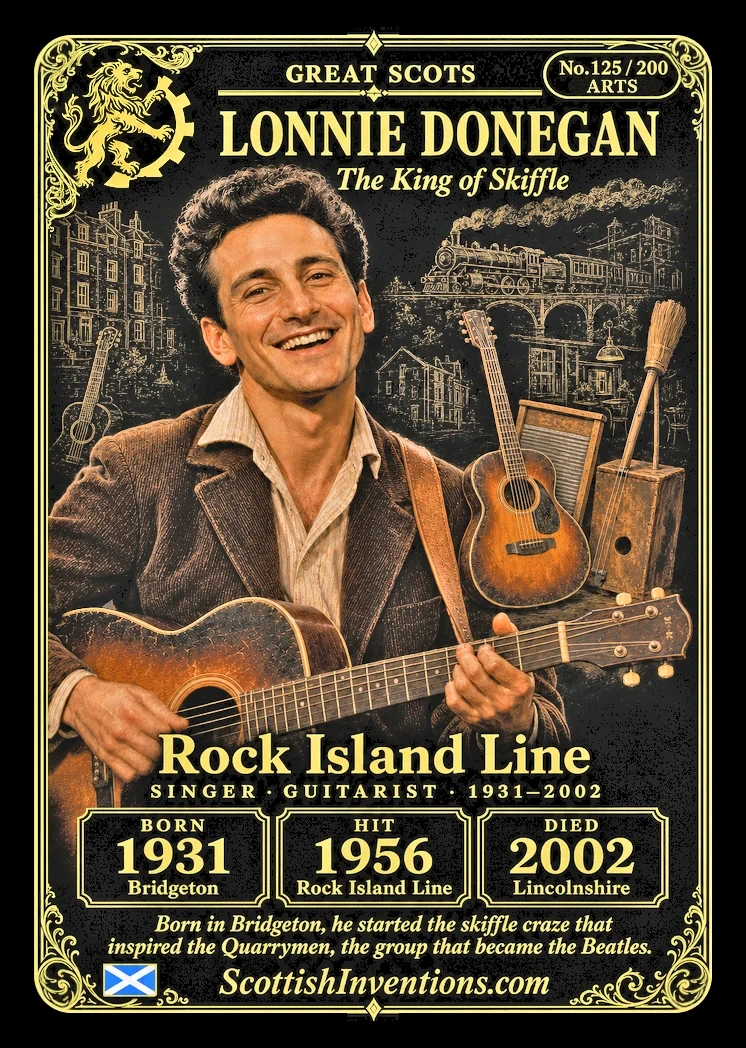
Lonnie Donegan, the "King of Skiffle", was born in Glasgow and became Britain's first home-grown pop star. His 1950s version of Lead Belly's "Rock Island Line" sparked a craze that put cheap guitars, washboards and tea-chest basses into the hands of thousands of teenagers, among them John Lennon, Paul McCartney and George Harrison.
TL;DR
- established Born Anthony James Donegan in Bridgeton, Glasgow, in 1931, he moved with his family to East Ham, near London, as a small child.
- established Playing banjo with Chris Barber's jazz band, he sang short "skiffle" sets of American folk and blues songs between the jazz numbers.
- established His recording of "Rock Island Line", made in July 1954 and a hit in 1956, reached the top ten in both Britain and the United States and went gold.
- established He had three UK number ones, including "Gamblin' Man"/"Puttin' On the Style" (1957) and the comic "My Old Man's a Dustman" (1960).
- established The skiffle boom he started inspired the Quarrymen, the group John Lennon formed in 1957 that grew into the Beatles.
Key Facts
- Born
- 29 April 1931, Bridgeton, Glasgow
- Died
- 3 November 2002, Market Deeping, Lincolnshire (aged 71)
- Birth name
- Anthony James Donegan
- Parents
- Peter John Donegan, violinist; Mary Josephine Deighan, from Ireland
- Known as
- "The King of Skiffle"
- Breakthrough
- "Rock Island Line" (recorded 1954, hit 1956)
- UK number ones
- "Cumberland Gap" (1957), "Gamblin' Man"/"Puttin' On the Style" (1957), "My Old Man's a Dustman" (1960)
- Honours
- Ivor Novello lifetime achievement award (1995); MBE (2000)
A Note on Claims and Evidence
Each major claim carries one of three labels. established means supported by primary records, official bodies or several independent reliable sources. shared means the core fact is sound but sources disagree on details, dates or interpretation. traditional means widely repeated but not traceable to a primary or independent source.
Donegan's chart record and recording dates are well documented. His later accounts of his own early life, such as how he heard American music on forces radio, are labelled traditional where they cannot be checked. Sources differ on whether he died on 3 or 4 November 2002; the date most commonly given is 3 November.
Timeline
Born in Bridgeton, Glasgow, on 29 April.
Family moves to East Ham, Essex.
Leaves school at 14; works as a clerk; buys his first guitar.
National service in the army, partly in Vienna.
Opens for the blues guitarist Lonnie Johnson and adopts the name "Lonnie".
Plays banjo with Ken Colyer's and then Chris Barber's jazz bands.
Records "Rock Island Line" with members of the Barber band.
"Rock Island Line" becomes a hit in Britain and the United States.
Two UK number ones; John Lennon forms the Quarrymen.
"My Old Man's a Dustman" goes straight to number one.
"Does Your Chewing Gum Lose Its Flavour" becomes a US top ten hit.
Records Puttin' On the Style (1978) with rock stars who grew up on skiffle.
Ivor Novello lifetime achievement award.
Performs with Van Morrison in Belfast, released as The Skiffle Sessions.
Appointed MBE.
Dies in Lincolnshire on 3 November, during a UK tour.
Details
Bridgeton and East Ham
established Anthony James Donegan was born in Bridgeton, in Glasgow's East End, in 1931. His father, Peter John Donegan, was a violinist who had played with the Scottish orchestra, and his mother, Mary Josephine Deighan, was Irish. In 1933 the family moved to East Ham, on the eastern edge of London, where he grew up. established He left school at 14, worked as a clerk, and taught himself guitar.
American music and a new name
traditional During national service, partly in Vienna, he said he heard American folk and blues on the American Forces Network and began collecting records by artists such as Lead Belly and Woody Guthrie. established In 1952 his band opened for the American blues guitarist Lonnie Johnson at the Royal Festival Hall, and he took the name "Lonnie" in tribute.
The skiffle breaks
established Donegan joined the trad jazz revival, playing banjo first with Ken Colyer's Jazzmen and then with Chris Barber's band. Between sets the band's smaller "skiffle group" played American folk, blues and work songs with guitar, washboard and bass. The word "skiffle" came from 1920s America, where it meant music played on improvised instruments at rent parties.
"Rock Island Line"
established In July 1954, with members of the Barber band, he recorded a fast, driving version of "Rock Island Line", a song associated with Lead Belly. Released as a single, it became a hit in 1956, reaching the top ten in both Britain and the United States, rare for a British artist at the time. established It was the first debut record to earn a gold disc in Britain. Because it was recorded as a band session, Donegan received only his session fee, not royalties.
The skiffle craze
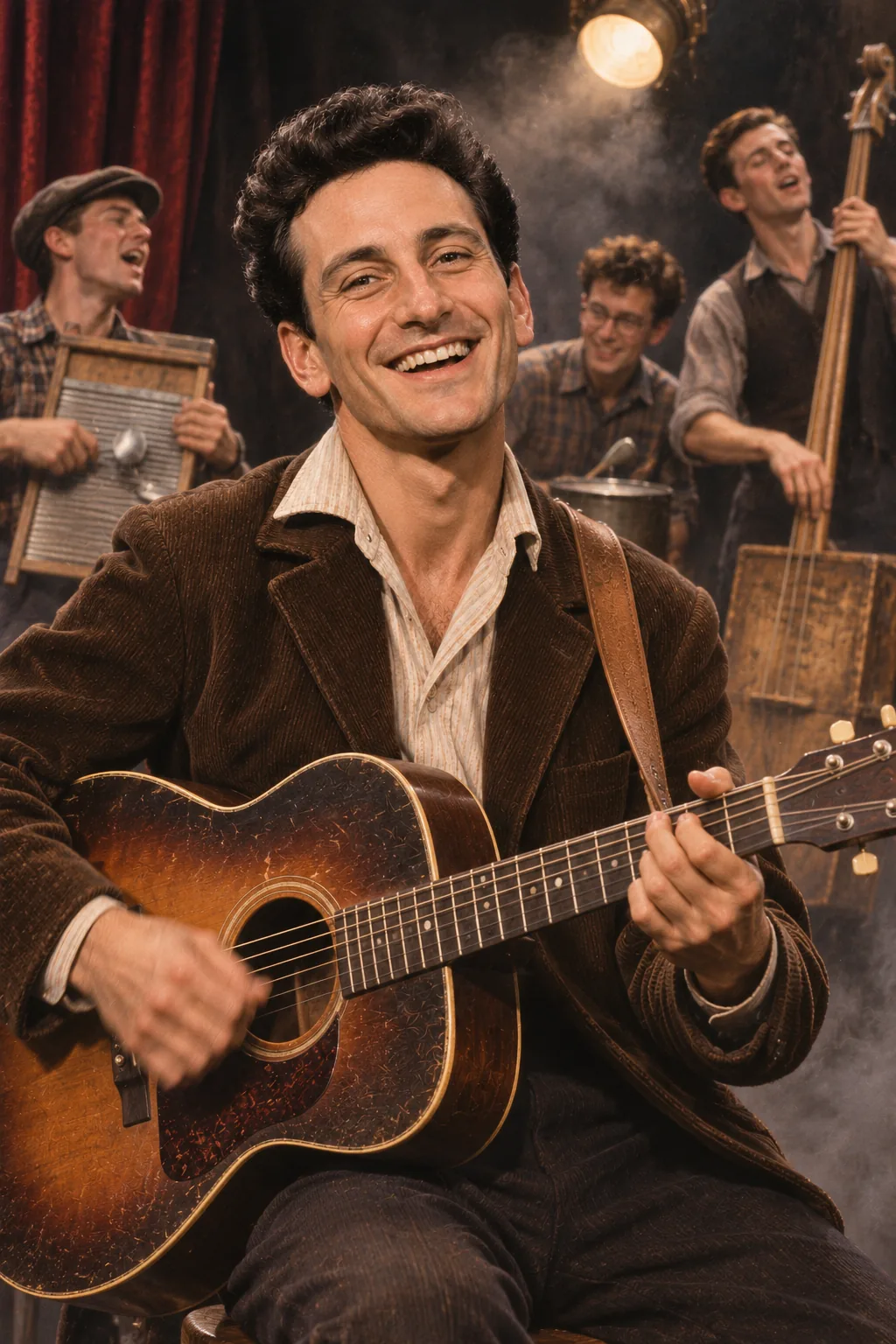
established "Rock Island Line" set off a national craze. Skiffle needed no expensive equipment: a cheap guitar, a washboard played with thimbles, and a tea-chest bass made with a broom handle and string. Thousands of teenagers formed skiffle groups. Donegan followed with a run of hits, including three number ones: "Cumberland Gap", "Gamblin' Man"/"Puttin' On the Style" and, in 1960, the music-hall comedy song "My Old Man's a Dustman". established The Glasgow singer Nancy Whiskey's "Freight Train" was another skiffle hit of the period, and she and Donegan both played the Royal Albert Hall in 1997 to mark forty years of skiffle.
Lennon, McCartney and the rest
established In 1957 John Lennon formed a skiffle group in Liverpool, the Quarrymen, which Paul McCartney and then George Harrison joined; it became the Beatles. All three credited Donegan as an early inspiration. Roger Daltrey, Brian May and many others did the same. shared Historians of British pop often describe Donegan as the bridge between American roots music and the British beat boom of the 1960s.
Later years
established As rock and roll and then the Beatles took over, Donegan moved towards cabaret and comedy songs. His career revived in the late 1970s with Puttin' On the Style (1978), on which he was joined by musicians who had grown up on his records. He later toured with Van Morrison and Chris Barber, and their 1998 Belfast concert was released as The Skiffle Sessions. He received an Ivor Novello lifetime achievement award in 1995 and an MBE in 2000. established He suffered several heart attacks in later life and died in Lincolnshire in November 2002 during a UK tour, shortly before he was due to play at a memorial concert for George Harrison.
Did You Know?
- He was born in Glasgow but grew up near London.
- He took the name "Lonnie" from the blues guitarist Lonnie Johnson.
- He received only a session fee for "Rock Island Line".
- "Rock Island Line" reached the US top ten in 1956.
- The Quarrymen, who became the Beatles, were a skiffle group.
- A tea-chest bass was a key skiffle instrument.
- He was due to play at George Harrison's memorial concert when he died.
FAQ
1Who was Lonnie Donegan?
A Glasgow-born singer and guitarist (1931–2002), known as the "King of Skiffle".
2What is skiffle?
A style of music using guitar, washboard and home-made bass to play American folk and blues songs.
3Was he Scottish?
He was born in Glasgow; his family moved to England when he was two.
4What was his biggest hit?
"Rock Island Line" made him famous; "My Old Man's a Dustman" was among his biggest sellers.
5Did he influence the Beatles?
Yes. John Lennon's Quarrymen began as a skiffle group inspired by him.
6Why was he called Lonnie?
After the blues musician Lonnie Johnson, whom his band supported in 1952.
7Did he have American hits?
Yes, "Rock Island Line" and "Does Your Chewing Gum Lose Its Flavour" both reached the US top ten.
8Did he write "Rock Island Line"?
No. It is a traditional American song associated with Lead Belly; Donegan arranged it.
9When did he die?
In November 2002, aged 71, during a UK tour.
10What honours did he receive?
An Ivor Novello lifetime achievement award and an MBE.
Sources and Further Reading
Primary/Institutional
- Official Charts Company: UK chart history for Lonnie Donegan.
- Elizabeth Ewan, Rose Pipes et al. (eds), The New Biographical Dictionary of Scottish Women (Edinburgh University Press, 2018), entry "Whiskey, Nancy".
Scholarly/Critical
- Patrick Humphries, Lonnie Donegan and the Birth of British Rock & Roll (2012).
- Billy Bragg, Roots, Radicals and Rockers: How Skiffle Changed the World (2017).
General
- Wikipedia, "Lonnie Donegan" (opened November 2026).
Caveats: Myths and Disputed Claims
- Disputed: date of death. Most sources give 3 November 2002; some give 4 November.
- Myth: he invented skiffle. The word and style came from America; he popularised it in Britain.
- Caution: "Rock Island Line" date. It was recorded in 1954 but became a hit in 1956.
Finished reading? Try the Fact Machine: three reels, one surprising Scottish connection →
Card 125 · Great Scots