
Alasdair Gray (1934–2019)
Contents
TL;DR
- established Alasdair Gray was a Glasgow novelist, painter, muralist, and playwright whose 1981 novel Lanark: A Life in Four Books, written over nearly two decades, is widely credited with reigniting modern Scottish literature and directly inspiring later writers including Janice Galloway, A. L. Kennedy, Alan Warner, Iain Banks, and Irvine Welsh.
- established His 1992 novel Poor Things, a Frankenstein-inflected tale set in Victorian Glasgow, won the Whitbread Novel Award and the Guardian Fiction Prize and was adapted into a 2023 Oscar-winning film directed by Yorgos Lanthimos.
- established Gray was a lifelong, outspoken Scottish nationalist and republican socialist, and his epigram "Work as if you live in the early days of a better nation" is engraved on the Canongate Wall outside the Scottish Parliament.
- disputed A 2012 essay dividing English people working in Scottish cultural institutions into "settlers" and "colonists" provoked a real and serious public row, with some figures calling it bigoted; Gray revised the essay and denied the racism charge, and the episode remains genuinely contested rather than settled.
- established He trained and worked throughout his life as a visual artist as much as a writer, producing major public murals across Glasgow (including at Hillhead subway station and the Òran Mór venue) alongside his fiction.
Key Facts
- Born
- 28 December 1934, Riddrie, Glasgow
- Died
- 29 December 2019 (aged 85), Glasgow
- Category
- Culture / Literature & Art
- Known for
- Lanark (1981); Poor Things (1992); murals across Glasgow; Scottish independence advocacy
- Trained as
- Design and Mural Painting, Glasgow School of Art (1952–1957)
- Key works
- Lanark, Unlikely Stories, Mostly, 1982, Janine, Poor Things, A History Maker
- Honours
- Whitbread Novel Award, Guardian Fiction Prize, inaugural Saltire Society Lifetime Achievement Award (2019)
Scottish Impact Index (SI Score)
- Global Influence
- 4/10
- Enduring Relevance
- 6/10
- Material Contribution
- 2/10
- Exceptional Achievement
- 7/10
- Lasting Legacy
- 4/10
- Recognition
- 3/10
26/60
Ranked =125th of 200 in Great Scots
A Note on Claims and Evidence
Gray's career, major works, and public political activity are extensively documented in his own writing, in contemporary press coverage, and in Rodge Glass's authorised biography, and are treated here as established. The 2012 "Settlers and Colonists" essay controversy involved genuinely disputed questions — what Gray intended, whether the language was reasonably read as bigoted, and how significant the episode should be in assessing his legacy — and is presented here with the documented facts of what he wrote, who objected and why, and how he responded, without declaring a final verdict.
Timeline
Born in Riddrie, Glasgow, to a wounded WWI veteran father and a mother who worked in a clothing warehouse.
Studies Design and Mural Painting at Glasgow School of Art.
Works as an art teacher in Lanarkshire and Glasgow while beginning what will become Lanark.
Marries Inge Sørensen; son Andrew born 1963; couple separates 1969.
Completes the first draft of his novel, then titled "Portrait of the Artist as a Young Scot"; rejected by a literary agency.
Participates in Philip Hobsbaum's influential Glasgow writing group alongside James Kelman, Tom Leonard, and Liz Lochhead.
Writer-in-residence at the University of Glasgow; serves as Glasgow's official "artist recorder."
Publishes Lanark: A Life in Four Books after nearly two decades of work.
Publishes Unlikely Stories, Mostly, winning the Cheltenham Prize for Literature.
Publishes 1982, Janine, which Gray considered his best novel.
Marries Morag Nimmo McAlpine.
Publishes Poor Things, winning the Whitbread Novel Award and Guardian Fiction Prize.
Serves as joint Professor of Creative Writing at Glasgow and Strathclyde Universities with James Kelman and Tom Leonard; resigns in 2003.
His epigram "Work as if you live in the early days of a better nation" is engraved on the Canongate Wall at the newly opened Scottish Parliament.
Publishes the "Settlers and Colonists" essay, triggering a major public controversy; subsequently revises the text.
Designs the Sunday Herald's pro-independence front page ahead of the Scottish independence referendum.
Suffers a serious fall and begins using a wheelchair; continues writing and publishing.
Publishes his verse translations of Dante's Inferno and Purgatorio.
Wins the inaugural Saltire Society Lifetime Achievement Award; dies on 29 December in Glasgow, one day after his 85th birthday.
Poor Things, adapted by Yorgos Lanthimos, wins multiple Academy Awards.
Details
A Glasgow childhood and a long artistic apprenticeship
Alasdair Gray was born in 1934 in Riddrie, in Glasgow's east end, the son of Alexander Gray, a box-factory worker who had been wounded in the First World War, and Amy Gray, who worked in a clothing warehouse. His family was evacuated during the Second World War before settling for a time in Yorkshire. Gray showed early creative promise, appearing on BBC children's radio at age eleven reading Aesop's Fables, and later edited his school magazine at Whitehill Secondary School. His mother died of cancer when he was eighteen, a loss biographers and Gray himself connected to recurring themes of maternal absence in his later fiction.
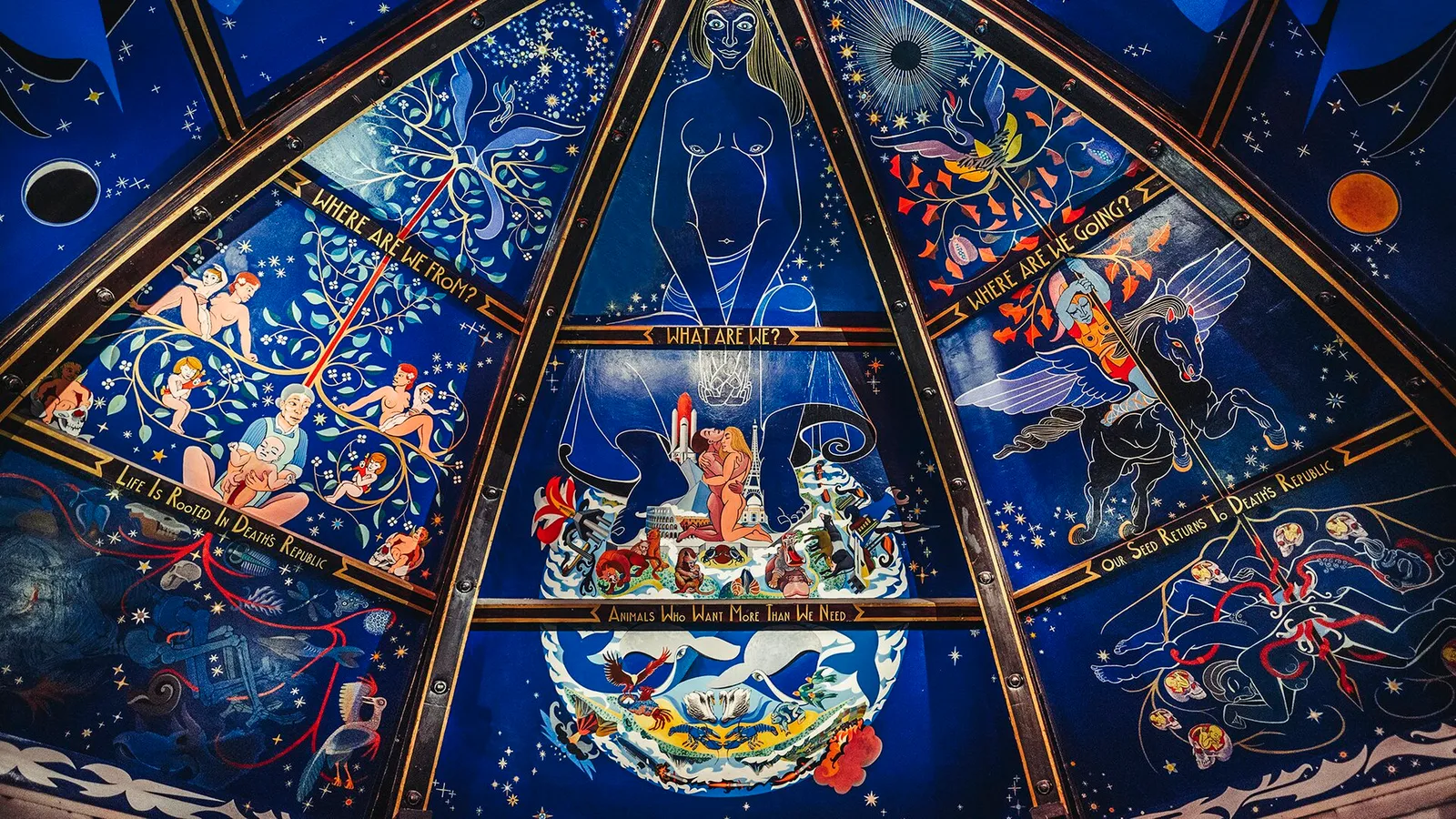
He trained formally as a visual artist, studying Design and Mural Painting at Glasgow School of Art from 1952 to 1957, and it was during these years that he began drafting what would eventually become Lanark — initially titled "Portrait of the Artist as a Young Scot." He completed a first version in 1963, only to have it rejected by a literary agency, and the book would not reach print for another eighteen years. In the intervening decades he worked as an art teacher, painted theatrical scenery for Glasgow's Pavilion and Citizens Theatres, and built a reputation as a serious, versatile visual artist — producing public murals, including an early work for the Scottish-USSR Friendship Society, and later major commissions at Hillhead subway station and the Òran Mór arts venue, where his large ceiling mural depicts Adam and Eve embracing above modern Glaswegians. From 1977 to 1978, funded by a Labour government scheme, he served as Glasgow's official "artist recorder," producing hundreds of drawings of the city's people and places now held at Kelvingrove Art Gallery.
Lanark and the revival of Scottish fiction
Lanark: A Life in Four Books, finally published in 1981, interweaves two narratives: a realist account of Duncan Thaw, a young artist coming of age in 1950s Glasgow, and a dystopian fantasy following the character Lanark through the nightmarish city of Unthank, governed by opaque and arbitrary institutional power. The novel's combination of realism, science fiction, and fable, together with Gray's own distinctive typography and illustrations (he designed the book himself), drew comparisons to Kafka, Orwell's Nineteen Eighty-Four, and the fabulism of Borges and Calvino.
Its impact on Scottish letters was immediate and lasting. A 2016 BBC public poll named it the third-best Scottish novel of all time, and it is widely credited with helping revive a distinctively confident Scottish literary voice after a relatively fallow period — directly inspiring a generation of writers including Janice Galloway, A. L. Kennedy, Alan Warner, Iain Banks, and Irvine Welsh, several of whom have spoken and written about its influence on their own work. Despite this critical standing, it did not make Gray wealthy, and money troubles recurred throughout his career; around 2000 he applied to the Scottish Artists' Benevolent Association for financial support while living largely on book-sales income.
A restless, genre-crossing body of work
Gray followed Lanark with a stream of formally adventurous fiction. Unlikely Stories, Mostly (1983), a short-story collection spanning work written as early as 1951, won the Cheltenham Prize for Literature. 1982, Janine (1984) — which Gray himself regarded as his best novel — is a stream-of-consciousness narrative following Jock McLeish, a middle-aged, alcohol-dependent security supervisor, partly inspired by Hugh MacDiarmid's long poem A Drunk Man Looks at the Thistle; its frank treatment of sadomasochistic fantasy divided critics, and the novelist Anthony Burgess, who had earlier called Gray "the most important Scottish writer since Sir Walter Scott," found this particular book "juvenile."
His most commercially and critically successful novel, Poor Things (1992), reimagines Mary Shelley's Frankenstein in Victorian Glasgow, following the scientist Godwin Baxter as he reanimates a suicide victim by implanting her unborn child's brain — a story that doubles as a meditation on class, gender, and Scotland's own colonial and imperial entanglements. It won the Whitbread Novel Award and the Guardian Fiction Prize, and the London Review of Books called it his funniest novel and "a welcome return to form." Its 2023 film adaptation, directed by Yorgos Lanthimos and starring Emma Stone, brought Gray's work to a vastly larger international audience and won multiple Academy Awards, three years after Gray's own death. He went on to write A History Maker (1994), set in a 23rd-century matriarchal utopia that curdles, and The Book of Prefaces (2000), an idiosyncratic, heavily annotated anthology tracing the history of English-language literature from Cædmon to Wilfred Owen.
A committed nationalist and republican socialist
Gray's politics were not incidental to his art but central to how he understood his own work, once describing his fiction as trying "to seduce the reader by disguising themselves as sensational entertainment, but are propaganda for democratic welfare-state Socialism and an independent Scottish parliament." He began voting for the Scottish National Party in the 1970s, motivated in part by concern over erosion of the welfare state that had funded his own education, and argued consistently for nationalising North Sea oil revenue and for Scottish independence, publishing three pamphlets on the subject, including Why Scots Should Rule Scotland (1992), in which he defined Scottish identity civically rather than ethnically: "by Scots I mean everyone in Scotland who is eligible to vote." His political loyalties were not simply tribal — he voted Liberal Democrat in 2010 specifically to unseat a Labour Party he considered "corrupted," and by 2019 was voting Labour again as a protest against the SNP for what he saw as insufficient radicalism.
His best-known political contribution is linguistic rather than electoral: the epigram "Work as if you live in the early days of a better nation," adapted from a line by the Canadian poet Dennis Lee, became an anti-Thatcherite rallying phrase from around 1991 and was engraved on the Canongate Wall outside the new Scottish Parliament building when it opened in 2004, later invoked by SNP politicians during election campaigns. Ahead of the 2014 independence referendum, he designed the front page for the Sunday Herald when it became the only Scottish newspaper to formally endorse a "Yes" vote — a large thistle surrounded by saltires that the paper's editor called "striking" and that was credited with doubling the paper's web traffic and lifting sales by 31 percent. Although the referendum result went 55–45 against independence, Gray reportedly considered the outcome more favourable to the cause than a narrow Yes victory would have been, given how close the result had come.
The "Settlers and Colonists" controversy
In 2012, Gray published an essay distinguishing two categories of English people working in Scottish cultural institutions: "settlers," whom he characterised as long-term contributors genuinely invested in Scottish culture, and "colonists," career administrators he accused of treating Scottish posts as short-term stepping stones. The essay explicitly suggested the pattern extended beyond the arts into other Scottish professions.
The response was immediate and serious, not a passing social-media flare-up: politicians and commentators objected strongly to the essay's language, and some public figures went so far as to call Gray a "racist bigot" over his characterisation of English professionals in Scotland. Gray revised the essay in response, removing a line that had broadened the claim beyond the arts — "I think Scottish folk in other professions will know settlers and colonists with similar attitudes" — and rebalancing the text to give more weight to positive examples of "settlers," including reclassifying the theatre director Vicky Featherstone, who had supported his work, from "colonist" to "good settler." Gray said the removal of the broader claim "may have been an accident," maintained that the underlying settler/colonist distinction remained valid, and stated plainly that he did not believe the charge of racism.
Gray's biographer and former secretary, Rodge Glass, who published an authorised biography of Gray in 2008, has characterised the episode and similar criticism of Gray as stemming partly from discomfort with his politics and from "his frequent tendency to pre-empt criticism in his work" — itself a notable critical judgment worth reporting rather than resolving. The episode remains a genuinely disputed part of Gray's legacy: it is neither erased from his record nor treated as having defined it, and readers encountering strong claims in either direction — that it was straightforwardly bigoted, or that it was wholly misunderstood — should be aware the documented facts support a more contested picture than either extreme.
A late flowering, and death
Gray continued working into his eighties despite a serious fall in 2015 that left him using a wheelchair, publishing verse translations of Dante's Inferno (2018) and Purgatorio (2019) in his final years. He died on 29 December 2019 at Glasgow's Queen Elizabeth University Hospital, one day after his 85th birthday, having left his body to science and requested no funeral. Scotland's First Minister, Nicola Sturgeon, called him "one of the brightest intellectual and creative lights Scotland has known in modern times," and The Guardian described him as "the father figure of the renaissance in Scottish literature and art." Tributes came from writers including Jonathan Coe, Val McDermid, Ian Rankin, Ali Smith, and Irvine Welsh. He had earlier that year received the inaugural Saltire Society Lifetime Achievement Award. His literary and artistic archive is held at the National Library of Scotland, and the independent Alasdair Gray Archive, established in 2020, continues to promote access to and new work drawing on his legacy; "Gray Day" is marked annually on 25 February.
Did You Know?
- Gray spent almost twenty years writing Lanark before it was finally published in 1981.
- He designed and illustrated Lanark himself, drawing on his training as a visual artist rather than leaving the book's look to a publisher.
- His ceiling mural at Òran Mór in Glasgow, depicting Adam and Eve above modern Glaswegians, remains one of the largest artworks of its kind in Scotland.
- His epigram "Work as if you live in the early days of a better nation" is permanently engraved on the Canongate Wall outside the Scottish Parliament.
- Anthony Burgess once called him "the most important Scottish writer since Sir Walter Scott" — and also called one of his novels "juvenile."
- Poor Things, his most commercially successful novel, became an Oscar-winning film only after his death.
- He left his body to science and requested no funeral.
- He died one day after turning 85.
FAQ
1What is Alasdair Gray best known for?
His 1981 novel Lanark, widely credited with reviving modern Scottish literature, and his 1992 novel Poor Things, later adapted into an Oscar-winning film.
2Was Alasdair Gray a writer or an artist?
Both, seriously and simultaneously — he trained in Design and Mural Painting at Glasgow School of Art and produced major public murals throughout his career alongside his novels.
3Why did it take so long for Lanark to be published?
Gray began the novel while still an art student in the 1950s and worked on it for nearly two decades; an early version was rejected by a literary agency in 1963, and it wasn't published until 1981.
4What was the "Settlers and Colonists" controversy?
A 2012 essay in which Gray distinguished English cultural administrators in Scotland he saw as genuine long-term contributors ("settlers") from short-term careerists ("colonists"). Some called it bigoted; Gray revised the essay and denied the charge. It remains a genuinely disputed part of his legacy.
5Was Alasdair Gray a supporter of Scottish independence?
Yes, consistently and publicly — he voted SNP from the 1970s, wrote pamphlets advocating independence, and designed the Sunday Herald's pro-independence front page in 2014.
6What happened to Alasdair Gray's novel Poor Things?
It won the Whitbread Novel Award and Guardian Fiction Prize in 1992 and was adapted into a 2023 film directed by Yorgos Lanthimos, starring Emma Stone, which won multiple Academy Awards.
7How did Alasdair Gray die?
He died on 29 December 2019 at a Glasgow hospital, one day after his 85th birthday, following a short illness.
8Did Alasdair Gray influence other famous Scottish writers?
Yes, directly — writers including Janice Galloway, A. L. Kennedy, Alan Warner, Iain Banks, and Irvine Welsh have acknowledged Lanark's influence on their own work.
9What does Gray's famous epigram mean?
"Work as if you live in the early days of a better nation" calls on people to act now in the spirit of the better, more just country they hope to build — it became a rallying phrase against Thatcherism and later a symbol of Scottish political aspiration.
Sources and Further Reading
Primary / Institutional
- National Library of Scotland, Alasdair Gray literary and artistic archive
- Alasdair Gray Archive (established 2020), biographical and bibliographic materials
- Alasdair Gray, Of Me & Others (2014), autobiography
Scholarly / Critical
- Rodge Glass, Alasdair Gray: A Secretary's Biography (2008), Somerset Maugham Award winner
- Studies in Scottish Literature, scholarly essays on Gray's work and reception
- "The 'Settlers and Colonists' Affair," scholarly analysis of the 2012 controversy
General
- Wikipedia, "Alasdair Gray" (overview, cross-checked against institutional and scholarly sources above)
- The Scotsman, coverage of the "Settlers and Colonists" essay revision
- The Guardian, obituary and tributes, December 2019
Caveats: Myths and Disputed Claims
- disputed Whether the 2012 "Settlers and Colonists" essay reflected genuine prejudice or a defensible, if bluntly expressed, distinction about cultural institutions is not resolved by the available record; both the strongest criticisms and Gray's own denial are documented here without a final verdict imposed.
- Myth: Gray was primarily a novelist who also painted as a hobby. Reality: He trained formally as a visual artist first, worked professionally as a muralist and illustrator throughout his life, and considered his visual and literary work to be part of a single creative practice.
- Clarify: Poor Things' Academy Award-winning 2023 film adaptation arrived after Gray's death in 2019; he did not live to see its international success.
Card 101 · Great Scots