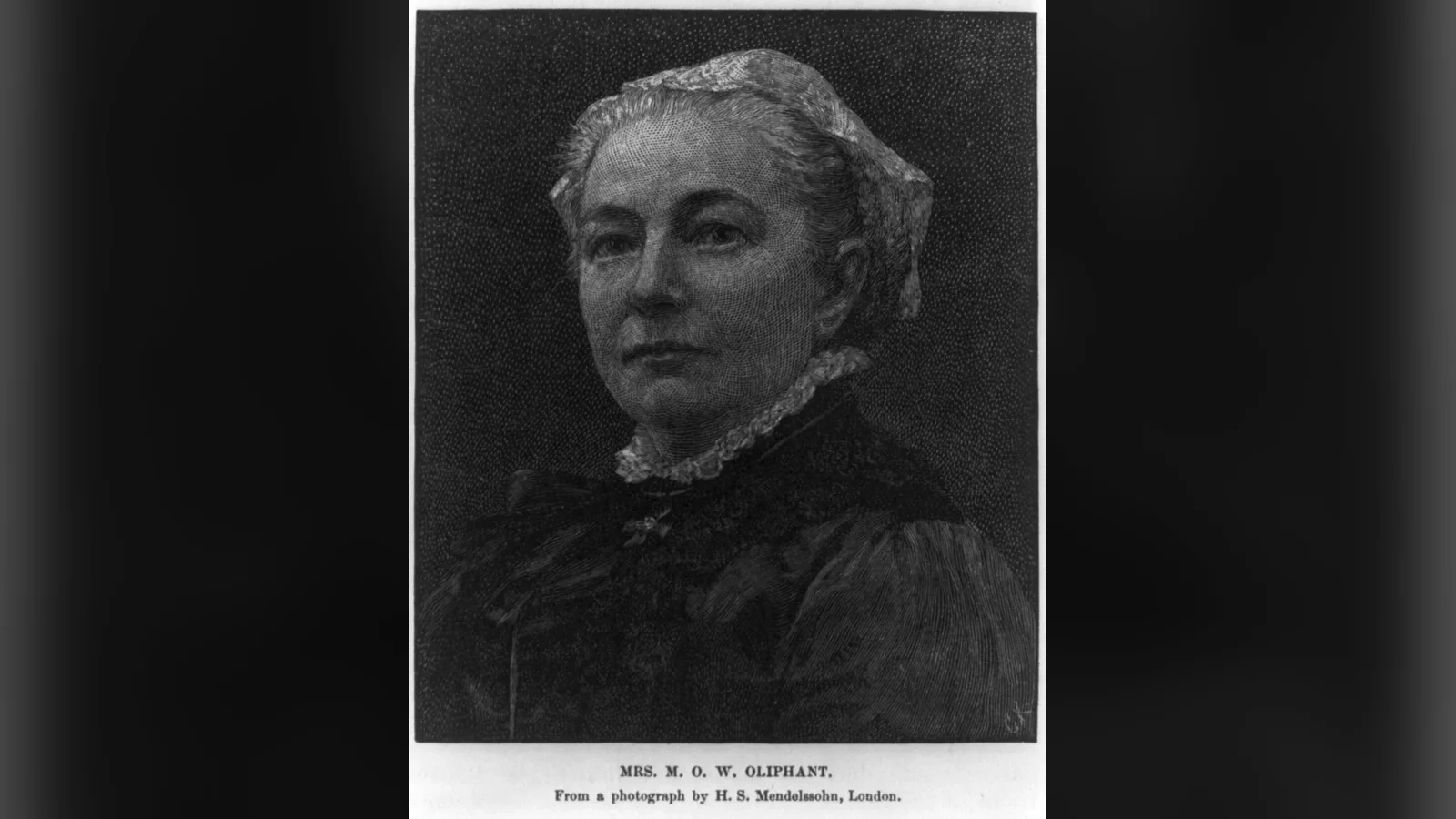

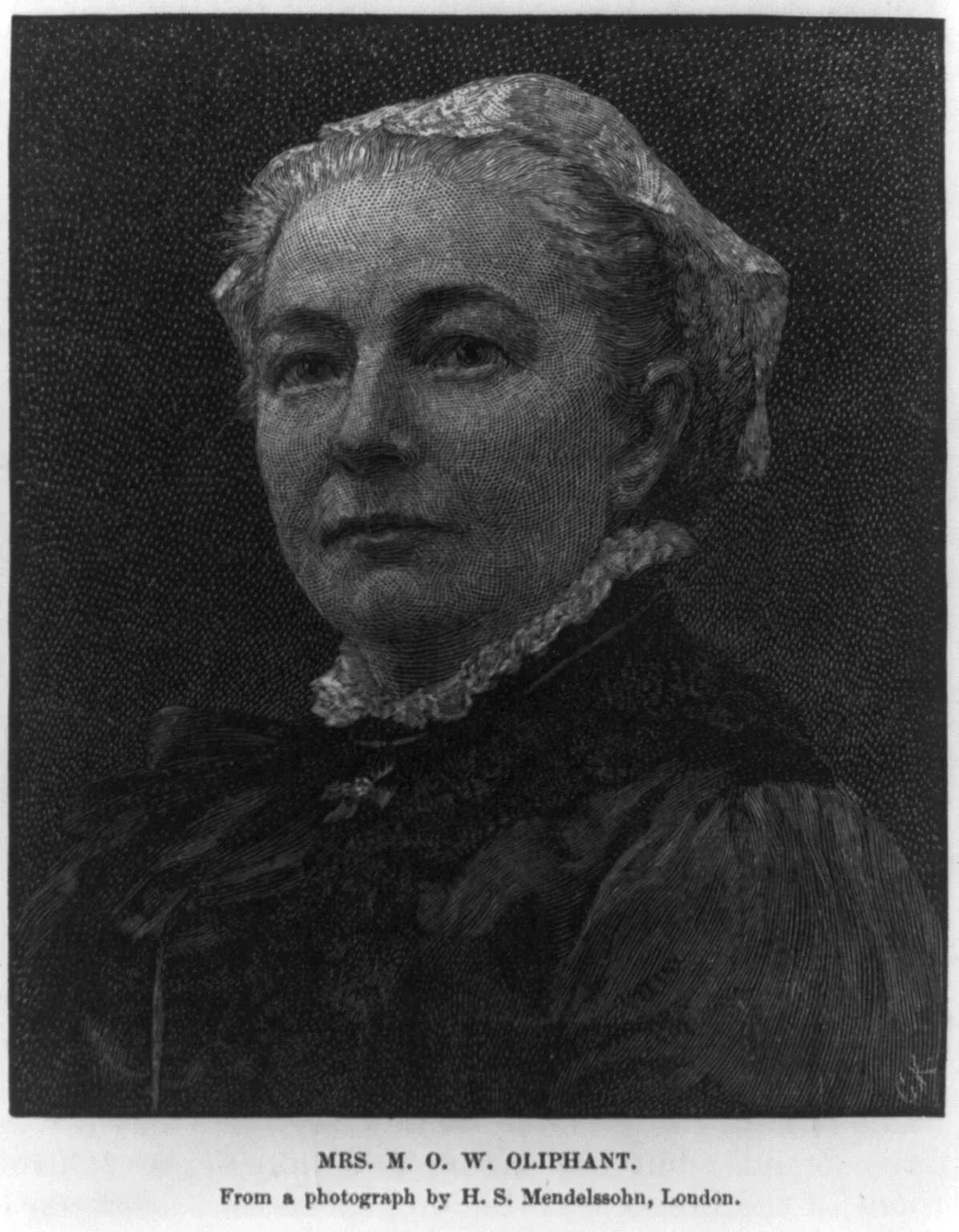
Margaret Oliphant (1828–1897)
Contents
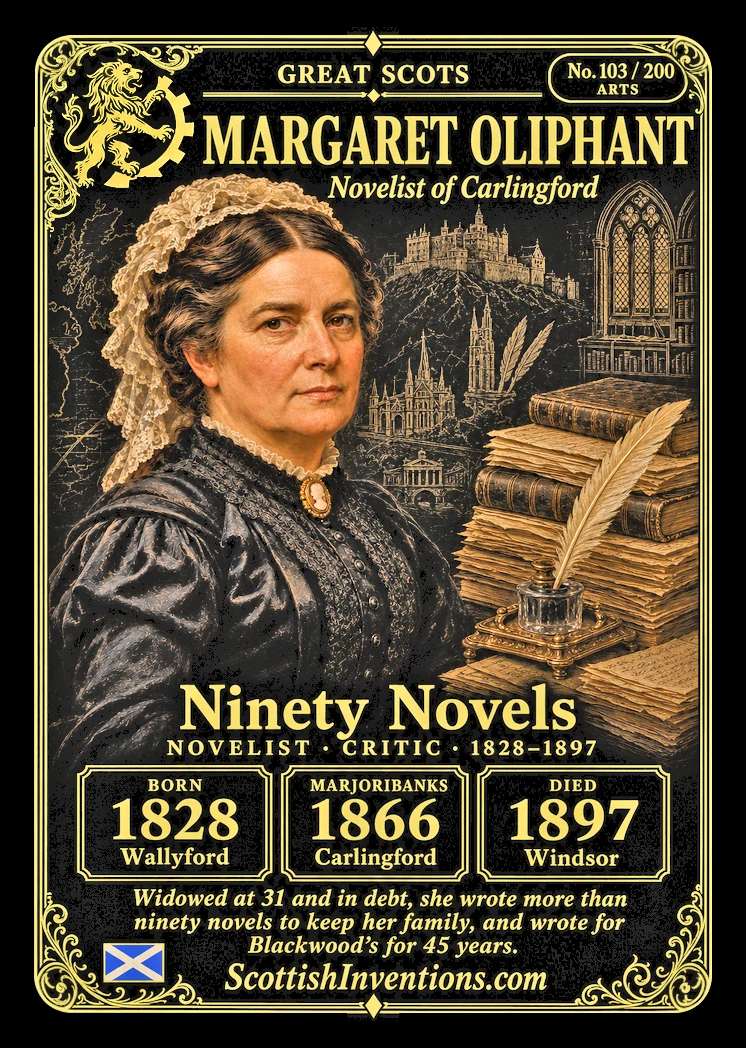
Margaret Oliphant wrote more than ninety novels and hundreds of essays, and kept a family of up to eight people on her earnings for nearly forty years.
TL;DR
- established Born Margaret Oliphant Wilson at Wallyford, near Musselburgh, in 1828, she published her first novel, Passages in the Life of Mrs Margaret Maitland, at 21 in 1849.
- established Widowed in 1859 with two small children, pregnant and £1,000 in debt, she wrote to support her own family and later her bankrupt brother's children too.
- established Her output is enormous: more than 90 novels, about 50 short stories, roughly 300 articles and 25 works of non-fiction, much of it for the Edinburgh publisher Blackwood and its magazine "Maga".
- shared Her Carlingford novels, especially Miss Marjoribanks and The Perpetual Curate, and her ghost stories, notably "The Library Window" (1896), are now regarded as her best work; contemporaries often compared her to George Eliot.
- established All six of her children died before her. Her Autobiography, published after her death in 1899, is one of the great Victorian accounts of grief and of writing for a living.
Key Facts
- Born
- 4 April 1828, Wallyford, East Lothian
- Died
- 25 June 1897, Windsor, Berkshire (aged 69)
- Parents
- Francis W. Wilson, clerk; Margaret Oliphant
- Married
- Frank Wilson Oliphant (1818–1859), artist and her cousin, in 1852
- Occupation
- Novelist, critic, biographer, historian
- Best-known works
- Miss Marjoribanks (1866), Salem Chapel (1863), Kirsteen (1890), A Beleaguered City (1880), "The Library Window" (1896), Autobiography (1899)
- Main publisher
- William Blackwood and Sons, Edinburgh, for 45 years
A Note on Claims and Evidence
Each major claim carries one of three labels. established means supported by primary records, official bodies or several independent reliable sources. shared means the core fact is sound but sources disagree on details, dates or interpretation. traditional means widely repeated but not traceable to a primary or independent source.
Oliphant's life is unusually well recorded: her autobiographical notebooks survive in the National Library of Scotland, along with her correspondence with Blackwood, Macmillan and others. Publication dates and the sums she was paid come from those records and are established. Her literary standing is shared: Victorian reviewers praised her, later critics often dismissed her as too prolific, and recent scholars have rescued the best of her work.
Timeline
Born on 4 April at Wallyford, East Lothian.
The family moves to Lasswade, Glasgow and Liverpool; she writes her first novel at 17.
Passages in the Life of Mrs Margaret Maitland is published in London, sold for her by her brother Willie for £150.
Introduced to the Blackwood family in Edinburgh through the poet D. M. Moir.
Marries her cousin Frank Oliphant; Katie Stewart begins her 45-year association with Blackwood's Magazine.
Frank dies of tuberculosis in Rome, leaving her pregnant, with two children and £1,000 of debt.
The Chronicles of Carlingford series, including Salem Chapel (1863), The Perpetual Curate (1864) and Miss Marjoribanks (1866).
The Life of Edward Irving, praised by Thomas Carlyle.
Her ten-year-old daughter Maggie dies suddenly in Rome.
A Beleaguered City, a novella of the supernatural.
Kirsteen, her finest Scottish novel; her son Cyril dies.
Her last surviving son, Francis ("Cecco"), dies.
"The Library Window" appears in Blackwood's Magazine.
Completes Annals of a Publishing House, a history of Blackwood's; dies at Windsor on 25 June.
The Autobiography and Letters of Mrs Margaret Oliphant is published.
Details
A Scottish girlhood and an early start
established Margaret Oliphant Wilson was born at Wallyford, near Musselburgh, and grew up in a lower-middle-class household that moved to Lasswade, Glasgow and then Liverpool. Her mother, ambitious for her, passed on a deep knowledge of Scottish culture and ballads. Oliphant said later that her Scottishness "ran through everything", even though she spent most of her adult life in England. She wrote her first novel at 17. In 1849, aged 21, her brother Willie sold the manuscript of Passages in the Life of Mrs Margaret Maitland, the story of a shrewd Scottish spinster, to the London publisher Henry Colburn for £150. It was a success.
Blackwood's and "Maga"
established In 1851 her mother renewed an old family connection with the poet and physician David Macbeth Moir, who wrote for Blackwood's Edinburgh Magazine as "Delta" and introduced the young author to the Blackwood family. On her wedding day in 1852 she received the proofs of Katie Stewart, which began a relationship with Blackwood's and its magazine, nicknamed "Maga", that lasted 45 years. She became one of its most dependable essayists and reviewers. shared The relationship was conducted as a friendship rather than a business deal. According to the book historian Zsuzsanna Varga, this left her in a weak bargaining position: she usually sold her copyrights outright for advances rather than taking royalties, and from 1868 Blackwood's rejected more of her fiction than it accepted. She never got the editorship she hoped for, though she was asked, at the end of her life, to write the firm's official history.
Widowhood and the economics of writing
established Her husband, the artist Frank Oliphant, died of tuberculosis in Rome in 1859. She was left with two young children, pregnant with a third and £1,000 in debt. During his illness the family had lived on £20 a month that John Blackwood advanced against her future articles. From then on, writing was not a pleasure but her family's only income. She supported her own children and, later, the children of her bankrupt brother.
established The sums could be large. For The Perpetual Curate (1864) Blackwood offered £1,500, £500 more than she had asked, and the magazine Good Words paid £1,000 for Madonna Mary (1866). In the 1860s she was writing at least two books a year alongside a stream of essays. She wrote so much that she wore a groove in her right forefinger. In 1888 she wrote: "I don't think I have ever had two hours undisturbed (except at night, when everyone is in bed) during my whole literary life."
Carlingford and the best of her fiction
shared The Chronicles of Carlingford, set in an imaginary English country town, are the core of her reputation. They give a sharp, often comic picture of English church and chapel life, and pay unusual attention to the inner lives of women. Miss Marjoribanks (1866), about a young woman who sets out to run the social life of her town, is now often called her masterpiece. Her later heroines broke new ground: Hester (1883) is set in the world of banking, and Kirsteen (1890) follows a determined Scottish girl who runs away to London and makes her living as a dressmaker.
Ghost stories and grief
established All her children died before her. Three died in infancy; her ten-year-old daughter Maggie died suddenly in 1864; and her sons Cyril and Francis, known as "Tiddy" and "Cecco", died in their early thirties in 1890 and 1894. shared Critics have connected these losses to her stories of the unseen, A Beleaguered City (1880) and A Little Pilgrim in the Unseen (1882), which drew on her non-denominational Christian faith and on Scottish Celtic folklore. Her short story "The Library Window" (1896), about a girl in a Fife town who sees a man writing in a window that may not exist, is widely regarded as one of the finest Scottish short stories.
Biographer and historian
established Oliphant's non-fiction was as wide-ranging as her fiction. The Life of Edward Irving (1862), about the Scottish preacher, was praised by Thomas Carlyle. For Macmillan she wrote popular histories, including The Makers of Florence (1876), The Makers of Venice (1887) and The Makers of Modern Rome (1895), as well as The Literary History of England (1882). Her last major work was Annals of a Publishing House, the history of Blackwood's, finished just before she died at Windsor in June 1897.
Reputation
shared Contemporaries often set her beside George Eliot, and she measured herself against Eliot and Trollope, usually unfavourably. Her own doubts about the worth of her writing, voiced in the Autobiography, helped later critics write her off as a hack. Since the 1980s, new editions of the Carlingford novels and her Autobiography have made the case that, among much hurried work, she wrote several of the best English novels of the 1860s.
Did You Know?
- She was paid £150 for her first novel, more than Charlotte Brontë received for Jane Eyre (£100).
- She wrote so much that she wore a groove in her writing finger.
- On her wedding day she received the proofs of a new novel.
- Her association with Blackwood's lasted 45 years, and she ended it by writing the firm's history.
- Thomas Carlyle praised her Life of Edward Irving.
- Her ghost story "The Library Window" is set in an imagined Fife town based on St Andrews.
- She outlived all six of her children.
From the archive
Original documents and images from the period.
FAQ
1Who was Margaret Oliphant?
A Scottish novelist, critic and historian (1828–1897), one of the most prolific and widely read writers of the Victorian age.
2How many books did she write?
More than 90 novels, about 50 short stories, roughly 300 articles and 25 works of non-fiction.
3Why did she write so much?
After her husband died in 1859 she had to support her children, and later her brother's family, entirely from her writing.
4What are the Carlingford novels?
A series of six books set in an imaginary English country town, published from 1861, including Salem Chapel, The Perpetual Curate and Miss Marjoribanks.
5Is she related to Carolina Oliphant, Lady Nairne?
No close relationship is known. Oliphant was her mother's maiden name, and it became her married name when she married her cousin Frank.
6What is "The Library Window"?
A short ghost story of 1896 about a young girl who watches a man writing in a window across the street that others say is not there. It is often called her finest short work.
7Was she Scottish or English?
Scottish by birth and, in her own words, by identity, though she lived most of her adult life in England and Italy.
8Did she write about Scotland?
Yes. Margaret Maitland, Katie Stewart, Kirsteen and "The Library Window" are all set in Scotland, and she wrote often about Scottish history and character.
9What happened to her children?
All six died before her: three in infancy, her daughter Maggie at ten, and her two sons in their early thirties.
10Where can I read her autobiography?
It was first published in 1899; Elisabeth Jay's complete edition (1990, revised 2002) restores the full text.
Sources and Further Reading
Primary/Institutional
- National Library of Scotland, MSS 21501–23000 and 23218–19: Oliphant correspondence, papers and autobiographical notebooks.
- Margaret Oliphant, The Autobiography of Margaret Oliphant, ed. Elisabeth Jay (1990; 2002).
Scholarly/Critical
- Elizabeth Ewan, Rose Pipes et al. (eds), The New Biographical Dictionary of Scottish Women (Edinburgh University Press, 2018), entry "Oliphant, Margaret".
- Zsuzsanna Varga, "Margaret Oliphant and the Profession of Writing", in Bill Bell (ed.), The Edinburgh History of the Book in Scotland, vol. 3 (2007).
- The Edinburgh History of Scottish Literature, vol. 2: Enlightenment, Britain and Empire (1707–1918) (2007).
- Elisabeth Jay, Mrs Oliphant: "A Fiction to Herself" (1995).
- Merryn Williams, Margaret Oliphant: A Critical Biography (1986).
General
- T. M. Devine and Jenny Wormald (eds), The Oxford Handbook of Modern Scottish History (2012).
Caveats: Myths and Disputed Claims
- Myth: she was merely a hack. She did write quickly and sometimes carelessly, but the Carlingford novels, Kirsteen and her ghost stories are now widely regarded as accomplished work.
- Disputed: her earnings. Her Autobiography stresses hardship, but the publishing records show she was often well paid. Her difficulties came from the size of the household she supported and from selling copyrights outright.
- Disputed: the St Andrews setting of "The Library Window". The story's town is unnamed; the identification with St Andrews is a common reading, not something she stated.
Finished reading? Try the Fact Machine: three reels, one surprising Scottish connection →
Card 103 · Great Scots