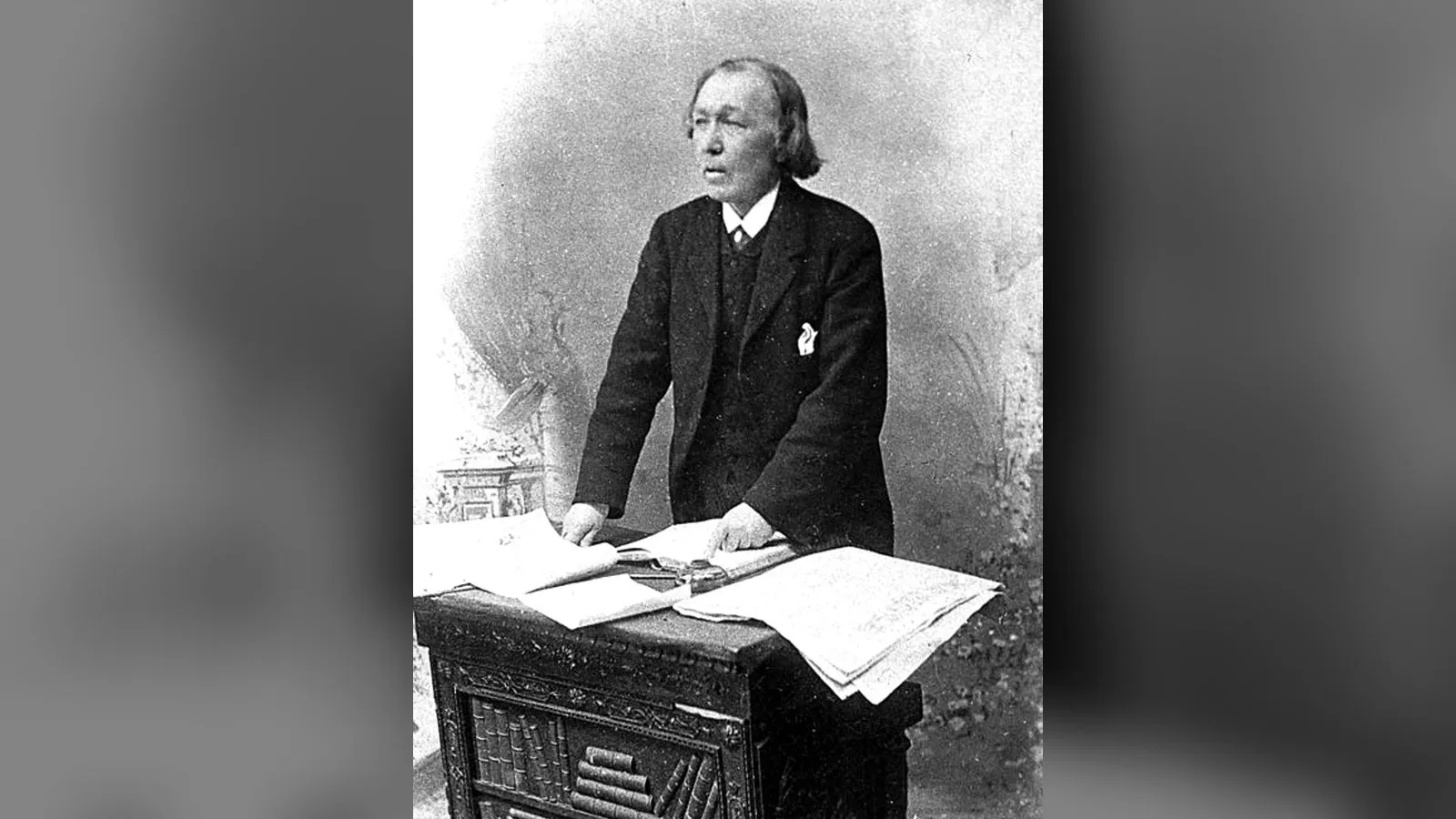

William McGonagall: The Poet Who Would Not Stop
Contents
- TL;DR
- Key Findings
- Key Facts
- Claim Status
- A Weaver's Life
- "Write! Write!"
- The Road to Balmoral
- The Silvery Tay
- How to Write Badly: The McGonagall Method
- Pelted, Banned and Undaunted
- Sir William Topaz McGonagall
- The Temperance Poet and the Stage
- Was He Serious?
- An Afterlife Nobody Predicted
- Timeline
- Did You Know?
- Honest Caveats
- FAQ
- Related
- Sources
TL;DR
William McGonagall (probably 1825–1902) was a Dundee handloom weaver who, in June 1877, felt a "flame" kindle through his body and heard a voice crying "Write! Write!" He spent the next twenty-five years writing hundreds of poems about battles, shipwrecks, royalty, temperance, local beauty spots and, most famously, the Tay Bridge disaster of 1879. They are so earnestly, consistently awful, with rhymes forced at any cost, lines that sprawl past all metre and pathos punctured by stray facts, that he is widely called the worst poet in the English language.
He was pelted with eggs and herrings, banned from performing by Dundee's magistrates and fooled by a hoax knighthood. He never made a living from poetry, and he never stopped. Since his death his Poetic Gems have never gone out of print, and he has inspired the Goons, Monty Python, Terry Pratchett and J. K. Rowling's Professor McGonagall. He is a Great Scot not for achievement but for something rarer: an unbreakable belief in himself, and a body of work that has given more lasting pleasure than many better poets managed.
Key Findings
- His origins are uncertain, largely by his own doing. He claimed to have been born in Edinburgh in 1830. The editor Chris Hunt concludes he was probably born in 1825 to Irish immigrant parents, Charles and Margaret McGonagall, and an early census gives his birthplace as Ireland.
- He was a skilled Dundee weaver who taught himself Shakespeare by heart and once paid a theatre £1 to let him play Macbeth. On the night he refused to die in the final fight.
- His "call" came in June 1877, during Dundee's holiday week. His first published poem, praising the Rev. George Gilfillan, appeared in the Weekly News.
- He walked to Balmoral in July 1878 to perform for Queen Victoria, through a thunderstorm at the Spittal o' Glenshee, and was turned away at the lodge gate with the words: "Tennyson's the real poet to Her Majesty."
- "The Tay Bridge Disaster" (1880) is his best-known poem. Disasters made up only about a tenth of his output, though: he wrote far more about places, famous people and the wars of empire.
- Dundee's magistrates banned his circus act. He performed in a local circus for fifteen shillings a night while the crowd threw eggs, flour, herrings, potatoes and stale bread, until the magistrates stopped the shows.
- He became "Sir William Topaz McGonagall, Knight of the White Elephant, Burmah" after a hoax package from the supposed court of King Theebaw of Burma. He used the title for the rest of his life.
- He was almost certainly sincere. His technique slowly improved over the years, which is the opposite of what a deliberate comedian would do.
Key Facts
- Born
- Probably 1825 (he claimed 1830); probably Ireland (he claimed Edinburgh)
- Parents
- Charles and Margaret McGonagall, Irish immigrants
- Died
- 29 September 1902, Edinburgh, of a cerebral haemorrhage
- Married
- Jean King, 1846; five sons and two daughters
- Trade
- Handloom weaver, Dundee
- Poetic "call"
- June 1877
- Balmoral walk
- July 1878
- Best-known poem
- "The Tay Bridge Disaster" (1880)
- First collection
- Poetic Gems (April 1890), published by friends
- Later collections
- More Poetic Gems (1962); Last Poetic Gems (1968)
- Self-styled title
- Sir William Topaz McGonagall, Knight of the White Elephant, Burmah (a hoax)
- Reputation
- Widely called the worst poet in the English language
Scottish Impact Index (SI Score)
- Global Influence
- 4/10
- Enduring Relevance
- 7/10
- Material Contribution
- 2/10
- Exceptional Achievement
- 6/10
- Lasting Legacy
- 4/10
- Recognition
- 6/10
29/60
Ranked =105th of 200 in Great Scots
Claim Status
established
- his life in Dundee as a weaver;
- his poetic career from 1877 and the Balmoral walk of 1878;
- the circus performances and the magistrates' ban;
- the publication of Poetic Gems in 1890;
- the hoax knighthood;
- his moves to Perth (1894) and Edinburgh (1895);
- his death in 1902.
disputed
- his year of birth: 1825 according to the record evidence, 1830 according to McGonagall;
- his place of birth: Ireland according to an early census, Edinburgh according to McGonagall. This matters for a Great Scots card. If the census is right, McGonagall was Irish-born and raised in Scotland, a Scot by upbringing, work and identity rather than by birth. We flag this openly.
traditional
- whether McGonagall was in on the joke. Some writers have argued he was a satirist or a deliberate comedian. Hunt's verdict, which this card follows, is that the evidence points to complete sincerity (see "Was He Serious?").
A Weaver's Life
McGonagall's own account of his childhood, written for his Poetic Gems, opens with a claim: "My parents were both born in Ireland... I was born in the year of 1830 in the city of Edinburgh." The surviving records do not support either detail very well. What is clear is that the family moved repeatedly in search of work, through Edinburgh, Paisley, Glasgow and, by some accounts, Maybole, before settling in the west end of Dundee. William had perhaps a year of formal schooling.
In Dundee he was sent to work in Peter Davie's mill in the Scouringburn, then apprenticed as a handloom weaver in Ex-Provost Reid's factory nearby, following his father's trade. Handloom weaving was already being displaced by machines, but there was still work for skilled men on complex fabrics, and for a time McGonagall earned good wages. In 1846 he married Jean King. They had seven children.
His evenings went on reading, above all Shakespeare. He learned the parts of Macbeth, Richard III, Hamlet and Othello by heart and performed scenes for his workmates in the weaving shop. They responded by raising money to get him on a real stage. For £1, Mr Giles, who ran a brick-built theatre in Lindsay Street quarry, agreed to let McGonagall play Macbeth for one night. The house was packed with his friends. Convinced that the other actors were jealous of his success, McGonagall refused to be killed in the final fight, and Macduff was eventually beaten instead. He was carried from the theatre in triumph, having given Shakespeare a new ending.
By the 1870s he was a respectable Victorian working man: a family man, a churchgoer and a committed supporter of the temperance movement. The decade was hard, though. Weaving work was scarce, and the household was crowded and under strain.
"Write! Write!"
Then came what McGonagall called "the most startling incident in my life". In June 1877, during the Dundee holiday week, he was alone in his back room in Paton's Lane, thinking of the crowds who had gone away by rail and steamer:
I seemed to feel as it were a strange kind of feeling stealing over me, and remained so for about five minutes. A flame, as Lord Byron has said, seemed to kindle up my entire frame, along with a strong desire to write poetry; and I felt so happy, so happy, that I was inclined to dance... It was so strong, I imagined that a pen was in my right hand, and a voice crying, "Write! Write!"
His first poem praised the Rev. George Gilfillan, a well-known Dundee preacher. He slipped it into the letterbox of the Weekly News, which printed it with gentle irony, noting that "W. M'G., Dundee... modestly seeks to hide his light under a bushel". The poem began:
Rev. George Gilfillan of Dundee, There is none can you excel; You have boldly rejected the Confession of Faith, And defended your cause right well.
Odes to Shakespeare and Burns followed. McGonagall decided that, like any great artist, he needed a patron, and he wrote to Queen Victoria. He received a polite acknowledgement from her private secretary's office, signed on the envelope by Sir Thomas Biddulph. McGonagall treated it for the rest of his life as a letter of royal patronage.
The Road to Balmoral
If the Queen had thanked him for his written verses, he reasoned, how much more would she value a live performance? In July 1878 he set out on foot from Dundee for Balmoral, about fifty miles away through the hills. His own account of the journey is one of the great comic documents of Scottish literature, though he did not intend it to be.
He spent the first night at Alyth. At the Spittal o' Glenshee he was caught in a violent thunderstorm. He pressed on through Braemar and reached the lodge gates of Balmoral as the tower clock struck three. He knocked and showed the constable his royal letter. The constable doubted it was genuine until McGonagall pointed out Sir Thomas Biddulph's signature on the envelope. Then the constable looked at the title page of McGonagall's poems and delivered the verdict that has followed him ever since: "You are not poet to Her Majesty; Tennyson's the real poet to Her Majesty."
Asked to give a sample of his abilities where he stood, McGonagall refused: "No, sir, nothing so degrading in the open air. When I give specimens of my abilities it is either in a theatre or some hall." Even when the constable suggested he might perform to oblige a young lady watching from the lodge, he would not. The constable bought a copy of his poems for twopence and told him to go straight home. He walked back to Dundee, and turned the whole episode into material for the local papers.
The Silvery Tay
McGonagall's most famous subject was the railway bridge over the Tay, then the longest in the world. In 1878, shortly after it opened, he celebrated it in "The Railway Bridge of the Silvery Tay":
Beautiful Railway Bridge of the Silvery Tay! With your numerous arches and pillars in so grand array And your central girders, which seem to the eye To be almost towering to the sky.
On the stormy night of 28 December 1879, the central girders of the bridge collapsed in a gale as a train crossed from Edinburgh. Everyone aboard was killed. McGonagall's "The Tay Bridge Disaster" became his most quoted work:
Beautiful Railway Bridge of the Silv'ry Tay! Alas! I am very sorry to say That ninety lives have been taken away On the last Sabbath day of 1879, Which will be remember'd for a very long time.
The poem shows all his habits at once: the refrain repeated like a ballad's, the weather personified as "Boreas" and "the Storm Fiend", and an ending that turns a tragedy into building advice:
For the stronger we our houses do build, The less chance we have of being killed.
His figure of "ninety lives" reflected early newspaper estimates. Modern research has identified fewer victims: the memorials unveiled in Dundee and Wormit in 2013 name 59 people. He went on to write about the new bridge as well ("An Address to the New Tay Bridge") and about the humpback whale that swam up the river in 1883 ("The Famous Tay Whale").
How to Write Badly: The McGonagall Method
Chris Hunt identifies three habits that make a McGonagall poem unmistakable.
Rhyme at any cost. Once inspiration struck, he could not stop rhyming. The same pairs recur: a queen will be somewhere "green" or "wondrous to be seen", and uplifting stories are "engraved in letters of gold". The habit even leaked into his prose, as when a steamer leaves the quay and "the passengers' hearts felt light and gay".
No sense of metre. Rhyme was compulsory, but scansion was beyond him. His lines sprawl to whatever length is needed to reach the rhyming word:
On one occasion King James the Fifth of Scotland, when alone, in disguise, Near by the Bridge of Cramond met with rather a disagreeable surprise.
The fatal fact. He had an unerring instinct for puncturing his own pathos with an irrelevant detail. In "The Albion Battleship Calamity", the sympathy of the royal family turns into a subscription list:
Her Majesty has sent a message of sympathy to the bereaved ones in distress, And the Duke and Duchess of York have sent 25 guineas I must confess.
He was far more than a disaster poet. Hunt calculates that disasters made up barely 10 per cent of his output. He wrote much more about places (Balmerino, Tayport, the Hill of Balgay), famous people and the battles of Queen Victoria's empire. The one thing almost absent is his own private life: there are no poems to his wife or his children.
Pelted, Banned and Undaunted
With his poems printed on broadsheets, McGonagall walked the streets of Dundee selling them and hired halls for evening recitals. Audiences soon learned what to expect and came armed with rotten food. He took it all as appreciation. Faint praise became proof of genius, and critics became enemies. On a tour of Fife in 1879, a temperance official in Dunfermline told him his poetry was very bad. McGonagall replied that Her Majesty had thanked him for it, and promised to report the man.
He tried bigger stages. In 1880 he sailed to London, where no theatre would take him and he considered street performance beneath his dignity. On 10 March 1887 he left Glasgow for New York aboard the steamer Circassia. At the immigration station he told officials he was a weaver, reasoning that if he had said he was a poet they would not have let him in. New York's theatre managers told him they "didn't encourage rivalry", and he was soon home again.
Back in Dundee, now in his sixties, he took a regular spot in a circus, declaiming his verse for fifteen shillings a night while the crowd threw eggs, flour, herrings, potatoes and stale bread. The riotous shows came to the attention of the city's magistrates, who banned them. McGonagall answered in verse:
Fellow citizens of Bonnie Dundee Are ye aware how the magistrates have treated me? Nay, do not stare or make a fuss When I tell ye they have boycotted me from appearing in Royal Circus.
In April 1890 his friends organised the publication of Poetic Gems, with a biographical sketch by the author. Two hundred copies sold at once, and he presented an inscribed copy to Dundee's Free Library. Appeals to the Home Secretary to lift the ban failed, as did a petition, signed by hundreds of Dundee citizens, for a pension from the civil list.
He found other ways to earn a little. He wrote lines praising a local tweed manufacturer in return for a suit of the cloth. He wrote advertising verse for Beecham's Pills and for Sunlight Soap, which paid him two guineas. That makes him an early example of the celebrity endorsement. In 1893, angered by his treatment in the streets, he threatened in verse to leave the city. A newspaper suggested that once he noticed Dundee rhymed with 1893, he might stay another year.
Sir William Topaz McGonagall
In October 1894 William and Jean finally left Dundee, their home for more than fifty years, and moved to Perth. There he received an extraordinary package, supposedly from the court of King Theebaw of Burma. It contained a small silver elephant and a letter making him a Knight of the Order of the White Elephant. It was a hoax, but if McGonagall knew it, he never admitted it. He printed the whole "Royal patent letter" in his autobiography. It claimed that the honour had been arranged by his fellow countrymen serving in India, and that King Theebaw was "just now holding his Court in the Andaman Islands". In reality Thibaw had been deposed by the British in 1885 and was living in exile in India. The letter was signed by a string of invented officials, including the "Topaz General" and the "Keeper of the White Elephant". McGonagall described the insignia proudly, a silver elephant on a green silk ribbon, and apologised that he could not copy the "Indian language" or the four red seals. From then on he signed himself Sir William Topaz McGonagall, Knight of the White Elephant, Burmah.
While based in Perth he performed in Edinburgh, where he was visited by the great actor Henry Irving and the actress Ellen Terry. He received them, it was reported, with the graciousness of one tragedian to another. It was a sweet reversal. In London in 1880, McGonagall had gone to the stage door of Irving's Lyceum Theatre, only to be told by the doorkeeper that Mr Irving "wouldn't speak to the likes of me". He wrote: "I told him I considered myself to be as great a man as he is... but he will speak to me now, my friends, and has done so in Edinburgh." In 1895 he moved to Edinburgh, where he enjoyed the most successful period of his career. The students of the capital made him a cult figure and invited him to entertainments. They may have been laughing behind his back, but at least they were not throwing food.
The fashion faded. By the turn of the century he was old, deaf and bronchitic, too frail to tramp the streets with his broadsheets, and he lived on donations from friends. He kept writing: on Queen Victoria's death in January 1901, on the new king, Edward VII, and on Edward's coronation in August 1902, a poem now lost. He died of a cerebral haemorrhage on 29 September 1902 and was buried in an unmarked grave in Edinburgh's Greyfriars Kirkyard, where a memorial plaque was later placed.
The Temperance Poet and the Stage
Two pieces in More Poetic Gems show the passions behind the verse. The first is "The Destroying Angel, or the Poet's Dream", a temperance fantasy set in his own city. An angel in white with a "flaming brand" wakes the poet and leads five thousand men up Dundee's High Street, where she announces that it is God's decree to destroy every public house in the city:
Because God has said there's no use preaching against strong drink, Therefore, by taking up arms against it, God does think, That is the only and the effectual cure To banish it from the land, He is quite sure.
The Devil appears on the Townhouse steeple, "foaming at the mouth with rage... and kicking the Steeple". The angel then burns her way along the Perth Road, the Hawkhill, the Scouringburn and the Bonnet Hill, real streets in the weaving districts McGonagall knew, until the poet wakes: "But, alas, I started up in bed, and behold it was a dream!"
The second is "Lines in Defence of the Stage", in which the devout churchgoer turns on the clergy who condemned the theatre:
Good people of high and low degree, I pray ye all be advised by me, And don't believe what the clergy doth say, That by going to the theatre you will be led astray.
His proof is Shakespeare: Hamlet, he notes, exposed his father's murderer by staging a play. For a man who first stepped on stage as Macbeth and billed himself to the end as "Poet and Tragedian", it was a cause close to his heart.
The same collection shows how wide his subjects ranged: a "Summary History of Sir William Wallace", "Loch Ness", "The Relief of Mafeking", "The Burial of Mr Gladstone", "Captain Teach alias Black Beard", and a whole series of resort poems, from "Beautiful Crieff" and "Beautiful Nairn" to "Beautiful North Berwick" and "Beautiful Torquay". In his autobiography he also noted, with no sense of irony, that his celebrated first Tay Bridge poem was out of print and that he did not intend to publish it again, "owing to the fall of the bridge in the year of 1879".
Was He Serious?
The question was asked in his lifetime and is still asked. Some have argued he was a satirist, quietly mocking the causes he seemed to champion. The best case for this is "The Funeral of the Late Ex-Provost Rough", in which a temperance hero refuses the wine his doctor prescribes:
So in a short time his spirit fled to heaven, where all troubles are o'er.
Hunt dismisses the theory. McGonagall wrote hundreds of poems with no conceivable satirical purpose: why write "Beautiful Balmerino" or "Forget-Me-Not" as satire? The idea that he was a deliberate comedian also fails. Apart from his brief Edinburgh vogue, his act never earned him real money or recognition, so it is hard to see why he would keep it up. His technique also improved slightly over time. His early poems have stanzas of ragged length, packed with as many rhymes as he could find. By "The Storming of the Dargai Heights" (1897) he had settled into regular four-line stanzas rhyming AABB, though the metre was as wild as ever. A comedian chasing laughs would have got worse, not better. Keeping up a comic character on stage and off for twenty-five years would have been one of the greatest feats of acting ever. The simpler explanation is that he was being himself.
An Afterlife Nobody Predicted
McGonagall did not fade into obscurity. A new edition of Poetic Gems appeared in the 1930s and has never gone out of print. By the 1960s his fame had spread south of the border, helped by fans such as the actor John Laurie, who recited him at parties. More Poetic Gems followed in 1962 and Last Poetic Gems in 1968.
He inspired characters in The Goon Show, Monty Python's Flying Circus and The Muppet Show. Spike Milligan made the film The Great McGonagall (1974), and his life has been staged many times. Terry Pratchett's Discworld novels feature the Gonnagles, a clan of bards who specialise in deliberately terrible poetry. J. K. Rowling named Professor Minerva McGonagall in the Harry Potter books after him. Dundee, the city that pelted him, now celebrates him, and "McGonagall suppers", with competitions in deliberately awful verse, are held in his honour.
Hunt suggests he was simply born too early, and would have thrived in the age of reality television. Perhaps. He also stands for something oddly admirable: a working man of very little schooling who decided he was an artist and never let the world talk him out of it.
Timeline
Born, probably in Ireland — He claimed Edinburgh, 1830
Family settles in Dundee — Mill work, then handloom weaving
Marries Jean King — Seven children
Plays Macbeth at Giles' theatre, Lindsay Street — Refuses to die
Poetic "call" during Dundee holiday week — First poem, to George Gilfillan
"The Railway Bridge of the Silvery Tay" —
Walks to Balmoral; turned away at the gate — "Tennyson's the real poet"
Tay Bridge collapses —
"The Tay Bridge Disaster"; trip to London —
Sails from Glasgow to New York — Returns soon after
Circus performances; magistrates' ban —
Poetic Gems published — 200 copies sold at once
Leaves Dundee for Perth — Hoax Burmese knighthood
Moves to Edinburgh — Student cult
Dies in Edinburgh — Greyfriars Kirkyard
Poetic Gems reissued — Never out of print since
More Poetic Gems; Last Poetic Gems —
Spike Milligan's film The Great McGonagall —
Did You Know?
- When he emigrated briefly to New York, McGonagall told the immigration officers he was a weaver, because he feared they would turn away a poet.
- He refused to recite for the constable at Balmoral because performing in the open air was "degrading". His terms were a hall, and payment in advance.
- He was paid two guineas for verses advertising Sunlight Soap.
- He wrote his poetic "call" in his back room in Paton's Lane, Dundee.
- In one poem he dreamt of an angel burning down every pub in Dundee.
- J. K. Rowling's Professor McGonagall and Terry Pratchett's Gonnagles are both named after him.
Honest Caveats
- His own accounts are unreliable. Much of his life story comes from his autobiographical writings, which contradict each other and the official records, most obviously on his birth year and birthplace.
- Was he Scottish-born? The census evidence points to Ireland. He lived in Scotland from childhood, worked and wrote there all his life and called himself a Scot, but the claim that he was "born in Edinburgh" rests on his word alone.
- The "worst poet" label is a judgement, popularised in the twentieth century. It is affectionate as much as critical.
- Tay Bridge casualties. His "ninety lives" was a contemporary estimate. Modern research names 59 victims, and the true total is still uncertain.
FAQ
1Why is McGonagall called the worst poet in English?
Because of his forced rhymes, his total disregard for metre and his habit of undermining serious subjects with clumsy or irrelevant detail, all delivered with complete sincerity.
2What is his most famous poem?
"The Tay Bridge Disaster" (1880), about the collapse of the Tay rail bridge on 28 December 1879.
3Did he really walk to Balmoral?
Yes. In July 1878 he walked from Dundee to Balmoral to perform for Queen Victoria and was turned away at the lodge gate.
4Was he knighted?
No. His "knighthood" of the Order of the White Elephant of Burma was a hoax, but he used the title for the rest of his life.
5Was he joking?
The evidence suggests not. His technique improved over the years, he made little money, and he kept up the same character on and off stage for a quarter of a century.
6Where is he buried?
In Greyfriars Kirkyard, Edinburgh, originally in an unmarked grave.
Related
- Robert Burns
- Robert Fergusson
- The Tay Bridge
- Dundee & the Tay
Sources
Primary/Institutional
- Tay Bridge Disaster Memorial Trust, memorials at Dundee and Wormit (2013).
Scholarly/Critical
- William McGonagall, Collected Poems (Birlinn, 2011), including Poetic Gems, More Poetic Gems, Last Poetic Gems, the "Brief Autobiography", "Reminiscences" and The Autobiography of Sir William Topaz McGonagall.
- Chris Hunt, Introduction to McGonagall, Collected Poems (2006; Birlinn edition 2011).
- Oxford Dictionary of National Biography, "McGonagall, William (1825–1902)".
General
- McGonagall Online, collected poems and life. https://www.mcgonagall-online.org.uk/
Further reading
- William McGonagall, Poetic Gems, selected from the works of Mr William McGonagall, with biographical sketch by the author, and portrait (Dundee, 1890).
- William McGonagall, More Poetic Gems, ed. D. W. Smith (David Winter & Son, Dundee, and Duckworth, London; 1962, this printing 1969). Includes "The Destroying Angel", "Lines in Defence of the Stage" and The Autobiography of Sir William Topaz McGonagall.
Card 175 · Great Scots