Scottish Inventions · Transport
Two Scots, Two Inventions, One Story:
The Pneumatic Tyre
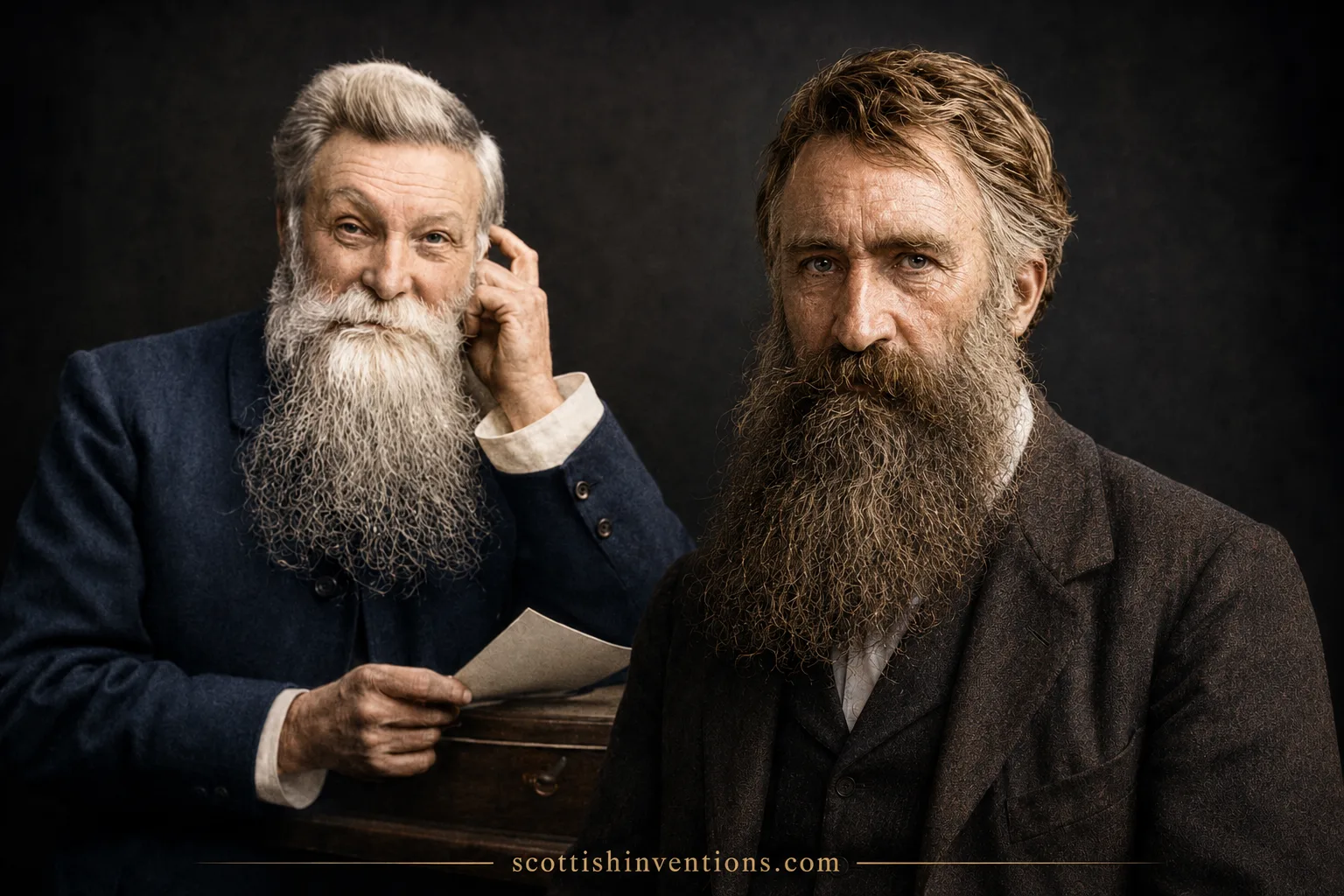
Invented twice — forty-three years apart — by two Scotsmen who never met.
SI Score57/60Ranked =2nd of 50 in InventionsBreakdown
Scottish Impact Index (SI Score)
- Global Impact
- 10/10
- Longevity
- 10/10
- Economic / Material Impact
- 10/10
- Originality / Distinctiveness
- 9/10
- Legacy (Built Upon)
- 9/10
- Recognition
- 9/10
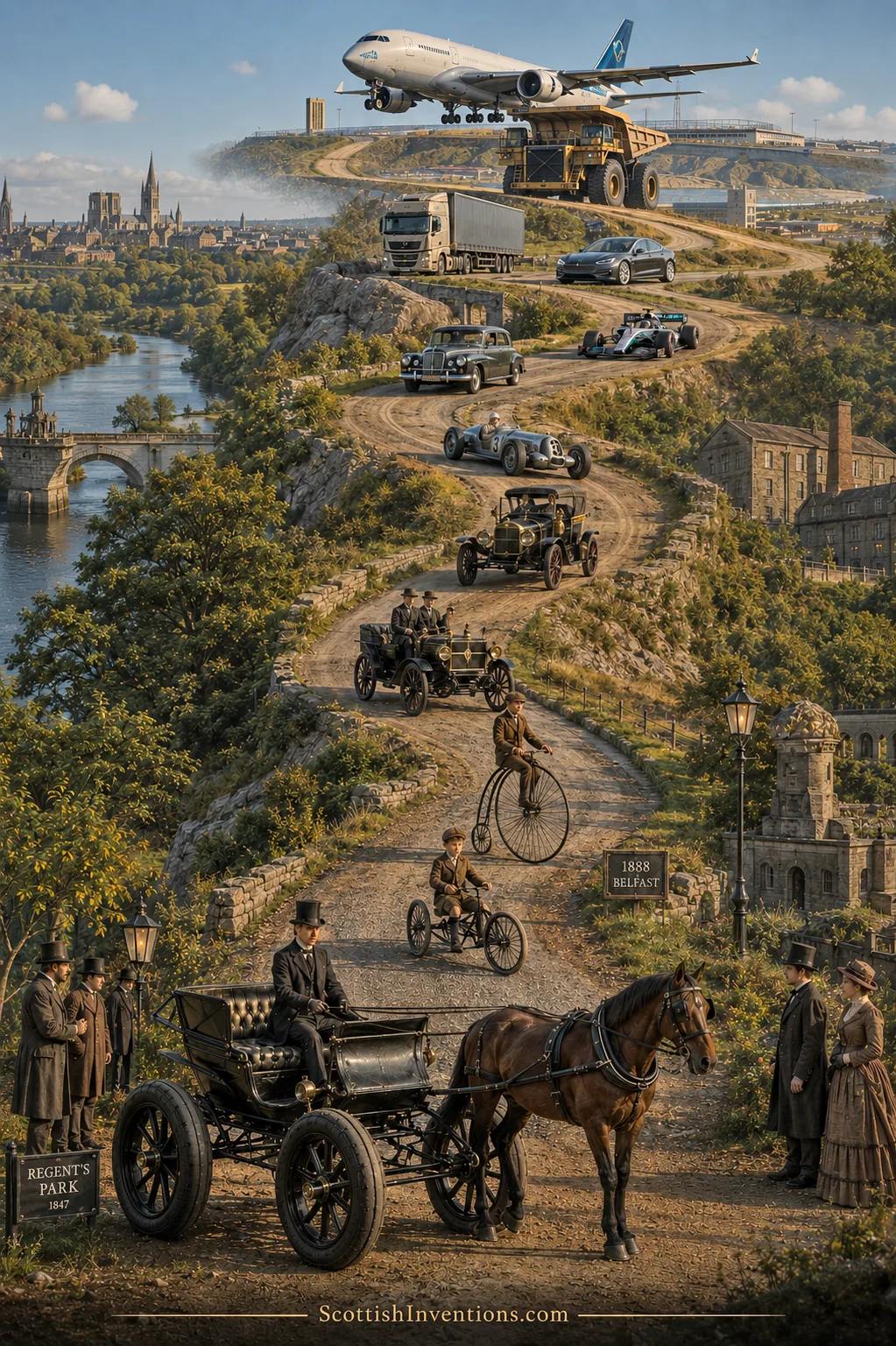
The pneumatic tyre is unique in the history of invention. It was independently invented twice — and both inventors were Scots. Robert William Thomson pioneered the idea in 1845, while John Boyd Dunlop unknowingly reinvented it forty-three years later, transforming transport forever.
Quick Answer
Who invented the pneumatic tyre?
The pneumatic tyre was first invented by Scottish engineer Robert William Thomson in 1845 (British Patent No. 10,990) and independently reinvented by Scottish veterinary surgeon John Boyd Dunlop in 1888 (British Patent No. 10,607). Thomson created the original "Aerial Wheel"; Dunlop's version arrived at the moment the world was ready to use it.
Scotland's roll-call of inventors trips off the tongue — Watt and steam, Bell and the telephone, Logie Baird and television, Macintosh and the raincoat. But the pneumatic tyre holds a special, almost improbable distinction: it was invented not once but twice, and both times by a Scot. It is a double-Scots triumph — a relay race run across 43 years between two men who never met and who each, independently, arrived at the same world-changing idea.
Robert William Thomson (1822–1873)
Robert William Thomson was born on 29 June 1822 in Stonehaven, on the Aberdeenshire coast, the eleventh of twelve children of a woollen-mill owner. His family hoped he would enter the ministry, but he could not master Latin. At 14 he was sent to Charleston, South Carolina, to be apprenticed to a merchant uncle. He disliked commerce and returned home after two years, whereupon he taught himself chemistry, electricity and astronomy — with a local weaver helping him with mathematics.
His genius was practical and precocious. While still a teenager he devised a method of detonating explosive charges remotely by electricity — an invention examined and approved by Michael Faraday — and was employed by the great engineer William Cubitt supervising blasting of the chalk cliffs near Dover for the South Eastern Railway. He worked, too, under the Stephensons. He was a working civil engineer barely out of his teens.
The Aerial Wheel Patent (1845)
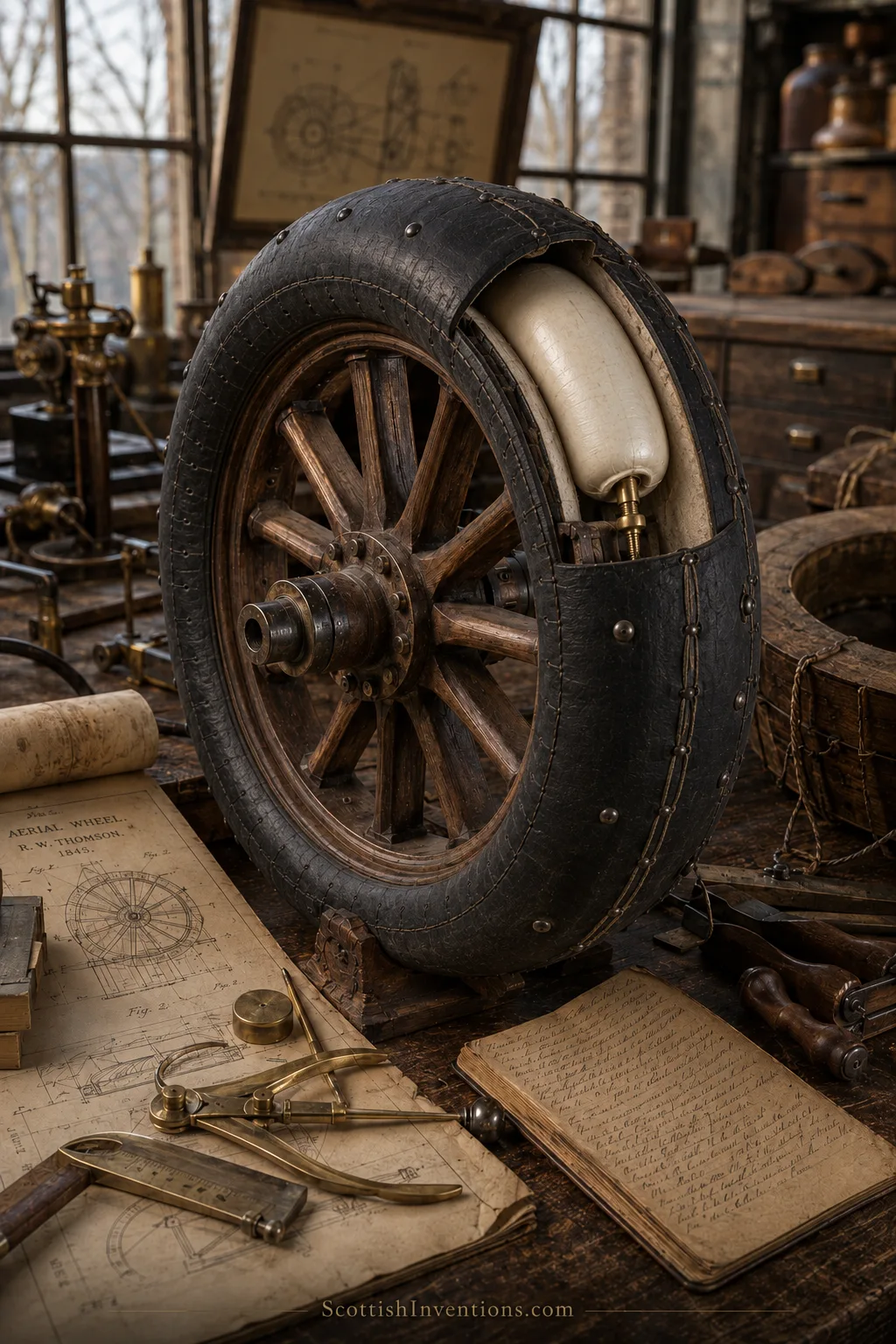
On 10 December 1845, aged just 23, Thomson lodged the patent that should have made him immortal: British Patent No. 10,990, "an improvement in carriage wheels." His language is strikingly modern:
“A hollow belt composed of some air and water tight material such as sulphurized caoutchouc or gutta-percha, and inflating it with air, whereby the wheels will in every part of their revolution present a cushion of air to the ground or rail or track on which they run.
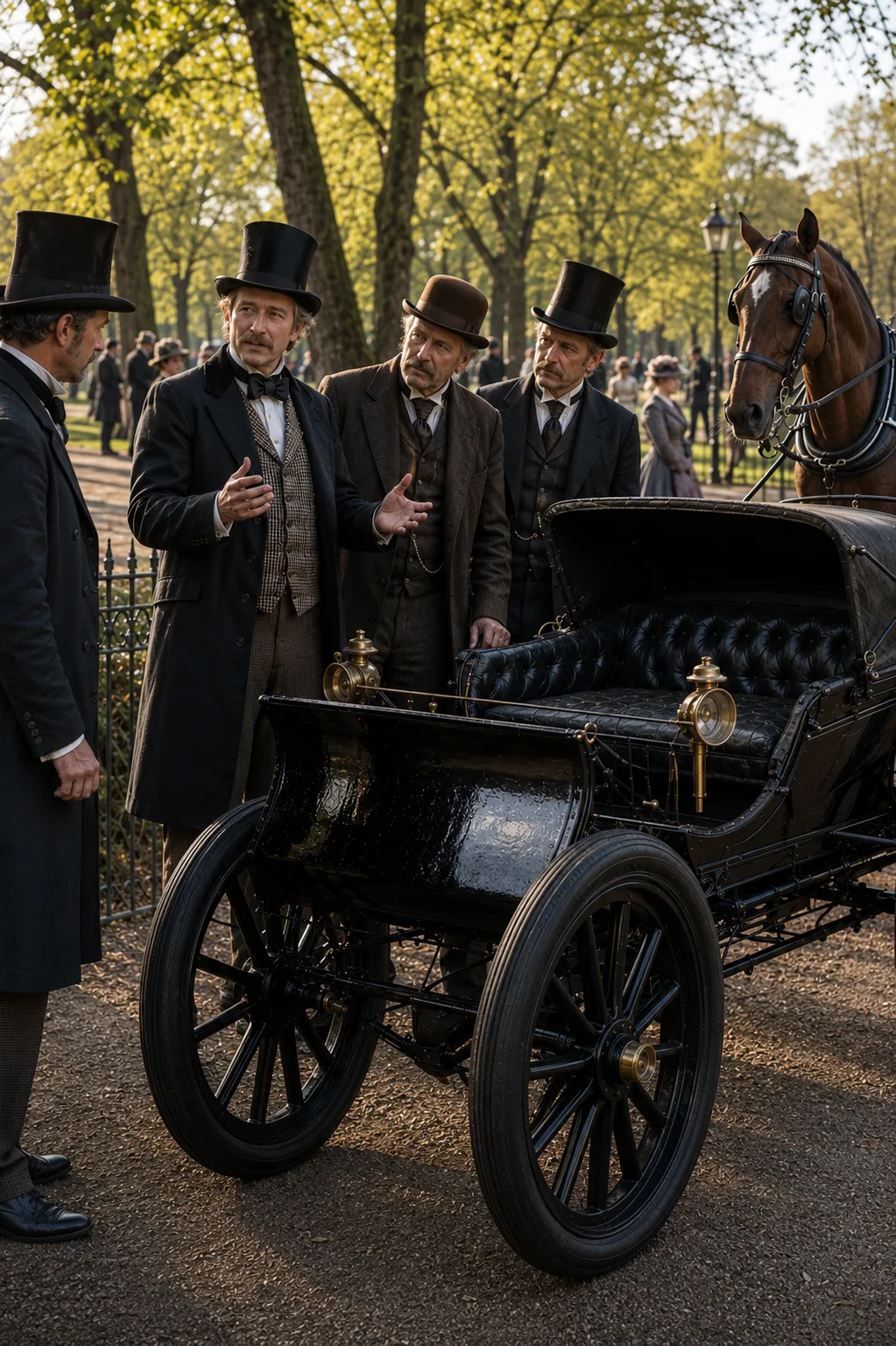
Thomson followed up with patents in France (1846) and the United States (US Patent 5,104, dated 8 May 1847). His Aerial Wheels were fitted to a brougham and demonstrated in Regent's Park, London, in 1847. The London Mechanics' Magazine reported that a single set ran 1,200 miles without the slightest symptoms of deterioration. The first set was fitted on 1 October 1847 at a cost of £42 and 2 shillings — a colossal sum.
But Thomson was a man ahead of his industry. Natural rubber was scarce and prohibitively expensive in the 1840s, the bicycle was still decades away, and the motor car not yet imagined. The Aerial Wheel was a beautiful answer to a question almost nobody was yet asking. Frustrated, Thomson abandoned the pneumatic idea and turned to solid rubber tyres instead — going on to invent the portable steam crane in Java, a hydraulic dry dock, and the "Thomson Steamer" road-traction engine, exported worldwide. He amassed around 14 patents in his lifetime, was elected a Fellow of the Royal Society of Edinburgh in 1863, and served as President of the Royal Scottish Society of Arts from 1869 to 1871. He died at his home, 3 Moray Place, Edinburgh, on 8 March 1873, aged 50, and is buried in Dean Cemetery.
John Boyd Dunlop (1840–1921)
John Boyd Dunlop was born on 5 February 1840 on a farm at Dreghorn, North Ayrshire. He trained as a veterinary surgeon at the Highland Society's Veterinary College in Edinburgh (the "Dick Vet," now part of the University of Edinburgh), qualifying around the age of 19, and practised in Scotland before moving in 1867 to Downpatrick and then to Belfast. By the mid-1880s his practice on May Street, Belfast, was one of the largest in Ireland. He had no idea Thomson's 1845 patent existed.
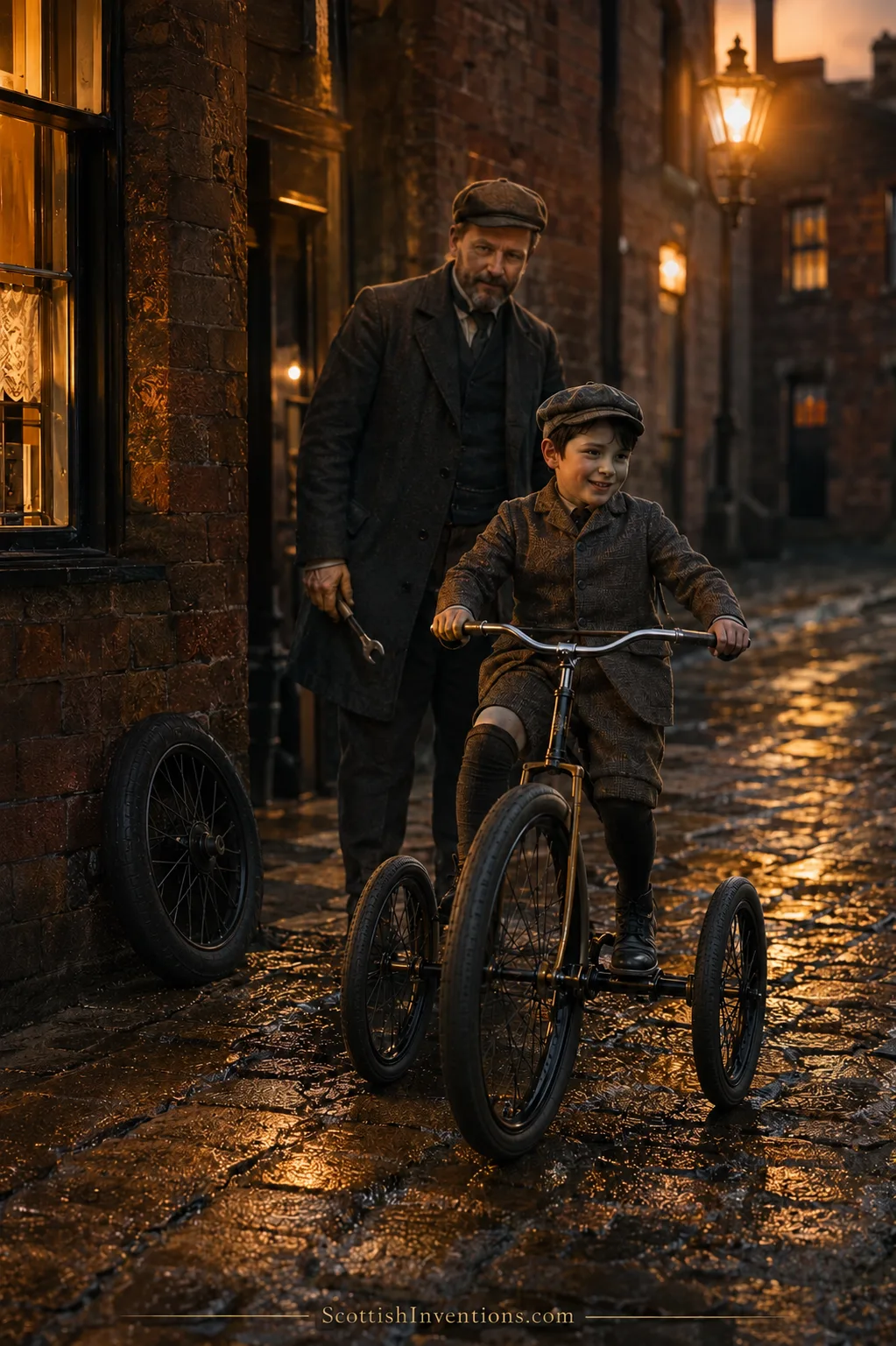
In late February 1888 his nine-year-old son Johnnie — reportedly prescribed cycling to help recover from a cold — was struggling to ride his solid-tyred tricycle over Belfast's cobbled streets. Drawing on his everyday familiarity with rubber, Dunlop took thin sheet rubber, wrapped an inflated tube of linen bonded with liquid rubber, and fitted it to the tricycle's wheels. In a celebrated test he rolled his air-filled wheel and a solid metal tricycle wheel across his yard together: the metal wheel stopped dead; the pneumatic wheel rolled on until it struck the gatepost and bounced back. On the night of 28 February 1888, Johnnie took his rebuilt tricycle out into the lamplit streets — and the future of cycling, then motoring, then aviation, rolled silently after him.
“The boy's comfort was the first inspiration; the world's benefit is the result.”
Dunlop applied for his patent on 23 July 1888; British Patent No. 10,607 — "An improvement in Tyres of Wheels for Bicycles, Tricycles or other Road Cars" — was granted on 7 December 1888. What made the tyre a commercial rocket was the man who spotted its potential: Willie Hume, captain of the Belfast Cruisers Cycling Club, became the first member of the public to buy a bicycle fitted with the new pneumatic tyres. On 18 May 1889 he won all four cycling events at the Queen's College Sports in Belfast, then triumphed again in Liverpool. Among the beaten riders were the sons of Harvey Du Cros, president of the Irish Cyclists' Association. Du Cros, an astute businessman, built a company around Dunlop's rights — the venture that became the Pneumatic Tyre and Booth's Cycle Agency, and eventually the mighty Dunlop Rubber Company.
Dunlop himself made remarkably little from the revolution he had started. He assigned his rights to Du Cros's company for a modest cash sum and around 1,500 shares, then sold out in the mid-1890s. When Du Cros later sold the business to the financier Terah Hooley for £3 million (Hooley promptly re-floated it publicly for £5 million), Dunlop was not the one counting the millions. He died in comparatively modest circumstances at his home in Ballsbridge, Dublin, on 23 October 1921, and is buried in Deansgrange Cemetery.
Why Thomson Was Forgotten and Dunlop Took Off
When Dunlop's 1888 patent was challenged, Thomson's prior art was rediscovered and Dunlop's original patent was formally invalidated in 1892. Yet the Dunlop name lived on — and Thomson stayed in the shadows. Why? Timing decided everything.
When Thomson patented his Aerial Wheel in 1845, Charles Goodyear had only just patented vulcanisation (US Patent 3,633, 15 June 1844), and reliable, affordable rubber simply did not yet exist in the form Thomson needed. Worse, there was almost nothing to fit tyres to. By 1888 the world had transformed: vulcanised rubber was cheap, the safety bicycle had triggered a genuine cycling craze, and the motor car was only five years away. Dunlop's idea landed on fertile ground that had not existed in 1845. The genius of both patents is identical — a compressed-air chamber that absorbs impact, maintains contact and recovers instantly — but Dunlop happened to invent it at the precise moment civilisation was ready to roll.
| Robert William Thomson | John Boyd Dunlop | |
|---|---|---|
| Birthplace | Stonehaven, Aberdeenshire | Dreghorn, Ayrshire |
| Profession | Civil engineer | Veterinary surgeon |
| Patent | GB 10,990 · 10 Dec 1845 | GB 10,607 · 7 Dec 1888 |
| Age at patent | 23 | 48 |
| Significance | The original Aerial Wheel | First commercially successful tyre |
| Legacy | Visionary forerunner rediscovered in 1892 | Founded the global Dunlop industry |
How Thomson's Aerial Wheel Worked
The principle Thomson set down in 1845 has never been superseded. Trap a column of compressed air between the road and the wheel, and let physics do the rest.
- 1
Inflatable rubber tube
A hollow inner tube of sulphurised caoutchouc or gutta-percha holds compressed air.
- 2
Protective leather casing
A stitched outer casing shields the tube and bolts to the wheel rim.
- 3
Wooden spoked wheel
The tyre wraps a conventional carriage wheel — no change to the axle or hub.
- 4
Air cushions impact
Compressed air deforms elastically to absorb shocks from every stone and rut.
- 5
Lower rolling resistance
The tyre maintains contact and rebounds instantly, cutting the power needed to draw the carriage.
- 6
Quieter, safer travel
Noise drops sharply and grip improves, transforming the ride quality of every vehicle it touches.
From Bicycle to Motor Car
The bicycle boom of the 1890s was the pneumatic tyre's first global stage. Then, in 1895, the Michelin brothers, André and Édouard, fitted air-filled tyres to a Peugeot motor car — the famous L'Éclair ("the Lightning") — and entered it in the Paris–Bordeaux–Paris trial, one of the first motor races. The car was plagued by punctures throughout, finishing tenth and last — and technically disqualified — but it proved the point: inflatable tyres made motoring smoother and faster. Within a decade the pneumatic tyre had all but replaced solid rubber, and the entire modern motor industry was built upon it.
It is a lineage that runs straight back to two Scottish patents. Without pneumatic tyres, no motorway, no Formula One, no global haulage, no jet-aircraft landing gear, no school run. The tyre joins a long Scottish list that also includes James Watt's steam engine, John Loudon McAdam's roads, Kirkpatrick Macmillan's pedal bicycle, and William Symington's Charlotte Dundas.
Timeline of the Pneumatic Tyre
1845
Aerial Wheel patented
Robert William Thomson, aged 23, registers British Patent No. 10,990 on 10 December 1845.
1847
Regent's Park demonstration
Aerial Wheels fitted to a brougham cover 1,200 miles in London with no measurable deterioration. Fitted at £42 2s per set.
1888
Johnnie's first ride
On the night of 28 February 1888, John Boyd Dunlop's son rides his rebuilt tricycle through Belfast on air-filled tyres. Patent 10,607 granted 7 December.
1889
First cycling victory
Willie Hume wins all four events at the Queen's College Sports in Belfast, 18 May 1889 — the tyre's first public triumph.
1892
Dunlop patent invalidated
Court rules Thomson's 1845 patent is prior art. The Dunlop company survives regardless.
1895
Michelin brings tyres to motoring
The Michelin brothers fit pneumatic tyres to L'Éclair in the Paris–Bordeaux–Paris race. The motor age begins on air.
2025
Dunlop brand sold to Sumitomo
Goodyear sells the Dunlop trademark to Sumitomo Rubber Industries for approximately $701 million.
Today
A world on air
More than 2.5 billion pneumatic tyres are manufactured every year worldwide.
By the Numbers
1845
First pneumatic tyre patent
43
Years before Dunlop reinvented it
2.5B+
Tyres manufactured annually
180+
Years of influence
Two
Independent Scottish inventors
$200B
Global tyre market each year
Legacy
Robert William Thomson's memory is kept alive in Stonehaven. A bronze plaque presented by the Royal Scottish Automobile Club in 1922 marks his birthplace on Market Square, and an annual R W Thomson Memorial Rally of vintage vehicles has run in his honour for decades. John Boyd Dunlop is commemorated by the Dunlop Memorial Hall on Main Street in Dreghorn; his image appeared on Northern Ireland's £10 banknote (the Inventor Series); the National Museum of Scotland holds his first pneumatic bicycle tyre; and he was inducted into the Automotive Hall of Fame in 2005. Both men are honoured in the Scottish Engineering Hall of Fame.
The Dunlop brand itself is very much alive. In a deal announced on 7 January 2025 and completed in May 2025, The Goodyear Tire & Rubber Company sold the Dunlop trademark for Europe, North America and Oceania to Japan's Sumitomo Rubber Industries for approximately $701 million. The name of a Dreghorn vet still rolls along the world's roads.
More than 2.5 billion pneumatic tyres are produced worldwide every year — a global market worth over $200 billion. Every car on every motorway, every articulated lorry, every Boeing landing on every runway, every Tour de France stage and Formula One Grand Prix rolls on the principle two Scotsmen patented independently in the nineteenth century. It is one of the most quietly important inventions in human history — and Scotland gave it to the world not once, but twice.
Did You Know?
Doubly Scottish
Both inventors were born in Scotland — one in Stonehaven, the other in Dreghorn.
43 years apart
Thomson patented in 1845; Dunlop reinvented it independently in 1888.
1,200 miles without wear
Thomson's Aerial Wheels ran on a London brougham with no measurable deterioration.
Born for a child's tricycle
Dunlop's prototype was built so his son Johnnie could ride smoothly over Belfast cobbles.
Won its first race
Willie Hume beat every rival at Belfast's Queen's College Sports in May 1889.
Helped emancipate women
The tyre powered the 1890s bicycle boom that Susan B. Anthony credited with liberating Victorian women.
Frequently Asked Questions
▸Who invented the pneumatic tyre?
The pneumatic tyre was invented independently by two Scots: Robert William Thomson of Stonehaven patented the original 'Aerial Wheel' in 1845 (British Patent No. 10,990), and John Boyd Dunlop of Dreghorn reinvented it in Belfast in 1888 (British Patent No. 10,607). Thomson was 43 years ahead of the market; Dunlop's version triumphed commercially.
▸Who was Robert William Thomson?
Robert William Thomson (1822–1873) was a self-taught Scottish engineer born in Stonehaven, Aberdeenshire. By his early twenties he had already invented an electric mine-detonator approved by Michael Faraday and worked under the Stephensons. In 1845, aged just 23, he patented the pneumatic tyre. He held about 14 patents in his lifetime, including the portable steam crane and the 'Thomson Steamer' road traction engine.
▸Why is John Boyd Dunlop famous?
John Boyd Dunlop (1840–1921) was a Scottish-born veterinary surgeon working in Belfast when, in 1888, he built the first commercially successful pneumatic tyre so his young son Johnnie could ride his tricycle more smoothly over cobbles. His patent seeded the global Dunlop Rubber Company and coincided with the bicycle boom, ensuring worldwide adoption.
▸Did Dunlop invent the pneumatic tyre first?
No. Robert William Thomson patented the pneumatic tyre 43 years earlier, on 10 December 1845. Dunlop's 1888 patent was later declared invalid in 1892 on the basis of Thomson's prior art. The Dunlop business survived because Thomson's patent had long expired and the company held other valuable patents such as Charles Welch's detachable-tyre design.
▸Why did Thomson's invention fail commercially?
Timing. In 1845 vulcanised rubber had only just been invented by Goodyear (1844), reliable rubber tube was scarce and ruinously expensive (£42 per set), and there were essentially no bicycles or motor cars to fit tyres to. The Aerial Wheel was a brilliant answer to a question the world was not yet asking.
▸How does a pneumatic tyre work?
A pneumatic tyre traps a column of compressed air between the road and the wheel. The air acts as a spring, absorbing shocks, maintaining continuous contact with the road, and recovering its shape instantly. This reduces rolling resistance, cuts noise, and provides comfort and traction — the same principle Thomson patented in 1845 still underpins every modern tyre.
▸How many pneumatic tyres are produced every year?
Global production exceeds approximately 2.5 billion pneumatic tyres annually across cars, trucks, motorcycles, bicycles and aircraft, with some analysts putting the figure as high as 4 billion when every tyre type is counted. The global tyre market is worth more than $200 billion each year.
▸Why are both inventors of the pneumatic tyre Scottish?
It is one of the most remarkable coincidences in the history of invention. Both men emerged from the same 19th-century Scottish culture of practical engineering education, self-reliance and mechanical curiosity — the tradition that also produced James Watt, Alexander Graham Bell and John Logie Baird. Thomson was Stonehaven-born; Dunlop was Dreghorn-born and Edinburgh-trained. Neither knew of the other's work.