Scottish Inventions · Transport
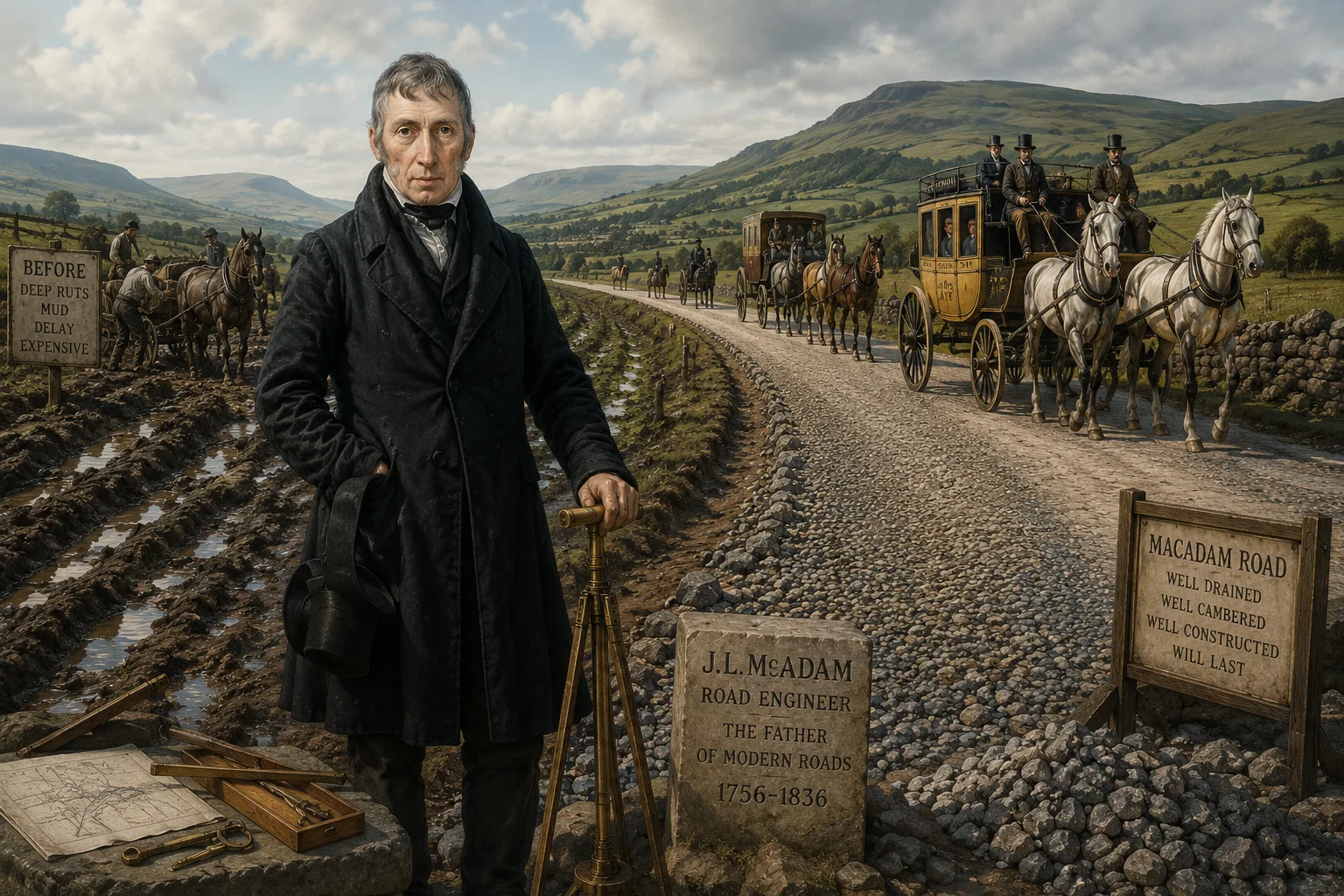
John Loudon McAdam: The Scottish Inventor Who Changed Every Road
From an Ayrshire boy sent across the Atlantic at fourteen, to the man whose name became a word in every language with cars — this is the story of the Scot who taught the world how to build a road.
SI Score54/60Ranked =10th of 50 in InventionsBreakdown
Scottish Impact Index (SI Score)
- Global Impact
- 10/10
- Longevity
- 6/10
- Economic / Material Impact
- 10/10
- Originality / Distinctiveness
- 9/10
- Legacy (Built Upon)
- 10/10
- Recognition
- 9/10
On this page
- Introduction
- Key Facts
- From Ayr to New York
- The Horror of the Pre-McAdam Road
- The McAdam Method
- How the Macadam Road Worked
- Bristol's Surveyor, Britain's Reformer
- The Network That Connected Britain
- Macadam vs Telford
- Tarmacadam: The Accidental Sequel
- Macadam vs Tarmac
- Legacy and Honours
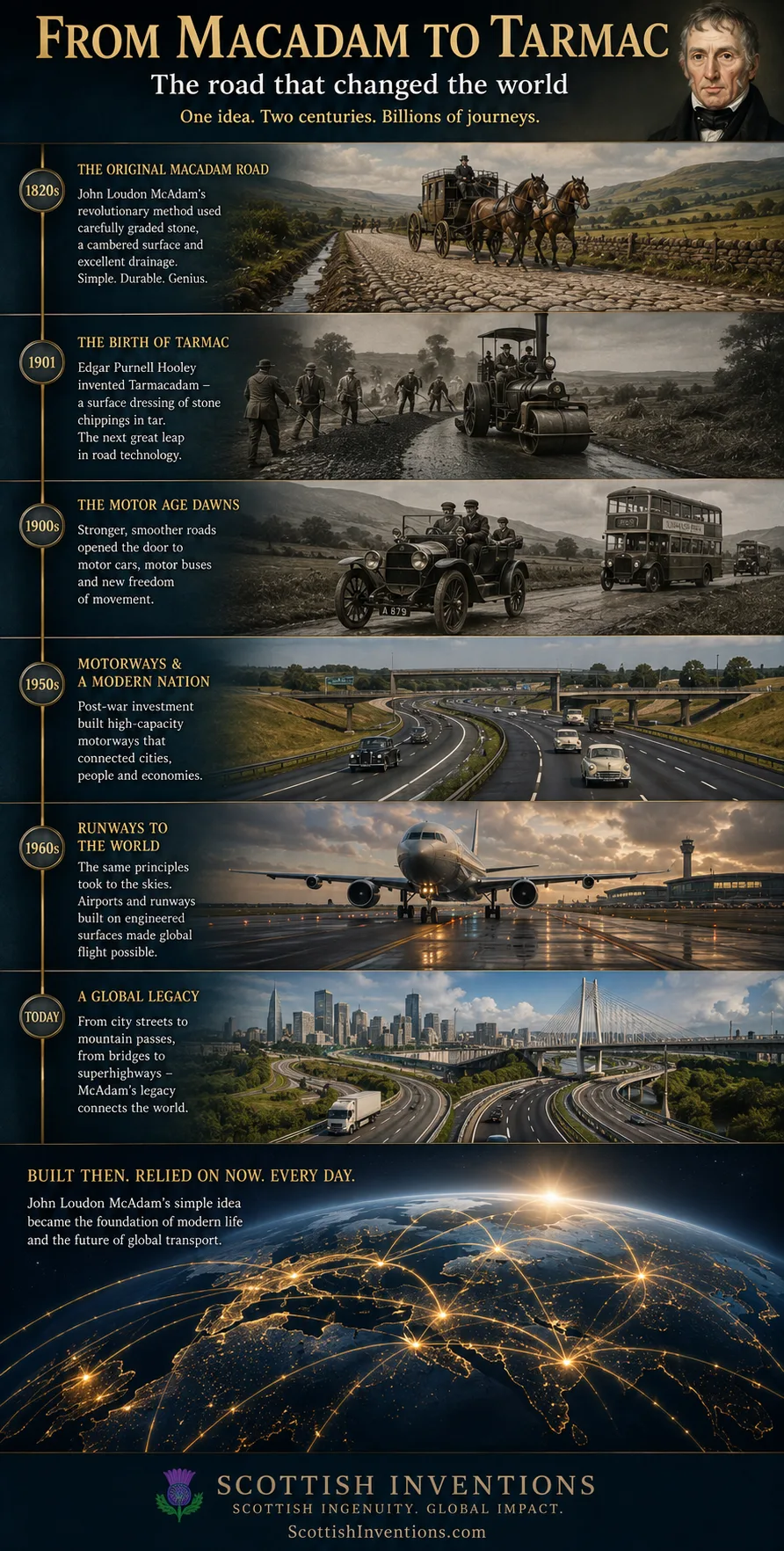
- From Macadam to the Motorway
- Timeline
- FAQ
- Related Scottish Engineering
Every time you drive to the shops, cycle to work, or wait on the “tarmac” for a delayed flight, you are using a word — and a technology — invented by a son of Ayr. John Loudon McAdam did not merely improve the roads of Britain; he reimagined what a road was, and in doing so gave his name to the very surface beneath our wheels.
“Macadam,” “macadamise,” “tarmacadam,” “tarmac” — these are Scottish words now spoken in every language with cars. This is the story of how a bankrupt banker’s son, shipped off to America at fourteen, came home to revolutionise the way the world moves.
Key Facts
Born Ayr, 1756
John Loudon McAdam was born on 21 September 1756 in Lady Cathcart's House on the Sandgate in Ayr, Scotland.
Bristol, 1816
Elected Surveyor-General to the Bristol Turnpike Trust on 15 January 1816 — the first properly macadamised road, Marsh Road at Ashton Gate, was laid the same year.
Published 1816 & 1819
'Remarks on the Present System of Road Making' (1816) and 'A Practical Essay on the Scientific Repair and Preservation of Public Roads' (1819).
34 → ~70 trusts
Consulting to 34 turnpike trusts by 1818, around 70 by 1823. France adopted the system in 1830; it spread across Europe and the United States.
£10,000 from Parliament
Parliament voted McAdam £10,000 by 1827 to reimburse his years of private spending on road experiments, plus a gratuity of £2,000.
'Tarmac', 1902
Edgar Purnell Hooley patented tar-bound macadam in 1902 and named it 'Tarmac' — short for 'tar macadam' — in McAdam's honour.
From Ayr to New York: The Making of a Road-Builder
John Loudon McAdam was born on 21 September 1756 in Lady Cathcart’s House on the Sandgate in Ayr — a building that still stands and which the Institution of Civil Engineers marked with a commemorative plaque in 2006. He was the youngest of ten children of James McAdam, Baron of Waterhead, and Susanna Cochrane, a niece of the 7th Earl of Dundonald.
In 1770 catastrophe struck twice: his father’s bank, the Bank of Ayr, collapsed and his father died. The fourteen-year-old was packed off to New York to live with his prosperous merchant uncle, William McAdam. He prospered, married Gloriana Nicoll, and built a considerable fortune — but when the American Revolution came, McAdam sided firmly with the Crown as a “prize agent” auctioning captured ships. In 1783 he returned to Scotland, still wealthy but chastened, bought the estate of Sauchrie near Maybole, and became a trustee of the Ayrshire turnpike from 1783.
It was the daily grind of the turnpike trust, and his own endless travelling, that turned a hobby into an obsession. Britain’s roads appalled him, and he resolved to understand why they failed. In his own testimony to Parliament, he claimed to have travelled over 30,000 miles of British roads between 1798 and 1814 in pursuit of his investigations.
One honour that should be treated with caution is the frequently repeated claim that McAdam was elected a Fellow of the Royal Society in 1825. There is no reliable primary-source evidence for it: the election appears in neither the Dictionary of National Biography, the Oxford DNB, Britannica nor the National Portrait Gallery. It is very likely a confusion with the unrelated Australian chemist Dr John Macadam (1827–1865), the man the macadamia nut is named after. McAdam’s real reward was parliamentary, not academic.
The Horror of the Pre-McAdam Road
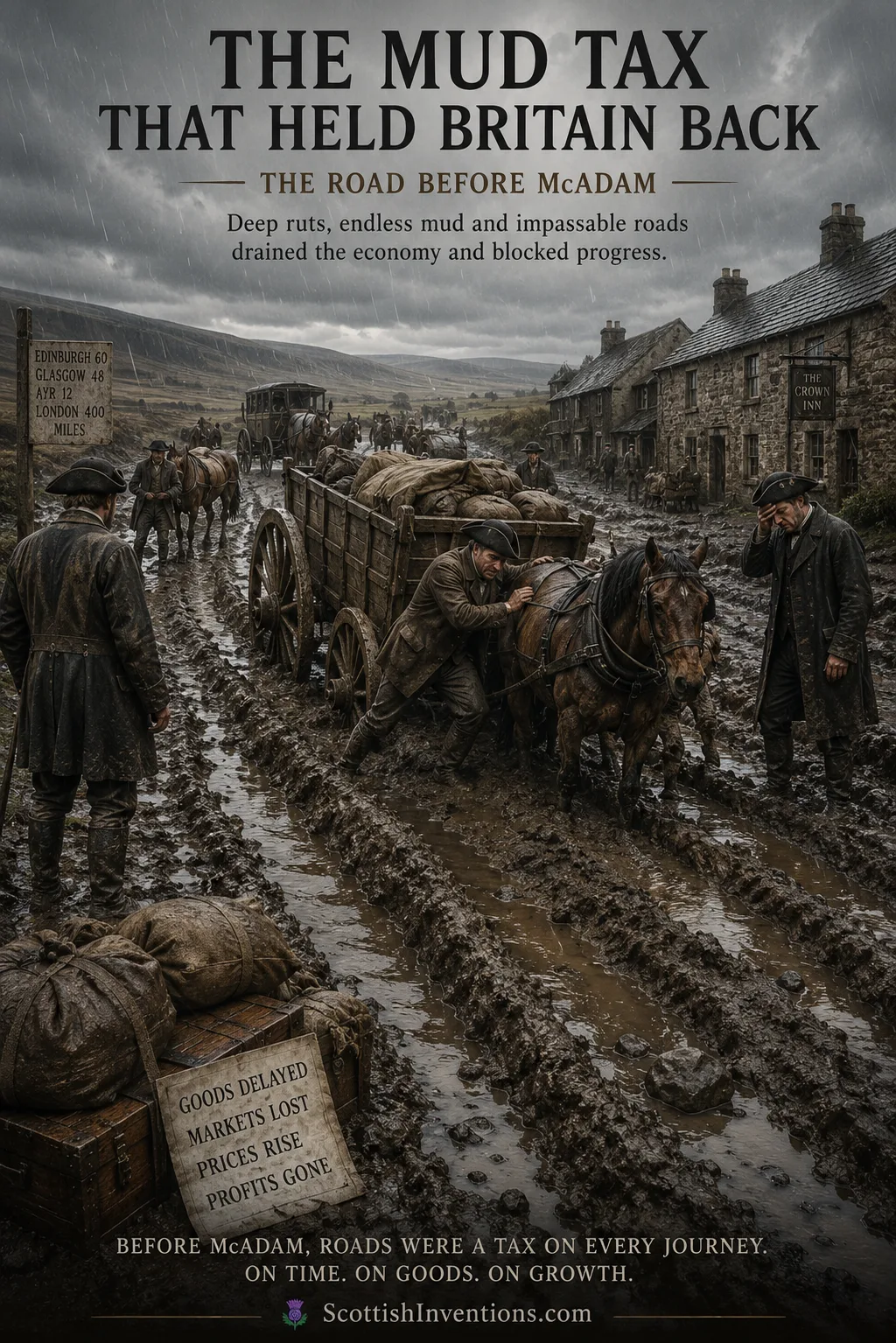
It is hard, in an age of motorways, to grasp how bad eighteenth-century roads were. With the exception of the surviving Roman roads, they were just as bad as they had been hundreds of years before. A road was simply a right of way — a well-trodden track that existed because people used it, not because anyone built it. In summer it was choked with dust; in winter it became, in the words of the period, a “sticky, impassable swamp.”
The Swedish traveller Pehr Kalm, visiting England in 1748, was astonished at how British roads sat lower than the surrounding land: “Through many years’ driving, the wagons seem to have eaten down into the ground… to a depth of two, four, or six feet.” The agricultural writer Arthur Young described one road between Preston and Wigan as “most execrably vile with ruts four feet deep.” In Sussex the roads were so impassable in winter that judges on circuit refused to travel to Lewes, the county town.
Bad roads were not merely uncomfortable; they throttled the economy. A team of eight horses pulling a wagon could shift the load of thirty pack-horses, if only the road would allow it. This was the “mud tax”: the vast, invisible levy that terrible roads imposed on trade, agriculture, communication and daily life. McAdam set out to abolish it.
The McAdam Method: The Genius Was in the Simplicity
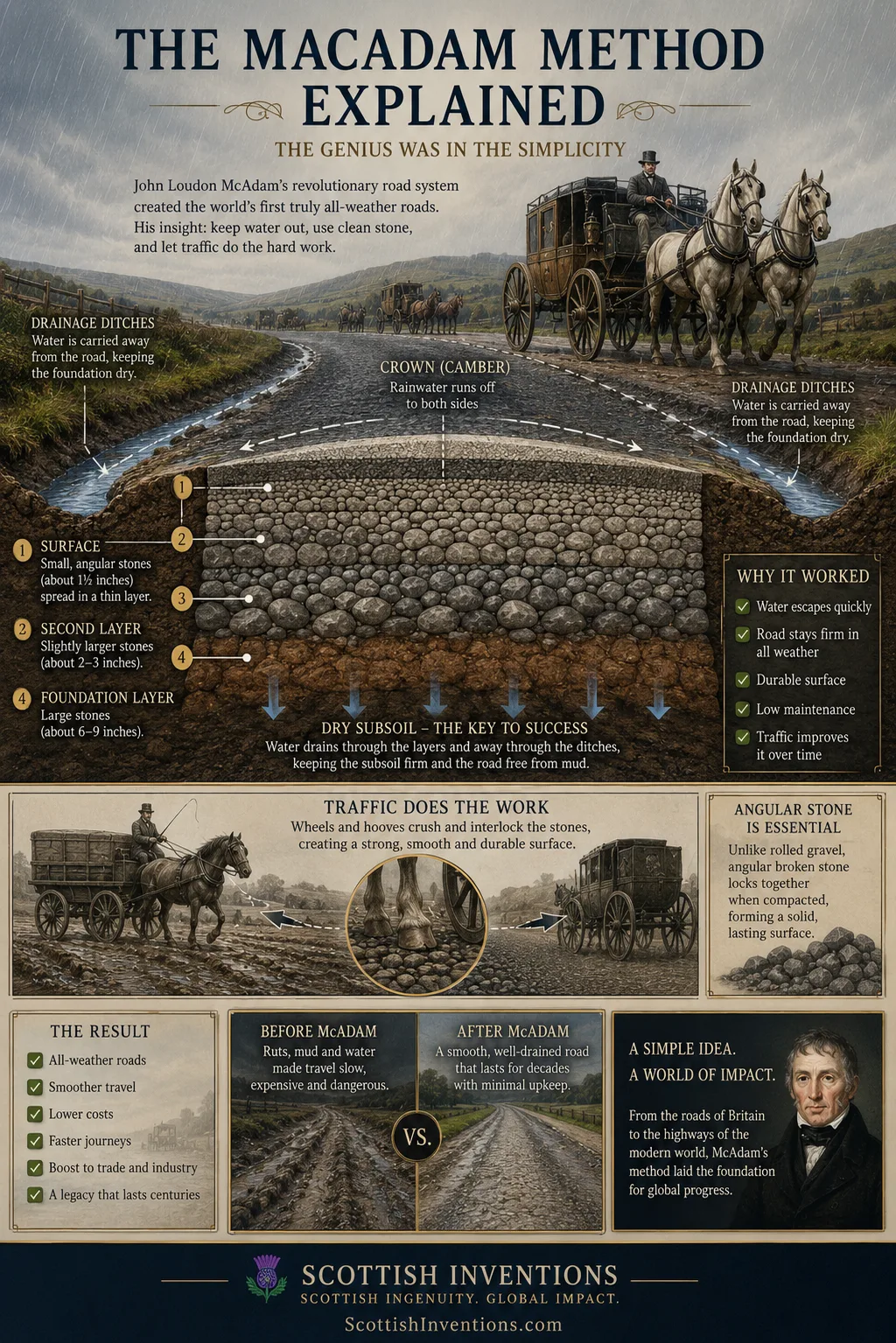
McAdam’s insight was radical precisely because it was so simple. Where others believed a road needed a massive, expensive foundation of large stones, McAdam argued the exact opposite. His first principle, stated in his own words, was this:
“That it is the native soil which really supports the weight of traffic; that while it is preserved in a dry state, it will carry any weight without sinking.”
In other words, the earth itself is the foundation. The job of the road is not to replace the soil but to protect it — to keep it dry, because a wet sub-soil is a weak sub-soil. Keep the water out and the ground will carry anything.
How the Macadam Road Worked
From the principle flowed the whole method:
- The road was raised slightly above the surrounding land.
- It was given a gentle convex camber — a 30-foot-wide road needed a rise of only about three inches from edge to centre — so rain would run off into side ditches rather than soak in.
- On the prepared, well-drained sub-soil went layers of small, clean, angular broken stones — and nothing else. No clay, no sand, no soil, no binding material whatsoever.
- The stones, ground together under the wheels of passing traffic, would knit into a single dense, hard, water-resistant crust that actually improved with use.
The size of the stones was everything. No stone in the upper layer was to be larger than about an inch — roughly two centimetres, no heavier than six ounces. Supervisors carried scales, but a workman could check his own stones with a test that became legend: if a stone would fit in his mouth, it was too big. The reason was practical: the stones had to be smaller than the four-inch width of an iron carriage wheel so they would compact rather than be flung aside.
Bristol’s Surveyor, Britain’s Reformer
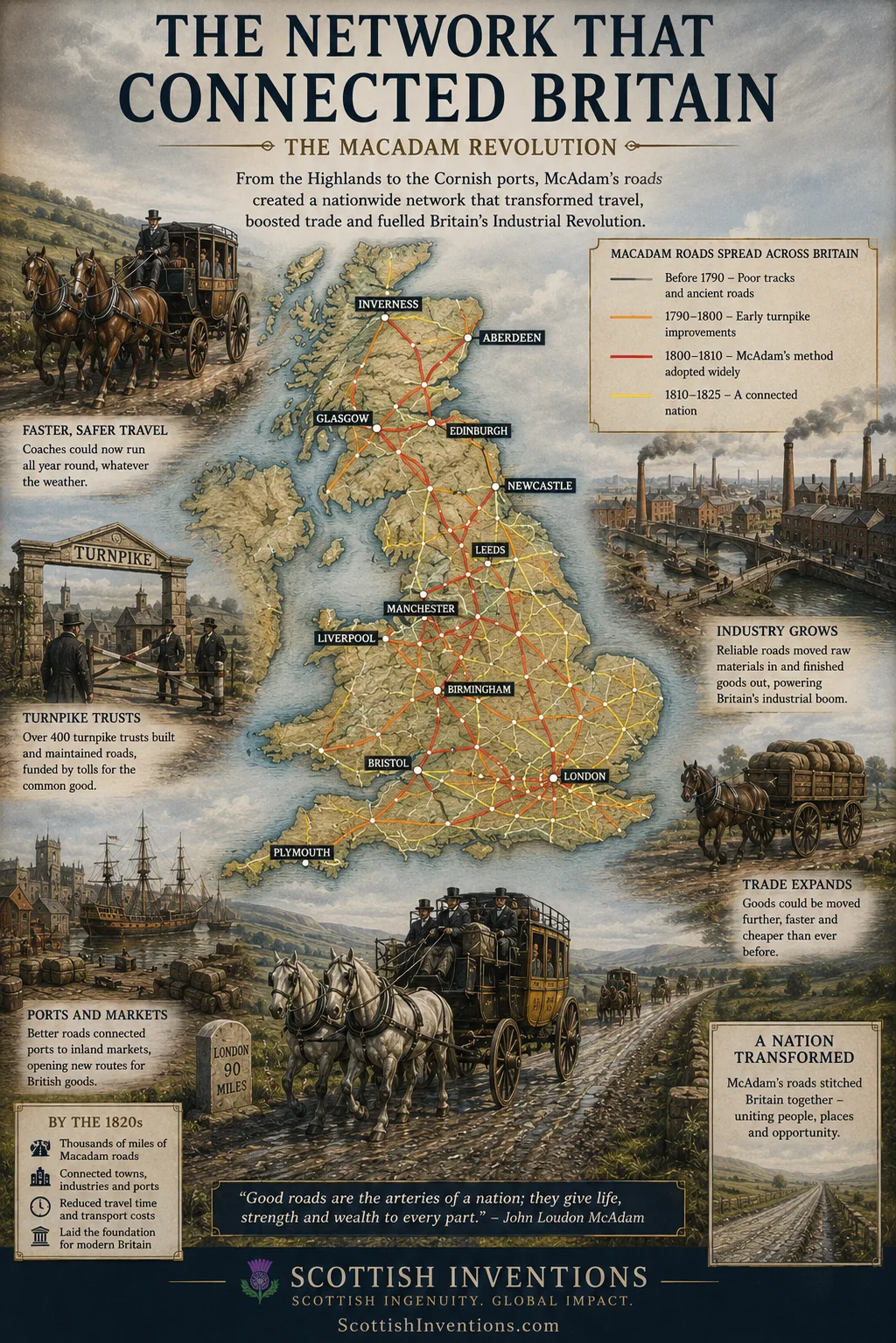
McAdam’s chance to prove his theory at scale came in Bristol. Having moved to England around 1802 and served the city as a paving commissioner, he was elected surveyor-general to the Bristol Turnpike Trust on 15 January 1816, taking charge of some 149 miles of road. There, the first properly “macadamised” stretch was laid — Marsh Road at Ashton Gate. The results were a sensation, and proof of concept for the whole nation.
Demand exploded. By 1818 McAdam was consulting surveyor to 34 trusts; by 1823, to around 70. He set out his theories in print — Remarks on the Present System of Road Making (1816) and A Practical Essay on the Scientific Repair and Preservation of Public Roads (1819) — and gave evidence to parliamentary inquiries in 1819 and 1823. The committees adopted his views wholeheartedly. The macadam system became, in effect, national policy.
Macadam vs Telford
This is where McAdam parted company with his great contemporary, the Scottish engineer Thomas Telford. Telford — the “Colossus of Roads” and first president of the Institution of Civil Engineers — built superb roads on a heavy, hand-set foundation of large stone blocks (“Telford pitching”), topped with smaller stones. They were magnificent and they lasted, but they were slow and costly. For the cash-strapped turnpike trusts of Britain, macadam was transformative.
The two Scots, born a year apart, were open rivals. Telford’s base drew on the French engineer Pierre-Marie-Jérôme Trésaguet, and he regarded McAdam’s method as little more than gravel laid on mud. McAdam replied that he never used large stones at the bottom of a road, whatever the soil. Both gave evidence to the parliamentary select committee of 1819, and each was cutting about the other. Asked whether he had seen Telford’s famous road to Holyhead, McAdam answered that he understood it was a new road: his business was mending old ones.
Telford’s allies kept score. On the Holloway Road in north London part of a stretch was rebuilt with his stone base and part without, and a coach company reported that four horses could then do the work of six. Sir Henry Parnell blamed the decline of a road near St Albans, maintained by McAdam’s son James, on the McAdam method, and Telford seems to have enjoyed the failure of the macadamised surface in Whitehall in 1827. Julian Glover, in his biography Man of Iron (2017), nonetheless concludes that McAdam “had a point”: his method was simple and cheap, which was what toll-funded trusts needed. The evidence for Telford’s superiority came from his friends, and the argument was as much about the balance of building cost against upkeep as about engineering.
| Macadam (1816) | Telford | |
|---|---|---|
| Foundation | None — dry sub-soil is the foundation | Heavy hand-set layer of large stone blocks ('Telford pitching') |
| Stone size | Small, angular, ≤ 1 inch / 6 oz on the surface | Large base stones set by hand, points up; then 6 in of broken stone, the largest passing a 2-inch ring |
| Labour | Unskilled labourers with breaking hammers | Skilled masons |
| Cost | Very low — a fraction of Telford's roads | High — durable but expensive |
| Camber | Gentle: ~3 in on a 30 ft road | Built into the base: 7 in at the centre, falling to 3 in at 15 ft out |
| Maintenance | Improves with use; easy top-up | Telford's allies claimed lower upkeep; disputed |
| Typical work | Resurfacing existing turnpikes | New and realigned roads (Highlands, Holyhead Road) |
Tarmacadam: The Accidental Sequel
For all his genius, McAdam never bound his stones with tar. His roads relied on traffic alone to compact them, and in the age of the horse this worked beautifully. But the motor car changed everything. Fast-moving vehicles sucked the dust from a macadam surface, creating choking clouds and slowly tearing the road apart.
The fix came by accident in 1901. Edgar Purnell Hooley, the county surveyor of Nottinghamshire, was walking near an ironworks at Denby in Derbyshire when he noticed a stretch of road that was dust-free and unrutted. A barrel of tar had burst, and someone had dumped waste slag over the mess. Hooley realised he was looking at the future. In 1902 he patented a process for mixing tar with slag and broken stone (British patent GB 7796 of 1902, granted 1903). He named it — in tribute to McAdam — “Tarmac,” short for tar macadam, and in 1903 founded the Tar Macadam (Purnell Hooley’s Patent) Syndicate Limited. Radcliffe Road in Nottingham became the world’s first tarmac road.
The name stuck. “Tarmac” entered everyday speech around 1926 as a general term for a paved surface, and then leapt to the airport: travellers everywhere speak of waiting “on the tarmac,” even though modern runways are usually asphalt or concrete. From an Ayrshire boy’s principles, via a chance spillage in Derbyshire, came a word now heard in departure lounges across the planet.
Macadam vs Tarmac
| Macadam | Tarmac (Tarmacadam) | |
|---|---|---|
| Inventor | John Loudon McAdam (1816, Bristol) | Edgar Purnell Hooley (1902, Nottinghamshire) |
| Binder | None — traffic compacts the stone | Tar bound with slag and crushed stone |
| Best for | Horse and slow wheeled traffic | Motor cars, buses, lorries — dust-free |
| First road | Marsh Road, Ashton Gate, Bristol (1816) | Radcliffe Road, Nottingham (1902) |
| Legacy | The template for every modern road | The name we still use for a paved surface — and for an airport runway |
Legacy and Honours
Parliament voted McAdam a total of £10,000 — an indemnity reimbursing him for the substantial sums he had personally spent on his experiments, plus a gratuity of £2,000 — around 1825–1827. In 1827 he was appointed Surveyor-General of Metropolitan Roads in Great Britain. McAdam made it a family enterprise: his three sons and four grandsons followed him into the profession, holding well over a hundred surveyorships across Britain.
McAdam declined the offer of a knighthood, reportedly on account of his age and failing health; his son James Nicoll McAdam — himself nicknamed “the Colossus of Roads” — accepted a knighthood in 1834. On the return from one of his beloved annual summer trips to Scotland he died at Moffat in Dumfriesshire on 26 November 1836, in his eighty-first year. He is buried in Moffat Old Churchyard, where his grave remains the cemetery’s most famous occupant.
Timeline: John Loudon McAdam & the Macadam Road
1756
Born in Ayr
Born 21 September 1756 in Lady Cathcart's House on the Sandgate, Ayr.
1770
Sent to New York
Family bank collapses; his father dies; the fourteen-year-old is sent to work in his uncle's counting house in New York.
1783
Returns to Scotland
With American assets seized after the Revolution, McAdam returns to Ayrshire and buys the estate of Sauchrie. Becomes a trustee of the Ayrshire turnpike.
c.1790s
Tar kilns at Kaims
Through his kinsman Archibald Cochrane, 9th Earl of Dundonald, McAdam runs tar kilns at his Kaims colliery in Muirkirk under the British Tar Company — his one real link to tar, and a famous irony given the later word 'tarmac'.
1798–1814
30,000 miles of investigation
By his own account McAdam travelled over 30,000 miles of British roads studying why they failed.
15 Jan 1816
Bristol Turnpike Trust
Elected Surveyor-General to the Bristol Turnpike Trust, taking charge of ~149 miles. First macadamised stretch laid at Marsh Road, Ashton Gate.
1816
Remarks published
'Remarks on the Present System of Road Making' is published and runs through numerous editions.
1819
Practical Essay published
'A Practical Essay on the Scientific Repair and Preservation of Public Roads' published. McAdam appears before a House of Commons select committee on his own petition; Thomas Telford also gives evidence and attacks his method.
1823
~70 trusts, US adoption
Consulting to around 70 turnpike trusts. Second parliamentary inquiry adopts his views. Boonsborough Turnpike, Maryland — an early US macadam road — completed.
1824
'Macadamisation' enters the language
The word 'macadamisation' is already in print. Jeremy Bentham writes that 'MacAdam's system justified the perpetuation of MacAdam's name in popular speech.'
1827
Surveyor-General of Metropolitan Roads
Appointed Surveyor-General of Metropolitan Roads in Great Britain. Parliament votes him £10,000 in total, plus a £2,000 gratuity.
1830
France adopts the system
The French government formally adopts the macadam system; it spreads across Europe and the United States.
1836
Death at Moffat
McAdam dies on 26 November 1836 at Moffat, in his eighty-first year, returning from his annual summer trip to Scotland. Buried at Moffat Old Churchyard.
1901–02
Tarmac
Edgar Purnell Hooley patents tar-bound macadam after a chance spillage near Denby ironworks. Radcliffe Road, Nottingham becomes the world's first tarmac road.
Today
The foundation of every road
McAdam's cambered, layered, well-drained principles underpin virtually every road, motorway and airport runway on Earth.
Frequently Asked Questions
+Who invented modern roads?
The Scottish engineer John Loudon McAdam (1756–1836), born in Ayr and later Surveyor-General of Metropolitan Roads in Great Britain, is universally credited as the father of modern road building. His 'macadam' system — a cambered, well-drained crust of small, angular broken stones — became the world's first practical all-weather road surface and remains the basis of virtually every road on Earth.
+Who invented macadam?
John Loudon McAdam invented the macadam method of road construction. He set it out in his 1816 book 'Remarks on the Present System of Road Making' and proved it at scale from 1816 as Surveyor-General to the Bristol Turnpike Trust, where the first properly macadamised road — Marsh Road at Ashton Gate — was laid.
+Why is it called tarmac?
'Tarmac' is short for 'tar macadam', coined in tribute to John Loudon McAdam. It was patented in 1902 by Edgar Purnell Hooley, the county surveyor of Nottinghamshire, who mixed tar with slag and broken stone after seeing a tar-and-slag surface at an ironworks in Denby, Derbyshire. Radcliffe Road in Nottingham became the world's first tarmac road.
+Did McAdam invent tarmac?
No. McAdam never used tar on his roads. Despite once owning tar kilns at Muirkirk in Ayrshire, he relied on clean, dry, angular stone alone, compacted by traffic. Tarmac was patented by Edgar Purnell Hooley in 1902, more than 60 years after McAdam's death, but Hooley named it in McAdam's honour.
+What is the difference between macadam and tarmac?
Macadam is McAdam's original system: layers of clean, angular broken stone on a well-drained cambered sub-soil, bound together by traffic alone. Tarmac (tar macadam) adds tar as a binder to hold the stones in place — an invention of Edgar Purnell Hooley in 1902 that made McAdam's surface durable enough for fast motor traffic.
+How did roads look before McAdam?
Eighteenth-century British roads were mostly ancient tracks worn into the ground. In summer they were choked with dust; in winter they became, in the words of the period, 'a sticky, impassable swamp'. The Swedish traveller Pehr Kalm in 1748 described British roads as sitting 'lower than the land around', worn 'to a depth of two, four, or six feet' by heavy wagons.
+Why are roads cambered?
McAdam's second key principle was that water must be shed from the surface as quickly as possible. He gave his roads a gentle convex camber so that rainwater ran off to drainage ditches at each side, keeping the sub-soil dry and firm. Every modern road is still cambered for the same reason.
+Why are modern roads still based on McAdam's ideas?
The three principles McAdam set out in 1816 — a dry sub-soil as the true foundation, a cambered surface to shed water, and successive layers of small, well-graded, angular broken stone bound by compaction — remain the mechanical basis of every asphalt, tarmac and concrete road built today. Only the top wearing course has changed.
+Who invented road drainage?
Effective drainage was McAdam's central insight. He argued that 'it is the native soil which really supports the weight of traffic; while it is preserved in a dry state, it will carry any weight without sinking' — so his roads were raised, cambered, and flanked by side ditches. Modern highway drainage is a direct descendant of this system.
+What did Edgar Purnell Hooley invent?
Edgar Purnell Hooley (1860–1942), county surveyor of Nottinghamshire, invented tarmac — a process for binding McAdam's crushed stone with tar and slag. He patented it in 1902 (British Patent GB 7796 of 1902, granted 1903) and founded the Tar Macadam (Purnell Hooley's Patent) Syndicate in 1903. Radcliffe Road, Nottingham was the world's first tarmac road.
+How did McAdam's roads differ from Thomas Telford's?
Telford, McAdam's fellow Scot and rival, built new roads on a foundation of large stones set by hand, covered with about six inches of smaller broken stone. McAdam left out the foundation, relying on a dry, cambered sub-soil and small stones packed by traffic. Telford's roads were stronger and far dearer; McAdam's were cheap and suited turnpike trusts repairing existing roads. The two men criticised each other before a parliamentary committee in 1819.
+Was John Loudon McAdam a Fellow of the Royal Society?
Almost certainly not. The claim that McAdam was elected FRS in 1825 is often repeated online but is unverified: it does not appear in the Dictionary of National Biography, the Oxford DNB, Britannica or the National Portrait Gallery. It is very likely a confusion with the unrelated Australian chemist Dr John Macadam (1827–1865), after whom the macadamia nut is named.
Key Takeaways
- John Loudon McAdam (1756–1836), born in Ayr, invented the macadam road system.
- His method uses a dry sub-soil, a cambered surface and layers of small angular broken stone compacted by traffic itself.
- The first properly macadamised road was Marsh Road, Ashton Gate, Bristol (1816).
- Tarmac was patented in 1902 by Edgar Purnell Hooley — and named in McAdam’s honour.
- McAdam’s principles still underpin virtually every road, motorway and airport runway on Earth.
Discover More Scottish Inventions
Continue exploring the Scots who paved the modern world.
From roads and railways to steam, telephones and television — discover the remarkable Scottish engineers and inventors whose ideas transformed transport, engineering and everyday life around the globe.
Explore the Scottish Inventions CollectionSources & Further Reading
Tier 2 · Scholarly and institutional
- Oxford Dictionary of National Biography — McAdam, John Loudon
- National Portrait Gallery — John Loudon McAdam
- Institution of Civil Engineers
- Historic Environment Scotland
- Julian Glover, Man of Iron: Thomas Telford and the Building of Britain (Bloomsbury, 2017), chapter 13
Tier 3 · General reference