Scottish Inventions · Engineering
Coal Gas Lighting: How William Murdoch Banished the Darkness
Scottish Impact Index (SI Score)
- Global Impact
- 9/10
- Longevity
- 2/10
- Economic / Material Impact
- 10/10
- Originality / Distinctiveness
- 9/10
- Legacy (Built Upon)
- 9/10
- Recognition
- 7/10
In 1792 a Scottish engineer in a Cornish mining town lit his own home with a flame made from coal — and quietly began the most important transformation of urban life since the invention of the wheel.
For most of human history, nightfall brought a sharp reduction in activity. Homes, streets and workshops were lit by candles, oil lamps and rushlights — dim, smoky, expensive and often dangerous. Factories and mines operated for limited hours. Cities became hazardous after dark. The idea of bright, reliable artificial light that could turn night into day seemed a distant dream.
Then, at the end of the eighteenth century, a Scottish engineer working for Boulton & Watt made that dream a practical reality. William Murdoch developed the first effective system for producing and using coal gas for lighting. In 1792 he lit his own house with coal gas. A decade later he staged a dramatic public demonstration at the Soho Foundry in Birmingham that astonished onlookers and helped launch one of the defining technologies of the nineteenth century.
Murdoch did not invent the concept of illuminating gas entirely on his own — earlier philosophers had noted that coal released flammable fumes when heated. But he was the first to develop a complete, working system for generating, purifying, storing, distributing and burning coal gas on a practical scale. His work transformed factories, streets and eventually homes across Britain and the world.
Key Facts
Born Ayrshire, 1754
William Murdoch was born at Lugar near Cumnock in Ayrshire, into a family of Scottish millwrights and engineers.
Joined Boulton & Watt, 1777
Aged 23, Murdoch travelled to Birmingham to work with James Watt's engineering firm — and stayed for life.
Redruth, 1792
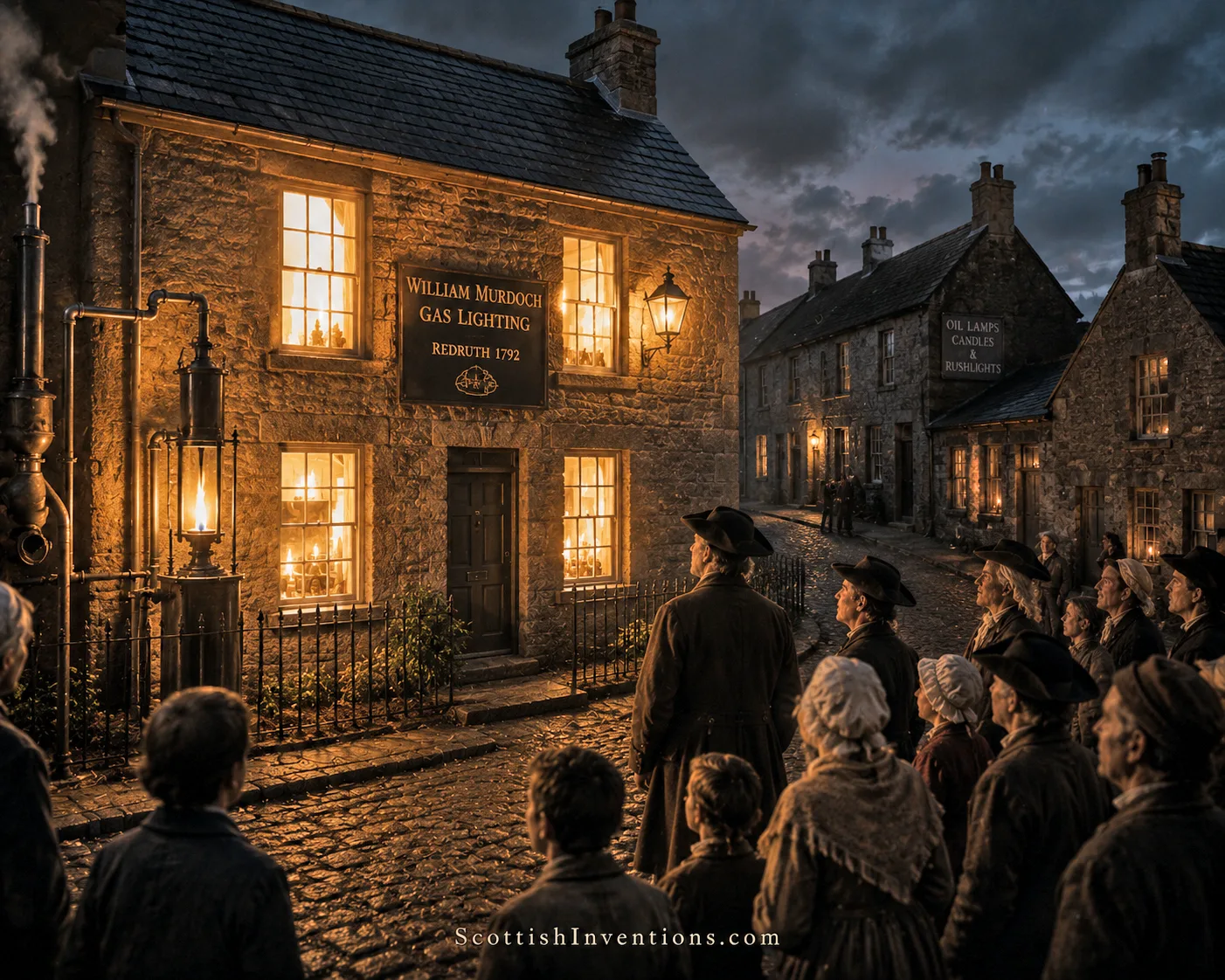
Murdoch lit his own house in Cornwall with coal gas — the first practical use of gas lighting in a building.
Soho Foundry, 1802
His spectacular public illumination of the Soho Foundry proved gas lighting was a viable industrial technology.
Rumford Medal, 1808
The Royal Society awarded Murdoch its Rumford Medal in recognition of his work on coal gas lighting.
Foundation of modern utilities
His piped-gas network was the template for every modern urban energy and water utility.
A Scottish Engineer in the Age of Steam
William Murdoch was born in 1754 in Lugar, near Cumnock in Ayrshire. He came from a family of millwrights and engineers and showed exceptional mechanical talent from an early age. In 1777, aged 23, he walked the long road to Birmingham and presented himself at the works of Boulton & Watt, where he was hired on the spot.
Murdoch quickly proved himself one of the firm's most skilled and inventive engineers. He was sent to Cornwall to erect and maintain the famous Boulton & Watt pumping engines that kept the deep tin and copper mines clear of water. Based at Redruth, he combined punishing on-site work with a constant habit of private experiment. It was here, in his rented house, that the observations leading to gas lighting were made.
The Discovery of Coal Gas Illumination
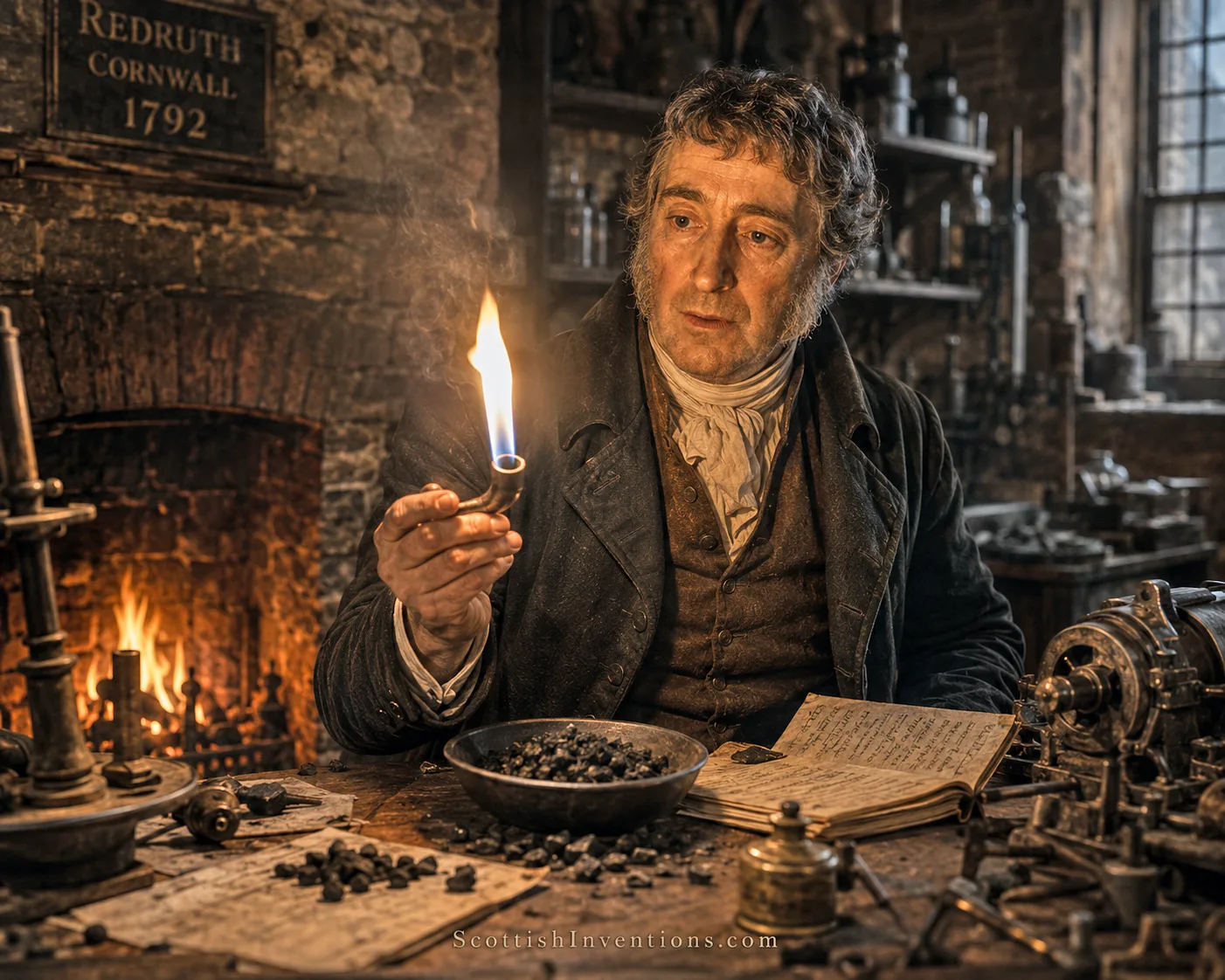
According to tradition, Murdoch's breakthrough came almost by accident. One evening, sitting by the fire, he placed some coal dust into the bowl of his clay pipe and held it in the flames. He noticed that a flammable gas was given off — and that it burned with a bright, steady flame when ignited at the end of the pipe.
That simple observation sparked a series of careful experiments. Murdoch realised that coal, when heated in the absence of air, released a gas that could be collected and burned for light. He began distilling coal in small iron retorts and piping the resulting gas to burners. By 1792 he had successfully lit his own house in Redruth using coal gas. He also lit the offices of Boulton & Watt in the town.
These early installations were small-scale and experimental, but they proved the concept worked. The gas produced a much brighter and more consistent light than candles or oil lamps. It did not flicker as much and could be turned on and off easily. Murdoch had created the first practical domestic gas lighting system.
Scaling Up at Soho
In 1798 Murdoch returned to Birmingham to work at the Soho Foundry, the manufacturing heart of Boulton & Watt's operations. He continued his gas experiments on a much larger scale, constructing a gas-producing apparatus and using it to light parts of the main foundry buildings — one of the first times a factory had been illuminated by gas at any significant scale.
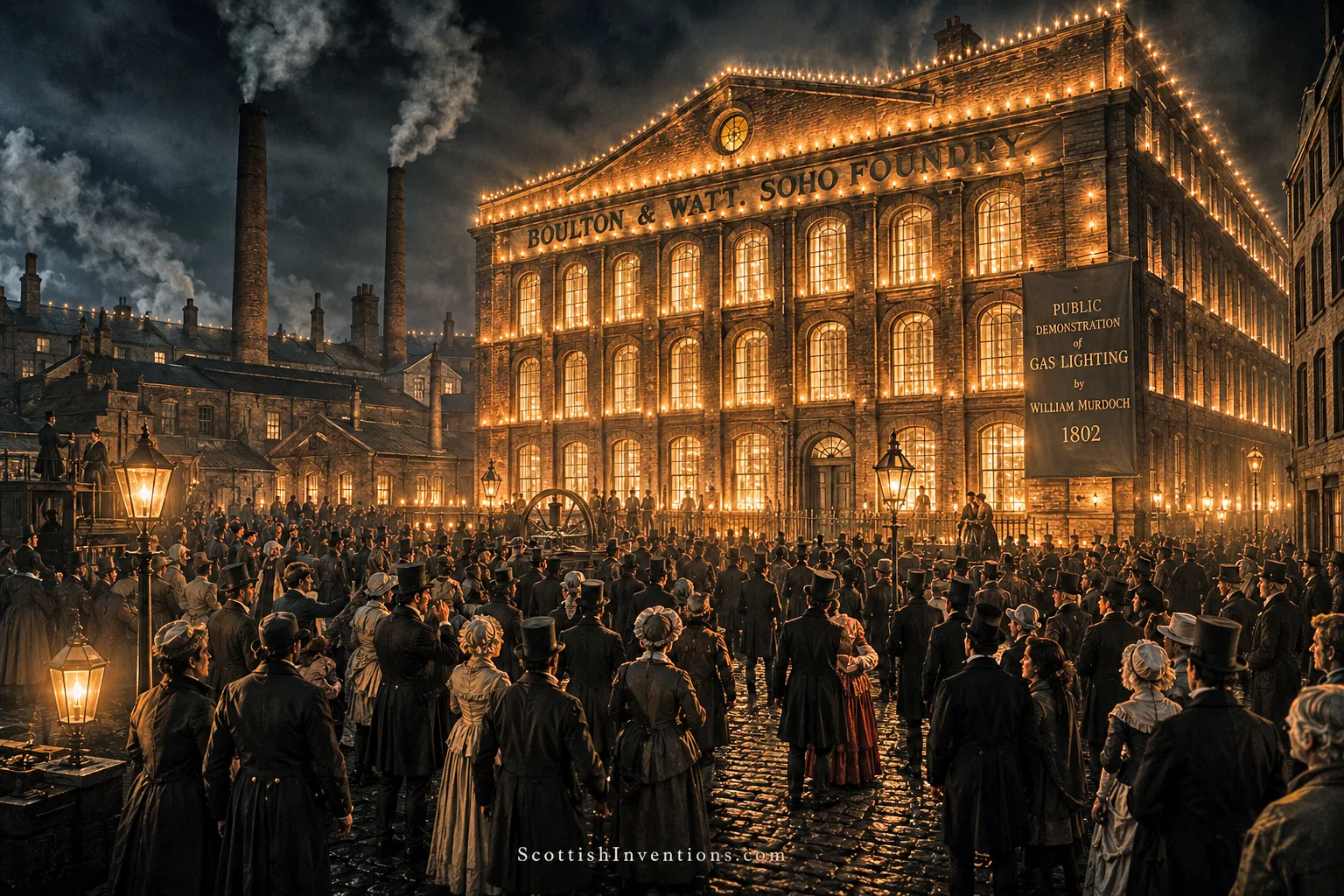
The breakthrough in public awareness came in 1802. To celebrate the Peace of Amiens — a short-lived treaty with France — Murdoch organised a spectacular public demonstration. He lit the entire exterior of the Soho Foundry with gas lights. Contemporary accounts describe the scene as astonishing: a great industrial building outlined against the night sky in steady golden flame. The crowd that gathered to see it had never witnessed anything like it.
This public display helped convince industrialists and civic leaders that gas lighting was not merely a philosophical curiosity but a viable technology with enormous commercial potential — a moment as important to artificial light as James Bowman Lindsay's electric light demonstration would later prove to be for the next chapter of illumination.
How Coal Gas Lighting Worked
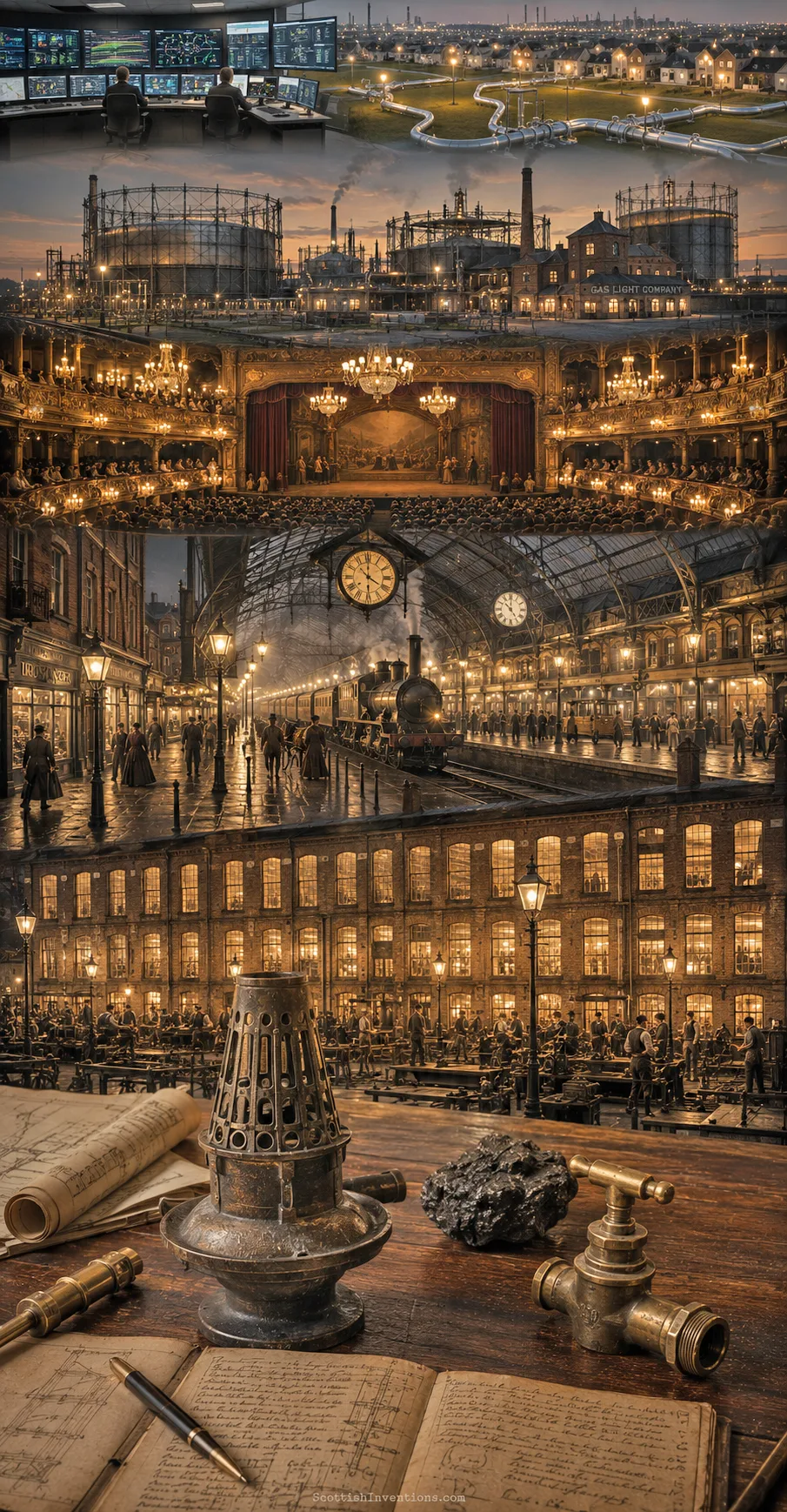
Murdoch did not simply discover that coal produced flammable gas. He developed practical methods for producing it in useful quantities, purifying it, storing it and distributing it through pipes to burners. Early gas contained impurities that caused unpleasant smells and poor burning quality. Murdoch experimented with washing and purifying the gas using water and other media to make it cleaner and more pleasant to use. He also designed better burners and early versions of what would later be called gasometers — holders for storing the gas under gentle pressure.
Engineering Explainer — From Coal to Flame
1. Coal in sealed retorts
Coal is loaded into iron retorts and sealed off from the air to prevent it burning directly.
2. Destructive distillation
External heat drives off a mix of flammable gases — chiefly hydrogen and methane — leaving coke behind.
3. Cooling & condensing
The hot gas passes through pipes that cool it, condensing tar and ammoniacal liquor for separate use.
4. Washing & purification
Gas is bubbled through water and (later) lime to strip out sulphur compounds and sweeten the smell.
5. Storage in gasometers
Clean gas is collected in large bell-shaped holders that float in water, holding it at steady pressure.
6. Distribution by mains
A network of cast-iron pipes carries gas from the works to factories, streets and homes.
7. Burners and jets
At each fitting, an open jet or shaped burner ignites the gas, producing a bright, steady flame.
8. Lighting on demand
Unlike candles or oil lamps, gaslight could be turned on and off by simply opening or closing a tap.
9. A networked utility
Production, storage, distribution and metering — the template for every modern public utility.
Industrial Impact
The introduction of coal gas lighting had immediate and far-reaching effects. Factories and workshops could operate safely and productively for longer hours, especially during the long Scottish and English winters. Streets and public spaces became safer: well-lit streets reduced crime and accidents, and allowed people to move around cities more freely after dark. Homes, theatres, shops and assembly rooms adopted gas lighting rapidly. Working conditions improved across many industries, as better lighting reduced eye strain and accidents.
Combined with Watt's centrifugal governor, Nasmyth's steam hammer and Neilson's hot blast process, Murdoch's gaslight helped place Scottish engineering at the heart of an industrial revolution that ran around the clock for the first time in human history.
Feature
Why Coal Gas Lighting Changed the World
First practical gas lighting system
A complete chain from coal to flame — production, purification, storage and distribution.
Longer factory hours
Industry could safely run shifts long into the night, multiplying output.
Safer streets
Public gaslight reduced crime, accidents and the fear of moving around after dark.
Brighter homes
Steady, clean light transformed reading, sewing, study and family life indoors.
Industrial expansion
Theatres, shops, stations and exhibitions adopted gas, fuelling Victorian consumer culture.
Birth of modern public utilities
The piped-gas model became the template for water, electricity and gas networks everywhere.
Foundation for later energy networks
Metering, mains, leak-tracing and pressure control all began with Murdoch's gasworks.
A bridge to electric light
The infrastructure of public lighting was built around gas — and inherited by electricity.
Interactive Timeline
- ●
1754
William Murdoch born in Ayrshire
Born at Lugar, near Cumnock, into a family of millwrights and engineers.
- ●
1777
Joins Boulton & Watt
Aged 23, Murdoch walks to Birmingham and joins James Watt's engineering firm.
- ●
1779–1798
Cornwall years
Erects and maintains Boulton & Watt pumping engines for the Cornish mining industry, based at Redruth.
- ●
1792
First gas-lit house at Redruth
Murdoch illuminates his own home and the Boulton & Watt offices with coal gas — the first practical building lit by gas.
- ●
1798
Returns to the Soho Foundry
Murdoch comes back to Birmingham and continues his gas experiments at a much larger industrial scale.
- ●
1802
Public gas lighting demonstration at Soho
Murdoch lights the exterior of the Soho Foundry to celebrate the Peace of Amiens. Crowds and industrialists are astonished.
- ●
1808
Awarded the Rumford Medal
The Royal Society recognises Murdoch's pioneering work on coal gas lighting.
- ●
1812
First commercial gas company established
The Gas Light and Coke Company is incorporated in London — the world's first public gas utility.
- ●
Mid-1800s
Gas lighting spreads worldwide
Gasworks appear in cities across Britain, Europe and the Americas. Streets, factories and theatres are routinely lit by gas.
- ●
Late 1800s
Electric lighting begins to replace gas
Carbon-arc and incandescent electric lamps gradually supersede gas for general illumination.
- ●
1839
William Murdoch dies
Murdoch dies at Handsworth, near Birmingham, having shaped one of the defining technologies of the nineteenth century.
- ●
Today
Legacy in modern infrastructure
Murdoch's networked utility model lives on in every gas, water, electricity and broadband network in the world.
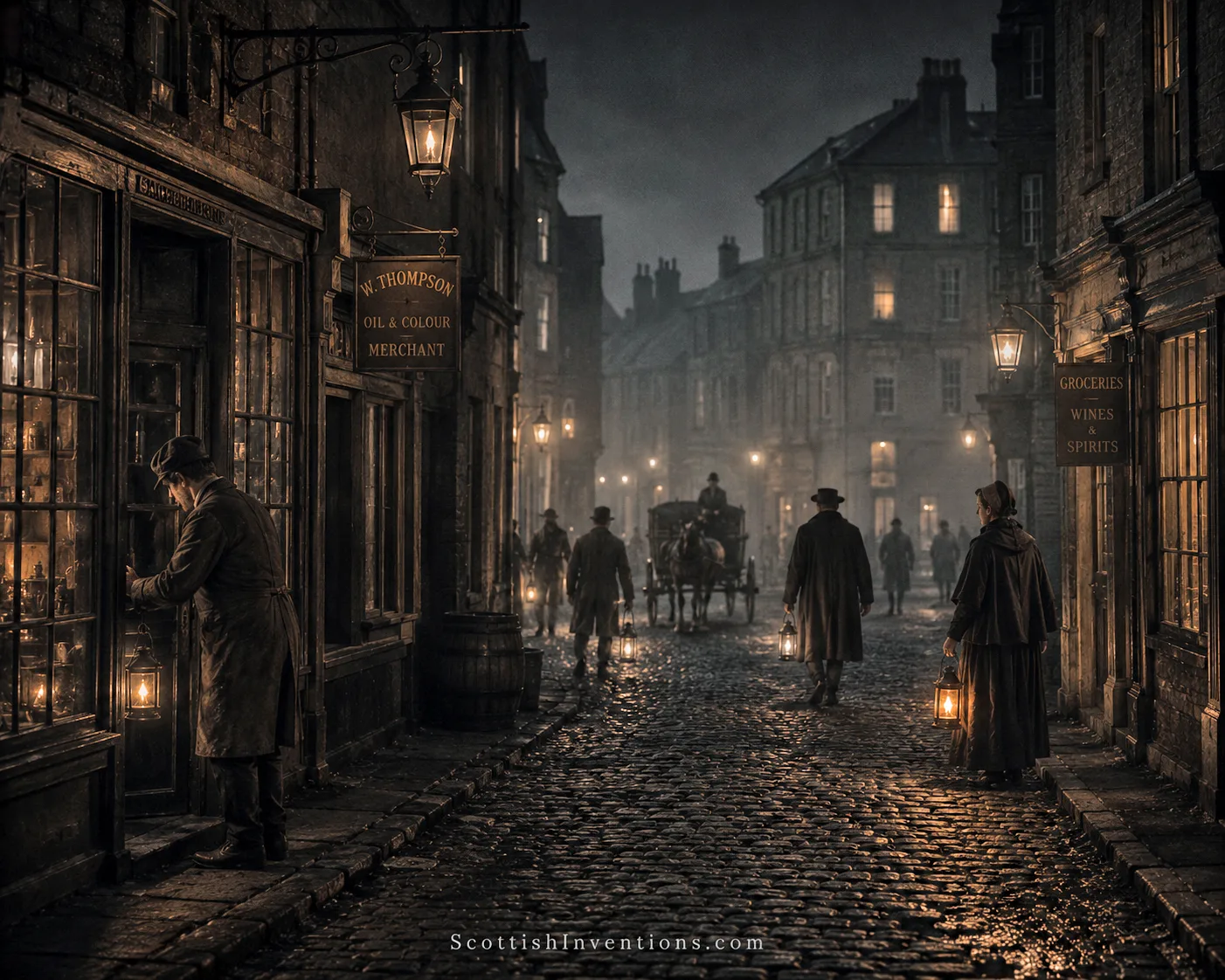
From Gaslight to the Modern City
After the Soho demonstration, gas lighting spread rapidly. The first public gas company — the Gas Light and Coke Company — was established in London in 1812, and gasworks soon appeared in major cities across Britain and Europe. By the middle of the nineteenth century, gas lighting was commonplace in towns and cities throughout the industrialised world. Murdoch himself received recognition during his lifetime, including the Royal Society's Rumford Medal in 1808, though he has sometimes been overshadowed by the more famous figures associated with Boulton & Watt, particularly James Watt himself.
Murdoch's legacy reaches well beyond illumination. The systems of central production, piped distribution, metered supply and municipal regulation that grew up around coal gas became the template for every modern public utility. When electricity eventually displaced gas for lighting in the late nineteenth and early twentieth centuries — beginning with the experiments of James Bowman Lindsay and culminating in the work of Swan, Edison and others — it inherited the streets, the mains, the offices and the very habits of supply that gas had created. Even James Clerk Maxwell's later work on electromagnetism, which underpins the entire electric age, built on a Victorian world Murdoch had helped to construct.
Murdoch died in 1839 at Handsworth, near Birmingham. Coming soon to ScottishInventions.com: the Scottish Inventions Collection, exploring the scientific breakthroughs that grew out of the same engineering culture that produced him.
Frequently Asked Questions
- Who invented coal gas lighting?
- The Scottish engineer William Murdoch (1754–1839) developed the first practical coal gas lighting system. While the flammability of coal gas was known to earlier experimenters, Murdoch was the first to design a complete working system for producing, purifying, storing, distributing and burning coal gas on an industrial scale. He lit his own house in Redruth, Cornwall, with coal gas in 1792.
- Was William Murdoch Scottish?
- Yes. William Murdoch was born in 1754 at Lugar, near Cumnock in Ayrshire, into a family of Scottish millwrights and engineers. He travelled to Birmingham in 1777 to join the engineering firm of Boulton & Watt, where he spent most of his working life — but his training, instincts and engineering education were firmly rooted in the Scottish millwright tradition.
- How did coal gas lighting work?
- Coal was heated in sealed iron retorts in the absence of air. This process — destructive distillation — released a mixture of flammable gases (mostly hydrogen and methane). The raw gas was washed and purified, stored in large gas holders (gasometers), and piped to burners in homes, factories and streets, where it was ignited to produce a bright, steady flame.
- Where was gas lighting first demonstrated?
- Murdoch lit his own home and the Boulton & Watt offices at Redruth, Cornwall, with coal gas in 1792 — the first practical use of gas lighting in a building. The first great public demonstration came at the Soho Foundry, Birmingham, in 1802, when Murdoch illuminated the entire exterior of the foundry to celebrate the Peace of Amiens.
- Why was the Soho Foundry demonstration important?
- The 1802 Soho Foundry illumination was a deliberate, large-scale public proof that coal gas lighting worked. Crowds gathered to see an entire factory bathed in steady gaslight — something no oil lamp or candle scheme could achieve. It convinced industrialists, civic leaders and entrepreneurs that gas lighting was a commercial technology, not a curiosity, and launched the rapid spread of gas works across Britain.
- How did gas lighting change cities?
- Gas lighting transformed urban life. Factories could safely run shifts long after sunset. Streets and public spaces became safer and more sociable, reducing crime and accidents. Theatres, shops, assembly rooms and railway stations adopted gas lighting rapidly. It helped shift Britain from a daylight-based rural society into a 24-hour industrial economy.
- What replaced gas lighting?
- Electric lighting — pioneered later in the nineteenth century by figures including Scotland's own James Bowman Lindsay and (later) Joseph Swan and Thomas Edison — gradually replaced gas for general illumination from the 1880s onward. Gas remained important for cooking and heating, and Murdoch's pioneering systems of production, distribution and metering laid the foundations for modern utility networks.
- Did Murdoch work with James Watt?
- Yes. Murdoch joined Boulton & Watt in 1777 and spent his career inside the firm, erecting and maintaining Watt's pumping engines (especially in Cornwall) and later running the Soho Foundry. He was a trusted colleague of James Watt and Matthew Boulton, and his loyalty to the partnership is one reason he did not aggressively patent his gas lighting innovations.
- Was coal gas lighting dangerous?
- Early gas was impure and could leak, smell unpleasant, or, in poorly ventilated spaces, cause asphyxiation or explosions. Murdoch's engineering improvements — better burners, purification of the gas using water washing, sealed iron retorts and properly built distribution pipes — made the technology dramatically safer. The hazards never disappeared entirely, but engineering practice reduced them to acceptable levels for industrial and civic use.
- Why is William Murdoch important today?
- Murdoch's coal gas system was the first large-scale public utility for delivering energy from a central plant to many users through a pipe network — the template every modern gas, water and electricity utility still follows. He helped invent not just a new form of lighting, but the entire idea of networked public infrastructure that defines modern cities.
Sources
Tier 1 · Primary
- John Griffiths, The Third Man: The Life and Times of William Murdoch, 1754–1839 (André Deutsch, 1992).
- Samuel Smiles, Lives of the Engineers: Boulton and Watt (John Murray, 1865).
- H. W. Dickinson & Rhys Jenkins, James Watt and the Steam Engine (Oxford University Press, 1927).
- M. E. Falkus, "The British Gas Industry before 1850", Economic History Review, vol. 20 (1967).
Tier 2 · Scholarly and institutional
- Royal Society — Rumford Medal citations and Fellows' biographical records.
- Science Museum Group — Boulton & Watt and early gas lighting collections.
Tier 3 · General reference
- Encyclopædia Britannica — entries on William Murdoch, coal gas and gas lighting.
Newsletter
Discover Scotland's hidden inventors
One short, beautifully illustrated story a fortnight. No spam, ever.
Sign up free