Scottish Inventions · Transport
Kirkpatrick Macmillan
Scotland’s Bicycle Pioneer — History, Evidence and Legacy
SI Score51/60Ranked =20th of 50 in InventionsBreakdown
Scottish Impact Index (SI Score)
- Global Impact
- 9/10
- Longevity
- 9/10
- Economic / Material Impact
- 9/10
- Originality / Distinctiveness
- 8/10
- Legacy (Built Upon)
- 8/10
- Recognition
- 8/10
How one Dumfriesshire blacksmith became forever linked with one of history’s greatest inventions — and what the evidence really does, and does not, tell us.
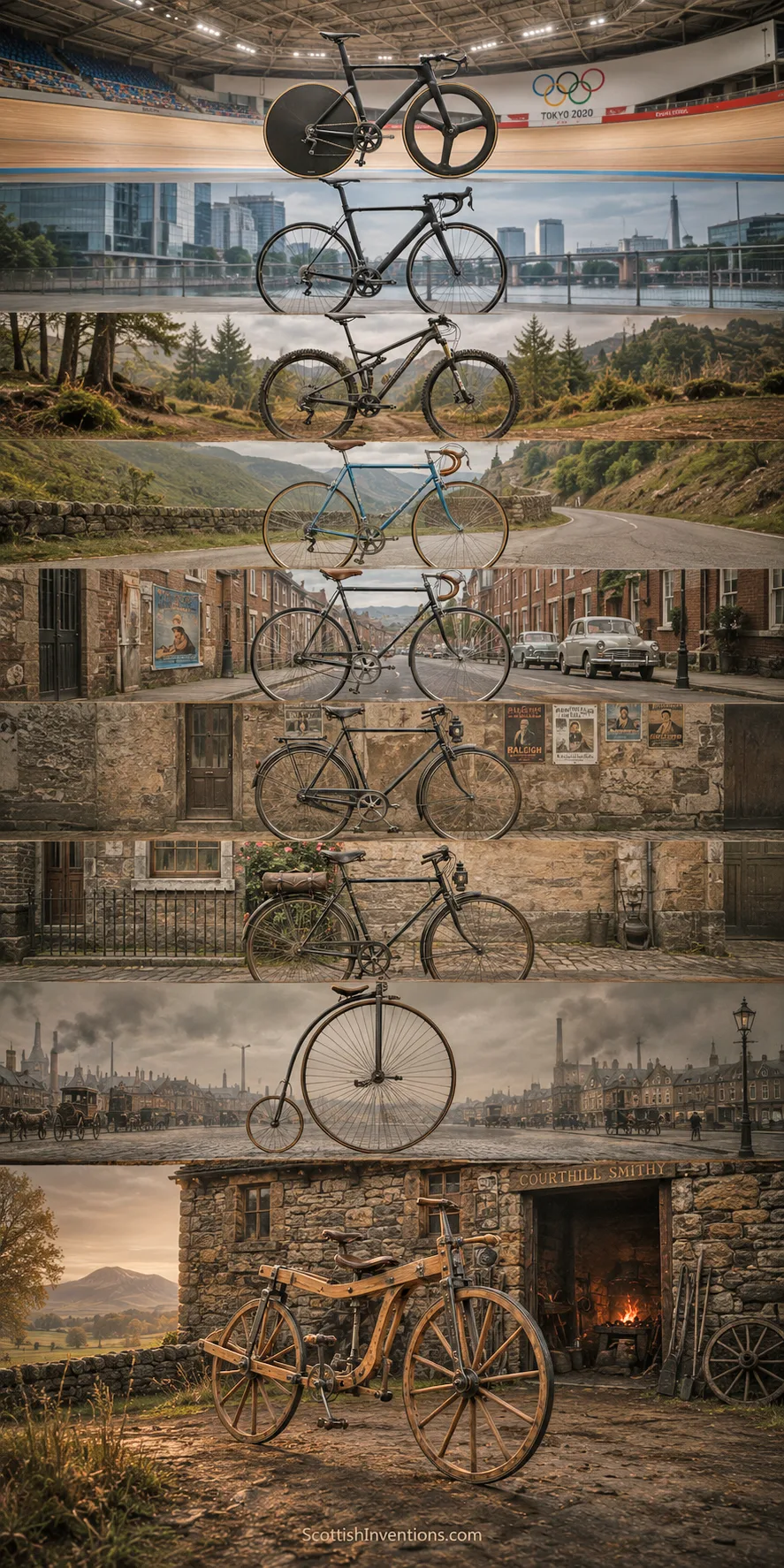
TL;DR
- Kirkpatrick Macmillan, a blacksmith from Keir Mill, Dumfriesshire, is traditionally credited with building the first mechanically (treadle-) driven two-wheeled bicycle around 1839 — but virtually the entire detailed story rests on a publicity campaign launched by his relative James Johnston fifty years later, in the 1890s, and no original machine, drawing, or contemporary description survives.
- The famous 1842 ride to Glasgow and the “first cycling fine” trace back to a single anonymous Glasgow newspaper report of an unnamed “gentleman from Dumfries-shire” on a velocipede — never securely dated or sourced to a named masthead, and never naming Macmillan.
- Leading cycling historians — Alastair Dodds (National Museums Scotland), Nicholas Oddy, Nicholas Clayton and David Herlihy — agree the priority claim is unproven; the two machines usually shown to the public as “Macmillan’s bicycle” were actually built years later by other Scottish craftsmen, Gavin Dalzell and Thomas McCall. The honest, defensible position is that a Scottish rear-driven treadle bicycle very likely existed by the mid-1840s — but that it probably cannot be proven to have been built by Macmillan himself, in 1839, in the form the legend describes.
Key Facts
Timeline
- •
1817
Karl Drais patents the Laufmaschine ('hobby horse') in Mannheim — the first steerable two-wheeler, propelled by pushing off the ground.
- •
1839
Traditional date for Kirkpatrick Macmillan's treadle-driven bicycle at Courthill Smithy, Keir Mill. No 1839 document survives.
- •
1842
Traditional date of the Glasgow ride and 'first cycling fine' — sourced only to a single anonymous newspaper item never linked to a named masthead.
- •
1845–46
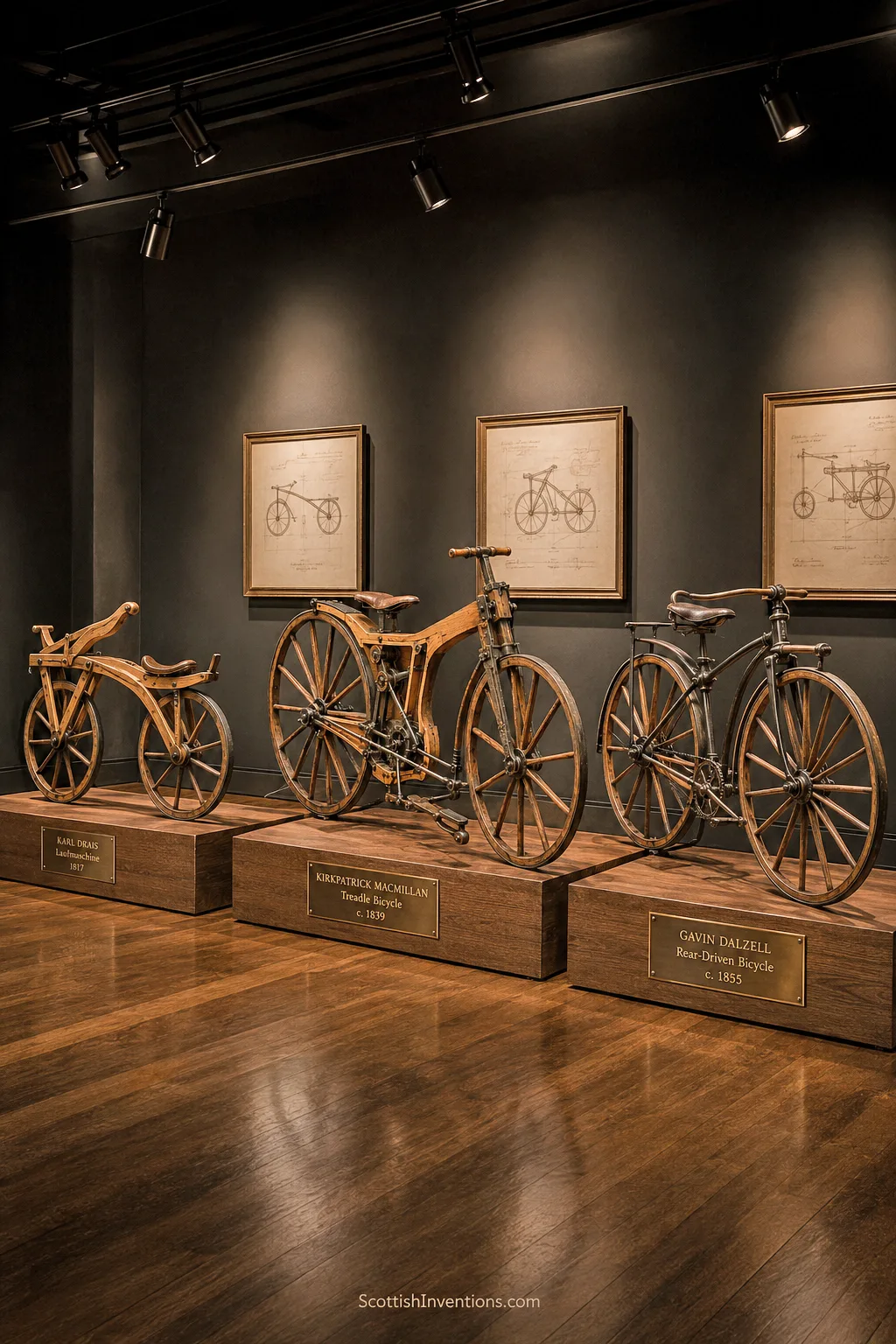
Gavin Dalzell of Lesmahagow builds a rear-driven treadle bicycle — the oldest surviving pedal-driven bicycle in the world.
- •
1869
Thomas McCall of Kilmarnock builds two rear-wheel-driven velocipedes, documented in the journal English Mechanic.
- •
1888
Dalzell's son exhibits the family machine at the Glasgow Exhibition, credited as the invention of the bicycle.
- •
1899
James Johnston publishes 'The First Bicycle' in The Gallovidian — the campaign document that started the modern Macmillan legend.
- •
1939
Cyclists' Touring Club plaque unveiled at Courthill Smithy: 'He builded better than he knew.'
- •
1987–92
Nicholas Clayton, Nicholas Oddy and Alastair Dodds publish critical scholarly reassessments of the Macmillan claim.
- •
2004
David V. Herlihy's Bicycle: The History (Yale) concludes there is no contemporary evidence for a two-wheeled pedal bicycle in Scotland in 1839.
- •
2023
Scotland hosts the UCI Cycling World Championships. A new coast-to-coast route is named in Macmillan's honour.
1. Biography: The Village Blacksmith
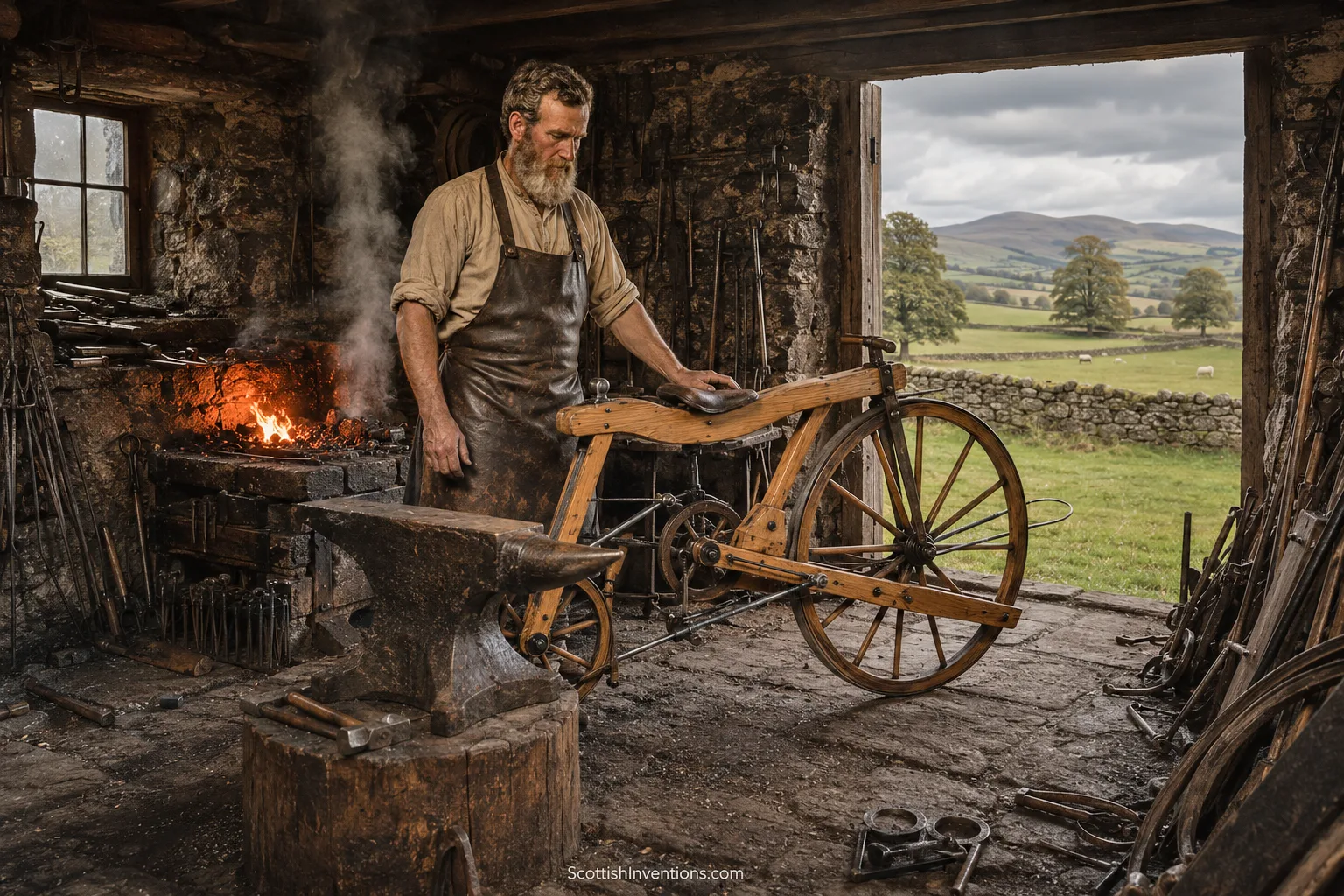
Kirkpatrick Macmillan was born in 1812 in the rural parish of Keir, near Thornhill in what is now Dumfries and Galloway, the fifth son of Robert Macmillan, blacksmith at Courthill Smithy in Keir Mill. He was baptised on 18 September 1812; most sources give his birth date as 2 September 1812. Growing up at the forge gave him a practical grounding in metalworking and mechanics. He began his apprenticeship under his father at around the age of 12 (about 1824), and as a young man in his early twenties he is said to have worked for a time as an assistant to the blacksmith at Drumlanrig Castle, seat of the Duke of Buccleuch, before returning to Courthill to work alongside his father.
Macmillan lived the life of a respected country tradesman, repairing farm tools and vehicle parts for the agricultural community of Nithsdale. Local tradition holds that his neighbours nicknamed him “Daft Pate” for the eccentric machine he rode, that he pulled teeth for both horses and humans, and that he played the fiddle at weddings — all colourful details that come down to us through family and local recollection rather than independent record. Shortly after his father’s death he married Elizabeth (Elspeth) Goldie in 1854; sources disagree on the number of children, with some accounts giving two surviving children and others six. Tragedy struck in 1865, when he lost his wife, a baby, and his ten-year-old son. Macmillan died at Courthill on 26 January 1878, aged 65, and is buried in the old kirkyard at Keir Mill, where the family headstone bears the words “Inventor of the Bicycle.”
2. The Invention, c.1839, and How It Worked
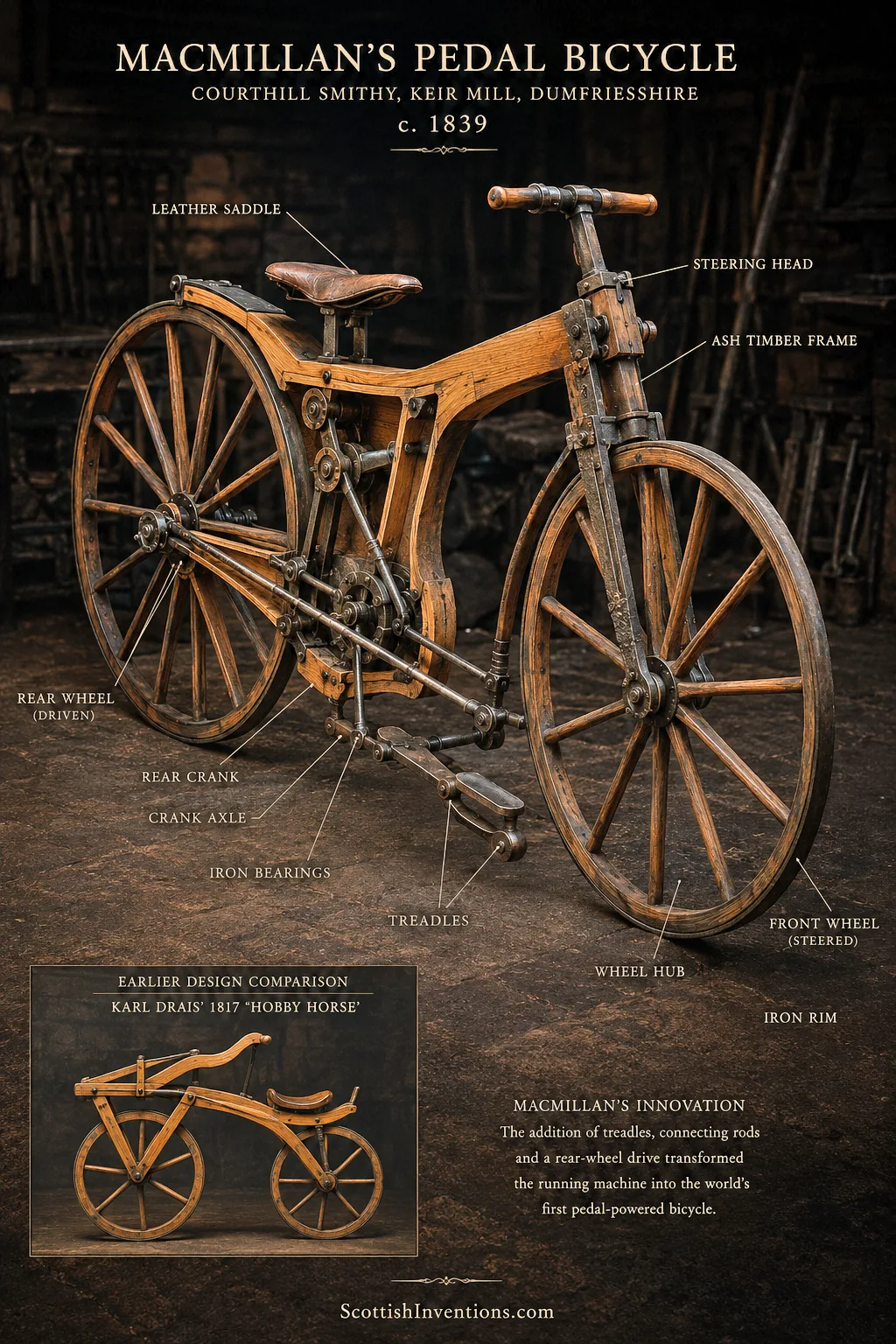
The traditional account holds that Macmillan, having seen and then built a hobby-horse (dandy horse), grew frustrated with having to push it along with his feet on the ground. Around 1839 he is said to have solved the problem by adding a mechanical drive: treadles (swinging foot-levers) mounted mid-frame, connected by long iron rods to cranks on the rear wheel. The rider worked the treadles back and forth in a horizontal, reciprocating motion — not unlike the connecting rods that drive the wheels of a steam locomotive — turning the rear wheel without the feet ever touching the ground.
This is the crucial distinction from earlier machines. The 1817 Laufmaschine (“running machine”) of Baron Karl von Drais — variously called the draisine, velocipede, dandy horse or hobby horse — was the first steerable two-wheeler, but it had no pedals; the rider propelled it by pushing against the ground with alternating strides. Drais first rode it on 12 June 1817 near Mannheim. Macmillan’s reputed contribution was to make the two-wheeler genuinely self-propelled: a rear-wheel-drive treadle bicycle whose rider’s feet left the ground entirely.
The reputed machine was made of wood with iron-rimmed wooden wheels, a smaller steerable front wheel and a larger rear wheel, and is said to have weighed around 26 kg (57 lb), with a rear wheel somewhat larger than the front to compensate for the fixed gearing of the treadle-and-crank system. It had no brakes; the rider slowed by pressing back on the treadles. It is worth being precise about what Macmillan is and is not credited with: he did not invent pedals in the modern rotary sense, nor the treadle mechanism itself, which had been known since the Middle Ages in other machinery. His reputed achievement was adapting the treadle to drive a two-wheeler’s rear wheel — a genuinely clever piece of lateral thinking, if the story is accurate.
3. The Famous 1842 Ride to Glasgow — and the “First Cycling Fine”
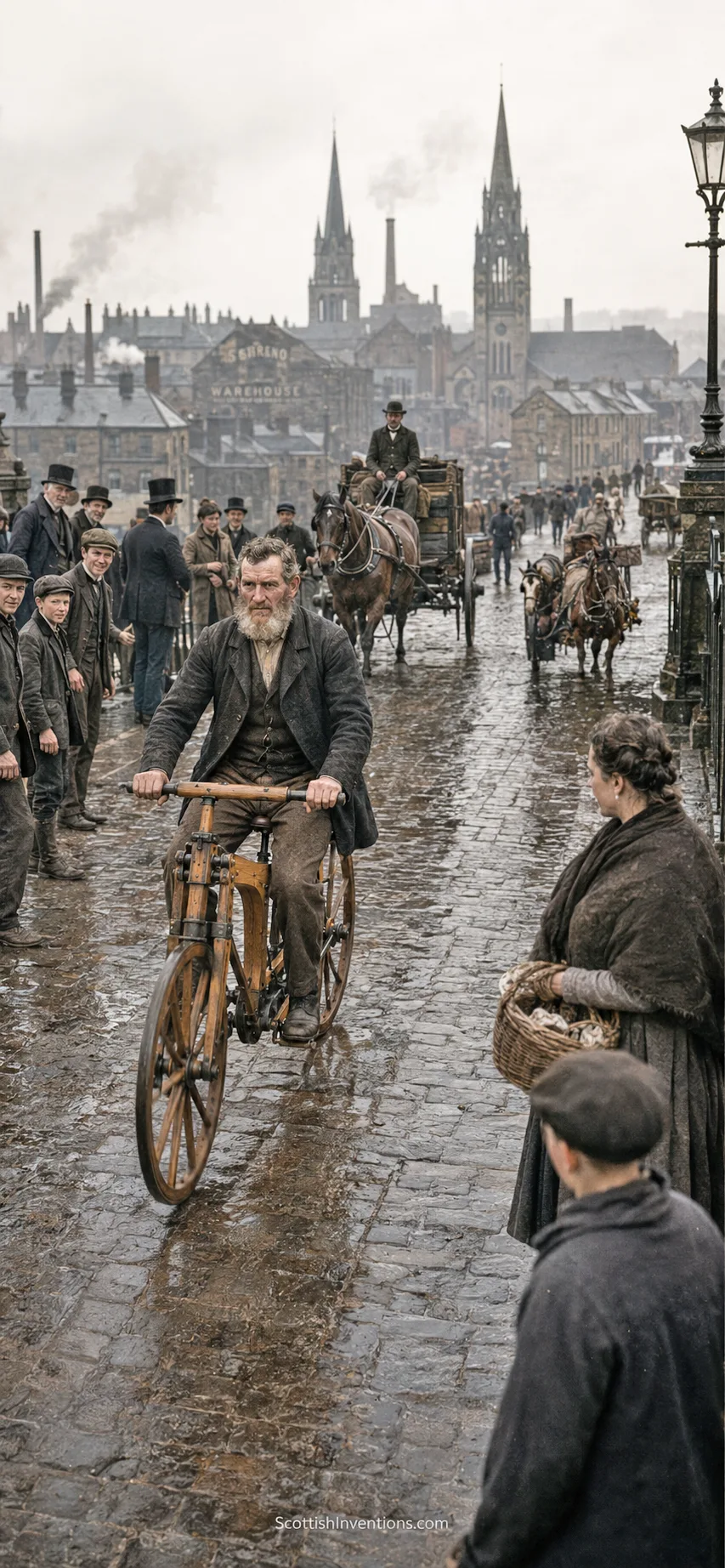
The most colourful episode in the legend has Macmillan riding to Glasgow in June 1842, visiting his brothers, staying overnight en route, and arriving on the second day. Popular retellings put the distance at anywhere from 40 to 70 miles, a wide variance that is itself a signal of how loosely sourced the story is. In the Gorbals, he is said to have knocked down a child who ran into his path and to have been fined five shillings by the local court — making him, in the popular telling, the first person ever penalised for a cycling offence. A frequently added embellishment has the presiding magistrate so impressed by the machine that he paid the fine himself in exchange for a demonstration.
“Hearsay, family folklore and conjecture — a claim without evidence by his nephew in a letter to a newspaper 50 years later, with subsequent embellishments.”
— Rob Ainsley, BikeRadar, 2025 (retracing the supposed route)
The documentary basis for all of this is genuinely thin, and readers deserve the honest version rather than the confident one. The entire episode rests on a single newspaper item — reliably described in careful secondary sources only as “a Glasgow newspaper,” since no historian has been able to pin the report to a securely dated, named masthead — describing an anonymous “gentleman from Dumfries-shire… bestride a velocipede… of ingenious design” who knocked over a pedestrian and was fined five shillings. The clipping does not name Macmillan; he was identified as the rider only decades later, by his relative James Johnston, during his 1890s campaign to establish the bicycle’s Dumfriesshire origins. No surviving court or police record has ever been produced to confirm the fine actually took place, or to confirm the rider’s identity.
Cycling historian Nicholas Oddy has argued the “velocipede” described could equally have been a tricycle rather than a two-wheeler, and Alastair Dodds separately raised a pointed objection: an early-Victorian newspaper reporting on a working tradesman would have been unlikely to describe him as a “gentleman” — casting further doubt on the identification.
4. The Priority Dispute: Dalzell and McCall
Macmillan never patented his invention, never sought commercial gain from it, and never publicised it widely — which is precisely why his claim is so hard to substantiate today. Several other Scottish craftsmen built or sold similar machines in the following decades, and credit for the “first” pedal bicycle shifted between them for the better part of a century.
5. What Mainstream History Says About the Strength of the Evidence
The Macmillan story was widely and uncritically accepted by British historians through the early twentieth century, but has come under sustained scholarly scrutiny since the late twentieth century. The evidence rests heavily on testimony collected decades after the fact, principally by James Johnston, a corn trader and keen tricyclist, and a relative of Macmillan, whose explicit stated aim was “to prove that to my native country of Dumfries belongs the honour of being the birthplace of the invention of the bicycle.” Johnston’s key publication was “The First Bicycle,” in The Gallovidian (Dumfries), no. 4, Winter 1899 — the true origin point of the modern legend in something close to its familiar form.
Several cycling historians have published critical assessments of the claim:
- Nicholas Clayton — “The first bicycle!”, The Boneshaker no. 113 (1987).
- Nicholas Oddy — “Kirkpatrick MacMillan, the inventor of the pedal cycle or the invention of cycle history?”, 1st International Cycling History Conference, Glasgow (1990).
- Alastair Dodds, Curator of the Road Transport Collection at National Museums Scotland — “What did Kirkpatrick MacMillan invent?”, The Boneshaker no. 127 (Winter 1991), and “Kirkpatrick MacMillan — Inventor of the bicycle: fact or hearsay?”, 3rd International Cycling History Conference, Neckarsulm (1992).
- David V. Herlihy, in the authoritative Bicycle: The History (Yale University Press, 2004), argues there is no contemporary documentary evidence that a pedal-crank design was applied to a two-wheeled vehicle anywhere in Macmillan’s era — noting, in particular, that letters from Scottish customers to the French Michaux velocipede company as late as 1868 describe only tricycles and quadricycles in use in Scotland, which sits awkwardly with the claim that two-wheeled pedal bicycles had existed there since 1839. Cycling historian David Gordon Wilson (Bicycling Science) makes a similar point.
Yet the sceptics do not all reach the same flat conclusion, and it would be its own kind of distortion to present the debate as fully settled against Macmillan. Oddy has suggested Macmillan probably did experiment with treadle-driven machines — quite possibly tricycles rather than two-wheelers — as several contemporaries in Lowland Scotland evidently did. And Dodds, in his book Scottish Bicycles and Tricycles (National Museums Scotland), reached a carefully hedged verdict that is arguably the fairest summary available:
“Whether indeed Macmillan was the inventor of the bicycle or merely a copyist may never be known but it is almost certain that the inventor was Scots… The sheer number of stories suggests that there must have been quite a cottage industry building various types in Lowland Scotland at this time.”
— Alastair Dodds, Scottish Bicycles and Tricycles (National Museums Scotland)
In 2025, cycling journalist Rob Ainsley, retracing the supposed Dumfries-to-Glasgow route for BikeRadar, summarised the modern consensus bluntly — and noted that when enthusiasts have built working reconstructions from the surviving McCall and Dalzell machines, they have proven remarkably difficult to steer or ride.
6. Honours and Legacy
Despite the doubts, Macmillan is warmly and enduringly commemorated in Scotland — a reminder that a story can be culturally important and historically unproven at the same time. Two plaques are mounted on the gable ends of Courthill Smithy in Keir Mill (now a private house); one, erected in 1939 by the Cyclists’ Touring Club to mark the supposed centenary of the invention, reads “He builded better than he knew.” His family grave in the old kirkyard at Keir Mill, reached by a signed footpath, calls him “Inventor of the Bicycle.”
A 1990-built reproduction of his machine is on display at Drumlanrig Castle, near Thornhill, which has long celebrated the cycling connection, while the McCall-built 1890s “Macmillan” machine is held by Dumfries Museum and the genuine Dalzell machine of the 1840s — the oldest surviving pedal-driven bicycle in the world — is held by Glasgow Museums at the Riverside Museum.
Macmillan is honoured today in local cycling routes, including the Kirkpatrick Macmillan Trail between Dumfries and Drumlanrig and an eleven-mile circular “Kirkpatrick Macmillan Loop” around Keir Mill. In 2023, when Scotland hosted the UCI Cycling World Championships, a new coast-to-coast cycle route was named in his honour. Scottish cyclewear brand Endura ran a “Forgotten Legend” project, building a rideable replica and re-creating the reputed 1842 Thornhill-to-Glasgow ride with a team of athletes; the replica was subsequently exhibited at Dumfries Museum. Cycling UK and other bodies have repeatedly promoted Scotland as “the birthplace of the bicycle” on the strength of the Macmillan story — a claim that, as this article sets out, is better understood as a proud and enduring tradition than as an established historical fact.
Did You Know?
Frequently Asked Questions
Did Kirkpatrick Macmillan invent the bicycle?
He is traditionally credited with building the first mechanically driven two-wheeler around 1839, but the claim cannot be proven. No original machine, drawing or contemporary document survives, and the detailed story rests on a publicity campaign launched by his relative James Johnston in the 1890s — more than fifty years after the supposed event, with the detailed account published only in 1899. Historians now treat the priority as unproven while accepting that a Scottish rear-driven treadle bicycle very likely existed in the Lowlands by the mid-1840s.
Who invented the first pedal bicycle?
There is no single settled answer. Karl Drais built the first steerable two-wheeler (the Laufmaschine or 'hobby horse') in 1817, but it had no pedals. Kirkpatrick Macmillan is traditionally credited with adding a treadle drive around 1839. Gavin Dalzell of Lesmahagow built a very similar rear-driven machine in 1845–46, and Thomas McCall of Kilmarnock built his own rear-driven velocipedes in 1869. The modern rotary-pedal bicycle came from the French Michaux workshop in the 1860s.
What is a treadle bicycle?
A treadle bicycle uses swinging foot-levers (treadles) mid-frame, connected by iron rods to cranks on the rear wheel — a reciprocating motion, more like a steam locomotive's connecting rods than a modern rotary pedal. Macmillan's reputed 1839 machine, and the surviving Dalzell and McCall bicycles, all use this treadle-and-crank drive rather than rotary pedals on the wheel hub.
Why is Macmillan's claim disputed?
Four reasons. First, no original machine, drawing or patent survives. Second, the detailed story was published only in 1899, sixty years after the supposed invention. Third, the machine displayed to the public as 'Macmillan's bicycle' at Dumfries Museum was actually built in the 1890s by Thomas McCall. Fourth, for over fifty years credit for this style of bicycle went to Gavin Dalzell of Lesmahagow, not Macmillan.
Where can I see Macmillan's bicycle?
The machine displayed at Dumfries Museum as 'Macmillan's bicycle' is a Thomas McCall reconstruction from the 1890s, not an original. The genuine Gavin Dalzell bicycle of the 1840s — the world's earliest surviving pedal-driven bicycle — is held by Glasgow Museums at the Riverside Museum. A 1990 replica is on display at Drumlanrig Castle near Thornhill.
Who was Gavin Dalzell?
Gavin Dalzell was a cooper from Lesmahagow in Lanarkshire who built a rear-driven treadle bicycle around 1845–46. For more than fifty years, before James Johnston's 1890s campaign, Dalzell — not Macmillan — was widely regarded as the original inventor of the mechanically driven two-wheeler. His surviving machine at the Riverside Museum in Glasgow is the oldest confirmed pedal-driven bicycle in the world.
Who was Thomas McCall?
Thomas McCall (born Penpont 1834) was a joiner and cartwright from Kilmarnock who built two rear-wheel-driven velocipedes in 1869, documented at the time in the journal English Mechanic. He sold copies of his own design for about £7. At James Johnston's request in the 1890s he also built the machine long exhibited as 'Macmillan's original bicycle' — the one now at Dumfries Museum.
Where was Kirkpatrick Macmillan born?
Kirkpatrick Macmillan was born at Keir Mill, in the rural parish of Keir near Thornhill in what is now Dumfries and Galloway, on 2 September 1812 (baptised 18 September 1812). He was the fifth son of Robert Macmillan, blacksmith at Courthill Smithy, and trained in the family trade from around age 12.
How did Macmillan's bicycle work?
The traditional reconstruction shows a wooden frame with iron-rimmed wooden wheels — a smaller steerable front wheel and a larger rear wheel — weighing around 26 kg (57 lb). Two swinging treadles mid-frame were connected by long iron rods to cranks on the rear wheel. The rider worked the treadles horizontally, back and forth, turning the rear wheel. It had no brakes; the rider slowed by pressing back on the treadles.
What evidence survives today?
Essentially none from Macmillan himself: no machine, no drawing, no patent, no contemporary letter or newspaper report naming him. The surviving evidence is the 1840s Dalzell machine at the Riverside Museum, the McCall-built 1890s machine at Dumfries Museum, James Johnston's 1899 article 'The First Bicycle' in The Gallovidian, family and local recollections gathered in the 1890s, and two commemorative plaques and a headstone at Keir Mill.
Further Reading & Places to Visit
Tier 1 · Primary
- For serious readers: David V. Herlihy, Bicycle: The History (Yale University Press, 2004); Alastair Dodds, Scottish Bicycles and Tricycles (National Museums Scotland); and the papers by Clayton, Oddy and Dodds in The Boneshaker and the International Cycling History Conference proceedings give the sceptical, evidence-based view. James Johnston’s 1899 article in The Gallovidian remains the original source of the popular legend, and is worth reading precisely because it is the campaign document that started it all.
Tier 2 · Scholarly and institutional
- Courthill Smithy, Keir Mill: See the two commemorative plaques on the former smithy (now a private house — view from the road only) and the family grave in the old kirkyard nearby.
- Drumlanrig Castle, near Thornhill: View the 1990 replica bicycle and the cycling heritage displays; the estate offers cycle hire and is the start of the Kirkpatrick Macmillan Loop.
- Dumfries Museum: Home to the McCall-built machine long exhibited as “Macmillan’s bicycle.”
- Riverside Museum, Glasgow (Glasgow Museums): See the genuine Gavin Dalzell machine of the 1840s — described by Glasgow Museums as the world’s earliest surviving pedal-driven bicycle.
Caveats: Myths and Disputed Claims
- The 1839 date and the invention itself. No original Macmillan machine, drawing, patent, or contemporary document survives. The earliest detailed claims date from the 1880s–90s — roughly fifty years later, and after Macmillan’s own death. “1839” is a traditional date, not a documented one.
- The Glasgow ride and fine. The episode rests on one imprecisely sourced newspaper item. No court record has been found, no historian has been able to secure a precise masthead and date for the report, the distance ridden is variously given as anywhere from 40 to 70 miles, and Macmillan was linked to the item only retrospectively by James Johnston. Any version of this article — or of anyone else’s — that cites a specific newspaper title, exact date, or direct quote for this episode should be treated with real caution unless it can point to a genuine primary source.
- The surviving “Macmillan” machine at Dumfries Museum. This widely displayed and photographed machine was built by Thomas McCall in the 1890s, not by Macmillan in 1839. Sceptics argue its design is substantially a composite of McCall’s own 1869 velocipedes, retrospectively presented as a faithful copy of an earlier original.
- “Macmillan invented the first pedal bicycle.” This cannot be stated with confidence. Mainstream historians such as Herlihy and Wilson argue there is no contemporary evidence for a two-wheeled pedal or treadle bicycle in Scotland as early as 1839, and note that rear-driven two-wheelers were independently devised by several inventors, including McCall, around 1869. The honest formulation is that Macmillan is traditionally credited with, or associated with, early Scottish treadle bicycles — with the attribution remaining genuinely and probably permanently uncertain.
- The Dalzell question. For over fifty years, Gavin Dalzell — not Macmillan — was credited as the inventor of this style of machine. The claim that Dalzell “copied” Macmillan comes from Johnston’s later campaign and is itself part of the disputed, retrospectively-constructed narrative, not an independently established fact.
- Minor biographical inconsistencies — the number of Macmillan’s children (variously given as two or six), his wife’s name (Elizabeth or Elspeth Goldie), and his exact birth and baptism dates — recur across popular sources and should be treated as uncertain rather than harmonised into false precision.
- A specific 1841 census record placing Macmillan in Glasgow as a “journeyman hammer-maker,” sometimes repeated online, has not been located or verified in any traceable source and should not be treated as established fact. A related, genuinely scholarly hypothesis — that Macmillan may for a period have lived and worked in Glasgow, possibly at the Vulcan Foundry, rather than continuously at Courthill — has been raised by historian Alastair Dodds, but its underlying documentary basis has not been made publicly available and should be presented as an open question, not a correction to the record.
Discover the remarkable inventions and discoveries that changed the world at ScottishInventions.com.