Scottish Inventions · Communications & Media
Alexander Graham Bell and the Telephone
The Edinburgh-Born Inventor Who Made the Wires Speak
SI Score57/60Ranked =2nd of 50 in InventionsBreakdown
Scottish Impact Index (SI Score)
- Global Impact
- 10/10
- Longevity
- 8/10
- Economic / Material Impact
- 10/10
- Originality / Distinctiveness
- 10/10
- Legacy (Built Upon)
- 10/10
- Recognition
- 9/10
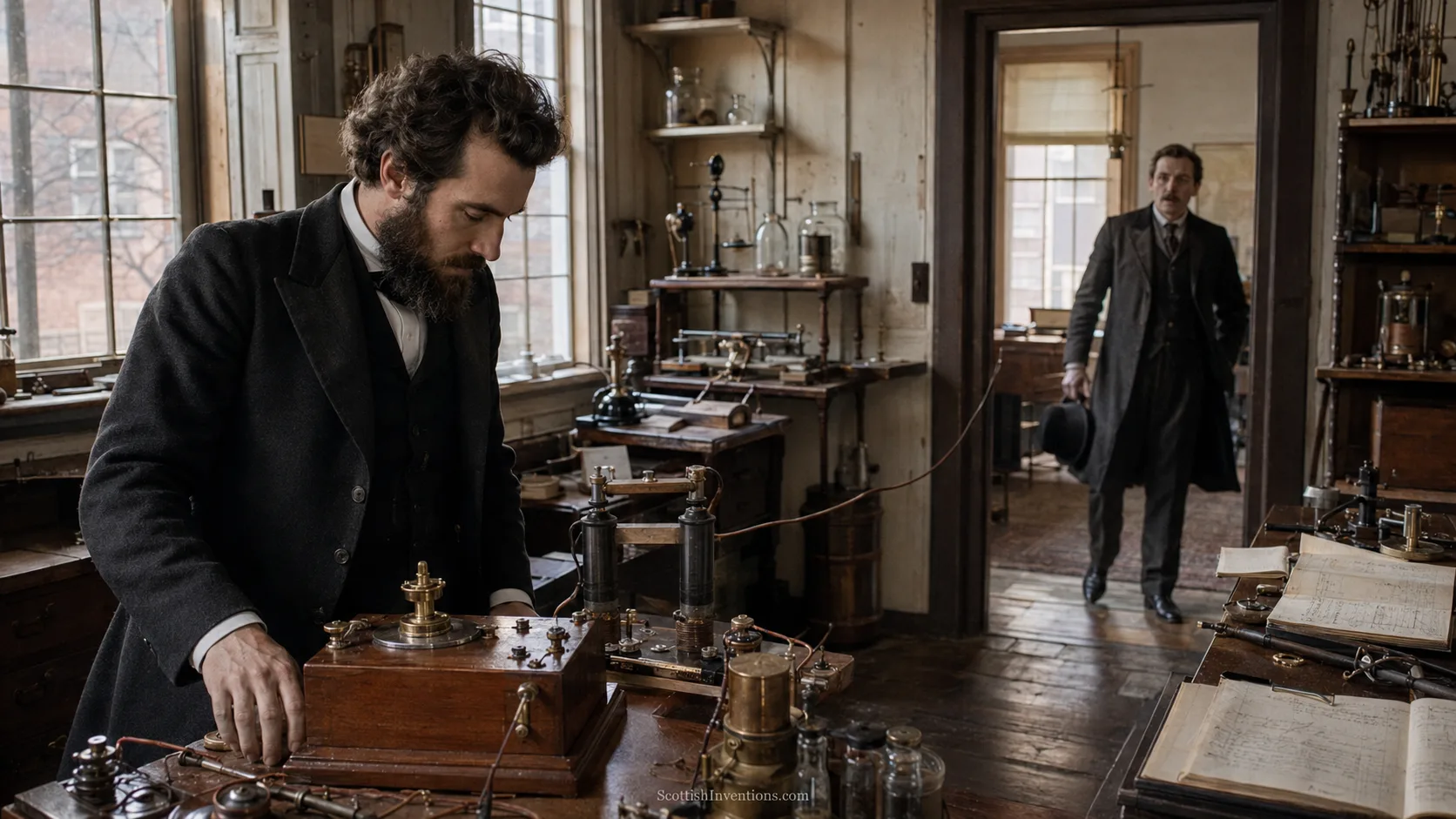
Alexander Graham Bell (1847–1922), born in Edinburgh, built the first practical telephone — not by accident, and not alone. On 10 March 1876, in a small Boston laboratory at 5 Exeter Place, he spoke into a jar of acidulated water and sent the first intelligible words ever carried by electric wire: “Mr. Watson — come here — I want to see you.”
TL;DR
- Bell was born in Edinburgh and educated in Scotland; his father Alexander Melville Bell’s Visible Speech system was the intellectual seedbed of everything that followed.
- The invention itself was conceived largely at Brantford, Ontario in 1874 and built in Boston. Bell was Scottish-born — the telephone is not, strictly speaking, a Scottish invention in the way the tarmac road is.
- US Patent No. 174,465 was granted on 7 March 1876; the first intelligible call followed on 10 March 1876.
- The first clearly intelligible speech over miles of real telegraph line was heard around Brantford in August 1876; the first two-way conversation followed in Boston on 6 October 1876.
- The Supreme Court’s Telephone Cases (1888) upheld Bell 4–3. The Bell companies fought some 600 patent cases (often given as 587) and won every one that reached a final hearing.
- The acid-spill story is a myth; House Resolution 269 did not declare Meucci the inventor.
Key Facts
1. An Edinburgh Boyhood & Visible Speech
Alexander Bell — the “Graham” was his own choice, borrowed from Alexander Graham, a Canadian pupil of his father’s who boarded with the family, and toasted at the table on his eleventh birthday in 1858 — was born on 3 March 1847 at 16 South Charlotte Street, Edinburgh. The commemorative stone above the door still reads: “Alexander Graham Bell / Inventor of the Telephone / Was born here 3rd March 1847.” The modern door number is 14, but Historic Environment Scotland — which lists the Category A building — consistently gives 16 as the birthplace.
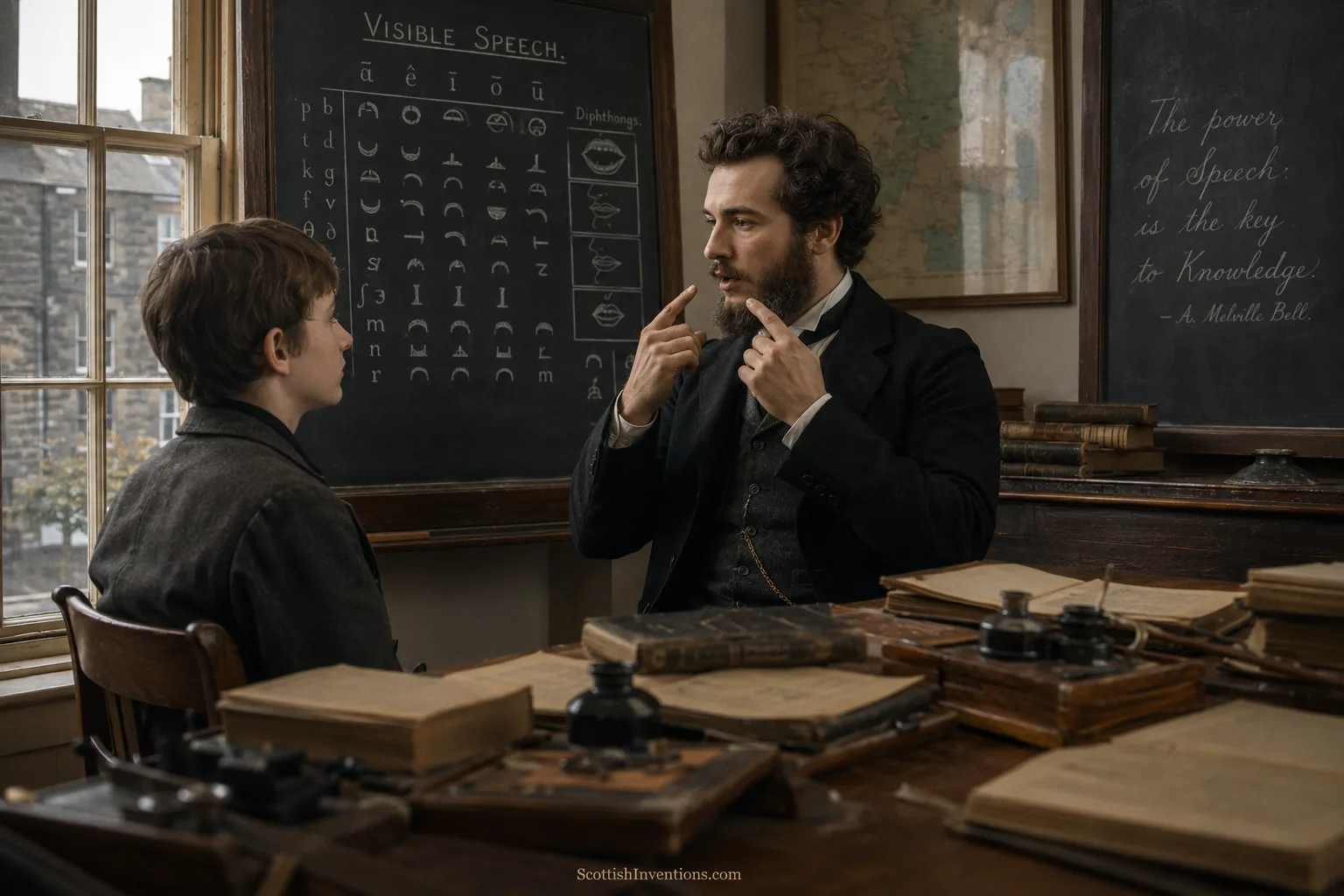
Bell was born into a dynasty of elocutionists. His grandfather Alexander Bell taught elocution in London; his uncle in Dublin; and his father Alexander Melville Bell at the University of Edinburgh. In 1867, Melville Bell published Visible Speech: The Science of Universal Alphabetics — a phonetic notation system that rendered the positions of the tongue, lips and throat as symbols, so that a deaf child could see how to shape a sound they had never heard.
Bell’s mother, Eliza Grace Symonds, began losing her hearing in childhood. Young Alexander developed a way of speaking to her in low resonant tones close to her forehead. His future wife, Mabel Hubbard, had lost her hearing to scarlet fever. Deafness was never abstract to him; it was familial. Everything he later did with electricity and sound grew out of that fact.
He was taught at home by his mother, spent a year at Hamilton Place Academy, and entered the Royal High School on Calton Hill in October 1858. In the autumn of 1862, aged fifteen, he left Edinburgh to live for a year with his grandfather in London. In August 1863, aged sixteen, he became a pupil-teacher of elocution and music at Weston House Academy in Elgin, Moray, paid in board, ten pounds and lessons in Latin and Greek. He enrolled at the University of Edinburgh in the autumn of 1864 (his notes survive from Professor Blackie’s Greek and Professor Sellar’s Latin classes), went back to Elgin as an assistant master in 1865, taught at Somersetshire College in Bath, and in June 1868 matriculated at the University of London, attending classes at University College. The historian Robert V. Bruce, in Bell: Alexander Graham Bell and the Conquest of Solitude (1973), traces each step from the family papers. Emigration ended any hope of a degree.
2. Grief, Emigration & Boston
By 1870 Bell’s two brothers, Edward (d. 1867) and Melville (d. 1870), had both died of tuberculosis. His own health was faltering. His father, terrified of losing the last son, moved the family to Canada. They sailed on 21 July 1870, landed at Quebec on 1 August, and on 6 August paid $2,600 for a house with ten and a half acres at Tutelo Heights, near Brantford, Ontario. In April 1871 Bell went south to Boston to introduce Visible Speech at the Boston School for Deaf Mutes. In 1873 he was appointed Professor of Vocal Physiology and Elocution in Boston University’s new School of Oratory.
It was in Boston that he met the people who would make the telephone possible. Thomas Sanders, a Haverhill leather merchant whose deaf son Georgie Bell taught, and Gardiner Greene Hubbard, a Boston lawyer and long-time campaigner against the Western Union monopoly whose deaf daughter Mabel was also Bell’s pupil, agreed on 27 February 1875 to share his telegraphic inventions in thirds, Bell supplying the ideas and they the cash. Thomas Augustus Watson, a young machinist at Charles Williams’s electrical shop at 109 Court Street, began working on Bell’s apparatus in January 1875. Hubbard became his father-in-law.
3. Harmonic Telegraph & the Idea of a Speaking Wire
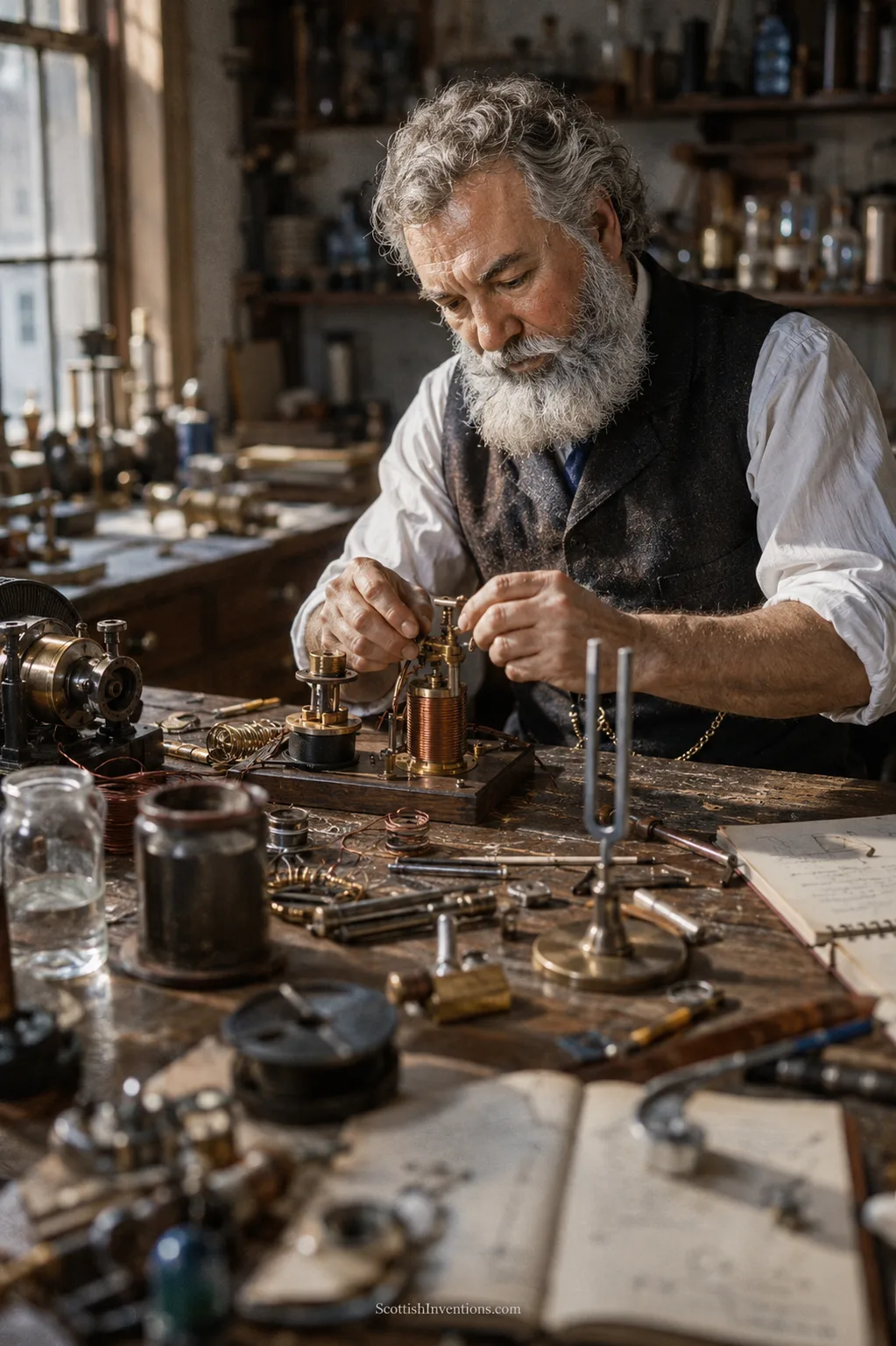
Bell’s first project was not the telephone but the harmonic telegraph — a scheme to send several Morse messages down one wire at once by tuning each to a different pitch. It was a well-funded, respectable idea. But Bell kept getting distracted by a stranger question: if a wire could carry a musical tone, could it not carry the shifting overtones of a human voice?
The breakthrough insight came at his father’s house in Brantford in the summer of 1874. Rather than trying to switch a current on and off in the rhythm of speech, Bell realised he needed a continuous current whose intensity varied in perfect analogy to the pressure waves of the voice — an undulatory current. This is the phrase that would later carry the day in the Supreme Court.
Bruce dates the insight to about 26 July 1874, when his father’s diary noted “Electric speech (?)”. It was first written down in a letter to his parents of 23 November 1874. The steps that followed were all in the United States:
- 1 March 1875, Washington. Bell described his idea to Joseph Henry of the Smithsonian, who called it “the germ of a great invention”. When Bell said he lacked the electrical knowledge, Henry replied: “Get it!”
- 4 May 1875. In a letter to Hubbard, Bell proposed varying the resistance of a circuit to make the current undulate. Bruce treats this letter as proof that Bell, not Gray, first conceived variable resistance.
- 2 June 1875, 109 Court Street, Boston. In the attic of Williams’s shop, Watson plucked a stuck reed on a harmonic telegraph receiver and Bell, in the next room, heard its full tone come through the wire. The feeble current induced by the reed alone was enough. The site now carries a plaque: “Here the Telephone Was Born.”
- 1 July 1875. With a membrane transmitter, Watson heard Bell singing and his voice, but could not make out words. Hubbard then pushed Bell back to the multiple telegraph, and the telephone waited until after the patent.
4. 14 February 1876 — The Patent Race
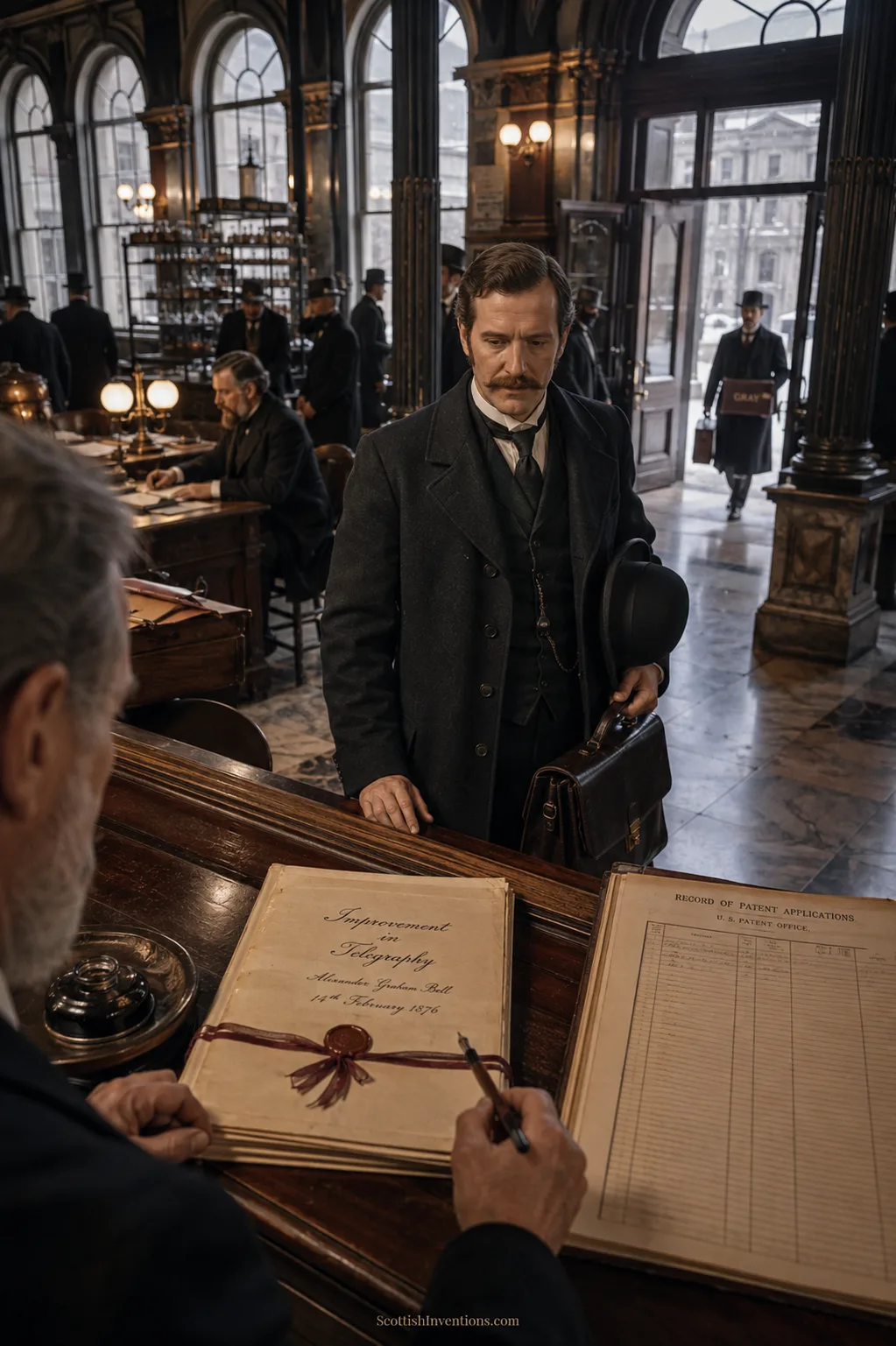
Bell had sworn to his specification on 20 January 1876, but held it back. He had promised George Brown, the Edinburgh-born owner of the Toronto Globe and a Brantford neighbour, who took a half share in his foreign rights, not to file in America until Brown had applied in Britain. No word came from Brown. On 14 February 1876, without consulting Bell, Gardiner Hubbard had Bell’s attorneys, Anthony Pollok and Marcellus Bailey, file the full patent application at the US Patent Office in Washington that morning. Later the same day Elisha Gray’s lawyer William D. Baldwin entered a caveat — a notice of an invention not yet perfected — for a speaking telephone using a liquid variable resistance. Bell himself was in Boston.
The examiner, Zenas Fisk Wilber, suspended Bell’s application on 19 February because of the caveat. Bailey asked the office to check which document had arrived first. According to Bruce, the records showed Bell’s application ahead of Gray’s caveat, whose fee had been paid separately to beat the two o’clock deadline. Acting Commissioner Ellis Spear overruled Wilber, and the interference was dissolved on 25 February. On 3 March Gray’s lawyer advised him not to contest, writing that Gray had made the invention in Washington “after Bell’s application was sworn to”. Critics read the same records differently (see section 9).
The examiners approved the patent on 3 March 1876, Bell’s twenty-ninth birthday. Four days later, on 7 March 1876, US Patent No. 174,465, “Improvement in Telegraphy”, was issued — often called the most valuable patent ever issued. George Brown, as it turned out, never even mentioned the telephone in England.
5. 10 March 1876 — The First Call
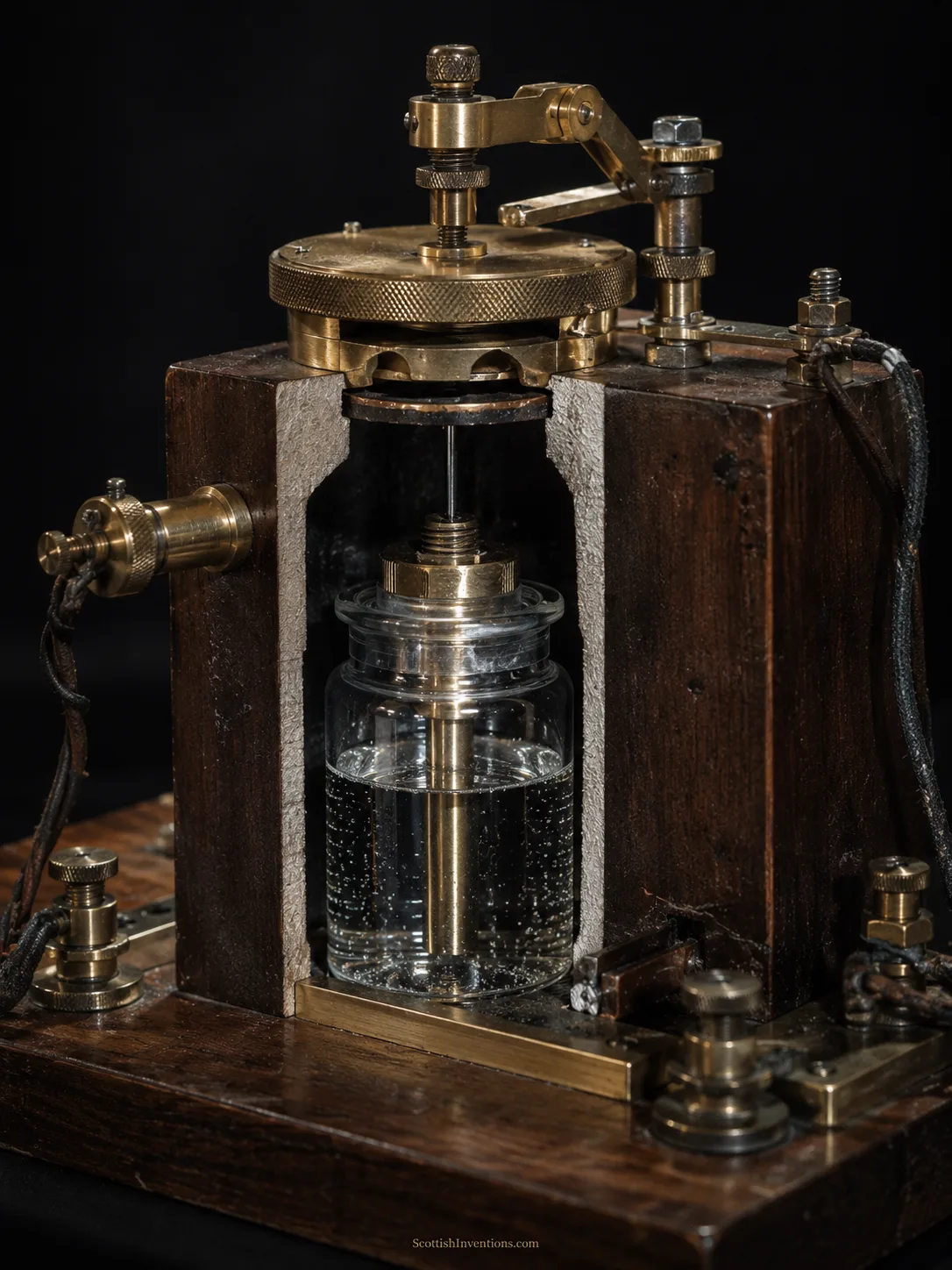
Bell had moved into two rooms at 5 Exeter Place, Boston, in January 1876, partly to escape suspected spies at the Williams shop. Three days after the patent issued, he tried a new instrument there — a liquid transmitter in which a platinum needle on a diaphragm dipped into water with a little sulphuric acid. He had tested the idea with a tuning fork in water on 8 March. On the afternoon of 10 March Watson waited by the bureau in Bell’s bedroom with the receiver to his ear, at the far end of a hall with two doors closed. Bell’s laboratory notebook, held at the Library of Congress and written up two days later, records what happened in his own hand:
“I then shouted into M the following sentence: ‘Mr. Watson — come here — I want to see you.’ To my delight he came and declared that he had heard and understood what I said.”
— Alexander Graham Bell, laboratory notebook, 10 March 1876
Note the wording. Bell’s notebook and his letter to his father that evening both say “I want to see you.” Watson’s own memo book has “Mr. Watson I want you”, with “come here” added above the line, and Bell himself used “I want you” when he repeated the call to open the New York–San Francisco line in 1915. The same letter to his father predicted that wires would one day be “laid on to houses just like water or gas”.
The liquid transmitter was messy: gas bubbles fizzed, water splashed the membrane, and a black deposit built up on the wire. By the end of April 1876 Bell had gone back to the simpler electromagnetic (“magneto”) instrument, which first carried an intelligible word, “Papa”, on 27 March with his father listening. The variable-resistance principle would return in Edison’s carbon transmitter of 1877–78, and the industry came to rest on it.
6. Killing the Acid-Spill Myth
The story every schoolchild has heard is that Bell knocked over a jar of sulphuric acid onto his trousers and cried out for help — and that was the first call. It is a lovely story. It is also probably false.
Bell’s notebook for 10 March 1876 makes no mention of any acid spill. Neither does the letter he wrote to his father the same day. Neither does Watson’s own memo of the words, nor Watson’s sworn testimony in August 1882 — which was also the first time the famous sentence went on public record. The acid detail appears for the first time fifty years later, in Thomas Watson’s autobiography Exploring Life (D. Appleton, 1926, p. 211) — published four years after Bell’s death. Robert V. Bruce judged that Watson had probably confused the day with another, more dramatic one, though he allowed that Bell might simply have left out an undignified accident.
7. The 1876 Centennial Exhibition
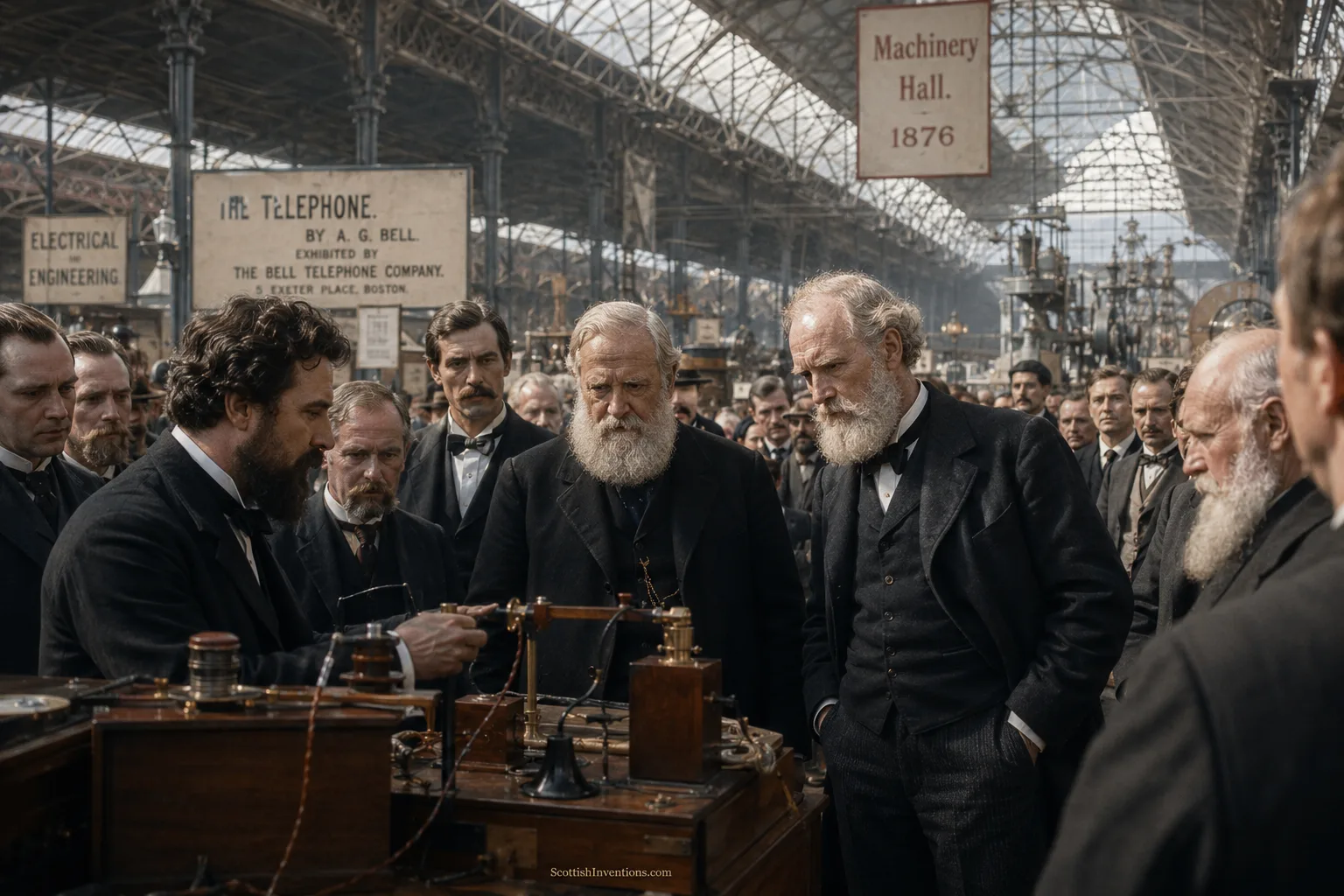
Bell nearly did not go. He had exam papers to mark, and Mabel had to take him to the station. His exhibit sat in the Massachusetts education section, beside the Visible Speech charts, because he had missed the deadline for the electrical section. On Sunday 25 June 1876, with the grounds closed to the public, about fifty judges and guests came up to the east gallery of the Main Building after a long demonstration by Elisha Gray. With them was Brazil’s Emperor Dom Pedro II, who had watched Bell teach at the Boston School for the Deaf on 14 June.
Bell went to a transmitter about a hundred yards away and sang, then spoke. Sir William Thomson (later Lord Kelvin), the Belfast-born professor of natural philosophy at Glasgow, heard “Do you understand what I say?” and ran down the gallery to find him. By Bell’s account to his parents, Dom Pedro started from his chair crying “I hear, I hear!” and then caught “to be or not to be”. The famous “My God, it talks!” is a later retelling, not found in Bell’s letter. Gray listened too and caught the words “Aye, there’s the rub” — by his own later admission, the first telephonic speech he had ever heard. That evening Gray and Bell had a friendly talk in Bell’s hotel room, and Gray laid no claim to the telephone.
Thomson took a transmitter and receiver back to Britain. In his address to the British Association in Glasgow that September, printed in Nature on 14 September, he called Bell’s instrument “the greatest by far of all the marvels of the electric telegraph.” Bell received a Centennial award, not a gold medal, with a judges’ report over Thomson’s signature calling the telephone “of transcendent scientific interest”.
8. Brantford, Paris & the First Conversations
The telephone first proved itself over real distances in Ontario. On 3 August 1876 Bell sat in the general store at Mount Pleasant, which doubled as the Dominion Telegraph office, and heard his uncle David Bell reciting at Brantford, about five miles away. The next evening he wired the family house at Tutelo Heights to the telegraph line with stovepipe wire run along the fences, for a supper party. On 10 August he listened at Paris, Ontario, eight miles from Brantford, through crackling noise until a change of coils brought the voices through. He recognised his father, who had not been expected. These tests ran one way only.
Back in Boston, Watson gave up his job at the Williams shop to work on the telephone full time for a tenth share in Bell’s patents. On 6 October 1876 the two held the first two-way telephone conversation, between rooms at Exeter Place. On 9 October they talked over a two-mile private line between Boston and East Cambridge, and the Boston Advertiser printed their notes side by side. A permanent magnet replaced the battery that winter, and on 3 December Watson spoke from North Conway, New Hampshire, 143 miles away, though the line was barely usable.
In 1917, at the unveiling of the Bell Memorial in Brantford, Bell gave the fairest summary: the telephone “was conceived in Brantford in 1874 and born in Boston in 1875.”
9. The Elisha Gray Controversy
Bell’s greatest rival was Elisha Gray, co-founder of what became Western Electric. Gray’s 14 February caveat had described a liquid variable-resistance transmitter — a needle in acidulated water — almost exactly the mechanism Bell used on 10 March. That fact alone would raise eyebrows. Two further facts have kept the controversy alive for 150 years.
First, a passage of seven sentences describing variable resistance was demonstrably added to a late draft of Bell’s patent application. Bell testified he added them “almost at the last moment” before the application was engrossed and notarised on 20 January 1876 — before Gray’s caveat existed. Second, the patent examiner, Zenas Fisk Wilber, later swore an affidavit (1886) that he had improperly shown Gray’s caveat to Bell in exchange for $100. Bell immediately swore a counter-affidavit denying bribery, and Wilber — an admitted alcoholic financially indebted to Bell’s attorney — gave several conflicting affidavits over the years.
The case for Bell. Robert V. Bruce’s Pulitzer-winning biography (1973), built on the Bell family papers, sets out the defence in detail. Bell’s letter of 4 May 1875 already proposed varying resistance. Bruce dates the liquid clause to the night of 12 January 1876, when Bell worked late in Hubbard’s library on the “hole” in his specification, prompted by a cup-of-acidulated-water spark arrester he was designing. Gray, by his own account, only thought of a liquid transmitter in late 1875, after seeing a toy string telephone; his chief assistant first saw a sketch in the second week of February 1876; and the caveat was dictated in Baldwin’s office on 14 February itself. Gray’s first liquid model, built in Philadelphia that summer, did not work. Bruce concludes that Bell “had clear priority at every point except the liquid-transmitter embodiment”, and that even there Bell had notarised his idea first. He describes Wilber’s 1885–86 affidavits as contradicted by others Wilber swore in between, and thinks Wilber was probably drunk or bribed by agents of a rival company when he made them. Bruce does record one real lapse: on 26 February, after the interference was dissolved, Wilber told Bell which clause Gray’s caveat had touched. Bruce calls it a casual indiscretion, technically improper.
The case against. Bruce’s own research supplies some of the critics’ evidence. The copy of the specification given to George Brown in January 1876 had no variable-resistance clause at all. Seth Shulman (The Telephone Gambit, 2008) notes that in the surviving application the liquid passage sits in the margin, and that Bell’s notebook sketch of 8 March 1876 closely resembles Gray’s caveat drawing; he argues the clause was added after Bell learned of Gray’s idea. A. Edward Evenson (2000) reaches a similar view. Bell himself, after talking with Gray at Philadelphia, wrote that Gray was “an honorable man & an independent inventor”. Gray grew bitter only from 1885, when Wilber’s affidavits appeared.
10. The Meucci Myth & Resolution 269
Antonio Meucci (1808–1889), an Italian immigrant on Staten Island, built voice-communication devices he called teletrofoni and filed a patent caveat in December 1871. Unable to afford the $10 renewal fee, he let it lapse in 1874. His 1871 caveat did not describe electromagnetic transmission of voice — a critical technical shortfall.
Meucci’s claim first reached the courts in the 1880s, when a promoter, Dr Seth R. Beckwith, used it to launch the Globe Telephone Company and then a Meucci Telephone Company, both stopped by Bell injunctions. Bruce (1973), following the Bell lawyers, treats the claim as baseless and the caveat as describing an acoustic telephone. Meucci’s modern defenders, notably the historian Basilio Catania, argue from his notebooks that he experimented with electrical speech transmission in the 1850s. That part remains disputed. What is not disputed is that Meucci neither patented nor publicly demonstrated a working electric speaking telephone before Bell.
In 2002 the US House of Representatives passed Resolution 269 by voice vote. It is widely misreported. The operative clause reads verbatim:
“Resolved, That it is the sense of the House of Representatives that the life and achievements of Antonio Meucci should be recognized, and his work in the invention of the telephone should be acknowledged.”
— H.Res. 269, 107th Congress, 11 June 2002
That is narrower than “Meucci invented the telephone.” The resolution is non-binding, has no legal effect on Bell’s patent, and does not name Meucci “the true inventor.” Days later the Canadian Parliament passed a counter-motion affirming Bell.
11. Reis, Bourseul & What “Invention” Means
Historians converge on one criterion for “inventing the telephone”: a device that transmits articulate speech intelligibly using a continuous undulatory current, not a make-and-break signal that can carry only pitch.
- Charles Bourseul (1854) described the principle in a French magazine article but proposed a make-and-break mechanism and never built a working speech transmitter.
- Johann Philipp Reis (Germany, 1858–63) coined the word Telephon and built apparatus that could transmit musical tones and occasional words, but his make-and-break design could not reliably carry articulate speech. He died in 1874.
- Elisha Gray conceived variable resistance but filed only a caveat and abandoned it. The Patent Office later ruled that his “failure to take any action amounting to completion until others had demonstrated the utility of the invention deprives him of the right to have it considered.”
Each was a genuine precursor. None built a working practical speaking telephone before Bell.
12. The Telephone Cases (1888)
The first and decisive fight was with Western Union. On 12 September 1878 the Bell Telephone Company sued Peter A. Dowd, an agent renting out Edison transmitters and receivers claimed for Gray; Western Union took over the defence. Bell’s deposition of 1879, nearly a hundred printed pages, carried the case. Western Union’s own counsel, George Gifford, advised that the Bell patents could not be beaten, and on 10 November 1879 Western Union agreed to leave the telephone business and assign its telephone patents, including Edison’s transmitter, to the Bell company in return for 20 per cent of telephone rental receipts for 17 years. A consent decree in 1881 upheld Bell’s patents.
Other challengers followed. Daniel Drawbaugh, a Pennsylvania mechanic, claimed in 1880 to have built telephones between 1866 and 1876; Bell was cross-examined for four weeks in 1883 and Drawbaugh’s claims failed after eight years. The Pan-Electric Company, whose stockholders included US Attorney General Augustus Garland, persuaded the government in 1887 to sue to annul Bell’s patents for fraud; Bell testified for nine weeks in 1892, and the suit simply lapsed in the late 1890s.
Several suits were consolidated into The Telephone Cases, 126 US 1 (1888), whose opinions run to some 600 pages of volume 126 of United States Reports. On 19 March 1888 Chief Justice Waite, writing for a 4–3 majority, upheld the validity and priority of Bell’s patents. The Court held Bell was the “first discoverer of the art or process of transferring to, or impressing upon, a continuous current of electricity in a closed circuit, by gradually changing its intensity, the vibrations of air produced by the human voice in articulate speech” — and that this discovery was patentable.
Bruce counts some 600 cases over eighteen years (a figure often given as 587), with printed records filling 149 volumes. Most defendants gave up early; of those that went to a final hearing, the Bell company won every one.
13. A Global Network in a Generation
The business began on a shoestring. Some time in the winter of 1876–77 Hubbard seems to have offered Western Union all the telephone rights for $100,000 and been turned down; Bruce notes that the offer is known from later testimony, not from Bell’s letters. Instead the patent associates kept control. On 9 July 1877 the Bell Telephone Company was formed as an unincorporated association, with Bell’s patents held by Hubbard as trustee. Two days later Bell married Mabel Hubbard in her parents’ house in Cambridge and gave her all but ten of his 1,507 shares. The company leased telephones rather than selling them. It merged with the New England Telephone Company into the National Bell Telephone Company in early 1879, and became the American Bell Telephone Company in 1880. Bell left the board at his own request in 1879 and took out his last telephone patents in 1881.
The commercial numbers are dizzying. Contemporary figures sometimes conflict because they measure different things — Bell-system only versus total US — but the reconciled picture is this:
- End of 1877: ~3,000 telephones in service. The first commercial exchange opened in New Haven, Connecticut, on 28 January 1878.
- 1880 (US Census): ~48,000–50,000 telephones across 148 companies.
- Early 1881 (American Bell’s first annual report): 133,692 Bell-licensed telephones.
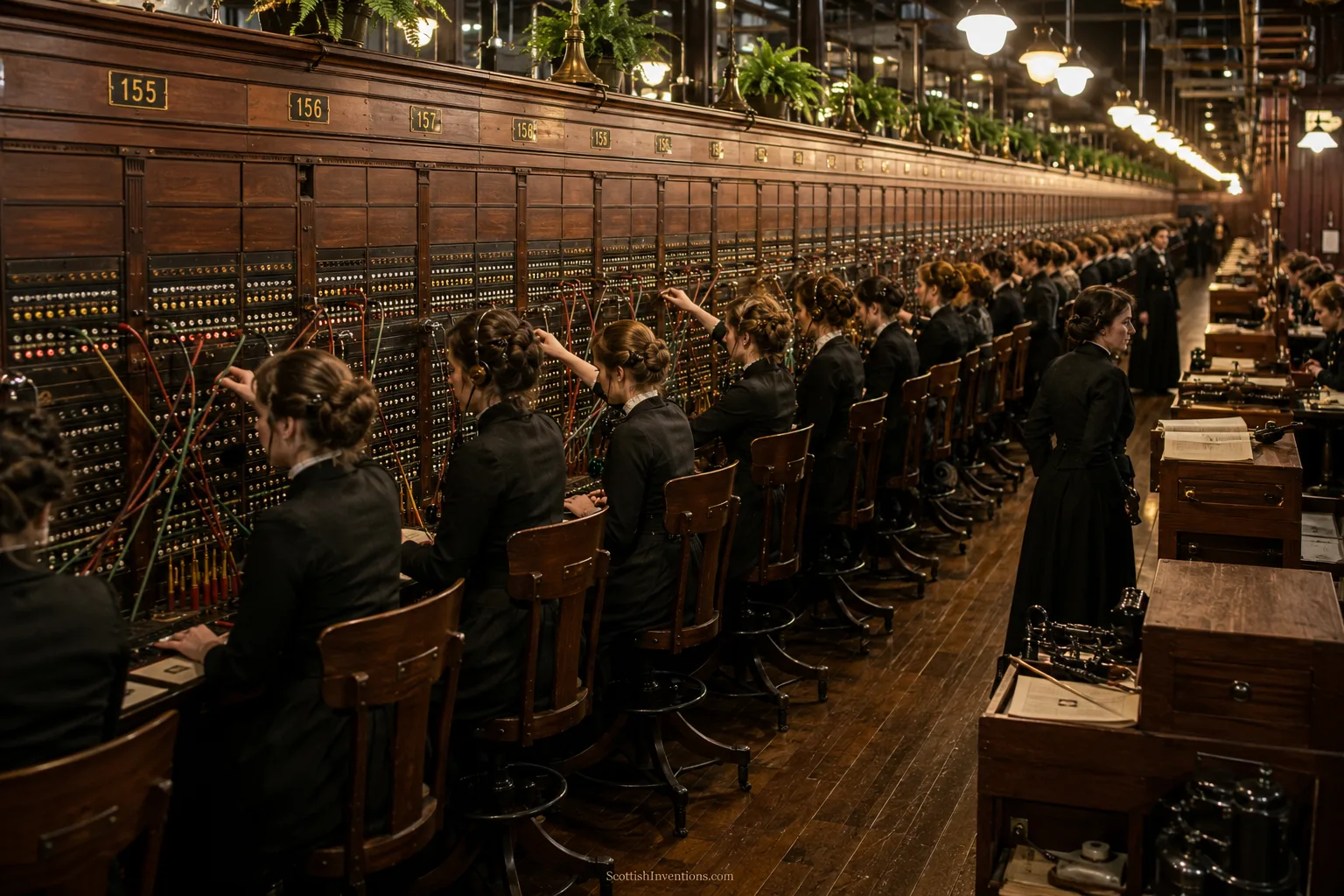
- 1900: ~600,000 in the Bell system, ~1.35 million total in the US.
The switchboard operator — almost always a woman — became the human interface of a new global network.
14. Home Again: Britain, 1877–78
The newly married Bells sailed for Britain in August 1877 and stayed more than a year. Bell gave a telephone demonstration to leading citizens of Glasgow, spoke at the British Association meeting in Plymouth that August, and over the next four months gave at least ten public lectures in England and Scotland, two of them to crowds of about two thousand. He showed the telephone working from a Newcastle coal mine and between divers in the Thames. He visited Thomson’s laboratory at the University of Glasgow, toured Edinburgh and Elgin with Mabel, and in November 1877 lectured on Visible Speech to the Philosophical Society of Glasgow with Thomson in the chair. Their first daughter, Elsie May, was born in London in May 1878.
On the evening of 14 January 1878 he demonstrated the telephone to Queen Victoria in the Council Room at Osborne House, with lines from Osborne Cottage, Cowes and London. The Cowes line failed, but speech and a song came through. Her journal called the invention “most extraordinary”. Bell, used to his wife’s deafness, touched the Queen’s hand to offer her the receiver, a breach of etiquette she did not seem to mind.
The business side went less well. Thomson’s published description of 1876 put the British patent at risk; the courts saved it because the printed drawing showed the metal diaphragm wrongly fixed. In 1878 Bell’s Providence partner William H. Reynolds sold 55 per cent of the English patent to investors who formed the Telephone Company, Limited. Bell took out a British patent for twisted-pair wiring in November 1877, but resigned as a director in October 1878 over what he called “gross mismanagement”. Hubbard reorganised the company in 1879. The German patent was lost because Bell could not afford to apply in time, which let Siemens & Halske make telephones there freely.
15. Photophone, Hydrofoils & Later Work
Bell privately resented the telephone as a distraction from “real” science. His later career was strikingly varied:
- Photophone (1880). With Charles Sumner Tainter, Bell transmitted speech on a beam of light — wirelessly — about 213 metres from the roof of the Franklin School to his laboratory window in Washington in 1880 (Bruce dates this to 1 April; other accounts give June). It anticipated fibre-optic communication by a century. Guinness recognises it as the first optical telephone. Bell called it “the greatest invention I have ever made, greater than the telephone.”
- Induction-balance metal detector (1881). Built to locate the bullet in President James A. Garfield after his shooting. The device worked but the bullet was too deep and on the opposite side from where the physicians insisted Bell search. Later used routinely in surgery and wartime.
- Hydrofoils. With Casey Baldwin, Bell’s HD-4 set a marine speed record of ~70.86 mph (114 km/h) in 1919 on Bras d’Or Lake, Nova Scotia.
- Aviation. The Aerial Experiment Association (1907), which he founded, built the Silver Dart — an early powered flight in Canada in 1909.
- National Geographic. Bell did not found the National Geographic Society (its first president was his father-in-law Gardiner Greene Hubbard). Bell was the second president (1898–1903), and transformed the magazine into the photograph-rich publication it remains today by installing Gilbert H. Grosvenor as editor.
16. Legacy
Bell died on 2 August 1922 at his estate Beinn Bhreagh in Nova Scotia, and was buried on the mountain there on 4 August. At the time of the burial, 6.25 p.m., telephone service throughout the United States stopped for one minute, and Bell System flags flew at half-mast; many accounts add Canada. He had become a US citizen on 10 November 1882, and his grave tablet reads, at his own request, “Died a Citizen of the United States.” Yet he never stopped thinking of Elgin and Edinburgh; on landing in Britain in 1877 he went straight to Glasgow, where, Mabel reported, he went “perfectly wild” at being back in Scotland.
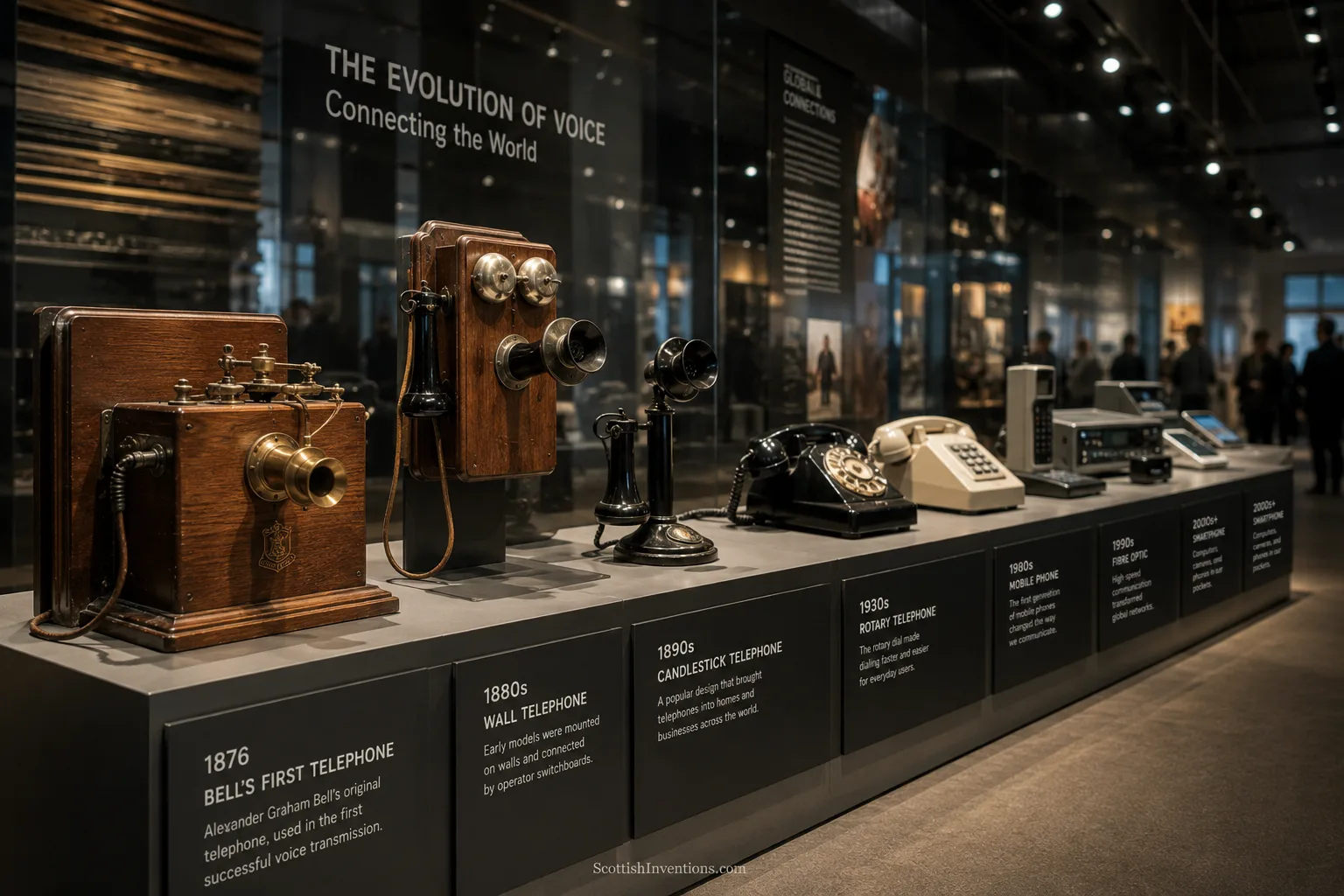
The telephone he built at 5 Exeter Place is not the smartphone in your pocket — but the smartphone in your pocket is unthinkable without the fifth claim of Patent 174,465. The method of impressing the vibrations of speech onto a continuous carrier is the ancestor of every voice call, mobile network, video chat and streaming service on the planet.
He is the Scottish-born inventor of the first practical telephone. That is enough.
Frequently Asked Questions
- Who invented the telephone?
- Alexander Graham Bell built and patented the first practical speaking telephone. On 7 March 1876 the US Patent Office granted him Patent No. 174,465, and three days later, on 10 March 1876, he made the first intelligible telephone call from his Boston laboratory: 'Mr. Watson — come here — I want to see you.' The US Supreme Court upheld Bell's priority in the Telephone Cases (1888) by a 4–3 majority.
- Where was Alexander Graham Bell born?
- Alexander Graham Bell was born on 3 March 1847 at 16 South Charlotte Street, Edinburgh, Scotland. The commemorative stone above the door still reads 'Alexander Graham Bell / Inventor of the Telephone / Was born here 3rd March 1847'. The modern door number is 14, but heritage bodies including Historic Environment Scotland list the birthplace as 16 South Charlotte Street.
- Is the telephone a Scottish invention?
- Bell was Scottish-born and Scottish-educated, and his lifelong obsession with speech and hearing came directly from his Edinburgh family — particularly his father Alexander Melville Bell's 'Visible Speech' system. But the telephone itself was conceived largely at Brantford, Ontario in 1874 and built and demonstrated in Boston, Massachusetts. Bell put it this way himself in 1917: the telephone 'was conceived in Brantford in 1874 and born in Boston in 1875.' He became a US citizen in 1882. The honest framing is 'Scottish-born inventor of the telephone', not 'the telephone is a Scottish invention'.
- What were the first words spoken on the telephone?
- Bell's laboratory notebook, held at the Library of Congress, records the words as: 'Mr. Watson — come here — I want to see you.' The date was 10 March 1876, at his rooms at 5 Exeter Place, Boston; he wrote the notebook entry up two days later, and the same words appear in a letter to his father written that day. Watson's own memo book has 'Mr. Watson I want you', with 'come here' squeezed in. Popular retellings often say 'I want you' or 'I need you'; Bell's two accounts say 'see you'.
- Did Bell really spill acid on himself before the first phone call?
- Probably not. Bell's notebook, the letter he wrote his father that day, Watson's own memo of the words and Watson's sworn court testimony of 1882 never mention acid. The acid-spill story first appears in Thomas Watson's memoir Exploring Life (1926), half a century after the event and four years after Bell's death. The historian Robert V. Bruce (1973) thought Watson had probably merged two occasions, while allowing that Bell might have left out an undignified detail.
- Did Bell steal the idea from Elisha Gray?
- This is genuinely contested. Bell and Gray both filed telephone-related documents at the US Patent Office on 14 February 1876: Bell's backer Gardiner Hubbard had Bell's full application filed that morning, and Gray's lawyer entered a caveat later the same day. When the office records showed Bell's application had arrived first, the Acting Commissioner overruled the examiner and the interference was dissolved on 25 February; Gray, on his lawyer's advice, did not file a full application. Robert V. Bruce's standard biography (1973) and Benjamin Lathrop Brown's study in Proceedings of the IEEE (2020) conclude that Bell did not take Gray's idea. A. Edward Evenson (2000) and Seth Shulman (2008) argue that he did. Bell won every court challenge that reached a final judgment, including the Telephone Cases (1888), 4–3 in the Supreme Court.
- Did the US Congress declare Antonio Meucci the true inventor of the telephone?
- No. House Resolution 269 (2002) is a non-binding 'sense of the House' resolution. Its operative clause resolved only that Meucci's 'life and achievements … should be recognized, and his work in the invention of the telephone should be acknowledged'. It did not declare him the inventor and had no effect on Bell's patents. Days later the Canadian Parliament passed a counter-motion affirming Bell. Meucci's 1871 caveat lapsed in 1874. What it described is disputed: Bell's biographer Robert V. Bruce read it as an acoustic, string-type telephone, while Meucci's modern advocates argue his notebooks show electrical voice transmission years earlier.
- What is Bell's Patent No. 174,465?
- US Patent 174,465, 'Improvement in Telegraphy', filed 14 February 1876 and granted 7 March 1876, is often called the most valuable patent ever issued. Its famous fifth claim covered 'the method of, and apparatus for, transmitting vocal or other sounds telegraphically … by causing electrical undulations, similar in form to the vibrations of the air accompanying the said vocal or other sounds'. That method — a continuous undulatory current, not a make-and-break signal — is what separated Bell from earlier inventors like Reis and Bourseul.
- What did Bell demonstrate at the 1876 Centennial Exhibition?
- On Sunday 25 June 1876, in the east gallery of the Main Building at the Centennial Exhibition in Philadelphia, Bell demonstrated the telephone to the judges. Sir William Thomson (later Lord Kelvin), the Belfast-born Glasgow physicist, heard 'Do you understand what I say?' Brazil's Emperor Dom Pedro II, who had met Bell at a Boston school for the deaf eleven days earlier, cried 'I hear, I hear!' according to Bell's letter home; the better-known 'My God, it talks!' is a later retelling. That September, in his address to the British Association in Glasgow, Thomson called the telephone 'the greatest by far of all the marvels of the electric telegraph'. Bell received a Centennial award, with a judges' report signed by Thomson, not a gold medal.
- Where was the telephone tested in Canada?
- Around Brantford, Ontario, in August 1876. On 3 August Bell heard his uncle David Bell's voice at Mount Pleasant, about five miles from the Brantford telegraph office. On 10 August, using the Dominion Telegraph Company's line, he listened at Paris, Ontario, eight miles away, while relatives spoke and sang at Brantford. Both tests ran one way only. The first two-way telephone conversation followed on 6 October 1876 between two rooms at Exeter Place, Boston, and on 9 October Bell and Watson talked over a two-mile private telegraph line between Boston and East Cambridge.
- When was the Bell Telephone Company founded?
- On 9 July 1877, as an unincorporated 'voluntary association' under a Declaration of Trust that assigned Bell's patents to Gardiner Hubbard as trustee. Two days later, on 11 July 1877, Bell married Mabel Hubbard and gave her all but ten of his 1,507 shares. The company became the National Bell Telephone Company in 1879 and the American Bell Telephone Company in 1880. In November 1879 Western Union settled the Dowd patent suit by leaving the telephone business and handing over its telephone patents for 20 per cent of telephone rental receipts for 17 years.
- Did Bell demonstrate the telephone to Queen Victoria?
- Yes. On the evening of 14 January 1878, at the Queen's invitation, Bell set up lines to the Council Room at Osborne House on the Isle of Wight. The line to Cowes failed, but speech and a song came through from Osborne Cottage. The Queen's journal called the telephone 'most extraordinary'. Bell had spent the previous months lecturing in England and Scotland, and the Telephone Company, Limited was formed in London in 1878 to work his British patent.
- What else did Alexander Graham Bell invent?
- Bell resented the telephone as a distraction from 'real' science. He invented the photophone (1880), which sent speech on a beam of light — a century-early ancestor of fibre-optic communication he considered his greatest invention. He built an induction-balance metal detector used to search for the bullet in President Garfield in 1881, developed hydrofoils (his HD-4 set a marine speed record of ~70.86 mph in 1919), and co-founded the Aerial Experiment Association whose Silver Dart made an early powered flight in Canada in 1909. He was the second president of the National Geographic Society, not its founder.
- When did Bell die?
- Alexander Graham Bell died in the early hours of 2 August 1922, aged 75, at his estate Beinn Bhreagh in Nova Scotia, Canada, and was buried on the hill there on 4 August. At the time of the burial, 6.25 p.m., telephone service throughout the United States stopped for one minute in his honour; many accounts add Canada. His grave tablet carries the words he chose: 'Died a Citizen of the United States.'
- Was Bell's wife deaf?
- Yes. Mabel Hubbard, whom Bell married in 1877, lost her hearing to scarlet fever as a child. Bell's mother Eliza was also deaf. His work on the telephone grew directly out of his family's teaching of the deaf and his father Alexander Melville Bell's 'Visible Speech' notation system.
Sources & Further Reading
Tier 1 · Primary
- US Patent No. 174,465, “Improvement in Telegraphy,” filed 14 February 1876, granted 7 March 1876 (Alexander Graham Bell).
- Bell, A.G. — laboratory notebook entry, 10 March 1876, Library of Congress.
- The Telephone Cases, 126 U.S. 1 (1888), US Supreme Court.
- H.Res. 269, 107th Congress, 11 June 2002 (US House of Representatives, on Antonio Meucci).
- US Patent No. 161,739 (Alexander Graham Bell, April 1875) and US Patent No. 186,787 (30 January 1877).
- Wilber, Zenas Fisk — affidavit, 1886, on the handling of Elisha Gray’s patent caveat.
Tier 2 · Scholarly and institutional
- Bruce, Robert V. — Bell: Alexander Graham Bell and the Conquest of Solitude, Little, Brown, 1973 (Cornell University Press reprint, 1990). Pulitzer Prize for History, 1974.
- Brown, Benjamin Lathrop — “[study of the Bell–Gray telephone priority dispute],” Proceedings of the IEEE, Vol. 108, No. 11 (November 2020), pp. 2083–2096.
- Evenson, A. Edward — The Telephone Patent Conspiracy of 1876, McFarland, 2000.
- Shulman, Seth — The Telephone Gambit, W. W. Norton, 2008.
- Watson, Thomas A. — Exploring Life, D. Appleton, 1926.
- PBS American Experience — on the apocryphal acid-spill story.
- Historic Environment Scotland — listing record for 16 South Charlotte Street, Edinburgh.
- National Geographic Society — records of its presidency and founding.
- Guinness World Records — recognition of the photophone as the first optical telephone.
Discover More
Continue the story
Explore the wider constellation of Scottish inventors whose work sits alongside Bell’s.