Scottish Inventions · Technology · Card No. 5 of 50
Sir Robert Watson-Watt & the Invention of Radar
The Scot who taught Britain to see in the dark
SI Score57/60Ranked =2nd of 50 in InventionsBreakdown
Scottish Impact Index (SI Score)
- Global Impact
- 10/10
- Longevity
- 9/10
- Economic / Material Impact
- 10/10
- Originality / Distinctiveness
- 9/10
- Legacy (Built Upon)
- 10/10
- Recognition
- 9/10
A failed inquiry into a Nazi "death ray" led a Brechin-born physicist to a far more powerful idea: bounce radio waves off aircraft and read the echoes. Five years later his Chain Home network was watching the skies as the Luftwaffe crossed the Channel.
TL;DR
- Sir Robert Watson-Watt (1892-1973), born in Brechin, Angus, led the team that turned radio waves into a working air-defence system — radar — and his Chain Home network gave the RAF the early warning that helped win the 1940 Battle of Britain.
- The breakthrough came from a failed "death ray" inquiry: when Arnold Wilkins calculated that radio waves could never cook an enemy pilot, he and Watson-Watt realised the same waves could detect an aircraft by reflection — proven in the Daventry Experiment of 26 February 1935.
- Watson-Watt's genius was pragmatic. His "cult of the imperfect" delivered a working, if crude, system in time for war; he was knighted in 1942, was famously caught by a radar speed trap in 1956, and died in Inverness on 5 December 1973.
Key Findings
- Birth and background verified. Robert Alexander Watson-Watt was born on 13 April 1892 at 5 Union Street, Brechin, Angus, the youngest child of master carpenter Patrick Watson Watt and Mary Matthew (National Records of Scotland statutory birth register).
- The James Watt descent is unproven. Watson-Watt claimed descent from the great steam-engine improver James Watt, and only formally hyphenated his surname after his 1942 knighthood in pride of the supposed ancestry — but no genealogist has ever substantiated the link. Treat it as a cherished family tradition, not documented fact.
- The memo and the Daventry Experiment are firmly dated. The secret memorandum "The Detection and Location of Aircraft by Radio Methods" went to the Air Ministry on 12 February 1935; the practical demonstration followed on 26 February 1935 near Daventry, Northamptonshire.
- Chain Home worked in time. RAF Bawdsey became operational on 24 September 1937 — often described as the world's first fully operational radar station; by September 1939 there were 21 operational stations guarding Britain's coasts.
- Radar was decisive but not solitary. Chain Home only mattered because it fed the Dowding System — the world's first integrated air-defence network. Churchill personally credited this integrated system as decisive.
- The speed-trap irony is real. Watson-Watt was caught by a radar speed trap in Canada in 1956 and wrote a self-mocking poem, "Rough Justice."
Watson-Watt at a glance
- Inventor
- Sir Robert Watson-Watt FRS
- Born
- Brechin, Angus — 13 April 1892
- Died
- Inverness — 5 December 1973
- Educated
- Brechin High School · University College, Dundee (St Andrews)
- Central achievement
- First operational air-defence radar and the Chain Home network
- Proof of concept
- Daventry Experiment — 26 February 1935
- First operational station
- RAF Bawdsey — 24 September 1937
- Stations by Sept 1939
- 21 Chain Home stations
- Warning time
- ≈ 15–20 minutes to Fighter Command
- Honours
- FRS 1941 · Knighted 1942 · US Medal of Merit 1946
- Motto
- The 'cult of the imperfect' — get it working now
Early Life & Background
Robert Alexander Watson-Watt came into the world on 13 April 1892 in the ancient Angus burgh of Brechin, at 5 Union Street — a fact preserved in the National Records of Scotland's statutory register of births. He was the fifth son and youngest child of Patrick Watson Watt, a master carpenter and joiner, and Mary Matthew. As a boy he spent hours in his father's workshop, and he was educated first at Damacre Primary School and then, on a scholarship, at Brechin High School.
A word of caution belongs here, because this is exactly the kind of claim that gets repeated uncritically: Watson-Watt is very widely described as a direct descendant of James Watt, and he made the claim himself. But genealogists have never substantiated it. The honest verdict — a cherished family tradition rather than a documented fact.
He won a place at University College, Dundee — then part of the University of St Andrews — graduating BSc in engineering in 1912 and winning the Carnelley Prize for Chemistry. Professor William Peddie, the chair of physics, took him on as an assistant and steered the young graduate towards the study of radio — then called "wireless telegraphy" — giving him what amounted to a private postgraduate education in radio-frequency oscillators and wave propagation.
In 1915 Watson-Watt joined the Meteorological Office, where he tackled a practical problem: detecting thunderstorms by the radio "atmospherics" (sferics) that lightning gives off, to warn airmen. To pin down those fleeting signals he combined rotating and fixed antennas with a cathode-ray oscilloscope — building the very mastery of direction-finding and rapid display that radar would later require. By 1927 he was director of the newly-amalgamated Radio Research Station and after a 1933 reorganisation became Superintendent of the Radio Department of the NPL at Teddington. Along the way he coined the term "ionosphere."
His character was as distinctive as his science: brilliant, fast-talking, self-confident, sometimes abrasive — and above all a pragmatist who preferred a workable answer now to a perfect answer too late. That philosophy would define his greatest achievement.
Britain's Air Defence Crisis
To understand why radar mattered so much, you have to feel the fear of the early 1930s. The First World War had shown that bombers could reach British cities; by the 1930s aircraft had improved so dramatically that heavy bombers could fly higher than anti-aircraft guns could reach and faster than defenders could respond. With enemy airfields across the Channel only about twenty minutes' flying time away, a bomber could drop its load and be home before intercepting fighters clawed their way to altitude.
The mood of the age was captured by Stanley Baldwin, then Lord President of the Council. In a Commons debate on disarmament on 10 November 1932 he warned that "the bomber will always get through." It was a counsel of near-despair, and it haunted defence planners.
In 1934 the Air Ministry set up the Committee for the Scientific Survey of Air Defence (CSSAD) under Sir Henry Tizard to find a way out. And then came one of the most productive wrong turns in the history of science. Rumours swirled that Nazi Germany had built a radio "death ray" capable of destroying towns and killing people. In January 1935 Harry Wimperis, the Air Ministry's Director of Scientific Research, asked Watson-Watt whether Britain could build such a beam to use against aircraft.
Watson-Watt handed the problem to his assistant Arnold "Skip" Wilkins, framing it as an oblique calculation: how much radio-frequency power would be needed to raise the temperature of eight pints of water from 98°F to 105°F at a distance of 5 km and a height of 1 km? Wilkins saw through the riddle at once — a human body holds roughly eight pints of blood, and a pilot whose temperature reached 105°F would lapse into delirium. His verdict: the energy required was so colossal that a death ray was impossible. But — and this is the hinge on which the whole story turns — Watson-Watt's covering note added a fateful afterthought drawn from Wilkins's recollection that aircraft were known to disturb shortwave radio signals: "Meanwhile, attention is being turned to the still difficult, but less unpromising, problem of radio detection."
The Daventry Experiment
That afterthought became a formal proposal. On 12 February 1935 Watson-Watt sent the Air Ministry a secret memorandum, "The Detection and Location of Aircraft by Radio Methods." The idea was elegant: don't try to destroy the aircraft, just see it from far away by bouncing radio waves off it.
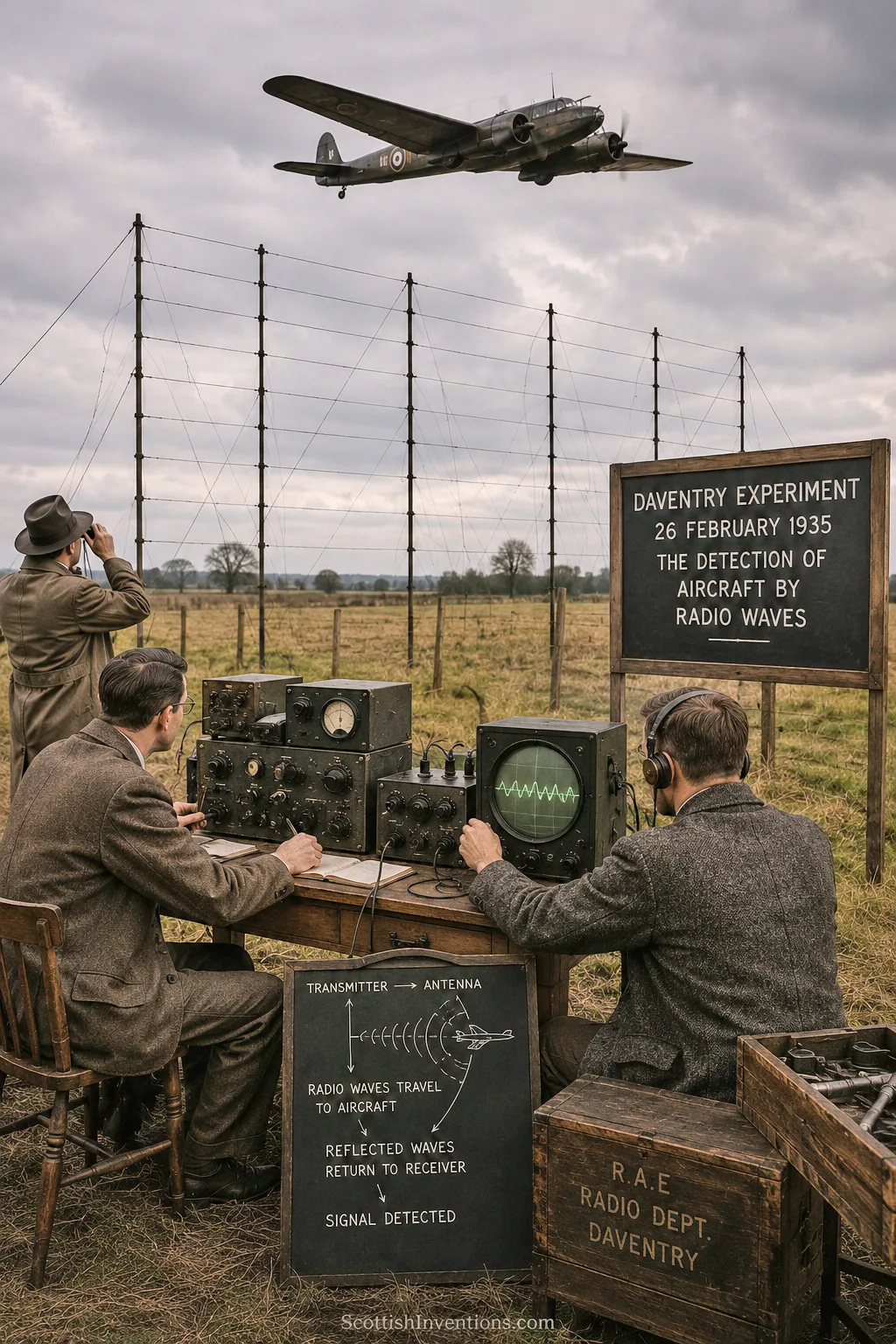
The Air Ministry, sensibly, wanted proof. It came on 26 February 1935 in a damp field near Upper Stowe, close to the village of Weedon, Northamptonshire — an event known ever after as the Daventry Experiment. Watson-Watt and Wilkins parked a van containing a receiver and a cathode-ray oscilloscope about six miles from the BBC's powerful Borough Hill shortwave transmitter at Daventry. They strung simple wire antennas on poles across the field, phased so that the direct signal from the transmitter cancelled out, leaving the receiver sensitive to any reflected signal. Then a Handley Page Heyford biplane bomber, flown by Flight Lieutenant Robert Blucke, was sent flying up and down the beam. On several passes the team watched the trace on the oscilloscope dance — a clear "rhythmic beating" — as the aircraft reflected the radio waves. They tracked it to a range of about eight miles.
The secrecy was absolute: only three men witnessed the birth of British radar — Watson-Watt, Wilkins, and A. P. Rowe representing the Tizard Committee. Rowe and, crucially, Air Marshal Hugh Dowding were deeply impressed. Days later the Treasury released funds for development, and on 2 April 1935 Watson-Watt was granted a patent for his radio aircraft-detection device.
Progress was astonishingly fast. A team including Wilkins and Edward "Taffy" Bowen moved to Orford Ness on the Suffolk coast; by June 1935 they were detecting aircraft at 16 miles, and by the year's end at about 60 miles. Bawdsey Manor, nearby, was bought to become the main radar research centre. On 24 September 1937 RAF Bawdsey became operational — often described as the world's first fully operational radar station — some two and a half years after the field experiment. By the outbreak of war in September 1939 there were 21 operational Chain Home stations standing guard along Britain's east and south coasts, able to detect aircraft at ranges up to roughly 100 miles.
How Radar Works
Radar is, at heart, an echo. The word itself is an American coinage: RADAR, for RAdio Detection And Ranging, was adopted by the United States Navy in November 1940, eventually displacing the deliberately vague British term "RDF" (Radio Direction Finding).
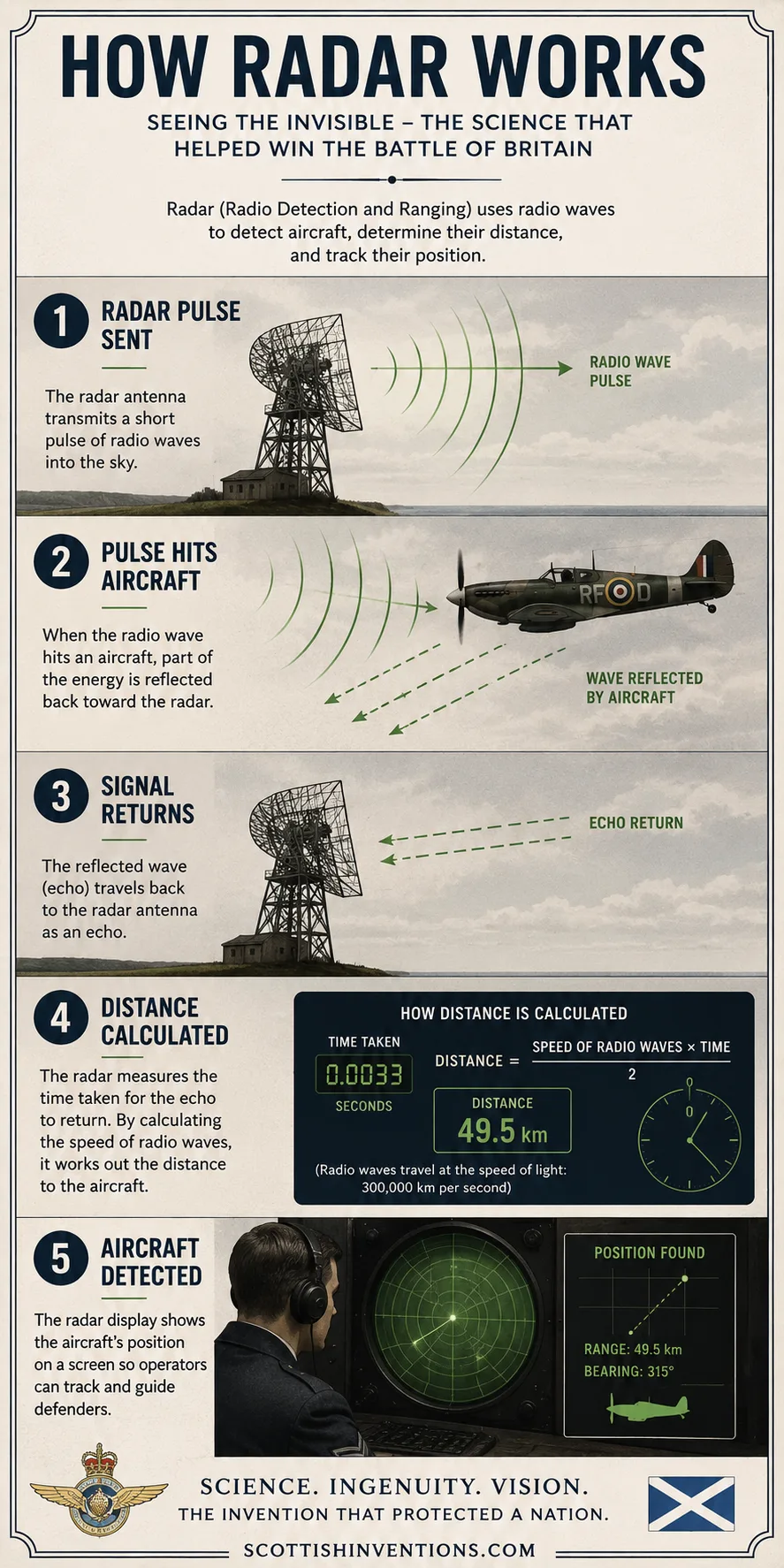
- A transmitter sends out short pulses of radio waves.
- Those waves travel at the speed of light and bounce back off metal objects — such as an aircraft — in their path.
- A receiver picks up the faint returning echo.
- Because radio waves travel at a known, constant speed, the time between sending a pulse and hearing its echo tells you the range to the object.
- The direction in which the antenna is pointing (or the comparison of signals between antennas) tells you the bearing.
Watson-Watt did not invent the underlying physics. Heinrich Hertz had shown in 1886 that radio waves reflect off metal objects, and in 1904 the German engineer Christian Hülsmeyer demonstrated and patented his "telemobiloscope," a device that rang a bell when it detected a ship by radio reflection — recognised by the IEEE as the first working radar-type system. What Watson-Watt and his team did was different and arguably more important: under crushing time pressure, they built the first operational, militarily decisive radar system — and vitally, wove it into a command network that could act on what it saw.
Technically, Chain Home was crude. It used relatively long wavelengths — around 20-50 MHz, with wavelengths of several metres — and large fixed antennas on huge towers rather than the elegant rotating dishes of later radar. It demanded enormous transmitter power and skilled operators to interpret its messy returns. But it had one supreme virtue: it existed, and it worked, in the summer of 1940.
"Give them the third best to go on with; the second best comes too late, the best never comes."
Chain Home and the Battle of Britain
When the Battle of Britain opened in the summer of 1940, the Luftwaffe heavily outnumbered RAF Fighter Command. Radar was the great equaliser. Chain Home could spot German formations as they assembled over France and crossed the Channel, giving Fighter Command roughly 15 to 20 minutes' warning of incoming raids. That margin transformed the arithmetic of defence: instead of wasting fuel and pilots on continuous standing patrols, the RAF could keep its precious Spitfires and Hurricanes on the ground until radar told them exactly when — and roughly where — to scramble.
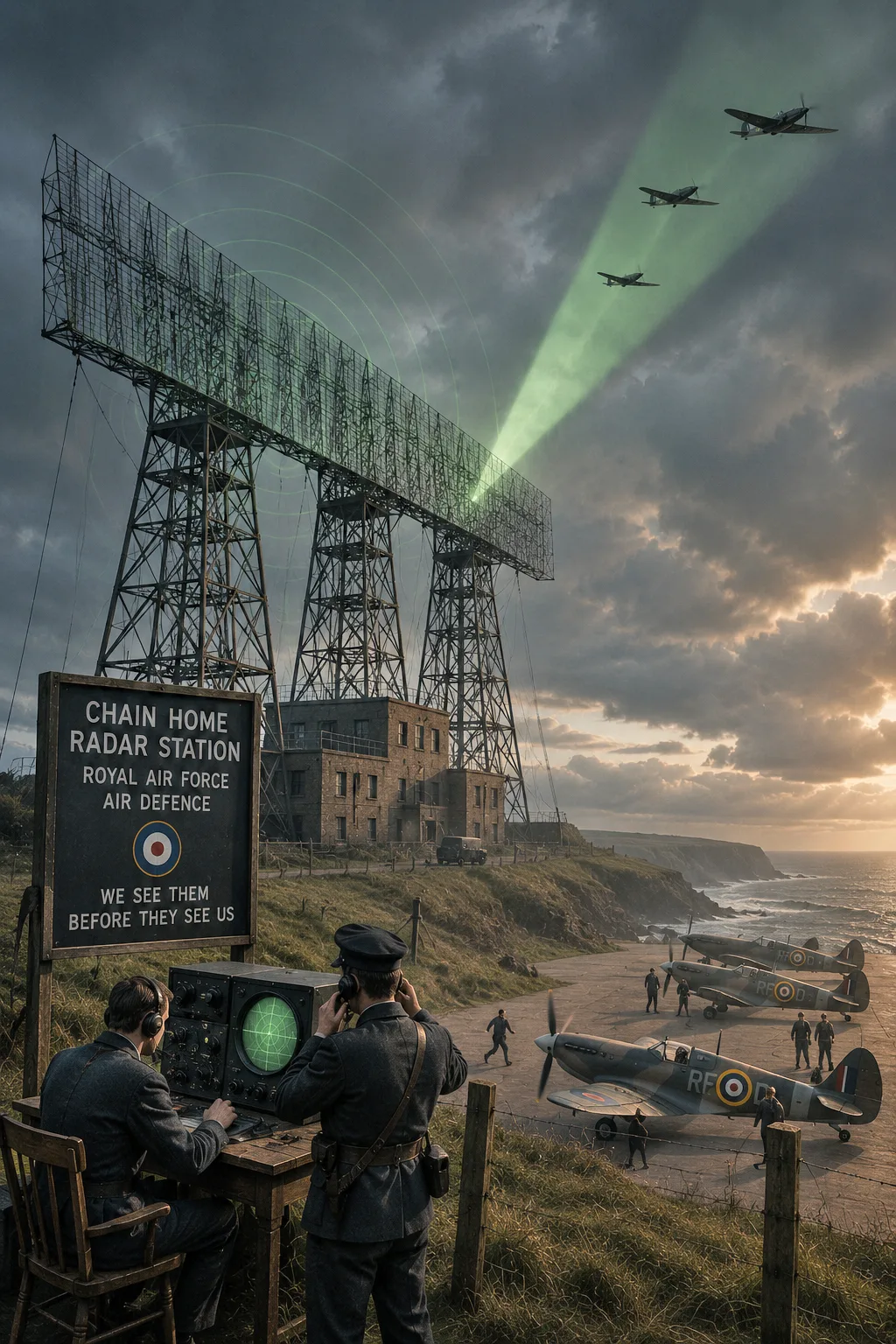
But radar alone was not enough — and this is the part of the story most popular accounts get wrong. The genius lay in the system into which radar was plugged: the Dowding System, named for Air Chief Marshal Sir Hugh Dowding, the world's first integrated, wide-area ground-controlled interception network. Raw plots from the Chain Home stations were telephoned to the Filter Room at Fighter Command headquarters, Bentley Priory, where they were checked and consolidated, then passed to Group and Sector Operations Rooms. There the radar picture was combined with visual sightings from the Royal Observer Corps. WAAF plotters moved markers across vast map tables; controllers read the unfolding battle and vectored fighters by radio to intercept. The whole chain — from detection to scramble order — could run in as little as four minutes.
The Luftwaffe had nothing comparable. It had good radar sets, but no integrated national system feeding a central command that could direct fighters in real time — and it fatally underestimated the British network, never pressing home a sustained campaign against the radar towers. The Dowding System made each British fighter perhaps twice as effective as it would otherwise have been.
"All the ascendancy of the Hurricanes and Spitfires would have been fruitless but for this system which had been devised and built before the war… fused together into a most elaborate instrument of war, the like of which existed nowhere in the world."
IFF, Huff-Duff & Later Life
Radar detection created a new problem: once fighters were aloft, how could the ground tell friend from foe on a radar screen? Watson-Watt filed patents in 1935 and 1936 for what became Identification Friend or Foe (IFF) — a transponder carried on friendly aircraft that, when hit by a radar pulse, sent back an identifying signal. IFF remains fundamental to both military and civilian air traffic control to this day.
He rose through the wartime scientific establishment: Director of Communications Development from 1938 and, by 1940, Scientific Adviser on Telecommunications to the Air Ministry and Ministry of Aircraft Production. His teams' work extended to airborne interception radar (which helped end the night Blitz of 1940-41) and to "huff-duff" high-frequency direction-finding, credited with a role in about a quarter of all Allied attacks on U-boats. All of this was part of what Churchill called the "Wizard War" — the secret scientific struggle that ran beneath the visible conflict. He was elected a Fellow of the Royal Society in 1941 and knighted in 1942 — the moment he formally hyphenated his surname.
Then comes the most delicious irony in the history of invention. In 1956, driving in Canada, he was pulled over for speeding by a policeman wielding a radar speed gun — a direct descendant of his own creation. He is said to have declared: "If I'd known what they were going to do with it, I never would have invented it!" — and later wrote a self-mocking poem, "Rough Justice," which begins: "Pity Sir Robert Watson-Watt, / strange target of this radar plot / And thus, with others I can mention, / the victim of his own invention."
In 1952 the Royal Commission on Awards to Inventors granted him a tax-free award of £50,000 "in respect of his initiation of radar" — the largest single payment the Commission made that year. He returned to Scotland in his final years, dying at Craig Dunain Hospital, Inverness, on 5 December 1973, and is buried at the Episcopal Church of the Holy Trinity, Pitlochry.
Learn More: Interactive Panels
Tap any panel to expand.
+Learn more: Close: Why the death ray was impossible
The Air Ministry's "death ray" question assumed radio waves could be focused tightly enough to cook a pilot at long range. Arnold Wilkins's calculation — how much radio-frequency power would be needed to lift eight pints of water (roughly the volume of blood in a human body) from 98°F to 105°F at 5 km range and 1 km height — showed the required transmitter would need to be astronomically powerful. But the very reasoning that killed the death ray revealed that far weaker pulses would still be reflected in detectable amounts by the aircraft's own metal skin. Detection was not just possible; it was much easier than destruction.
+Learn more: Close: The Daventry Experiment, step by step
The van sat about six miles from the BBC's Borough Hill shortwave transmitter at Daventry. Two wire antennas were phased so the direct signal cancelled out, leaving the receiver sensitive only to any reflected signal. Flight Lieutenant Robert Blucke flew a Handley Page Heyford up and down the beam; each pass produced a visible "rhythmic beating" on the oscilloscope — the echo from the aircraft's fabric-and-metal airframe. Range: about eight miles. Witnesses: three. It was arguably the most quietly momentous experiment in British scientific history.
+Learn more: Close: The Dowding System — why radar alone was not enough
Chain Home saw the enemy; the Dowding System acted on what it saw. Every plot from the coastal stations was telephoned to the Filter Room at Bentley Priory, checked for duplicates and errors, then relayed to Group and Sector Operations Rooms. There WAAF plotters pushed markers across giant map tables while controllers ordered squadrons to scramble by radio. Overlaying visual sightings from the Royal Observer Corps once aircraft crossed the coast — where Chain Home was blind — completed the picture. The whole loop, from radar echo to scramble order, could run in four minutes.
+Learn more: Close: Radar versus sonar
Both radar and sonar use the same principle — send a pulse, measure the echo — but through different media. Radar (RAdio Detection And Ranging) uses electromagnetic radio waves, which travel at the speed of light and pass freely through air but are absorbed by water. Sonar (SOund Navigation And Ranging) uses sound waves, which travel far more slowly (about 1,500 m/s in seawater) but propagate well underwater, where radio does not. Watson-Watt's genius lay in the airborne domain; submarine warfare needed the parallel sonar work of others.
+Learn more: Close: Modern radar technology
Today's radar uses much shorter wavelengths (microwaves), phased-array antennas that steer electronically without moving, and Doppler processing that distinguishes moving targets from clutter. Synthetic-aperture radar (SAR) images landscapes from orbit. Automotive radar tracks vehicles and pedestrians for self-driving cars. Weather radar profiles storms in three dimensions. All of them descend from Watson-Watt's simple insight: send a pulse, listen for the echo, compute the range.
+Learn more: Close: Identification Friend or Foe (IFF)
Once fighters were airborne, radar alone could not tell friendly Spitfires from enemy bombers. Watson-Watt's 1935-36 patents solved that with a small onboard transponder: when illuminated by a friendly radar pulse, it broadcast a coded reply. Every civilian airliner today still carries a direct descendant — the Mode-S transponder — which is why air traffic controllers see aircraft on their screens by identity, altitude and squawk code, not just as anonymous blips.
Timeline of Radar Development
13 April 1892
Born in Brechin
Robert Alexander Watson-Watt is born at 5 Union Street, Brechin, Angus, youngest child of master carpenter Patrick Watson Watt and Mary Matthew.
1912
Graduates from Dundee
Graduates BSc in engineering from University College, Dundee (then part of St Andrews), winning the Carnelley Prize for Chemistry. Becomes assistant to Professor William Peddie, who steers him into radio research.
1915
Joins the Meteorological Office
Works on detecting thunderstorms by radio 'atmospherics' using rotating antennas and a cathode-ray oscilloscope — the exact skills radar will later require.
1927
Coins the term 'ionosphere'
Becomes director of the newly formed Radio Research Station, combining the Met Office and NPL radio teams.
January 1935
The death-ray inquiry
The Air Ministry asks whether a radio 'death ray' could destroy aircraft. Watson-Watt hands the problem to Arnold 'Skip' Wilkins.
12 February 1935
The radar memorandum
Watson-Watt sends the secret memo 'The Detection and Location of Aircraft by Radio Methods' to the Air Ministry.
26 February 1935
The Daventry Experiment
Near Weedon, Northamptonshire, a Handley Page Heyford bomber is tracked to about eight miles using reflected radio waves — the birth of British radar, witnessed by just three men.
2 April 1935
Patent granted
Watson-Watt is granted a patent for his radio aircraft-detection device.
24 September 1937
Bawdsey operational
RAF Bawdsey becomes operational — often described as the world's first fully operational radar station.
September 1939
21 Chain Home stations
By the outbreak of war, 21 operational Chain Home stations guard Britain's east and south coasts, able to detect aircraft up to about 100 miles away.
Summer 1940
Battle of Britain
Chain Home, feeding the Dowding System, gives Fighter Command 15–20 minutes' warning of Luftwaffe raids. The RAF wins the battle against heavy numerical odds.
1941
Fellow of the Royal Society
Elected FRS; sent to the United States after Pearl Harbor to advise on air defence.
1942
Knighted
Knighted for his services to radar; formally hyphenates his surname to 'Watson-Watt'.
1952
£50,000 award
The Royal Commission on Awards to Inventors grants him a tax-free award of £50,000 for 'his initiation of radar'.
1956
Caught by a radar speed trap
In Canada, Watson-Watt is pulled over by a policeman with a radar gun — a direct descendant of his own invention. He writes a wry poem, 'Rough Justice'.
5 December 1973
Died in Inverness
Watson-Watt dies at Craig Dunain Hospital, Inverness, and is buried at the Episcopal Church of the Holy Trinity, Pitlochry.
3 September 2014
Statue unveiled in Brechin
HRH The Princess Royal unveils Alan Beattie Herriot's bronze statue of Watson-Watt in St Ninian's Square, Brechin.
Key Takeaways
Watson-Watt's Enduring Contributions
- The first operational radar — Chain Home, built in just four years and ready before the war.
- The Daventry Experiment — the field test that proved radio waves could see aircraft.
- Identification Friend or Foe — the transponder principle every airliner still uses today.
- The "cult of the imperfect" — a working system now beats a perfect one too late; the founding creed of modern engineering delivery.

Legacy
The technology Watson-Watt forced into being now underpins modern life. Radar guides aircraft through air traffic control, tracks storms in weather forecasting, steers ships in maritime navigation, enforces speed limits on the roads, maps planets in space exploration, probes the cosmos in radio astronomy, and remains a backbone of national defence worldwide. It is now finding fresh life in self-driving cars and advanced driver-assistance systems. The global radar market is large and growing, estimated at around USD 38 billion in 2025.
The Battle of Britain stands as one of the decisive moments of the twentieth century — the first major defeat of Nazi Germany, and a turning point that kept Britain in the war. Watson-Watt's place in that story is secure. Yet his homeland was slow to honour him. For decades the main memorial was a modest plaque in the Northamptonshire field where the Daventry Experiment took place. The first permanent Chain Home station at Bawdsey is now home to the Bawdsey Radar Museum, preserving the story.
Scotland finally paid full tribute on 3 September 2014, when HRH The Princess Royal unveiled a bronze statue of Watson-Watt in St Ninian's Square, Brechin. Sculpted by Alan Beattie Herriot, it shows him holding a Spitfire in one hand and a radar tower in the other. The Watson-Watt Society of Brechin, which campaigned for the monument, continues to champion his memory, and Brechin's Town House Museum holds an exhibition on the radar story. The University of Dundee, his alma mater, established a Watson-Watt Chair of Electronic Engineering in his honour.
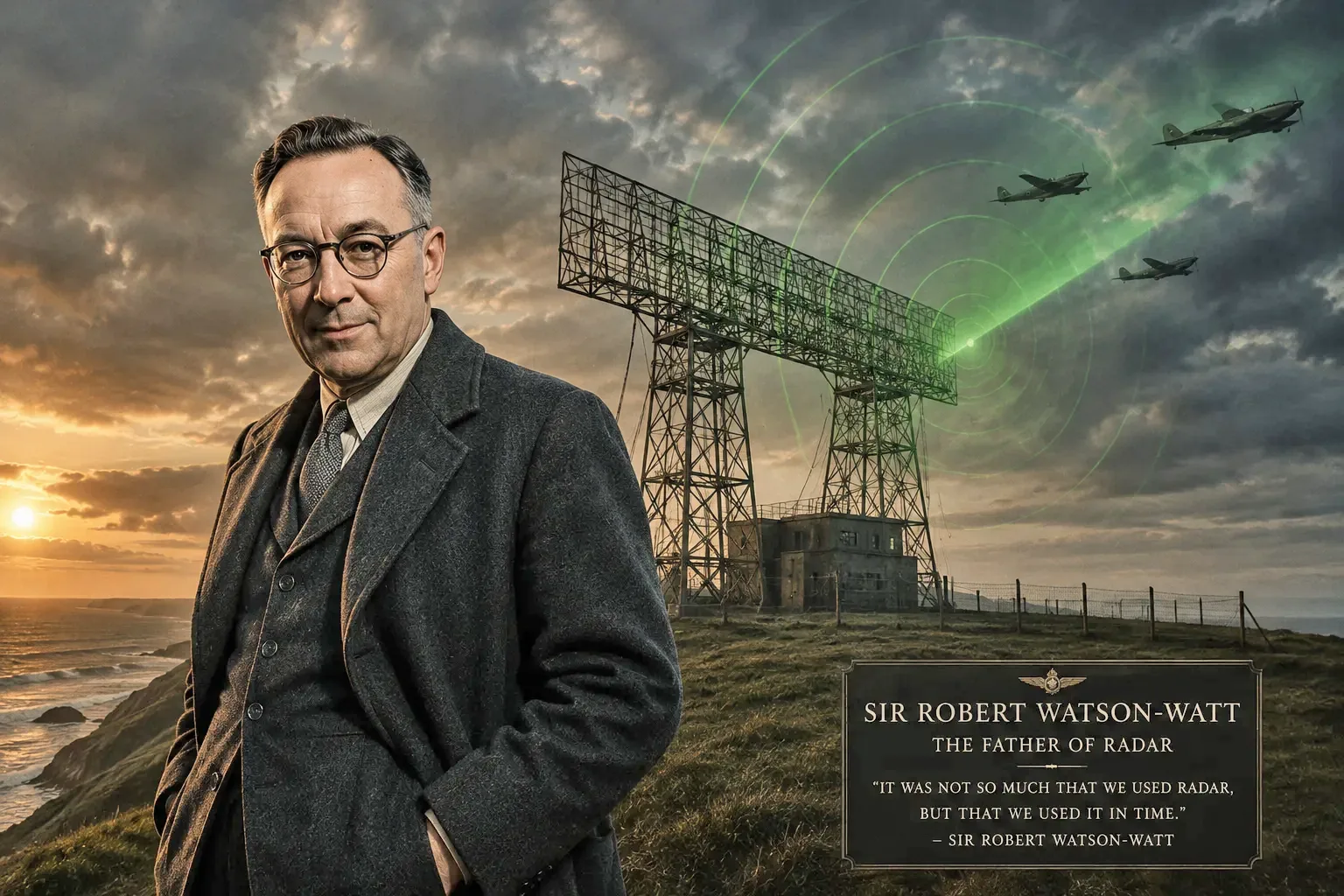
"It was not so much that we used radar, but that we used it in time."
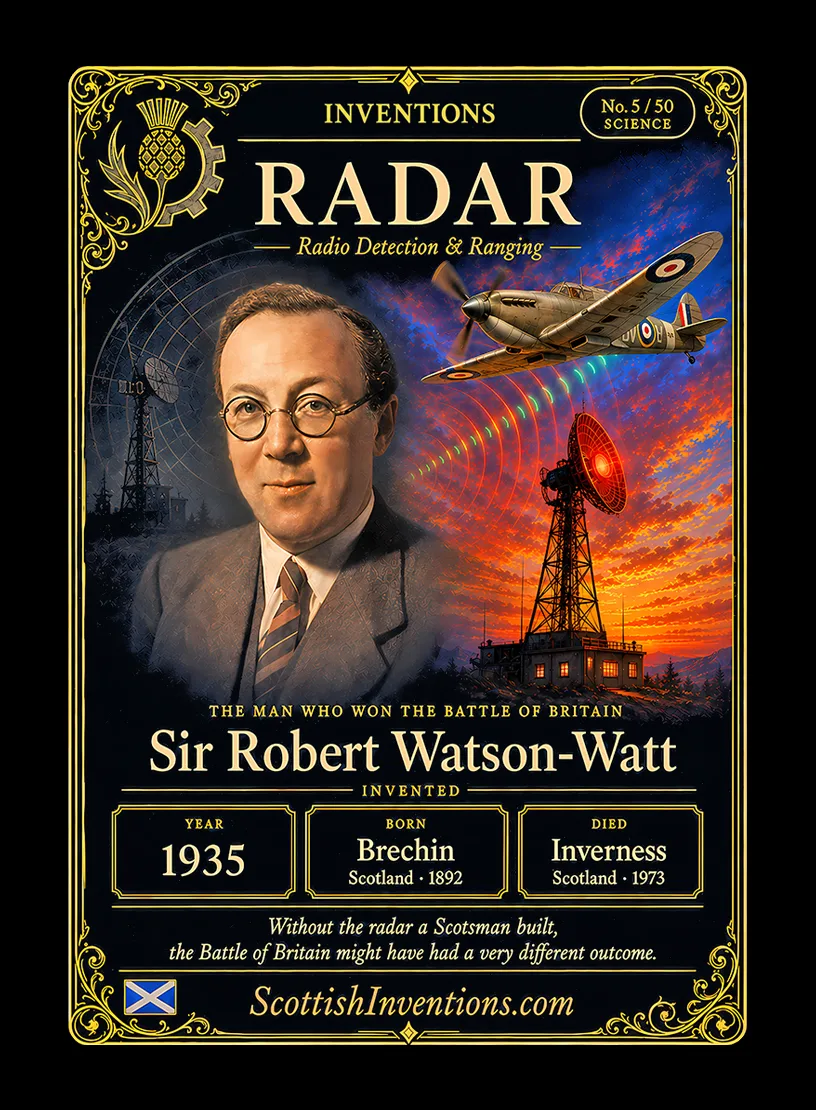
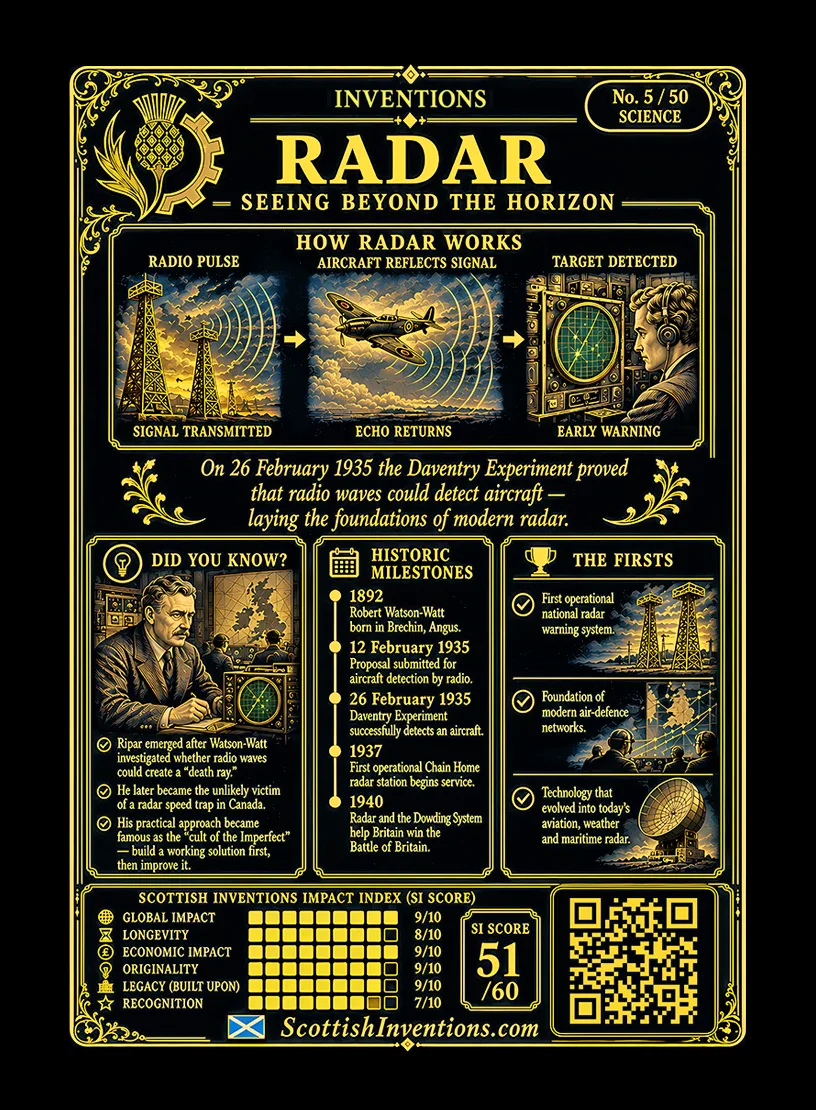
The Radar trading card
Card No. 5 of 50 in the Scottish Inventions Collection.
Frequently Asked Questions
- Who invented radar?
- Sir Robert Watson-Watt, a Scottish physicist born in Brechin in 1892, led the British team that built the world's first operational radar air-defence system in the mid-1930s. The underlying physics — that radio waves reflect off metal objects — had been shown by Heinrich Hertz in 1886, and Christian Hülsmeyer patented a rudimentary ship-detector in 1904, but Watson-Watt's team was the first to turn radio detection into a working, war-ready system.
- Was Robert Watson-Watt Scottish?
- Yes. Robert Alexander Watson-Watt was born on 13 April 1892 at 5 Union Street, Brechin, Angus, and educated at Damacre Primary School, Brechin High School and University College, Dundee (then part of the University of St Andrews). He died in Inverness on 5 December 1973 and is buried at Pitlochry.
- How does radar work?
- Radar is a radio echo. A transmitter emits a pulse of radio waves; when the pulse strikes an object such as an aircraft, part of the energy is reflected back to a receiver. Because radio waves travel at the speed of light, the time between transmission and echo gives the range to the target, while the direction of the antenna gives the bearing.
- What was the Daventry Experiment?
- The Daventry Experiment on 26 February 1935 was the first practical proof that radio waves could detect an aircraft. Watson-Watt and Arnold Wilkins parked a receiving van in a field near Weedon, Northamptonshire, and used the BBC's Borough Hill shortwave transmitter at Daventry as a source. A Handley Page Heyford bomber flying up and down the beam produced a visible reflected signal on the oscilloscope, tracked to about eight miles.
- What was Chain Home?
- Chain Home was the world's first operational radar early-warning network, built along Britain's east and south coasts from 1936 onward. By September 1939 there were 21 operational stations able to detect aircraft at ranges up to roughly 100 miles. RAF Bawdsey, on the Suffolk coast, became operational on 24 September 1937 and is often described as the world's first fully operational radar station.
- How did radar help win the Battle of Britain?
- Chain Home gave RAF Fighter Command roughly 15 to 20 minutes' warning of Luftwaffe raids forming over France. That allowed British fighters to be scrambled at the right moment rather than kept flying costly standing patrols. Fed into the Dowding System — the world's first integrated ground-controlled interception network — radar effectively doubled the fighting value of each Spitfire and Hurricane.
- Did Watson-Watt invent radar alone?
- No. He led the team, framed the problem and pushed the project through the Air Ministry, but the breakthrough was collective. Arnold 'Skip' Wilkins did the key calculation, Edward 'Taffy' Bowen developed airborne radar, and figures such as A. P. Rowe and Air Chief Marshal Sir Hugh Dowding turned the technology into an integrated air-defence system. Watson-Watt himself always insisted radar's success was a team achievement.
- What does RADAR stand for?
- RADAR stands for RAdio Detection And Ranging. The acronym is an American coinage, adopted by the United States Navy in November 1940 and eventually displacing the deliberately vague British codename 'RDF' (Radio Direction Finding).
- Is radar still used today?
- Yes — radar underpins modern life. It guides commercial aircraft through air traffic control, tracks storms in weather forecasting, steers ships in maritime navigation, enforces speed limits, maps planets in space exploration, powers self-driving car sensors and remains a backbone of national defence.
- Why is Robert Watson-Watt important?
- Because he delivered a working air-defence radar system in time to matter. His pragmatic 'cult of the imperfect' — 'Give them the third best to go on with; the second best comes too late, the best never comes' — produced Chain Home in barely four years, giving Britain the early warning that helped make the difference in the Battle of Britain and shaping the electronic-warfare age that followed.
Continue Exploring
Discover More Scottish Innovations That Changed the World
Radar was just one of many Scottish breakthroughs that transformed global science, engineering and communications. Explore the inventions and discoveries that continue to shape everyday life.
Explore More Scottish InventionsSources
Tier 1 · Primary
- National Records of Scotland — statutory birth register entry for Robert Alexander Watson Watt, Brechin, 13 April 1892.
- IEEE — recognition of Christian Hülsmeyer's 1904 telemobiloscope.
Tier 2 · Scholarly and institutional
- Winston S. Churchill, Their Finest Hour (1949), vol. 2 of The Second World War.
- Sir Robert Watson-Watt, Three Steps to Victory (1957) and The Pulse of Radar (1959).
- Bawdsey Radar Museum, Suffolk — history of RAF Bawdsey and Chain Home.
- Watson-Watt Society of Brechin — biographical and memorial material.
- The Sunday Post — Watson-Watt family archive interviews.
Tier 3 · General reference
- Wikipedia — biographical entries on Robert Watson-Watt, Chain Home, the Dowding System and the Daventry Experiment.