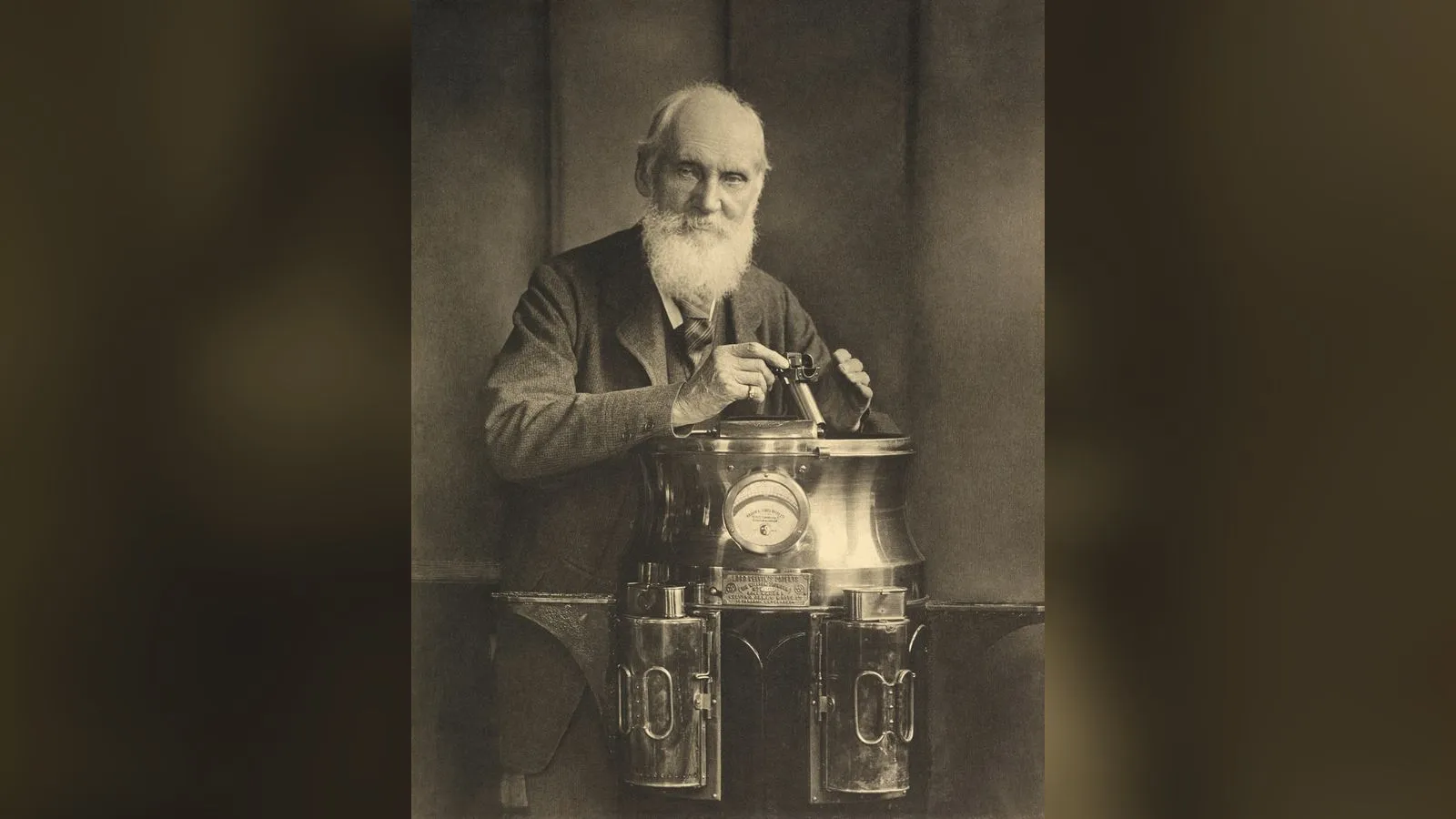

Lord Kelvin: The Glasgow Professor Who Measured the World
Contents
TL;DR
William Thomson, later Lord Kelvin (1824–1907), was one of the great physicists of the nineteenth century, and for fifty-three years he did his work in Glasgow. He matriculated at the University of Glasgow at ten and became its Professor of Natural Philosophy at twenty-two. He proposed the absolute temperature scale that now bears his name, helped found thermodynamics and formulated the dissipation of energy. He founded the first physics teaching laboratory in Britain, in a disused wine cellar, and wrote, with P. G. Tait, the textbook that shaped classical physics. He was also the scientist who made the transatlantic telegraph work.
His instruments, patents and compasses made him rich. In 1892 he became the first British scientist raised to the peerage for his science, as Baron Kelvin of Largs. He was born in Belfast into an Ulster-Scots family that had left the Scottish Lowlands around 1641, so his Scottishness is a matter of family, upbringing and a lifetime's work rather than birthplace. He also made famous mistakes, above all his short age for the Earth.
Key Findings
- His family was Ulster-Scots. His biographer Silvanus Thompson records that the Thomsons "migrated from the Lowlands of Scotland about the year 1641" to County Down. His father James, a farm boy who taught himself mathematics, studied at Glasgow from 1810 to 1814 and became its professor of mathematics in 1832.
- He started university at ten. William matriculated at Glasgow in October 1834, aged "ten years and three months". At sixteen he wrote an essay on the figure of the Earth that a later professor called "a truly astonishing performance".
- He was Second Wrangler at Cambridge. In the Senate House examination of January 1845 he came second to Stephen Parkinson of St John's, to his friends' "amazement and chagrin", then won the Smith's Prize, the harder test of mathematical power.
- He became a professor at twenty-two. He was elected to the Glasgow chair of Natural Philosophy in 1846 and held it until 1899.
- He fixed absolute zero. His 1848 paper "On an Absolute Thermometric Scale founded on Carnot's Theory" gave temperature a scale independent of any substance. The SI unit of temperature, the kelvin, is named after him.
- He helped build thermodynamics. After meeting James Joule in 1847 he worked out, with Joule, Rankine and Clausius, the laws of energy and its transformation. In 1852 he announced the "dissipation of energy". With Joule he discovered the Joule–Thomson effect, the basis of refrigeration and gas liquefaction.
- He founded the first student physics laboratory. In about 1850 he took over "an old disused wine-cellar" in the college basement, the first physical laboratory for students in Britain.
- He saved the Atlantic cable. His theory of signalling and his mirror galvanometer made the transatlantic telegraph possible. After the triumph of the 1866 cable he was knighted.
Key Facts
- Born
- 26 June 1824, Belfast
- Died
- 17 December 1907, Netherhall, Largs, Ayrshire
- Buried
- Westminster Abbey, beside Isaac Newton
- Family
- Ulster-Scots; father James Thomson, Professor of Mathematics at Glasgow (from 1832)
- Education
- University of Glasgow (matriculated 1834, aged ten); Peterhouse, Cambridge (Second Wrangler and Smith's Prizeman, 1845); Regnault's laboratory, Paris
- Post
- Professor of Natural Philosophy, Glasgow, 1846–1899
- Key ideas
- Absolute temperature scale (1848); dissipation of energy (1852); Joule–Thomson effect; theory of the telegraph cable
- Inventions
- Mirror galvanometer (1858 patent); siphon recorder; improved mariner's compass; sounding machine
- Book
- Treatise on Natural Philosophy (1867), with P. G. Tait
- Wives
- Margaret Crum (married 1852; died 1870); Frances Anna Blandy (married 1874)
- Honours
- Knighted 1866; Baron Kelvin of Largs 1892; Order of Merit 1902
Scottish Impact Index (SI Score)
- Global Influence
- 9/10
- Enduring Relevance
- 10/10
- Material Contribution
- 8/10
- Exceptional Achievement
- 9/10
- Lasting Legacy
- 9/10
- Recognition
- 6/10
51/60
Ranked =10th of 200 in Great Scots
Claim Status
established
- his education, chair, papers, inventions, honours and role in the Atlantic cable, documented in his papers and in Thompson's authorised biography;
- the wine-cellar laboratory.
shared
- credit for thermodynamics. The second law and the conservation of energy emerged from the work of Carnot, Joule, Rankine, Clausius, Helmholtz and Thomson together. Thompson's biography devotes a section to "Controversy over Various Claims".
- "first". The cellar is generally described as the first physics teaching laboratory in Britain, but claims of this kind depend on definitions.
disputed
- the age of the Earth. Thomson argued from the cooling of the Earth and Sun that the habitable Earth was tens of millions of years old, and attacked the geologists' "uniformitarian" claims for limitless time. Thompson, writing as a devoted disciple in 1910, said this argument had "proved the untenability of the enormous claims for TIME" made by geologists and biologists. He was wrong. Radioactivity, unknown when Thomson made his calculations, supplies heat inside the Earth, and the Earth is about 4.5 billion years old.
traditional
- quotations such as "heavier-than-air flying machines are impossible" and "there is nothing new to be discovered in physics now". They are widely attributed to him but poorly sourced.
An Ulster-Scots Family
Thompson opens with the family's origins. The Thomsons "migrated from the Lowlands of Scotland about the year 1641 in the troublous times of the civil wars" and farmed for nearly two hundred years at Annaghmore, near Ballynahinch in County Down.
Kelvin's father, James Thomson, was born there in 1786. He was brought up as a farm labourer and taught himself astronomy and "the art of dialling", making sundials and a night-dial that told the time by the stars of the Plough. Hoping to become a Presbyterian minister, he spent four winters, from 1810 to 1814, studying at the University of Glasgow and crossing the Irish Sea twice a year "in whatever sailing craft they could find". Kelvin later told the story at his installation as Chancellor. Once the becalmed boat was "carried three times round Ailsa Craig by flow and ebb of the tide". On another trip, walking from Greenock to Glasgow in 1813, his father and friends saw "a prodigy — a black chimney moving rapidly beyond a field". It was Henry Bell's Comet, Europe's first commercial steamboat, then less than a year old.
James Thomson became a mathematics teacher in Belfast, and in 1832 Professor of Mathematics at Glasgow. William, born in Belfast on 26 June 1824, was eight when the family moved.
The Boy Professor's Son
James Thomson taught his children himself. In October 1834 William and his older brother James, later a distinguished engineer, matriculated together at Glasgow. William was "ten years and three months" old, and he signed the register himself. The boys built electrical machines and Leyden jars and gave their friends electric shocks. At sixteen William wrote an essay on the figure of the Earth. The mathematician A. E. H. Love, reading it decades later, called it "a truly astonishing performance for a boy of sixteen... Thomson writes like a scientific investigator."
In 1841 he went to Peterhouse, Cambridge. He rowed and played in the university musical society's orchestra, and he published original mathematical papers as an undergraduate. He discovered for himself theorems that, he later found, George Green had published years earlier in a rare essay he did not see until 1845. In the Senate House examination of January 1845 everyone expected him to come first. When the names were read, the Senior Wrangler was Stephen Parkinson of St John's and Thomson was second, to his friends' "amazement and chagrin". The disappointment was eased when he won the Smith's Prize, awarded on a test "where mathematical power counted for more".
He then spent time in Paris, meeting the mathematician Joseph Liouville and working in the laboratory of the physicist Henri Victor Regnault. There he learned precise experimental measurement and read Clapeyron's account of Sadi Carnot's theory of heat engines.
The Glasgow Chair
In 1846 the chair of Natural Philosophy at Glasgow fell vacant. His father organised a campaign of testimonials, and William was elected at twenty-two. His inaugural Latin dissertation, De Motu Caloris per Terrae Corpus ("On the Motion of Heat through the Body of the Earth"), began the line of thought that would lead him to calculate the age of the Earth. He held the chair for fifty-three years.
He found the teaching apparatus woefully inadequate. In about 1850 he "took possession of" an old disused wine cellar in the college basement next to his classroom and turned it into a laboratory where students did real research alongside him. It is generally regarded as the first physical laboratory for students in Britain. Eighteen years later he quietly annexed an abandoned examination room next door, in Thompson's words "an unauthorised annexation". His students, a "volunteer laboratory corps", measured the properties of materials that he needed for his theories and his cables.
In 1852 he married his cousin Margaret Crum, of the calico-printing family of Thornliebank. She was soon an invalid. When the German physicist Hermann von Helmholtz met Thomson at the spa of Kreuznach in 1855, where he had taken his wife for her health, Helmholtz wrote home in astonishment:
I expected to find the man, who is one of the first mathematical physicists of Europe, somewhat older than myself, and was not a little astonished when a very juvenile and exceedingly fair youth, who looked quite girlish, came forward... He far exceeds all the great men of science with whom I have made personal acquaintance, in intelligence, and lucidity, and mobility of thought, so that I felt quite wooden beside him sometimes.
Margaret died in 1870 after years of illness. Thomson wrote that "the bitterness of my great grief... is unspeakable and not to be written about". He bought a yacht, the Lalla Rookh, and sailed to the Hebrides.
Heat, Energy and Absolute Zero
Thomson came to heat through Carnot, whose theory treated heat as a fluid, "caloric", that produced work as it flowed from hot to cold. In 1848 he used Carnot's theory to define an absolute scale of temperature that did not depend on the properties of any particular substance, and so implied an absolute zero.
Meanwhile James Joule, a Manchester brewer, had been showing that heat and mechanical work were interchangeable. When Joule presented his results at the British Association meeting in Oxford in 1847, Thomson was at first doubtful, since Joule's work seemed to contradict Carnot. But he saw its importance immediately, and the two became lifelong collaborators. Out of the tension between Carnot and Joule came the modern laws of thermodynamics, worked out in parallel by Thomson, Rankine in Glasgow and Clausius in Germany. In 1852 Thomson published his paper on "a universal tendency in nature to the dissipation of mechanical energy", the idea that usable energy is always running down. With Joule he discovered that a gas cools when it expands through a small opening without doing external work. The Joule–Thomson effect underlies refrigerators and the liquefaction of gases. Thomson also did much to establish the word "energy" in its modern scientific sense, and he introduced the term "kinetic energy".
The Atlantic Telegraph
Thomson's practical fame came under the sea. In 1854–55 he worked out the theory of signalling through long submarine cables. Signals blurred as they travelled, and the delay grew with the square of the cable's length, the "law of squares". That meant a transatlantic cable needed a thick copper core and very sensitive detecting instruments.
He joined the board of the Atlantic Telegraph Company, but his advice was often overruled. The company's electrician, Wildman Whitehouse, disputed his theory and favoured high-voltage induction coils. In 1857 and 1858 Thomson sailed with the cable squadron, Britain's HMS Agamemnon and the American USS Niagara, and operated his new mirror galvanometer, a tiny magnet and mirror that threw a spot of light across a scale and could detect very faint signals. After two failures, the cable was completed in August 1858, amid wild celebrations on both sides of the Atlantic. It failed within weeks, damaged in part by Whitehouse's high voltages. Thompson's chapter headings tell the story: "How not to work a Cable" and "Termination of Whitehouse's Appointment".
The project revived in the 1860s, using the giant steamship Great Eastern. Thomson sailed with the 1865 expedition, when the cable broke in mid-ocean, and again in 1866, when a new cable was laid successfully and the lost 1865 cable was grappled from the seabed and completed. He was knighted that year. In accepting, he expressed his sympathy "with my former colleagues, and other friends on the Atlantic Board", and his pleasure in "the complete success" of the enterprise. His siphon recorder, which wrote incoming signals as a wavy ink line on paper tape, followed in 1867. With his partners he made a fortune from cable patents and consultancy.
Teacher, Author and Inventor
With his Edinburgh friend P. G. Tait, Thomson wrote the Treatise on Natural Philosophy (1867), known to generations of students as "T and T′". It reorganised mechanics around energy and became one of the foundations of classical physics. His lectures were famous for their brilliance and their digressions. He would follow an idea wherever it led, sometimes leaving his students far behind.
Ships and the sea, which he loved, inspired many of his inventions. He redesigned the mariner's compass so that it worked reliably on iron ships, and developed a sounding machine that let ships measure depth with piano wire without stopping. Both were adopted by the Royal Navy and merchant fleets. His instrument-making business, Kelvin & James White, grew into a major Glasgow firm.
Lord Kelvin
Thomson married again in 1874. His second wife, Frances Anna Blandy, came from a Madeira wine family, and they made their home at Netherhall, near Largs. In 1892 he was raised to the peerage as Baron Kelvin of Largs, the first British scientist ennobled for his science. He took his title from the River Kelvin, which flows past the University of Glasgow. In 1896 the university and scientists from around the world celebrated his jubilee as professor. He retired in 1899 and enrolled himself as a research student so that he could keep working in the laboratory. He died at Netherhall on 17 December 1907 and was buried in Westminster Abbey, next to Isaac Newton.
The Age of the Earth
Kelvin's great mistake grew out of his first lecture. From the rate at which heat flows out of the Earth, and from the energy the Sun could supply, he calculated in the 1860s that the Earth could have been habitable for only tens of millions of years, later narrowing it to around 20–40 million. He used this to attack the uniformitarian geology that descended from James Hutton, and Darwin's need for vast stretches of time. T. H. Huxley, as President of the Geological Society, replied in 1869. Kelvin's physics was rigorous, but he did not know about radioactivity, discovered in 1896, which provides a hidden source of heat inside the Earth. The Earth is now dated to about 4.5 billion years. His biographer's 1910 claim that he had "proved the untenability" of the geologists' time is a reminder that even a great scientist's followers could be too loyal.
Timeline
Thomson family migrates from Lowland Scotland to County Down —
Father, James Thomson, born at Annaghmore —
James Thomson studies at Glasgow — Sees Bell's Comet in 1813
William Thomson born in Belfast —
Father becomes Professor of Mathematics at Glasgow —
Matriculates at Glasgow, aged ten —
Enters Peterhouse, Cambridge —
Second Wrangler; Smith's Prize — Then studies in Paris
Professor of Natural Philosophy, Glasgow — Aged twenty-two
Meets Joule at the British Association, Oxford —
Absolute thermometric scale —
Wine-cellar laboratory — First student physics lab in Britain
Dissipation of energy; marries Margaret Crum —
Meets Helmholtz at Kreuznach —
Atlantic cable laid; fails within weeks — Mirror galvanometer patented
Successful Atlantic cable; knighted —
Treatise on Natural Philosophy with Tait; siphon recorder —
Death of Margaret Thomson — Buys the Lalla Rookh
Marries Frances Anna Blandy —
Created Baron Kelvin of Largs —
Jubilee as professor —
Retires —
Dies at Largs — Buried in Westminster Abbey
Did You Know?
- Kelvin's father, as a student, saw Henry Bell's Comet steaming on the Clyde in 1813, when it was not yet a year old.
- William Thomson matriculated at Glasgow aged ten years and three months.
- His first laboratory was a disused wine cellar in the old college.
- Helmholtz, meeting him in 1855, said he "felt quite wooden beside him".
- After retiring as professor in 1899, he enrolled as a research student at his own university.
Honest Caveats
- An admiring biography. Silvanus Thompson was a devoted disciple and admitted his "affectionate admiration" might have "warped his judgment". His verdicts, especially on the age of the Earth, are handled with care here.
- Scope. This card uses Thompson's first volume, which covers Kelvin's life to the early 1870s. Later details (the compass, the peerage, retirement and death) are standard facts summarised from general sources.
- Belfast or Glasgow? Born in Belfast, he is claimed by both Ireland and Scotland. His family was of Scottish descent and his whole career was in Glasgow.
FAQ
1Was Lord Kelvin Scottish?
He was born in Belfast to an Ulster-Scots family that had left the Scottish Lowlands around 1641. He was raised in Glasgow from the age of eight and worked there all his life.
2What is the Kelvin scale?
An absolute temperature scale, proposed by Thomson in 1848, starting from absolute zero. The kelvin is the SI unit of temperature.
3What did he do for the telegraph?
He explained how signals travel along submarine cables and invented the mirror galvanometer and siphon recorder, which made transatlantic telegraphy practical.
4Why is he called Kelvin?
When he was made a peer in 1892, he took his title from the River Kelvin beside the University of Glasgow.
5What did he get wrong?
His estimate of the age of the Earth was far too short, because radioactivity was then unknown.
Related
- Absolute Zero, Kelvin Scale & Laws of Thermodynamics
- James Clerk Maxwell
- Peter Guthrie Tait
- William John Macquorn Rankine
- The Charlotte Dundas
- University of Glasgow
Sources
- Silvanus P. Thompson, The Life of William Thomson, Baron Kelvin of Largs, 2 vols. (Macmillan, 1910). Vol. I: family, childhood, Cambridge, Glasgow chair, laboratory, thermodynamics, Atlantic telegraph, the Treatise.
- William Thomson, "On an Absolute Thermometric Scale founded on Carnot's Theory", Philosophical Magazine (1848).
- William Thomson, "On a Universal Tendency in Nature to the Dissipation of Mechanical Energy", Proceedings of the Royal Society of Edinburgh (1852).
- Crosbie Smith and M. Norton Wise, Energy and Empire: A Biographical Study of Lord Kelvin (Cambridge University Press, 1989).
- University of Glasgow, "Lord Kelvin". https://www.gla.ac.uk/
Scholarly/Critical
- Alexander Broadie, "The Rise (and Fall?) of the Scottish Enlightenment", in T. M. Devine and Jenny Wormald (eds), The Oxford Handbook of Modern Scottish History (Oxford University Press, 2012)
Card 032 · Great Scots