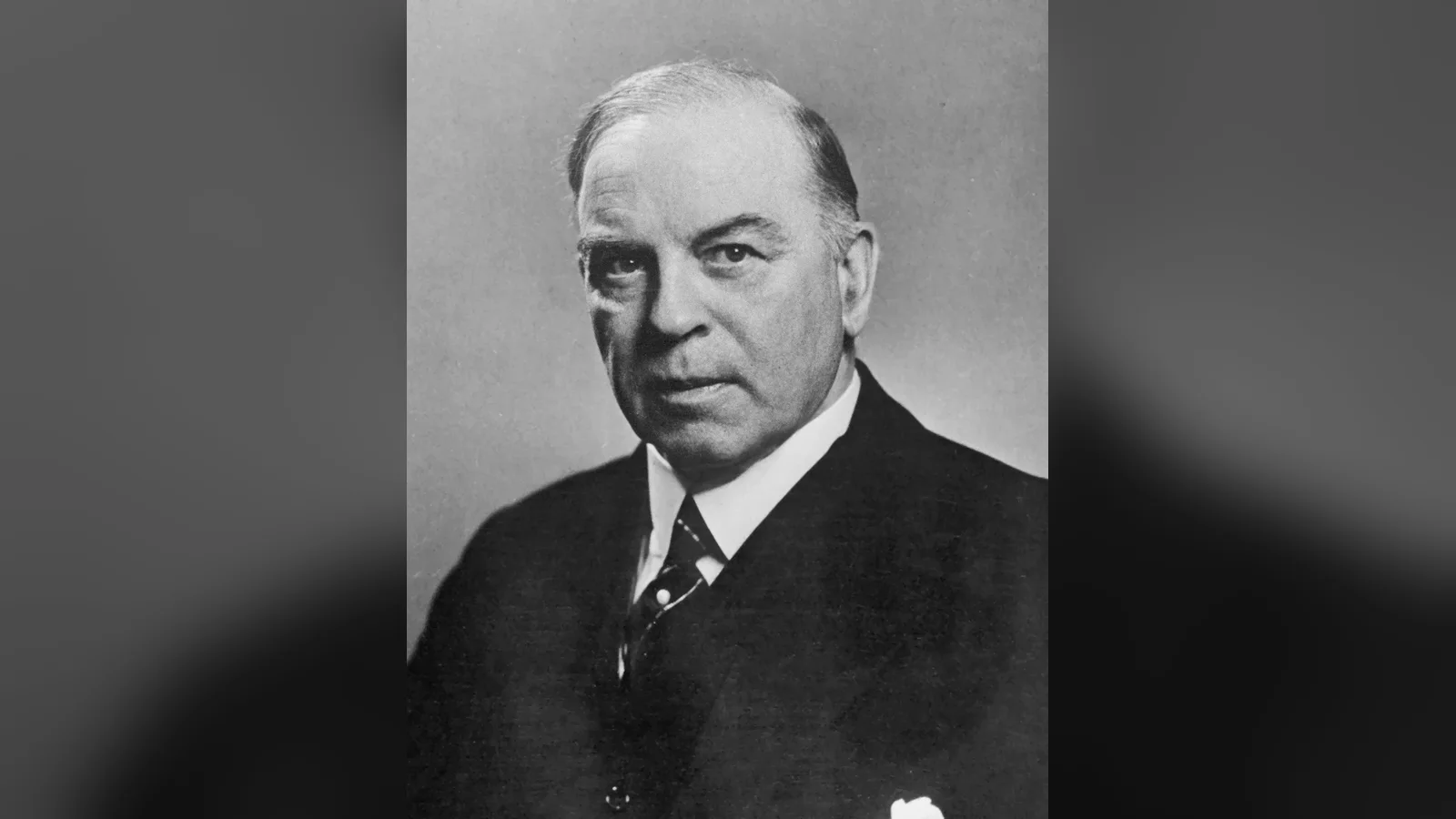

William Lyon Mackenzie King (1874–1950): Canada's Longest-Serving Prime Minister
Contents
Mackenzie King led Canada for more than twenty-one years between 1921 and 1948, longer than anyone has led a parliamentary democracy. He took the country through the Second World War without breaking it in two over conscription, and began its welfare state. He was also a bachelor who consulted his dead mother through mediums, kept a diary of everything, and came away from a meeting with Hitler in 1937 thinking of Joan of Arc. All four of his grandparents were Scots or the children of Scots, and one of them, the rebel William Lyon Mackenzie, shaped his sense of mission for life. It does not leave out the refugees he turned away in 1938–39 or the Japanese Canadians his government uprooted in 1942.
TL;DR
- established King was born at Berlin, now Kitchener, Ontario, on 17 December 1874, and died at Kingsmere, Quebec, on 22 July 1950.
- established His father's father, John King, was born in north-east Scotland in 1814 and came to Upper Canada as a soldier. His father's mother, Christina Macdougall, was a Scottish immigrant. His mother was the youngest child of William Lyon Mackenzie, leader of the 1837 rebellion.
- established He was prime minister in 1921–26, 1926–30 and 1935–48. He passed Sir John A. Macdonald's 6,937 days on 7 June 1946.
- established In 1914–18 he worked for the Rockefellers after the Ludlow Massacre and designed the "Colorado Plan" of employee representation, which shut out the miners' union.
- established He met Hitler in Berlin on 29 June 1937 and judged him sincere and "distinctly mystic". In 1938–39 his government kept Canada's door shut to Jewish refugees, and in 1942 it ordered about 23,500 Japanese Canadians away from the British Columbia coast.
- shared King and his family held that his grandfather's rebellion won Canada responsible government. Levine calls this a family myth and credits a change in British policy.
Key Facts
- Born
- 17 December 1874, Berlin (Kitchener), Ontario
- Died
- 22 July 1950, Kingsmere, Quebec
- Parents
- John King, lawyer (b. 1843), and Isabel Grace Mackenzie (b. New York, 1843)
- Scottish descent
- Paternal grandfather born in north-east Scotland, 1814; paternal grandmother a Scottish immigrant; maternal grandfather William Lyon Mackenzie, born near Dundee, 1795; maternal grandmother Isabel Baxter, schooled in Scotland
- Education
- University of Toronto (BA 1895, LLB 1896, MA 1897); Chicago; Harvard (MA 1898, PhD 1909); London School of Economics
- Offices
- Deputy minister of labour 1900; Canada's first minister of labour 1909; Liberal leader 1919–48; prime minister 1921–26, 1926–30, 1935–48
- Never married
- Main sources
- Allan Levine, King (2011); William Kilbourn, The Firebrand (1956)
Scottish Impact Index (SI Score)
- Global Influence
- 8/10
- Enduring Connection
- 8/10
- Material Contribution
- 9/10
- Scottish Diaspora Distinctiveness
- 8/10
- Diaspora Legacy
- 7/10
- Recognition
- 6/10
46/60
Ranked =36th of 93 in Diaspora
A Note on Claims and Evidence
Each major claim carries one of three labels. established means supported by primary records, official bodies or several independent reliable sources. shared means the core fact is sound but sources disagree on details, dates or interpretation. traditional means widely repeated but not traceable to a primary or independent source.
Levine's book rests on King's diary, which he began on 6 September 1893 and kept until his death. The diary is the reason so much is known about his private beliefs. It also means that most judgments of his motives are his own.
Levine says little about Scotland. He states where King's paternal grandfather was born and that his paternal grandmother was a Scottish immigrant. He does not give a birthplace for William Lyon Mackenzie or Isabel Baxter. William Kilbourn's The Firebrand (1956) supplies both: Mackenzie was born near Dundee in 1795, and Isabel Baxter had been his schoolmate in Scotland before she followed him to Canada in 1822. See William Lyon Mackenzie.
Levine was searched and read in part, including his chapters on the refugee question of 1938–39 and the Japanese Canadians in 1942. His long chapters on Canadian party politics were not read in full. Kilbourn's opening chapter on Mackenzie's childhood in Dundee was read in full. Kilbourn writes for a general reader and gives no notes for the Dundee years, so the childhood stories in it are family tradition handed down through Mackenzie's son-in-law, Charles Lindsey.
Timeline
William Lyon Mackenzie is born near Dundee. His father, a weaver, dies three weeks later.
John King senior is born in north-east Scotland.
Mackenzie sails for Canada on the schooner Psyche.
Isabel Baxter, his schoolmate in Scotland, follows him. They marry at Quebec.
Mackenzie visits Dundee for the last time and pays off his old Scottish debts.
Mackenzie becomes the first mayor of Toronto.
William Lyon Mackenzie leads a failed rebellion in Upper Canada. John King senior is on garrison duty at Fort Henry, Kingston, on the other side.
John King senior dies of tuberculosis at twenty-nine. His son John is born four months later. Isabel Grace Mackenzie is born in New York during her father's exile.
John King and Isabel Mackenzie marry.
William Lyon Mackenzie King is born.
Begins his diary.
Appointed editor of the Labour Gazette and then deputy minister of labour.
Elected to Parliament for North Waterloo.
Becomes Canada's first minister of labour.
Hired by the Rockefeller Foundation as a labour consultant.
His mother dies the day after he loses an election.
Elected leader of the Liberal Party.
Becomes prime minister.
The governor general, Lord Byng, refuses him a dissolution. He resigns, wins the election that follows and returns to office.
Defeated by R. B. Bennett.
Attends his first séance.
Returns to office with a majority.
Meets Hitler in Berlin. Visits Abbotsford and Tiree the same summer.
Canada's delegates at the Évian refugee conference are told to promise nothing.
After Kristallnacht, King tells Jewish leaders that the unemployed must come first.
Hosts the royal tour. Declines to take in the Jewish refugees on the St Louis.
Canada declares war on Germany.
About 23,500 Japanese Canadians are ordered away from the British Columbia coast.
A plebiscite releases the government from its pledge against conscription.
The Family Allowance Act is passed. A second conscription crisis is contained.
Passes Macdonald's record.
Becomes the first Canadian citizen under the new Citizenship Act.
Hands over to Louis St Laurent.
Dies.
Details
The weaver's son from Dundee
established The grandfather King revered was born near Dundee in 1795. His father, Daniel Mackenzie, a weaver, died when the baby was three weeks old, and his mother, Elizabeth, brought him up alone. Kilbourn describes her as a strict Calvinist who drilled him in the psalms and the catechism and who was proud of the Mackenzie name to the point of poverty.
traditional The family stories of his childhood come down through his son-in-law's biography of 1862 and are not otherwise recorded. In them his mother sold a Mackenzie tartan she had woven herself to buy barley meal in the famine year of 1810; he ran away at ten to live as a hermit in a castle in the hills above Dundee; and he nearly drowned in the Tay after a bet over marbles.
established At eleven he joined the reading room of the Dundee Advertiser, and he kept a list of every book he read until he left Scotland: 957 of them, 352 of them novels. He clerked for a merchant, ran a general store and circulating library that failed in the post-war slump, and worked in England before sailing for Canada in the spring of 1820. Two years later Isabel Baxter, who had been at school with him in Scotland, crossed the Atlantic to marry him. They had thirteen children, six of whom died young. He went back to Dundee once, in 1833, to pay off his old debts, and in 1834 became the first mayor of Toronto.
Two Scottish grandfathers on opposite sides
established King's Scottish descent runs through every line Levine records. His paternal grandfather came out from the north-east of Scotland as a young soldier of the Crown and married Christina Macdougall, herself an immigrant from Scotland. He died before his son was born. The widow took the baby to Berlin, a largely German town in Upper Canada, where her brother Dougall Macdougall published a newspaper and belonged to what Levine calls the town's English and Scottish elite. Macdougall was a committed Reformer and brought the boy up as one.
established That boy, John King, became a lawyer and married Isabel Grace Mackenzie, thirteenth and youngest child of William Lyon Mackenzie and Isabel Baxter. She had been born in New York while her father was a fugitive, and never lost the memory of a poor childhood or the stigma of being an outlaw's daughter.
established So in December 1837 one of the future prime minister's grandfathers was leading an armed rising at Toronto and the other was in uniform at Kingston, ready to put it down.
The grandson's mission
established King grew up as Willie King. At university he read his uncle's life of Mackenzie and wrote that he could feel his grandfather's blood in his veins, and that he was prouder than ever of "the race from which I am sprung". From 1896 he signed himself W. L. Mackenzie King. He learned by heart the proclamation of 1837 that offered £1,000 for his grandfather, and later hung a copy of the wanted poster in his house.
shared The family believed that without the rebellion Upper Canada would never have gained responsible government in 1848–49. Levine treats this as revisionism. In his account the change came mainly from a shift in British economic policy. King never accepted that. Near the end of his life he commissioned a new biography of Mackenzie that would show the injustice done to him, and insisted that it be written by a Scottish author he admired, Catherine Macdonald Maclean.
Labour expert and Rockefeller's man
established King was a trained economist with degrees from Toronto and Harvard, and at twenty-five he was deputy minister of a new federal labour department. In 1909 he became the first minister of labour. He lost his seat in 1911.
established In 1914 the Rockefeller Foundation hired him. That April a strike at the family's Colorado Fuel and Iron Company had ended at Ludlow, where a tent colony of strikers was burned and two women and eleven children suffocated in a pit beneath it. King's answer was a scheme under which miners elected representatives to a joint board with management and could not be dismissed for joining a union. It gave them a hearing and gave the United Mine Workers no role. Union leaders such as Samuel Gompers resented it as paternalism. The miners voted for it, and it became a model for American big business. King also arranged a well-publicised meeting between John D. Rockefeller junior and the veteran agitator Mother Jones. Rockefeller (Diaspora 48).
Prime minister
established He became Liberal leader in 1919 and prime minister in 1921. His method was caution. Contemporaries thought him a dull man who waited to see which way the wind blew, and Levine notes that historians rank him near the top of Canadian prime ministers for results, not personality.
established Two themes run through his years in office. The first was Canadian autonomy. At the Imperial Conference of 1923 he argued that Canada must decide its own policy within the Empire, and in 1926 he fought and won an election on the governor general's refusal to grant him a dissolution. The second was national unity, which in practice meant never forcing Quebec further than it would go. His formula in 1942, "not necessarily conscription, but conscription if necessary", was borrowed from a newspaper editorial and was designed to commit him to nothing.
established His governments passed family allowances in 1944 and a Citizenship Act, under which he became the first Canadian citizen in 1947.
Hitler, 1937
established King visited Berlin after the coronation of George VI and met Hitler on 29 June 1937. He told Joachim von Ribbentrop, then Germany's ambassador in London, that he had been born in Berlin, Ontario, and understood the German character. His diary describes Hitler as calm, direct and sympathetic, a man humble people would love, and compares him to Joan of Arc. In 1938 he still thought the world would come to see a very great man. Levine explains it by King's belief that Hitler, like himself, was guided by the spirit of his mother. It is the most damaging page in the diary.
The spirits
established King was a devout Presbyterian who also believed he could reach the dead. He was drawn to palmistry and reincarnation, and on 21 February 1932 sat in his first séance, with a Detroit medium. Sessions followed in a small dark room at the top of Laurier House, where his mother, his friend Bert Harper and Sir Wilfrid Laurier were heard. Later he held sessions at what he called the "little table". None of this was public in his lifetime.
established His spiritualist circle had a Scottish thread. He corresponded with Lady Aberdeen, widow of a former governor general, and with the Duchess of Hamilton, and in London in 1948 his favourite mediums included Edith Thomson from Glasgow.
established His imagination ran to Scotland here too. In June 1937 he toured Abbotsford, Sir Walter Scott's house, and was struck by how like the country was to Kingsmere, his estate in the Gatineau hills, where he was assembling a set of artificial ruins from demolished buildings. The last photograph of him, taken four days before he died, shows him in a chair presented to him on Tiree in 1937.
The refugees and the Japanese Canadians
established In 1938 Canada had no refugee policy, and King's cabinet was divided on whether to admit Jews fleeing Germany. Ernest Lapointe, his senior Quebec minister, led the majority against. The Jewish community offered to take full financial responsibility for up to ten thousand refugees, and the offer was refused. King told the Canadian delegates to the Évian conference in July 1938 to say as little as possible and promise nothing.
established After Kristallnacht in November 1938 King wrote that Canada "must do her part", and he urged his cabinet to think how the country would be judged in years to come. He did not press the point. He told a Jewish delegation that the unemployed had to come first, and left the matter to Frederick Blair, the deputy minister of immigration, whose hostility to Jewish immigrants Levine calls legendary. In June 1939, during the royal tour, he decided that the 907 German Jews on the liner St Louis, turned away from Cuba, were not Canada's problem. Of the 907, 254 died in the Holocaust. Levine judges it one of King's weakest moments: political expediency over a conscience that told him otherwise, for the sake of national unity and Quebec votes.
established After Pearl Harbor, King's government ordered about 23,500 Japanese Canadians away from the British Columbia coast in the week of 24 February 1942. Nearly three-quarters were Canadian citizens. They lost their homes, boats and businesses, and most ended up in government camps in the interior or as labourers on prairie farms. The chiefs of staff, the RCMP and his own external affairs officials advised against a mass evacuation. King listened instead to British Columbia's politicians and press, led within his cabinet by Ian Mackenzie. Levine calls it a shameful and unnecessary episode that rests on King himself. In August 1945 King wrote in his diary that it was fortunate the atomic bomb had been used on the Japanese rather than on "the white races of Europe".
A Scottish governor general
established King's relations with John Buchan, Lord Tweedsmuir, governor general from 1935 to 1940, were prickly. He found Buchan haughty and imperial in manner and was irritated by his insistence on "His Excellency". He told a friend he found the President of the United States a hundred times easier to talk to than the governor general of his own country. For the royal tour of 1939 King made sure that he, not Tweedsmuir, was the face of Canada at the King's side. Levine adds that Tweedsmuir, for his part, had little patience with King's quirks and was scrupulous about his constitutional duties.
Did You Know?
- When Australia's prime minister Robert Menzies, the grandson of a Clyde seaman, visited Ottawa in May 1941, King wrote in his diary that Menzies revealed his "Scotch Presbyterian origin" in his thoughts and views generally (A. W. Martin, Robert Menzies, 1993).
- In 1837 one of King's grandfathers led a rebellion and the other served in the garrison that opposed it.
- He kept a copy of the wanted poster for his grandfather on the wall.
- His staff worked out the exact day he would pass Macdonald's record. It fell on the seventh of the month, which pleased him.
- He lost his own seat in the election of 1945 while winning the country, and was returned for Glengarry, Ontario.
- He owned three Irish terriers in succession, all called Pat.
- His grandfather listed every book he read as a boy in Dundee: 957 in all.
- Two of the women he wrote to about the spirit world were Scottish aristocrats, Lady Aberdeen and the Duchess of Hamilton.
- A chair given to him on the Hebridean island of Tiree is in the last photograph taken of him.
FAQ
1Was Mackenzie King of Scottish descent?
Yes. His paternal grandfather was born in north-east Scotland, his paternal grandmother was a Scottish immigrant, and his mother was the daughter of William Lyon Mackenzie.
2How long was he prime minister?
More than twenty-one years in three periods between 1921 and 1948, the longest of any Canadian prime minister.
3Who was William Lyon Mackenzie?
His maternal grandfather, a newspaper publisher who led the failed Upper Canada rebellion of 1837 and spent years in exile in the United States.
4Did he really talk to spirits?
He believed so. From 1932 he took part in séances and recorded the messages in his diary.
5What did he think of Hitler?
After meeting him in 1937 he thought him sincere and a mystic. He was wrong, and Canada went to war under his leadership in 1939.
6Did Canada take in Jewish refugees under King?
Almost none. In 1938–39 his cabinet refused, despite an offer from Canadian Jews to pay for ten thousand refugees, and he declined to help the passengers of the St Louis.
7What happened to Japanese Canadians under King?
In February 1942 about 23,500 were ordered away from the British Columbia coast and lost their homes and property. His military and police advisers had said it was unnecessary.
8Where was William Lyon Mackenzie from?
He was born near Dundee in 1795 and emigrated in 1820.
9What was the Colorado Plan?
A scheme of elected employee representatives that King designed for the Rockefellers after the Ludlow Massacre of 1914. It excluded the miners' union.
10Did he marry?
No.
Related
Sources and Further Reading
- William Kilbourn, The Firebrand: William Lyon Mackenzie and the Rebellion in Upper Canada (Clarke, Irwin, 1956): Mackenzie's Dundee birth and Isabel Baxter's Scottish schooling
Scholarly/Critical
- Allan Levine, King: William Lyon Mackenzie King, A Life Guided by the Hand of Destiny (Douglas and McIntyre, 2011).
Caveats: Myths and Disputed Claims
- Myth: The 1837 rebellion won Canada responsible government. King believed it. Levine attributes the change to British policy.
- Myth: King was a colourless man. The public figure was. The diary shows someone much stranger.
- Disputed: the Colorado Plan. King presented it as a fair hearing for miners. Organised labour saw a device to keep unions out.
- Myth: Canada was a haven for Jewish refugees before the war. King's government admitted almost none in 1938–39 and turned down an offer from Canadian Jews to support ten thousand.
- Myth: the Japanese Canadian evacuation was a military necessity. The chiefs of staff and the RCMP advised against it. Levine attributes it to politics and prejudice in British Columbia.
- Disputed: Mackenzie's Dundee childhood. The tartan, the runaway hermit and the near-drowning come from family tradition, not records.
- Disputed: how much the spirits guided policy. Levine records the séances and does not claim they decided affairs of state.
Finished reading? Try the Fact Machine: three reels, one surprising Scottish connection →
Card 058 · Diaspora