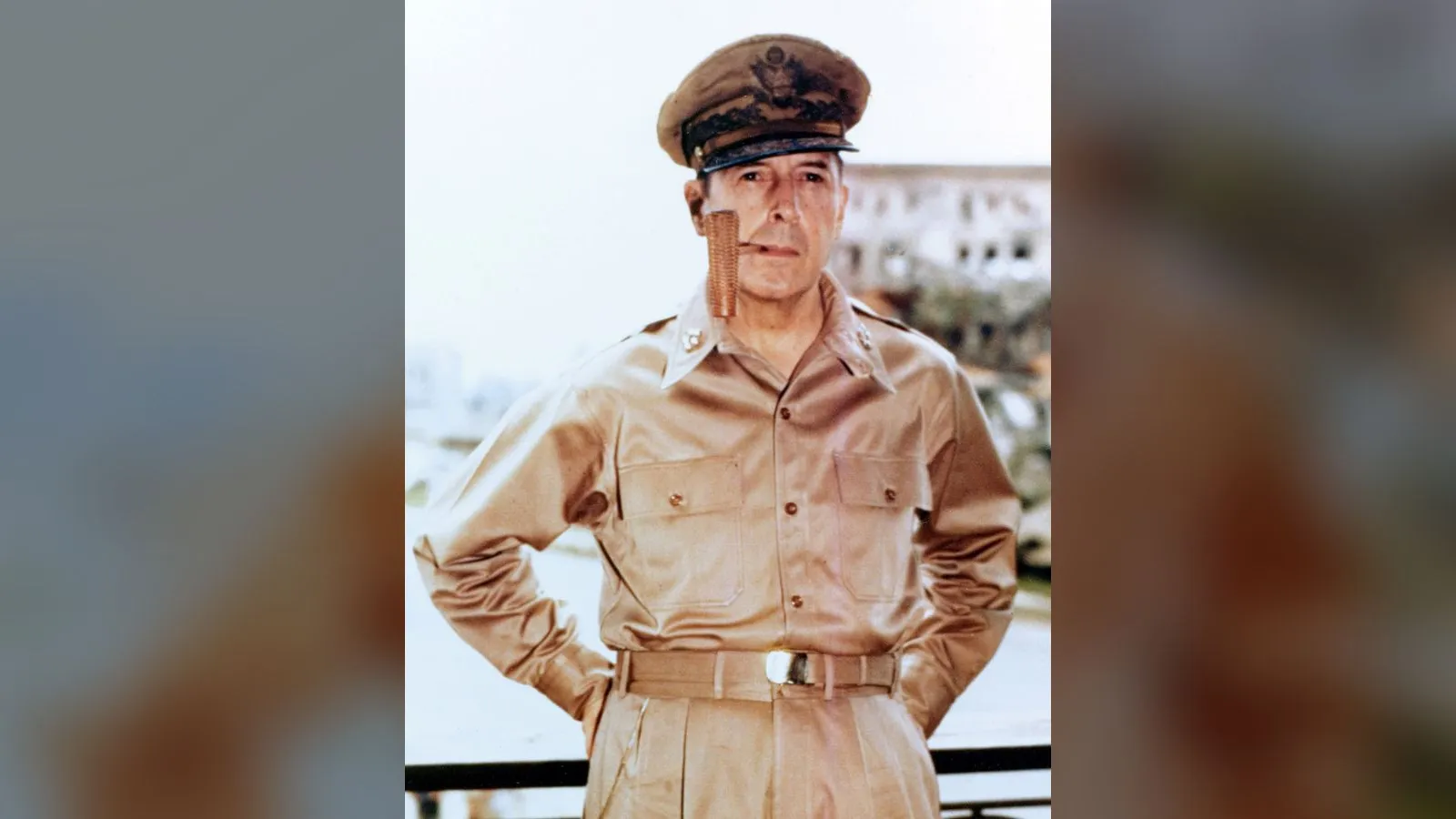

Douglas MacArthur (1880–1964)
Contents
TL;DR
- established Douglas MacArthur's Scottish ancestry is documented with real specificity: his grandfather, Arthur MacArthur Sr., was born in Glasgow, Scotland, on 26 January 1815, and emigrated with his family to the United States in 1828, settling near Uxbridge, Massachusetts — this article states this specific, documented place and date directly, a connection considerably more precise than many figures in this series.
- established MacArthur graduated first in his 1903 West Point class with a score of 98.14 percent, becoming the youngest brigadier general in the American Expeditionary Forces at age 38 during the First World War, where he earned the Distinguished Service Cross twice and the Silver Star seven times — this article names these specific, documented military distinctions directly, establishing MacArthur's record well before his more famous Second World War command.
- disputed The Medal of Honor MacArthur received in 1942, for his defence of the Philippines, remains genuinely contested: Army Chief of Staff George Marshall authorised the award specifically "to offset any propaganda by the enemy directed at his leaving his command," and Dwight Eisenhower, who had served under MacArthur, stated he "had not actually performed any acts of valor as required by law" — this article names this documented controversy directly rather than presenting the award as an uncomplicated recognition of battlefield heroism.
- established As Supreme Commander for the Allied Powers in Japan from 1945 to 1951, MacArthur oversaw the country's demilitarisation, democratisation, and postwar reconstruction, presiding over war crimes tribunals — a specific, documented administrative role this article states directly as distinct from, and arguably as consequential as, his wartime combat command.
- established On 11 April 1951, President Harry Truman relieved MacArthur of his Korean War command over fundamental disagreements about war strategy and MacArthur's public criticism of administration policy, a specific, documented act of civilian authority over a celebrated military commander this article states directly.
Key Facts
- Born
- 26 January 1880, Little Rock, Arkansas, USA
- Died
- 5 April 1964, Washington, D.C., USA
- Category
- Statesmen, Politicians & Public Figures
- Scottish ancestry
- Documented, specific — grandfather born Glasgow, 1815; emigrated 1828
- Key achievement
- Supreme Commander, Allied Forces, Southwest Pacific Area (WWII)
- Other key role
- Supreme Commander for the Allied Powers, postwar Japan (1945–1951)
- Career-ending controversy
- Relieved of Korean War command by President Truman, 1951
Scottish Impact Index (SI Score)
- Global Influence
- 10/10
- Enduring Connection
- 7/10
- Material Contribution
- 10/10
- Scottish Diaspora Distinctiveness
- 8/10
- Diaspora Legacy
- 10/10
- Recognition
- 10/10
55/60
Ranked =10th of 45 in Diaspora
A Note on Claims and Evidence
Family background and the specific, documented Scottish ancestral connection — his grandfather's birth in Glasgow in 1815 and emigration in 1828 — are drawn from Wikipedia's published biographical record. Education, military career across three wars, the controversial 1942 Medal of Honor, the postwar occupation of Japan, and the Korean War relief by President Truman are drawn from Wikipedia's published research record.
Timeline
Arthur MacArthur Sr., Douglas MacArthur's grandfather, is born in Glasgow, Scotland.
The MacArthur family emigrates to the United States, settling near Uxbridge, Massachusetts.
Douglas MacArthur is born in Little Rock, Arkansas, to Arthur MacArthur Jr., a Union Army officer and Medal of Honor recipient, and Mary Pinkney Hardy MacArthur.
MacArthur graduates first in his class from West Point and is commissioned in the Army Corps of Engineers, beginning service in the Philippines that October.
MacArthur conducts reconnaissance missions during the US occupation of Veracruz, Mexico, earning a Medal of Honor nomination that is ultimately withheld.
During the First World War, MacArthur is promoted to brigadier general at age 38, becoming the youngest general in the American Expeditionary Forces, and earns the Distinguished Service Cross twice and the Silver Star seven times.
MacArthur serves as Superintendent of West Point, formalising the Cadet Honor Code in 1922.
MacArthur serves as Army Chief of Staff, overseeing modernisation including the M1 Garand rifle, and plays a controversial role in the 1932 expulsion of the Bonus Army from Washington, D.C.
MacArthur becomes Military Advisor to the Commonwealth of the Philippines, retiring from the US Army in 1937 while retaining this position.
Roosevelt recalls MacArthur to active duty ahead of the Pacific War.
Following the Pearl Harbor attack and the destruction of his air forces, MacArthur retreats to Bataan before escaping to Australia, declaring "I came through and I shall return."
MacArthur is appointed Supreme Commander of Allied Forces in the Southwest Pacific Area and receives a Medal of Honor that later draws documented controversy over its justification.
MacArthur directs the New Guinea campaign and the liberation of the Philippines, and is promoted to General of the Army in December 1944.
MacArthur serves as Supreme Commander for the Allied Powers in Japan, overseeing demilitarisation, democratisation, and war crimes tribunals.
Following North Korea's invasion, MacArthur is appointed commander of the United Nations Command in the Korean War, directing the successful Inchon landing.
Following China's entry into the war, MacArthur's forces suffer major defeats.
President Truman relieves MacArthur of command over strategic disagreements and MacArthur's public criticism of administration policy; MacArthur addresses Congress, concluding, "Old soldiers never die; they just fade away."
MacArthur dies in Washington, D.C., at age 84.
Details
A specific, documented ancestral origin stated with precision
This article names Douglas MacArthur's Scottish ancestry with real specificity rather than a vague claim of general heritage: his grandfather, Arthur MacArthur Sr., was born in Glasgow in 1815 and emigrated to the United States in 1828 at around age thirteen. This article states this documented place and date directly because it represents a precise, traceable connection considerably stronger than many figures in this series receive.
An early military record named before the Pacific War fame that followed
This article states MacArthur's documented First World War distinctions directly, rather than letting his Second World War command overshadow his earlier career: his record-setting West Point graduation, his youngest-general status in the AEF, and his repeated decorations for valour. This article names this record because it represents the real, documented foundation of MacArthur's later reputation, not an incidental prelude.
A contested medal named without resolving the controversy unfairly
This article states the 1942 Medal of Honor's documented controversy directly rather than presenting it as an uncomplicated recognition of heroism: the award was explicitly authorised to counter enemy propaganda about MacArthur's departure from the Philippines, and a fellow general who had served under him stated he had not performed acts of valour meeting the legal standard. This article names this dispute because omitting it would present an incomplete and misleadingly straightforward account of a genuinely controversial honour.
A relief from command named as a real, consequential act of civilian authority
This article states Truman's 1951 relief of MacArthur directly and with its real documented stakes, rather than presenting it as a minor administrative footnote: a sitting president removing one of the most celebrated military commanders in American history over open disagreement about war strategy and public criticism of policy. This article names this because it represents a significant, documented assertion of civilian control over the military, central to any honest account of MacArthur's career.
Did You Know?
- Douglas MacArthur's grandfather, Arthur MacArthur Sr., was born in Glasgow, Scotland, in 1815 and emigrated to the United States as a child in 1828.
- MacArthur graduated first in his 1903 West Point class and became the youngest general in the American Expeditionary Forces during the First World War, at age 38.
- The Medal of Honor MacArthur received in 1942 is documented as having been authorised partly to counter enemy propaganda, and a fellow general stated he had not performed the acts of valour legally required for it.
- MacArthur's famous line "I shall return," declared after escaping the Philippines in 1942, became one of the most quoted statements of the Second World War.
- As head of the postwar occupation of Japan, MacArthur oversaw the country's demilitarisation and democratisation from 1945 to 1951.
- In 1951, President Truman relieved MacArthur of his Korean War command over open disagreements about military strategy.
- MacArthur's father, Arthur MacArthur Jr., was also a Medal of Honor recipient, making the family one of only two in US history with a father and son both awarded the medal.
FAQ
1Was Douglas MacArthur actually of Scottish descent?
Yes, documented with real specificity — his grandfather was born in Glasgow in 1815 and emigrated to the United States in 1828.
2Was Douglas MacArthur's 1942 Medal of Honor controversial?
Yes — it was explicitly authorised partly to counter enemy propaganda about his departure from the Philippines, and a fellow general stated he had not met the legal standard of valour required.
3What did MacArthur do after World War II?
He led the Allied occupation of Japan from 1945 to 1951, overseeing its demilitarisation and democratisation.
4Why was MacArthur relieved of his Korean War command?
President Truman removed him in April 1951 over fundamental strategic disagreements and MacArthur's public criticism of administration policy.
5What is MacArthur's most famous quote?
"I shall return," declared after escaping the Philippines in 1942; he later closed his farewell address to Congress with "Old soldiers never die; they just fade away."
6Did MacArthur serve in more than one war?
Yes — he served in the First World War, the Second World War, and the Korean War, across more than four decades of military service.
7When did Douglas MacArthur die?
5 April 1964, in Washington, D.C., at age 84.
Sources and Further Reading
Caveats: Myths and Disputed Claims
- disputed This article does not present Douglas MacArthur's 1942 Medal of Honor as an uncomplicated recognition of battlefield heroism; the documented record includes its propaganda-countering justification and a fellow general's direct statement that it did not meet the legal standard for the award.
- Clarification: This article does not treat President Truman's 1951 relief of MacArthur as a minor footnote; it represents a significant, documented assertion of civilian authority over military command, central to MacArthur's historical legacy.
Card 021 · Diaspora