Scottish Inventions · Science & Optics
Sir David Brewster
The Scottish Physicist Who Taught the World to See Beautiful Forms
SI Score48/60Ranked #31 of 50 in InventionsBreakdown
Scottish Impact Index (SI Score)
- Global Impact
- 7/10
- Longevity
- 10/10
- Economic / Material Impact
- 6/10
- Originality / Distinctiveness
- 10/10
- Legacy (Built Upon)
- 6/10
- Recognition
- 9/10
Inventor of the kaleidoscope, discoverer of Brewster’s Angle, and the man William Whewell called the “father of modern experimental optics.”
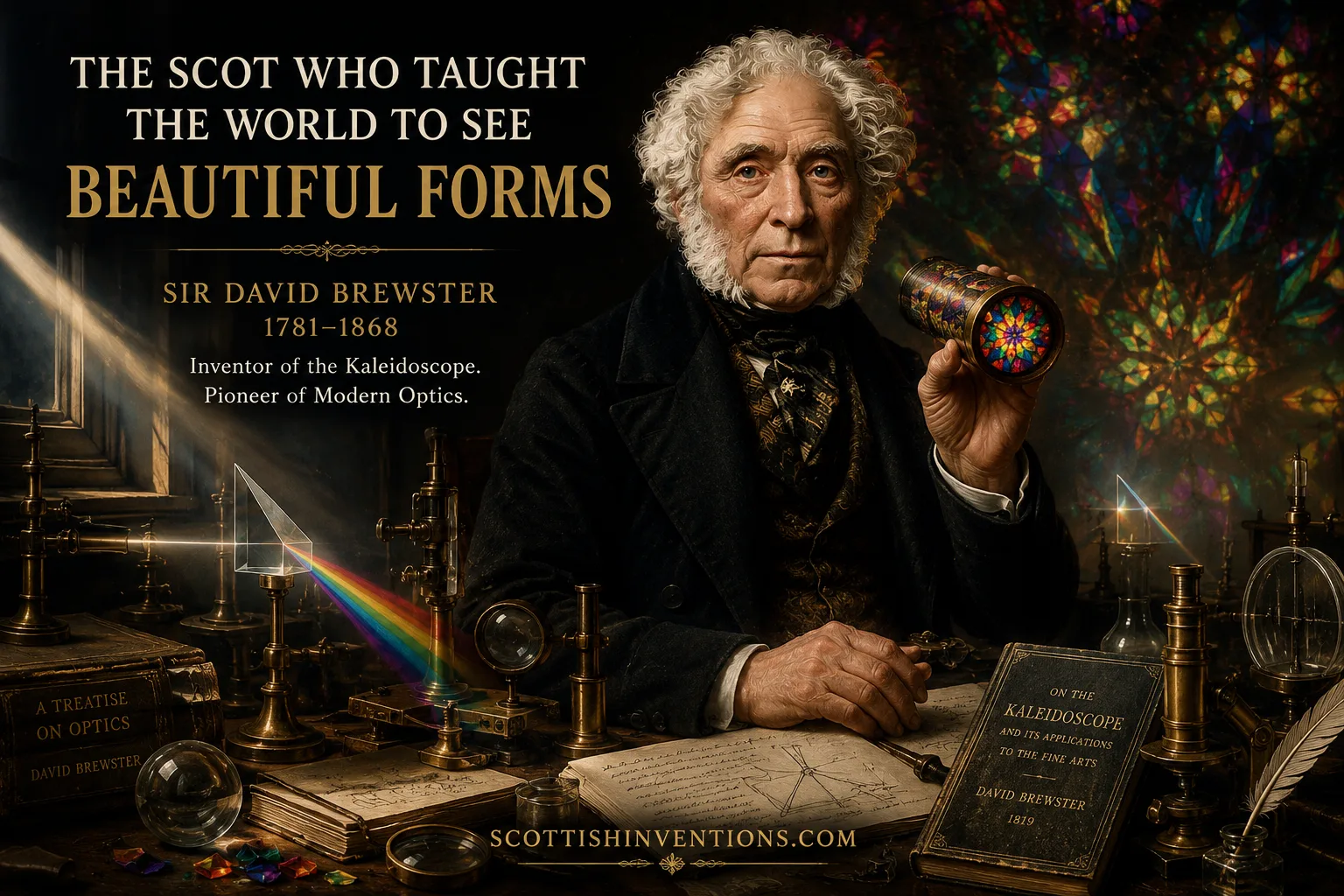
Sir David Brewster (1781–1868) matters today for two reasons that could hardly be more different. In 1816 he invented the kaleidoscope, an optical toy that became one of the greatest consumer crazes of the nineteenth century — an estimated 200,000 sold in London and Paris in three months. And between 1811 and 1815, working in Edinburgh, he discovered the law of polarised light now known as Brewster’s Angle.
That second discovery is the one that quietly runs the modern world. Every pair of polarised sunglasses, every LCD screen on a phone or television, every camera polarising filter and every laser cavity window works on the principle Brewster set down two centuries ago. William Whewell called him the “father of modern experimental optics” and “the Kepler of optics.”
Yet it is the kaleidoscope — the toy that made him famous and earned him almost nothing — that has kept his name in the public mind. This is the story of both.
Key Facts
Timeline
- •
1781
Born 11 December in the Canongate of Jedburgh, Scottish Borders.
- •
1793
Matriculates at the University of Edinburgh, aged just 12.
- •
1811
Begins the experiments on reflected light that will yield Brewster's Angle.
- •
1815
Elected Fellow of the Royal Society; awarded the Copley Medal.
- •
1816
Invents the kaleidoscope in Edinburgh, as a by-product of polarisation experiments.
- •
1817
Granted British Patent No. 4136 for the kaleidoscope (July).
- •
1819
Publishes A Treatise on the Kaleidoscope: '200,000 sold in London and Paris in three months.'
- •
1831
Knighted; helps found the British Association for the Advancement of Science at York.
- •
1849
Designs the lenticular (binocular) stereoscope; shown to Queen Victoria at the 1851 Great Exhibition.
- •
1859
Appointed Principal of the University of Edinburgh.
- •
1868
Dies 10 February at Allerly, near Melrose; buried at Melrose Abbey.
1. Who Was Sir David Brewster?
Sir David Brewster (1781–1868) was a Scottish physicist, mathematician, astronomer and writer, best known as the inventor of the kaleidoscope and discoverer of the law of polarisation now known as Brewster’s Angle.
He was born on 11 December 1781 in the Canongate of Jedburgh, in the Scottish Borders. His father James was rector (headmaster) of Jedburgh Grammar School; his mother was Margaret Key. As a boy Brewster fell under the spell of James Veitch of Inchbonny, a self-taught local astronomer and instrument-maker, and built his first telescope at about the age of ten. In 1793, aged just twelve, he matriculated at the University of Edinburgh, studying under Dugald Stewart and John Playfair.
He was licensed to preach in 1804, but crippling nervousness in the pulpit — combined with an irresistible pull toward science — turned him away from the Church. In 1810 he married Juliet Macpherson, youngest daughter of James Macpherson of Belleville, the controversial translator of the Ossian poems.
He was a man of extraordinary energy: he communicated 315 scientific papers and articles in his lifetime, mostly on optics, and was a tireless populariser of science. He was knighted in 1831 — reportedly the first person knighted for scientific research since Sir Isaac Newton — served as Principal of the United College of St Salvator and St Leonard at the University of St Andrews from 1838, and became Principal of the University of Edinburgh in 1859. He died at Allerly, near Melrose, on 10 February 1868 and is buried in the grounds of Melrose Abbey.
2. How Brewster Invented the Kaleidoscope
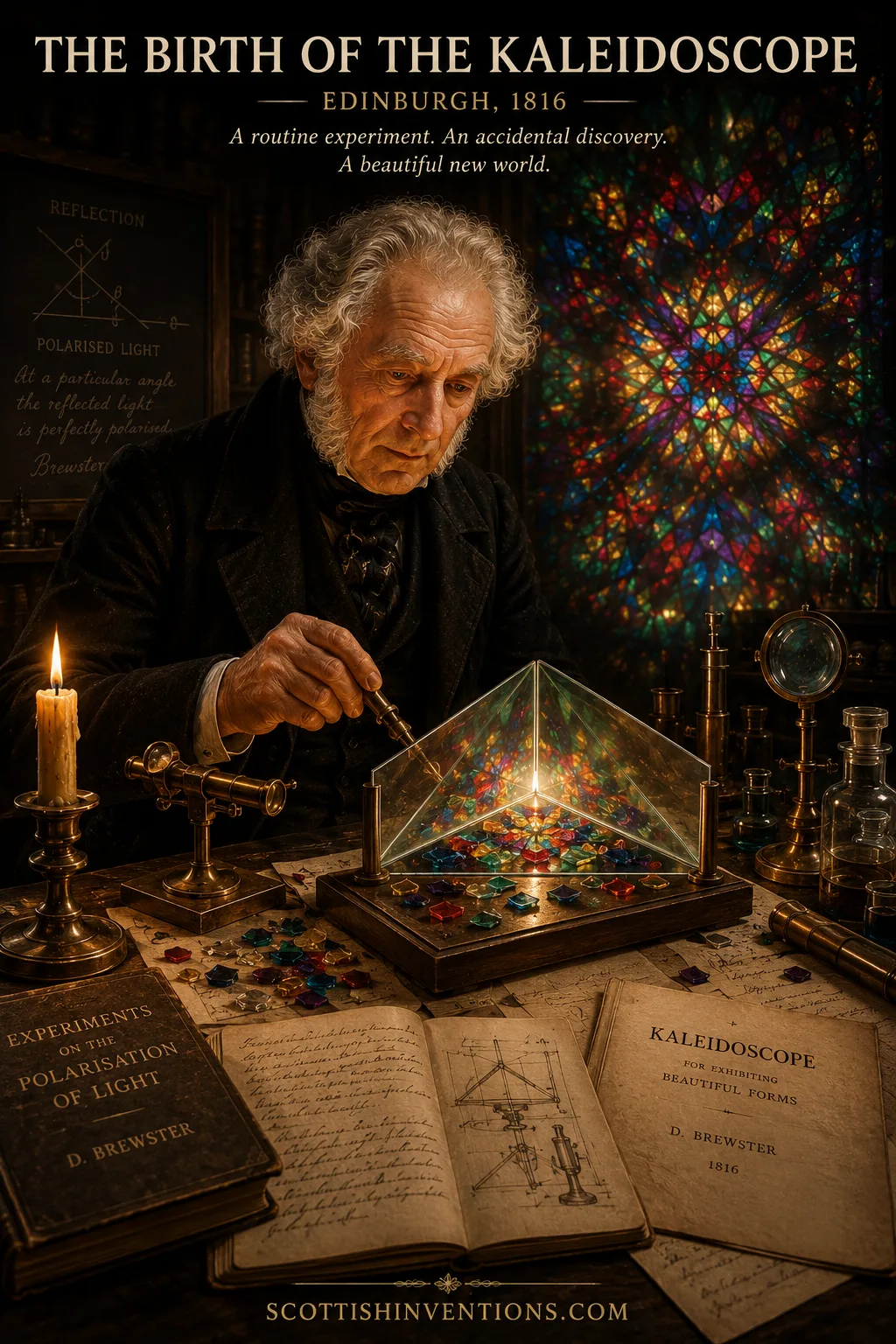
The kaleidoscope was born of laboratory accident. In 1814, Brewster was studying the polarisation of light by successive reflections between plates of glass, and noticed “the circular arrangement of the images of a candle round a centre.” Refining the experiment in 1815 — and struck by how a fragment of cement near the end of a triangular glass trough produced an almost perfectly symmetrical pattern — he realised that two or more mirrors set at a precise angle, with loose objects placed at one end, created endlessly repeating symmetrical figures.
He coined the name from the Greek kalos (beautiful), eidos (form) and skopein (to look at): “to see beautiful forms.” In July 1817 he was granted British Patent No. 4136 — “for a new Optical Instrument called ‘The Kaleidoscope’ for exhibiting and creating beautiful Forms and Patterns of great use in all the ornamental Arts.”
3. The Kaleidoscope Craze — and the Financial Disaster
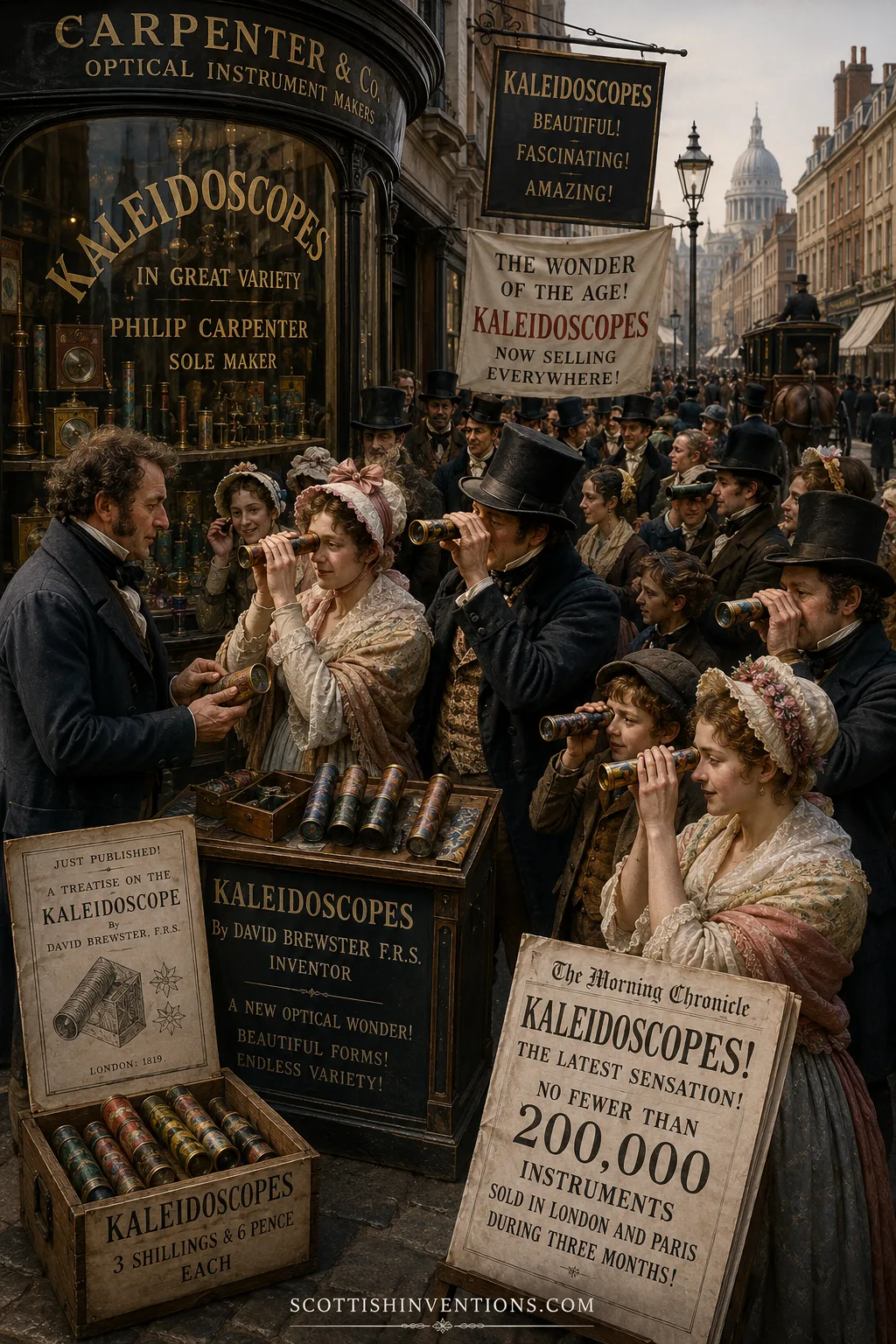
The kaleidoscope became one of the greatest commercial crazes of the nineteenth century, almost overnight. In his 1819 A Treatise on the Kaleidoscope Brewster wrote:
“No fewer than two hundred thousand instruments have been sold in London and Paris during three months.”
— Sir David Brewster, A Treatise on the Kaleidoscope (1819)
People walked the streets staring into the tubes; those who could not afford one paid “a penny for a peek.” The kaleidoscope had done something rare — it had become the first true consumer-media craze, a Regency-era equivalent of a viral gadget.
But Brewster made almost nothing. The fatal flaw was that a working model had been shown to London opticians before the patent was secured. Under contemporary patent law that public disclosure fatally weakened his protection, and the instrument was copied and marketed before authorised production had even begun. The manufacturer he engaged was the Birmingham optician Philip Carpenter (not, as is sometimes stated, “Philip Newsom”), whose models were stamped “sole maker”; from 1818 Brewster licensed more than a dozen further makers to try to keep up with demand. He later reckoned that of the vast number sold, perhaps no more than a thousand were properly constructed authorised copies.
4. Brewster’s Greatest Scientific Discovery: Brewster’s Angle
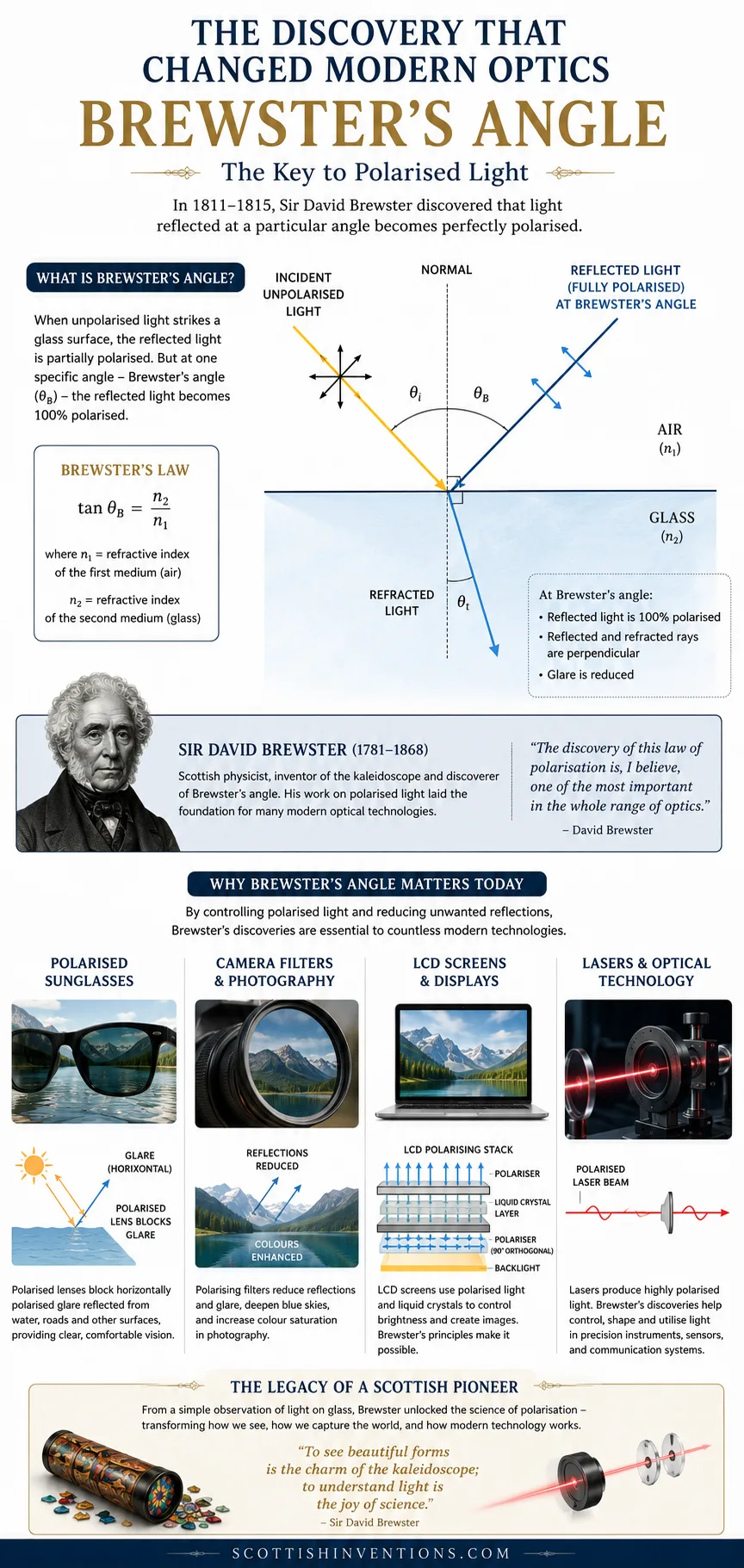
Long before the kaleidoscope, Brewster made the discovery that secures his place in the history of physics. Building on the work of Étienne-Louis Malus, he investigated what happens when light strikes a transparent surface. Around 1811–1815 he established that at one specific angle of incidence — now called the Brewster angle or polarising angle — the reflected light is completely polarised.
5. Modern Impact: From Sunglasses to Lasers
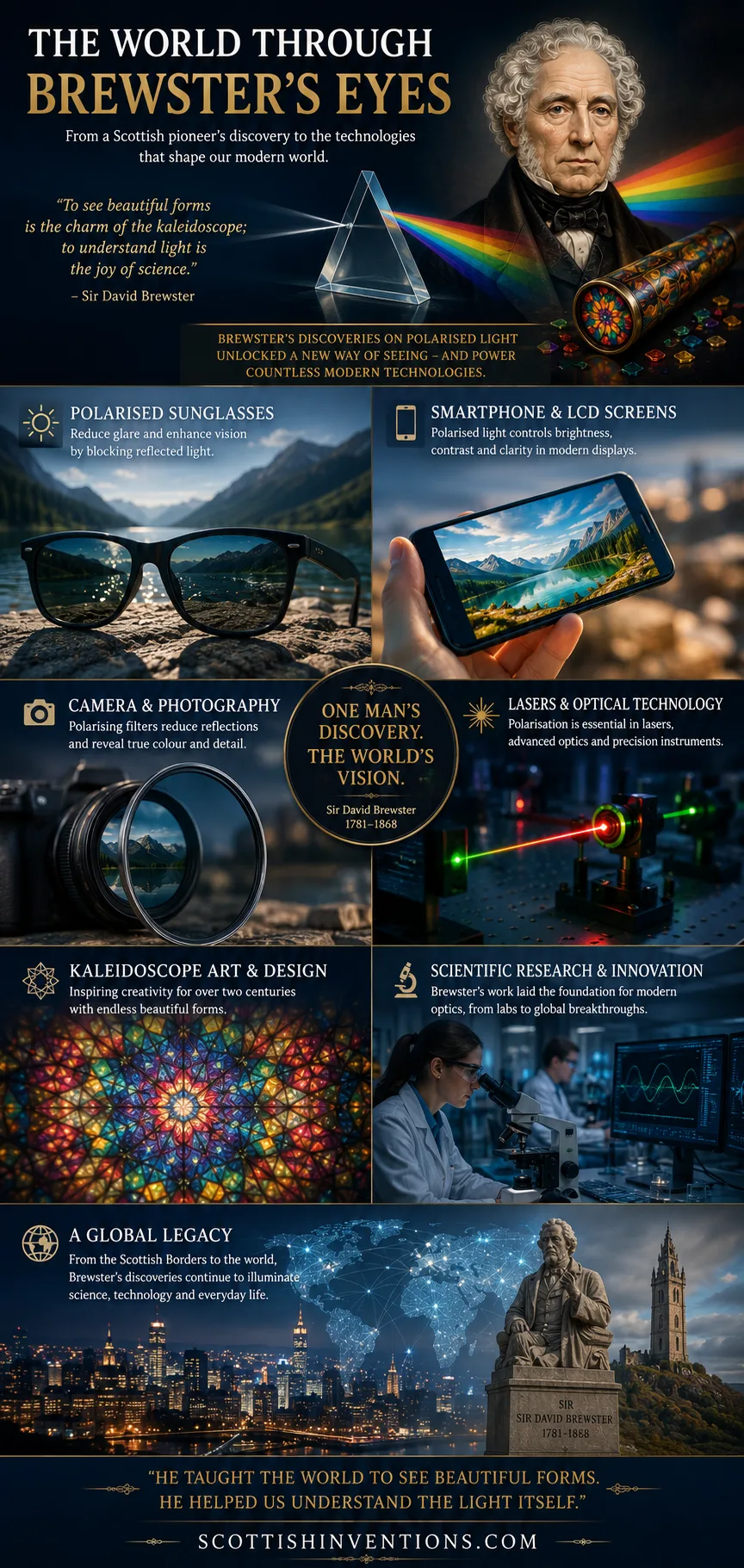
Brewster’s Law is the working principle behind an astonishing amount of modern technology:
- Polarised sunglasses block horizontally polarised light — the plane in which glare reflected from roads and water is strongest.
- Polarising filters that photographers screw onto their lenses cut reflections and deepen sky colours.
- Liquid-crystal displays (LCDs) in phones, laptops, tablets and televisions use crossed polarisers to control brightness pixel by pixel.
- Brewster-angle windows in laser cavities allow one polarisation of light to pass with almost no loss — essential to modern laser design.
- Optical sensors, ellipsometry and metrology instruments rely on precise polarisation control to measure thin films to nanometre accuracy.
For this and related work — including his laws of double refraction and optical mineralogy — Brewster was elected a Fellow of the Royal Society in 1815, and he was one of only a handful of scientists to win all three of the Society’s major medals: the Copley (1815), the Rumford (1818, awarded specifically for his work on the polarisation of light), and a Royal Medal (1830). He also took a prize of the Paris Institut de France in 1816. It was this body of work — not the kaleidoscope — that led William Whewell in 1859 to call Brewster “the father of modern experimental optics” and “the Kepler of optics.”
6. Legacy, Honours and Institutions
The stereoscope. In 1849 Brewster designed the lenticular (binocular) stereoscope, using lenses and prisms rather than the bulky mirrors of Sir Charles Wheatstone’s 1838 reflecting model. Shown at the Great Exhibition of 1851, it launched a Victorian 3-D photography craze — nearly half a million devices sold by 1856. (Wheatstone had established the stereoscope’s principle first; the two men feuded bitterly over priority for years.)
Lighthouses. Brewster was an early and persistent British champion of the dioptric (lens-based) lighthouse system, describing the polyzonal “built-up” lens around 1811 — slightly ahead of, and independently of, Augustin Fresnel, whose name is now attached to it.
Institutions. Brewster edited the eighteen-volume Edinburgh Encyclopaedia and the Edinburgh Journal of Science, contributed major articles to the Encyclopaedia Britannica, and helped found the British Association for the Advancement of Science in 1831 alongside Charles Babbage and Sir John Herschel; he was its President in 1849. In 1821 he founded the Royal Scottish Society of Arts.
Newton’s biographer. His monumental Memoirs of the Life, Writings, and Discoveries of Sir Isaac Newton (1855) remains a major nineteenth-century biography, the fruit of more than twenty years’ study of original manuscripts.
Commemoration. A bust stands in the Hall of Heroes at the National Wallace Monument in Stirling. The physics building at Heriot-Watt University is named the David Brewster Building, and in 2015 a street at the University of Edinburgh’s King’s Buildings science campus was named David Brewster Road. A blue plaque marks his connection to Jedburgh. His name lives on internationally through the Brewster Kaleidoscope Society, founded in 1986 — a worldwide community of kaleidoscope artists and collectors.
“To see beautiful forms is the charm of the kaleidoscope; to understand light is the joy of science.”
— Sir David Brewster
Did You Know?
Frequently Asked Questions
Who invented the kaleidoscope?
The Scottish physicist Sir David Brewster (1781–1868) invented the kaleidoscope in Edinburgh in 1816 during experiments on the polarisation of light by reflection. He was granted British Patent No. 4136 in July 1817. He coined the name from the Greek kalos (beautiful), eidos (form) and skopein (to look at) — 'to see beautiful forms.'
What is Brewster's Angle?
Brewster's Angle (or the polarising angle) is the specific angle of incidence at which light reflected from a transparent surface becomes completely polarised. Brewster expressed it in a simple law: tan θ_B = n₂/n₁, where n₁ and n₂ are the refractive indices of the two media. For ordinary glass (n ≈ 1.5), the Brewster angle is about 56.3°.
Who was Sir David Brewster?
Sir David Brewster (1781–1868) was a Scottish physicist, mathematician, astronomer and writer born in Jedburgh. He invented the kaleidoscope (1816), discovered Brewster's Angle (1811–1815), designed the lenticular stereoscope (1849), and served as Principal of St Andrews and later the University of Edinburgh. He was elected a Fellow of the Royal Society in 1815 and knighted in 1831.
How does a kaleidoscope work?
A kaleidoscope uses two or more mirrors set at a precise angle inside a tube. Loose fragments of coloured glass sit at one end. When light enters, the mirrors create multiple symmetrical reflections of the fragments, producing endlessly changing patterns of 'beautiful forms.' Even mirror angles that are aliquot divisions of 360° produce the most regular symmetries.
Why is Sir David Brewster important?
Brewster is called the 'father of modern experimental optics.' His discovery of the law of polarisation (Brewster's Angle) underpins polarised sunglasses, camera filters, LCD screens and laser cavities. He also invented the kaleidoscope, designed the lenticular stereoscope, championed the dioptric lighthouse lens, and helped found the British Association for the Advancement of Science.
What is polarised light?
Ordinary light waves vibrate in all directions perpendicular to their direction of travel. Polarised light vibrates in only one plane. Brewster showed that when unpolarised light strikes a transparent surface at a specific angle, the reflected light becomes completely polarised — a foundational discovery in optical physics.
How do polarised sunglasses work?
Polarised sunglasses use a filter that blocks horizontally polarised light — the plane in which glare reflected from roads, water and other flat surfaces is most strongly polarised. The principle rests directly on Brewster's 1811–1815 discovery of the polarising angle.
Did Brewster invent the stereoscope?
Not outright. Sir Charles Wheatstone established the stereoscope's principle in 1838 using mirrors. In 1849 Brewster designed the compact lenticular (lens-based) stereoscope, which used prisms and lenses instead of bulky mirrors. Shown at the 1851 Great Exhibition, it launched the Victorian 3-D photography craze; nearly half a million had been sold by 1856.
Why didn't Brewster become wealthy from the kaleidoscope?
Brewster's 1817 patent (No. 4136) was fatally weakened because a working model had been shown to London opticians before protection was secured. Manufacturers copied the design freely. An estimated 200,000 kaleidoscopes sold in London and Paris in three months, yet Brewster saw almost none of the profits — perhaps only a thousand were properly authorised copies.
Where is Sir David Brewster buried?
Brewster died on 10 February 1868 at Allerly, near Melrose in the Scottish Borders, and is buried in the grounds of Melrose Abbey. A bust of him stands in the Hall of Heroes at the National Wallace Monument in Stirling, and the physics building at Heriot-Watt University bears his name.
Caveats & Historical Notes
- The 200,000 figure is Brewster’s own estimate, repeated in 1819 and 1858; it is impossible to verify independently, though the documented public furore confirms the device’s enormous success.
- Brewster did not invent the stereoscope outright — Sir Charles Wheatstone established its principle in 1838. Brewster’s contribution was the lens-based lenticular design of 1849.
- The famous Queen Victoria stereoscope anecdote rests on Brewster’s own testimony and should be enjoyed as a good story rather than treated as independently documented.
- On lighthouses, Brewster was an early and persistent advocate of the dioptric/polyzonal lens but not its sole inventor; Fresnel developed his design independently and first put it into operation.
- A supposed “Brewster Chair” at the University of Edinburgh and a “Brewster window” or statue at Jedburgh Abbey could not be verified in reputable sources, and are not repeated as fact here.
Sources & Further Reading
Tier 1 · Primary
- British Patent No. 4136, granted July 1817, “for a new Optical Instrument called ‘The Kaleidoscope’.”
- Brewster, D. — A Treatise on the Kaleidoscope, 1819.
Tier 2 · Scholarly and institutional
- Brewster, D. (ed.) — Edinburgh Encyclopaedia, and the Edinburgh Journal of Science.
- Encyclopaedia Britannica — contributions by Brewster.
- British Association for the Advancement of Science — founding record, 1831.
- Royal Scottish Society of Arts — founded by Brewster, 1821.
- Brewster, D. — Memoirs of the Life, Writings, and Discoveries of Sir Isaac Newton, 1855.
- Royal Society — Fellowship (1815), Copley Medal (1815), Rumford Medal (1818) and Royal Medal (1830) citations.
- William Whewell, 1859 — describing Brewster as “the father of modern experimental optics” and “the Kepler of optics.”
Tier 3 · General reference
- National Wallace Monument, Stirling — Hall of Heroes bust.
- Heriot-Watt University — David Brewster Building.
- Brewster Kaleidoscope Society, founded 1986.
Discover the remarkable inventions and discoveries that changed the world at ScottishInventions.com.