Scottish Inventions · Engineering & Agriculture
Andrew Meikle: The Scottish Inventor Who Revolutionised Farming Forever
He worked in wood, iron and leather in a small East Lothian mill — and produced the single most consequential agricultural machine in modern history. Every combine harvester on Earth still uses his idea.

On this page
- Introduction
- Key Facts
- Who Was Andrew Meikle?
- Life Before Mechanical Threshing
- Inventing the World's First Successful Threshing Machine
- How Meikle's Machine Worked
- The Drum-and-Concave Principle
- Changing Agriculture Forever
- From Threshing Machine to Combine Harvester
- The Swing Riots and the Human Cost
- Timeline
- Lasting Legacy
- FAQ
- Related Scottish Engineering
For thousands of years, the separation of grain from straw was done by hand — sheaves laid on a barn floor and beaten, hour after hour, with a wooden flail through the long winter months. In late-eighteenth-century Britain, about a quarter of all farm labour was devoted to this single, brutal task. Then a quiet East Lothian millwright changed everything.
Andrew Meikle built the world's first genuinely successful threshing machine at Houston Mill near East Linton in 1786, and patented it in 1788. It is one of the most quietly consequential Scottish inventions in history — because the drum-and-concave mechanism he perfected that year still sits, scaled and steel-bodied, inside the threshing cylinder of every modern combine harvester in the world.
Key Facts
Born East Lothian, 1719
Andrew Meikle was born on 5 May 1719 at Saltoun in Haddingtonshire (East Lothian), into a family of distinguished millwrights.
Patented 1788
English Patent No. 1645, granted 9 April 1788 — 'a Machine for Separating Corn from the Straw.' The first working machine was built in February 1786.
Up to 40 bushels/hour
Meikle's machine threshed up to 40 bushels of corn an hour — many times faster than a labourer with a flail.
Houston Mill
Meikle lived and worked at Houston Mill on the Phantassie estate near East Linton, where he mentored the great civil engineer John Rennie.
Died poor at 92
Pirated across Britain, the patent earned him little. A subscription of upwards of £1,500 raised by Sir John Sinclair in 1809 kept him in dignified old age.
Still in every combine
The drum-and-concave threshing mechanism Meikle perfected in 1786 is still used, in modern form, inside every combine harvester in the world today.
Who Was Andrew Meikle?
Andrew Meikle was born on 5 May 1719 at Saltoun in Haddingtonshire (today East Lothian), into a family already steeped in mechanical ingenuity. His gravestone famously describes him as "descended from a race of ingenious mechanics." His father, James Meikle, had been sent to Holland in 1710 by Andrew Fletcher of Saltoun to learn Dutch grain processing, and brought back the designs for a pot-barley mill and a hand-cranked winnowing machine — the "fanners" — the first of its kind in Britain, with the first pair set up at Saltoun in 1720.
Andrew settled at Houston Mill on the Phantassie estate near East Linton, combining the trades of farmer, miller and millwright. He was patient, methodical and intensely practical, working in stone, wood, leather and increasingly iron. Around 1772 he invented self-regulating windmill spring sails — hinged shutters, like a Venetian blind, that reefed themselves in high winds. He mentored the young John Rennie, son of his Phantassie landlord, who would go on to become one of Britain's greatest civil engineers; Samuel Smiles called Meikle "Rennie's Master." He died on 27 November 1811, aged 92, and was buried at Prestonkirk churchyard, East Linton.
Life Before Mechanical Threshing
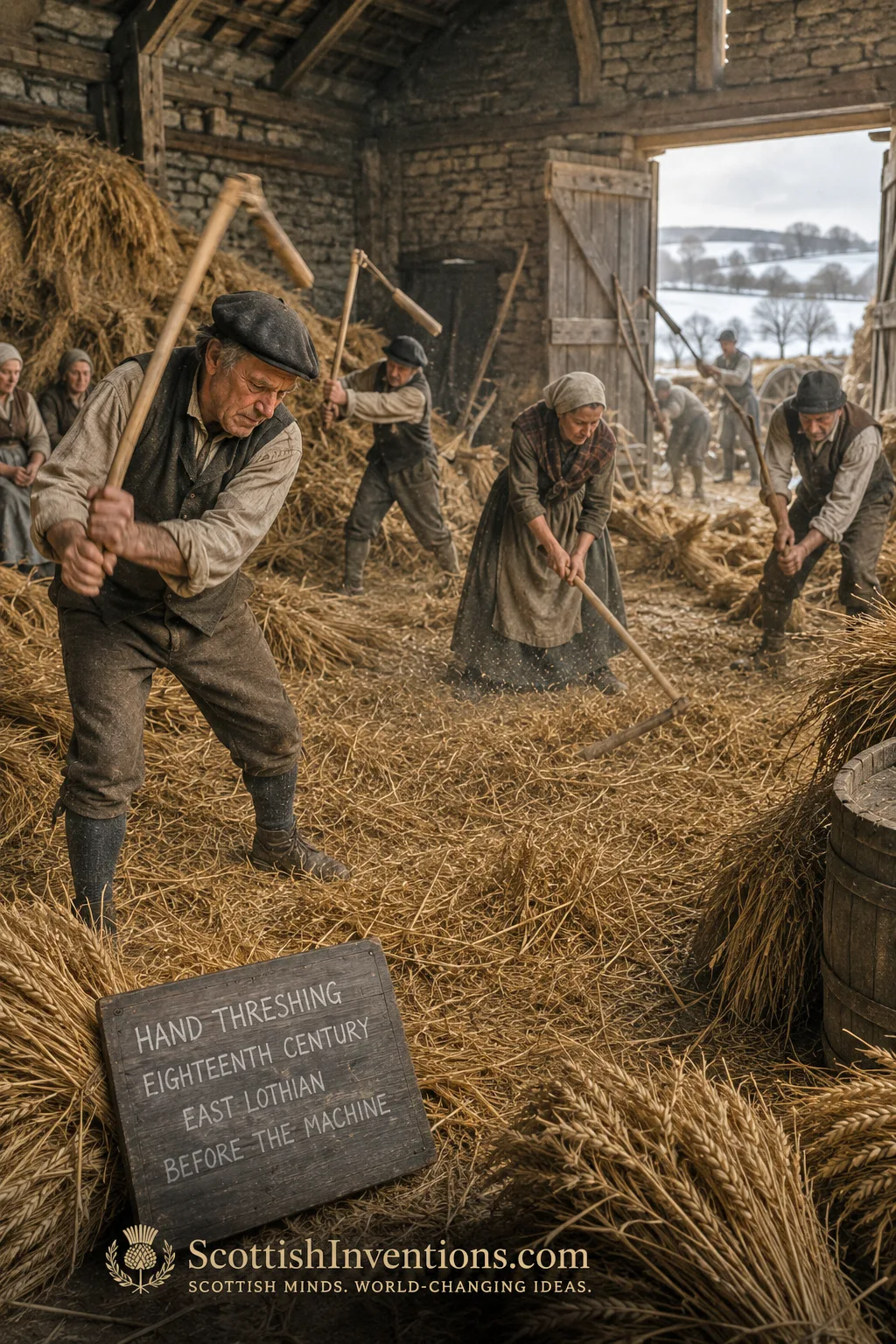
Threshing is the separation of grain from the stalks and husks on which it grows. For millennia it was done by hand, chiefly with the flail — two pieces of wood joined by a leather thong, the handstaff in one hand and the beater swinging from the other. Labourers laid sheaves on a barn floor and beat them, hour after hour, throughout the long winter months.
It was brutally slow. Encyclopaedia Britannica records that with a flail "one man could thresh 7 bushels of wheat, 8 of rye, 15 of barley, 18 of oats, or 20 of buckwheat in a day." A single bushel of wheat took roughly an hour of beating. Before mechanisation, about one-quarter of all agricultural labour in late-eighteenth-century Britain was devoted to threshing alone. Many had tried to mechanise it — Michael Menzies in 1732, a Mr Stirling of Dunblane in 1758 — and all had failed, their machines either disintegrating or rubbing the grain and ruining it.
Inventing the World's First Successful Threshing Machine
Meikle's road to success ran through failure. Around 1778 he built a thresher resembling the Menzies design and it failed. About 1784, the gentleman farmer Sir Francis Kinloch of Gilmerton had a model of a Northumberland machine sent to Meikle's workshop. Run at high speed, it too was destroyed in the experiment.
But Meikle saw why it failed. He conceived a drum strong enough to run at great speed, armed with fixed beaters (or "scutchers") that would beat the grain free rather than rub it out. He communicated the idea to his son George, then at Alloa, and in February 1786 they completed the first machine on the new principle for Mr Stein, a large distiller and farmer at Kilbagie, Clackmannanshire — for about £80, on the bold understanding that if it failed to satisfy Stein, Meikle would not be paid. It worked, and worked for years.
The English Patent (No. 1645) was granted on 9 April 1788 for "a Machine, which may be worked by Cattle, Wind, Water or other Power, for the purpose of Separating Corn from the Straw." Tellingly, the patent was for England only: Meikle had forfeited his right to a valid Scottish patent by publicly using the invention before applying. He began manufacturing threshing machines as a business around 1789.
How Meikle's Machine Worked
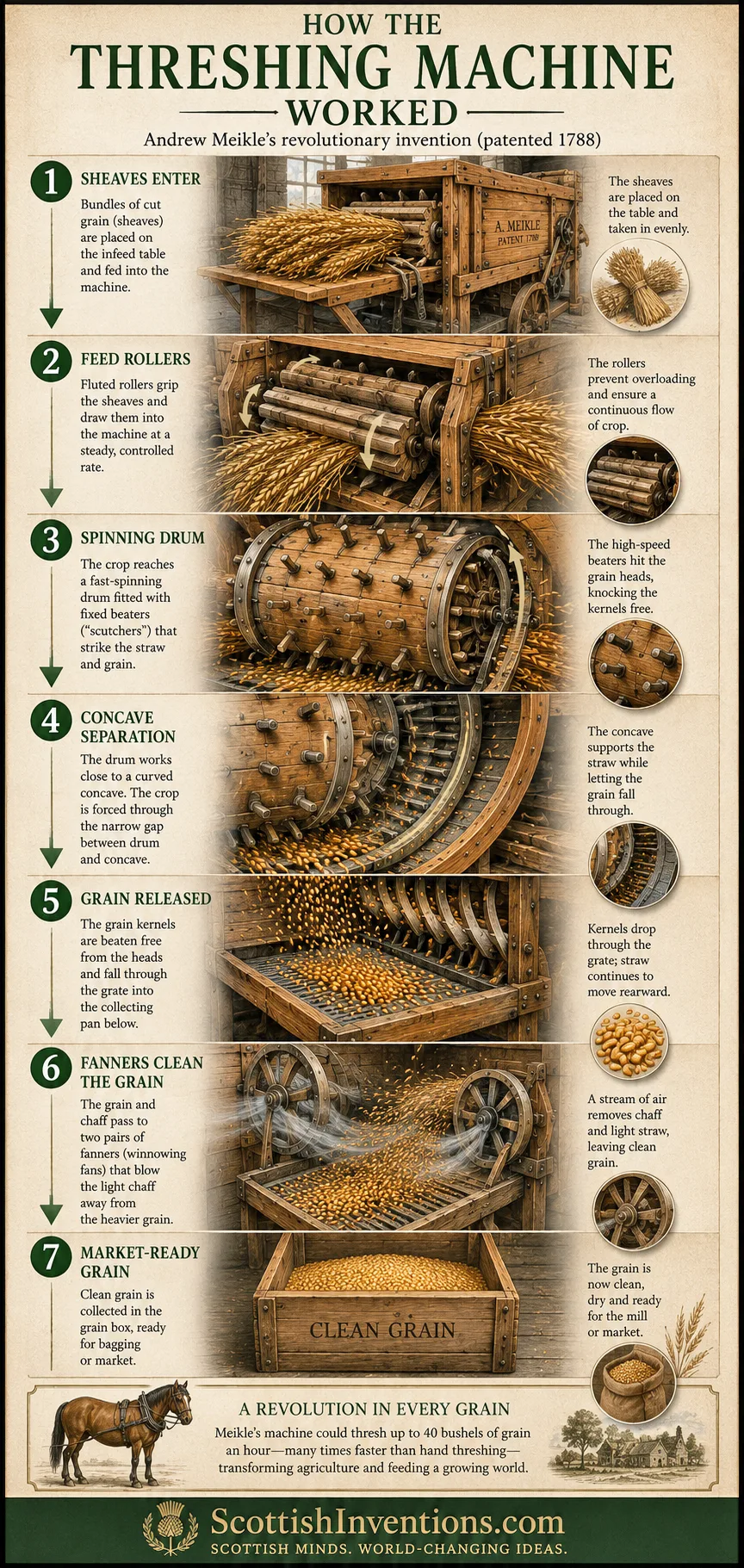
Strip away the eighteenth-century vocabulary and Meikle's machine is beautifully simple:
- Sheaves are fed in. Fluted rollers grip the cut grain and draw it into the machine at a steady, controlled rate.
- A drum spins fast. A robust rotating cylinder, fitted with fixed wooden or iron beaters, whirls at high speed.
- The grain passes a narrow gap. The drum sits close to a curved fixed surface called the concave. The crop is forced through the tight gap between them.
- The grain is beaten free. The beaters knock the kernels out of the husks without crushing them.
- Straw and grain part company. The straw is thrown clear out the rear (useful for thatch and bedding); the grain and chaff drop through a grating.
- Fanners clean the grain. Two pairs of fanners (winnowing fans of the kind Meikle's father had pioneered) plus sieves blow and sift the chaff away, leaving clean grain ready for market.
The payoff was enormous. Meikle's machine "could handle up to forty bushels of corn an hour" — perhaps five to ten times faster than men with flails. Where a labourer might thresh seven bushels of wheat in a hard day, the machine could do that and far more in an hour.
The Drum-and-Concave Principle
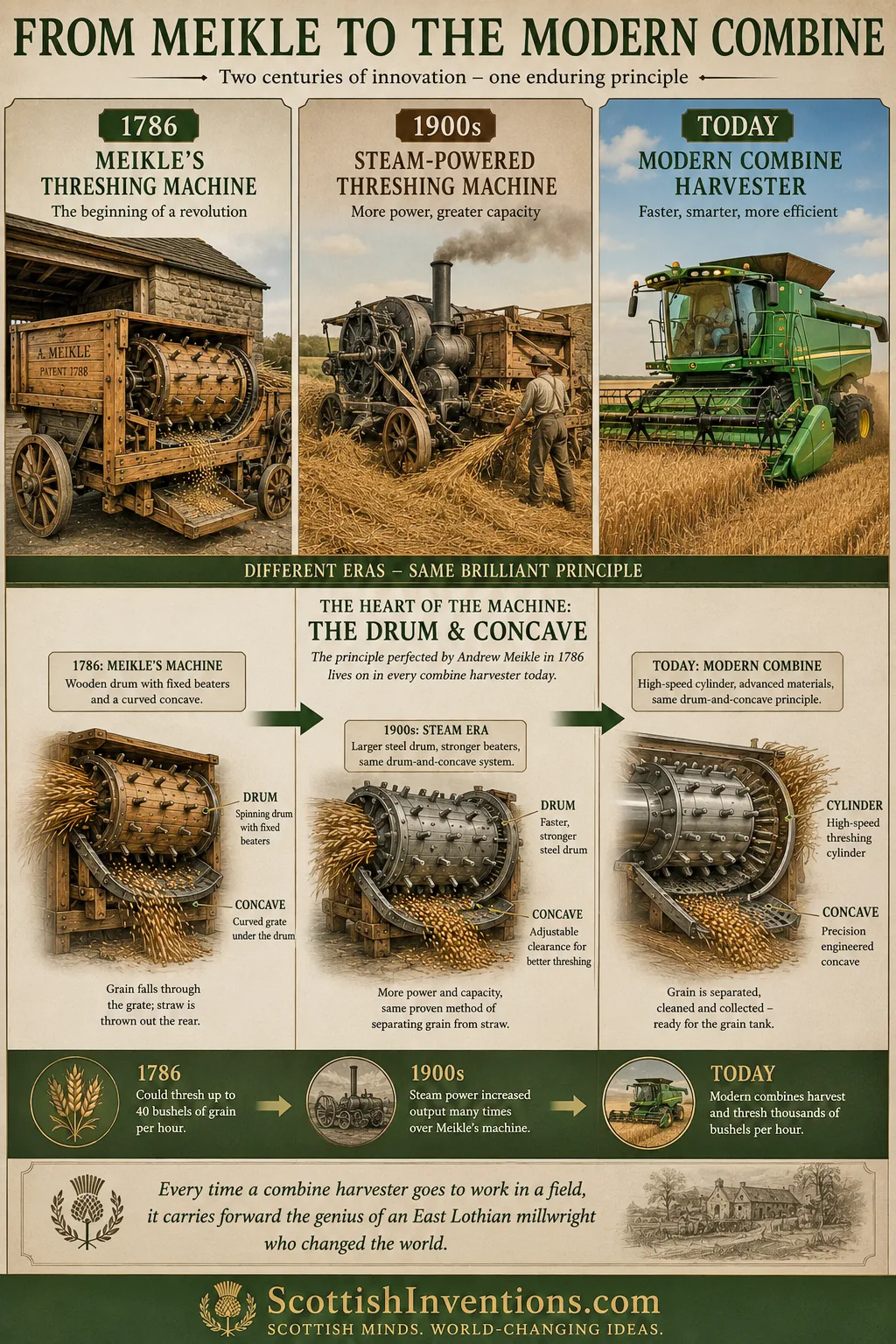
The heart of Meikle's invention is the relationship between two components: a fast-spinning drum with fixed beaters, and a curved fixed grate beneath it called the concave. The crop is forced through the narrow gap; the impact of the beaters and the rubbing action against the concave knock the grain free without crushing the kernels.
| Meikle, 1786 | Steam era, 1900s | Modern combine | |
|---|---|---|---|
| Drum | Wooden, with fixed beaters | Steel drum, stronger beaters | High-speed serrated cylinder (~500 rpm) |
| Concave | Curved fixed grate | Adjustable clearance | Precision-engineered concave |
| Power | Horse, water, wind | Steam engine | Diesel / electric |
| Output | Up to 40 bushels/hour | Many times Meikle's rate | Thousands of bushels/hour |
"There are few, if any, mechanical devices of Scottish origin which have had such an immediately transformative effect on a major industry and the supply of food."— Scottish Engineering Hall of Fame
Changing Agriculture Forever
Meikle's machine landed at exactly the right moment. The Lothians were the very crucible of the Scottish Agricultural Revolution: a generation of landowners — Fletcher of Saltoun, John Cockburn of Ormiston, George Rennie of Phantassie — were enclosing fields, draining marshes, liming soil and rebuilding farm steadings around new, scientific methods, drawing on the same Enlightenment culture that produced James Hutton's modern geology. A machine that demolished the single biggest winter labour bottleneck fitted perfectly.
Adoption was steady, then rapid. The Scottish Engineering Hall of Fame records that "Meikle began making threshing machines for sale in 1789. Other inventors improved the effectiveness of the device during the next few years, and by 1800 it was in general use… The fixed threshing mill, powered by water-wheel, windmill, or animal power rapidly became a standard feature of all arable farms." In East Lothian alone, over 300 Meikle-pattern machines were built in the twenty years after his patent.
From Threshing Machine to Combine Harvester
The combine harvester — which reaps, threshes and cleans grain in a single pass — was developed in nineteenth- and early-twentieth-century America. But the threshing mechanism inside every modern combine is a direct descendant of Meikle's 1786 design. The cylinder "has sharp serrated bars, and rotates at high speed (about 500 RPM) so that the bars beat against the entire plant as it is mechanically fed… to the gap between the concave and the rotating beater/cylinder." That is, in essence, the sequence Meikle assembled — drum, concave, shakers, fans — just at far greater scale, and with reaping bolted on the front. The same Scottish-engineering tradition that produced James Watt's steam engine and James Nasmyth's steam hammer, alongside William Symington's Charlotte Dundas, built the mechanical world the modern combine inherits.
The Swing Riots and the Human Cost of Mechanisation
Because the machine did in hours what had kept whole families employed through the winter, it dramatically reduced the demand for winter farm labour. In Scotland the transition was comparatively smooth. In southern England, it was catastrophic — and it exploded into violence.
In the late summer and autumn of 1830, agricultural labourers across southern and eastern England rose in the Swing Riots, named for the fictitious "Captain Swing" who signed their threatening letters. The first machine was smashed on the night of 28 August 1830 at Lower Hardres, near Canterbury in Kent; by the third week of October more than 100 had been destroyed in East Kent alone. Nearly 2,000 protesters were brought to trial in 1830–1831; 252 were sentenced to death (though only 19 were actually hanged), 644 were imprisoned and around 481 were transported to penal colonies in Australia. The Swing Riots came nearly two decades after Meikle's death, were driven by enclosure, low wages and bad harvests as much as by machinery, and were overwhelmingly an English phenomenon — but the threshing machine had become their symbol.
Timeline
1719
Andrew Meikle born
Born 5 May 1719 at Saltoun, East Lothian, son of millwright James Meikle, who had brought Dutch barley-mill and winnowing-fan designs to Scotland.
1720
First fanners in Britain
His father James installs the first pair of winnowing 'fanners' at Saltoun — denounced by some clergy as the 'Devil's Wind.'
c. 1772
Spring sails for windmills
Meikle invents self-regulating windmill spring sails — hinged shutters that reef themselves in high winds.
1778
Early failed thresher
Builds an early machine based on the Menzies/Northumberland design — it fails because it rubs and damages the grain.
1784
Sir Francis Kinloch's model
A model thresher from Northumberland is sent to Houston Mill; run at speed, it is destroyed. Meikle sees why it failed.
1786
First working machine
In February 1786 Meikle and his son George build the first machine on his new drum-and-concave principle for distiller Mr Stein at Kilbagie, Clackmannanshire.
1788
English Patent No. 1645
Patent granted on 9 April 1788 — for 'a Machine, which may be worked by Cattle, Wind, Water or other Power, for the purpose of Separating Corn from the Straw.'
1789
Commercial manufacture
Meikle begins making threshing machines for sale. East Lothian builds over 300 of his pattern in the next twenty years.
1800
In general use
The threshing machine is in general use across British arable farms — water-, wind-, animal- and (soon) steam-powered.
1809
Sinclair subscription
Sir John Sinclair of Ulbster raises upwards of £1,500 to keep the inventor in comfort in his old age — almost entirely subscribed in Scotland (James Watt and John Rennie among the contributors).
1811
Death at Houston Mill
Andrew Meikle dies on 27 November 1811, aged 92, at Houston Mill. Buried at Prestonkirk, East Linton.
1830
Swing Riots
English agricultural labourers smash over 100 threshing machines in East Kent alone; nineteen men are hanged and around 481 transported to Australia.
Today
Inside every combine
The drum-and-concave principle survives, scaled and steel-bodied, inside every combine harvester working in the fields of the world.
Andrew Meikle's Lasting Legacy
Here is the bitter heart of the story: Andrew Meikle, whose invention enriched the agriculture of Britain and beyond, made almost nothing from it himself. His patent was openly pirated — "owing to piracy he made no money out of it," in the National Portrait Gallery's blunt summary. By his old age he was dependent on charity. In 1809 a subscription for his relief was started by Sir John Sinclair and others, raising upwards of £1,500; only about £85 came from England, of which £21 was subscribed by two of Meikle's distinguished friends — James Watt and John Rennie.
You can get close to that heritage in Scotland today. The National Museum of Rural Life at Wester Kittochside holds Scotland's largest collection of tractors, combines and threshing machinery, including the oldest known surviving threshing mill in the world, from Breck of Rendall in Orkney. And in East Lothian itself, you can stand at Preston Mill (in the care of the National Trust for Scotland), walk the few minutes to Prestonkirk churchyard where Meikle lies, and look out over the very fields his machines once served. In 2011 he was one of seven inaugural inductees to the Scottish Engineering Hall of Fame; further records of his life are held by National Records of Scotland.
Conclusion
In a small mill on the Phantassie estate, Andrew Meikle solved a problem that had defeated farmers for thousands of years. His first working machine of 1786 and the 1788 patent that followed turned the threshing of grain from the great winter drudgery of European agriculture into a few hours of machine time — and the drum-and-concave principle he established has outlasted the wooden drum, the horse, the watermill, the steam engine and the threshing barn itself.
Every combine harvester harvesting grain anywhere in the world still carries the engineering genius of Andrew Meikle. Discover hundreds more world-changing Scottish inventions at ScottishInventions.com.
Frequently Asked Questions
Who invented the threshing machine?
The first genuinely successful threshing machine was invented by the Scottish millwright Andrew Meikle (1719–1811) at Houston Mill near East Linton, East Lothian. The first working machine on his new drum-and-concave principle was built in February 1786 for the distiller Mr Stein of Kilbagie, Clackmannanshire; the English patent (No. 1645) followed on 9 April 1788.
Who was Andrew Meikle?
Andrew Meikle was an East Lothian millwright, born 5 May 1719 at Saltoun and died 27 November 1811 at Houston Mill near East Linton. The son of a distinguished millwright, he combined the trades of farmer, miller and engineer and was responsible for the first practical threshing machine, the self-regulating spring sails for windmills (c. 1772) and the mentoring of the great civil engineer John Rennie.
When was the threshing machine invented?
Andrew Meikle built the first working machine on his new drum-and-concave principle in February 1786. He took out the English patent (No. 1645) on 9 April 1788. By 1800 the design was in general use across Britain.
How did Meikle's threshing machine work?
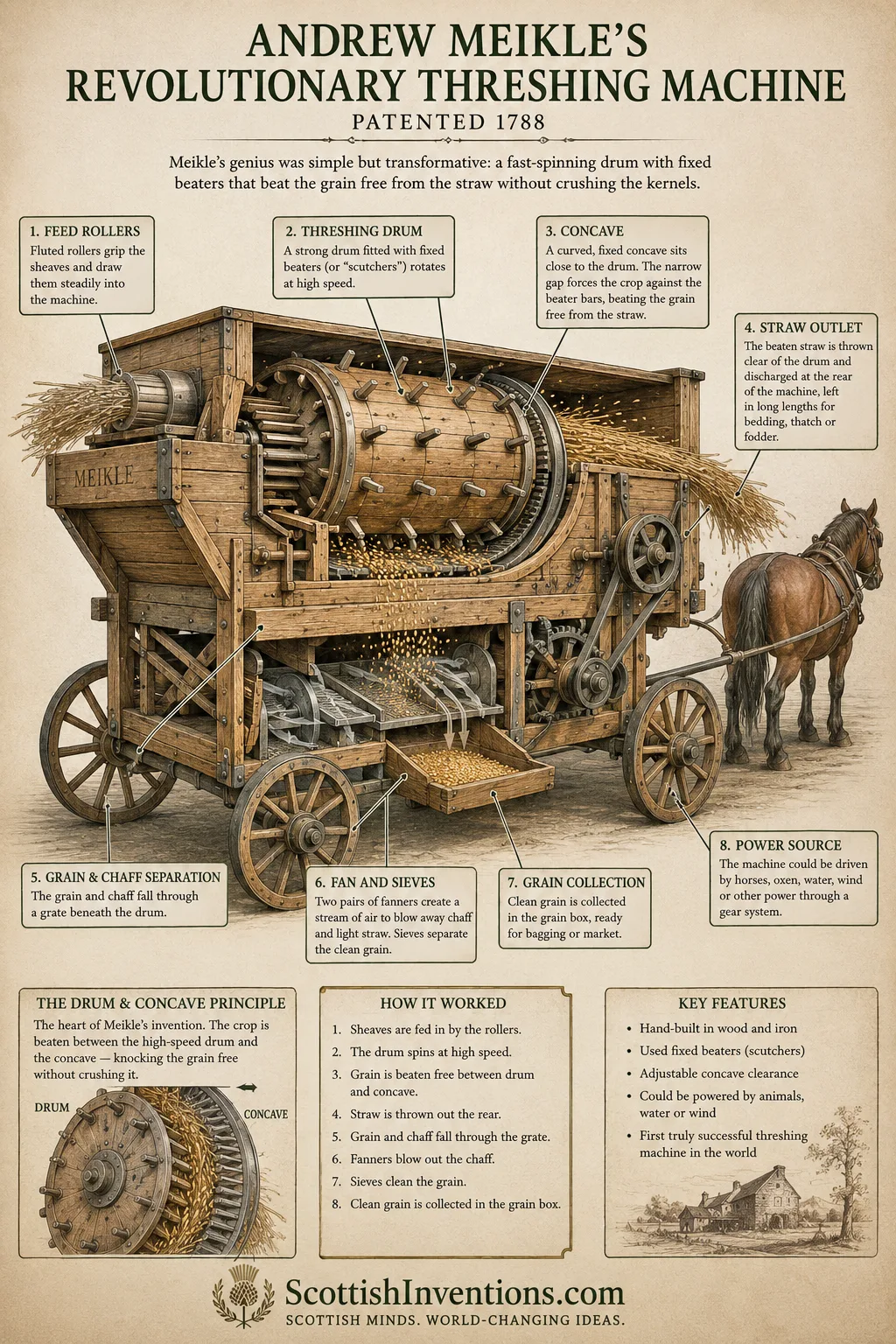
Sheaves of corn were fed in by fluted rollers; a fast-spinning drum fitted with fixed beaters ('scutchers') beat the grain free as the crop was forced through a narrow gap against a curved fixed 'concave'; the straw was thrown clear out the rear; the grain and chaff fell through a grate; and two pairs of fanners (winnowing fans) plus sieves blew and sifted the chaff away, leaving clean grain ready for market.
What is the drum-and-concave system?
The drum-and-concave system is the heart of Meikle's invention: a fast-rotating drum with fixed beaters runs close to a curved, fixed grate (the concave). The crop is forced through the narrow gap, beating the grain free without crushing the kernels. It is the same principle still used inside the threshing cylinder of every modern combine harvester.
Why was Meikle's invention important?
Before mechanisation about one-quarter of all agricultural labour was devoted to threshing, with a single bushel of wheat taking roughly an hour of beating with a flail. Meikle's machine could thresh up to 40 bushels of grain an hour, eliminating the single biggest winter labour bottleneck on British arable farms and underpinning the explosive nineteenth-century growth in grain output that fed industrialising, urbanising populations.
How did the threshing machine lead to the combine harvester?
The combine harvester reaps, threshes and cleans grain in a single pass and was developed in nineteenth- and early-twentieth-century America. But the threshing mechanism inside every modern combine — a high-speed cylinder beating the crop against a curved concave, with rakes/shakers and fans behind — is a direct descendant of Meikle's 1786 design, refined but never replaced in principle.
What were the Swing Riots?
The Swing Riots were a wave of agricultural unrest across southern and eastern England in the late summer and autumn of 1830, named after the fictitious 'Captain Swing' who signed the rioters' threatening letters. Labourers smashed threshing machines (over 100 in East Kent alone in just a few weeks), burned ricks and demanded higher wages. The government responded ferociously: nearly 2,000 people were tried, 19 were hanged and around 481 were transported to penal colonies in Australia.
Where can you see Andrew Meikle's legacy today?
You can see surviving threshing mills and the world's oldest known threshing machine (from Breck of Rendall in Orkney) at the National Museum of Rural Life at Wester Kittochside, East Kilbride. In East Lothian itself you can visit Preston Mill (National Trust for Scotland) at East Linton and Meikle's grave in Prestonkirk churchyard, just a few minutes from his Houston Mill workshop. He is one of seven inaugural inductees to the Scottish Engineering Hall of Fame.