Scottish Inventions · Medicine
The Scottish Surgeons Who Invented the Chainsaw — To Cut Bone, Not Wood
Long before it ever felled a tree, the chainsaw was a small, elegant surgical instrument invented in the anatomical theatres of eighteenth-century Edinburgh and Glasgow — designed to save lives, not to end them.
SI Score40/60Ranked =47th of 50 in InventionsBreakdown
Scottish Impact Index (SI Score)
- Global Impact
- 6/10
- Longevity
- 7/10
- Economic / Material Impact
- 5/10
- Originality / Distinctiveness
- 9/10
- Legacy (Built Upon)
- 6/10
- Recognition
- 7/10

On this page
- Introduction
- Key Facts
- Early Life and Background
- The Invention — the Surgical Chain Saw
- Why a Chain Instead of a Rigid Saw?
- Symphysiotomy and Surgery Before Anaesthesia
- Bernhard Heine and the Osteotome
- From Surgical Tool to the Modern Chainsaw
- Original vs Modern — Side by Side
- Timeline
- Myths vs Facts
- Legacy
- FAQ
- Related Scottish Medical Inventions
The chainsaw is one of the most instantly recognisable machines in the modern world — the noisy, dangerous, petrol-driven emblem of forestry and horror films alike. Almost no one realises where it actually came from.
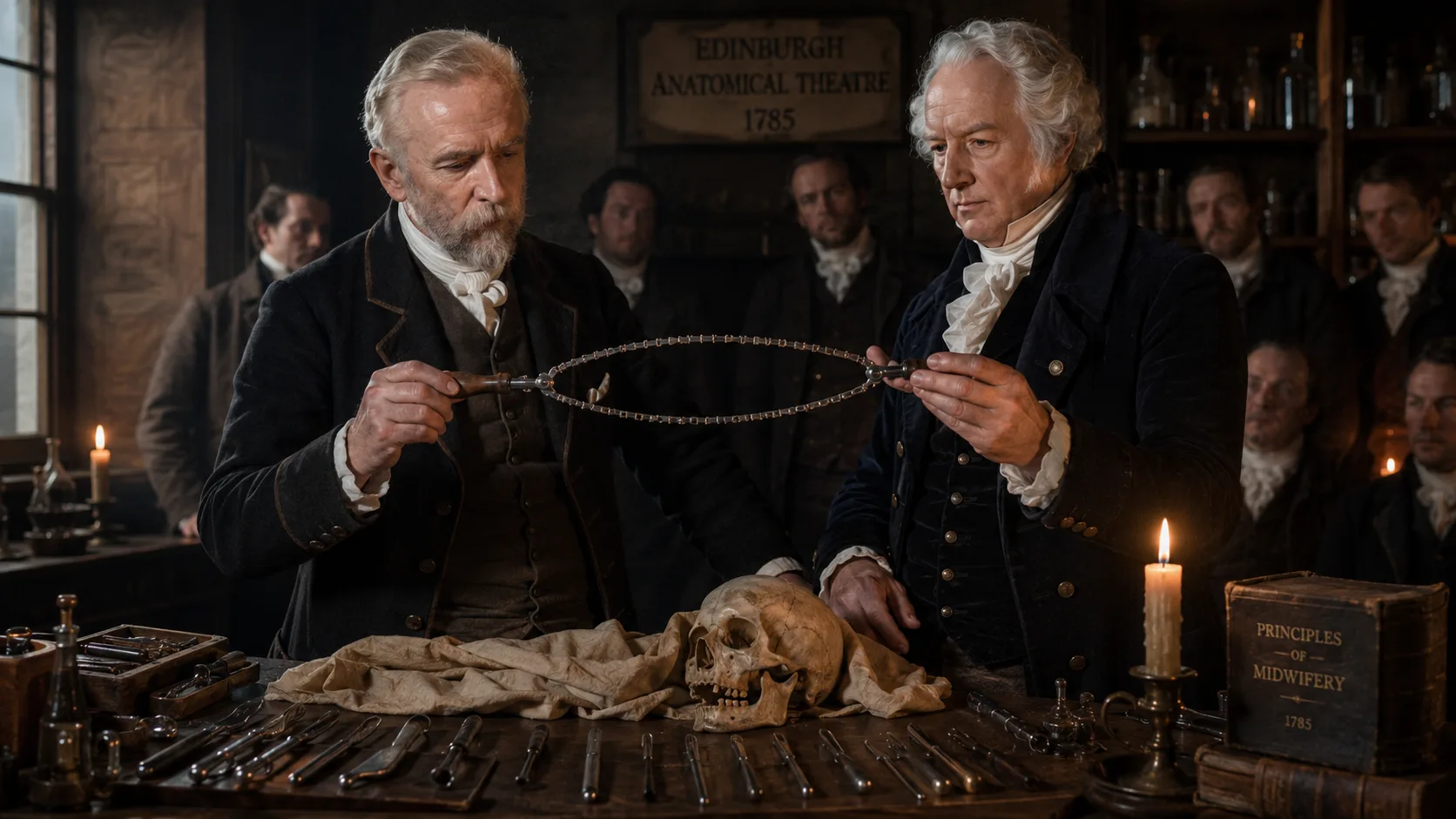
The original chainsaw was a Scottish invention. In the 1780s two Scottish surgeons — John Aitken of Edinburgh and James Jeffray of Glasgow — independently designed a small, hand-held flexible chain saw. It was made not to cut down trees, but to cut through bone. Its first uses were in symphysiotomy (dividing the pubic bone during obstructed childbirth) and in the removal of diseased bone during amputation. The petrol chainsaw of the forestry industry is a much later German engineering descendant — the great-great-grandchild, not the powered original.
Key Facts
Invented in Scotland
The chain saw was first described in print by Edinburgh surgeon John Aitken in his Principles of Midwifery (1785). Glasgow anatomist James Jeffray independently developed a similar instrument around the same time.
Made to cut bone, not wood
It was a surgical instrument for symphysiotomy and the removal of diseased bone — decades before anyone thought of using a chain to fell a tree.
Entirely hand powered
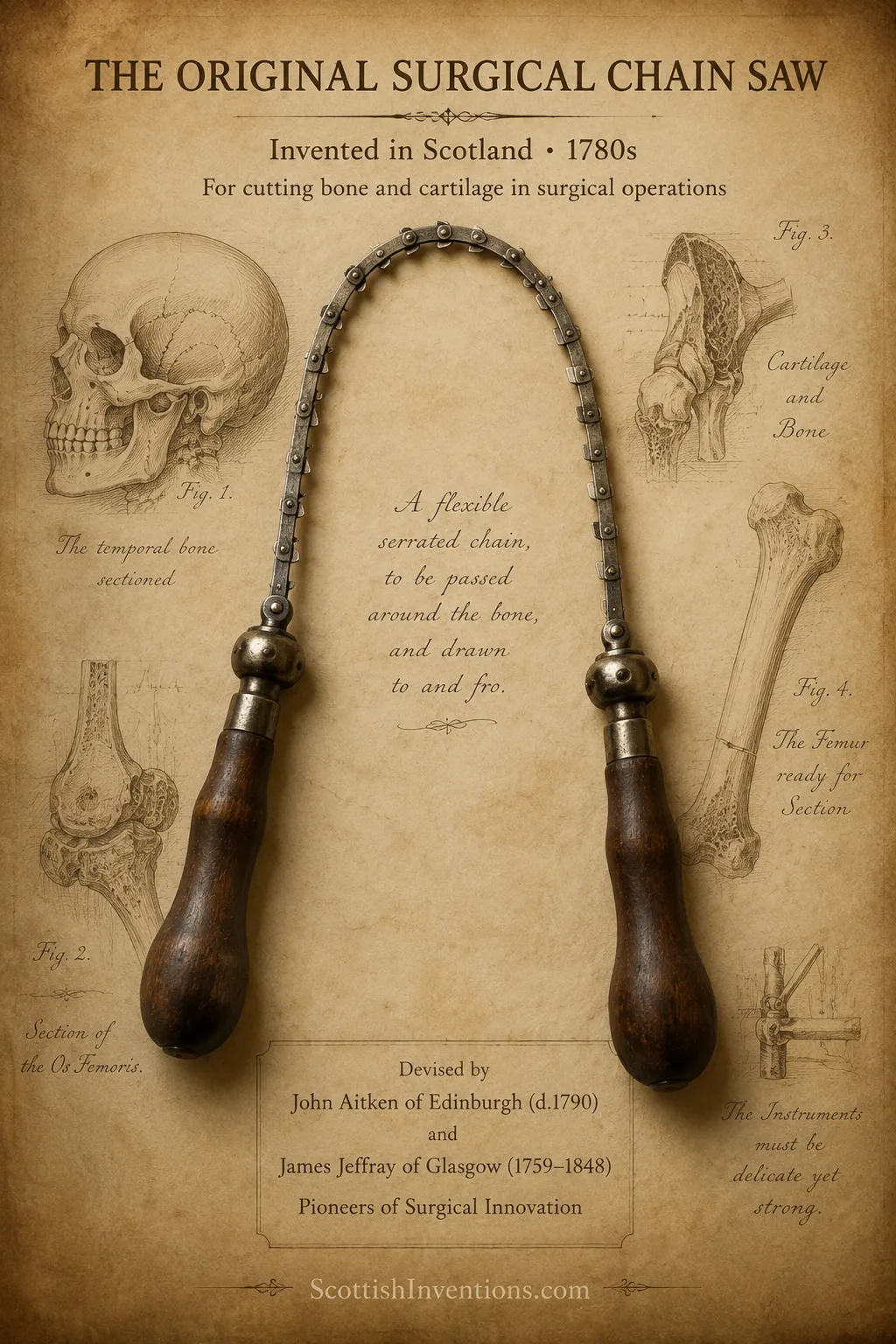
The original had two wooden handles and a fine linked chain with tiny angled teeth. The surgeon drew it back and forth by hand.
Answer to obstructed labour
Before survivable caesarean section, symphysiotomy — enlarging the pelvis by dividing the pubic symphysis — was one of the very few options in obstructed childbirth.
Bernhard Heine, 1830
The German surgeon Bernhard Heine refined the concept into a hand-cranked 'osteotome' — the crucial bridge between the Scottish surgical instrument and later industrial chain cutters.
Forestry chainsaw, 1927
Emil Lerp (Dolmar) demonstrated the first portable petrol chainsaw for felling trees in 1927 in Germany — an engineering descendant, not a powered copy, of the Scottish instrument.
Early Life and Background
Eighteenth-century Scotland was the world capital of medicine. The University of Edinburgh Medical School (founded 1726) and the University of Glasgow rivalled Leiden and Paris, and Edinburgh's Royal College of Surgeons was already the crucible of a distinctive Scottish surgical tradition — practical, anatomical, publicly demonstrated.
John Aitken (d. 1790) was an Edinburgh surgeon and Fellow of the Royal College of Surgeons of Edinburgh who lectured extramurally on anatomy, surgery, midwifery and the theory of physic. He was industrious, inventive and a prolific author, publishing textbooks on all four subjects. James Jeffray (1759–1848), a generation younger, held the Regius Chair of Anatomy and Botany at the University of Glasgow for an astonishing 58 years, from 1790 until his death in 1848. Both men worked in an era when the mortality of major surgery was terrifying and when the surgeon's ingenuity — his choice of instrument, his speed, his knowledge of anatomy — was often the difference between life and death.
The Invention — the Surgical Chain Saw
The earliest documented description of a working chain saw is in John Aitken's Principles of Midwifery, or Puerperal Medicine, published in Edinburgh in 1785. Aitken describes and illustrates a small flexible chain — a series of tiny linked cutting teeth mounted on a light chain, with two wooden handles — that could be passed around a bone and drawn back and forth to divide it cleanly, without the crushing action of a rigid saw.
Around the same period James Jeffray in Glasgow was independently developing a very similar instrument. Historians of surgery have long argued about which came first; the modern consensus is that Aitken's is the earliest that survives in print, and that Jeffray's is a genuine parallel invention, arrived at because both men were solving the same clinical problem with the same anatomical intuition.

Why a Chain Instead of a Rigid Saw?
In an era without anaesthesia and without antisepsis, every additional second on the operating table increased the patient's chance of dying from shock, blood loss or later sepsis. Speed was everything. A flexible chain saw let the surgeon divide a bone in situ, with tiny incisions, without dislocating joints or exposing large amounts of tissue. It made previously impossible operations — especially in the confined space of the pelvis — briefly, brutally, possible.
Symphysiotomy and Surgery Before Anaesthesia
The pubic symphysis is the tough cartilaginous joint at the front of the pelvis where the two pelvic bones meet. In obstructed labour — when a baby was too large, or the mother's pelvis too narrow — surgeons in the eighteenth century faced an almost impossible choice. Caesarean section was, before Joseph Lister's antiseptic revolution, effectively a death sentence. The only alternatives were embryotomy (destroying the baby) or the operation now called symphysiotomy: dividing the pubic symphysis to enlarge the birth canal.
Aitken's Principles of Midwifery is a working practitioner's manual for exactly this world. Sir James Young Simpson's discovery of chloroform anaesthesia in Edinburgh in 1847 lay more than sixty years in the future. Every operation was performed on a fully conscious, restrained patient.
What was symphysiotomy?
Symphysiotomy is the surgical division of the cartilaginous joint at the front of the pelvis (the pubic symphysis) to widen the birth canal in obstructed labour. First proposed by the French surgeon Jean-René Sigault in 1777, it was one of very few options open to eighteenth-century obstetricians before survivable caesarean section. Aitken's chain saw provided a tool that could reach and divide the joint quickly.
Surgery before anaesthesia
Before 1846–47, surgery was performed on conscious patients restrained by assistants. The great London surgeon Robert Liston was famous for amputating a leg in under thirty seconds. The apocryphal story of Liston's "300% mortality" operation (patient, assistant and an onlooker all reputedly dying) is a nineteenth-century medical joke that has hardened into internet folklore — it is not well documented in contemporary sources, and is best treated as anecdote rather than history.
Bernhard Heine and the Osteotome
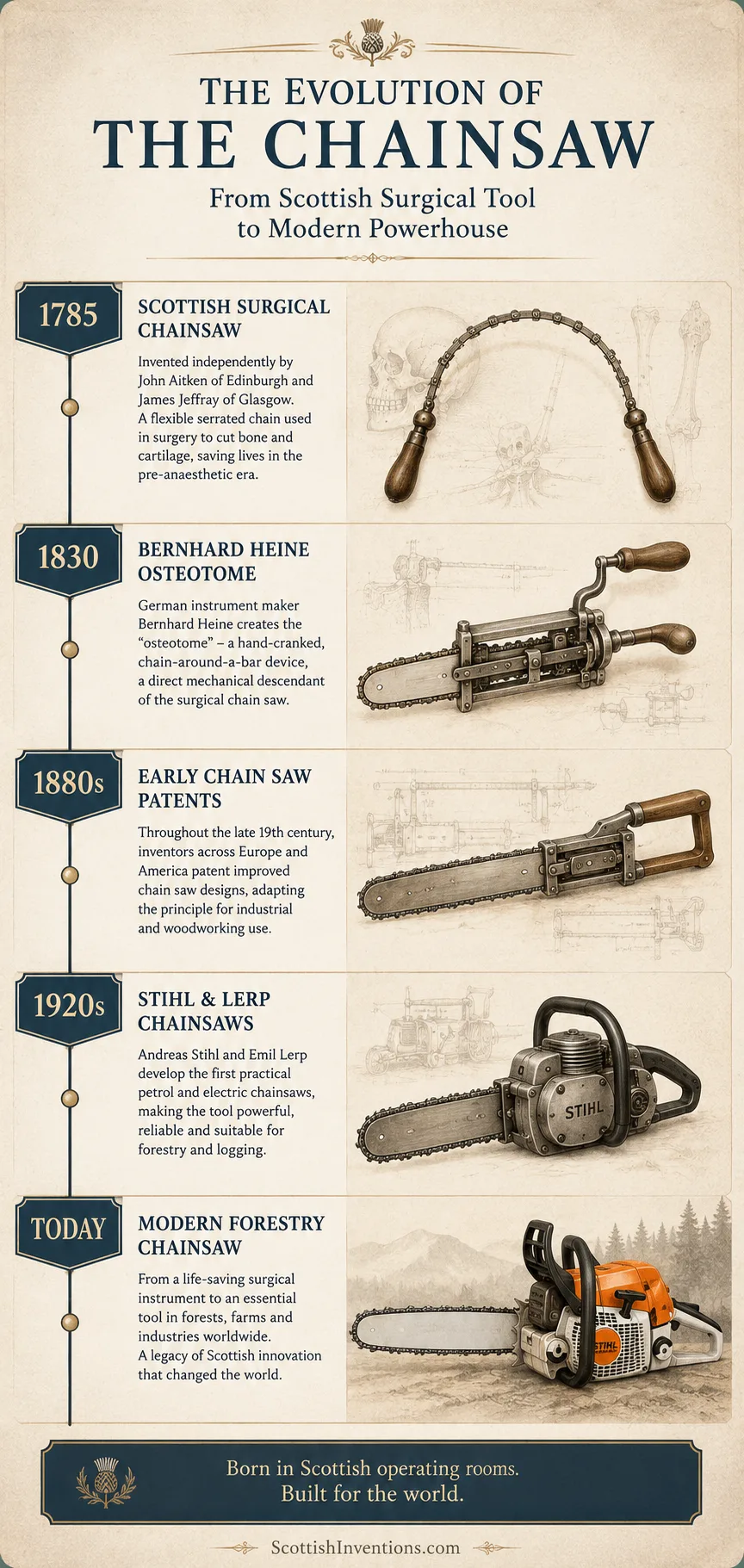
The Scottish surgical chain saw was refined and transformed in 1830 by the German orthopaedic surgeon Bernhard Heine of Würzburg, who invented the osteotome — a hand-cranked chain saw with a rigid guide bar and a properly driven cutting chain. It won him the Grand Prix at the French Academy of Sciences and became the standard bone-cutting instrument for much of the nineteenth century. Heine's osteotome is the true engineering bridge between the eighteenth-century Scottish surgical instrument and the industrial chain cutters of the twentieth century.
From Surgical Tool to the Modern Chainsaw
The petrol chainsaw of the modern forestry industry did not appear until the 1920s, and it emerged in Germany, not Scotland. In 1926 Andreas Stihl of Stuttgart patented and marketed an electric chainsaw for cross-cutting logs at forest landings; in 1927 Emil Lerp, founder of Dolmar in Hamburg, demonstrated the first portable petrol chainsaw for felling trees; Stihl's own petrol chainsaw followed in 1929. Post-war engineering produced the lightweight one-man chainsaw that eventually reached every corner of forestry, arboriculture and horror cinema.
The line of descent is real, but it is indirect. The modern forestry chainsaw is not a powered version of Aitken's instrument. It is a distant industrial cousin that inherited the same core idea — a flexible chain of small cutting teeth driven back and forth — scaled up, motorised and repurposed for a completely different task.
Original vs Modern — Side by Side
| Original Scottish Chain Saw | Modern Chainsaw |
|---|---|
| Invented 1780s | 1920s onward |
| Human surgery | Forestry |
| Hand powered | Petrol / electric |
| Bone & cartilage | Wood |
| Medical instrument | Industrial tool |
| Fits in a doctor's bag | Two-handed power machine |
Timeline: From Edinburgh to Every Forest on Earth
1780s
Aitken's surgical chain saw
Edinburgh surgeon John Aitken develops a small flexible chain saw for symphysiotomy and bone surgery.
1785
First published description
Aitken publishes Principles of Midwifery, or Puerperal Medicine (Edinburgh) — the earliest known illustrated account of an operable chain saw.
c. 1790
Jeffray in Glasgow
James Jeffray, Regius Professor of Anatomy at the University of Glasgow, independently develops and uses a similar flexible chain saw for surgical work.
1830
Heine's osteotome
Bernhard Heine of Würzburg invents the hand-cranked osteotome — a chain-driven bone saw with a rigid guide bar, refining the Scottish concept.
1861
Gigli saw
Italian obstetrician Leonardo Gigli publishes his wire saw for pubiotomy — one of several instruments that eventually supersede the surgical chain saw.
1905
Endless-chain cutters
American inventors develop early endless-chain wood cutters; industrial chain sawing enters the timber trade at scale.
1926–1929
Stihl and Lerp
Andreas Stihl patents his electric chainsaw (1926); Emil Lerp of Dolmar demonstrates the first petrol chainsaw (1927); Stihl markets a petrol chainsaw (1929).
1950s
One-man chainsaw
Post-war German and Scandinavian engineering delivers the lightweight one-man petrol chainsaw that revolutionises forestry worldwide.
Today
Two parallel descendants
Modern surgical saws and modern forestry chainsaws are cousins — both descended, at different scales, from the Scottish surgeons' original idea of a flexible cutting chain.
Myths vs Facts
Legacy
The Scottish surgical chain saw itself is long obsolete, superseded by the Gigli wire saw, the oscillating bone saw and modern powered surgical instruments. But its idea never died. It lives on, at one scale, in every modern surgical bone saw; and at another scale, in every petrol chainsaw howling in every forest on the planet.
It also belongs to a much larger Scottish medical tradition — one that includes Sir James Young Simpson's chloroform anaesthesia, Joseph Lister's antisepsis, Alexander Wood's hypodermic syringe, Sir James Dewar's vacuum flask, Ian Donald's diagnostic ultrasound and the Glasgow Coma Scale. Scotland did not merely invent a machine; it invented, again and again, the instruments of modern medicine.
Frequently Asked Questions
Who invented the chainsaw?
The earliest documented chainsaw was invented in the 1780s by two Scottish surgeons working independently: John Aitken of Edinburgh, whose 1785 Principles of Midwifery describes and illustrates the instrument, and James Jeffray, Regius Professor of Anatomy at Glasgow, who independently developed a similar 'flexible saw' around the same time. It was a hand-cranked surgical instrument, not a woodcutting tool.
Was the chainsaw invented in Scotland?
Yes. The original chain saw is a Scottish invention. The first known published description of an operable chain saw is in John Aitken's Principles of Midwifery (Edinburgh, 1785). James Jeffray of the University of Glasgow independently developed a comparable flexible chain saw around the same period. The modern petrol forestry chainsaw is a much later German engineering descendant.
Was the chainsaw invented for childbirth?
Broadly, yes. Aitken designed his chain saw for symphysiotomy — cutting through the pubic symphysis (the cartilage joining the two halves of the pelvis) to enlarge the birth canal when a baby was obstructed. Before caesarean section was survivable, this was one of very few options in obstructed labour. The instrument was also used more generally to cut diseased or damaged bone.
Who were John Aitken and James Jeffray?
John Aitken (d. 1790) was an Edinburgh surgeon, extramural lecturer in midwifery and fellow of the Royal College of Surgeons of Edinburgh; his Principles of Midwifery (1785) contains the first known illustrated description of a chain saw. James Jeffray (1759–1848) was Regius Professor of Anatomy and Botany at the University of Glasgow for more than half a century and independently developed a similar flexible chain saw for surgical use.
What did the original chainsaw look like?
It was a small, elegant hand-held instrument: a fine linked chain, roughly the width of a bread knife, with tiny angled teeth on the links. Two wooden handles were fitted at each end, and the surgeon drew the chain back and forth (or turned a small hand crank in later versions) to cut through bone and cartilage. It fitted comfortably in a doctor's bag.
Was the original chainsaw powered?
No. The original Scottish surgical chain saw was entirely hand powered — worked by the surgeon pulling the chain backwards and forwards through the tissue, or, in later refinements, by turning a small hand crank. Steam, petrol and electric power all belong to the nineteenth- and twentieth-century industrial line of descent.
How did the modern chainsaw evolve?
The evolution runs from Aitken and Jeffray's late-18th-century hand-held surgical chain saws, through Bernhard Heine's 1830 osteotome (a hand-cranked chain saw for cutting bone), to nineteenth-century industrial chain-driven cutting machines used in mining and lumber, to the first portable petrol chainsaws developed in Germany in the 1920s by Andreas Stihl and Emil Lerp — the direct ancestors of today's forestry chainsaws.
Who invented the forestry chainsaw?
The portable petrol-powered forestry chainsaw was pioneered in Germany in the 1920s. Emil Lerp of Dolmar built and demonstrated the first petrol chainsaw for felling trees in 1927, and Andreas Stihl patented and marketed an electric chainsaw in 1926 and a petrol chainsaw in 1929. These are engineering descendants — not powered versions — of the Scottish surgical instrument.
What was Bernhard Heine's osteotome?
The osteotome, invented in 1830 by the German surgeon Bernhard Heine of Würzburg, is a hand-cranked chain saw designed specifically for cutting bone. It refined the Aitken/Jeffray concept with a rigid guide bar and a driven cutting chain, and it is the crucial engineering bridge between the eighteenth-century Scottish surgical chain saw and later industrial chain cutters.
Is the original Scottish chain saw still used today?
The instrument itself is obsolete — replaced by the oscillating bone saw, the Gigli wire saw and modern powered surgical saws. But its core idea — a flexible chain of small cutting teeth driven back and forth to cut through tissue — never went away. It survives in modified form in medical instruments and, at a very different scale, in every chainsaw used today by surgeons, arborists and lumberjacks.
Discover More Scottish Medical Innovations