Scottish Inventions · Engineering
James Blyth and the Birth of Wind-Generated Electricity: A Precise Account
Scottish Impact Index (SI Score)
- Global Impact
- 9/10
- Longevity
- 8/10
- Economic / Material Impact
- 9/10
- Originality / Distinctiveness
- 9/10
- Legacy (Built Upon)
- 9/10
- Recognition
- 7/10
A Glasgow professor lit his Aberdeenshire holiday cottage from the breeze in July 1887. What exactly he was first at — and what he was not — repays careful reading.
On this page
- Introduction
- Key Takeaways
- Wind Power Is Not Wind Electricity
- Who Was James Blyth?
- The July 1887 Machine
- The First-Known Wind-Lit House
- How It Worked
- Priority: The Four Rival Claims
- The Marykirk "Devil" Story
- The 1891 Patent and the Montrose Turbine
- Recognition and the Medal Question
- Why It Did Not Spread
- Modern Scottish Wind
- Caveats and Corrections
- Timeline
- FAQ
Introduction
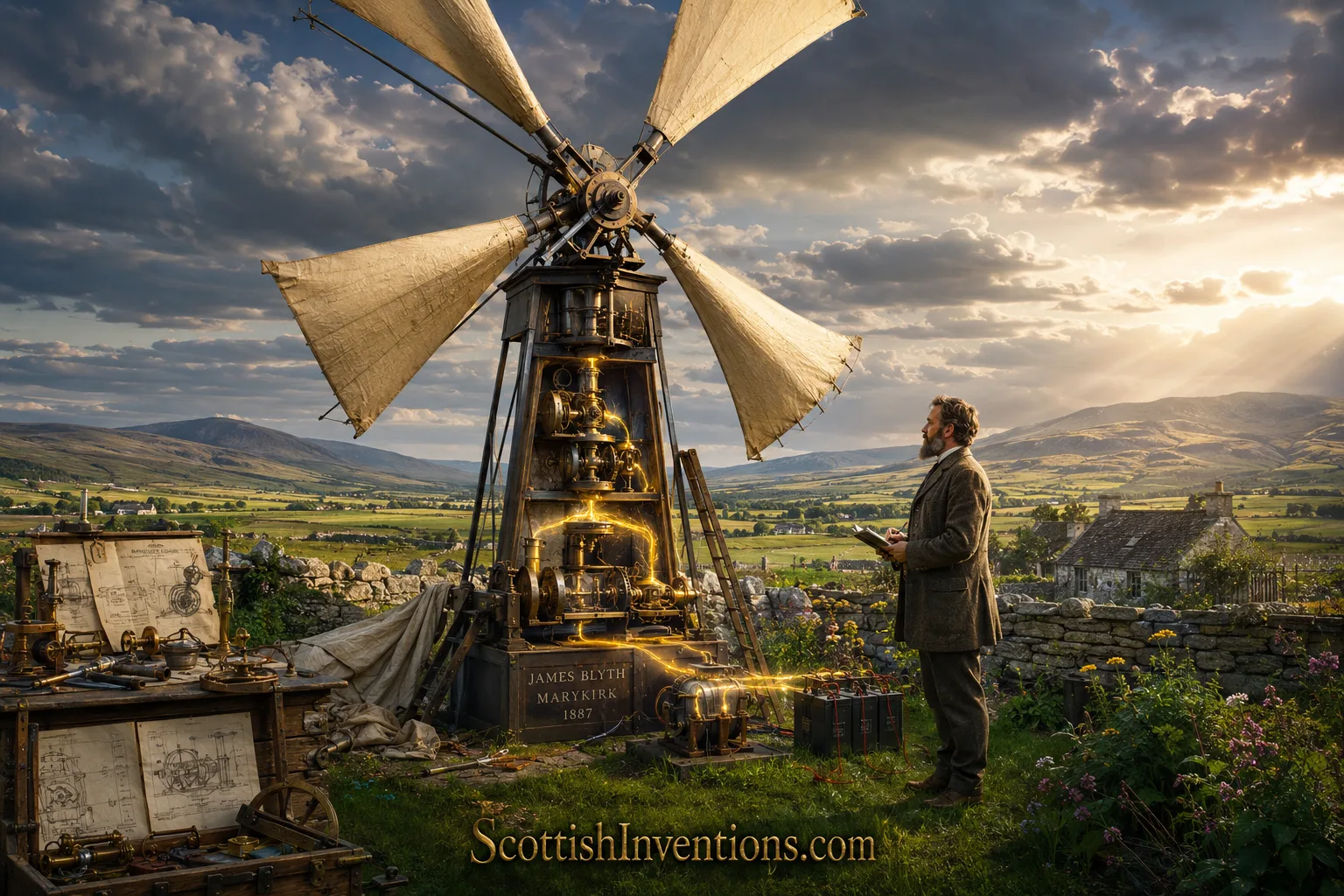
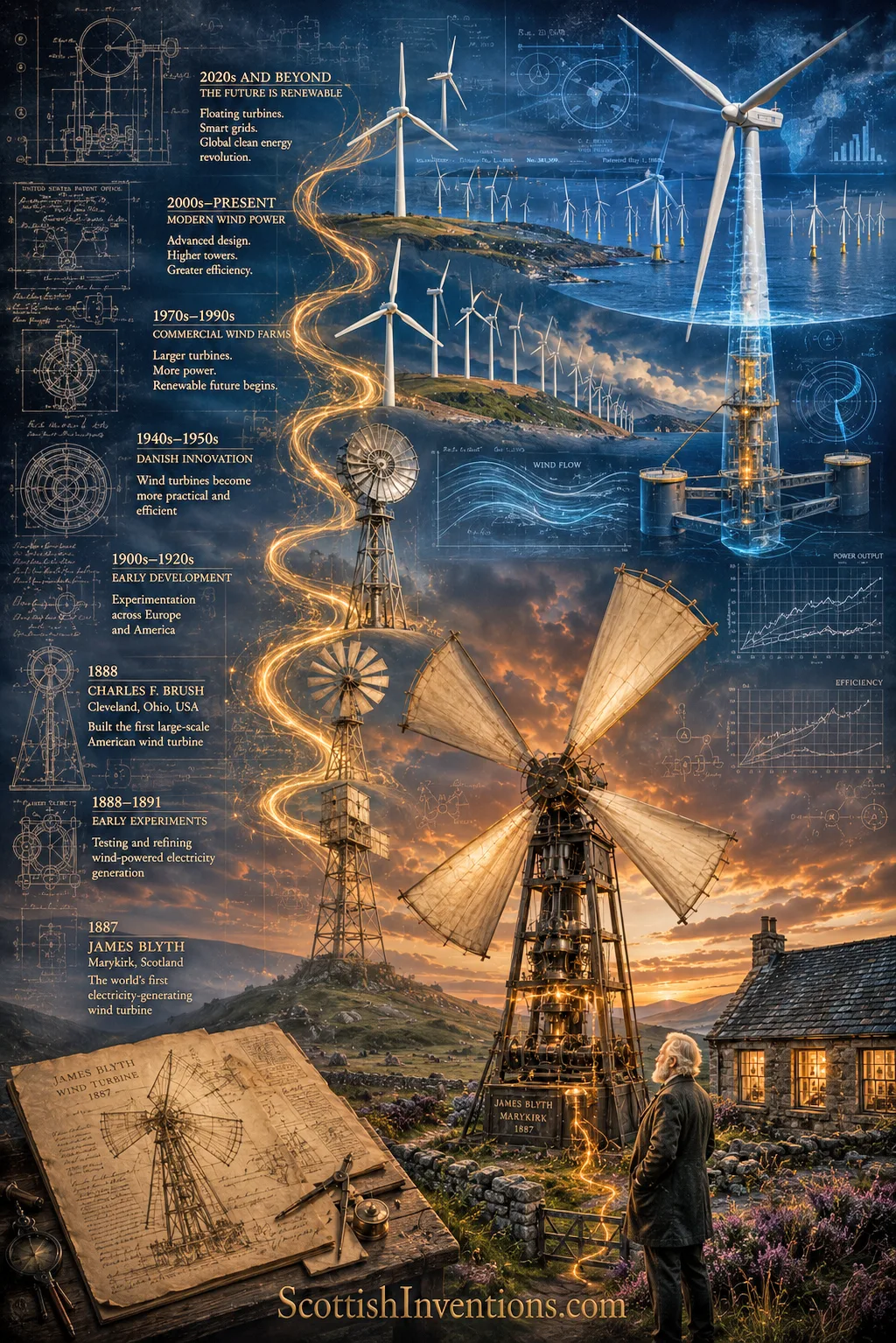
In July 1887, in the garden of a holiday cottage in Marykirk, a professor of natural philosophy raised a tripod of timber carrying four canvas sails, connected it by rope to a dynamo, and charged a bank of batteries with the Aberdeenshire wind. That evening his cottage was lit by electricity that had come out of the air.
James Blyth (1839–1906) has been described for a century as the man who built the world's first wind turbine. The defensible version of that claim is narrower and, read carefully, no less impressive: he built Britain's first, and one of the world's earliest, wind turbines for generating electricity, and his cottage is the first-known private house lit by wind-generated electricity.
The blanket "world's first" no longer survives contact with the archives. Recent scholarship has established an earlier wind-electric machine in Vienna in 1883. This article states Blyth's priority precisely, names each rival, and flags the two popular claims about him that the evidence does not support.
Key Takeaways
- Blyth BUILT Britain's first wind turbine for electricity generation, at Marykirk in July 1887.
- His cottage is the first-known private house lit by wind-generated electricity — the careful institutional wording is "first-known structure", and that hedge matters.
- Josef Friedländer demonstrated a wind-driven dynamo charging batteries at the 1883 Vienna International Electrical Exhibition, four years earlier.
- Blyth preceded Charles F. Brush by months, and Charles de Goyon by a season — but Brush's machine was the first automatic wind turbine.
- He PATENTED an improved wind engine (GB19,401) in 1891 and licensed it to Mavor & Coulson for the Montrose asylum in 1895, where it ran 27 years.
- The "work of the devil" villagers' story is TRADITIONAL — undocumented before a 1993 letter to New Scientist.
- Modern turbines descend from Poul la Cour's lift-based aerodynamics, not from Blyth's drag machine.
July 1887, Marykirk
Britain's first wind turbine for electricity generation, in the garden of Blyth's holiday cottage.
Claim status: contested
First-known wind-electric house is defensible. 'World's first wind turbine' is not: Friedländer's Vienna demonstration came in 1883.
Tripod, 33-foot windshaft
Four arms of 13 feet with canvas sails, driving a Burgin dynamo from the flywheel by rope.
Faure accumulators
'I stored as much in half a day as gave me light for four evenings,' Blyth wrote.
Patent GB19,401
Applied 10 November 1891, accepted 12 December 1891 — a vertical-axis, drag-based, self-limiting wind engine.
27 years at Sunnyside
The 1895 Mavor & Coulson machine ran at the Montrose asylum until it was dismantled in 1914.
Makdougall Brisbane Medal
Royal Scottish Society of Arts — not the Royal Society of Edinburgh, despite common misattribution.
64-year gap
No further UK wind turbine until the public-utility machine at Costa Head, Orkney, in 1951.
Wind Power Is Not Wind Electricity
Almost every confused claim about Blyth comes from collapsing two different things. Using the wind to do mechanical work is ancient: vertical-axis mills were grinding grain and pumping water in Persia from around the ninth century AD, horizontal-axis mills appear in Europe by the twelfth and thirteenth centuries, and the Dutch refined the tower mill for drainage from the fourteenth.
What Blyth's claim concerns is generating electricity from wind — a nineteenth-century problem that required a dynamo to convert the motion and a battery to store the result. Wind power predates him by a millennium; wind electricity predates him by four years. Keeping those two statements apart is the whole discipline of this article.
Who Was James Blyth?
James Blyth was born on 4 April 1839 in the hamlet of Marykirk, Kincardineshire — the area now falls within Aberdeenshire — near Montrose. His father John ran an inn and a small farm; his mother was Catherine. He attended the local parish school and Montrose Academy, then won a scholarship to the General Assembly Normal School in Edinburgh in 1856. He graduated BA from the University of Edinburgh in 1861 and completed his MA in 1871, the year he married Jesse Wilhelmina Taylor. They had seven children, two of whom died in infancy.
After teaching mathematics at Morrison's Academy in Crieff and helping to establish the science curriculum at George Watson's College in Edinburgh, Blyth was appointed Freeland Professor of Natural Philosophy at Anderson's College, Glasgow, in 1880. The college became the Glasgow and West of Scotland Technical College in 1886–87 and is an antecedent of today's University of Strathclyde. He held the chair until his death.
He was a popular lecturer who contributed entries to the ninth edition of the Encyclopaedia Britannica and researched lighting efficiency, telephony and microphones. The University of Glasgow gave him an honorary LLD in 1900. He died of apoplexy at his Glasgow home, 170 Great Western Road, on 15 May 1906, and is buried at Marykirk. He was inducted posthumously into the Scottish Engineering Hall of Fame in 2021.
One influence deserves naming. In 1881 William Thomson — Lord Kelvin — addressed the possibility of using a windmill to charge Faure's newly improved battery. Blyth cited Thomson's report in his later papers, and the Marykirk machine is best read as a Scottish physicist taking a Scottish physicist's suggestion seriously.
The July 1887 Machine
Between about 1885 and 1887 Blyth experimented with windmills in the garden of Blyth House, his Marykirk holiday cottage. In July 1887 the cloth-sailed turbine charged accumulators — of the type developed by Camille Alphonse Faure — and the stored electricity lit the cottage.
Everything reliable we know about the machine comes from Blyth's own paper to the Philosophical Society of Glasgow on 2 May 1888, in which he described it as:
"of a tripod design, with a 33-foot windshaft, four arms of 13 feet with canvas sails, and a Burgin dynamo driven from the flywheel using a rope."
What it produced
- Enough power to light ten 25-volt bulbs in a "moderate breeze".
- Enough torque to drive a small lathe.
- Enough storage that, in Blyth's words, "when a good breeze was blowing, I stored as much in half a day as gave me light for four evenings."
Note the modest register. Blyth was not claiming a power station; he was reporting a working domestic experiment, with figures, to a learned society within ten months of building it. That documentary discipline is the reason his claim survives at all.
The First-Known Wind-Lit House
Multiple reputable institutional sources — the University of Strathclyde Archives, the Scottish Engineering Hall of Fame and the Oxford Dictionary of National Biography — describe Blyth's cottage as "the first house in the world to be powered by wind-generated electricity" and his turbine as "the world's first-known structure by which electricity was generated from wind power".
That phrase "first-known" is doing important work, and the best sources use it deliberately. The claim is defensible for a private dwelling. It is not defensible as the first-ever wind-electric machine. Where neighbouring homes still relied on candles, paraffin lamps and the smoky glow of coal-gas lighting, Blyth's parlour was lit from a battery charged by the weather — and no earlier house is known to have been.
How It Worked
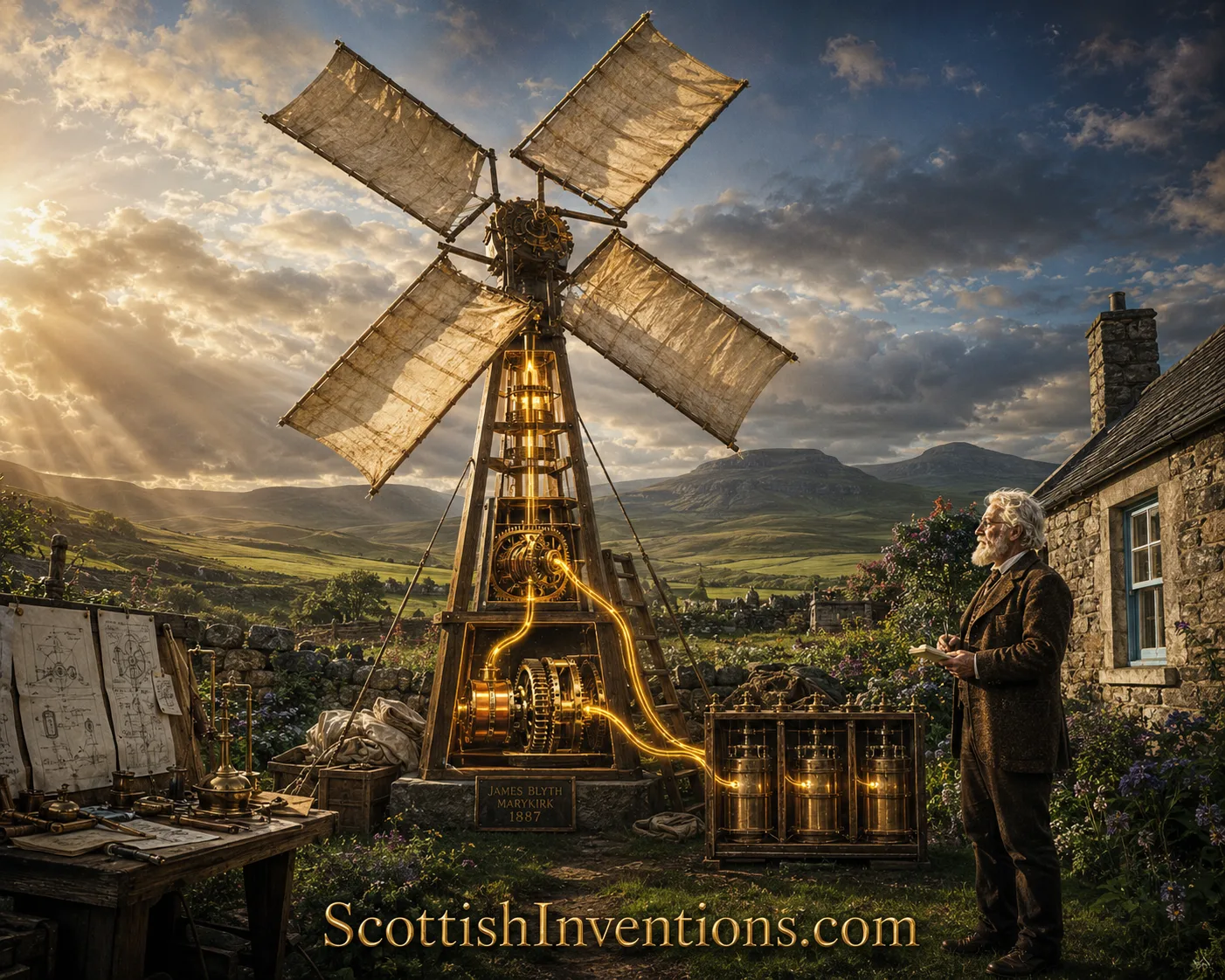
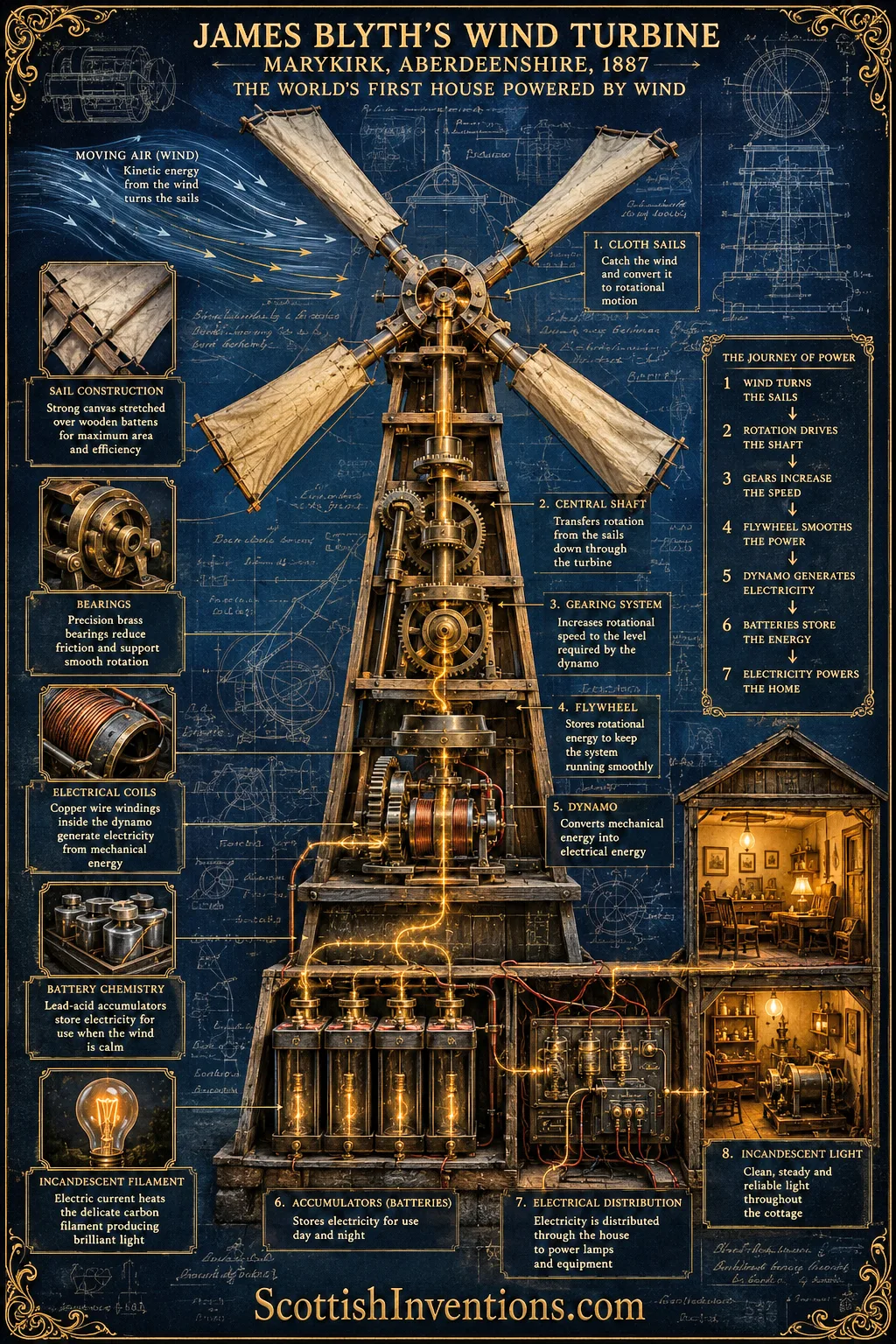
The machine combined three separate Victorian technologies into one system. The canvas sails, four arms of thirteen feet on a thirty-three-foot windshaft, caught the wind and turned a flywheel. A rope drive carried that motion to a Burgin dynamo, which converted it into direct current. The current charged Faure accumulators — lead-acid batteries — so that the cottage could be lit at night, or in still weather, from wind that had blown hours earlier.
Blyth understood from the outset that an intermittent source demands storage, which is precisely the problem grid engineers are still solving. He also identified, with unusual clarity, the engineering difficulty that would define the whole field:
"any fool can make a wind turbine go round to generate electricity, but the challenge is to make one that can be left unattended without over-speeding to destruction."
His first machine did not solve it. The sailed design had no effective braking and was vulnerable in strong winds — which is exactly why his second design abandoned sails altogether.
Priority: The Four Rival Claims
Blyth's place in the record is best established by naming everyone who has a claim on the same ground, and saying exactly how each compares.
Josef Friedländer — Vienna, 1883
The strongest prior claim · four years before Blyth
The Austrian engineer Josef Friedländer (1836–1905) installed a wind-driven dynamo at the 1883 Vienna International Electrical Exhibition. His 6.6 m (22 ft) Halladay "wind motor", supplied by the U.S. Wind Engine & Pump Co. of Batavia, Illinois, drove a dynamo feeding a series of batteries that powered tools, lamps and a threshing machine. It was an exhibition demonstration, and there is no evidence he installed further examples — but it happened, and it is why a blanket "world's first" claim for Blyth is now academically untenable. The finding rests on archival work by Philippe Bruyerre (Rétrofutur, 2022), publicised by the wind historian Paul Gipe and reviewed by Möllerström, Gipe & Ottermo in Wind Engineering.
Charles de Goyon, Duc de Feltre — France, 1886–87
A few months after Blyth
De Goyon filed a patent in 1886 and installed a roughly 12 m Halladay turbine at the Cap de la Hève lighthouse on the French coast in autumn 1887. He was arguably the first person to sell wind-generated electricity. The installation did not survive the winter.
Charles F. Brush — Cleveland, Ohio, 1887–88
Blyth wins by months; Brush wins on engineering
Brush — already wealthy from arc lighting and dynamos — built a colossal wind dynamo at his Euclid Avenue mansion: a 17 m (56 ft) rotor with 144 blades on an 18 m (60 ft) tower, weighing around 80,000 lb and driving a 12 kW DC dynamo charging twelve batteries. It made his the first house in Cleveland with electric light, and it was the first automatically operated wind turbine, with self-regulating furling that let it run largely unattended for about twenty years. Scientific American, on 20 December 1890, called it the only "successful system of electric lighting operated by means of wind power", adding: "Every contingency is provided for, and the apparatus, from the huge wheel down to the current regulator, is entirely automatic."
The chronology favours Blyth: July 1887 against a machine built and operating over the winter of 1887–88 and usually dated 1888. Trevor Price's 2005 paper argues that "it was Blyth and not Brush who was the first to produce wind-powered electricity" — true as between those two men, but superseded by the Friedländer finding. The margin is months, and the two machines had almost nothing in common.
Poul la Cour — Denmark, from 1891
Later than Blyth — and the true technical ancestor
The Danish scientist-educator built his first experimental turbine at Askov Folk High School in summer 1891, using surplus electricity for electrolysis to store energy as hydrogen, and lighting Askov from 1895 to 1902. La Cour is the most technically significant figure of the group: he used one of the world's first wind tunnels, established that fewer, aerodynamically shaped lift-based blades outperform many flat drag blades, invented a regulator (the "Kratostat"), founded the Danish Wind Electricity Society in 1903 and trained a generation of Danish wind electricians. Modern turbine design descends from la Cour's lineage — later confirmed at Göttingen, developed by Hütter and the Danish industry — not from Blyth's drag machine.
The defensible priority statement
Blyth built Britain's first wind turbine for electricity generation and one of the world's earliest. His Marykirk cottage is the first-known private house lit by wind-generated electricity. He pre-dated Brush by a few months. He was not the first person ever to generate electricity from wind — that is Friedländer, 1883 — and his machine is not the technical ancestor of modern turbines, which is la Cour.
The Marykirk "Devil" Story
Traditional — not documented
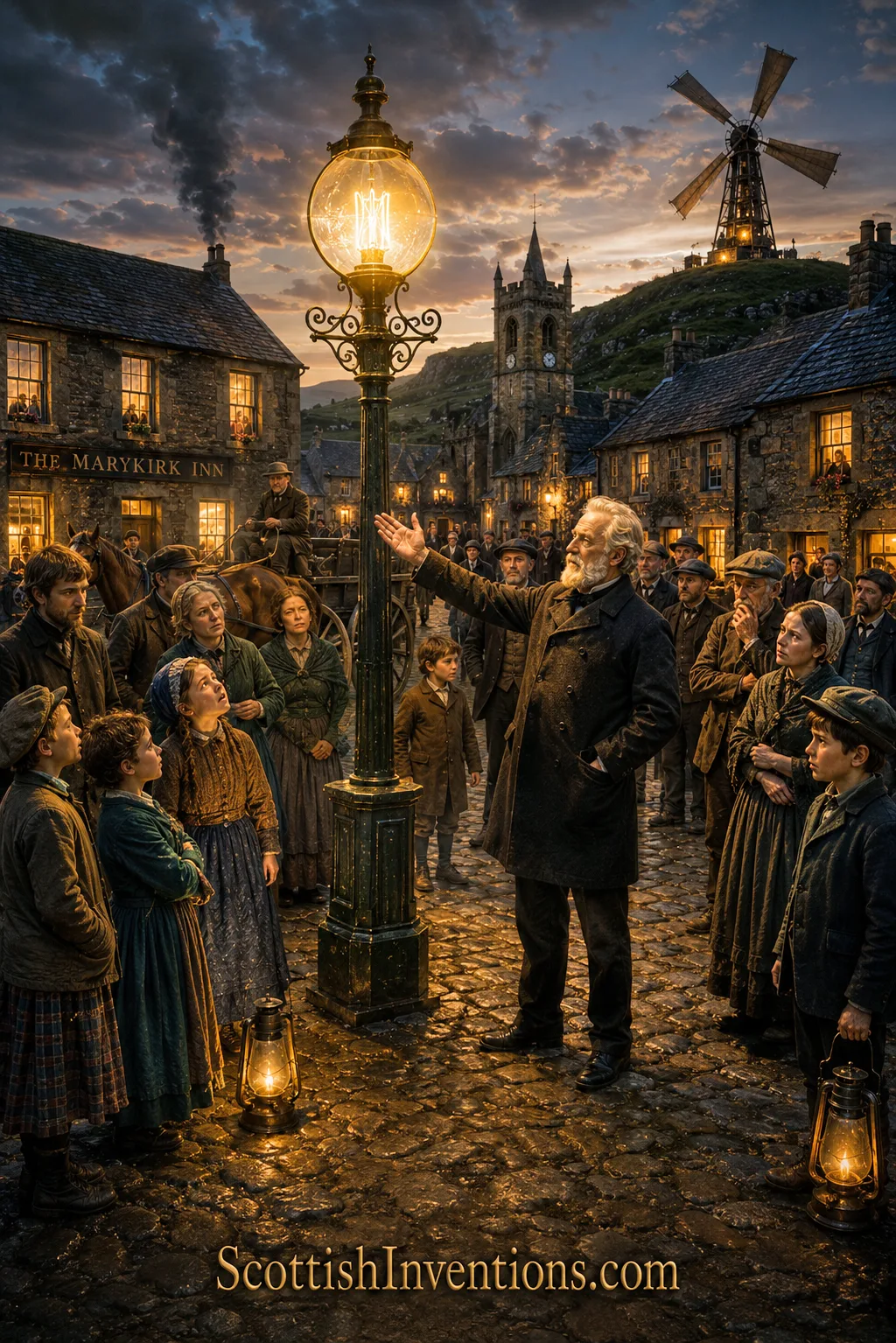
The best-loved story about Blyth is that he offered his surplus electricity to light Marykirk's main street for free, and that the villagers refused, calling electricity "the work of the devil".
It may well be true. It is not documented. The anecdote appears nowhere in Blyth's own papers of 1888 and 1892, nor in any located contemporary source. Its earliest traceable appearance in print is a 1993 letter to New Scientist by E. Allan, apparently a Blyth descendant — which strongly suggests it descends from family oral tradition — and it was repeated in a 2004 Aberdeen Press & Journal feature. Trevor Price's 2005 paper cites it to those modern secondary sources, not to any primary document.
Accordingly this article presents the story as tradition and does not quote the villagers' words as if they were verified. If a contemporary newspaper report or a Blyth manuscript describing the rejection ever surfaces, the label can be upgraded.
The 1891 Patent and the Montrose Turbine
Blyth patented an improved wind engine — GB19,401, applied 10 November 1891 and accepted 12 December 1891. The improvement was a direct answer to his own over-speeding problem: he abandoned the traditional sailed design in favour of a vertical-axis, drag-based machine that was self-limiting in high winds, and therefore safe to leave unattended.
In 1895 he licensed the Glasgow engineers Mavor & Coulson to build this machine to supply emergency power to the Montrose Lunatic Asylum, now Sunnyside Royal Hospital. The Aberdeenshire Historic Environment Record (building record MAB40764) describes it precisely: it "was modelled on Thomas Robinson's anemometer (invented in 1846) and instead of the vertical canvas sails of his first turbine, had eight semi-cylindrical boxes (10 feet by 6 feet) turning a vertical axis that drove a 6 foot flywheel." The same record states it "operated for 27 years and was dismantled in 1914".
A note on that lifespan: the widely repeated "30 years" and the Scottish Engineering Hall of Fame's "20 years" both conflict with the Aberdeenshire HER figure. This article uses 27 years, which is corroborated by the University of Strathclyde Archives.
Recognition and the Medal Question
Blyth received real scientific recognition in his lifetime: papers to the Philosophical Society of Glasgow (1888) and to the Royal Scottish Society of Arts (1892), and the Society's Makdougall Brisbane Medal for the paper read on 25 January 1892. He argued presciently for renewable energy — wind and even wave power — writing that "the wind is proverbially free, and is to be had everywhere."
A documented conflict in the sources
The awarding body is correctly the Royal Scottish Society of Arts, which has its own Makdougall Brisbane medal, distinct from the Royal Society of Edinburgh's similarly named prize. Attributions to the Royal Society of Edinburgh — including the ODNB's own prose — conflate the two and are erroneous. The decisive evidence is the physical medal held by the University of Strathclyde Archives (Accession 1634 / OM/17/11), together with Blyth's prize paper published in the Transactions of the Royal Scottish Society of Arts, vol. 13 (1894), pp. 170–81. Two minor conflicts remain unresolved: most sources say "Gold Medal" while Price uniquely calls it silver, and Price's narrative confusingly dates the award to 1900 although it relates to the 1892 paper.
Why It Did Not Spread
Wind-electric power did not spread commercially in Blyth's lifetime for reasons that had nothing to do with the physics. It was simply uneconomical against abundant cheap coal and, soon after, central-station electricity. Batteries were expensive. There was no distribution network. Variable output was hard to manage.
The same economics defeated everyone in the field. Brush's machine fell into disuse once Cleveland's central stations arrived — it ran to about 1900 and was abandoned in 1908 — and la Cour's Danish programme eventually faltered too. In Britain the gap was extraordinary: no further wind turbines were built in the UK until the first public-utility machine at Costa Head, Orkney, in 1951 — sixty-four years after Marykirk.
Did You Know?
- Blyth's 1887 machine was driven by a rope running from the flywheel to a Burgin dynamo.
- He was probably prompted by Lord Kelvin's 1881 address on using a windmill to charge Faure's battery.
- His second turbine was modelled on Robinson's 1846 anemometer — eight semi-cylindrical boxes on a vertical axis.
- The asylum machine at Sunnyside ran for 27 years before being dismantled in 1914.
- He wrote entries for the ninth edition of the Encyclopaedia Britannica and researched telephony and microphones.
- "The wind is proverbially free, and is to be had everywhere" — Blyth, arguing for renewables in the 1890s.
- Britain built no further wind turbine for 64 years after his.
- He was inducted into the Scottish Engineering Hall of Fame in 2021, 115 years after his death.
Modern Scottish Wind
Today Blyth is celebrated as a pioneer of wind power in Scotland — a country that has become a world leader in the technology, especially in floating offshore wind. A commemorative blue plaque was unveiled at Blyth House, Marykirk, by Scottish Renewables.
The scale of the modern industry is worth stating in figures. Scotland had 17.7 gigawatts of installed wind capacity by Q2 2025, including 10.4 GW onshore and 4.3 GW of offshore generators. In January 2026 the offshore target for Scotland was increased to 40 GW by 2040, announced by the Cabinet Secretary for Climate Action and Energy, Gillian Martin, at the Scottish Renewables Offshore Wind Conference in Glasgow, with the ScotWind leasing round adding a further multi-gigawatt pipeline.
Industry bodies like to draw a direct line from Marykirk to those turbines standing in the North Sea. It is a good line, and it is inspirational lineage rather than technical descent: the machines out there are lift-based descendants of Poul la Cour's wind-tunnel work. What genuinely connects Blyth to them is not the hardware but the proposition — that a country with a great deal of wind and not much sun should build its electricity out of the weather.
Caveats and Corrections
- Never write "invented the wind turbine" or an unqualified "world's first". The correct formulations are "built Britain's first wind turbine for electricity generation", "one of the world's earliest" and "first-known house lit by wind electricity".
- The "work of the devil" anecdote is traditional. Undocumented before a 1993 New Scientist letter, and probably Blyth family lore.
- There is no technical lineage from Blyth to modern turbines. That belongs to Poul la Cour.
- Several details rest heavily on Trevor J. Price's scholarship — his 2005 Wind Engineering paper and his ODNB entry — which is authoritative but occasionally internally inconsistent on the medal's year, metal and awarding society.
- The Friedländer priority rests on recent archival work (Bruyerre, 2022) that reframes older accounts. It is well supported but still being absorbed into the literature.
- The Montrose turbine's lifespan is reported as 20, 27 and 30 years. This article uses the Aberdeenshire HER's 27 years, dismantled 1914.
- Dimensions and dates vary slightly across sources — "33 ft windshaft" against "10 m tower", Brush dated "1887–88" or "1888". Where they conflict, the earliest primary description is preferred.
- Promotional and tourism sources repeat the strongest "world first" claims uncritically. They are useful for the modern-legacy narrative and worthless for priority.
Timeline
4 April 1839
Born at Marykirk
Son of John Blyth, innkeeper and small farmer, and his wife Catherine, in Kincardineshire near Montrose.
1856
Scholarship to Edinburgh
Wins a place at the General Assembly Normal School after Marykirk parish school and Montrose Academy.
1861 / 1871
BA and MA, Edinburgh
Graduates BA from the University of Edinburgh in 1861 and completes his MA in 1871; marries Jesse Wilhelmina Taylor the same year.
1880
Freeland Professor
Appointed Professor of Natural Philosophy at Anderson's College, Glasgow — an antecedent of the University of Strathclyde — a post he holds until his death.
1881
Kelvin's suggestion
William Thomson (Lord Kelvin) addresses the use of a windmill to charge Faure's new battery. Blyth cites the report in later papers.
1883
Friedländer at Vienna
Josef Friedländer's Halladay wind motor drives a dynamo charging batteries at the Vienna International Electrical Exhibition — four years before Blyth.
c. 1885–87
Garden experiments
Blyth tests windmill designs at Blyth House, his Marykirk holiday cottage.
July 1887
BUILT and DEMONSTRATED
The cloth-sailed turbine charges accumulators and lights the cottage — the first-known private house lit by wind-generated electricity.
Autumn 1887
De Goyon at Cap de la Hève
A c. 12 m Halladay turbine is installed on the French coast, months after Blyth; it does not survive the winter.
1887–88
Brush in Cleveland
Charles F. Brush's 17 m, 144-blade, 12 kW machine — the first automatically operated wind turbine — runs at his Euclid Avenue mansion.
2 May 1888
Paper to the Philosophical Society of Glasgow
Blyth publishes the technical description on which everything reliable about the 1887 machine rests.
Summer 1891
La Cour at Askov
Poul la Cour begins the aerodynamic research from which modern turbine design actually descends.
10 Nov 1891
PATENTED
Wind engine GB19,401 applied for; accepted 12 December 1891.
25 Jan 1892
Makdougall Brisbane Medal paper
Read to the Royal Scottish Society of Arts; published in its Transactions, vol. 13 (1894), pp. 170–81.
1895
Montrose asylum turbine
Mavor & Coulson build the improved vertical-axis machine for the Montrose Lunatic Asylum; it runs 27 years.
1900
Honorary LLD
The University of Glasgow confers an honorary doctorate.
15 May 1906
Death in Glasgow
Dies of apoplexy at 170 Great Western Road; buried at Marykirk.
1914
Sunnyside machine dismantled
The asylum turbine is taken down after 27 years of service (Aberdeenshire HER MAB40764).
1951
Costa Head, Orkney
Britain's first public-utility wind turbine — 64 years after Marykirk.
2021
Scottish Engineering Hall of Fame
Blyth is inducted posthumously.
Related Scottish Inventions
Frequently Asked Questions
- Did James Blyth invent the wind turbine?
- No, and the careful formulation matters. Wind power for mechanical work is a thousand years old. Blyth BUILT Britain's first wind turbine for electricity generation, in July 1887 at Marykirk, and his cottage is the first-known private house lit by wind-generated electricity. He was not the first person ever to generate electricity from wind: Josef Friedländer demonstrated a wind-driven dynamo charging batteries at the 1883 Vienna International Electrical Exhibition, four years earlier.
- What exactly did Blyth build in July 1887?
- In his paper to the Philosophical Society of Glasgow on 2 May 1888 Blyth described the machine as 'of a tripod design, with a 33-foot windshaft, four arms of 13 feet with canvas sails, and a Burgin dynamo driven from the flywheel using a rope'. It lit ten 25-volt bulbs in a moderate breeze and could drive a small lathe.
- How much electricity did it actually store?
- Blyth wrote: 'when a good breeze was blowing, I stored as much in half a day as gave me light for four evenings.' The current was stored in accumulators of the type developed by Camille Alphonse Faure.
- Who was first to generate electricity from wind?
- On present scholarship, Josef Friedländer (1836–1905) at the 1883 Vienna International Electrical Exhibition. His 6.6 m Halladay wind motor, supplied by the U.S. Wind Engine & Pump Co. of Batavia, Illinois, drove a dynamo feeding batteries that powered tools, lamps and a threshing machine. The finding rests on archival work by Philippe Bruyerre (2022), publicised by Paul Gipe and reviewed by Möllerström, Gipe & Ottermo in Wind Engineering.
- Did Blyth beat Charles F. Brush?
- Yes, but narrowly and with a caveat. Blyth's machine ran in July 1887; Brush's giant Cleveland wind dynamo was built over the winter of 1887–88 and is usually dated 1888. The margin is months, and the machines were utterly different: Blyth's was a small, cheap, experimental sail device; Brush's was a 17 m rotor with 144 blades on an 18 m tower, weighing some 80,000 lb and driving a 12 kW DC dynamo. Brush's was the first automatically operated wind turbine.
- What about Charles de Goyon in France?
- Charles de Goyon, Duc de Feltre, filed a patent in 1886 and installed a roughly 12 m Halladay turbine at the Cap de la Hève lighthouse in autumn 1887 — a few months after Blyth. He was arguably the first to sell wind-generated electricity, but the installation did not survive the winter.
- Did villagers really call it the work of the devil?
- This is TRADITION, not documented history. The story that Blyth offered to light Marykirk's main street and was refused does not appear in his own 1888 or 1892 papers or in any located contemporary source. Its earliest traceable appearance in print is a 1993 New Scientist letter by E. Allan, apparently a Blyth descendant, and it was repeated in a 2004 Aberdeen Press & Journal feature. It is very likely family oral tradition, and the villagers' words should not be quoted as verified.
- Did Blyth patent his wind turbine?
- Yes. He patented an improved 'wind engine', GB19,401, applied 10 November 1891 and accepted 12 December 1891. The improved design abandoned canvas sails for a vertical-axis, drag-based machine that was self-limiting in high winds.
- What happened at the Montrose asylum?
- In 1895 Blyth licensed the Glasgow engineers Mavor & Coulson to build the improved turbine, which supplied emergency power to the Montrose Lunatic Asylum, now Sunnyside Royal Hospital. The Aberdeenshire Historic Environment Record (MAB40764) states it was modelled on Thomas Robinson's anemometer of 1846 and had eight semi-cylindrical boxes, 10 feet by 6 feet, turning a vertical axis that drove a 6-foot flywheel. It operated for 27 years and was dismantled in 1914.
- What medal did Blyth win?
- The Makdougall Brisbane Medal of the Royal Scottish Society of Arts, for a paper read on 25 January 1892. The Society is distinct from the Royal Society of Edinburgh, which has a similarly named prize; attributions to the RSE — including the ODNB's own prose — conflate the two and are erroneous. The decisive evidence is the physical medal held by the University of Strathclyde Archives (Accession 1634 / OM/17/11).
- Are modern wind turbines descended from Blyth's design?
- No. Modern three-bladed, lift-based turbines descend from the aerodynamic research of Poul la Cour in Denmark from 1891, later confirmed at Göttingen and developed by Hütter and the Danish industry. Blyth's machines were drag-based. The line often drawn from Blyth to today's offshore farms is inspirational lineage, not technical descent.
- Why did wind-electric power not catch on in his lifetime?
- Economics. Batteries were expensive, there was no distribution network, and variable output was hard to manage against abundant cheap coal and then central-station electricity. The same forces defeated Brush, whose machine fell into disuse once Cleveland's central stations arrived, and eventually la Cour's Danish programme. No further wind turbines were built in the UK until Britain's first public-utility machine at Costa Head, Orkney, in 1951 — 64 years after Blyth.
Further Reading & Sources
Tier 1 · Primary
- James Blyth, paper to the Philosophical Society of Glasgow, 2 May 1888 — the primary technical description.
- James Blyth, prize paper read 25 January 1892, Transactions of the Royal Scottish Society of Arts, vol. 13 (1894), pp. 170–81.
- University of Strathclyde Archives — Blyth papers and the Makdougall Brisbane Medal (Accession 1634 / OM/17/11).
Tier 2 · Scholarly and institutional
- Trevor J. Price, "James Blyth — Britain's First Modern Wind Power Pioneer", Wind Engineering (2005); and his Oxford Dictionary of National Biography entry.
- Philippe Bruyerre, Rétrofutur (2022) on Josef Friedländer; Möllerström, Gipe & Ottermo, historical review, Wind Engineering (2024/2025).
- Aberdeenshire Historic Environment Record, building record MAB40764 (Montrose asylum turbine).
- Scottish Engineering Hall of Fame; Scottish Renewables — modern capacity figures and the Marykirk plaque.
Tier 3 · General reference
- Scientific American, 20 December 1890 — on Charles F. Brush's Cleveland wind dynamo.