Scottish Inventions · Engineering
The Hot Blast Process: Invention, Litigation and Contested Credit
A Glasgow gas engineer asked why furnaces made worse iron in summer, patented the answer in 1828, and spent the next fifteen years in court defending an idea that no one could see, weigh or take apart.
On this page
- Introduction
- Key Takeaways
- What the Evidence Supports
- The Gas Engineer
- The Cold-Blast Orthodoxy
- Patent No. 5701
- The Clyde Iron Works Trials
- How the Hot Blast Worked
- The Collective Invention
- The Botfield Priority Claim
- Fifteen Years of Litigation
- What It Did to Scotland
- The Human Cost
- Legacy and Modern Use
- Caveats and Corrections
- Timeline
- FAQ
Introduction
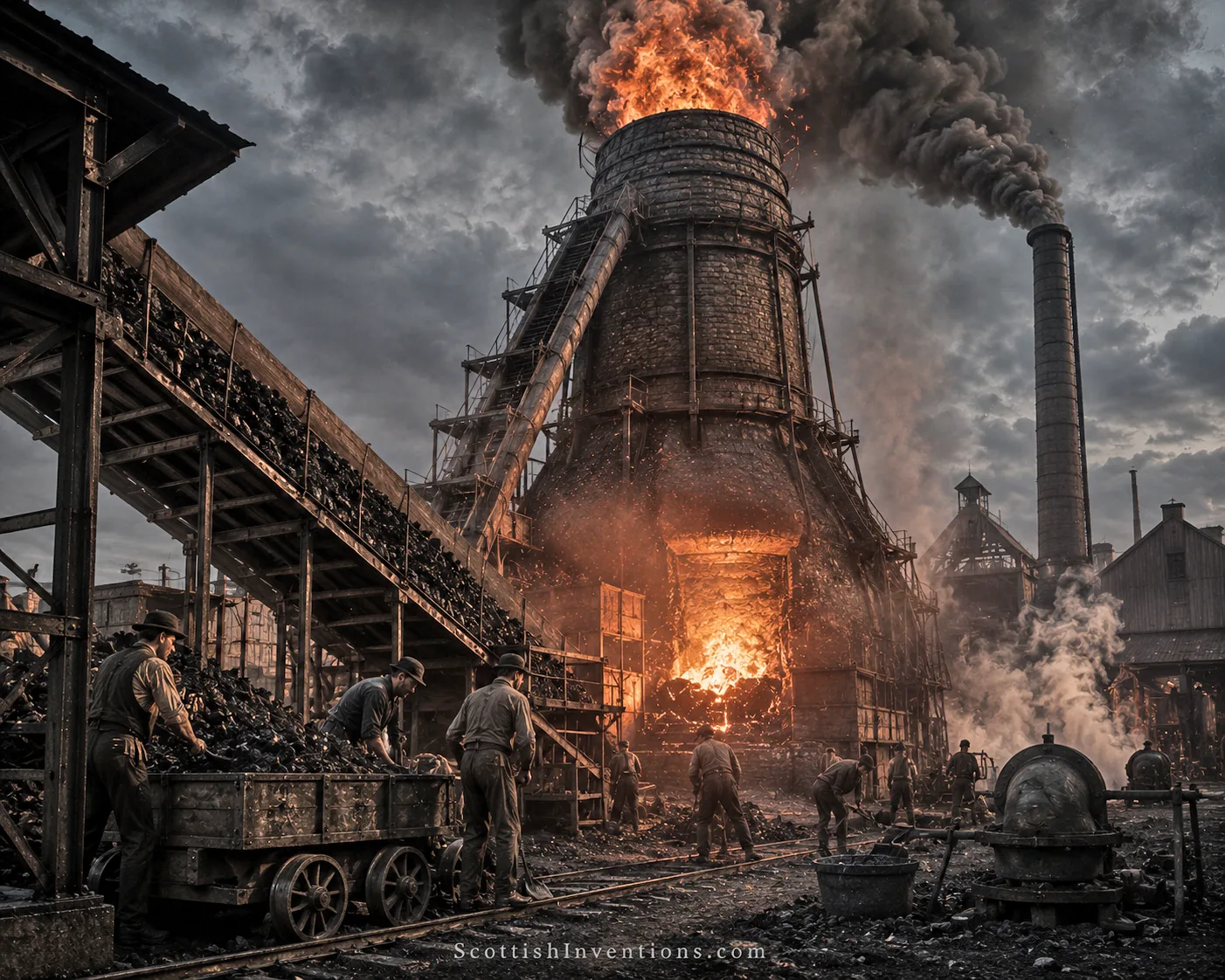
Around 1824 an ironmaster came to the manager of the Glasgow Gas Works with a complaint that sounded almost superstitious. His furnaces, he said, made worse iron in summer than in winter. Could the blast air be chemically purified? The manager, James Beaumont Neilson, thought about it and reached the opposite conclusion from the one the whole industry held: the problem was not the purity of the air but its temperature — and the answer was to make it hotter, not colder.
Four years later he patented that idea. British Patent No. 5701 was dated 11 September 1828 for England and 1 October 1828 for Scotland and Ireland. Within a decade the hot blast had cut the coal needed to make a ton of Scottish pig iron by more than half, turned worthless blackband ironstone into a national asset, and made Lanarkshire one of the great iron districts of the world. It also produced fifteen years of litigation, a still-cited precedent in patent law, and an argument about credit that has never fully settled.
This article follows the house rule for the Scottish Inventions Collection: what the evidence supports is stated plainly, what is disputed is labelled disputed, and what is merely repeated is labelled tradition. Neilson invented and patented the principle. He did not, on his own, build the industrial process that followed.
Key Takeaways
- Neilson INVENTED and PATENTED the hot blast principle — British Patent No. 5701, dated 11 September 1828 (England) and 1 October 1828 (Scotland and Ireland).
- The patent claimed a principle, not a machine: "the form or shape of the air-vessel or receptacle is immaterial to the effect".
- It was DEMONSTRATED at Colin Dunlop's Clyde Iron Works — cupola tests in 1828, full furnace trials 1829–1832.
- Fuel figures from Henry Marten (1859): nearly 7¾ tons of coal per ton of pig iron in 1829 down to about 3 tons in 1833 at a blast of 612°F.
- The industrial process was IMPROVED collectively: John Condie's tubular oven and water-cooled tuyère, William Dixon's raw splint coal smelting, David Mushet's blackband ironstone.
- Priority is DISPUTED: Belford (2012) argues Thomas Botfield's January 1828 Shropshire patent anticipated hot-air elements.
- Three lawsuits secured the credit: Harford (1841), Househill (1842), Baird (1843). The Baird jury awarded £11,876; a separate further-proceedings figure of £160,000 is recorded by the ODNB.
- Scottish pig iron output rose from 37,000 tons in 1830 to over a million tons by mid-century (R.H. Campbell, 1955).
Patent No. 5701
Dated 11 September 1828 for England and 1 October 1828 for Scotland and Ireland; specification February 1829.
Claim status: shared
Neilson INVENTED the principle and PATENTED it; the working industrial process was developed collectively, and priority is contested by the Botfield claim.
Written by a future Lord Chancellor
Henry Brougham drafted the patent title, and James Watt Jr — who had seen a hot-blast demonstration — annotated the specification.
Ironmasters iced their pipes
Before Neilson, furnace men packed blast pipes in ice and painted regulators white, convinced colder air made better iron.
£11,876 and £160,000
The May 1843 Baird jury awarded £11,876; the ODNB records a separate £160,000 from further proceedings. Two distinct figures, not one.
37,000 tons to a million
Scottish pig iron output in 1830 was 37,000 tons; by mid-century it exceeded a million (R.H. Campbell, 1955).
Still cited in US courts
Neilson v. Harford (1841) is invoked in modern American disputes over patentable subject matter, from software to genes.
An obelisk shaped like a furnace
The 35-foot Barstobrick monument raised by his son in 1883 reads simply 'NEILSON HOT BLAST 1828'.
What the Evidence Supports
The hot blast is a case where the honest verdict depends entirely on which claim is being tested. Sorted by evidence tier, the record reads as follows.
Established
- Neilson conceived the hot blast principle and obtained Patent No. 5701 in 1828.
- Preheated blast dramatically reduced fuel consumption, on figures recorded at the time.
- The patent was tested and upheld in three separate courts between 1841 and 1843.
- The hot blast made the commercial smelting of blackband ironstone with raw splint coal viable at scale.
Shared
- The tubular heating oven and the water-cooled "Scotch" tuyère — John Condie, Blair Ironworks.
- Raw splint coal smelting — William Dixon, at Calder and Wilsontown.
- Blackband ironstone — discovered by David Mushet in 1801, long before the hot blast made it pay.
- Capital, furnaces and risk — Colin Dunlop of the Clyde Iron Works, whose plant carried the trials.
Disputed / Contested
- Priority. Paul Belford (Historical Metallurgy, 2012) argues Thomas Botfield's January 1828 Shropshire patent anticipated significant hot-air elements.
- Sole authorship. David Philip Miller (2016) reads the hot blast as collective invention, with Neilson's legal victories doing much of the work of fixing credit on one name.
- The first-trial site. Clyde Iron Works is better documented; the Wilsontown claim is repeated but not confirmed.
Traditional / Unsupported
- That Neilson received a Telford Medal or a Rumford Medal. No reliable source supports either award.
- That the idea came to him in a single flash of insight. The consultation of about 1824 and the patent of 1828 are four years apart.
The Gas Engineer
James Beaumont Neilson was born at Shettleston, then a village east of Glasgow, on 22 June 1792. His father Walter was an engine-wright who moved in the same industrial circles as William Dixon and David Mushet at the Calder Ironworks — a detail worth holding on to, because Mushet's 1801 discovery of blackband ironstone would later be transformed in value by his old partner's son.
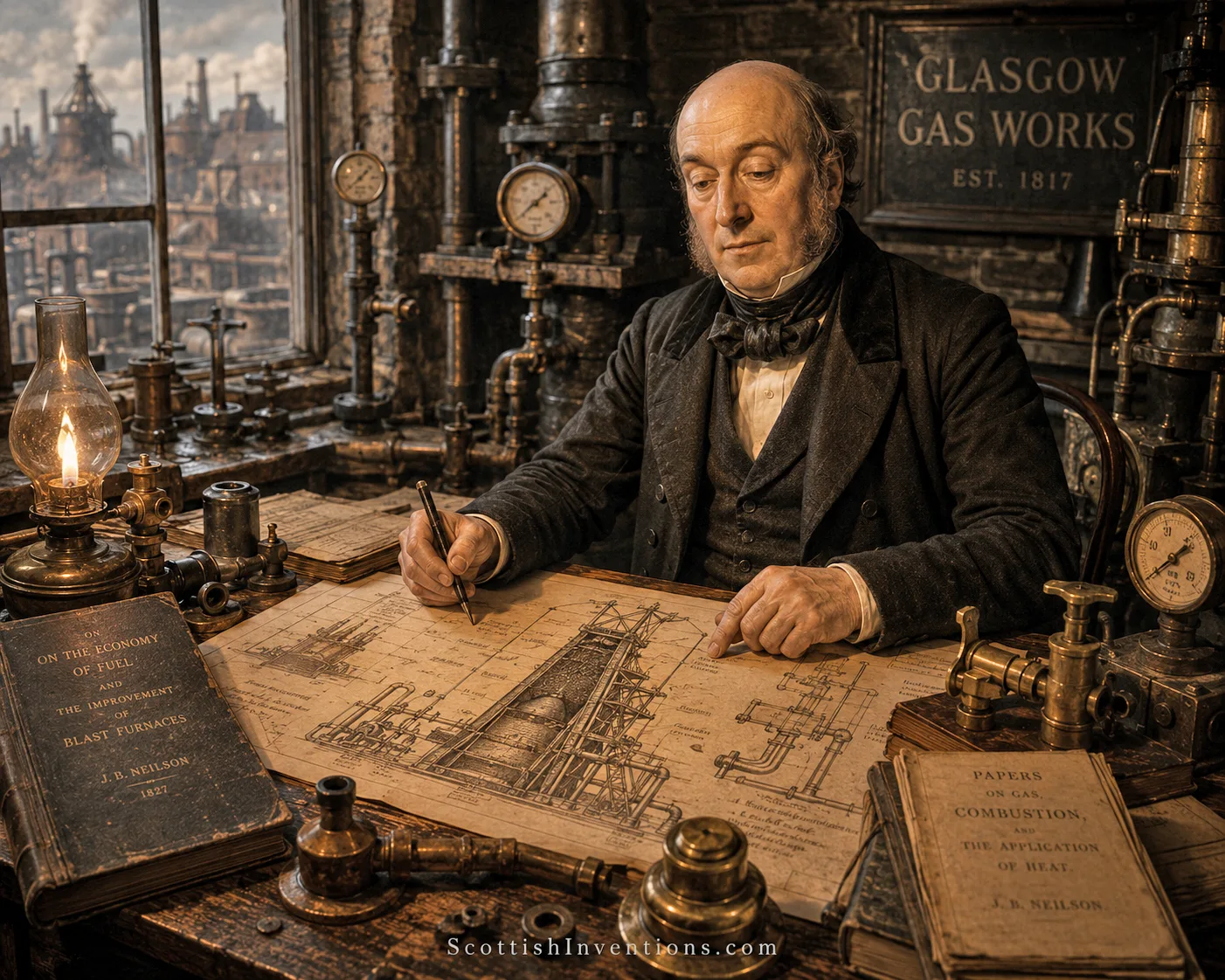
Neilson's formal schooling was slight. He worked as a colliery engineman, taught himself mathematics and chemistry in the evenings, and in 1817 applied for the post of foreman at the newly formed Glasgow Gas Company. He beat some twenty other applicants despite, by his own account, knowing very little about making gas. By about 1822 he was the company's manager and engineer, a position he held for roughly thirty years.
Gas engineering was the right apprenticeship for the hot blast. Neilson spent his working life thinking about combustion, about air supply, about how much heat a given fuel could be made to yield. He improved gas purification, introduced the swallow-tail burner, and was among the earliest to think systematically about the relationship between air and flame. He also founded what is generally regarded as the first workmen's reading room and institute in Britain, at the gasworks, and lectured to his own employees. He was, in short, an unusually rigorous industrial chemist who happened not to work in iron.
The Cold-Blast Orthodoxy
To understand why the hot blast was resisted, it helps to know how confident the industry was of the opposite. Ironmasters had observed that furnaces performed better in winter, and drew the obvious conclusion: cold air made good iron. Acting on it, they went to considerable trouble to chill the blast. Blast pipes were lagged with ice. Regulators were painted white to reflect the sun. Some works ran their blowing engines at night in preference to the day.
The reasoning was not stupid; it was simply an inversion of cause and effect. Cold winter air is denser, so a given volume of it carries more oxygen to the tuyeres. The improvement came from the extra oxygen, not from the low temperature. Once the air is measured by weight rather than by volume, the picture reverses: heating the blast means the furnace no longer has to spend its own fuel warming the incoming air from ambient to reaction temperature, and that saved fuel is available to make iron.
Neilson's insight was to see the confusion for what it was. When the ironmaster asked him about purifying the blast, the gas engineer's instinct was thermodynamic rather than chemical. If the air arrived hot, less coal would be consumed simply raising its temperature. It was a proposition that could only be settled by trial — and the trials were not immediately kind.
Patent No. 5701
The patent is the pivot of the entire story, and its exact particulars matter because so much later argument turned on them.
The patent in detail
- Number: British Patent No. 5701.
- Title: "An Invention for the improved application of Air to produce heat in fires, forges, and furnaces, where Bellows or other Blowing Apparatus are required."
- Dated: 11 September 1828 for England; 1 October 1828 for Scotland and Ireland.
- Specification finalised: February 1829.
- Drafting help: the title was written by Henry Brougham, the future Lord Chancellor; James Watt Jr, who had seen a hot-blast demonstration, annotated the draft specification.
- Licence terms: one shilling per ton of iron made — deliberately low, to encourage adoption.
The decisive sentence is the one that later filled courtrooms. Neilson specified that "the form or shape of the air-vessel or receptacle is immaterial to the effect". He was claiming the interposition of heated air between blowing engine and furnace as such — a principle applied to a practical object — rather than a particular vessel with particular dimensions. That breadth is why the patent was worth so much, and why every ironmaster who wanted to avoid paying argued that a principle could not be patented at all.
Neilson did not hold the patent alone. He took in partners to fund development and defence: Charles Macintosh — the same Charles Macintosh of the waterproof raincoat — together with Colin Dunlop of the Clyde Iron Works and John Wilson of the Dundyvan works. It was a shrewd arrangement, and it kept the patent alive through a decade and a half of attack.
The Clyde Iron Works Trials
The first experiments were run in 1828 on a cupola at Colin Dunlop's Clyde Iron Works, and they were unimpressive. The apparatus raised the blast temperature by only about 10°C, which was enough to show a direction but not enough to convince a sceptical ironmaster of anything. What followed was a grind of incremental engineering rather than a triumph: larger vessels, better heating surfaces, higher temperatures, from 1829 through to about 1832.
As the achievable blast temperature climbed past 300°F and then past 600°F, the results became impossible to argue with. The precise figures most often quoted come from Henry Marten's 1859 paper to the Institution of Mechanical Engineers, which reconstructed the Clyde numbers: at Dunlop & Co.'s works, coal consumption fell from nearly 7¾ tons per ton of pig iron in 1829 to about 3 tons in 1833, with the blast heated to 612°F (322°C). The heating apparatus itself consumed 8 cwt of coal — a real but trivially small offset against the saving.
A second, more conservative set of figures appears in the Oxford Dictionary of National Biography: a fall from 8.06 to 5.16 tons of coal per ton of iron at a blast temperature of 300°F. The two sets are not in conflict; they describe different blast temperatures at different stages of development, and together they show how strongly the saving scaled with the heat applied.
A note on Wilsontown
General reference works sometimes state that the hot blast was first tried at the Wilsontown Ironworks in Lanarkshire. The claim is repeated often but is not well evidenced, and the detailed scholarly accounts place the decisive experimental sequence at Clyde. This article treats Clyde as the documented first-trial site and Wilsontown as unconfirmed.
How the Hot Blast Worked
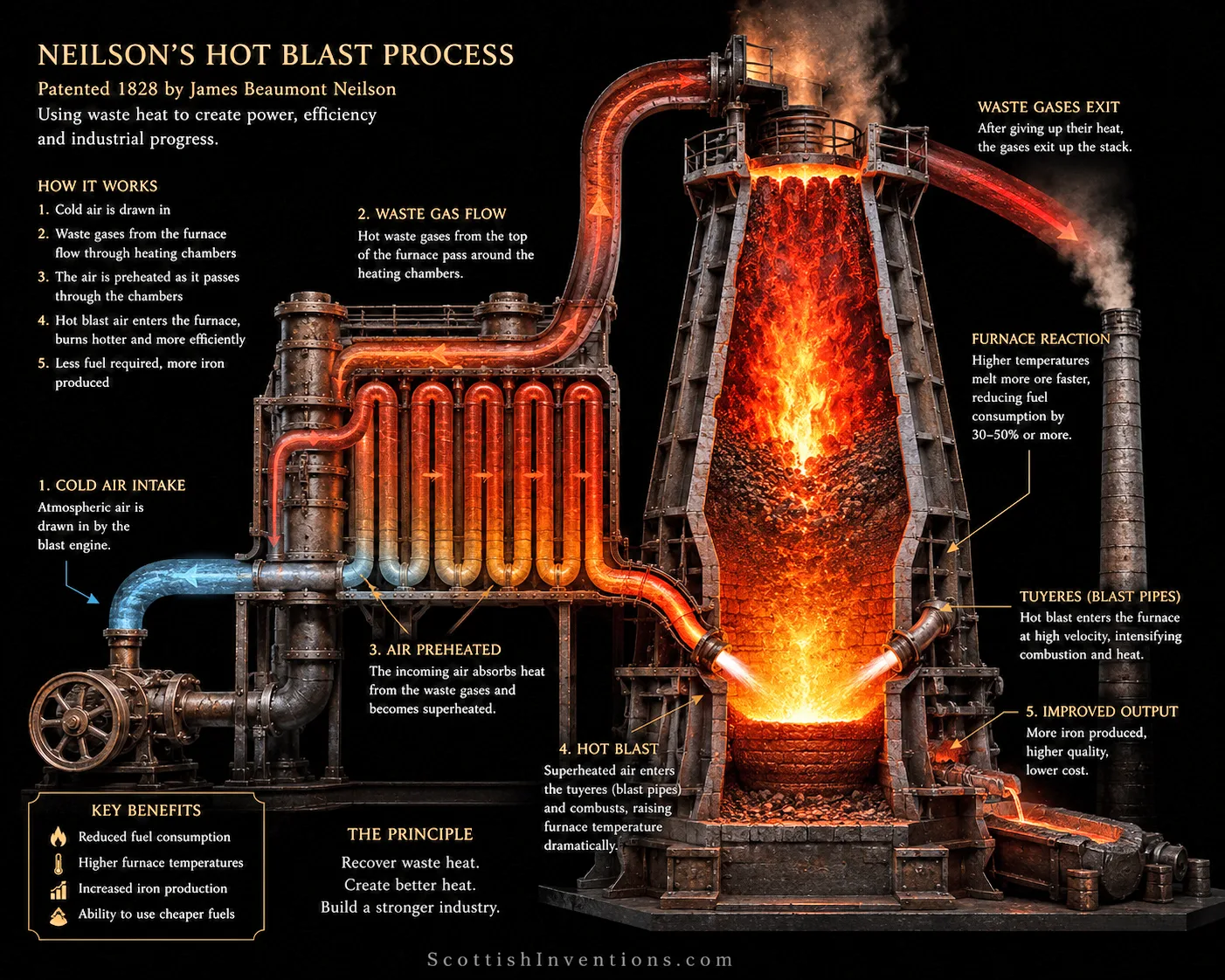
In a cold-blast furnace, the blowing engine drives ambient air straight through the tuyeres into the burning charge. Every cubic foot of that air arrives at whatever temperature the weather supplies, and the furnace must expend its own fuel raising it to reaction temperature before any of it does useful work on the ore.
Neilson's system inserted a heated air-vessel into that path. Air from the blowing engine passed through a chamber or, in the improved arrangements, a bank of tubes exposed to fire on the outside, and reached the tuyeres already hot. The consequences cascaded:
- Less fuel spent on preheating. The furnace no longer paid a thermal tax on every cubic foot of cold air.
- Higher hearth temperatures. Reduction proceeded faster and more completely.
- Tolerance of poorer fuel. Raw splint coal could be used directly instead of coking it first, cutting out an entire expensive stage.
- Tolerance of poorer ore. Blackband ironstone, previously marginal, became economic.
- Greater output per furnace. The same plant produced substantially more iron per week.
The engineering that made all of this durable at industrial scale was not Neilson's alone. Early heating vessels burned out; tuyeres failed under the hotter blast. It was John Condie at the Blair Ironworks who developed the tubular heating oven and the water-cooled tuyère — the so-called "Scotch" tuyère — that turned a working principle into equipment an ironworks could run day after day.
The Collective Invention
The historian David Philip Miller has argued (2016) that the hot blast is a textbook case of collective invention misremembered as individual genius. On his reading, the transformation of Scottish ironmaking between 1828 and 1840 was the product of many hands, and the reason one name attached to it is legal rather than technical: Neilson won in court, and the courtroom narrative — a single inventor, a single moment of insight, an army of infringers — became the historical narrative.
The components of that collective achievement can be named individually:
David Mushet
Discovered blackband ironstone in 1801, twenty-seven years before the hot blast made it commercially workable. A former partner of Neilson's father.
William Dixon
Realised the smelting of ore with raw splint coal at Calder and Wilsontown — an economic step often credited loosely to Neilson.
John Condie
Blair Ironworks. Developed the tubular heating oven and the water-cooled "Scotch" tuyère that made hot blast survivable in daily operation.
Colin Dunlop
Clyde Iron Works. Provided the furnaces, the capital and the operational risk across four years of trials, and became a patent partner.
None of this diminishes Neilson's contribution; it locates it. He supplied the counter-intuitive principle and the legal instrument that forced the industry to reckon with it. Others supplied the ore, the fuel practice, the metallurgy and the hardware. The accurate formulation is that Neilson invented and patented the hot blast, and that Scottish ironmaking collectively developed the process that made it pay.
The Botfield Priority Claim
The sharpest challenge to Neilson's priority is not Scottish but Shropshire. Paul Belford, writing in Historical Metallurgy in 2012, has drawn attention to a patent taken out by the ironmaster Thomas Botfield in January 1828 — some eight months before Neilson's English date — which Belford argues anticipated significant elements of the hot-air idea.
This claim sits in the disputed tier rather than the established one. It has not displaced the standard attribution, and Botfield's patent was never turned into the industry-wide transformation that followed from Clyde. But the claim is serious, made by a specialist in the archaeology of the English iron industry, and it should be stated rather than suppressed. Two things follow from it. First, the hot-air idea was evidently in the air — in more than one district, in the same year. Second, the reason the world remembers Neilson and not Botfield has as much to do with what happened in the Court of Exchequer in 1841 as with what happened in a patent office in 1828.
"Neilson is credited as inventor of hot blast, because he won patent litigation." — the blunt summary now carried by the standard reference account of the process.
Fifteen Years of Litigation
A patent that claims a principle is a patent that invites attack. Ironmasters across Britain adopted the hot blast, declined to pay the shilling, and argued in court that Neilson had patented nothing patentable — no machine, no composition of matter, merely an idea about warm air. Three cases settled the question.
Neilson v. Harford (1841)
Court of Exchequer · 151 ER 1266
The central case. The defendants argued the specification was insufficient and the subject matter unpatentable. The court held that although a mere principle cannot be patented, a principle embodied in a practical application can be — and that Neilson's disclosure was adequate even though he had expressly declined to specify the vessel's shape. The judgment became foundational authority on patentable subject matter and is still cited in United States patent law, in modern arguments over abstract ideas, software and isolated genes.
Neilson v. Househill Coal & Iron Co. (1842)
Scottish courts
The Scottish counterpart affirmed the same doctrine in the phrase most often quoted from the whole sequence: what had been patented was a principle "turned to account — to a practical object". With England and Scotland now aligned, the ground for further resistance narrowed sharply.
Neilson v. W. Baird & Co. (10–20 May 1843)
Court of Session · the biggest of the three
The Bairds of Gartsherrie were the largest hot-blast users in Scotland and the most determined opponents. The trial ran for eleven days and the jury found for Neilson on every count. Baird admitted more than £260,000 of additional net profit over ten years of using the process. Neilson claimed £20,000 in damages; the jury awarded £11,876.
Keep these two figures apart
The £11,876 is the jury award in the May 1843 trial. The £160,000 often quoted in accounts of the Baird dispute is recorded by the Oxford Dictionary of National Biography as arising from separate further proceedings against Baird. They are two distinct outcomes at two different stages. Reporting either as "the damages awarded in the 1843 trial", or adding them together, misstates the record.
The ordinary business of the patent was more prosaic and, cumulatively, more lucrative than any single award. The shilling-per-ton licence was pitched low enough that paying it was cheaper than fighting it. By 1840, 58 English and 13 Scottish ironmasters held licences, and the ODNB puts the royalty income at roughly £30,000 a year. The patent expired in 1842 in the ordinary course, having reshaped an industry in fourteen years.
What It Did to Scotland
The economic historian R.H. Campbell, writing in the Journal of Economic History in 1955, set out the transformation in figures that remain the standard citation.
| Date | Output | Share of British output |
|---|---|---|
| 1830 | 37,000 tons | about 5% |
| Mid-1840s | over 300,000 tons a year | about 25% |
| Mid-century | over 1,000,000 tons | a leading world producer |
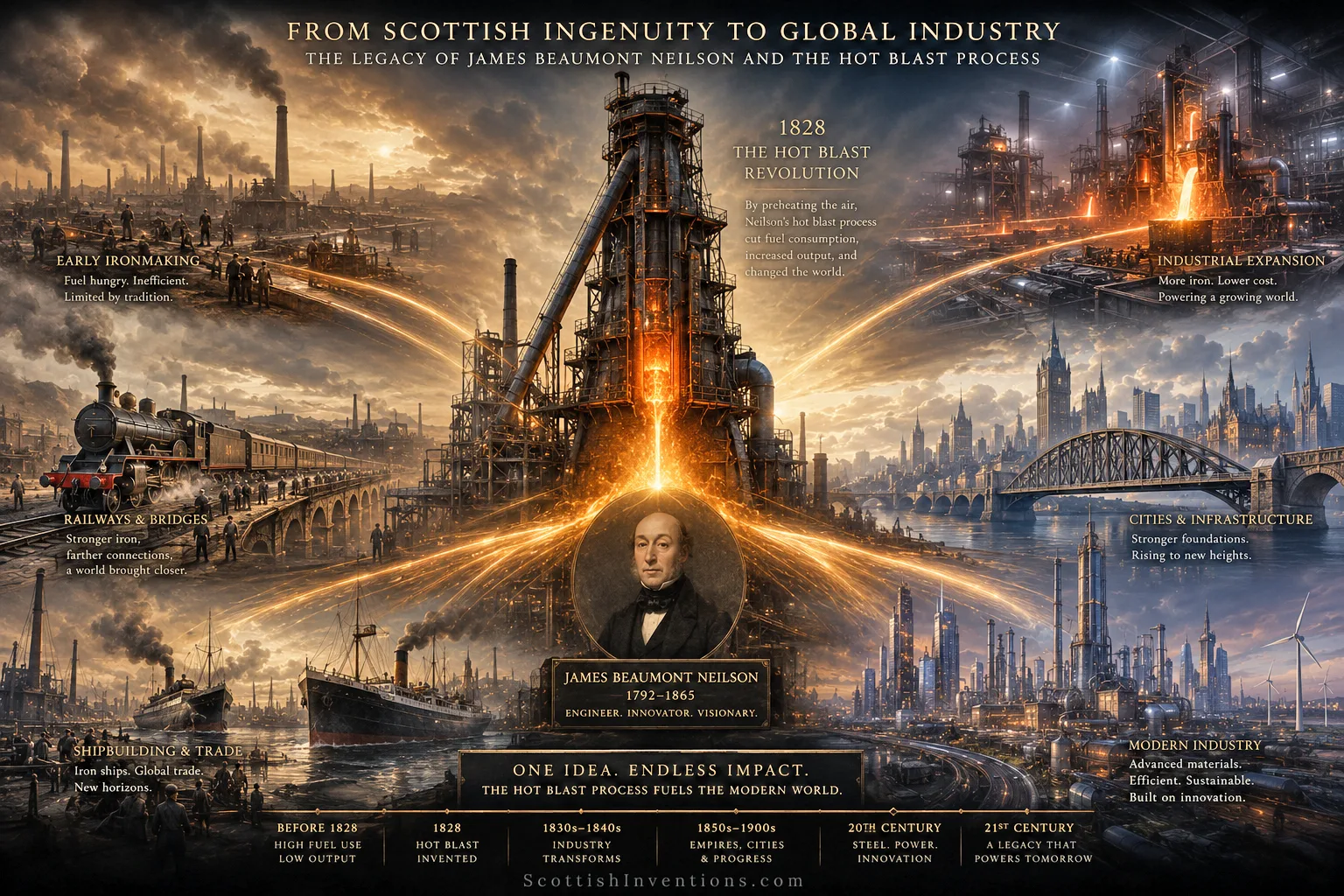
The furnace count tells the same story from a different angle: 27 Scottish blast furnaces in 1830, rising to a peak of 171 in 1860. Lanarkshire, sitting on blackband ironstone and splint coal that the hot blast had just made valuable, became one of the densest concentrations of heavy industry on earth. Cheap Scottish pig iron then fed everything downstream — rails, locomotives, bridges, and above all the Clyde shipyards, whose rise is inseparable from the ironworks upstream of them.
Adoption was rapid but not universal. By the mid-1840s the North British Review could report that among Scottish works the Carron Company alone still held out for the cold blast, on the grounds that it produced a superior grade of iron for certain castings — a defensible position that nevertheless became steadily more marginal.

The Human Cost
A collection that insists on accuracy over patriotism should not narrate the hot blast purely as a triumph. The industry it created was brutal. The expansion of Lanarkshire ironmaking pulled tens of thousands of workers — many of them Irish and Highland migrants — into furnace towns thrown up faster than sanitation, housing or schooling could follow. Furnace work was hot, dangerous and badly paid; the coal and ironstone that fed the furnaces were won in pits with high fatality rates.
Neilson himself is a somewhat unusual figure in this landscape. His reading room and institute at the gasworks, and his lecturing to his own workmen, place him among the Victorian industrial employers who took workers' education seriously. That does not offset the conditions in the ironfield, but it is part of an honest portrait of the man.
There is an environmental postscript too, and it cuts both ways. The hot blast is one of the earliest large-scale fuel-efficiency measures in industrial history: it made every ton of iron cost far less coal. It also made iron so cheap that vastly more of it was made, and total coal consumption rose regardless — an early and very clear instance of the rebound effect that still shapes debates about efficiency and emissions.
Did You Know?
- Before Neilson, ironmasters packed blast pipes in ice and painted their regulators white, convinced that colder air made better iron.
- The patent's title was written by Henry Brougham, later Lord Chancellor, and the specification was annotated by James Watt Jr.
- Neilson's business partner in the patent was Charles Macintosh — the inventor of the waterproof raincoat.
- The first cupola trial in 1828 raised the blast temperature by only about 10°C. It took four more years of work to reach 600°F.
- The Baird trial lasted eleven days and turned on more than £260,000 of admitted extra profit.
- Neilson v. Harford is still cited in American courtrooms arguing about whether software and genes are patentable.
- Neilson founded what is generally regarded as Britain's first workmen's reading room, at the Glasgow gasworks.
- His son Walter Montgomerie Neilson founded one of Glasgow's great locomotive works — built with the cheap iron his father's patent had made possible.
Legacy and Modern Use
Neilson retired from the Glasgow Gas Company in 1847 and bought the Queenshill estate in Kirkcudbrightshire, where he died on 18 January 1865, aged 72. He was elected a Fellow of the Royal Society on 15 January 1846, joined the Institution of Civil Engineers in 1832 and belonged to the Chemical Society. In 1883 his son raised a 35-foot obelisk at Barstobrick near Ringford, shaped in allusion to a furnace and inscribed with four words: NEILSON HOT BLAST 1828.
The technical legacy is more durable than any monument. Neilson's specific hardware disappeared within a generation, superseded first by Condie's tubular ovens and then, from the 1850s, by the regenerative stoves associated with Edward Alfred Cowper. Those stoves — enormous brick-checkered towers that soak up furnace waste gas and give it back to the incoming blast — are still standing beside every operating blast furnace in the world, delivering air at well over 1,000°C.
The principle underneath them has not changed since 1828. It also generalised far beyond iron: preheating combustion air, and recovering waste heat to do it, is now basic practice in glassmaking, cement, ceramics and power generation. The hot blast belongs in the same category as the separate condenser — a thermodynamic housekeeping measure so obviously correct in hindsight that its difficulty at the time is easily forgotten.
Caveats and Corrections
Several claims circulate widely about the hot blast that this article deliberately does not make.
- No Telford Medal, no Rumford Medal. Neilson is frequently said to have received one or both. No reliable source supports either. The Royal Society medal that belongs to the wider hot-blast story went to Eaton Hodgkinson for research on the strength of iron, which is the probable origin of the confusion.
- Wilsontown was not confirmed as the first trial site. Clyde Iron Works is far better sourced for the 1828–1832 experimental sequence.
- Do not conflate the damages figures. £11,876 was the May 1843 jury award; £160,000 is recorded for separate further proceedings against Baird.
- Neilson did not invent raw coal smelting. That belongs to William Dixon. The hot blast made it work economically at scale.
- Neilson did not discover blackband ironstone. David Mushet did, in 1801.
- Neilson did not design the equipment that industrialised the process. The tubular oven and water-cooled tuyère are substantially John Condie's.
- "Invented" is the wrong single verb for the whole story. He invented and patented a principle; an industry developed the process. Both statements are needed.
- Fuel-saving percentages should be quoted with their blast temperature. A saving of roughly a third at 300°F and a saving of nearly two-thirds at 612°F are both true, of different apparatus at different dates.
Timeline
22 June 1792
Born at Shettleston
Son of Walter Neilson, an engine-wright who had worked alongside William Dixon and David Mushet in the Calder Ironworks circle.
1817
Glasgow Gas Company
Beats some twenty applicants to become foreman despite little knowledge of gas-making; manager and engineer from about 1822.
c. 1824
The consultation
An ironmaster asks whether the blast can be chemically purified because furnaces make worse iron in summer — the question that begins everything.
January 1828
Botfield's rival patent
Thomas Botfield patents hot-air claims in Shropshire; Paul Belford (2012) argues this anticipated elements of the hot blast.
1828
PATENTED
British Patent No. 5701, dated 11 September 1828 (England) and 1 October 1828 (Scotland and Ireland).
1828–1832
DEMONSTRATED at Clyde
Cupola experiments in 1828 raise blast temperature by only about 10°C; full-scale furnace trials follow from 1829, exceeding 600°F by the early 1830s.
1833
The Marten figures
Dunlop & Co. cut coal from nearly 7¾ tons per ton of pig iron (1829) to about 3 tons, blowing at 612°F.
1841
Neilson v. Harford
Court of Exchequer upholds the patent; the judgment becomes foundational precedent on patenting a principle.
1842
Neilson v. Househill
A Scottish court affirms that a principle 'turned to account — to a practical object' is patentable.
10–20 May 1843
Neilson v. W. Baird & Co.
The largest trial; the jury finds for Neilson on all counts and awards £11,876 damages.
1 February 1845
The Tontine dinner
Glasgow fêtes Neilson as 'a second Watt' — the moment the lone-genius narrative hardens.
15 January 1846
Elected FRS
His principal documented honour. No Telford or Rumford Medal is supported by any reliable source.
18 January 1865
Death at Queenshill
Dies at his Kirkcudbrightshire estate, aged 72, having promoted workers' education throughout his career.
1883
Barstobrick obelisk
His son Walter Montgomerie Neilson, the locomotive builder, raises a 35-foot furnace-shaped monument near Ringford.
Related Scottish Inventions
Frequently Asked Questions
- Who was James Beaumont Neilson?
- James Beaumont Neilson (22 June 1792 – 18 January 1865) was a largely self-taught Glasgow gas engineer, born at Shettleston, who became manager and engineer of the Glasgow Gas Company. In 1828 he patented the hot blast — preheating the air blown into an iron furnace — one of the most consequential fuel-saving innovations of the Industrial Revolution.
- What exactly is the hot blast process?
- The hot blast places a heated air-vessel between the blowing engine and the blast furnace so that the air reaching the tuyeres arrives hot rather than at ambient temperature. Neilson's patent claimed the principle rather than a particular machine, stating that 'the form or shape of the air-vessel or receptacle is immaterial to the effect'.
- What is the hot blast patent number and date?
- British Patent No. 5701, titled 'An Invention for the improved application of Air to produce heat in fires, forges, and furnaces, where Bellows or other Blowing Apparatus are required'. It was dated 11 September 1828 for England and 1 October 1828 for Scotland and Ireland, with the specification finalised in February 1829.
- How much fuel did the hot blast actually save?
- The most precise contemporary figures come from Henry Marten's 1859 paper to the Institution of Mechanical Engineers: at Dunlop & Co.'s Clyde Works near Glasgow, coal consumption fell from nearly 7¾ tons per ton of pig iron in 1829 to about 3 tons in 1833, blowing at 612°F (322°C), at a cost of 8 cwt of coal burnt in the heating apparatus. The Oxford Dictionary of National Biography separately records a fall from 8.06 to 5.16 tons per ton of iron at 300°F.
- Where was the hot blast first tried?
- The better-sourced site is Colin Dunlop's Clyde Iron Works, where cupola experiments began in 1828 and full-scale furnace trials ran from 1829 to 1832. Some general accounts name Wilsontown Ironworks as the first trial site; the scholarly literature (Miller 2016; Belford 2012) centres the decisive work at Clyde, so this article treats the Wilsontown claim as unconfirmed.
- Was Neilson the sole inventor of the hot blast?
- No, and the qualification matters. Neilson originated the core insight and patented it, but historian David Philip Miller (2016) argues that the working industrial process was a collective achievement, and Paul Belford (2012) argues that Thomas Botfield's January 1828 Shropshire patent anticipated hot-blast elements. As the standard summary puts it, Neilson is credited as the inventor of hot blast because he won the patent litigation.
- Which parts of the hot blast were not Neilson's?
- Raw splint coal smelting was realised by William Dixon at Calder and Wilsontown, not by Neilson. The tubular heating oven and the water-cooled 'Scotch' tuyère are substantially attributable to John Condie of the Blair Ironworks. Blackband ironstone was discovered by David Mushet in 1801; the hot blast made it commercially workable rather than discovering it.
- What were the three great hot blast lawsuits?
- Neilson v. Harford in the Court of Exchequer (1841), Neilson v. Househill Coal & Iron Co. (1842) and Neilson v. W. Baird & Co. in the Court of Session (10–20 May 1843). Neilson won all three, and Neilson v. Harford (151 ER 1266) became foundational precedent on whether a principle can be patented — still cited in United States patent law.
- How much did Neilson earn from the hot blast?
- The licence fee was deliberately modest at one shilling per ton of iron. By 1840, 58 English and 13 Scottish ironmasters were licensed and royalties were producing roughly £30,000 a year (ODNB). Those royalties are distinct from the litigation figures: the May 1843 Baird jury awarded £11,876 in damages, while the ODNB records that separate further proceedings against Baird ended in an award of £160,000. The two figures should never be conflated or added together as a single award.
- What did the hot blast do to the Scottish iron industry?
- R.H. Campbell (Journal of Economic History, 1955) records Scottish pig iron output at only 37,000 tons in 1830 — about 5 per cent of British output — rising above 300,000 tons a year by the mid-1840s, roughly 25 per cent of British output, and past a million tons by mid-century. Scotland's furnace count rose from 27 in 1830 to 171 at its 1860 peak.
- Did Neilson win the Telford or Rumford Medal?
- No. No reliable source supports any named medal award to Neilson. His documented honours are election as a Fellow of the Royal Society on 15 January 1846 and membership of the Institution of Civil Engineers (1832) and the Chemical Society. A Royal Society medal in the wider hot-blast story went to Eaton Hodgkinson for iron-strength research, which is the likely origin of the confusion.
- Is the hot blast still used today?
- Yes. Every modern blast furnace preheats its air in large regenerative stoves. The nineteenth-century hardware is long gone, but the principle Neilson patented in 1828 — never blow cold air into a furnace — remains standard practice in global ironmaking.
Further Reading & Sources
Tier 1 · Primary
- Henry Marten, paper to the Institution of Mechanical Engineers (1859) — the Clyde Iron Works fuel-consumption figures.
- R.H. Campbell, "Developments in the Scottish Pig Iron Trade, 1844–1848", Journal of Economic History (1955).
- Oxford Dictionary of National Biography, "Neilson, James Beaumont (1792–1865)".
- Neilson v. Harford (1841) 151 ER 1266, Court of Exchequer.
- Neilson v. Househill Coal & Iron Co. (1842); Neilson v. W. Baird & Co., Court of Session, 10–20 May 1843.
Tier 2 · Scholarly and institutional
- David Philip Miller, The Life and Legend of James Watt and related work on collective invention in the Scottish iron industry (2016).
- Paul Belford, "Hot blast iron smelting in the early 19th century", Historical Metallurgy (2012) — the Botfield priority argument.
Tier 3 · General reference
- Grace's Guide to British Industrial History — James Beaumont Neilson and the Clyde Iron Works.