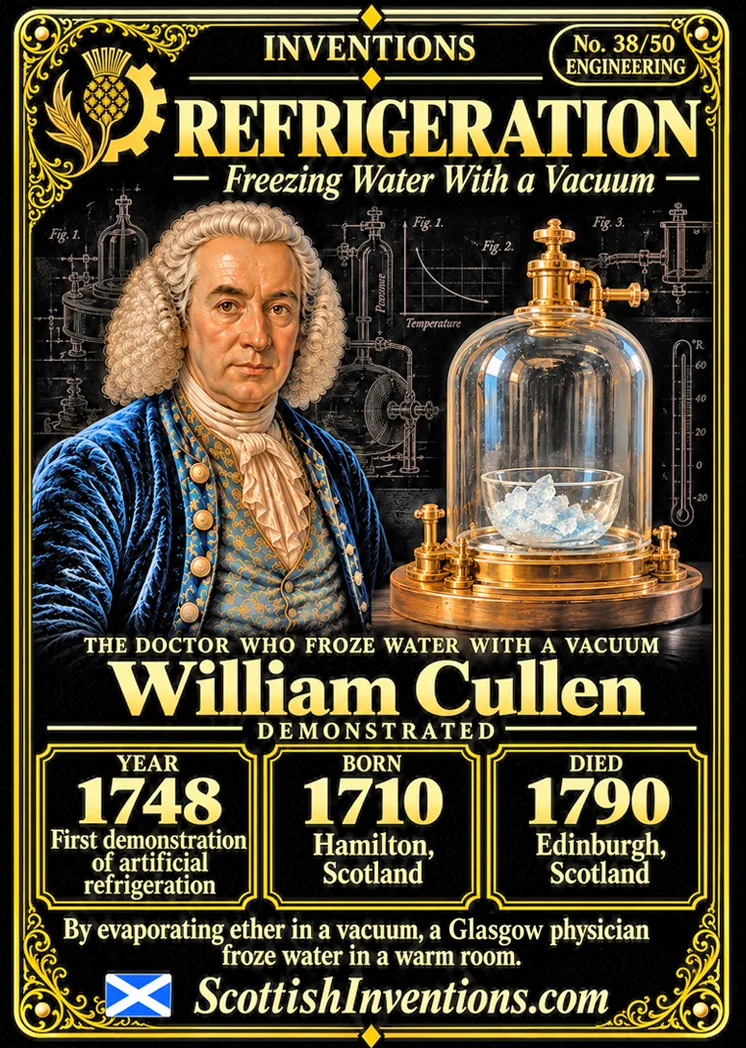
Refrigeration
by William Cullen
SI Score57/60Ranked =2nd of 50 in InventionsBreakdown
Scottish Impact Index (SI Score)
- Global Impact
- 10/10
- Longevity
- 10/10
- Economic / Material Impact
- 10/10
- Originality / Distinctiveness
- 10/10
- Legacy (Built Upon)
- 10/10
- Recognition
- 7/10
Introduction — a Glasgow professor freezes water with a vacuum
In a laboratory at the University of Glasgow in 1748, a Scottish physician did something nobody had ever done before. William Cullen pumped the air out of a glass receiver, set inside it a small dish of diethyl ether surrounded by water, and watched as the ether boiled away at room temperature — drawing so much heat from its surroundings that the water froze into a crust of ice. It was the first artificial refrigeration in history, and the scientific seed of every fridge, freezer and air-conditioner on Earth today.
Cullen never built a machine. His discovery sat almost unused for decades while inventors in Britain, America and Australia slowly turned it into industry. But the principle — that a rapidly evaporating liquid drinks in heat from its surroundings — is the principle on which all modern refrigeration rests. This is the story of the Hamilton-born doctor who quietly made one of the most consequential discoveries of the Scottish Enlightenment, the long road from his Glasgow experiment to the kitchen appliance we all take for granted, and the two persistent myths it is time to put right.
Early Life and the Rise of a Scottish Physician
William Cullen was born on 15 April 1710 in Hamilton, Lanarkshire. His father, also William, was a lawyer who served as factor to the Duke of Hamilton; his mother was of the Roberton family of Whistlebury. Young William attended Hamilton Grammar School and, around 1726, entered the University of Glasgow for an arts course before taking the classic winding road into medicine of his age: apprenticeship to a Glasgow surgeon-apothecary, a spell as surgeon aboard a merchant ship trading to the West Indies, a stint as assistant to a London apothecary, and from 1732 a country practice near Shotts.
He attended medical classes at the University of Edinburgh between 1734 and 1736, where he helped found the Royal Medical Society. In 1740 the University of Glasgow awarded him his MD, and in 1741 he married Anna Johnstone, with whom he had eleven children. From 1744 he gave hugely popular lectures at Glasgow — in English rather than Latin — on medicine, botany, materia medica and chemistry. He became Professor of Medicine at Glasgow in 1751 and in 1755 was lured to Edinburgh as Professor of Chemistry. There he became the most celebrated physician in Scotland, President of the Royal College of Physicians of Edinburgh and First Physician to the King in Scotland. He died on 5 February 1790 and was buried at Kirknewton, where his country estate lay.
The Problem — A World Without Cold
To understand why Cullen's experiment mattered, picture a world with no way to make cold. Food spoiled within days; summer heat was simply endured; meat, milk and fish were preserved by salting, smoking or drying, or eaten quickly. The only 'cold' available was natural ice, harvested from frozen ponds in winter and packed into insulated ice houses — a practice used since antiquity, when the Romans chilled wine with ice carried down from Vesuvius and Etna. By Cullen's day ice houses were common on the estates of the wealthy.
But natural ice was a luxury good with brutal limits: it could only be cut in cold climates, was ruinously expensive to transport, and melted away in storage. The great commercial ice trade — when the New England entrepreneur Frederic Tudor began shipping pond ice to the tropics in 1806, his first cargo bound for Martinique — still lay decades in the future. Into this world came the Scottish Enlightenment, and with it the young science of chemistry. Cullen was at its heart, treating heat and cold not as mysteries but as chemical phenomena to be measured and explained. It was this experimental curiosity — what happens, and why? — that led a doctor to investigate evaporative cooling.
The Breakthrough — The 1748 Demonstration
In 1748, while teaching at the University of Glasgow, Cullen demonstrated artificial refrigeration. He used a pump to create a partial vacuum over a container of 'nitrous aether' — diethyl ether. With the air pressure above it lowered, the ether boiled and evaporated furiously even at room temperature, absorbing so much heat from its surroundings that the water around the vessel froze into ice. In Cullen's own words from the published essay, when he set the vessel of nitrous aether inside a slightly larger vessel of water and exhausted the receiver, 'we found the most part of the water frozen, and the vessel containing the aether surrounded with a thick and firm crust of ice.'
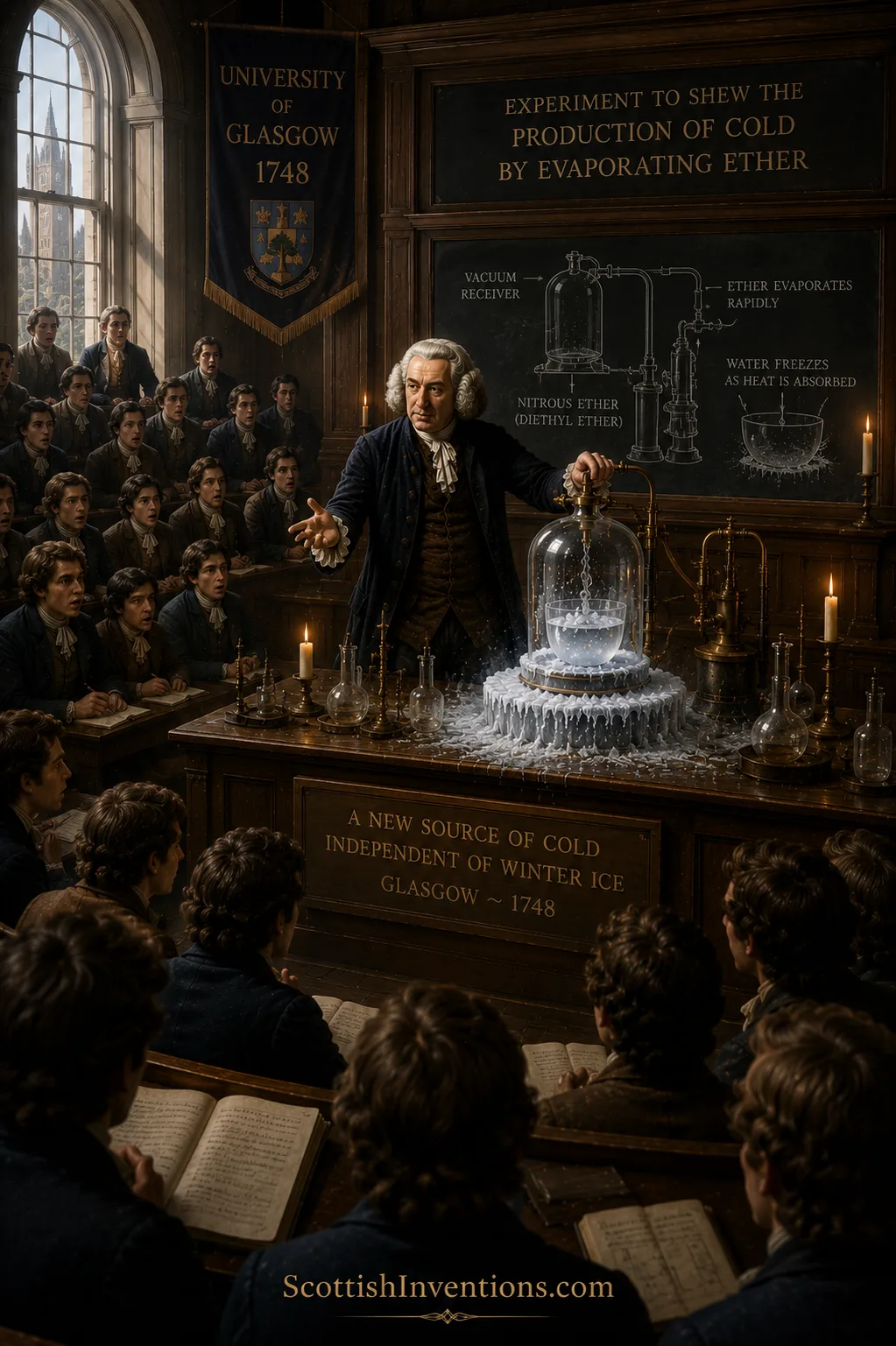
“We found the most part of the water frozen, and the vessel containing the aether surrounded with a thick and firm crust of ice.”
A word of caution on the date. Many websites give a precise '10 August 1748', but this exact day appears in no scholarly or primary source and should be treated as an internet artefact; the defensible statement is simply 1748, with some historians noting the experiments may have continued into the early 1750s before Cullen left Glasgow in 1755. Cullen published his findings in 1756 in a paper titled 'Of the Cold Produced by Evaporating Fluids, and of Some Other Means of Producing Cold', which appeared in Essays and Observations, Physical and Literary, Read Before a Society in Edinburgh (volume 2, pp. 145–156). It was his only published paper on chemistry. Cullen was scrupulously honest about precedent: he noted that the Russian academician Georg Wilhelm Richmann had, in 1747, already given a 'very exact account' of the cold produced by evaporating fluids. Cullen's own contribution was to repeat the experiments with a variety of fluids under an air-pump receiver and, crucially, to freeze water using nitrous aether in a vacuum.
The reaction to this marvel was, however, distinctly cool. With a thriving natural-ice industry and no obvious practical machine in sight, no one rushed to commercialise it. The discovery would wait the better part of a century before the world caught up.
The Science — Explained Accessibly
The physics is wonderfully intuitive once explained. When a liquid evaporates, it must absorb energy — the latent heat of vaporisation — and it takes that energy as heat from whatever it touches. Sweat cooling your skin is the same effect. By pumping away the air above the ether, Cullen made it evaporate far faster, sucking heat out of its surroundings rapidly enough to freeze water in a warm room.
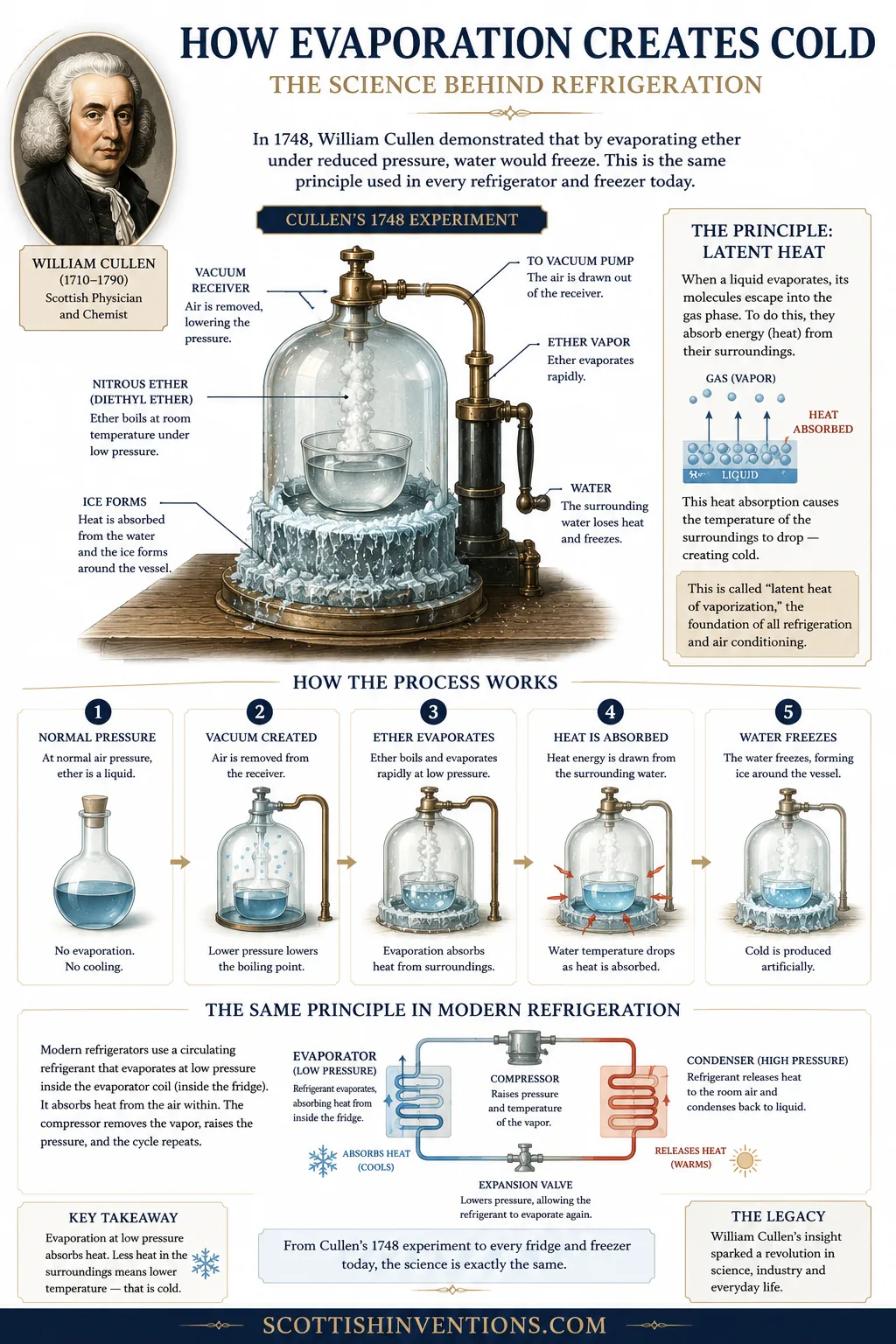
A modern fridge is Cullen's insight industrialised into a continuous loop, the vapour-compression cycle. A refrigerant fluid is compressed, which heats it; it passes through a condenser where it sheds that heat and turns liquid; it is then allowed to expand and evaporate in the cold compartment, where — exactly as in Cullen's vacuum — it absorbs heat from the food and air, cooling them. The vapour is then drawn back to the compressor and the cycle repeats. The principle that makes the whole thing work is the absorption of latent heat during evaporation, which is precisely what Cullen demonstrated in 1748.
There is an elegant scientific connection here to Joseph Black, Cullen's pupil and friend, who succeeded him in the chemistry chair at Glasgow in 1756 and again at Edinburgh in 1766. From 1761 Black developed the concept of latent heat — the very idea that explains why Cullen's evaporating ether produced cold. Teacher demonstrated the effect; pupil explained the cause. It is one of the loveliest hand-offs in the history of science, and both men were Scots working within a few miles of each other.
How Cullen Made Cold
Evaporation absorbs heat
When a liquid evaporates it must absorb energy — the latent heat of vaporisation — and it takes that energy as heat from whatever it touches. Sweat cooling your skin is the same effect at work.
A vacuum speeds it up
By pumping the air away above a dish of diethyl ether ('nitrous aether'), Cullen lowered the pressure so far that the ether boiled at room temperature, evaporating furiously and pulling heat out of its surroundings.
Water frozen in a warm room
The water around the ether vessel lost so much heat that it froze solid — the first time a human being had made ice without using natural cold.
Latent heat — explained by his pupil
Cullen's own pupil Joseph Black later developed the concept of latent heat from 1761, finally explaining the physics behind the experiment. Teacher demonstrated; pupil explained.
The vapour-compression cycle
Modern fridges industrialise Cullen's insight as a continuous loop: a refrigerant is compressed, sheds heat in a condenser, then expands and evaporates inside the cabinet — absorbing heat from your food just as Cullen's ether did.
The cold chain
The same principle now underpins food safety and the vaccine cold chain credited by the WHO with helping save an estimated 154 million lives over the past fifty years.
From Cullen's Experiment to Commercial Refrigeration
The gulf between a laboratory curiosity and a working appliance was vast, and it took more than a century to cross. The American engineer Oliver Evans designed a vapour-compression refrigeration machine in 1805 but never built it. The decisive practical step came from Jacob Perkins, an American working in Britain, whose landmark British patent No. 6662 — 'Apparatus and means for producing ice, and in cooling fluids' — was assigned on 14 August 1834 and granted in 1835. The machine itself was constructed and demonstrated in 1835 by the engineer John Hague.
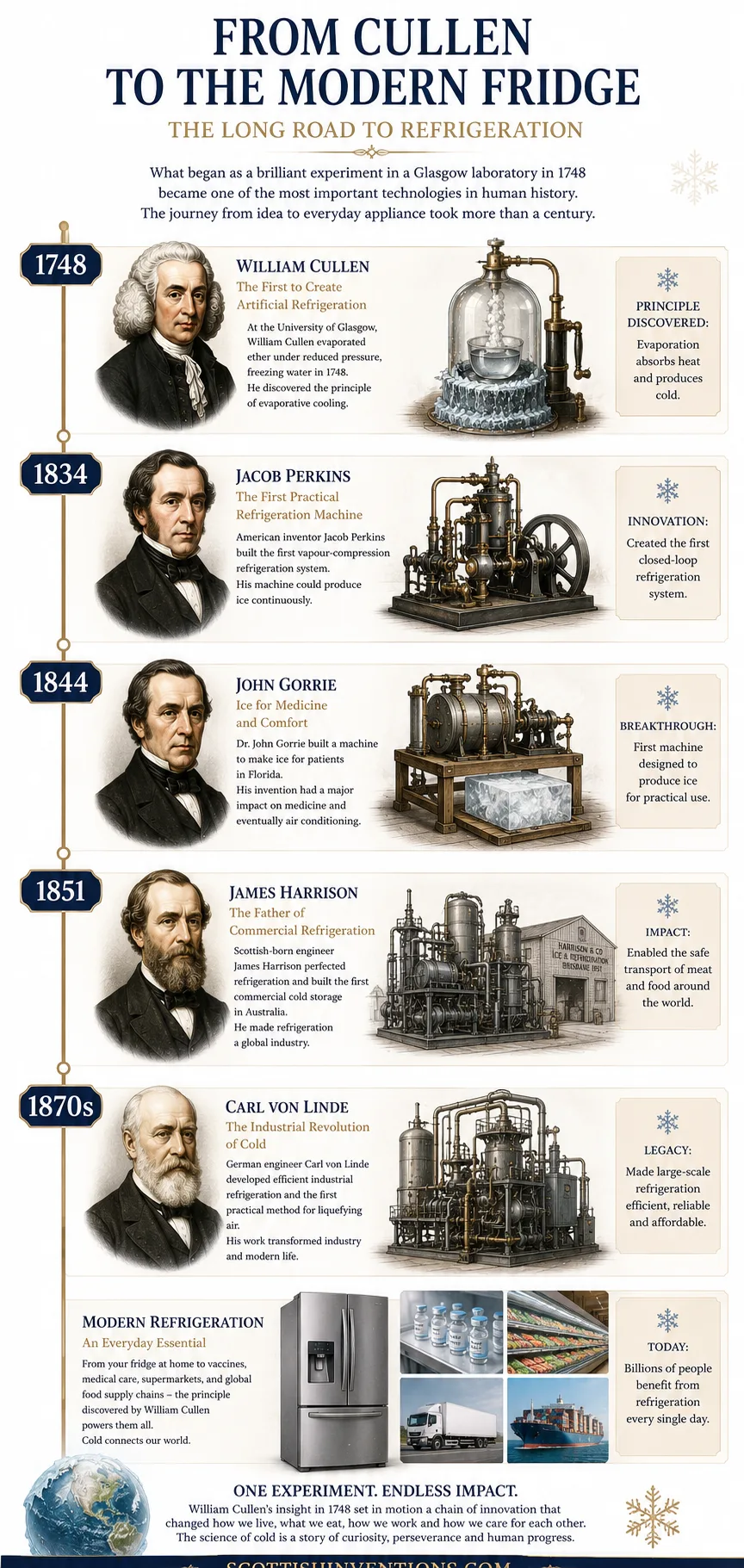
In Florida, the physician John Gorrie was granted U.S. Patent No. 8080 for an ice-making machine on 6 May 1851 — the first U.S. patent for mechanical refrigeration. He had built it to cool the rooms of yellow-fever patients; his original patent model survives in the Smithsonian. Then came the great Scottish coda. James Harrison, a Scottish-born Australian, built the first practical commercial ice-making and refrigeration machines, serving breweries and the meat trade from the 1850s. An important correction: Harrison was born on 17 April 1816 at Bonhill, near Renton, in Dunbartonshire — not, as is often claimed, in Lochgilphead, Argyll. A printer by trade who reportedly noticed the chilling effect of ether while cleaning type, he began ice-making at Rocky Point on the Barwon River in Geelong, Victoria, patented an ether vapour-compression system in the mid-1850s, and his machines were quickly adopted by brewers and meat-packers. In 1873 he attempted to ship frozen meat to Britain aboard the sailing ship Norfolk; the experiment failed when the ice ran out, denting confidence in refrigerated meat for years. The same year, he won a gold medal at the Melbourne Exhibition for proving that mechanically frozen meat stayed edible for months.
In Germany, Carl von Linde built reliable industrial refrigeration in the 1870s. After a methyl-ether prototype, he took out his patent for an ammonia machine on 5 April 1876; his first ammonia chiller was sold in September 1876 to the brewer Anton Dreher of Vienna for his Trieste plant, where it ran from 1877 until 1909, transforming the brewing of lager across Europe. Domestic refrigerators finally arrived in the early twentieth century, made practical by the chlorofluorocarbon (CFC) refrigerant 'Freon', developed in 1928 by Thomas Midgley Jr. with Albert Henne at General Motors' Frigidaire division. Midgley famously demonstrated its safety at the American Chemical Society meeting in Atlanta in April 1930 by inhaling it and using it to blow out a candle. Non-toxic and non-flammable, Freon made the home fridges of the 1920s and 1930s widespread — and put Cullen's principle into kitchens all over the world.
From Cullen to the Modern Fridge — Key Dates
1710
William Cullen born on 15 April in Hamilton, Lanarkshire — son of the Duke of Hamilton's estate factor.
1744
Begins lecturing at the University of Glasgow on medicine, botany, materia medica and chemistry — in English, not Latin.
1748
Demonstrates artificial refrigeration at Glasgow: evaporates diethyl ether under a vacuum and freezes water around the vessel.
1755
Lured to the University of Edinburgh as Professor of Chemistry, where he becomes the most celebrated medical teacher of the age.
1756
Publishes 'Of the Cold Produced by Evaporating Fluids, and of Some Other Means of Producing Cold' — his only paper on chemistry.
1834
American engineer Jacob Perkins is granted British patent 6662 for the first practical vapour-compression refrigeration machine; built by John Hague in 1835.
1851
Florida physician John Gorrie receives U.S. Patent 8080 — the first American patent for mechanical refrigeration, originally built to cool yellow-fever wards.
1850s
Scottish-born Australian James Harrison (born Bonhill, Dunbartonshire) builds the first commercial ice-making and refrigeration machines, serving breweries and the meat trade in Victoria.
1876
Carl von Linde patents his ammonia refrigeration machine; the first unit is sold to the brewer Anton Dreher of Vienna, transforming European lager.
1928
Thomas Midgley Jr. and Albert Henne develop 'Freon' (CFC) refrigerant at General Motors' Frigidaire — making the safe domestic fridge possible.
1987
The Montreal Protocol phases out CFCs after their role in destroying the ozone layer is established; industry shifts toward lower-impact refrigerants.
Cullen's Other Achievements
Refrigeration was, in truth, a footnote to Cullen's real fame. He was the pre-eminent medical teacher of his age, training a generation of leading physicians who carried his methods across Britain, Europe and America — including the chemist Joseph Black and many founders of the College of Physicians of Philadelphia. His major work, First Lines of the Practice of Physic, appeared in editions between 1777 and 1784 and was a standard textbook for decades. He devised an influential nosology — a classification of diseases into four classes (pyrexiae, neuroses, cachexiae and locales) — and coined the term 'neurosis'.
He was a central figure in the Scottish Enlightenment, a friend of Adam Smith and physician to David Hume, moving in the same circles as James Hutton, and helped obtain the royal charter that created the Royal Society of Edinburgh in 1783. He also ran a vast postal consultation practice, answering well over a hundred letters a year from patients who never met him in person. To his contemporaries he was, simply, the most important physician in Scotland.
Legacy
William Cullen holds an honoured place as the discoverer of the principle of artificial refrigeration. The industry that principle spawned is now enormous: Fortune Business Insights, for example, valued the global commercial refrigeration market at USD 51.66 billion in 2025, forecast to reach USD 82.78 billion by 2034 — and even firms that disagree on the exact figure agree it runs into many tens of billions of dollars a year.
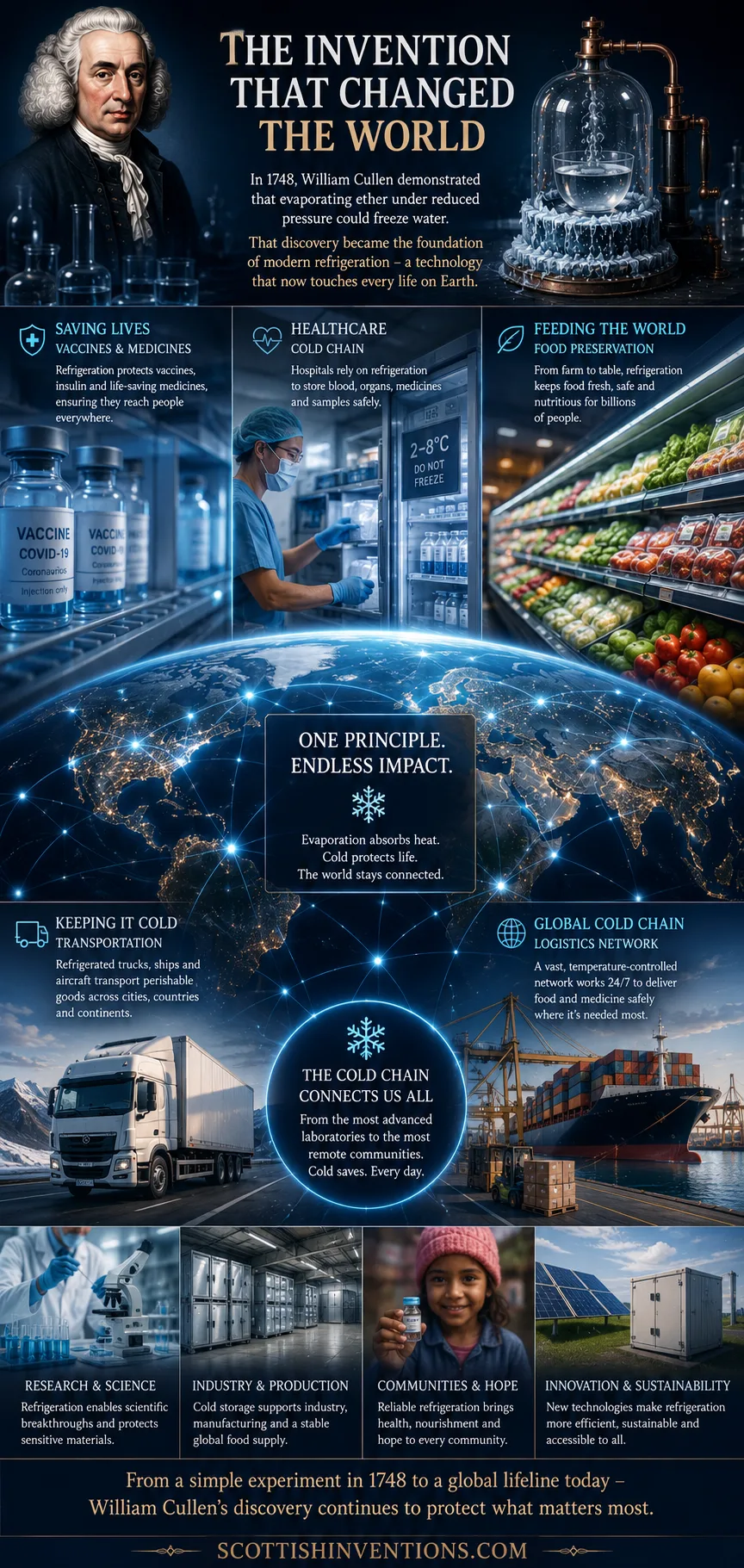
More importantly, refrigeration may have saved more lives than almost any other technology, through food safety and through the vaccine cold chain — the global web of cold rooms, fridges and cool-boxes that keeps vaccines viable from factory to syringe. According to a World Health Organization study published in The Lancet in April 2024, global immunisation efforts have saved an estimated 154 million lives over the past fifty years — 'the equivalent of 6 lives every minute of every year' — with 101 million of those lives being infants. None of that is possible without reliable cold storage.
An environmental paradox endures: the same machines that preserve food and medicine have, through their refrigerants, contributed to ozone depletion and climate change. Ozone-depleting CFCs were phased out under the 1987 Montreal Protocol, and the industry is now shifting again away from potent greenhouse-gas HFCs toward lower-impact and natural refrigerants. James Harrison's Scottish birth provides a satisfying coda — the principle discovered by a Scot in Glasgow in 1748 was commercialised by another Scot on the far side of the world. Cullen is commemorated in portraits held by the National Galleries of Scotland, and the Royal College of Physicians of Edinburgh honours him through the Cullen Medal and, since 2016, the William Cullen Prize.
Frequently Asked Questions
Who was William Cullen? William Cullen (1710–1790) was a Scottish physician, chemist and one of the leading figures of the Scottish Enlightenment. Born in Hamilton, he became Professor of Medicine at the University of Glasgow in 1751 and Professor of Chemistry at the University of Edinburgh from 1755, where he was the most celebrated medical teacher of his age and First Physician to the King in Scotland. In 1748, at Glasgow, he gave the first recorded demonstration of artificial refrigeration.
Did William Cullen invent the refrigerator? No — he did not build a working machine. What Cullen did, in 1748, was demonstrate the scientific principle on which every later refrigerator would be built: that a rapidly evaporating liquid absorbs heat from its surroundings and can be used to produce cold artificially. Practical refrigeration machines came a century later, through Jacob Perkins, John Gorrie, the Scottish-born Australian James Harrison and the German engineer Carl von Linde.
How did Cullen freeze water in 1748? Cullen placed a small vessel of diethyl ether ('nitrous aether') inside a larger vessel of water and pumped the air out above them. With the pressure lowered, the ether boiled at room temperature and evaporated furiously, drawing so much heat from its surroundings that the water around the ether vessel froze into a 'thick and firm crust of ice'.
What is artificial refrigeration? Artificial refrigeration is the production of cold by mechanical or chemical means rather than by using natural ice or cold weather. Cullen's 1748 experiment was the first demonstration of the underlying principle; modern fridges, freezers and air-conditioners industrialise the same principle in a continuous vapour-compression cycle.
How does refrigeration work? A refrigerant fluid is compressed, which heats it; it passes through a condenser where it gives off heat to the outside and turns liquid; it is then allowed to expand and evaporate inside the cold compartment, where it absorbs heat from the food and air. The vapour is drawn back to the compressor and the cycle repeats. The essential step is the evaporation, which absorbs heat — exactly as Cullen's ether did.
What is latent heat? Latent heat is the energy a substance absorbs or releases when it changes state — for example, from liquid to gas — without changing temperature. When a liquid evaporates it must absorb the latent heat of vaporisation from its surroundings, which is why evaporation cools whatever it touches. The concept was developed by Cullen's pupil Joseph Black from 1761, and it is the physics behind every refrigerator.
Why is refrigeration important today? Because it protects almost everything we eat and many of the medicines that keep us alive. Refrigeration underpins modern food safety, the global vaccine cold chain — credited by the WHO with helping save 154 million lives over the past fifty years — and the storage of blood, organs and biological samples in every hospital on Earth.