Scottish Inventions · Engineering & Power
Robert Stirling
The Scottish Minister Who Invented the Engine Two Centuries Ahead of Its Time
A safer alternative to steam. A closed-cycle air engine with a regenerative heat exchanger. A thermodynamic cycle that matches the absolute maximum efficiency allowed by physics — and now hides inside submarines, spacecraft and solar dishes.
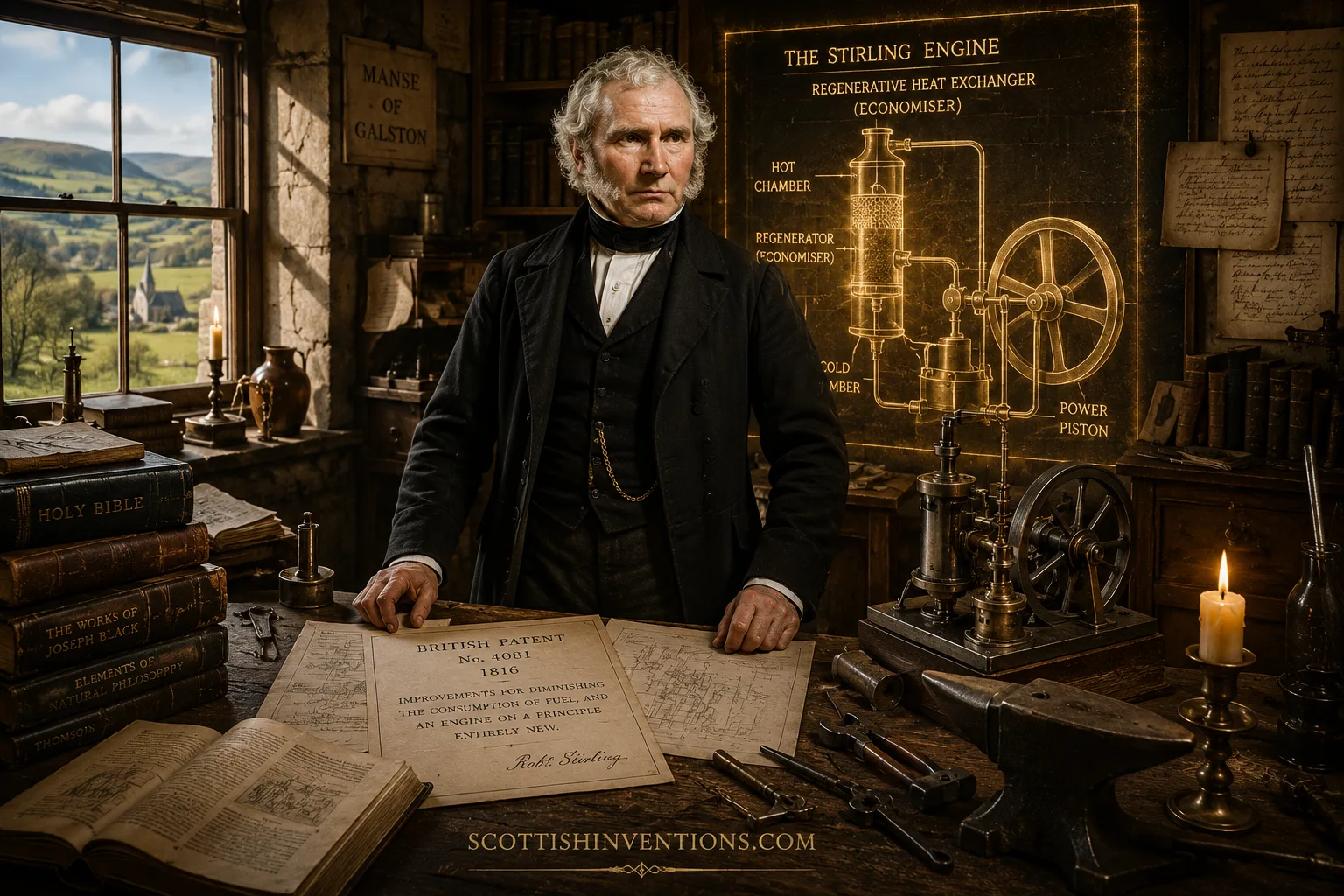
In 1816, in a small manse in Ayrshire, a newly ordained Church of Scotland minister sat down and quietly designed the most efficient heat engine that the laws of physics allow. He was 25 years old. He was not a professional engineer. He had been a minister for eight days when he applied for his patent. And yet the machine described in British Patent No. 4081 — the Stirling engine, with its heat-recycling regenerator or “economiser” — was so far ahead of its time that scientists could not fully explain why it worked for at least thirty years.
Robert Stirling had grown up amongst the boiler explosions of the early Industrial Revolution. His engine had one deceptively simple aim: to make steam power obsolete by removing the explosive high-pressure boiler altogether. What he actually did — as we now know, but as he could not — was write down the ideal closed-cycle engine, one whose Stirling cycle matches the Carnot limit, the absolute theoretical ceiling of energy efficiency.
Beaten by steam in the nineteenth century because the metals of the day melted under the heat, Stirling’s engine has been triumphantly revived. Today it powers the near-silent Swedish and Japanese submarines that hide from sonar, the NASA radioisotope generators that keep spacecraft alive in the outer solar system, dish-Stirling solar plants, and the cryogenic coolers behind thermal-imaging and night-vision cameras. This is the story of the parish minister from Galston who out-thought the steam age.
Key Facts
Timeline
- •
1790
Born 25 October at Cloag Farm, near Methven, Perthshire — third of eight children.
- •
1815
Licensed to preach by the Presbytery of Dumbarton on 4 July.
- •
1816
Ordained 19 September at Laigh Kirk, Kilmarnock. Applies for Patent No. 4081 eight days later, on 27 September.
- •
1817
Patent 4081 signed and sealed on 20 January — the world's first closed-cycle air engine and regenerator.
- •
1818
First practical Stirling engine built to pump water at an Ayrshire quarry — about 2 horsepower.
- •
1824
Translated to the parish of Galston, Ayrshire, where he ministers for the rest of his life.
- •
1827
Robert and his brother James take out an improved patent, adding pressurisation.
- •
1840
Awarded honorary DD by the University of St Andrews. Second improved patent with James Stirling.
- •
1843
James Stirling installs a 45 hp air engine at the Dundee Foundry — for a time its sole motive power.
- •
1845
James Stirling addresses the Institution of Civil Engineers, arguing the engine's safety motive.
- •
1878
Dies 6 June at Galston, aged 87 — after 54 years in one parish.
- •
1945
Philips of Eindhoven fixes the name 'Stirling engine' in April 1945; four decades of modern development follow.
- •
1996
HSwMS Gotland enters service — the world's first operational submarine with Stirling-engine air-independent propulsion.
- •
Today
Stirling engines power NASA radioisotope generators, dish-Stirling solar plants, cryocoolers and clean-energy CHP units.
1. Who Was Robert Stirling?
Short answer: Robert Stirling (1790–1878) was a Church of Scotland parish minister at Galston in Ayrshire whose lifelong sideline in engineering produced the closed-cycle air engine that now bears his name.
Stirling was born on 25 October 1790 at Cloag Farm, near Methven, in Perthshire — the third of eight children. His father, Patrick Stirling, was a farmer and mechanically minded improver of farm machinery; his grandfather Michael Stirling had built an early threshing machine. Mechanical ingenuity ran deep in the family.
He studied classical subjects at the University of Edinburgh from 1805, then divinity at the University of Glasgow and Edinburgh. Licensed to preach by the Presbytery of Dumbarton on 4 July 1815, he was ordained on 19 September 1816 as minister of the second charge of the Laigh Kirk in Kilmarnock. On 20 January 1824 he was translated to the nearby parish of Galston, Ayrshire, where he ministered until his death — over half a century in one parish. In 1840 the University of St Andrews awarded him an honorary Doctor of Divinity.
He married Jane (Jean) Rankine on 10 July 1819, and they had seven children — an extraordinary number of whom became distinguished engineers. Patrick and James became celebrated railway locomotive engineers; William a civil engineer in South America. His younger brother, James Stirling (b. 1800), trained as a professional engineer and became Robert’s indispensable collaborator on the engine.
“He sometimes surprised his neighbours at midnight by the hammering resounding from the anvil in his little smithy adjoining the manse.”
— Contemporary account of Stirling at the Manse of Galston
2. The Dangerous World of Steam
Short answer: In the early nineteenth century, high-pressure steam boilers exploded with appalling regularity. Robert Stirling, ministering in industrial Ayrshire, wanted an engine that could not explode.
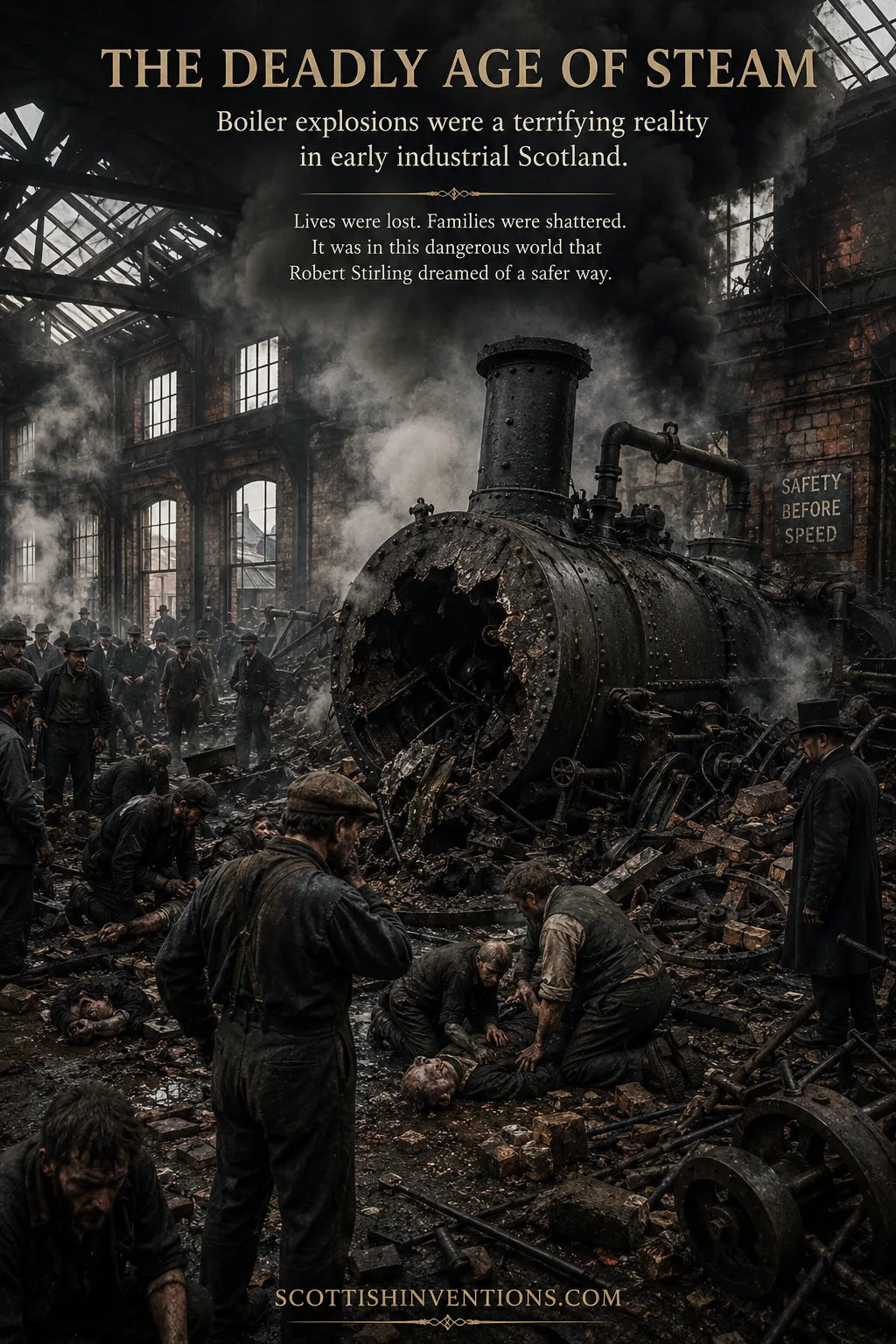
The early nineteenth century was the high noon of steam. Steam engines — building on James Watt’s revolutionary separate condenser and his centrifugal governor — powered mills, mines, factories and pumping stations across industrialising Scotland. But the high-pressure boilers that drove them were lethally dangerous: built from imperfect wrought iron, poorly understood, and frequently operated beyond safe limits. They exploded regularly, scalding and killing the workers who tended them.
As a minister in industrial Ayrshire, Stirling would have buried parishioners and comforted maimed and bereaved families. It is widely held — though, as careful historians note, partly inferred — that this human cost motivated his search for a safer “air engine.” The motive was spelled out explicitly by his brother in an 1845 paper to the Institution of Civil Engineers, arguing that the engine was designed not merely to save fuel but to provide a safer alternative to steam boilers, “which often explode and cause numerous deaths and injuries.”
3. Inventing the Stirling Engine — Patent 4081
Short answer: On 27 September 1816 — eight days after his ordination — Stirling applied for British Patent No. 4081, describing a closed-cycle air engine with a heat-recycling regenerator he called the “economiser.”
The patent was granted the wonderfully grandiose title “Improvements for Diminishing the Consumption of Fuel, and in particular an Engine capable of being Applied to the Moving of Machinery on a Principle Entirely New.” The specification was signed and sealed on 20 January 1817. It described two linked inventions that together constitute the Stirling engine: the economiser (a regenerative heat exchanger, or regenerator) and an air engine that used it.
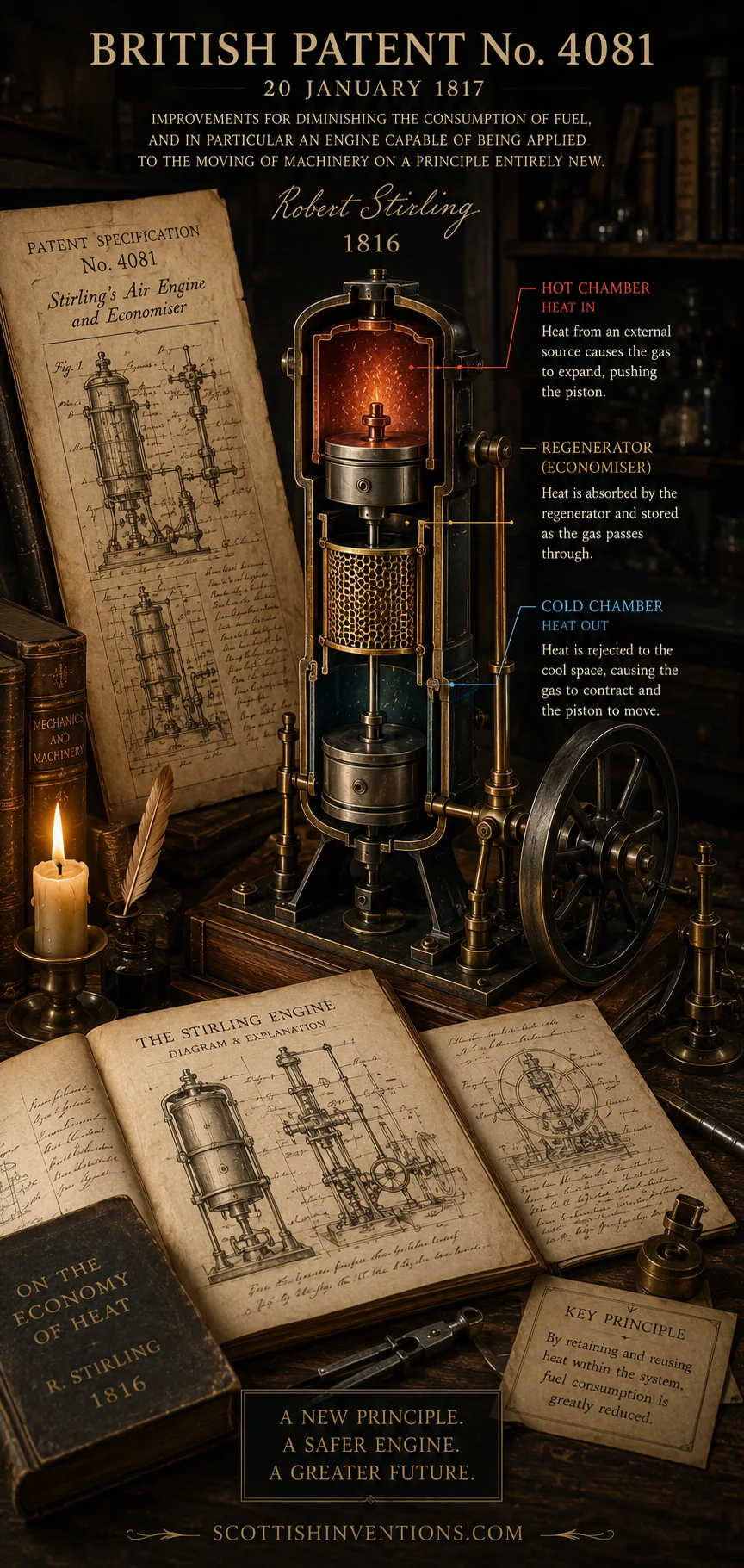
As the American Society of Mechanical Engineers has put it, in this patent Stirling “not only described the construction and use of a regenerator for the first time in history, but also foresaw its principal applications, such as for glass furnaces or iron smelting,” along with “a description of the first closed-cycle hot-air engine.”
The first practical version was built in 1818 to pump water at a quarry in Ayrshire, producing about 2 horsepower. By the contemporary account in The Engineer, it “continued to work for some time, until a careless attendant allowed the heater to become overheated.” That single sentence captures the whole nineteenth-century tragedy of the Stirling engine: it worked, but its materials could not take the punishment.
Robert and his brother James took out improved patents in 1827 and 1840, adding pressurisation. The high point came at the Dundee Foundry Company, where James built a large engine — a 16-inch cylinder, 4-foot stroke, producing about 45 horsepower — commissioned in March 1843. For a time it was the establishment’s only motive power. But the story ended as it always did: the hot air vessel failed in December 1845, again in May 1846, and again in December 1847. After Stirling left, the new management replaced it with a steam engine.
4. How the Stirling Engine Works
Short answer: A Stirling engine cycles a fixed quantity of sealed gas between a hot chamber and a cold chamber. Heating and cooling the gas makes it expand and contract, driving a piston. The regenerator recycles heat between the two sides.
The simple explanation
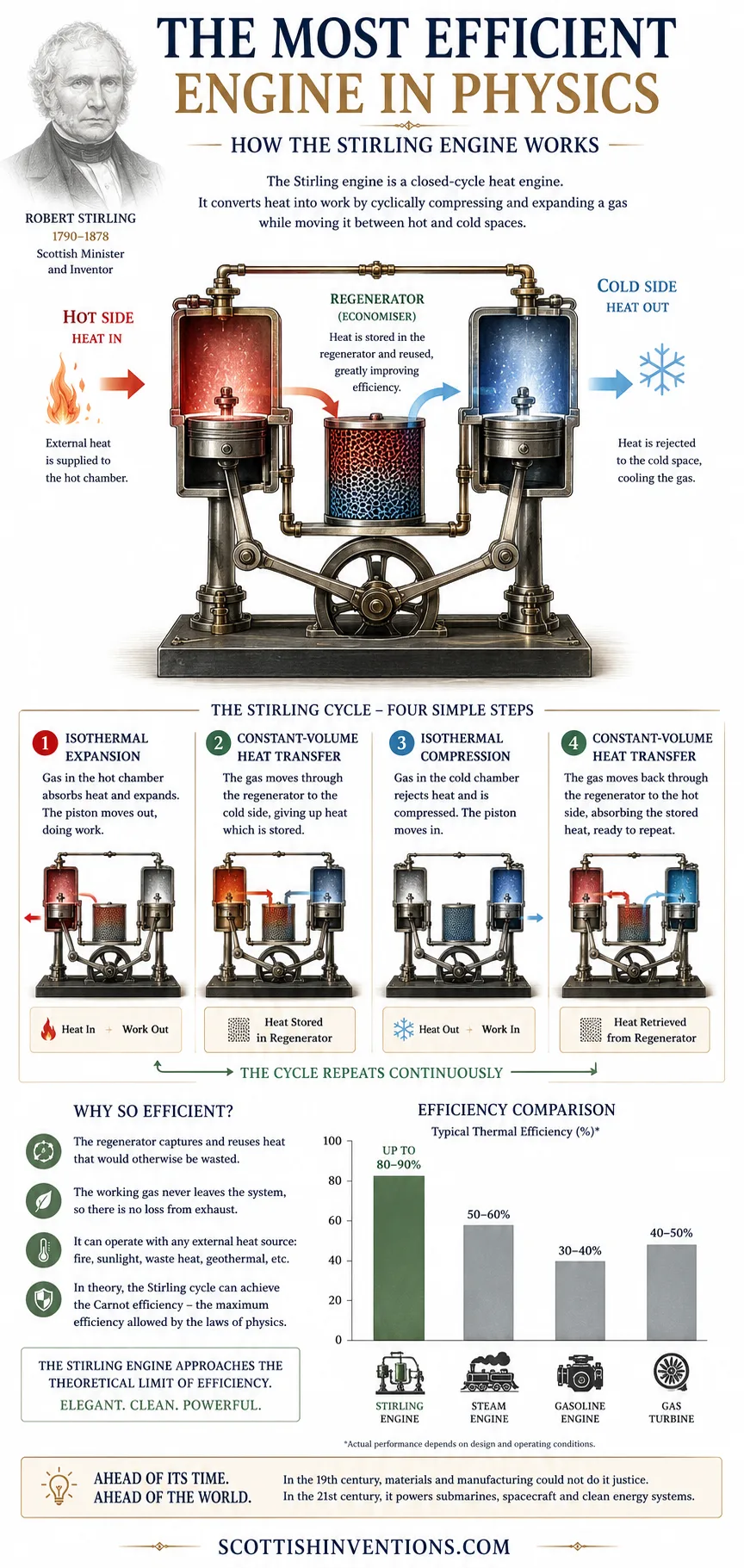
A Stirling engine is an external combustion engine operating on a closed thermodynamic cycle. A fixed quantity of working gas — originally air, in modern engines often helium or hydrogen — is permanently sealed inside the machine. It is shuttled back and forth between a hot space (heated from outside by any flame, sunlight or waste heat) and a cold space (cooled, for example, by water). As the trapped gas is heated it expands and pushes a piston; as it is cooled it contracts and the piston returns. The gas is never exhausted; the same gas is reused indefinitely.
The technical explanation — the four phases of the Stirling cycle
- Isothermal expansion. Gas in the hot chamber absorbs heat from the external source and expands at (ideally) constant temperature, doing work on the piston.
- Constant-volume regenerative cooling. The gas is displaced through the regenerator toward the cold side, giving up heat into the mesh, which stores it.
- Isothermal compression. In the cold chamber the gas is compressed at (ideally) constant temperature, rejecting heat to the coolant.
- Constant-volume regenerative heating. The gas is displaced back through the regenerator to the hot side, absorbing the heat it deposited on the previous pass — ready to expand again.
5. Why the Stirling Engine Was So Far Ahead of Its Time
Short answer: The Stirling cycle matches the Carnot limit — the theoretical maximum efficiency for any heat engine. Stirling wrote it down in 1816, before physicists had even understood what heat was.
As an engineering reference states plainly: “the Stirling cycle achieves the Carnot efficiency at a given hot and cold temperature.” This is astonishing. In 1816 the accepted theory was that heat was a fluid called “caloric” that flowed from hot to cold; the modern statistical theory of thermodynamics was decades away. Sadi Carnot would not publish his foundational theorem — the theorem that establishes the ceiling — until 1824. The second law of thermodynamics, in its modern form, would not be nailed down until the 1850s.
As the ASME’s own history marvels, Stirling’s regenerator “was so much in advance of scientific knowledge at the time that at least 30 years passed before anyone was in a position to understand what made the engine work at all.”
Why materials, not physics, killed it in the nineteenth century
To be powerful and efficient, a Stirling engine must run very hot. Efficiency rises with TH, and power density rises with pressure and temperature. But the cast iron and wrought iron available to Stirling melted, crept and cracked under the strain of continuous high-temperature operation, as the Dundee Foundry failures showed. In 1876 — two years before he died — Stirling himself wrote hopefully that Henry Bessemer’s new process for making steel might at last yield metals strong enough for a proper air engine. It would take another century of metallurgy, and eventually nickel and stainless alloys, before he was proved right.
Meanwhile steam technology matured rapidly; safer boilers, better regulation, and a booming railway market handed the nineteenth century to steam. Smaller, cooler-running hot-air engines did find niches from about 1860 — pumping water, driving small fans, blowing air for church organs — but the dream of a steam-beating industrial prime mover faded.
6. The Modern Stirling Engine
Short answer: Once modern alloys made high-temperature operation practical, the Stirling engine came back where its three superpowers — near-silence, high efficiency and heat-source flexibility — are decisive: submarines, spacecraft, solar power and cryogenic cooling.
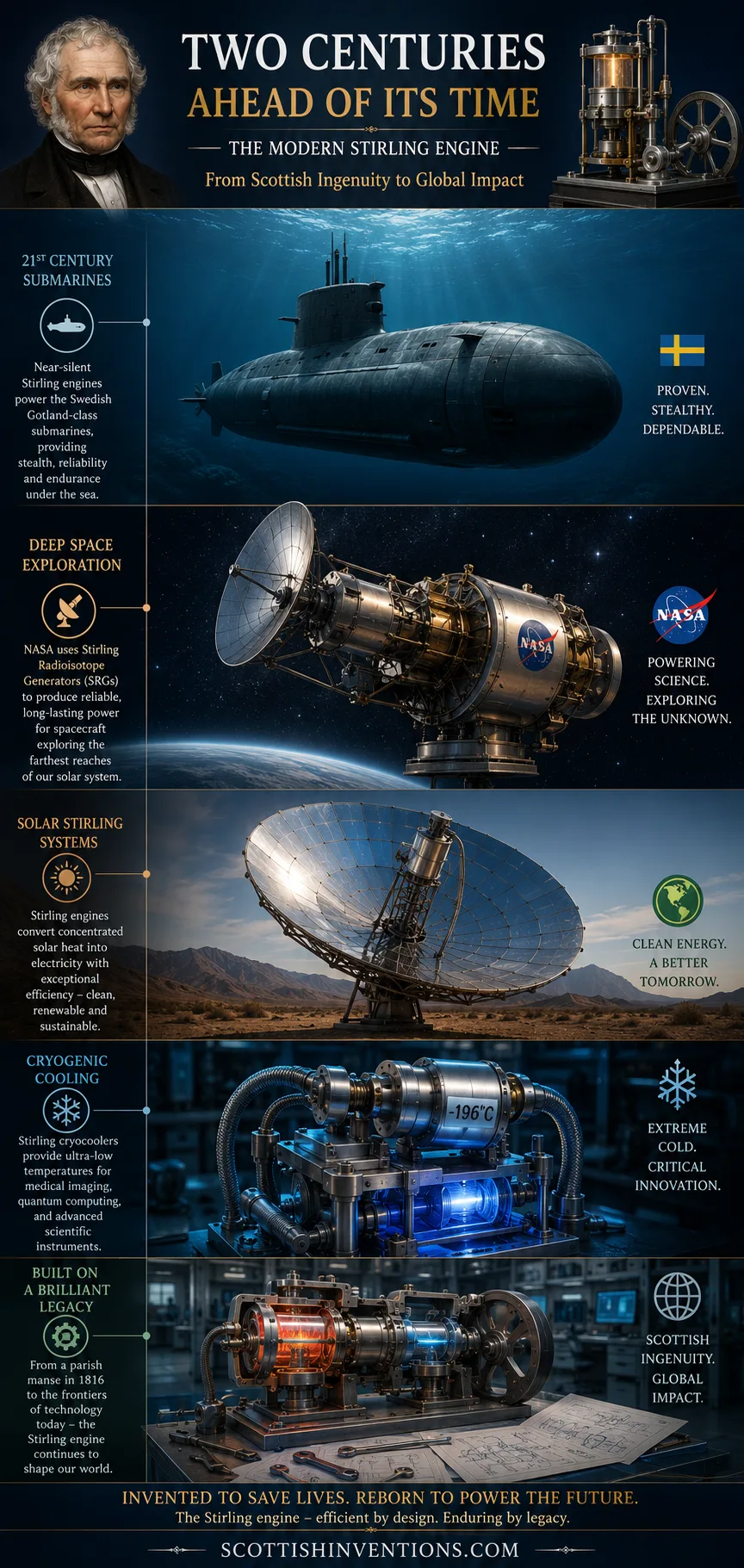
The engine’s resurrection began in the late 1930s at the Philips research laboratories in Eindhoven, which spent nearly forty years systematically developing modern, high-speed Stirling engines. From that foundation, the engine has found a series of high-value modern niches.
Silent submarines
Because a Stirling engine has no explosive combustion and few violently vibrating parts, it runs almost silently — exactly what a submarine needs to stay hidden. Sweden’s Gotland-class submarines, built by Kockums (now Saab Kockums) — HSwMS Gotland commissioned in 1996, with sisters Uppland and Halland joining in 1997 — were the world’s first operational submarines to use Stirling-engine Air-Independent Propulsion (AIP). Each carries two Kockums V4-275R Stirling units driving a 75-kilowatt generator, burning diesel with stored liquid oxygen. The system permits the vessel to stay submerged for 14 days at 5 knots — a range of 1,700 nautical miles — without surfacing to recharge batteries.
The capability is no gimmick. In 2005 the US Navy leased HSwMS Gotland; during a Pacific war-game the boat “managed to snap several pictures of USS Ronald Reagan… demonstrating that it was in a position to sink the aircraft carrier,” slipping through the supercarrier’s defences undetected. Japan’s Sōryū-class submarines followed from 2009, fitted with the same Kockums V4-275R engines license-built by Kawasaki Heavy Industries.
Deep space
NASA developed the Advanced Stirling Radioisotope Generator (ASRG), which uses the heat of decaying plutonium-238 to drive a free-piston Stirling converter. Its attraction is efficiency: Stirling radioisotope power systems reach “approximately 20% conversion efficiency, more than three times higher than previous NASA RPS (~6%),” potentially cutting the amount of scarce plutonium fuel required by a factor of four. NASA Glenn’s Technology Demonstration Convertor #13 has run continuously since 2003 — “the longest-running heat engine in the history of civilisation.”
Solar Stirling
Point a parabolic mirror at the sun, focus its heat onto a Stirling engine, and you have a solar generator. On 31 January 2008, Sandia National Laboratories and Stirling Energy Systems set a net solar-to-grid efficiency record of 31.25% at the National Solar Thermal Test Facility — the most efficient solar-to-electricity conversion of any solar technology to date.
Micro-CHP and cryocoolers
In domestic combined heat and power units, a small Stirling engine burns gas to make electricity while its waste heat warms the house. New Zealand’s WhisperGen was a notable commercial example. Run in reverse, a Stirling engine becomes a superb refrigerator: miniature Stirling cryocoolers chill the infrared detectors in thermal-imaging cameras, military night-vision, satellites and medical instruments down to cryogenic temperatures.
7. Legacy and Honours
Robert Stirling lived to 87, dying at Galston on 6 June 1878. He had served as a minister for over half a century. His foundational insight — the regenerator — went on to influence furnace and steel-making technology, and in an 1876 letter he expressed hope that Bessemer’s new steel would finally yield metals strong enough for a proper air engine.
A new gravestone was erected by public subscription in Galston Cemetery in December 2014 after the original had crumbled, and rededicated on 3 May 2015 in a service organised by Galston Parish Church; the new stone carries a line drawing of the engine that bears his name. In 2014 he was inducted into the Scottish Engineering Hall of Fame. The engine was only christened generically the “Stirling engine” long after his death: Fleeming Jenkin championed the name in 1884, but it was the Philips company that fixed it in April 1945. A UK enthusiasts’ organisation, the Stirling Engine Society, founded in January 1997, celebrated the bicentenary of his 1816 patent in 2016.
For a humble parish minister to leave behind not just a working engine but an entire idealised thermodynamic cycle that bears his name in physics textbooks — and that now hides inside submarines, spacecraft and solar dishes two centuries later — is a legacy of which Scotland can be immensely proud. His invention was limited by nineteenth-century materials, not by nineteenth-century imagination.
8. Steam Engine vs Stirling Engine
| Property | Steam Engine | Stirling Engine |
|---|---|---|
| Working fluid | Water / steam (consumed & vented) | Sealed gas (air, helium, hydrogen) |
| Cycle | Open — fresh water in, steam out | Closed — same gas reused indefinitely |
| Combustion | External (firebox) but through a pressurised boiler | External, entirely outside the working gas |
| Heat source | Coal, oil or gas — must boil water | Any: flame, sunlight, waste heat, radioisotope |
| Peak thermal efficiency | ~35% (best modern reciprocating; ~10–15% historically) | Ideal cycle matches Carnot limit; ~30–40% real-world |
| Noise & vibration | Loud, pulsating | Near-silent |
| Safety | High-pressure boiler risk of explosion | No boiler; no explosion risk |
| Maintenance | Feedwater, scale, boiler inspections | Sealed system; few wearing parts |
| Modern applications | Power stations, heritage rail, marine turbines | AIP submarines, NASA generators, solar dishes, cryocoolers |
Did You Know?
- He was a Church of Scotland minister, not an engineer — he applied for his patent eight days after his ordination.
- He was driven by death: boiler explosions regularly killed and maimed workers, and an engine that could not explode was, in part, a minister’s response to that suffering.
- It is as efficient as physics allows — the ideal Stirling cycle matches the Carnot limit.
- It powers silent submarines today: a leased Swedish Gotland famously “out-stealthed” a US aircraft carrier in a 2005 war-game.
- The “economiser” was the masterstroke — his regenerator, which recycles heat between cycles, is still used across engineering.
- He preached for over fifty years and lived to 87 — over half a century of it in a single parish, Galston.
Frequently Asked Questions
Who invented the Stirling engine?
The Reverend Robert Stirling (1790–1878), a Church of Scotland minister from Perthshire serving the parish of Galston in Ayrshire, invented the Stirling engine. He was granted British Patent No. 4081, applied for on 27 September 1816 and signed and sealed on 20 January 1817.
What is a Stirling engine?
A Stirling engine is a closed-cycle, external combustion heat engine. A fixed quantity of working gas — originally air — is permanently sealed inside the machine and shuttled between a hot space and a cold space. As the gas is alternately heated and cooled it expands and contracts, driving a piston. Heat is applied entirely outside the working gas, so there is no explosive combustion inside the engine.
How does a Stirling engine work?
The engine uses four thermodynamic phases: isothermal expansion in the hot chamber, constant-volume heat transfer through the regenerator to the cold side, isothermal compression in the cold chamber, and constant-volume heat transfer back through the regenerator to the hot side. Because the same gas is reused indefinitely and heat is recycled by the regenerator, the engine converts external heat into mechanical work with exceptional efficiency.
Why is the Stirling engine so efficient?
The ideal Stirling cycle achieves the same theoretical maximum efficiency as the Carnot cycle — the absolute ceiling set by the second law of thermodynamics for any heat engine working between two temperatures. In practice it is helped by the regenerator, which captures and re-uses heat that would otherwise be wasted.
What is a regenerator or 'economiser'?
The regenerator, which Robert Stirling called an 'economiser', is a heat-storing matrix (usually a fine metal mesh) placed between the hot and cold sides of the engine. It absorbs heat from the gas flowing toward the cold end and returns that heat to the gas flowing back toward the hot end, dramatically reducing the fuel needed each cycle.
Why didn't the Stirling engine replace the steam engine?
Nineteenth-century metallurgy could not withstand the sustained high temperatures needed for a powerful air engine. Cast-iron hot chambers cracked and failed — as they did repeatedly at the Dundee Foundry (1843–1847) — while steam technology matured rapidly. Steam won the century, and the Stirling engine was relegated to small, cool-running niches until modern alloys made a full revival possible.
Where are Stirling engines used today?
They power the near-silent air-independent propulsion systems of Swedish Gotland-class and Japanese Sōryū-class submarines, NASA's Stirling radioisotope generators for deep-space missions, dish-Stirling solar generators, domestic combined-heat-and-power units, and — when run in reverse — miniature cryocoolers for thermal-imaging, night-vision and satellite systems.
Does NASA use Stirling engines?
Yes. NASA's Advanced Stirling Radioisotope Generator (ASRG) programme developed free-piston Stirling converters that produced roughly 20% conversion efficiency — more than three times the ~6% of earlier radioisotope power systems. NASA Glenn's Technology Demonstration Convertor #13 has run continuously since 2003 and is described by NASA as the longest-running heat engine in the history of civilisation.
Why do submarines use Stirling engines?
A Stirling engine has no explosive combustion and few violently moving parts, so it runs almost silently — a decisive advantage for a submarine that must stay hidden. Sweden's Gotland class (1996 onward) uses Kockums V4-275R Stirling units burning diesel with stored liquid oxygen, giving 14 days submerged at 5 knots. Japan's Sōryū class uses the same engine, license-built by Kawasaki.
Who was Robert Stirling?
Robert Stirling (25 October 1790 – 6 June 1878) was a Scottish Church of Scotland minister and inventor. Born at Cloag Farm near Methven in Perthshire, educated at the Universities of Edinburgh and Glasgow, ordained in 1816 and translated to Galston, Ayrshire in 1824, he served as a parish minister for over half a century. In 1840 St Andrews awarded him an honorary Doctor of Divinity, and in 2014 he was inducted into the Scottish Engineering Hall of Fame.