Scottish Inventions · Communications & Media
Alexander Graham Bell and the Telephone
The Edinburgh-Born Inventor Who Made the Wires Speak
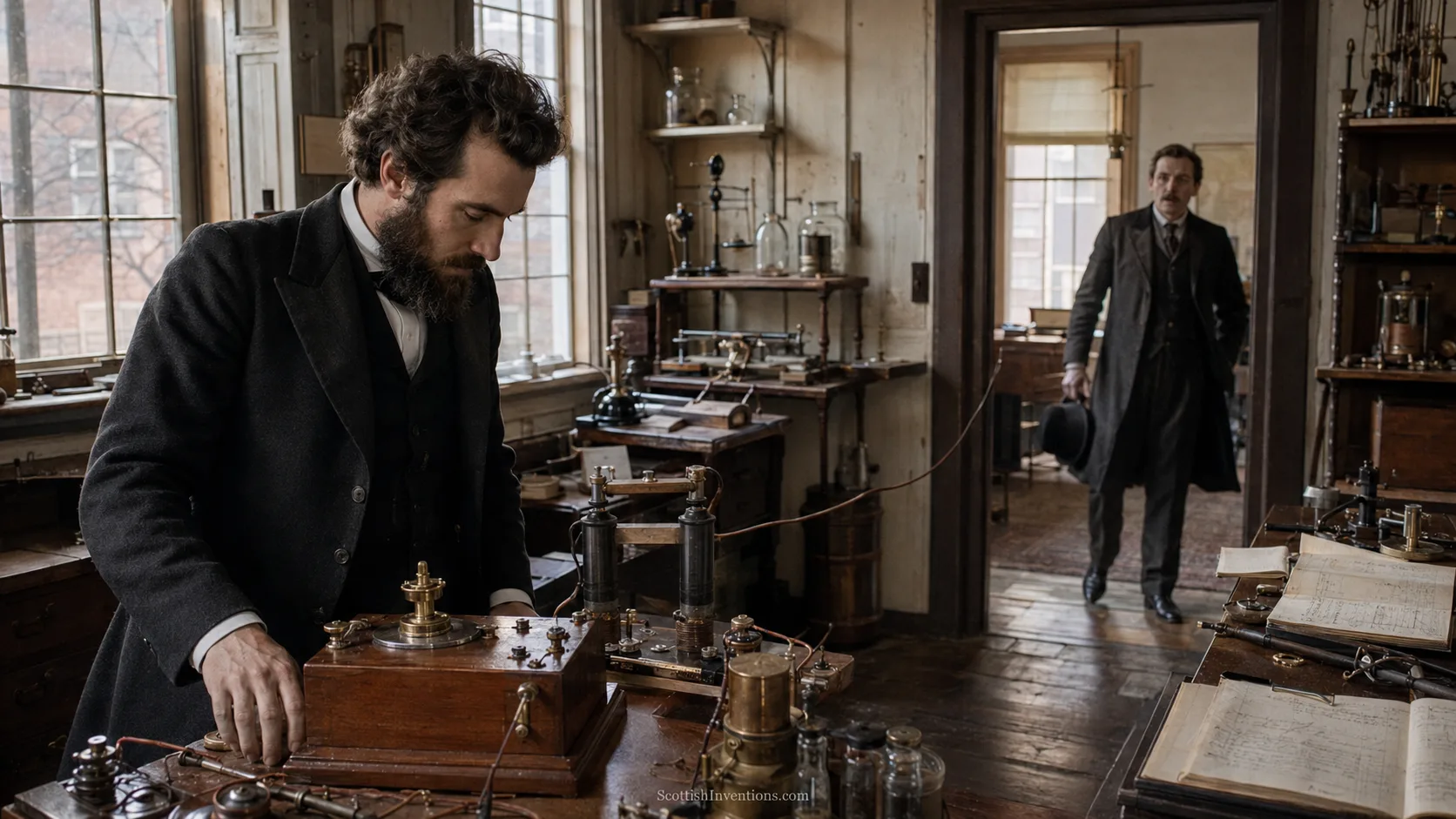
Alexander Graham Bell (1847–1922), born in Edinburgh, built the first practical telephone — not by accident, and not alone. On 10 March 1876, in a small Boston laboratory at 5 Exeter Place, he spoke into a jar of acidulated water and sent the first intelligible words ever carried by electric wire: “Mr. Watson — come here — I want to see you.”
TL;DR
- Bell was born in Edinburgh and educated in Scotland; his father Alexander Melville Bell’s Visible Speech system was the intellectual seedbed of everything that followed.
- The invention itself was conceived largely at Brantford, Ontario in 1874 and built in Boston. Bell was Scottish-born — the telephone is not, strictly speaking, a Scottish invention in the way the tarmac road is.
- US Patent No. 174,465 was granted on 7 March 1876; the first intelligible call followed on 10 March 1876.
- The Supreme Court’s Telephone Cases (1888) upheld Bell 4–3. Bell/AT&T litigated 587 patent challenges and never lost a case concluded with a final judgment.
- The acid-spill story is a myth; House Resolution 269 did not declare Meucci the inventor.
Key Facts
1. An Edinburgh Boyhood & Visible Speech
Alexander Bell — the “Graham” was added at his own request when he was ten — was born on 3 March 1847 at 16 South Charlotte Street, Edinburgh. The commemorative stone above the door still reads: “Alexander Graham Bell / Inventor of the Telephone / Was born here 3rd March 1847.” The modern door number is 14, but Historic Environment Scotland — which lists the Category A building — consistently gives 16 as the birthplace.
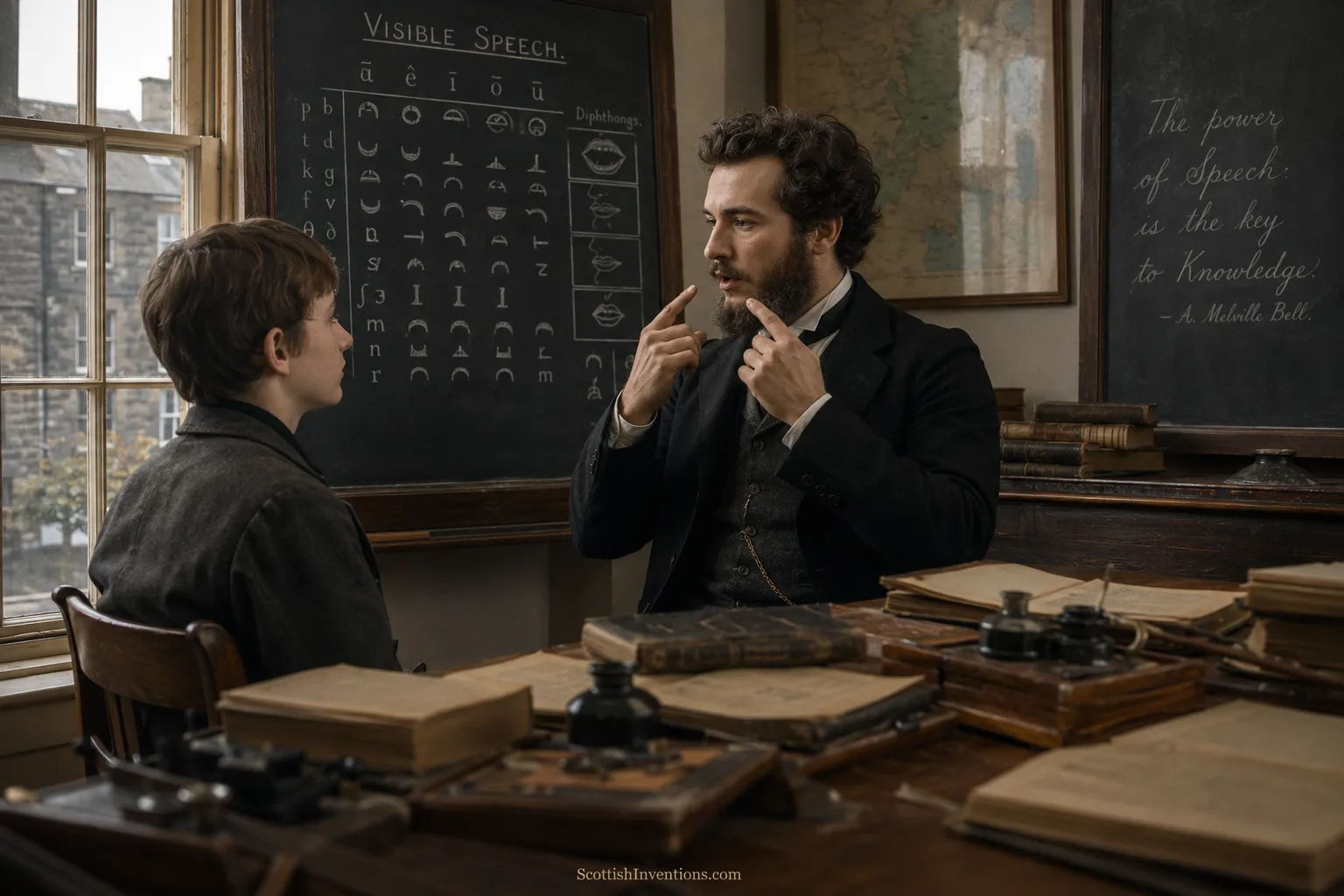
Bell was born into a dynasty of elocutionists. His grandfather Alexander Bell taught elocution in London; his uncle in Dublin; and his father Alexander Melville Bell at the University of Edinburgh. In 1867, Melville Bell published Visible Speech: The Science of Universal Alphabetics — a phonetic notation system that rendered the positions of the tongue, lips and throat as symbols, so that a deaf child could see how to shape a sound they had never heard.
Bell’s mother, Eliza Grace Symonds, began losing her hearing in childhood. Young Alexander developed a way of speaking to her in low resonant tones close to her forehead. His future wife, Mabel Hubbard, had lost her hearing to scarlet fever. Deafness was never abstract to him; it was familial. Everything he later did with electricity and sound grew out of that fact.
At sixteen he became a pupil-teacher of elocution and music at Weston House Academy in Elgin, Moray. He attended the University of Edinburgh in 1864, returned to Elgin, and later studied at University College London.
2. Grief, Emigration & Boston
By 1870 Bell’s two brothers, Edward (d. 1867) and Melville (d. 1870), had both died of tuberculosis. His own health was faltering. His father, terrified of losing the last son, moved the family to Brantford, Ontario. In 1871 Bell went south to Boston to teach at the Boston School for Deaf Mutes. In 1873 he was appointed Professor of Vocal Physiology and Elocution at Boston University.
It was in Boston that he met the two people who would make the telephone possible: Thomas Augustus Watson, a young electrical craftsman from Charles Williams’s workshop, and Gardiner Greene Hubbard, a wealthy Boston lawyer whose deaf daughter Mabel Bell was teaching — and who would eventually finance his experiments and become his father-in-law.
3. Harmonic Telegraph & the Idea of a Speaking Wire
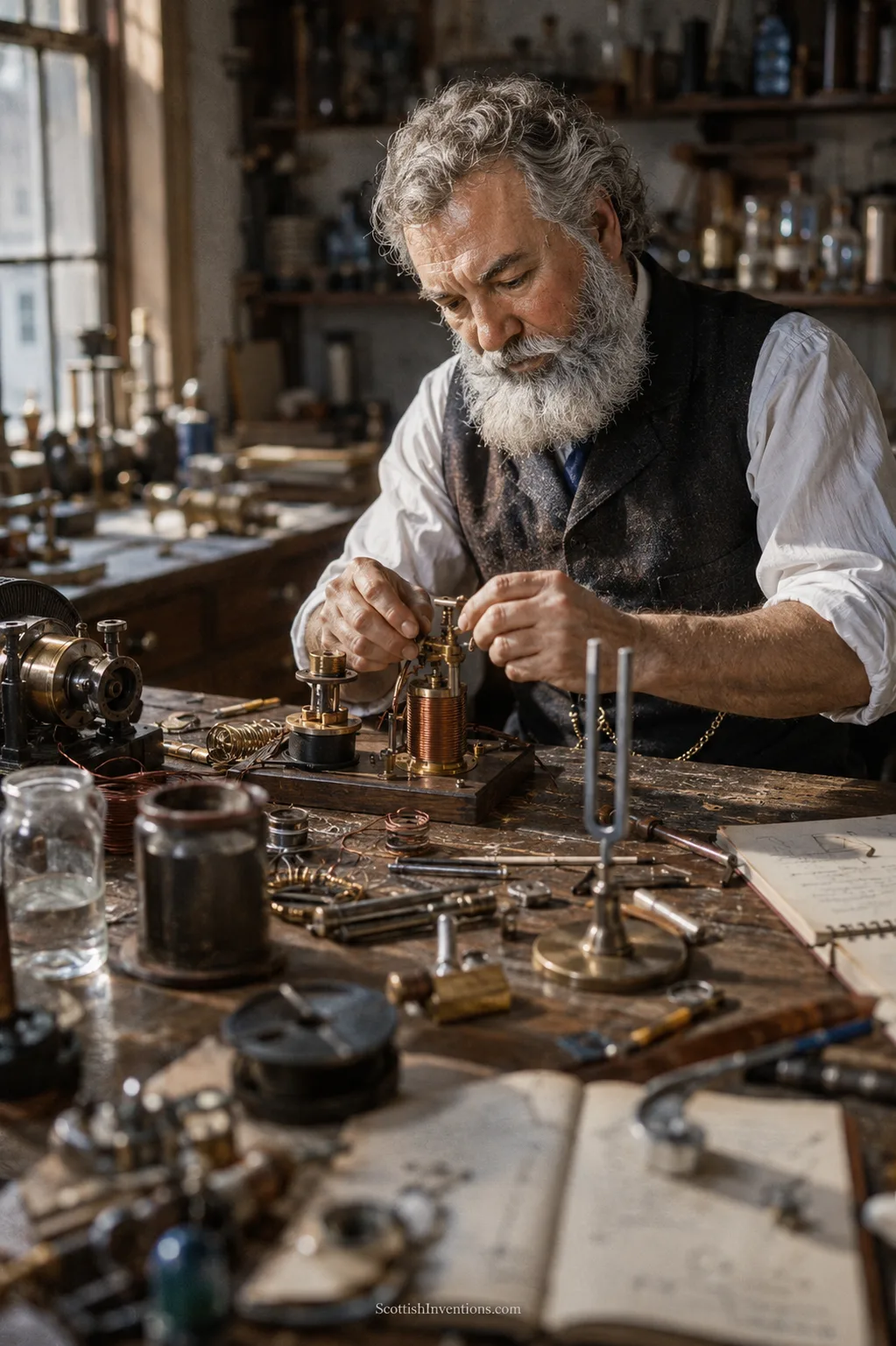
Bell’s first project was not the telephone but the harmonic telegraph — a scheme to send several Morse messages down one wire at once by tuning each to a different pitch. It was a well-funded, respectable idea. But Bell kept getting distracted by a stranger question: if a wire could carry a musical tone, could it not carry the shifting overtones of a human voice?
The breakthrough insight came at his father’s house in Brantford in the summer of 1874. Rather than trying to switch a current on and off in the rhythm of speech, Bell realised he needed a continuous current whose intensity varied in perfect analogy to the pressure waves of the voice — an undulatory current. This is the phrase that would later carry the day in the Supreme Court.
4. 14 February 1876 — The Patent Race
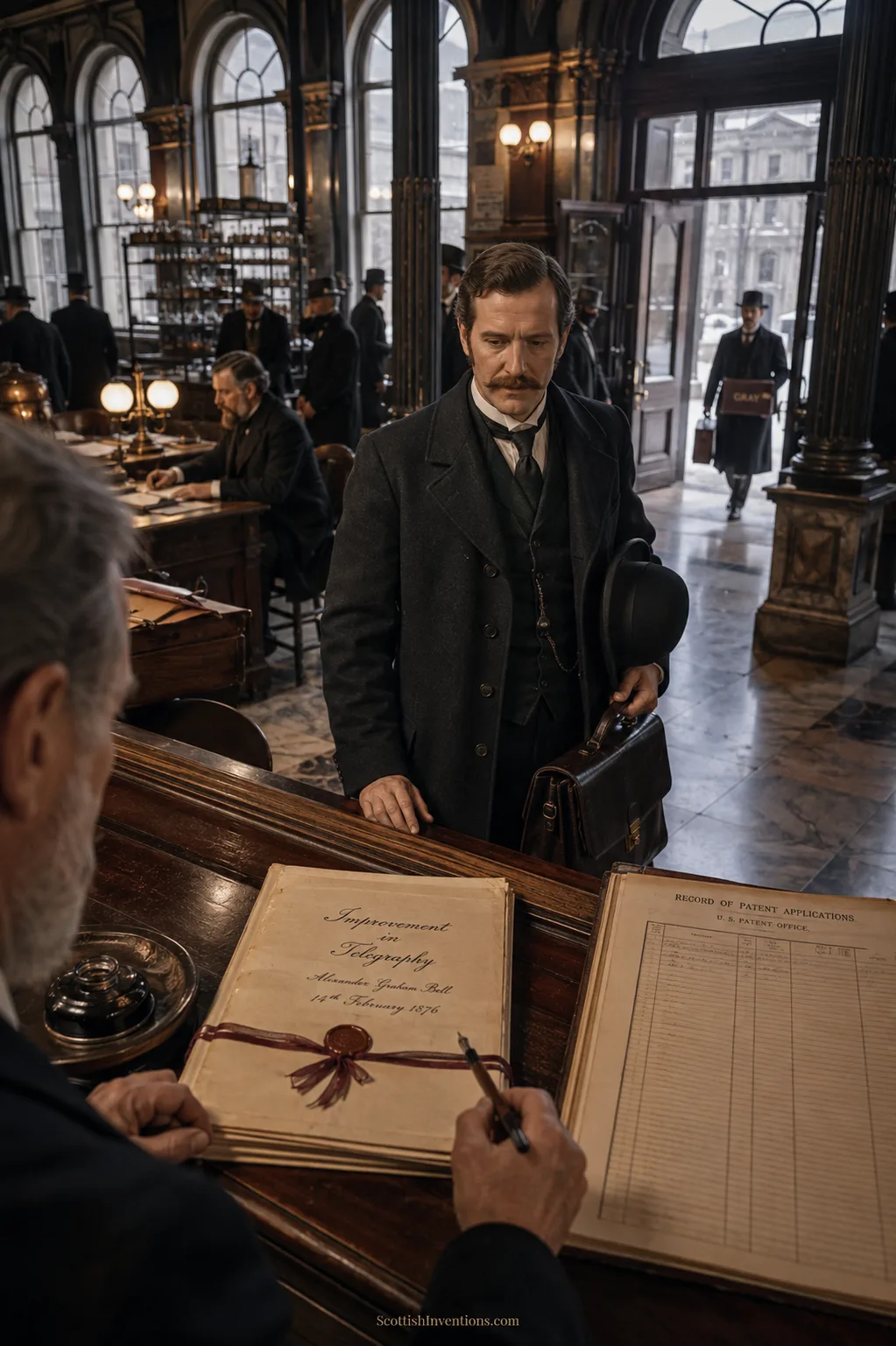
On 14 February 1876, two sets of attorneys walked into the US Patent Office in Washington. Bell’s lawyer Marcellus Bailey filed a full patent application. Elisha Gray’s lawyer William D. Baldwin filed a caveat — a provisional notice reserving the right to file a full application within three months. Bell himself was in Boston and did not even know his application was being filed that day.
The mythology is that Bell filed “hours before” Gray. The reality is procedurally messier: Bell’s filing fee was entered earlier in the cash blotter, but Gray’s caveat may have reached the examiner at about the same time. Priority-of-filing became moot when Gray abandoned his caveat rather than converting it to a full application — leaving the field to Bell.
Three weeks later, on 7 March 1876, US Patent No. 174,465 was granted — often called the most valuable patent ever issued.
5. 10 March 1876 — The First Call
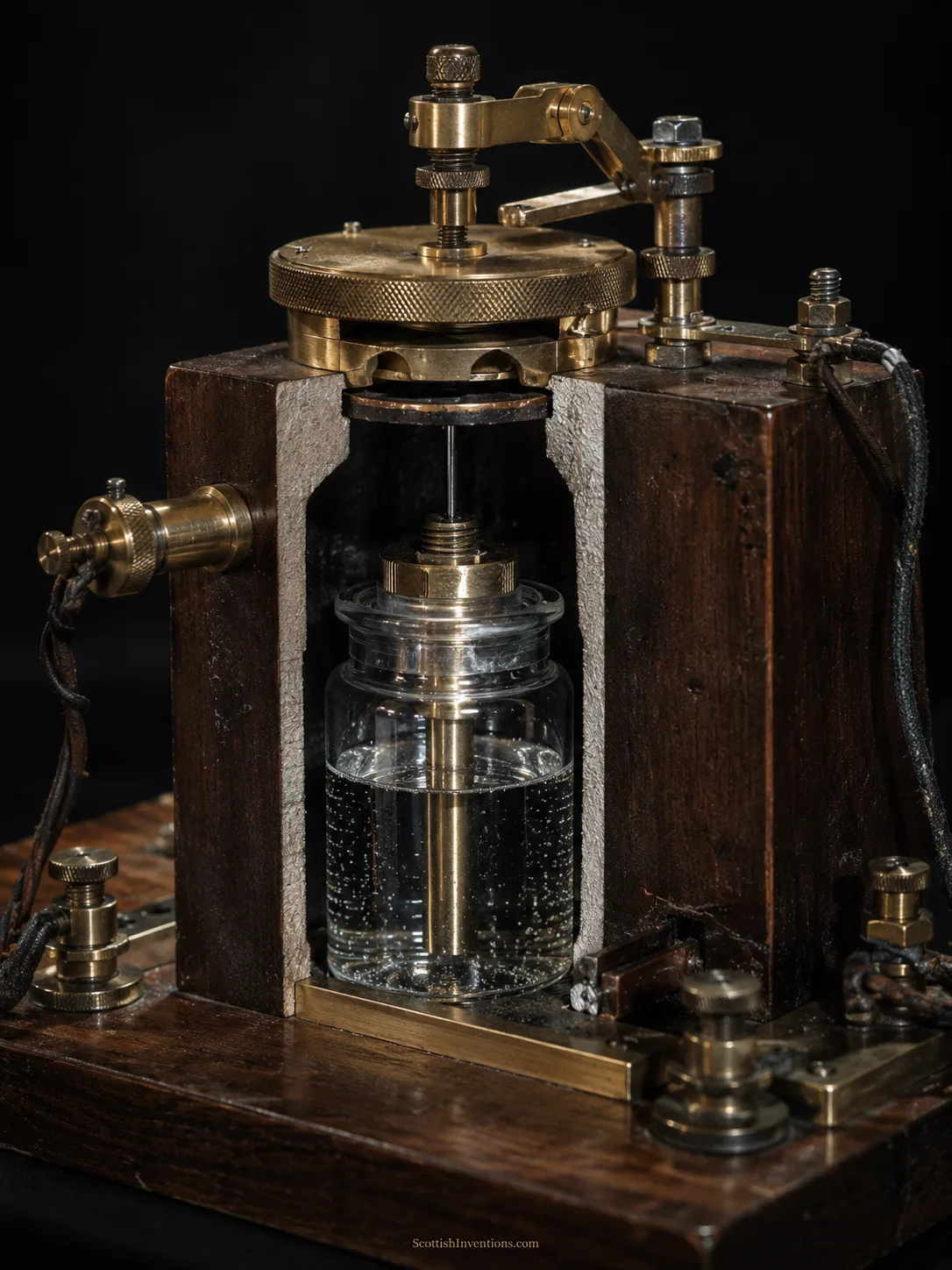
Three days after the patent issued, at his laboratory at 5 Exeter Place, Boston, Bell used a new instrument — a liquid transmitter in which a diaphragm-mounted needle dipped into acidulated water — and spoke down the wire to Watson in the next room. Bell’s laboratory notebook, held at the Library of Congress, records what happened next in his own hand:
“I then shouted into M the following sentence: ‘Mr. Watson — come here — I want to see you.’ To my delight he came and declared that he had heard and understood what I said.”
— Alexander Graham Bell, laboratory notebook, 10 March 1876
Note the wording. It is not “I want you” and it is not “I need you.” It is “I want to see you.” Every other version is a paraphrase.
6. Killing the Acid-Spill Myth
The story every schoolchild has heard is that Bell knocked over a jar of sulphuric acid onto his trousers and cried out for help — and that was the first call. It is a lovely story. It is also almost certainly false.
Bell’s notebook for 10 March 1876 makes no mention of any acid spill. Neither does the long letter he wrote to his father the same evening. Neither do Watson’s notes from that day. The acid detail appears for the first time fifty years later, in Thomas Watson’s autobiography Exploring Life (D. Appleton, 1926, p. 211) — published four years after Bell’s death.
7. The 1876 Centennial Exhibition
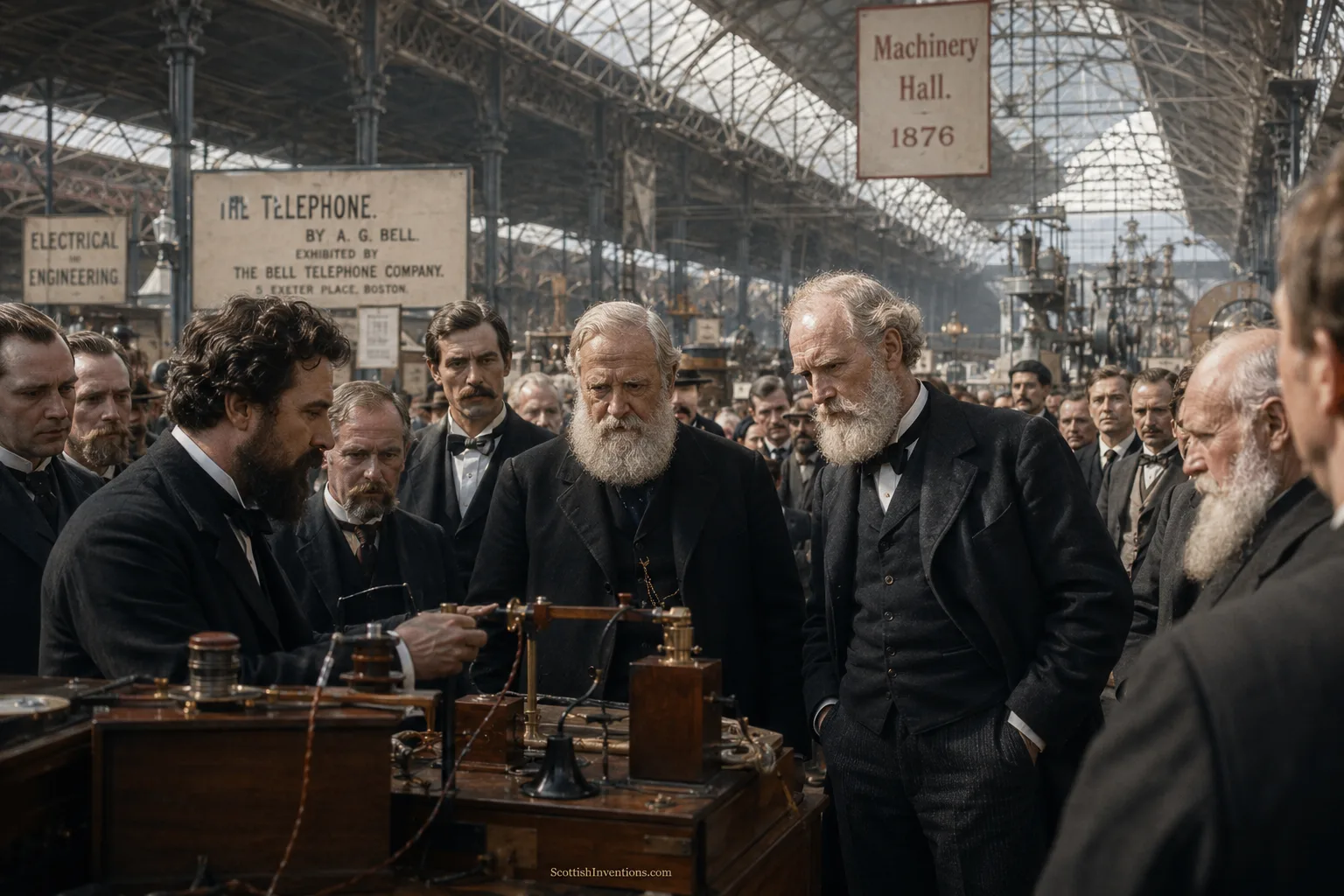
In June 1876 Bell hauled his instruments to the Centennial Exhibition in Philadelphia and demonstrated the telephone to the judges of the science hall. Brazil’s Emperor Dom Pedro II — who had met Bell during a visit to a Boston school for the deaf — picked up the receiver, listened, and is famously reported to have cried “My God, it talks!” The Scottish physicist Sir William Thomson (later Lord Kelvin) called it “the greatest by far of all the marvels of the electric telegraph.”
Bell won the Gold Medal and, more importantly, front pages across the world.
8. The Elisha Gray Controversy
Bell’s greatest rival was Elisha Gray, co-founder of what became Western Electric. Gray’s 14 February caveat had described a liquid variable-resistance transmitter — a needle in acidulated water — almost exactly the mechanism Bell used on 10 March. That fact alone would raise eyebrows. Two further facts have kept the controversy alive for 150 years.
First, a passage of seven sentences describing variable resistance was demonstrably added to a late draft of Bell’s patent application. Bell testified he added them “almost at the last moment” before the application was engrossed and notarised on 20 January 1876 — before Gray’s caveat existed. Second, the patent examiner, Zenas Fisk Wilber, later swore an affidavit (1886) that he had improperly shown Gray’s caveat to Bell in exchange for $100. Bell immediately swore a counter-affidavit denying bribery, and Wilber — an admitted alcoholic financially indebted to Bell’s attorney — gave several conflicting affidavits over the years.
9. The Meucci Myth & Resolution 269
Antonio Meucci (1808–1889), an Italian immigrant on Staten Island, built voice-communication devices he called teletrofoni and filed a patent caveat in December 1871. Unable to afford the $10 renewal fee, he let it lapse in 1874. His 1871 caveat did not describe electromagnetic transmission of voice — a critical technical shortfall.
In 2002 the US House of Representatives passed Resolution 269 by voice vote. It is widely misreported. The operative clause reads verbatim:
“Resolved, That it is the sense of the House of Representatives that the life and achievements of Antonio Meucci should be recognized, and his work in the invention of the telephone should be acknowledged.”
— H.Res. 269, 107th Congress, 11 June 2002
That is narrower than “Meucci invented the telephone.” The resolution is non-binding, has no legal effect on Bell’s patent, and does not name Meucci “the true inventor.” Days later the Canadian Parliament passed a counter-motion affirming Bell.
10. Reis, Bourseul & What “Invention” Means
Historians converge on one criterion for “inventing the telephone”: a device that transmits articulate speech intelligibly using a continuous undulatory current, not a make-and-break signal that can carry only pitch.
- Charles Bourseul (1854) described the principle in a French magazine article but proposed a make-and-break mechanism and never built a working speech transmitter.
- Johann Philipp Reis (Germany, 1858–63) coined the word Telephon and built apparatus that could transmit musical tones and occasional words, but his make-and-break design could not reliably carry articulate speech. He died in 1874.
- Elisha Gray conceived variable resistance but filed only a caveat and abandoned it. The Patent Office later ruled that his “failure to take any action amounting to completion until others had demonstrated the utility of the invention deprives him of the right to have it considered.”
Each was a genuine precursor. None built a working practical speaking telephone before Bell.
11. The Telephone Cases (1888)
Six lawsuits were consolidated into The Telephone Cases, 126 US 1 (1888) — the longest single Supreme Court opinion in history, filling the entire 126th volume of United States Reports. On 19 March 1888 Chief Justice Waite, writing for a 4–3 majority, upheld the validity and priority of Bell’s patents. The Court held Bell was the “first discoverer of the art or process of transferring to, or impressing upon, a continuous current of electricity in a closed circuit, by gradually changing its intensity, the vibrations of air produced by the human voice in articulate speech” — and that this discovery was patentable.
Bell and AT&T ultimately litigated 587 patent challenges, five of them reaching the Supreme Court, and — aside from two minor contract lawsuits — never lost a single case concluded with a final judgment.
12. A Global Network in a Generation
The commercial numbers are dizzying. Contemporary figures sometimes conflict because they measure different things — Bell-system only versus total US — but the reconciled picture is this:
- End of 1877: ~3,000 telephones in service. The first commercial exchange opened in New Haven, Connecticut, on 28 January 1878.
- 1880 (US Census): ~48,000–50,000 telephones across 148 companies.
- Early 1881 (American Bell’s first annual report): 133,692 Bell-licensed telephones.
- 1900: ~600,000 in the Bell system, ~1.35 million total in the US.
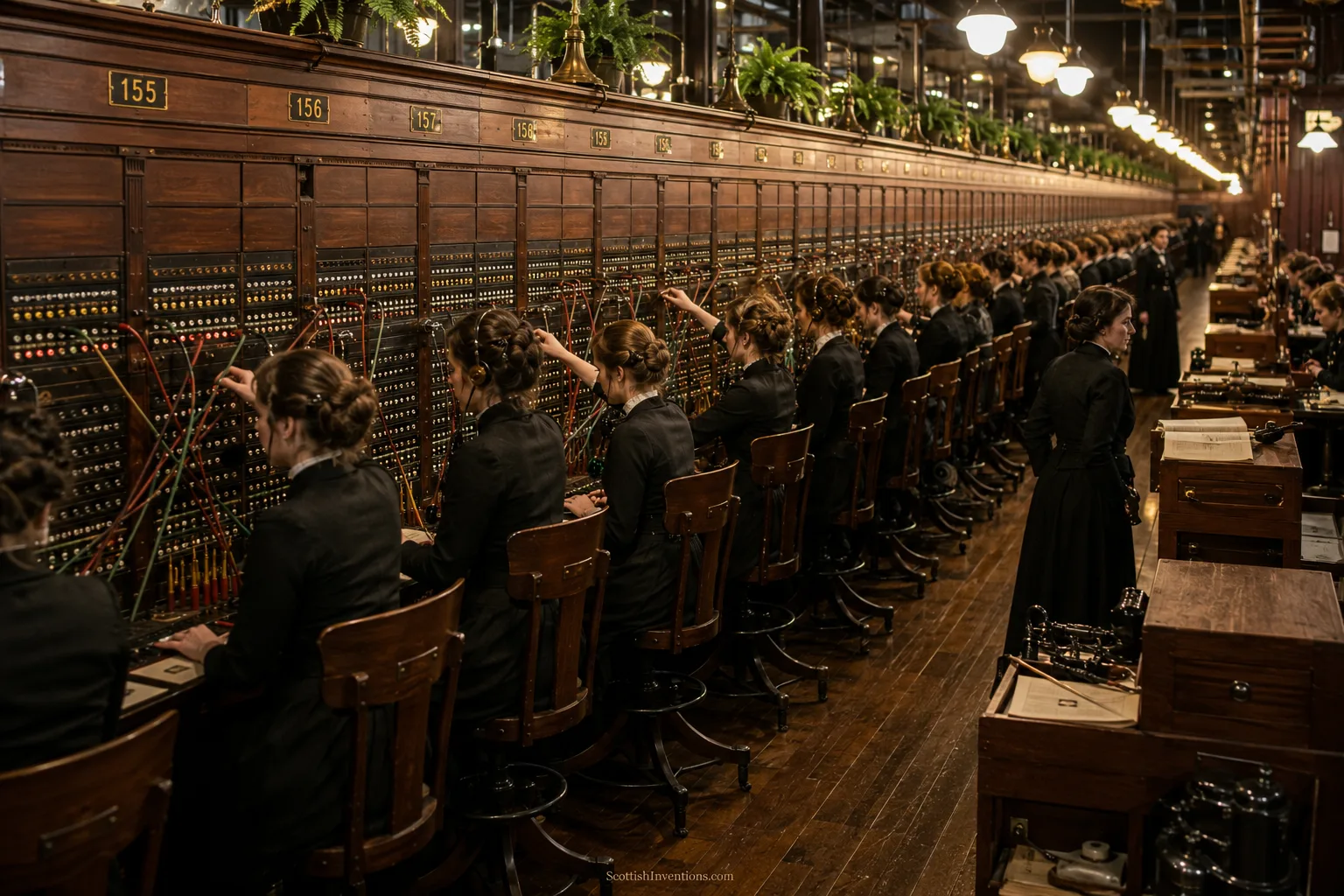
The switchboard operator — almost always a woman — became the human interface of a new global network.
13. Photophone, Hydrofoils & Later Work
Bell privately resented the telephone as a distraction from “real” science. His later career was strikingly varied:
- Photophone (1880). With Charles Sumner Tainter, Bell transmitted speech on a beam of light — wirelessly — about 213 metres across Washington on 21 June 1880. It anticipated fibre-optic communication by a century. Guinness recognises it as the first optical telephone. Bell called it “the greatest invention I have ever made, greater than the telephone.”
- Induction-balance metal detector (1881). Built to locate the bullet in President James A. Garfield after his shooting. The device worked but the bullet was too deep and on the opposite side from where the physicians insisted Bell search. Later used routinely in surgery and wartime.
- Hydrofoils. With Casey Baldwin, Bell’s HD-4 set a marine speed record of ~70.86 mph (114 km/h) in 1919 on Bras d’Or Lake, Nova Scotia.
- Aviation. The Aerial Experiment Association (1907), which he founded, built the Silver Dart — an early powered flight in Canada in 1909.
- National Geographic. Bell did not found the National Geographic Society (its first president was his father-in-law Gardiner Greene Hubbard). Bell was the second president (1898–1903), and transformed the magazine into the photograph-rich publication it remains today by installing Gilbert H. Grosvenor as editor.
14. Legacy
Bell died on 2 August 1922 at his estate Beinn Bhreagh in Nova Scotia. On the day of his funeral, at the request of AT&T, every telephone on the North American continent was silenced for one minute. It remains the only time in history the network has fallen deliberately quiet.
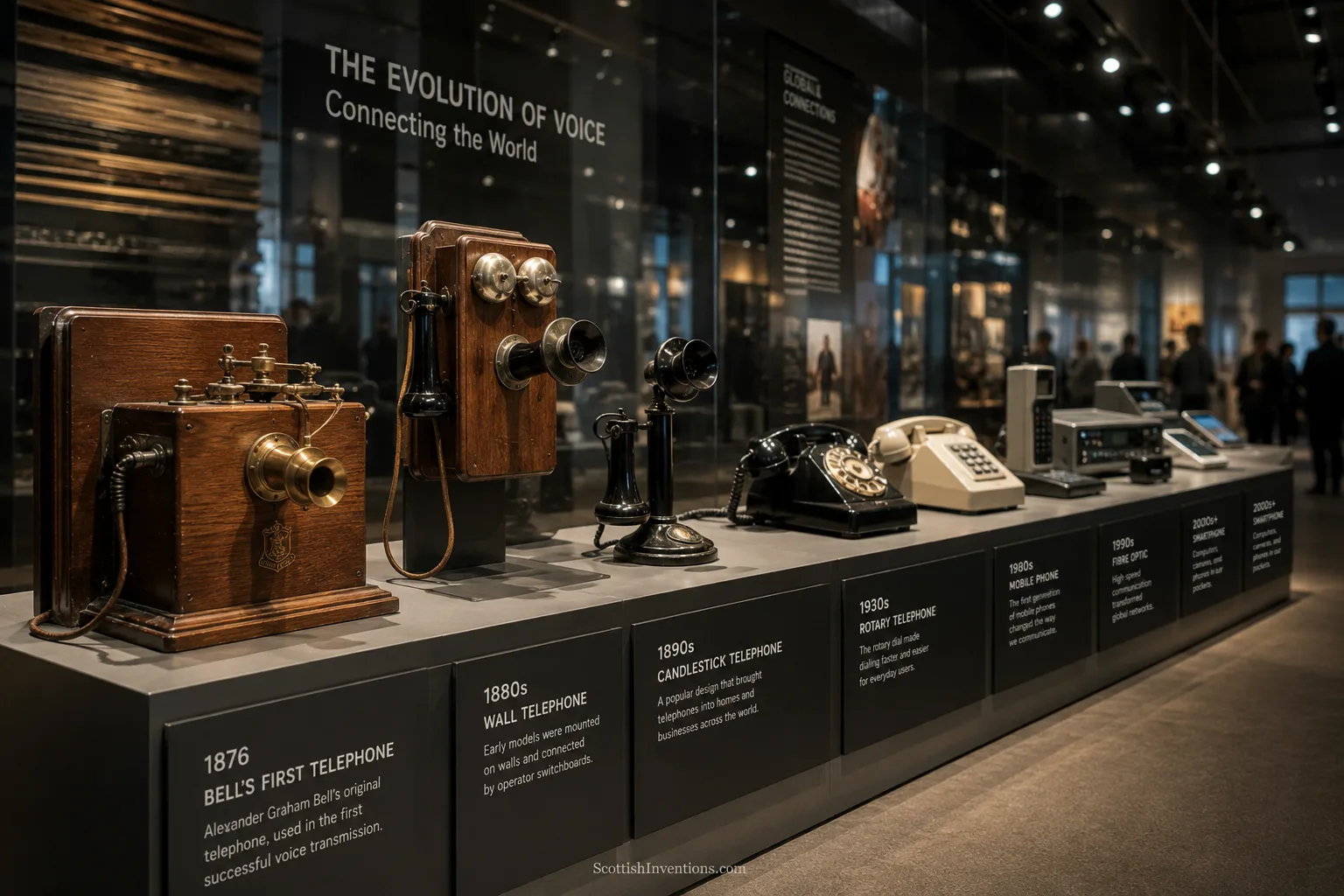
The telephone he built at 5 Exeter Place is not the smartphone in your pocket — but the smartphone in your pocket is unthinkable without the fifth claim of Patent 174,465. The method of impressing the vibrations of speech onto a continuous carrier is the ancestor of every voice call, mobile network, video chat and streaming service on the planet.
He is the Scottish-born inventor of the first practical telephone. That is enough.
Frequently Asked Questions
- Who invented the telephone?
- Alexander Graham Bell built and patented the first practical speaking telephone. On 7 March 1876 the US Patent Office granted him Patent No. 174,465, and three days later, on 10 March 1876, he made the first intelligible telephone call from his Boston laboratory: 'Mr. Watson — come here — I want to see you.' The US Supreme Court upheld Bell's priority in the Telephone Cases (1888) by a 4–3 majority.
- Where was Alexander Graham Bell born?
- Alexander Graham Bell was born on 3 March 1847 at 16 South Charlotte Street, Edinburgh, Scotland. The commemorative stone above the door still reads 'Alexander Graham Bell / Inventor of the Telephone / Was born here 3rd March 1847'. The modern door number is 14, but heritage bodies including Historic Environment Scotland list the birthplace as 16 South Charlotte Street.
- Is the telephone a Scottish invention?
- Bell was Scottish-born and Scottish-educated, and his lifelong obsession with speech and hearing came directly from his Edinburgh family — particularly his father Alexander Melville Bell's 'Visible Speech' system. But the telephone itself was conceived largely at Brantford, Ontario in 1874 and built and demonstrated in Boston, Massachusetts. The honest framing is 'Scottish-born inventor of the telephone', not 'the telephone is a Scottish invention'.
- What were the first words spoken on the telephone?
- Bell's own laboratory notebook, held at the Library of Congress, records the words as: 'Mr. Watson — come here — I want to see you.' The date was 10 March 1876, at his Boston laboratory at 5 Exeter Place. Popular retellings sometimes render the line as 'I want you' or 'I need you' — the notebook says 'see you'.
- Did Bell really spill acid on himself before the first phone call?
- Almost certainly not. Bell's own notebook and the letter he wrote his father the same evening never mention acid. The acid-spill story first appears in Thomas Watson's memoir Exploring Life (1926) — half a century after the event and four years after Bell's death. Mainstream historians and PBS's American Experience treat it as an apocryphal embellishment.
- Did Bell steal the idea from Elisha Gray?
- This is genuinely contested. Bell and Gray both filed telephone-related documents at the US Patent Office on 14 February 1876 — Bell a full application, Gray only a caveat. Gray abandoned his caveat rather than converting it to a full application. The most recent technical scholarship (Benjamin Lathrop Brown, Proceedings of the IEEE, 2020) argues Bell did not plagiarize Gray and had independent prior work on liquid variable-resistance transmitters as early as April 1875. Earlier books by A. Edward Evenson (2000) and Seth Shulman (2008) argue the opposite. Bell won every court challenge, including the Telephone Cases (1888) 4–3 in the Supreme Court.
- Did the US Congress declare Antonio Meucci the true inventor of the telephone?
- No. House Resolution 269 (2002) is a non-binding 'sense of the House' resolution. Its operative clause resolved only that Meucci's 'life and achievements … should be recognized, and his work in the invention of the telephone should be acknowledged'. It did not declare him the inventor and had no effect on Bell's patents. Days later the Canadian Parliament passed a counter-motion affirming Bell. Meucci's 1871 caveat lapsed in 1874 and described a device with no electromagnetic transmission of voice.
- What is Bell's Patent No. 174,465?
- US Patent 174,465, 'Improvement in Telegraphy', filed 14 February 1876 and granted 7 March 1876, is often called the most valuable patent ever issued. Its famous fifth claim covered 'the method of, and apparatus for, transmitting vocal or other sounds telegraphically … by causing electrical undulations, similar in form to the vibrations of the air accompanying the said vocal or other sounds'. That method — a continuous undulatory current, not a make-and-break signal — is what separated Bell from earlier inventors like Reis and Bourseul.
- What did Bell demonstrate at the 1876 Centennial Exhibition?
- At the Centennial Exhibition in Philadelphia (June 1876), Bell demonstrated the telephone before the judges. Brazil's Emperor Dom Pedro II — who had met Bell during a Boston school-for-the-deaf visit — is famously reported to have exclaimed 'My God, it talks!' The physicist Sir William Thomson (later Lord Kelvin) called it 'the greatest by far of all the marvels of the electric telegraph'. Bell won a Gold Medal and international recognition.
- What else did Alexander Graham Bell invent?
- Bell resented the telephone as a distraction from 'real' science. He invented the photophone (1880), which sent speech on a beam of light — a century-early ancestor of fibre-optic communication he considered his greatest invention. He built an induction-balance metal detector used to search for the bullet in President Garfield in 1881, developed hydrofoils (his HD-4 set a marine speed record of ~70.86 mph in 1919), and co-founded the Aerial Experiment Association whose Silver Dart made an early powered flight in Canada in 1909. He was the second president of the National Geographic Society, not its founder.
- When did Bell die?
- Alexander Graham Bell died on 2 August 1922, aged 75, at his estate Beinn Bhreagh in Nova Scotia, Canada. On the day of his funeral every telephone on the North American continent was silenced for one minute in his honour.
- Was Bell's wife deaf?
- Yes. Mabel Hubbard, whom Bell married in 1877, lost her hearing to scarlet fever as a child. Bell's mother Eliza was also deaf. His work on the telephone grew directly out of his family's teaching of the deaf and his father Alexander Melville Bell's 'Visible Speech' notation system.
Sources & Further Reading
Tier 1 · Primary
- US Patent No. 174,465, “Improvement in Telegraphy,” filed 14 February 1876, granted 7 March 1876 (Alexander Graham Bell).
- Bell, A.G. — laboratory notebook entry, 10 March 1876, Library of Congress.
- The Telephone Cases, 126 U.S. 1 (1888), US Supreme Court.
- H.Res. 269, 107th Congress, 11 June 2002 (US House of Representatives, on Antonio Meucci).
- US Patent No. 161,739 (Alexander Graham Bell, April 1875) and US Patent No. 186,787 (30 January 1877).
- Wilber, Zenas Fisk — affidavit, 1886, on the handling of Elisha Gray’s patent caveat.
Tier 2 · Scholarly and institutional
- Brown, Benjamin Lathrop — “[study of the Bell–Gray telephone priority dispute],” Proceedings of the IEEE, Vol. 108, No. 11 (November 2020), pp. 2083–2096.
- Evenson, A. Edward — The Telephone Patent Conspiracy of 1876, McFarland, 2000.
- Shulman, Seth — The Telephone Gambit, W. W. Norton, 2008.
- Watson, Thomas A. — Exploring Life, D. Appleton, 1926.
- PBS American Experience — on the apocryphal acid-spill story.
- Historic Environment Scotland — listing record for 16 South Charlotte Street, Edinburgh.
- National Geographic Society — records of its presidency and founding.
- Guinness World Records — recognition of the photophone as the first optical telephone.
Discover More
Continue the story
Explore the wider constellation of Scottish inventors whose work sits alongside Bell’s.