Scottish Inventions · Military & Naval
The Carronade
Scotland's Naval Cannon That Changed Warfare
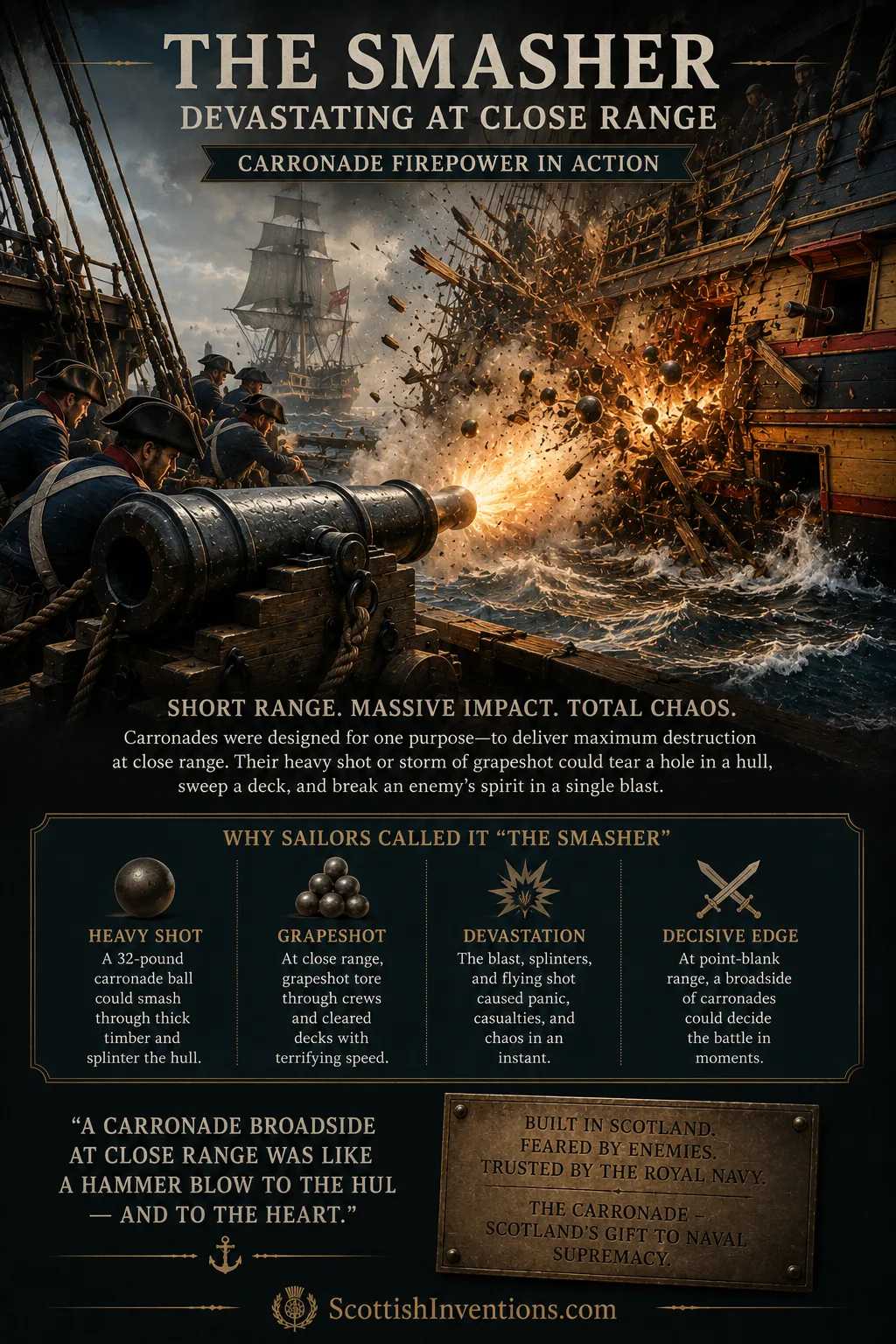
Cast at the Carron Company ironworks near Falkirk in 1778, the carronade was a short, savage cannon that punched far above its weight. Royal Navy sailors called it "The Smasher" — and at Trafalgar in 1805 it fired what may be the single most destructive shot in the history of the Age of Sail.
TL;DR
- The Carronade is a short, wide-bored naval cannon developed at the Carron Company ironworks near Falkirk. First cast in 1778 and adopted by the Royal Navy in 1779, it traded long range for a crushing close-quarters punch.
- Credit is shared: Robert Melville is credited with the concept (c.1759), Charles Gascoigne drove the manufacturing, and Patrick Miller was an influential promoter. There is no single inventor — the carronade was a Scottish collaboration.
- At the Battle of Trafalgar (1805) a single 68-pounder carronade shot from HMS Victory raked the French flagship Bucentaure from stern to bow, killing or wounding hundreds and helping decide the battle.
The Carronade at a glance
- Weapon
- Carronade — short-barrelled naval cannon
- Designed at
- Carron Company Ironworks, Falkirk
- First cast
- 1778
- Royal Navy adoption
- 1779
- Principal figures
- Robert Melville · Charles Gascoigne · Patrick Miller (promoter)
- Calibres
- 6, 12, 18, 24, 32, 42 and 68-pounder
- 32-pdr weight
- About 17 cwt (c. 864 kg) vs 56 cwt for a long gun
- Crew
- 4–5 men (42-pdr) vs 14+ for equivalent long gun
- Effective range
- About 400–500 yards
- Nickname
- 'The Smasher'
Introduction
The carronade is one of Scotland's great industrial-military contributions to the Age of Sail. A short-barrelled, wide-bored, cast-iron cannon, it traded long range for a crushing close-quarters punch while weighing a fraction of a conventional 'long gun' of the same shot weight. It needed far fewer men to work, could be mounted high on a ship's upper decks, and threw a heavy ball or a storm of musket balls that could clear an enemy deck in a single blast. Designed and cast at the Carron Company near Falkirk, it carried the name of its Scottish birthplace into every navy in the world.
For roughly seventy years the carronade was one of the deadliest weapons afloat. It armed the Royal Navy through the American War of Independence, the French Revolutionary Wars and the Napoleonic Wars, and it played a decisive part in some of the most famous single-ship actions of the War of 1812. Yet like all technologies of war, it eventually met its match — undone by the very naval gunnery revolution that its own success had helped provoke.
The Carron Company Ironworks
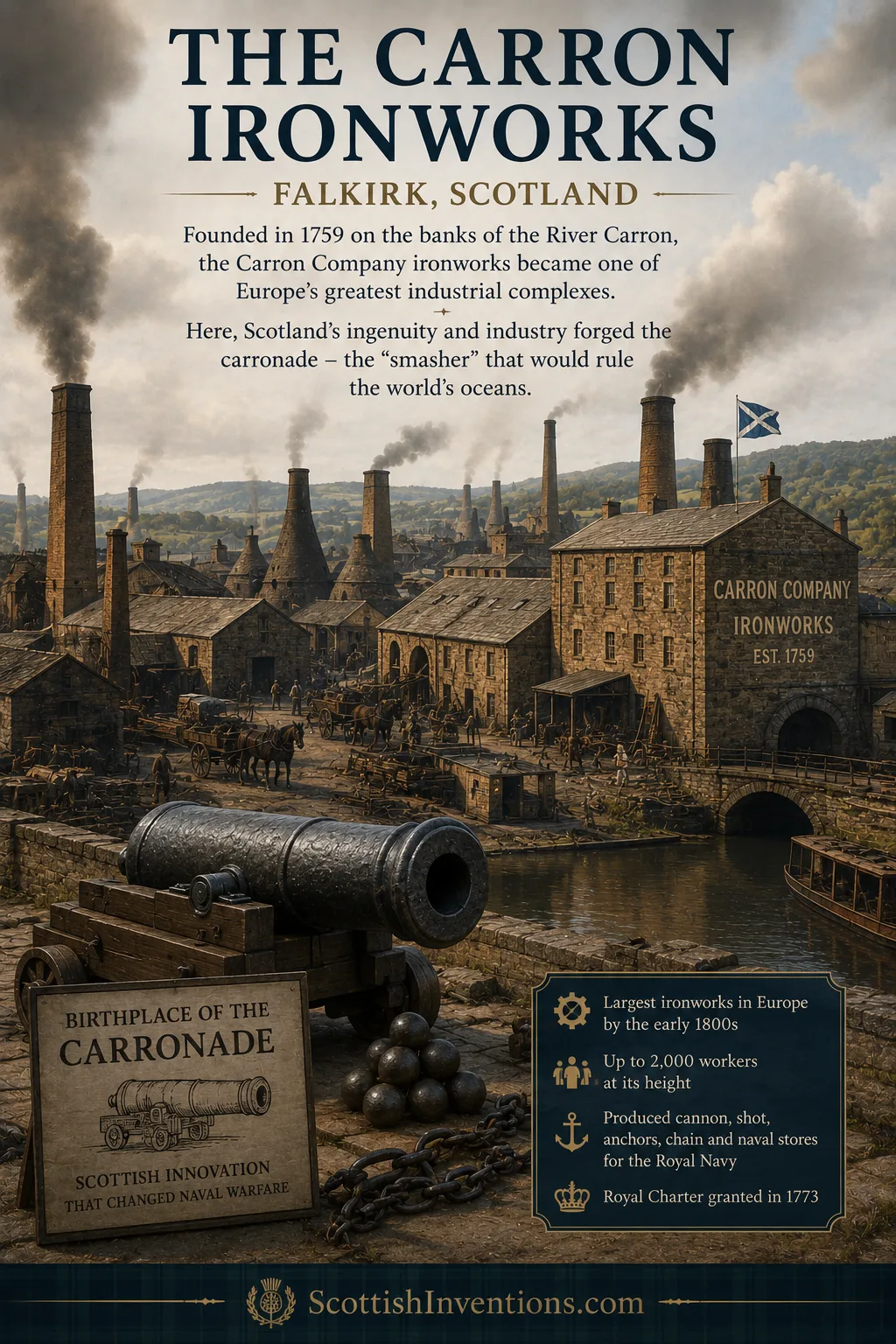
The carronade's true 'inventor', in a sense, was a place: the Carron Company, an ironworks established in 1759 on the north bank of the River Carron about two miles north of Falkirk, in Stirlingshire. It was founded by Dr John Roebuck, the Birmingham manufacturer Samuel Garbett, and the Scottish merchant William Cadell of Cockenzie, and was known in its earliest years as "Roebuck, Garbett and Cadells." The partners chose the site for its water power, river transport, and nearby coal and ironstone, adopting the coke-smelting method pioneered by Abraham Darby at Coalbrookdale. The first blast furnace was lit on 26 December 1760.
By the early 1800s Carron was the largest ironworks in Europe, employing roughly 2,000 workers at its height. It received a Royal Charter in 1773 and went on to produce everything from cannon and shot to balustrades and the famous Carron bath — and, generations later, the classic red telephone box — before finally becoming insolvent in 1982 after 223 years. Its story is inseparable from the wider story of the Scottish Industrial Revolution: James Watt had parts for his steam engine cast at Carron in 1766; John Smeaton consulted for the company; Benjamin Franklin visited; and William Symington's Charlotte Dundas engines were built there.
The Problem: Naval Gunnery in the 18th Century
To understand why the carronade mattered, picture the standard naval gun of the 1700s: a long, heavy cast-iron 'long gun' mounted on a four-wheeled wooden carriage that recoiled violently across the deck when fired. A 32-pounder long gun weighed over three tons, stretched more than nine feet, and needed a crew of a dozen or more to load, run out, fire and haul back into position. These guns were slow to reload, hungry for gunpowder, and took up enormous space.
The theory of the day held that long barrels meant long range. But in practice, naval gunnery in the Age of Sail was wildly inaccurate: smoothbore barrels, loose-fitting shot, no rifling, and the constant pitch and roll of the sea meant that battles were almost always decided at close range — a few hundred yards or less, sometimes with hulls nearly touching. At those ranges, what mattered was not accuracy but the sheer weight of metal you could hurl, and how fast you could reload. A lighter weapon that could throw a heavy ball at short range could do the real work of battle without the weight, expense and huge crews of a long gun. That was the gap the carronade filled.
What Was the Carronade?
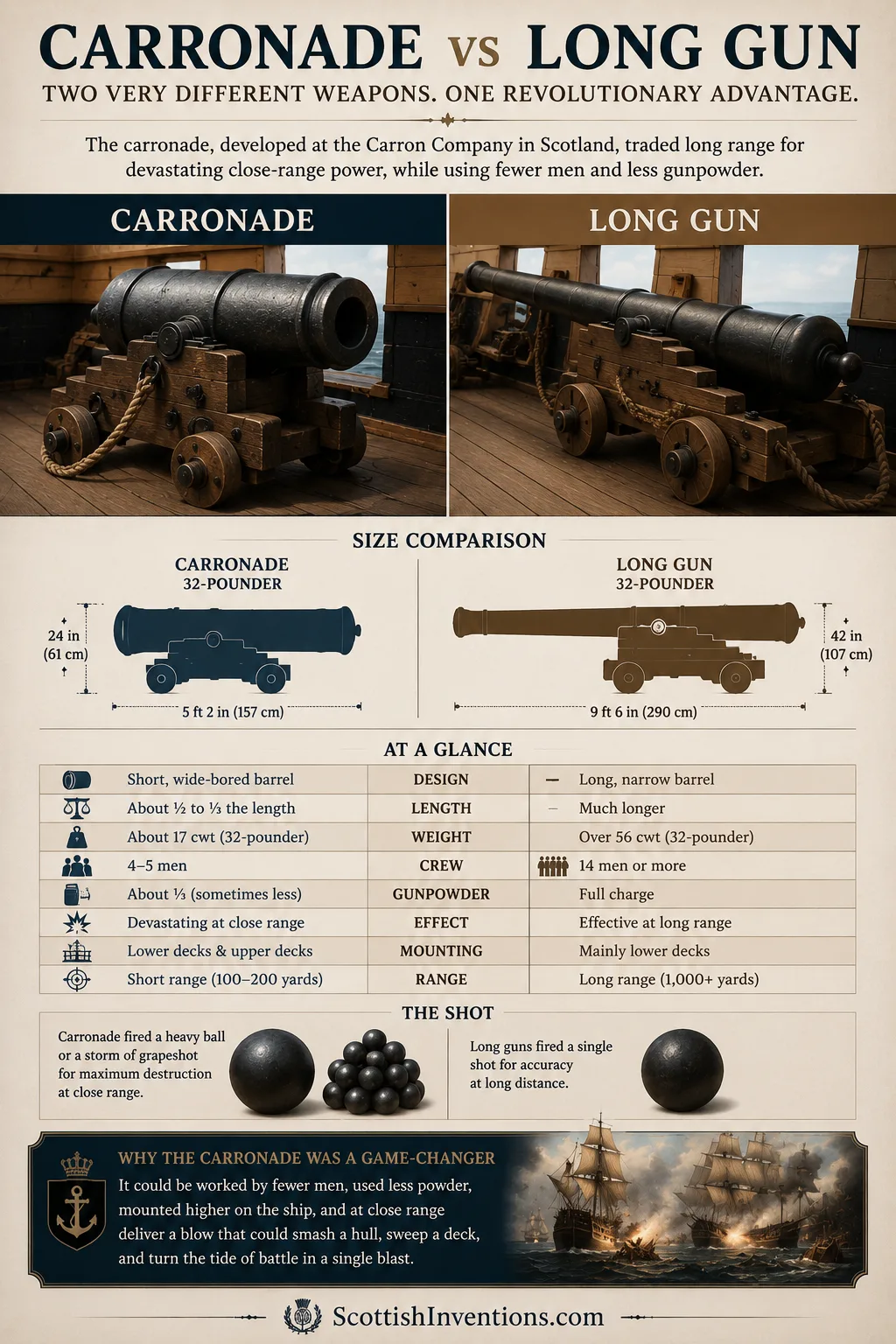
The carronade was a short, smoothbore, cast-iron cannon with a wide bore relative to its length. Its genius lay in a cluster of design choices: it was light and short, weighing roughly a third to a quarter of a long gun firing the same shot — a 32-pounder carronade weighed about 17 cwt (roughly 864 kg) against roughly 56–58 cwt for the long-gun equivalent. It used about a third of the gunpowder of a long gun, thanks to the Carron Company's precision manufacturing reducing 'windage' — the gap between the ball and the bore.
Instead of recoiling on side trunnions like a long gun's wheeled carriage, the carronade had no trunnions; it was bolted through a lug underneath to a bed and recoiled along a sliding wooden mounting that stayed in place, giving a wide arc of fire and freeing valuable deck space. A 42-pounder carronade could be worked by four or five men, against fourteen for a 42-pounder long gun. Its low muzzle velocity gave it an effective range of only around 400–500 yards with a higher trajectory than a long gun — but at close quarters its wide bore threw a very heavy ball, or could be packed with grape and canister, tearing huge ragged holes and lethal showers of wooden splinters. Hence the nickname: "the smasher."
The first carronades appeared at Carron in 1778; the Royal Navy formally accepted them in 1779. They were designated by the weight of shot they fired — 6-, 12-, 18-, 24-, 32-, 42- and 68-pounders — with the enormous 68-pounder reserved for the biggest ships and used to devastating effect at Trafalgar.
Who Invented the Carronade?
Attribution is genuinely disputed — and was disputed at the time. Modern historians generally regard the carronade as a collaborative Scottish achievement rather than the inspiration of a single individual. The most careful verdict, from naval historian Spencer Tucker drawing on R.H. Campbell's definitive Carron Company (1961), is that Robert Melville and Charles Gascoigne have the strongest claims, with Patrick Miller mainly promoting and publicising the work.
The Carronade at Trafalgar
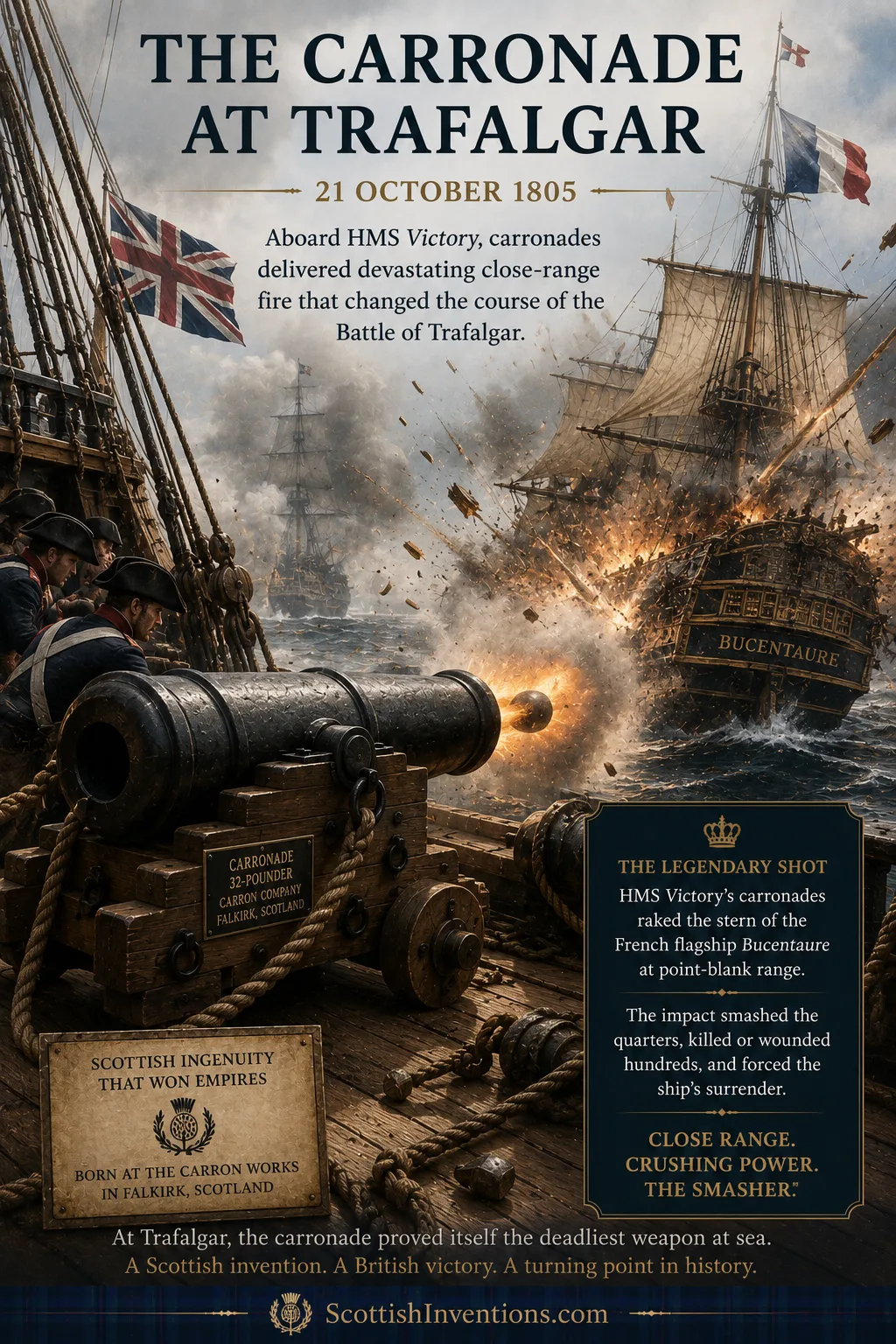
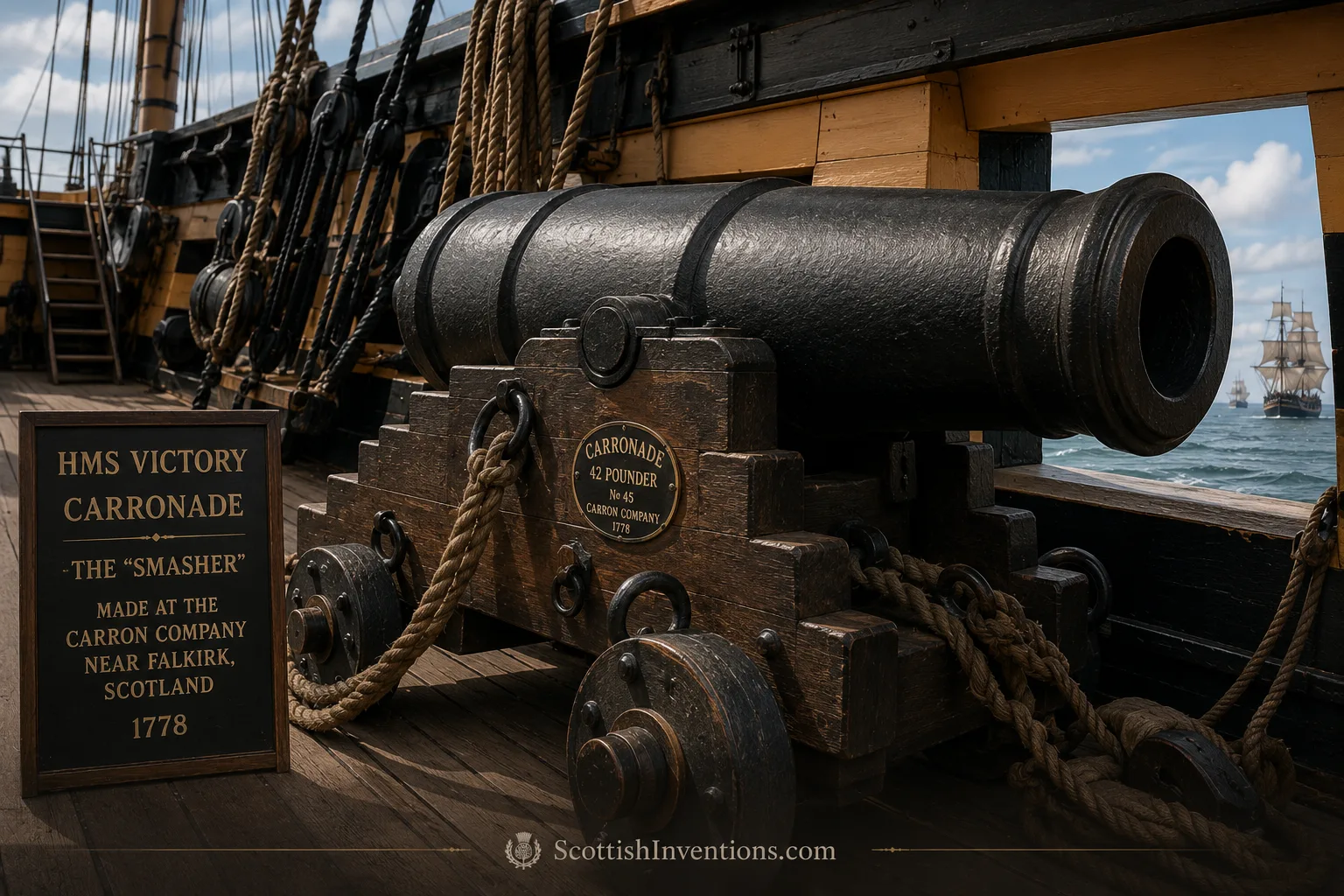
Aboard HMS Victory at the Battle of Trafalgar on 21 October 1805, the carronade earned its legend. As Victory cut across the stern of the French flagship Bucentaure at point-blank range, one of her two 68-pounder carronades — loaded with a round shot and a keg of around 500 musket balls — fired straight down the length of the enemy ship. The single shot raked Bucentaure from stern to bow, killed or wounded hundreds, dismounted guns and helped force her surrender. It was perhaps the most destructive shot in naval history.
Trafalgar cemented British naval supremacy for a century — and the carronade's part in it made the reputation of both the weapon and the Falkirk works that cast it. Every ship of the line in Nelson's fleet carried them, and their concentrated close-range fire was one of the tactical foundations of the Nelson touch.
American Frigates & the War of 1812
The U.S. Navy embraced the weapon enthusiastically. American super-frigates combined long guns for distance with a full battery of carronades for close work. USS Constitution — "Old Ironsides" — carried thirty long 24-pounders on her gun deck and twenty-four 32-pounder carronades on her spar deck when she destroyed HMS Guerrière on 19 August 1812, closing to "half pistol-shot" — about 25 yards — before unleashing her broadsides. Carronades helped ensure that British casualty lists in these single-ship actions ran far longer than American ones.
Weaknesses and Decline
At close range, the carronade's large bore meant it could throw a very heavy ball or be packed with grape and canister, turning it into a giant shotgun against massed crews on an open deck. It is no exaggeration to say it was one of the deadliest anti-personnel weapons afloat in the Age of Sail.
But the very feature that gave the carronade its punch was also its undoing: its short range. As naval gunnery improved through the early nineteenth century and engagements crept to longer distances, a ship armed mainly with carronades could be picked apart by an enemy that stayed beyond their reach. The most famous lesson came in March 1814 off Valparaíso, Chile, when the American frigate USS Essex — armed almost entirely with 32-pounder carronades — was battered into submission by HMS Phoebe and HMS Cherub firing long 18-pounders from half a mile away, well outside Essex's effective range.
By the 1850s the rapid development of rifled artillery, exploding shells and longer-ranged smoothbores rendered the carronade obsolete. It was gradually withdrawn from naval service, its devastating role at close quarters overtaken by weapons that could do the same damage from a mile or more away.
Legacy of the Carron Company
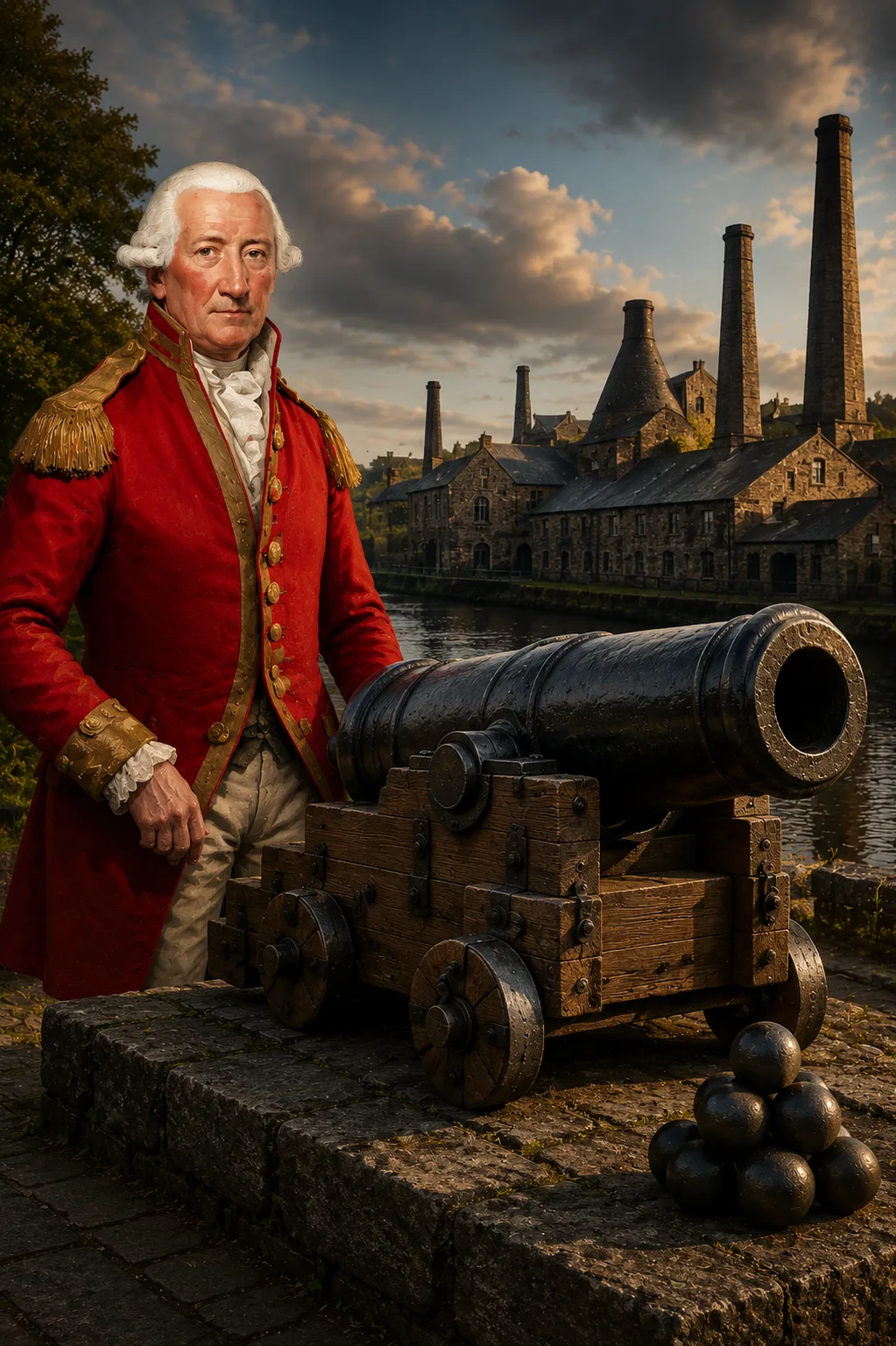
The Carron Company was one of the foundations of the Scottish Industrial Revolution, drawing in the era's greatest minds. James Watt had parts for his steam engine cast there in 1766; John Smeaton consulted for the company; Benjamin Franklin visited; and William Symington's pioneering steamboat engines were built at Carron. The works helped connect the world of the separate condenser, the steam hammer, the Charlotte Dundas and the hot-blast furnace to the wooden walls of the Royal Navy.
One of the best-loved stories of the works concerns the national bard. On Sunday 26 August 1787 Robert Burns and his travelling companion Willie Nicol tried to tour the Carron works but were turned away at the gate, because as a security measure visitors were not admitted on Sundays. The annoyed poet retreated to the Carron Inn opposite and scratched a verse on a windowpane with a diamond-tipped stylus given to him in Edinburgh — a verse later published in the Edinburgh Evening Courant in 1789. A plaque commemorating the event was placed at the Carron clocktower in 2012.
Surviving carronades can still be seen on HMS Victory in Portsmouth and at museums across Britain and North America. The Carron Works site at Falkirk is commemorated by the surviving clocktower and gateway, and the company's astonishing 223-year run remains one of the longest unbroken stories of any British industrial firm. Robert Melville's revolutionary concept, Charles Gascoigne's manufacturing drive and the Carron Works' engineering expertise together created one of Scotland's most influential military inventions — a weapon whose name still carries the sound of a Stirlingshire river into every history of the Age of Sail.
Timeline
1759
Carron Company founded
John Roebuck, Samuel Garbett and William Cadell establish the Carron Company on the River Carron near Falkirk. Around the same year, Robert Melville is credited with sketching the concept for a short, light 'carriage ordnance' naval gun.
26 December 1760
First blast furnace lit
Carron's first coke-fired blast furnace is lit — the technique of Abraham Darby brought to Scotland at industrial scale.
1765
Charles Gascoigne joins
English-born industrialist Charles Gascoigne becomes a partner in the Carron Company; he takes over as manager in 1769 and drives the works' technical development.
1773
Royal Charter
Carron receives its Royal Charter — a mark of its national industrial importance.
1776–1778
Carronade developed
Under Gascoigne, and drawing on Melville's earlier concept, the Carron Company perfects a short, wide-bored, light naval cannon. The first carronades are cast at Falkirk in 1778.
1779
Royal Navy adoption
After trials, the Royal Navy formally accepts the carronade into service. Contemporary rivals dub it a 'melvillade' or a 'gasconade' as arguments over its parentage rage.
1782
Rodney's carronades
Carronades play a decisive role at the Battle of the Saintes, giving British ships close-range superiority over larger French vessels.
26 August 1787
Robert Burns turned away
Robert Burns and Willie Nicol try to visit the Carron works on a Sunday, are refused entry, and Burns scratches a bitter verse on the window of the Carron Inn opposite.
21 October 1805
Trafalgar
Aboard HMS Victory, a 68-pounder carronade rakes the French flagship Bucentaure from stern to bow at point-blank range — perhaps the single most destructive shot in the age of sail.
1812–1815
War of 1812
American super-frigates like USS Constitution mix long guns with carronades. Close-quarter carronade broadsides devastate HMS Guerrière and other British ships.
28 March 1814
USS Essex defeated
Off Valparaíso, USS Essex — armed almost entirely with 32-pounder carronades — is battered into submission by HMS Phoebe's long 18-pounders firing from beyond her reach. The carronade's fatal weakness is exposed.
1850s
Rendered obsolete
Rifled artillery, exploding shells and longer-ranged smoothbores make the carronade obsolete. It is gradually withdrawn from naval service.
1982
Carron Company insolvent
After 223 years of continuous production — cannon, baths and even the classic British telephone box — the Carron Company finally becomes insolvent.
2012
Burns plaque unveiled
A plaque commemorating Robert Burns's 1787 visit and window verse is unveiled at the Carron clocktower in Falkirk.
Frequently Asked Questions
›What was the Carronade?
The carronade was a short, wide-bored, cast-iron naval cannon developed at the Carron Company ironworks near Falkirk in Scotland. First cast in 1778 and adopted by the Royal Navy in 1779, it traded long range for devastating close-range firepower, using less gunpowder and a fraction of the crew of a conventional long gun.
›Who invented the Carronade?
There is no single inventor. Modern historians regard the carronade as a Scottish collaboration. Lieutenant General Robert Melville is credited with the original concept around 1759; Charles Gascoigne, manager of the Carron Company, turned it into a manufacturable weapon between 1776 and 1778; and Edinburgh banker Patrick Miller was an influential promoter. In its own day the gun was even nicknamed a 'melvillade' or a 'gasconade' after its rival claimants.
›Why was it called the Carronade?
The weapon takes its name directly from the Carron Company ironworks on the River Carron in Stirlingshire, about two miles north of Falkirk, where it was designed and first cast in 1778.
›Why was it nicknamed 'The Smasher'?
Royal Navy sailors called the carronade 'The Smasher' because its heavy, low-velocity shot punched enormous ragged holes through wooden hulls and produced storms of lethal splinters. Loaded with grapeshot or canister, a single blast could sweep an entire enemy deck clear of men.
›Where was the Carronade invented?
The carronade was designed, developed and first manufactured at the Carron Company ironworks near Falkirk in Stirlingshire, Scotland. Founded in 1759, Carron was Europe's largest ironworks by the early 1800s and one of the great industrial complexes of the Scottish Industrial Revolution.
›What was the Carron Company?
The Carron Company was a Scottish ironworks founded in 1759 on the banks of the River Carron near Falkirk by Dr John Roebuck, Samuel Garbett and William Cadell. It pioneered coke-smelting in Scotland, grew into the largest ironworks in Europe, received a Royal Charter in 1773 and produced cannon, shot, anchors, cast-iron goods and — most famously — the carronade.
›How did the Carronade differ from a long gun?
A carronade was roughly half to a third the length of a long gun of the same shot weight, weighed about a third as much, and used around a third of the gunpowder. A 32-pounder carronade weighed about 17 cwt against roughly 56 cwt for a long-gun equivalent, and could be worked by four or five men instead of fourteen or more. It sacrificed long-range accuracy for a crushing close-range punch.
›Was the Carronade used at Trafalgar?
Yes. On 21 October 1805, as HMS Victory cut across the stern of the French flagship Bucentaure, one of her 68-pounder carronades — loaded with a round shot and a keg of around 500 musket balls — fired directly down the length of the enemy ship. The single shot dismounted guns, killed or wounded hundreds and helped force Bucentaure's surrender. It is often described as one of the most destructive shots in naval history.
›Why did navies eventually abandon the Carronade?
The carronade's short range became fatal as naval gunnery improved in the early nineteenth century. Ships armed mainly with carronades could be picked apart by opponents that stayed beyond their reach — as USS Essex discovered off Valparaíso in 1814. By the 1850s, rifled artillery, exploding shells and longer-ranged smoothbores had rendered the carronade obsolete.
›Can you still see original Carronades today?
Yes. Surviving carronades are displayed aboard HMS Victory in Portsmouth, at the National Museum of the Royal Navy, at museums across the United Kingdom and North America, and at heritage sites in Falkirk marking the Carron Company works itself.
Discover More Scottish Engineering That Changed the World
The Carronade transformed naval warfare, but it was only one of Scotland's extraordinary engineering achievements that reshaped world history.
Explore More Scottish Inventions