Scottish Inventions · Engineering & Power
James Watt and the Steam Engine
The Scottish Engineer Who Powered the Industrial Revolution
James Watt (1736–1819), born in Greenock, did not invent the steam engine — but his 1765 walk across Glasgow Green produced the insight that changed everything: the separate condenser. Patented as British Patent No. 913 in 1769, it cut coal use by roughly three‑quarters and, through the Boulton & Watt partnership, turned Newcomen’s wasteful pump into the prime mover of the Industrial Revolution.

TL;DR
- James Watt (1736–1819), born in Greenock, did not invent the steam engine. His 1765 Glasgow Green insight — the separate condenser — cut coal use by roughly three-quarters and made steam universal.
- In partnership with Matthew Boulton (1775–1800) he produced ~450 engines and a cascade of inventions: the double-acting cylinder, parallel motion, sun-and-planet gear, centrifugal governor and pressure indicator.
- His name endures in every appliance, solar panel and wind turbine rated in watts — the SI unit of power, adopted in 1960.
Key Facts
1. A Greenock Boy with Curious Hands
James Watt was born on 19 January 1736 in Greenock, Renfrewshire, on the south shore of the Firth of Clyde. His father was the town’s chief baillie — a shipwright, ship-owner and magistrate; his mother, Agnes Muirhead, well educated; his grandfather a teacher of mathematics and navigation. The talent ran deep.
A sickly, introspective child plagued by headaches, young James was schooled largely at home before Greenock Grammar. His real classroom was his father’s workshop — his own bench, forge and tools — where he built models of cranes, barrel-organs and nautical instruments. He was, from the first, a maker.
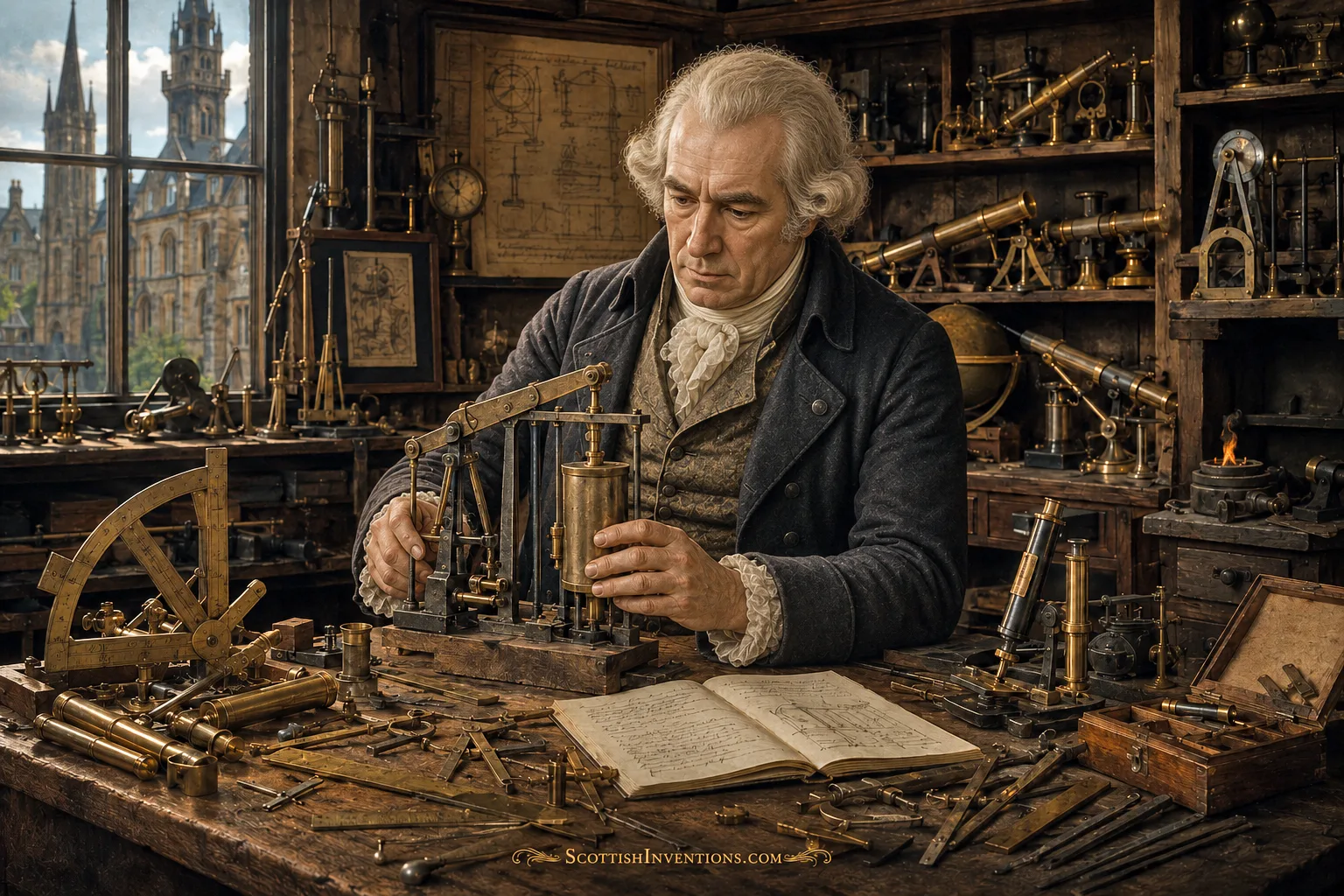
After a punishing year in London learning the instrument-maker’s craft, he returned north broken in health. Glasgow’s guild refused to recognise his brief apprenticeship; the professors of the University of Glasgow outflanked them in 1757 by appointing him Mathematical Instrument Maker to the University, installing him in a workshop on university grounds. It was a fortunate quirk of Scottish academic hospitality that would change the world.
There he met the two men who would shape his career: Joseph Black, whose theory of latent heat would give him the numbers behind the separate condenser, and student John Robison, who first turned his mind to steam. By 1763 both had pointed him toward a small model Newcomen engine sitting broken in the Natural Philosophy class. In fixing it, Watt found his life’s work.
2. Thomas Newcomen and the Machine Watt Inherited
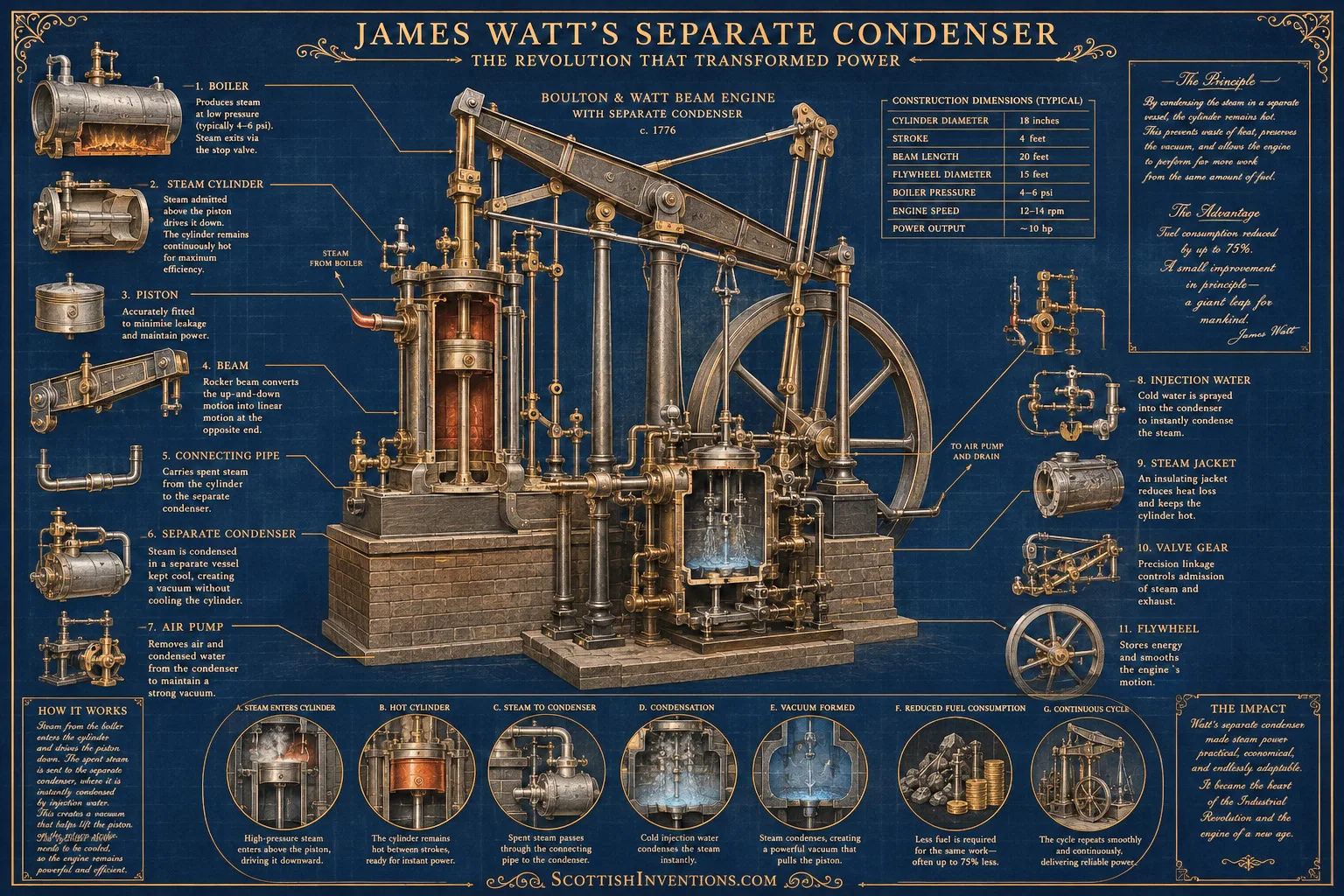
In 1712 the Devon ironmonger Thomas Newcomen erected the first practical steam engine near Dudley Castle. It was a marvel of practical engineering — and a masterpiece of inefficiency. Steam entered a great iron cylinder; cold water was injected to condense it; atmospheric pressure (not the steam itself) drove the piston down, pulling a pump rod via a rocking beam.
The flaw was fundamental: the same cylinder that had to be hot to admit steam was drenched with cold water on every stroke. Three-quarters or more of each fresh charge of steam went straight into reheating iron walls rather than doing work. Newcomen’s engine was catastrophically inefficient — but it ran in coal mines, where coal was free, and for two generations that was good enough.
3. The Separate Condenser — Glasgow Green, May 1765
Watt spent the winter of 1763–64 measuring steam consumption, calculating latent heats, and growing certain that the core problem was the repeated heating and cooling of the cylinder. Black’s latent-heat theory gave him the numbers. The solution came on a Sunday afternoon in May 1765, as he walked across Glasgow Green:
“I had not walked further than the Golf-house when the whole thing was arranged in my mind.”
— James Watt, recalling his Glasgow Green walk
The idea was devastatingly simple in principle and extraordinarily difficult to execute in practice. Keep the working cylinder permanently hot. Pipe the spent steam off into a separate vessel — the condenser — kept permanently cold. Each half of the engine could now do its job at its ideal temperature. He added a steam jacket around the cylinder to hold it at working temperature. Together these features virtually eliminated the cyclic heat loss that had crippled every previous engine.
4. Matthew Boulton and the Soho Manufactory
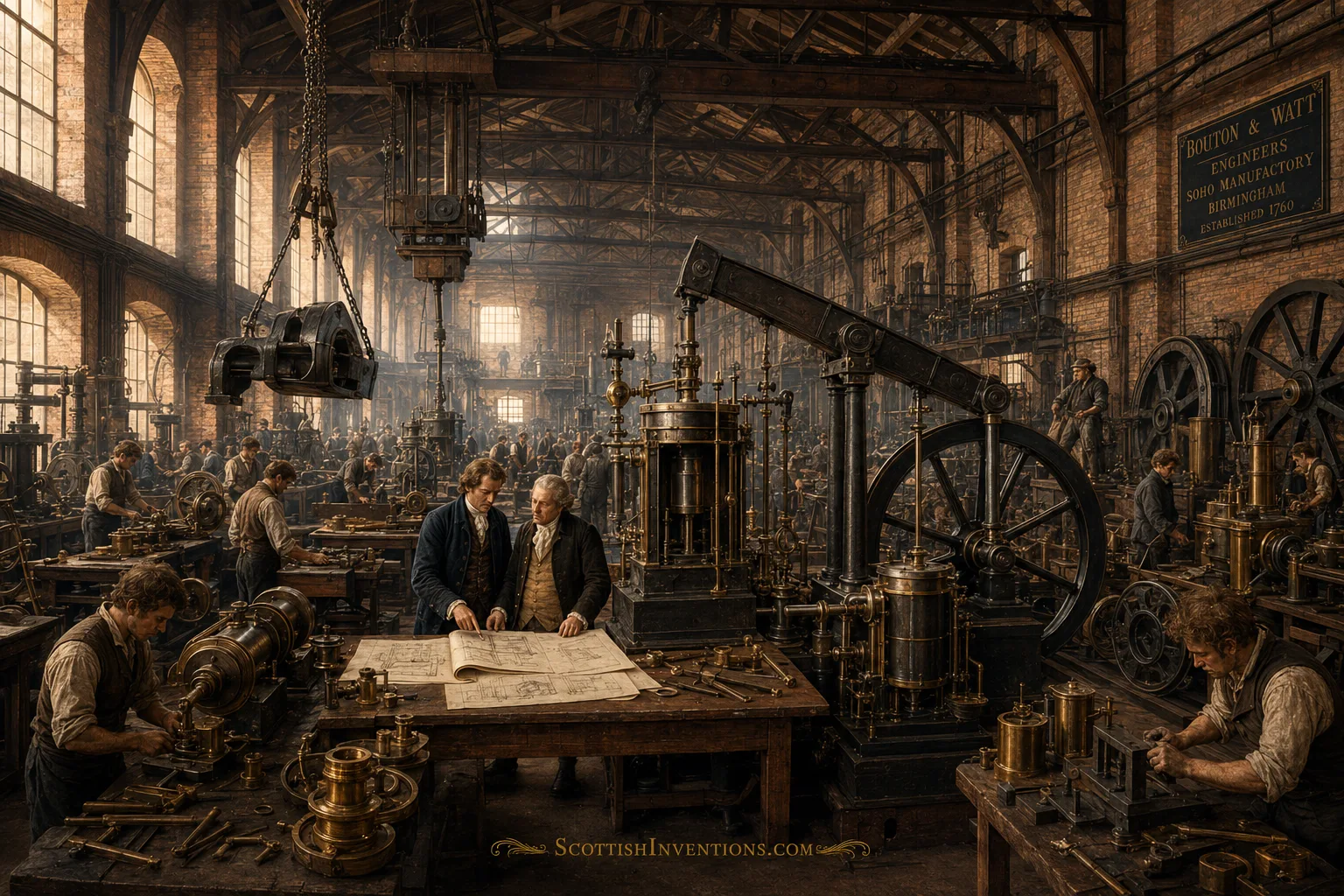
Matthew Boulton (1728–1809) was the ideal counterpart to Watt’s brooding, meticulous genius. Owner of the Soho Manufactory at Handsworth — a great Palladian works completed in 1766 — he was outgoing, commercially fearless and perpetually short of reliable mechanical power. When Roebuck’s Carron ironworks collapsed in 1772, his share of Watt’s patent passed to Boulton.
Watt moved to Birmingham in 1774. In 1775 — the year Parliament extended his patent to 1800 — the Boulton & Watt partnership was formally established. Boulton provided capital, commercial vision and access to John Wilkinson’s precision cylinder-boring machine, which for the first time could bore iron cylinders steam-tight. Watt provided genius; Boulton provided purpose.
Their early business model was ingenious: an annual royalty equal to one-third of the coal saving compared with an equivalent Newcomen engine. In Cornish copper mines, where coal was shipped expensively across the Bristol Channel, that saving — and the royalty — was enormous.
“I sell here, Sir, what all the world desires to have — POWER.”
— Matthew Boulton, greeting a visitor at Soho
5. A Suite of Inventions — Turning the Pump into a Prime Mover
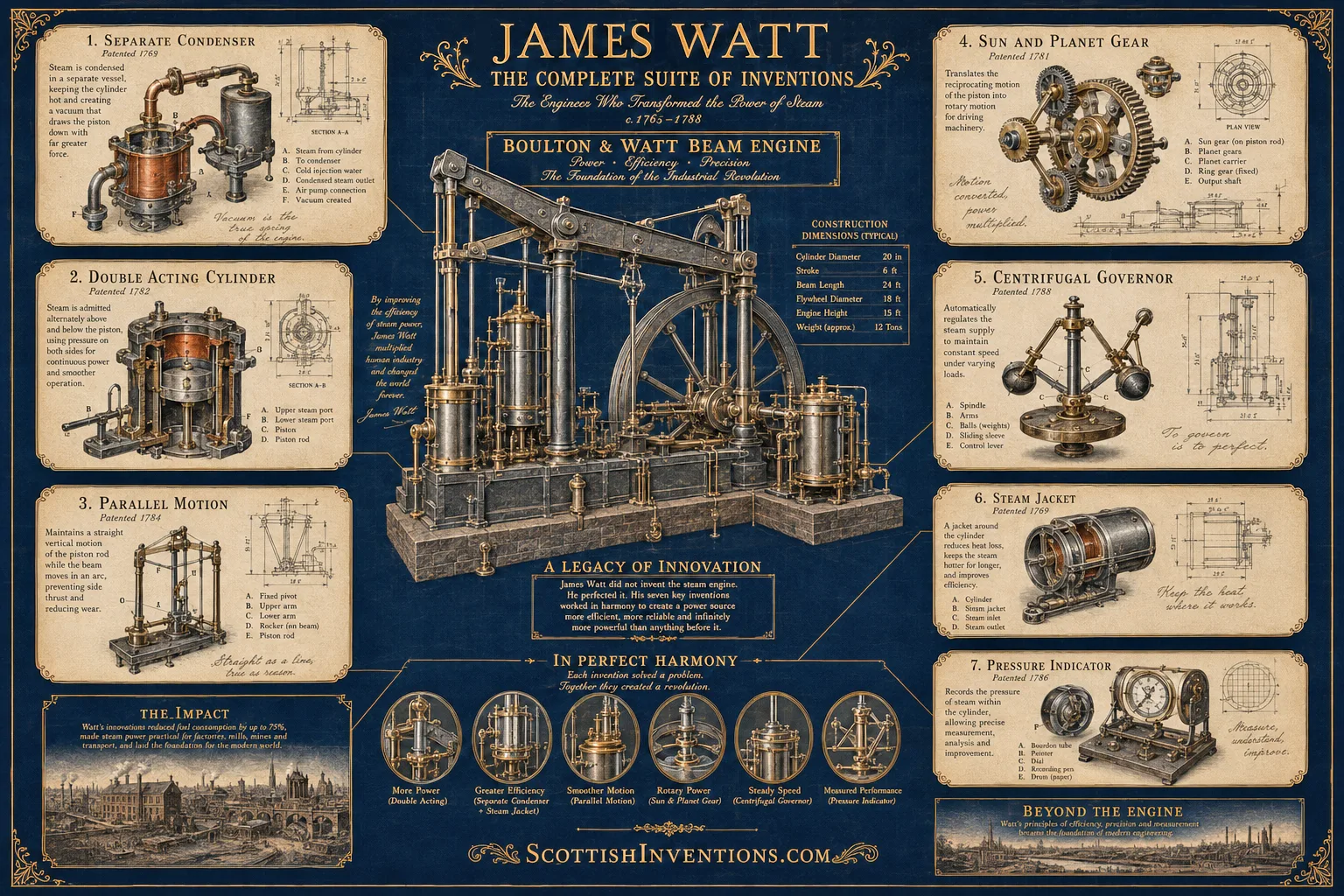
Between 1781 and 1790 Watt produced a cascade of innovations that turned his pumping engine into a universal source of rotary mechanical power — the prerequisite for mechanised industry.
- The double-acting engine (1782) — steam drives both up- and down-strokes, roughly doubling power for a given cylinder.
- The parallel motion (1784) — an elegant jointed linkage that converts a beam’s arc into a straight piston stroke. Watt was more proud of it than any other invention; three-bar linkages of the same family still appear in robotics and prosthetics.
- The sun-and-planet gear (patented 1781) — devised by his employee William Murdoch, allowed rotary output without infringing James Pickard’s 1780 crank patent.
- The centrifugal governor (1788) — two flying balls that opened or closed the steam valve as speed varied. One of the first practical examples of automatic feedback control.
- The expansive working principle (1782) — cutting off steam partway through the stroke and letting it expand against the piston. A practical forerunner of the Rankine cycle.
- The pressure indicator (1790s) — drew a pressure–volume diagram of the cylinder in real time, and became the standard tuning tool of steam engineering for a century.
Together, these turned the steam engine into a machine that could be installed anywhere and drive anything that needed rotating: mills, presses, lathes, looms, hammers, bellows, coin presses, and eventually the wheels of the first railways.
6. The Numbers — How Much Better Was a Watt Engine?
Watt himself calculated the saving at around 75%. Newcomen’s engines operated at 2–3% thermal efficiency; Watt’s reached 8–12% in practice. In fuel terms, Watt’s best engines used approximately one-quarter to one-fifth of the coal of a comparable Newcomen machine.
For a Cornish copper mine, that was the difference between marginal and profitable. For a Lancashire cotton mill, it was the difference between water power (frozen in winter, tied to riverbanks) and universal mechanical power that could be built anywhere. The economic logic was inexorable — and once you could power a factory anywhere with a fifth of the fuel of the previous generation, the factory could go anywhere. And it did.
7. The Lunar Society — Science at Supper
Watt’s Birmingham years were intellectually rich as well as commercially demanding. He joined the Lunar Society, meeting on the Sunday nearest the full moon — so members could ride home safely by moonlight — who called themselves the “lunaticks.”
The membership reads like a roll-call of the British Enlightenment: Boulton, Erasmus Darwin, Josiah Wedgwood, Joseph Priestley (discoverer of oxygen), William Withering (introducer of digitalis), James Keir, and Watt’s employee William Murdoch (later inventor of practical gas lighting). Franklin and Jefferson corresponded with them. The Scottish Enlightenment and the English Midlands industrial revolution met and sparked.
8. The Soho Foundry and the Scale of the Enterprise
By the 1790s Boulton & Watt had outgrown bespoke site installations. In 1796 they opened the Soho Foundry at Smethwick — a purpose-built, vertically integrated steam-engine factory, the first of its kind. By 1800 they had installed ~450 engines (or ~496 by Tann’s more recent count), of which some 270 were rotative engines driving factory machinery.
Customers spanned the economy: Cornish copper and tin mines; coal mines in Staffordshire and Scotland; cotton mills in Manchester, Glasgow, Paisley and Nottingham; flour mills and London breweries (the famous Whitbread engine of 1785 still survives in Sydney’s Powerhouse Museum); ironworks; the Royal Mint at Soho; distilleries; canal-pumping stations.
9. Legal Battles — Protecting the Monopoly
The 1769 patent, extended to 1800, gave Boulton & Watt a near-monopoly on condensing engines — and they enforced it. Jonathan Hornblower’s two-cylinder compound of 1781 was ruled an infringement in 1798; Edward Bull and others were pursued.
Historians still debate whether the monopoly retarded or stimulated innovation. What is certain is that within months of the patent’s expiry, Richard Trevithick had built a high-pressure engine that rendered much of Watt’s work technically obsolete — and within fifteen years steam locomotives were running on iron rails across Britain.
10. Impact — The World the Engine Made
Mining. Efficient pumping made deep mines economical; Cornish copper and tin surged; coal expanded to fuel the engines that fuelled the expansion.
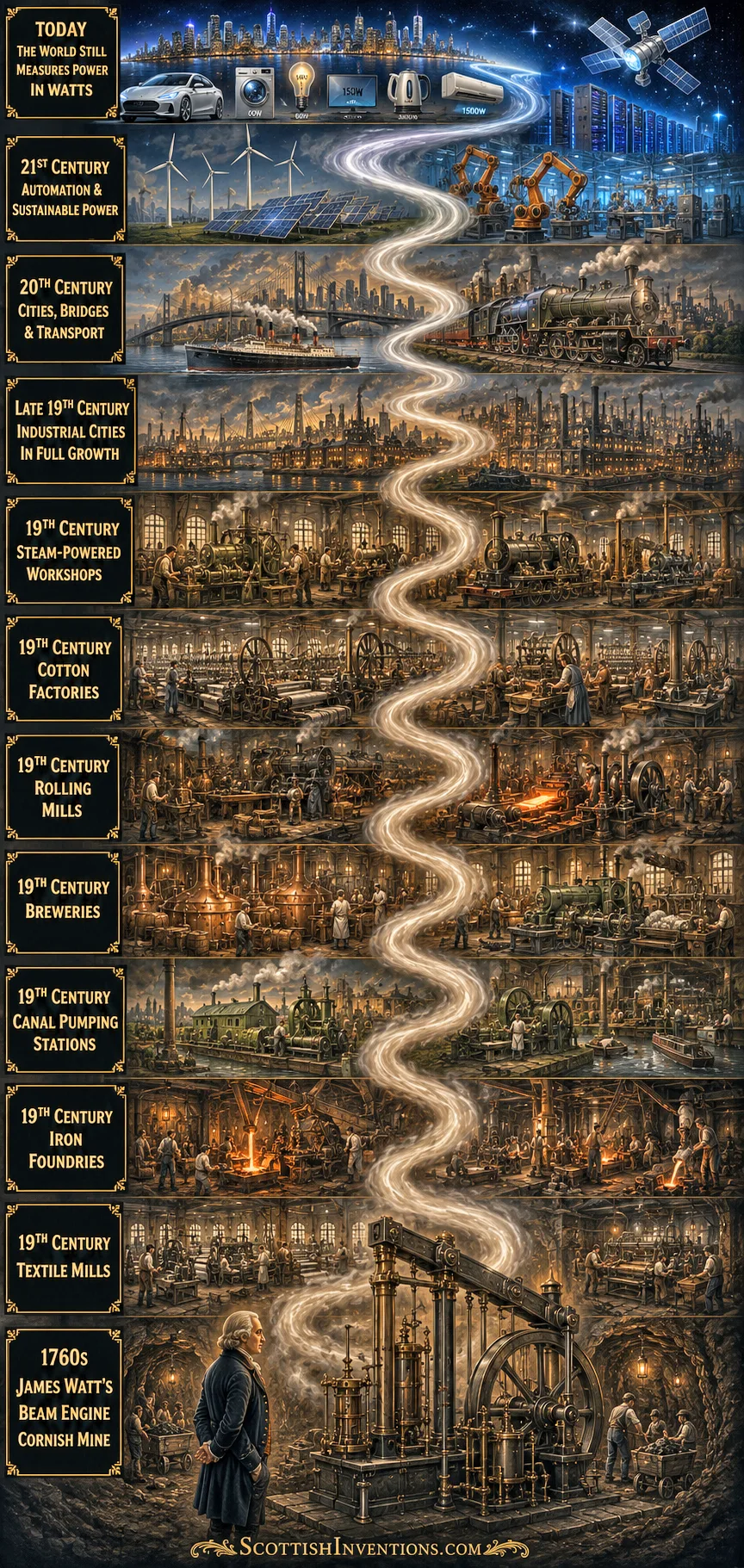
Textiles. The Watt rotative engine defined the cotton mill. Once steam power could reach anywhere coal could be delivered, mills multiplied across the north of England and the Clyde valley. Manchester, Leeds, Glasgow, Paisley and Dundee were built on steam.
Iron and steel. Watt’s blowing engines transformed iron-smelting — a precondition for the hot blast process, railways, bridges and machinery.
Urbanisation. Manchester grew from ~25,000 in 1772 to over 300,000 by 1850 — inseparable from steam.
Scotland specifically. The Clyde became the world’s premier shipbuilding river. Watt himself sailed on the first commercial steamship in Europe — Henry Bell’s Comet — on the Clyde in 1816, three years before his death.
11. Later Life and Other Inventions
Watt retired from the engine business in 1800 when the great patent expired, passing the firm to his sons and to William Murdoch. He was 64 and wealthy — and incapable of rest.
At Heathfield Hall he built a new attic workshop and spent the last nineteen years of his life inventing: refining his letter-copying press (1780, used by George Washington, Jefferson and Franklin), a sculpture-copying machine, and chemical experiments in bleaching.
His attic workshop was preserved intact after his death. In 1924 the entire room — floorboards, skylight, workbench, and more than 8,300 objects — was dismantled and re-erected at the Science Museum, London, where it has stood on public display since 2011 and remains one of the most remarkable objects in any museum in the world.
Watt died on 25 August 1819 at Heathfield Hall, aged 83, and was buried at St Mary’s Church, Handsworth.
12. The Unit — Watt’s Permanent Presence
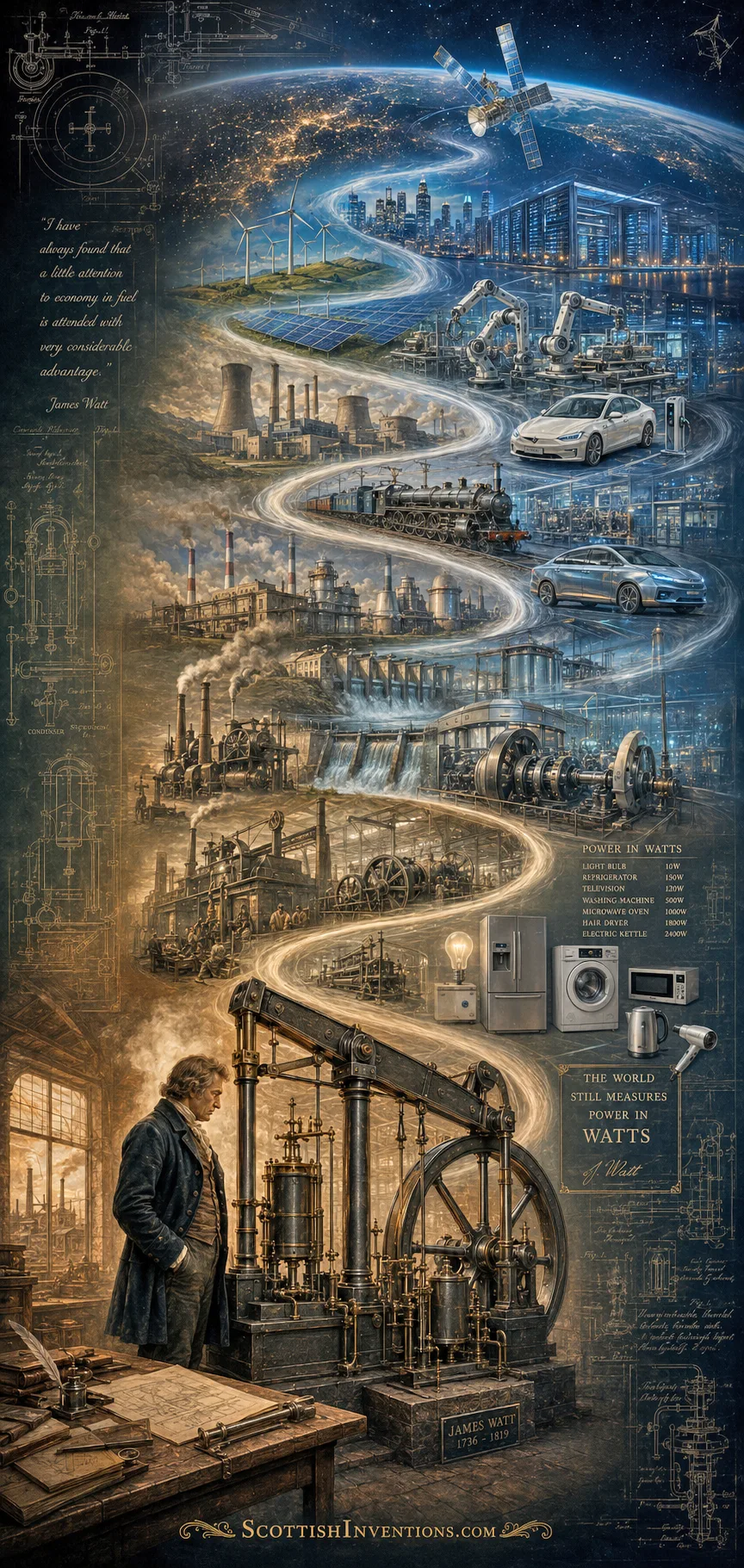
The watt was unofficially adopted by the British Association in 1889. On 11 October 1960, the 11th General Conference on Weights and Measures in Paris formally enshrined it in the International System of Units (SI): one watt = one joule per second.
Today the word appears on billions of objects: light bulbs, kettles, solar panels, wind turbines, EV chargers, microwaves, laptops, electricity bills. No other Scottish name is so ubiquitous, so universal, so quietly permanent.
13. Why Scotland?
It is worth pausing on why a Scottish instrument-maker in a Glasgow university workshop, and not a French physicist or an English ironmaster, made the decisive improvement.
Scotland in the 1760s had four universities in a population of 1.3 million, a culture of practical education, and a tightly networked intellectual community in which a university instrument-maker could walk next door and discuss thermodynamics with the chemist who had just discovered latent heat. It was the Scottish Enlightenment made industrial.
Did You Know?
Legacy
Watt’s Westminster Abbey memorial, unveiled in 1825, was inscribed by Lord Brougham: honouring the man who “directing the force of an original genius early exercised in philosophic research to the improvement of the steam engine enlarged the resources of his country, increased the power of Man, and rose to an eminent place among the most illustrious followers of science and the real benefactors of the world.”
Statues of Watt stand in Greenock, twice in Glasgow (George Square and Glasgow Green), in the National Museum of Scotland, in Birmingham, Manchester and London. The Hunterian Museum at the University of Glasgow holds the original Newcomen teaching model that started everything. The Smethwick Engine of 1779 — the oldest working steam engine in the world, a Boulton & Watt commission — still runs at Thinktank, Birmingham Science Museum.
He did not invent steam power. He made it matter — cheap enough, efficient enough, versatile enough to displace every other source of mechanical power in the world. That a lad from Greenock with headaches and an anxious temperament did this from a university workshop in Glasgow, because a classroom model needed mending, is perhaps the most remarkable industrial story in history.
Frequently Asked Questions
Who invented the steam engine?
The first practical steam engine was built by Devon ironmonger Thomas Newcomen in 1712. James Watt did not invent the steam engine — he transformed it. Watt's 1769 separate condenser cut its fuel consumption by roughly three-quarters and made steam power universal.
Did James Watt invent the steam engine?
No. Watt improved it. His decisive contribution was the separate condenser, conceived on Glasgow Green in May 1765 and patented in 1769 as British Patent No. 913. This, together with the double-acting cylinder, parallel motion, sun-and-planet gear and centrifugal governor, turned Newcomen's inefficient pump into the prime mover of the Industrial Revolution.
What did James Watt actually invent?
The separate condenser (1769), the steam jacket, the double-acting engine (1782), the expansive working principle (1782), the sun-and-planet gear (patented 1781, invented by his employee William Murdoch), the parallel motion (1784), the centrifugal governor (1788), the pressure indicator diagram, the letter-copying press (1780) and horsepower as a marketing unit.
What is the Separate Condenser?
A separate cold vessel piped to the working cylinder of a steam engine. Spent steam condenses in the condenser while the cylinder itself stays permanently hot, eliminating the wasteful reheating that had crippled Newcomen's design. It cut fuel use by up to 75% and made steam power economical outside coal mines.
Why is power measured in watts?
James Watt introduced 'horsepower' to sell his engines. In 1889 the British Association adopted 'watt' as a unit of electrical power in his honour, and on 11 October 1960 the 11th General Conference on Weights and Measures formally enshrined the watt in the International System of Units as one joule per second.
Who was Matthew Boulton?
Matthew Boulton (1728–1809) was Watt's Birmingham business partner. Owner of the Soho Manufactory, he provided capital, commercial drive and access to John Wilkinson's precision cylinder-boring machine. Boulton & Watt was formally established in 1775 and supplied around 450 engines by 1800. His famous line to a visitor: 'I sell here, Sir, what all the world desires to have — POWER.'
How efficient was Watt's engine?
A Newcomen engine operated at roughly 2–3% thermal efficiency. Watt's improved engines, with separate condenser, steam jacket and expansive working, reached 8–12% in practice — using approximately one-quarter to one-fifth of the coal a comparable Newcomen engine would burn for the same work.
Why was Glasgow important?
Watt was employed as Mathematical Instrument Maker to the University of Glasgow from 1757. There he met chemist Joseph Black, whose theory of latent heat gave him the numbers behind the separate condenser, and repaired the broken Newcomen teaching model that started everything. The Scottish Enlightenment, Glasgow Green and Glasgow University together produced the breakthrough.
Watt’s story is one of many that shaped the modern world. Explore the Scottish Inventions collection to discover more Scots whose ideas changed everything.