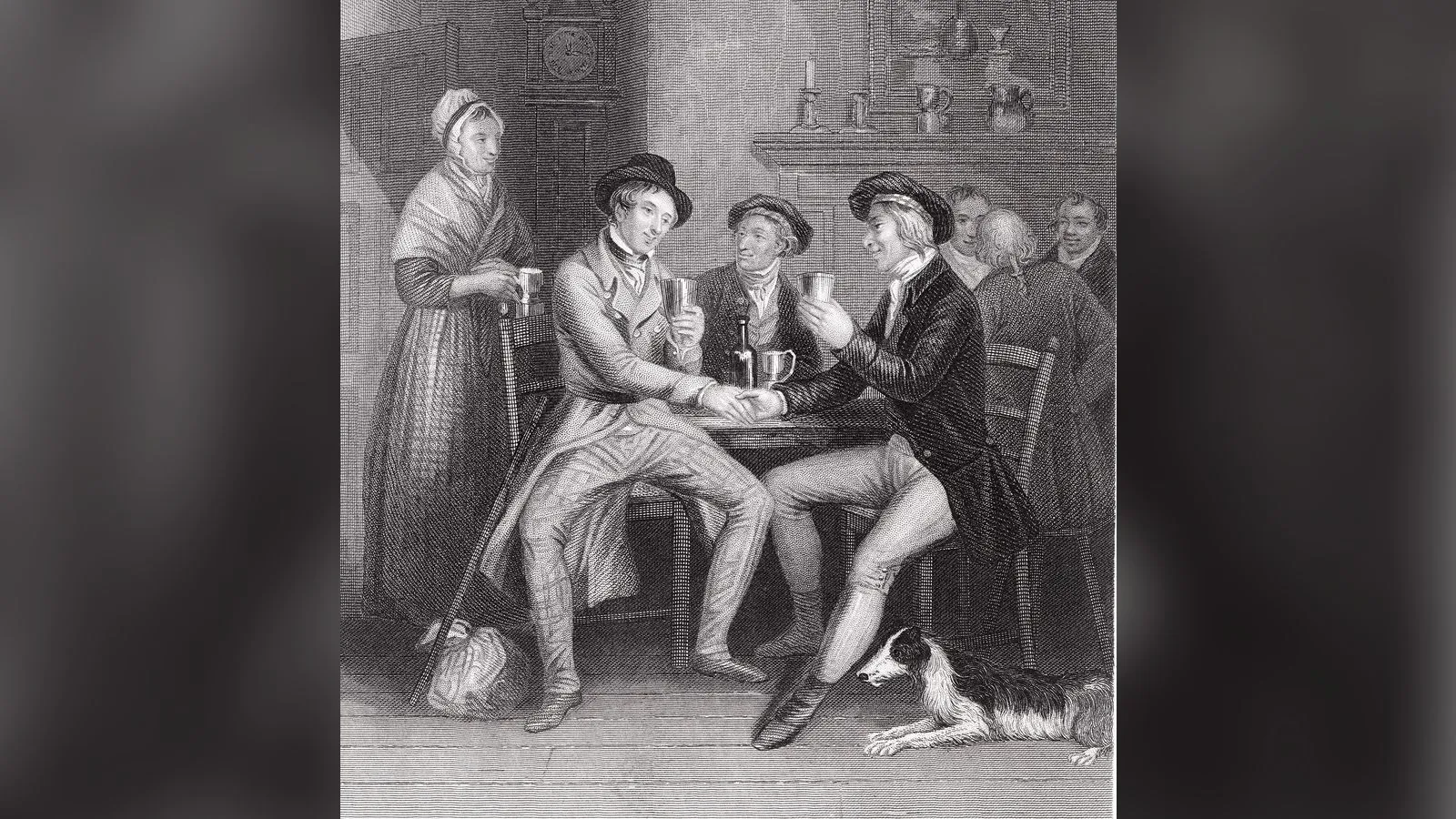

Auld Lang Syne
Contents
Sung at midnight from Times Square to Tokyo department stores, "Auld Lang Syne" is probably the most globally performed piece of Scottish culture in existence — and almost nobody singing it is entirely clear on what the words mean, who wrote them, or why it became a New Year's ritual at all. This card is about the song itself: its contested authorship, its specific journey from Ayrshire folk fragment to global institution, and how a Canadian bandleader did more to spread it worldwide than any Scot. (For Burns's wider poetic and song-writing career, see the separate "Burns's Poetry & Song" card.)
TL;DR
- Robert Burns did not invent "Auld Lang Syne" from nothing — he adapted and completed an older Scots song tradition. established Burns himself stated in an 1793 letter that he took the song down from an old man's singing, and a related printed ballad, "Old Long Syne," exists from 1711, predating Burns.
- The now-famous tune is not the one Burns originally intended or that first accompanied his published words. established The melody now universally used was a later substitution, associated with music publisher George Thomson's preference, distinct from the tune in Burns's own manuscript submission.
- Burns's version was first published after his death, in the Scots Musical Museum. established This is documented in the publication history of James Johnson's song collection.
- The song's global New Year's Eve association owes more to 20th-century American broadcast culture than to any Scottish tradition. established Bandleader Guy Lombardo's annual New Year's Eve broadcasts from 1929 onward are widely credited by music historians with cementing the specific "countdown to midnight" association in North America, from where it spread internationally via media and emigrant communities.
- "Auld Lang Syne" was entirely composed by Burns with no earlier source. [Legend] This is a persistent popular misconception; the documented evidence of Burns's own letter and the pre-existing 1711 ballad both contradict a claim of sole, original authorship.
Key Facts
- Song
- "Auld Lang Syne" ("For old times' sake")
- Credited author (words)
- Robert Burns, adapting/completing earlier traditional material
- Earlier antecedent
- "Old Long Syne," printed ballad, 1711 (possibly linked to earlier work attributed in tradition to Robert Ayton, 17th century)
- First Burns-linked publication
- Scots Musical Museum, James Johnson (song appeared in volumes published from the mid-1790s)
- Tune
- Traditional Scots strathspey-type air, popularised in its modern form via George Thomson's published arrangement, distinct from Burns's suggested tune
- Category
- Literature & Poetry (Song)
- Global role
- Standard New Year's Eve and farewell/leave-taking song in dozens of countries; also used at graduations, funerals, and as a store-closing signal in Japan
- Status/Legacy
- Among the most widely known and performed songs in the world, with a cultural reach far exceeding its specifically Scottish origin
Scottish Impact Index (SI Score)
- Cultural Impact
- 10/10
- Enduring Relevance
- 10/10
- Artistic / Cultural Contribution
- 10/10
- Artistic Originality
- 9/10
- Artistic Legacy
- 10/10
- Recognition
- 10/10
59/60
Ranked =9th of 50 in Arts
A Note on Claims and Evidence
The documentary record for "Auld Lang Syne" is better than for most 18th-century songs because Burns's own correspondence directly addresses its origin: in a 1793 letter to Mrs Agnes Dunlop, he describes the song as something an old man sang to him, which he wrote down, explicitly distancing himself from sole authorship of the core sentiment and phrase even while claiming credit for the finished literary form. This makes "Auld Lang Syne" an unusually well-documented case of Burns's general song-reworking method (discussed in the separate Burns's Poetry & Song card), rather than a disputed or purely inferred attribution. The chain of melody substitutions and the song's 20th-century globalisation, by contrast, rest on a wider range of secondary musicological and cultural-history sources, and some specific claims (exact dates of first American radio broadcasts, precise mechanisms of spread to particular countries) vary somewhat between popular and academic accounts; this article follows the most consistently corroborated version of events.
Timeline
"Old Long Syne," a ballad with thematic and some phrasal similarity to the later song, is printed, predating Burns by decades and sometimes linked in tradition (not firmly proven) to the 17th-century poet Robert Ayton.
Robert Burns sends a version of "Auld Lang Syne" to Mrs Agnes Dunlop, describing it as an old song he had taken down rather than composed outright.
Burns dies in Dumfries, before seeing the song's full eventual publication and impact.
The song is published, with Burns's name attached, in James Johnson's Scots Musical Museum.
The now-standard tune (distinct from Burns's own suggested air) becomes fixed as the song's accompanying melody, associated with George Thomson's published arrangement.
Canadian-American bandleader Guy Lombardo's orchestra performs the song live at midnight during a New York radio broadcast from the Roosevelt Hotel, an event widely credited with entrenching its specific New Year's Eve "countdown" role in North America.
The song spreads globally through emigrant Scottish communities, Hogmanay tradition, broadcast media, and independent local adoption (e.g., as a closing-time or farewell signal in Japan and other countries), becoming one of the most recognised songs in the world.
Details
What the words actually mean
"Auld Lang Syne" translates roughly as "old long since" or, more naturally, "for old times' sake" or "days gone by." The song is structured as a nostalgic toast between old friends, recalling shared past experiences — "we twa hae run about the braes" (we two have run about the hillsides) — and proposing a shared cup of kindness in their memory. Its sentiment is specifically about friendship, memory, and parting or renewal rather than anything explicitly tied to the New Year as a calendar event; the New Year association is a later cultural accretion rather than something built into the song's original content or occasion.
Burns's role: adaptation, not invention
Burns's own account of the song's origin is unusually direct for a figure whose biography is otherwise thick with later embellishment. In an often-cited 1793 letter, he describes having taken the song "down from an old man's singing," explicitly framing his role as one of recovery and literary polishing rather than original composition. This fits the documented pattern of his broader song-collecting practice (see the separate Burns's Poetry & Song card): Burns frequently encountered fragmentary or half-remembered traditional material and reshaped it into a finished, publishable lyric. Supporting this account, an earlier ballad titled "Old Long Syne" was printed as far back as 1711 — more than 80 years before Burns's version — sharing enough thematic and some phrasal DNA with the later song that most scholars treat it as part of the same evolving song tradition rather than coincidence. Some traditional accounts link this still-earlier material to the 17th-century courtier-poet Robert Ayton, though this specific attribution is not firmly established and should be treated as traditional rather than documented fact.
The tune problem
A detail that surprises many people: the tune now sung virtually everywhere is not straightforwardly "Burns's tune." Burns himself, when submitting the song, indicated a particular air he associated with the words, but the melody that eventually became fixed as the song's universal accompaniment was a different, separately circulating Scots air, associated with the arrangement published by George Thomson (Burns's other major song-publishing collaborator, discussed in the Burns's Poetry & Song card). This substitution happened within a few decades of Burns's death and was thoroughly settled by the mid-19th century. The result is a song whose words and whose now-"traditional" melody have somewhat separate, only partially overlapping histories — a detail essentially invisible to anyone encountering the song today, since the pairing feels, after two centuries of exclusive use, entirely natural and inevitable.
Hogmanay and the Scottish New Year connection
Within Scotland, "Auld Lang Syne" became closely associated with Hogmanay (the Scots New Year's Eve celebration) over the course of the 19th century, fitting naturally into a festival already built around themes of looking back over the departing year, visiting friends and neighbours ("first-footing"), and renewing social bonds. This Scottish domestic association predates, and is distinct from, the specifically American "countdown to midnight" ritual that would later globalise the song far beyond its country of origin. It is worth separating these two phenomena clearly: the song's role in Scottish Hogmanay tradition is a genuine, organically developed 19th-century cultural practice, while its status as the specific soundtrack to the global midnight countdown moment is a 20th-century, largely American-mediated development.
Guy Lombardo and global diffusion
The single most consequential event in the song's modern global spread was not Scottish at all. Guy Lombardo, a Canadian-American bandleader, began performing "Auld Lang Syne" as part of his orchestra's annual New Year's Eve broadcasts starting in 1929, continuing the tradition on American radio and later television for decades. These broadcasts, reaching enormous national (and eventually international) audiences through the mid-20th century's dominant mass media, are widely credited by music historians as the mechanism that fixed "Auld Lang Syne" as the specific, expected song for the midnight New Year transition across North America — a role it had not previously held with anything like that universality, even within Scotland itself. From this American broadcast-driven entrenchment, the song's New Year association spread further internationally through film, television, and the broader reach of Anglophone popular media across the 20th century.
A song for leave-taking everywhere
Beyond New Year, "Auld Lang Syne" has been independently adopted across a striking range of cultures and contexts entirely disconnected from its Scottish or even New Year origins: it is used as a farewell or closing signal in various countries, including as a store-closing tune in parts of Japan (where it circulates with Japanese lyrics under the title "Hotaru no Hikari"), as a graduation and funeral song in numerous countries, and as a general-purpose "farewell/parting" anthem wherever Western musical influence reached during the 19th and 20th centuries, often entirely detached from any specific New Year connotation. Its structural qualities — a simple, memorable melody paired with universally relatable sentiments of memory, parting, and renewed friendship — made it unusually portable across linguistic and cultural boundaries, with new lyric sets written in dozens of languages rather than the song simply being performed in Scots everywhere.
Did You Know?
- The melody everyone now associates with "Auld Lang Syne" is not the tune Burns originally submitted alongside the words.
- A ballad called "Old Long Syne," sharing thematic material with Burns's later version, was printed in 1711 — more than 80 years before Burns's documented version.
- Burns described the song in his own letter as something he "took down from an old man's singing," not as his own invention.
- A Canadian bandleader, Guy Lombardo, is widely credited with cementing the song's role as the specific soundtrack to the American midnight New Year countdown, starting in 1929.
- In parts of Japan, a version of the tune with entirely different Japanese lyrics ("Hotaru no Hikari") is commonly played as a signal that a shop or department store is closing for the day.
- The phrase "auld lang syne" literally translates closer to "old long since" than to any single fixed English idiom, though "for old times' sake" captures the sense well.
- The song's association with Scottish Hogmanay developed over the 19th century and is a separate historical thread from its later American-driven globalisation as a New Year's Eve anthem.
- Most people worldwide who sing the song each New Year could not translate its opening Scots lyrics, despite the song's near-universal recognisability.
FAQ
1Did Robert Burns write "Auld Lang Syne" from scratch?
No — by his own account, he adapted and completed an existing traditional song he heard sung by an old man, building on a tradition with documented roots at least as far back as a 1711 printed ballad.
2Is the tune we sing today the original tune Burns intended?
No — the words were originally paired with a different air; the now-standard melody became fixed later, through George Thomson's published arrangement, and became the universal pairing by the mid-19th century.
3Why is the song associated with New Year's Eve specifically?
Within Scotland, it became linked to Hogmanay over the 19th century; its specific role as the global "countdown to midnight" anthem, however, owes much more to 20th-century American radio and television broadcasts, especially by bandleader Guy Lombardo from 1929 onward.
4What do the words of the song actually mean?
They are a toast between old friends recalling shared past times and proposing to share a cup of kindness in memory of those days — "for old times' sake," broadly.
5Is "Auld Lang Syne" the same subject as the Burns's Poetry & Song card in this collection?
No — that card covers Burns's wider poetic and song-writing career and methods; this card focuses specifically on this one song's own distinct history and global cultural afterlife.
6Who was Robert Ayton, sometimes mentioned in connection with this song?
A 17th-century Scottish courtier-poet sometimes traditionally linked to earlier material behind the song, though this specific attribution is not firmly documented and should be treated as traditional rather than established fact.
7When was Burns's version first published?
It appeared in James Johnson's Scots Musical Museum in the mid-to-late 1790s, after being sent privately to a correspondent in 1793, and after Burns's own death in 1796.
8How did the song spread outside Scotland and the English-speaking world?
Largely through 19th- and 20th-century emigration, broadcast media, and independent local adoption, with new lyric sets written in numerous languages — in some cases, as in Japan, becoming attached to entirely new, unrelated lyrics.
9Why do people often get the words slightly wrong when singing it?
Because the song is in Scots, often sung from memory rather than text, and is overwhelmingly encountered outside Scotland with little context for its specific vocabulary and meaning.
10Is the song used for anything other than New Year's Eve?
Yes — it is also commonly used at funerals, graduations, and as a general farewell or leave-taking song in various cultural contexts worldwide.
11Did Guy Lombardo write or compose anything related to the song?
No — he did not write or alter the song itself; his significance lies in popularising its specific use as the ritual midnight New Year's Eve song through his long-running American broadcasts.
12Is there a definitive, single "correct" version of the lyrics?
Not entirely — as with much orally transmitted and later-collected folk material, minor textual variants exist, though Burns's published version in the Scots Musical Museum is treated as the standard reference text.
Sources and Further Reading
Primary/Institutional
- Robert Burns's letter to Mrs Agnes Dunlop (1793), held and referenced via the National Library of Scotland / Robert Burns Birthplace Museum manuscript collections
- James Johnson, Scots Musical Museum (original publication, 1787–1803)
Scholarly/Critical
- James Kinsley (ed.), The Poems and Songs of Robert Burns (Oxford University Press)
- Murray Pittock (ed.), Robert Burns in Global Culture, for discussion of the song's international reception
General
- Mental Floss, "A Brief History of 'Auld Lang Syne'"
- University of Edinburgh, "Auld Lang Syne Ritual Lodged in Scotland's Past" (research news feature on Hogmanay tradition)
Caveats: Myths and Disputed Claims
The most common misconception is that Burns composed "Auld Lang Syne" entirely as an original work; his own letter and the earlier 1711 "Old Long Syne" ballad both establish that he was adapting and completing existing traditional material, consistent with his broader song-reworking practice. A related myth treats the song's melody as having been fixed and "Scottish" from the start in its current form, when in fact the now-standard tune is a later substitution for whatever air Burns originally associated with the words. It is also often wrongly assumed that the song's global New Year's association is an ancient or purely Scottish tradition, when the specific "countdown to midnight" ritual owes a great deal to 20th-century American broadcast culture, particularly Guy Lombardo's annual performances from 1929. The precise 17th-century attribution to Robert Ayton, sometimes stated confidently in popular retellings, remains traditional rather than firmly documented and should be presented with appropriate caution.
Card 003 · Arts