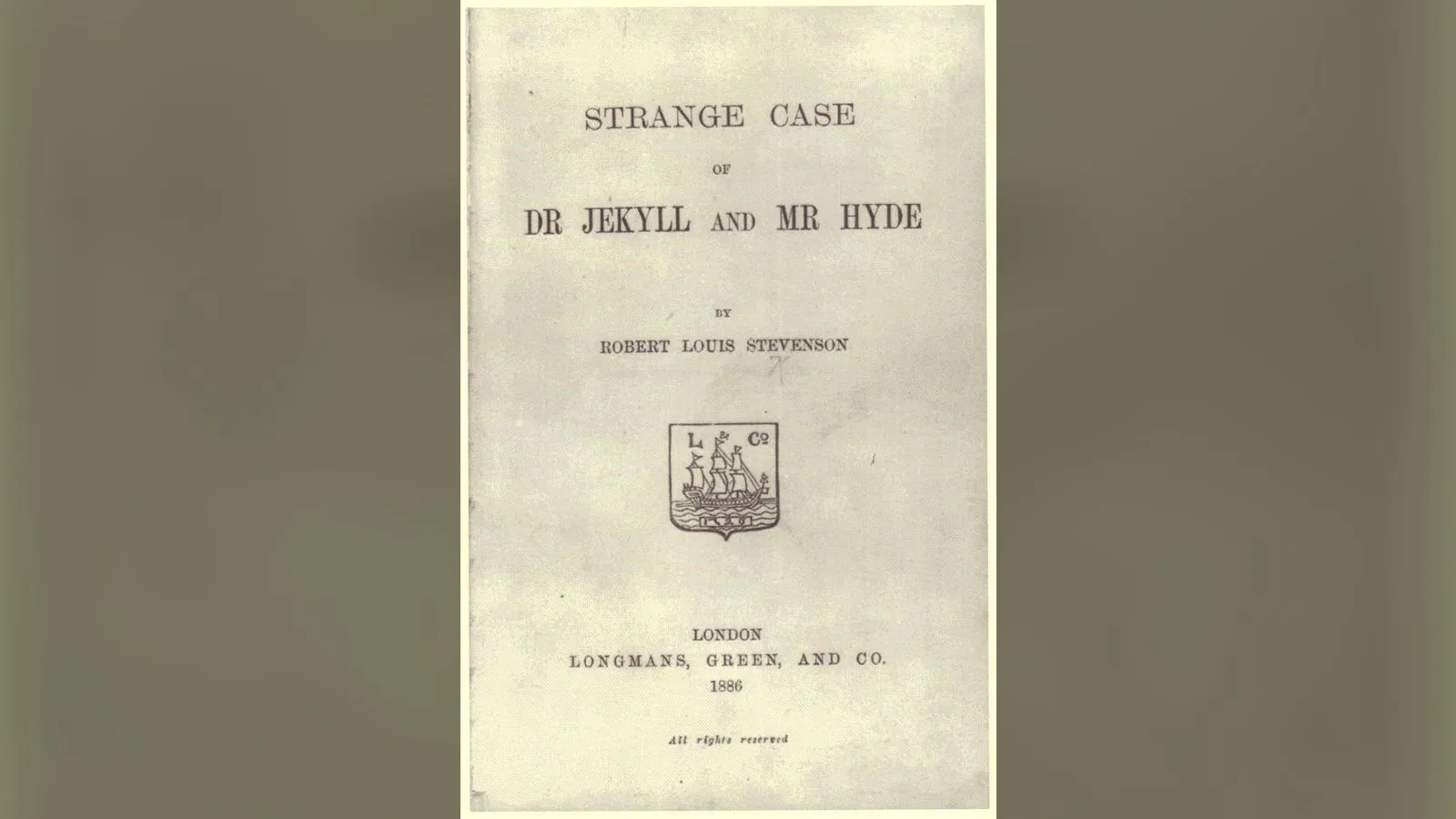

Strange Case of Dr Jekyll and Mr Hyde
Contents
Everyone knows the shorthand — "a real Jekyll and Hyde" — for someone with a hidden, darker second self. Fewer people know that Robert Louis Stevenson built his novella directly out of the lived, physical texture of Edinburgh itself: a city whose respectable Georgian New Town and its darker, crime-ridden Old Town sat within walking distance of each other, and whose most notorious real-life "double life" case — a council burgess running a secret burglary gang by night — was already a piece of local legend before Stevenson ever picked up a pen.
TL;DR
- Stevenson's novella, published in 1886, explores a literal and figurative psychological duality, embodied in a single man who physically transforms between two bodies. established This is the book's documented plot and stated thematic core, confirmed by the text itself and extensive critical analysis.
- Edinburgh's physical and social duality — genteel New Town versus the older, poorer, crime-associated Old Town — is widely cited as a direct inspiration for the novella's themes. traditional This connection is strongly supported by Stevenson's own upbringing and writings about the city, though it is an interpretive critical link rather than something Stevenson stated as a single, explicit source.
- The real-life 18th-century Edinburgh burgess and cabinetmaker Deacon William Brodie, who led a secret double life as a burglar, is frequently cited as a partial inspiration. traditional Stevenson had direct personal connection to the Brodie story (he even co-wrote an earlier play about him), making the influence plausible and widely accepted, though not something he explicitly confirmed as the specific source for Jekyll and Hyde itself.
- Stevenson wrote the first draft in a single intense burst, reportedly over three days, after a vivid dream. traditional This is a widely repeated account from Stevenson's own family and later biographical sources, though some details (exact number of days, the manuscript's subsequent fate) vary between retellings and should be treated as traditional anecdote rather than fully verified fact.
- The story is simply about "good versus evil" with no further complexity. [Legend] This flattens the novella considerably; critics have long read it as a much more specific exploration of repression, Victorian respectability, addiction, and the instability of a unified self, not a simple morality tale.
Key Facts
- Author
- Robert Louis Stevenson (1850–1894)
- Work
- Strange Case of Dr Jekyll and Mr Hyde (novella)
- First published
- January 1886
- Key inspirations (cited)
- Edinburgh's social/architectural duality; the real-life story of Deacon William Brodie; a vivid dream Stevenson reported having
- Category
- Literature & Poetry
- Themes
- Psychological duality, repression, Victorian respectability and hypocrisy, addiction, the instability of personal identity
- Status/Legacy
- One of the most adapted and culturally embedded works in the English language; "Jekyll and Hyde" is a standard idiom for duplicitous or split personality
Scottish Impact Index (SI Score)
- Cultural Impact
- 10/10
- Enduring Relevance
- 10/10
- Artistic / Cultural Contribution
- 10/10
- Artistic Originality
- 10/10
- Artistic Legacy
- 10/10
- Recognition
- 10/10
60/60
Ranked =1st of 50 in Arts
A Note on Claims and Evidence
The text of the novella and its initial publication and reception are matters of straightforward documentary record. The specific claims about Stevenson's inspirations are more layered: his personal connection to Edinburgh's social geography is well established through his own essays and letters, and his direct biographical connection to the Deacon Brodie story (via an earlier collaborative play, co-written with W. E. Henley) is documented fact. However, Stevenson never left a single definitive statement naming one specific real event or person as "the" source for Jekyll and Hyde; the connections to Brodie and to Edinburgh's social duality are best described as strongly supported traditional/critical inferences rather than confirmed authorial statements, and this article labels them accordingly. The dream-origin anecdote comes chiefly from accounts given by Stevenson's wife, Fanny Stevenson, and later biographers, and while widely repeated, carries the usual caveats of family-sourced literary anecdote.
Timeline
Robert Louis Stevenson born in Edinburgh, into a family of noted lighthouse engineers.
Stevenson co-writes (with W. E. Henley) a play about Deacon William Brodie, the real 18th-century Edinburgh burgess and secret burglar, showing his direct prior engagement with the "double life" story.
Stevenson writes Strange Case of Dr Jekyll and Mr Hyde, reportedly composing an initial draft in an intense short burst after a vivid dream, before extensively revising it.
The novella is first published in Britain, quickly achieving major popular and critical success.
The story rapidly enters popular culture, with stage adaptations appearing within a few years of publication.
The novella becomes one of the most frequently adapted literary works in film, television, and theatre worldwide, and "Jekyll and Hyde" enters common English usage as an idiom for a person with a concealed, contradictory second nature.
Details
Edinburgh's double city
Robert Louis Stevenson grew up in a city built, quite literally, on two contrasting halves. Edinburgh's elegant Georgian New Town — orderly, affluent, and associated with Enlightenment rationality and respectable professional life — stood in close physical proximity to the much older, poorer, overcrowded Old Town, long associated in the civic imagination with crime, disease, and social disorder. Stevenson, who wrote at length and with evident fascination about Edinburgh's contrasts in his own non-fiction essays (notably Edinburgh: Picturesque Notes, 1878), experienced this duality directly as a feature of his everyday urban environment rather than as an abstract literary concept. Critics have long treated this lived experience of a city physically split between respectable surface and disreputable depths as a plausible and compelling real-world correlate for the novella's central device: a single body housing both a socially respectable, controlled public self (Dr Henry Jekyll) and a violent, uninhibited, socially marginal second self (Edward Hyde) that the respectable self works to keep hidden.
Deacon Brodie: Edinburgh's real double life
Among the specific historical figures most consistently cited as a likely partial inspiration is William Brodie (1741–1788), a respected Edinburgh cabinetmaker, town councillor, and deacon of the trades guild by day, who secretly ran a burglary operation by night — reportedly using his legitimate trade access to clients' houses to make copies of their keys for later use by his criminal associates. Brodie was eventually caught, convicted, and hanged in 1788 (notably, according to persistent but unverified local legend, on a gallows he himself had helped design in his legitimate trade capacity — a detail that should be treated as colourful tradition rather than confirmed fact). Stevenson's connection to this story is not merely speculative: as a young writer, he co-authored an earlier stage play, Deacon Brodie, or The Double Life (1878–80, with W. E. Henley), directly engaging with Brodie's story years before writing Jekyll and Hyde. This documented prior engagement makes Brodie's influence on the later novella highly plausible and widely accepted by scholars and biographers, even though Stevenson did not leave an explicit statement directly naming Brodie as the specific trigger for the later, very different work.
The dream and the composition process
The most famous anecdote about the novella's composition describes Stevenson waking from a vivid, disturbing dream and rapidly drafting an initial version of the story within a few days, reportedly burning this first draft after his wife Fanny criticised it for treating the moral/psychological transformation too much as a surface-level horror device rather than exploring its deeper allegorical potential, and then rewriting the whole thing, again at considerable speed, into something closer to the published version. This account comes principally from later biographical retellings drawing on family testimony rather than Stevenson's own direct contemporary documentation of the process, and some specific details (the exact number of days, the full extent of the rewrite) vary across different tellings — it should be treated as well-established traditional anecdote about the book's genesis rather than a precisely documented production history.
Themes: respectability, repression, and addiction
Beyond its surface plot mechanics, the novella is widely read by critics as a pointed exploration of specifically Victorian anxieties about respectability and repression: Dr Jekyll's transformation into Hyde is framed not as the creation of something wholly external or alien, but as the release of impulses and appetites Jekyll himself already possessed and had been suppressing beneath a carefully maintained public reputation — the novella's horror lies partly in the implication that "Hyde" is not a separate monster but an authentic, if disowned, part of Jekyll all along. Many critics, especially from the later 20th century onward, have also read the novella's imagery of compulsive, escalating, secretive transformation as resonant with the language and experience of addiction, decades before clinical vocabulary for substance dependency had fully developed — Jekyll's early experimental, pleasurable use of the transformative drug giving way to compulsive, shame-ridden dependency maps closely enough onto later addiction narratives that the comparison is now a standard critical lens, though this is an interpretive reading applied to the text rather than something Stevenson can be shown to have consciously intended in modern clinical terms.
Publication, reception, and rapid popularisation
established Stevenson first offered the story to Longman's Magazine as a serial, but Longmans suggested publishing it separately as a cheap book. It came out at a shilling, and Stevenson was offered a royalty of one-sixth of the retail price, with royalties on the first 10,000 copies paid at once and half the returns on foreign sales. It sold 40,000 copies in its first six months, sales in a different league from anything he had known, though at twopence a copy his real earnings came later with American publication.
The novella was an immediate commercial and critical success on its January 1886 publication, helped by extensive newspaper coverage and strong reviews, and it achieved a level of mainstream cultural penetration unusually fast even by the standards of popular Victorian fiction. Stage adaptations followed within just a few years, and the story's central conceit proved so immediately graspable and reusable that "Jekyll and Hyde" passed into common English idiom — used to describe anyone whose public and private behaviour differ sharply — within a remarkably short span of time relative to the book's actual publication date, a linguistic absorption rate matched by very few other literary works of any era.
A century and a half of adaptation
Strange Case of Dr Jekyll and Mr Hyde has gone on to become one of the most frequently adapted literary works in the English language, with dozens of film, television, stage, and musical versions produced across more than a century, ranging from relatively faithful psychological horror treatments to loose reimaginings that use the "transformation" premise for entirely different genre purposes (comedy, science fiction, superhero narrative). This sustained adaptive afterlife, combined with the story's deep idiomatic embedding in everyday English, places the novella among a very small group of 19th-century literary works (alongside works like Frankenstein and Dracula) whose central concept has become more widely known, in some simplified form, than the specific original text itself — many people familiar with the general "Jekyll and Hyde" concept have never actually read Stevenson's novella.
Did You Know?
- Stevenson reportedly burned his first draft of the novella after his wife Fanny criticised its approach, then rewrote it from scratch at speed.
- William Brodie, the real Edinburgh burgess widely cited as a partial inspiration, was by day a respected cabinetmaker and town councillor, and by night allegedly ran a burglary gang using copied keys from his legitimate trade work.
- Stevenson co-wrote an earlier stage play specifically about Deacon Brodie's double life years before writing Jekyll and Hyde.
- The novella was written and published remarkably quickly even by Victorian standards, contributing to its unusually rapid entry into popular culture and common idiom.
- Stevenson came from a family of famous lighthouse engineers (the "Lighthouse Stevensons"), a very different career path from the one he eventually chose as a writer.
- Many adaptations of the story significantly alter or add plot elements (such as a romantic subplot) not present in Stevenson's considerably shorter and more restrained original novella.
- The phrase "Jekyll and Hyde" is now used as a general-purpose English idiom for anyone displaying sharply contradictory public and private behaviour, independent of any specific reference to the book's plot.
- Stevenson wrote the influential non-fiction essay collection Edinburgh: Picturesque Notes (1878), exploring the city's physical and social contrasts years before channelling similar observations into fiction.
FAQ
1What is the basic plot of Jekyll and Hyde?
Respectable Dr Henry Jekyll develops a chemical means of transforming into an alternate, uninhibited, and violent persona, Edward Hyde, exploring themes of repression and hidden identity, with tragic consequences as Jekyll increasingly loses control over the transformation.
2Did a real event or person directly inspire the story?
No single confirmed source exists, but Edinburgh's own social and architectural duality, and the real 18th-century story of Deacon William Brodie, are both widely and plausibly cited as influences, supported by Stevenson's documented personal connection to both.
3Who was Deacon Brodie?
A respected 18th-century Edinburgh cabinetmaker and town councillor who secretly led a double life as a burglar, eventually caught and hanged in 1788; Stevenson had co-written an earlier play about him before writing Jekyll and Hyde.
4Is it true Stevenson wrote the first draft after a dream?
This is a widely repeated traditional account, drawn mainly from family biographical testimony, describing a rapid initial draft followed by a complete rewrite; exact details vary between retellings.
5Is the story simply about good and evil?
Critics generally read it as considerably more specific than a simple morality tale — exploring Victorian anxieties about respectability, repression, and (in later readings) patterns resembling addiction.
6Why is Edinburgh considered important to the story's themes?
The city's genteel New Town and older, poorer Old Town existed in close physical proximity, giving Stevenson a lived, local model for a story about one entity containing two starkly different sides.
7How quickly did the book become popular?
Very quickly — it achieved strong sales and critical attention almost immediately on publication in January 1886, with stage adaptations following within a few years.
8How many adaptations of the story exist?
Dozens of film, television, stage, and musical adaptations have been produced since the late 19th century, making it one of the most adapted literary works in English.
9Did Stevenson write only this one famous novella?
No — Stevenson had an extensive and varied literary career, including works such as Treasure Island and Kidnapped, as well as travel writing and essays.
10Is "split personality" the same as what happens in the book?
Not precisely in a clinical sense — the novella predates modern psychiatric classifications and uses literal physical transformation rather than depicting what is now clinically understood as dissociative identity disorder, though the book's title has become a popular shorthand often loosely applied to such conditions.
11Why do many people know the story's premise without having read it?
Its central concept became embedded in everyday English idiom unusually quickly and thoroughly, and the story has been adapted so many times across different media that general familiarity with the premise now far exceeds readership of the original text.
12Was the Deacon Brodie connection something Stevenson stated directly?
Not explicitly as the specific source of Jekyll and Hyde; the connection rests on his earlier, documented engagement with the Brodie story via a co-written play, making it a strongly supported but still inferential critical link rather than a confirmed authorial statement.
Sources and Further Reading
Primary/Institutional
- National Library of Scotland, Robert Louis Stevenson manuscript and biographical collections
- Writers' Museum, Edinburgh (City of Edinburgh Museums and Galleries), Robert Louis Stevenson exhibits
Scholarly/Critical
- Roger Luckhurst (ed.), introduction and critical apparatus to the Oxford World's Classics edition of Strange Case of Dr Jekyll and Mr Hyde
- Claire Harman, Robert Louis Stevenson: A Biography (HarperCollins)
- Jenni Calder, "Robert Louis Stevenson and the Pursuit of Fame", in Bill Bell (ed.), The Edinburgh History of the Book in Scotland, Volume 3: Ambition and Industry 1800–1880 (Edinburgh University Press, 2007)
- Robert Mighall, introduction to the Penguin Classics edition of Dr Jekyll and Mr Hyde and Other Tales
- Cairns Craig, "The Literary Tradition", in T. M. Devine and Jenny Wormald (eds), The Oxford Handbook of Modern Scottish History (Oxford University Press, 2012) — further reading on Jekyll and Hyde and the Scottish novel
General
- Encyclopaedia Britannica, entry on Strange Case of Dr Jekyll and Mr Hyde
- University of Vermont Special Collections blog, "Robert Louis Stevenson's Inspiration for The Strange Case of Dr. Jekyll and Mr. Hyde"
Caveats: Myths and Disputed Claims
It is often stated with more certainty than the evidence supports that Deacon Brodie was "the" direct, confirmed inspiration for Jekyll and Hyde; the connection is strongly plausible and supported by Stevenson's earlier, documented engagement with the Brodie story, but Stevenson left no explicit statement naming Brodie as the specific source of the later, considerably different novella. The popular legend that Brodie was hanged on gallows of his own design is a colourful piece of local tradition that should not be presented as verified fact. The dream-origin story of the novella's composition, while widely repeated, rests chiefly on family and later biographical testimony rather than Stevenson's own contemporaneous documentation, and specific details vary between accounts. Finally, the story is frequently flattened in popular summary into a simple "good versus evil" fable, when critical reading has long emphasised a more specific engagement with Victorian respectability, repression, and (in many modern readings) patterns resembling addiction.
Card 006 · Arts