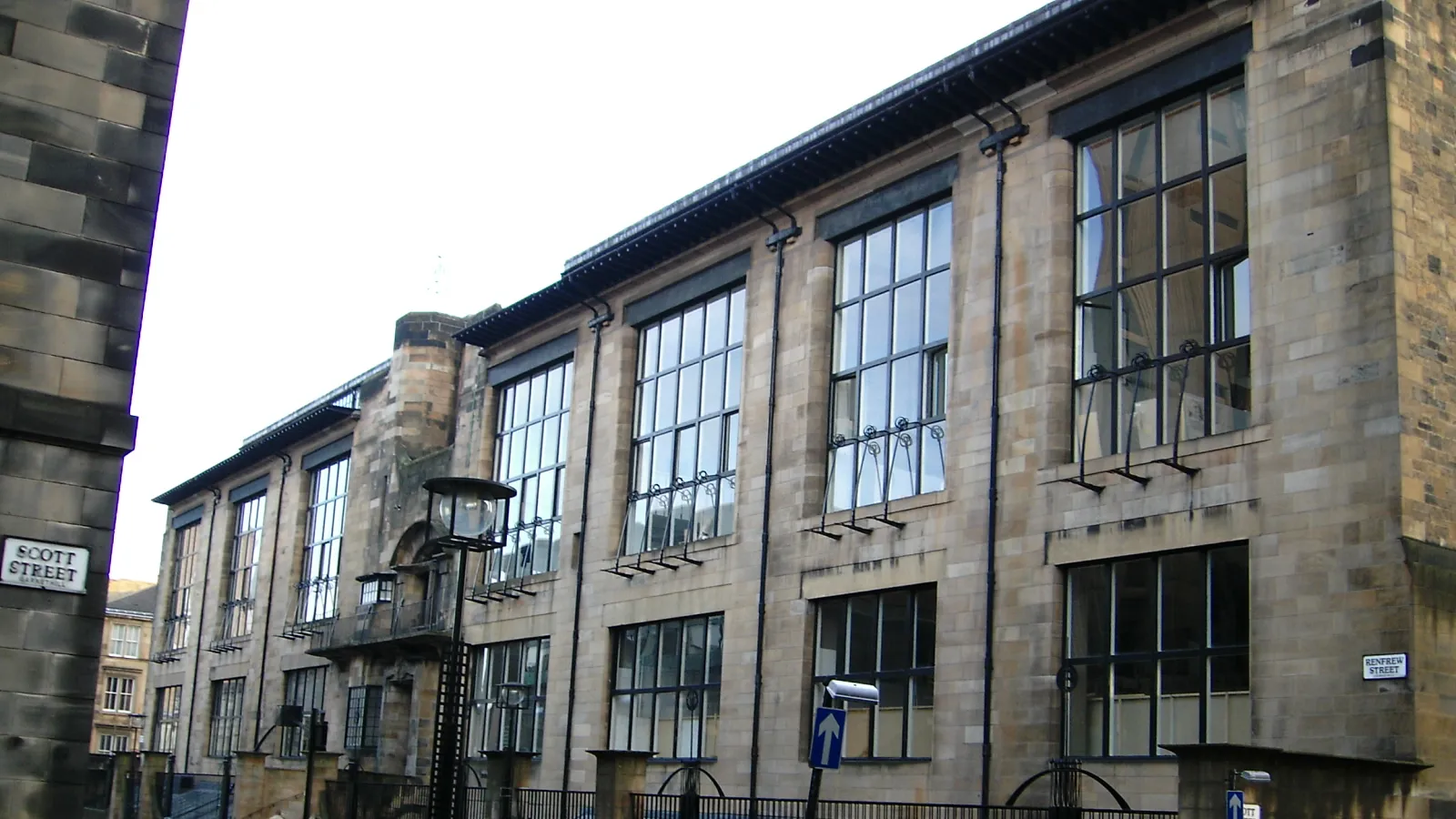

The Glasgow School of Art
Contents
Legend vs Myth
The Glasgow School of Art's Mackintosh Building is frequently described, in triumphant tones, as a masterpiece that has been "saved" after two devastating fires. As of the most recent available reporting, that is not an accurate summary of where things actually stand. The building has not been fully restored, a full restoration has been publicly judged too expensive to complete, and a significantly reduced reconstruction — retaining only parts of the historic fabric — is now the most likely outcome. This card tells that story honestly, including the parts that are still unresolved and genuinely disappointing to many who care about the building.
TL;DR
- established Charles Rennie Mackintosh designed the Glasgow School of Art's main building, constructed in two phases between 1897 and 1909, funded substantially by a £10,000 donation from the Bellahouston Trust — these dates and the funding source are documented through the school's own records and architectural history.
- established A fire in May 2014 destroyed the building's renowned Mackintosh Library and damaged roughly 10% of the structure and 30% of its contents, caused by an aerosol canister of expanding foam igniting near a hot projector, in violation of school policy — this cause was determined by formal fire investigation.
- established A second, far more destructive fire in June 2018 gutted the building during its ongoing restoration, leaving only a shell standing; after a 3.5-year investigation completed in 2022, Scottish Fire and Rescue Service concluded no definitive cause could be established — this is the official investigatory finding, not a gap in this article's research.
- established As of the most recent reporting, the Glasgow School of Art has stated it cannot afford a full, faithful restoration — estimated at around £265 million — and is instead pursuing a reduced reconstruction plan retaining parts of the historic façade rather than recreating lost interior spaces such as the original library in full — this is a live, contested decision, not a resolved success story.
- disputed Whether a partial reconstruction that abandons full "faithful reinstatement" preserves the building's essential architectural and historical integrity, or constitutes an unacceptable loss, is a genuine and currently unresolved point of disagreement among architects, heritage campaigners, and the School itself.
Key Facts
- Building
- Glasgow School of Art, Mackintosh Building
- Architect
- Charles Rennie Mackintosh (with Margaret Macdonald Mackintosh)
- Built
- 1897–1909, in two phases
- Funding
- Substantial donation from the Bellahouston Trust (£10,000)
- First fire
- May 2014 — destroyed the Mackintosh Library, damaged roughly 10% of structure
- Second fire
- June 2018 — gutted the building; cause undetermined after 3.5-year investigation
- Stabilisation cost (2018–2020)
- Over £12 million
- Estimated full restoration cost
- Around £265 million (per most recent GSA statements)
- Current plan (most recent reporting)
- Partial reconstruction retaining elements of the historic façade; enabling works from summer 2027
- Target reopening (as graduate school)
- 2030, per most recent public statements, though this remains contingent on funding and planning decisions
Scottish Impact Index (SI Score)
- Cultural Impact
- 10/10
- Enduring Relevance
- 10/10
- Artistic / Cultural Contribution
- 10/10
- Artistic Originality
- 10/10
- Artistic Legacy
- 10/10
- Recognition
- 10/10
60/60
Ranked =1st of 50 in Arts
A Note on Claims and Evidence
The construction history, the two fires, and their formally investigated causes are well documented through official fire service reports, the school's own public statements, and extensive press coverage, and are treated here as established fact. The current and future status of the building is a genuinely moving target: at the time of writing, the School has publicly stated that full restoration is financially unfeasible and is weighing a reduced reconstruction, a position that has shifted over several years and remains subject to ongoing arbitration, funding negotiations, and planning decisions. Readers should treat any claim about the building's "final" restored form as provisional rather than settled, and should expect that the specific plan, cost estimate, and timeline may continue to change after this article's publication.
Timeline
Construction begins on the first phase of Mackintosh's Glasgow School of Art building, funded substantially by the Bellahouston Trust.
First phase of construction completed.
Second phase completed, finishing the building largely as it became internationally known.
A fire, caused by an aerosol canister of expanding foam igniting near a hot projector, destroys the Mackintosh Library and damages roughly 10% of the structure.
A restoration programme, including a £25 million contract with Kier Group, is undertaken to repair fire damage and reinstate lost features.
A second, far more destructive fire breaks out during the ongoing restoration, gutting the building; the nearby O2 ABC music venue is also severely damaged.
Over £12 million spent on debris clearance and structural stabilisation.
GSA terminates its restoration contract with Kier Group and later pursues legal action against Page/Park Architects.
GSA announces an intention to pursue "faithful reinstatement" of the building.
Fire investigators conclude a 3.5-year inquiry with no definitive cause established for the 2018 fire.
A procurement process for restoration is abandoned after a £62 million contract offer is withdrawn.
GSA states full restoration (estimated around £265 million) is financially unfeasible and signals intent to pursue a reduced reconstruction retaining elements of the historic façade; an arbitration hearing with insurers takes place, with outcome undisclosed; an enabling project is scheduled to begin, aimed at securing the structure ahead of further works.
Details
Mackintosh's defining commission
The Glasgow School of Art building is widely regarded as Charles Rennie Mackintosh's single most significant architectural achievement, and the work that established his international reputation. Built in two phases between 1897 and 1909, with substantial funding from the Bellahouston Trust, the building combined a restrained, almost severe exterior massing with highly inventive interior spaces, most famously its double-height library, built using a complex timber structure that became one of the most celebrated interior spaces in early twentieth-century British architecture. The building is credited with helping pioneer what became known internationally as the "Modern Style," a British strand of Art Nouveau-adjacent design closely associated with the broader Glasgow Style movement, covered in its own dedicated card on this site.
The 2014 fire: an avoidable accident
The first major fire, in May 2014, was not the result of any inherent structural flaw in Mackintosh's original design, but of an identifiable and, in retrospect, avoidable accident: a canister of expanding foam, used in violation of school policy near a hot projector, ignited flammable gases. Fire investigators subsequently found that the building's historic construction — timber-lined walls and voids, and original ventilation ducting running both vertically and horizontally through the structure — significantly aided the fire's rapid spread, and noted that modern fire dampers had not been retrofitted and an intended suppression system remained incomplete. The fire destroyed the renowned Mackintosh Library outright and damaged roughly 10% of the building and 30% of its contents, though no casualties occurred, and archivists were able to salvage damaged materials through specialist air- and freeze-drying techniques.
The 2018 fire: catastrophic, and still unexplained
The second fire, in June 2018, occurred while restoration work following the first fire was still underway, and proved far more devastating: emergency services deployed around 120 firefighters and 20 fire engines, the blaze severely damaged the adjacent O2 ABC music venue (which was later demolished in 2024), and ultimately left only a burnt-out shell of Mackintosh's building standing. Remarkably, despite a formal investigation lasting three and a half years and concluding in January 2022, Scotland's Fire and Rescue Service was unable to determine a definitive cause — a genuinely unresolved question that this article does not attempt to answer beyond reporting the official finding, since no credible source currently offers one.
A restoration effort that stalled, then stalled again
In the years following the 2018 fire, the Glasgow School of Art pursued a stated goal of "faithful reinstatement" — rebuilding the Mackintosh Building as closely as possible to its pre-fire form, using historically accurate materials including original wood species such as longleaf pine and tulipwood, informed by extensive laser surveys of the building's remains. This ambition proved difficult to fund and execute: a £25 million restoration contract with the contractor Kier Group was terminated after the second fire, legal action was pursued against the architects involved in the earlier restoration, and a subsequent procurement process collapsed in 2023 after a £62 million contract offer was withdrawn. Stabilisation and debris clearance work alone cost over £12 million between 2018 and 2020.
The current, unresolved reality: restoration abandoned, not achieved
This is the part of the story that a purely celebratory account would prefer to skip, and the part this article insists on stating plainly. As of the most recent available reporting, the Glasgow School of Art has stated that it cannot afford a full, faithful restoration of the Mackintosh Building, with cost estimates reaching as high as £265 million — roughly five times the institution's annual turnover. Rather than achieving the "faithful reinstatement" announced in 2021, GSA has instead signalled an intention to pursue a significantly reduced reconstruction, retaining elements of the historic, Category A-listed façade while introducing contemporary interiors, with significant original spaces — including the celebrated library and a timber-framed corridor — potentially not recreated at all. This proposal has drawn sharp criticism from heritage architects: one prominent critic has publicly called the decision a "betrayal," arguing that a reconstruction departing from the original design loses the building's essential integrity regardless of how much of the façade survives. An enabling project to secure the structure, replacing external scaffolding with internal retention systems, is scheduled to begin, with GSA's most recent public target for reopening the building as a graduate school set at 2030 — a date that, given the project's history of delay, should itself be treated as provisional rather than guaranteed.
Why this matters for how the building is understood
It would be easy, and is in fact common in casual summaries, to tell this story as "a masterpiece, twice damaged by fire, lovingly restored" — a satisfying narrative arc that simply is not supported by the current record. The accurate account, as of this writing, is of a world-significant building destroyed by two fires (one an avoidable accident, one of undetermined cause), followed by a restoration effort that has repeatedly stalled over cost, and that currently appears headed toward a compromise reconstruction rather than a full recreation of Mackintosh's original design. This is a real and significant architectural loss, still playing out, and readers encountering more triumphant summaries elsewhere should treat them with appropriate scepticism until the building's actual final form is confirmed.
Did You Know?
- The Glasgow School of Art building was constructed in two separate phases, a decade apart (1899 and 1909), due to funding constraints.
- The 2014 fire was caused by a can of expanding foam used near a hot projector, in violation of school safety policy — not by any flaw in Mackintosh's original design.
- Investigators spent three and a half years examining the 2018 fire and still could not determine a definitive cause.
- The 2018 fire also severely damaged the neighbouring O2 ABC music venue, which was later demolished in 2024.
- Stabilising the gutted building after the 2018 fire alone cost over £12 million, before any actual restoration work began.
- A 2023 restoration procurement process collapsed after a £62 million contractor offer was withdrawn.
- GSA's own most recent cost estimate for a full, faithful restoration — around £265 million — is roughly five times the institution's annual turnover.
- The most recent public plan retains only parts of the historic façade, with some of the building's most celebrated original interior spaces potentially not recreated.
FAQ
1Who designed the Glasgow School of Art building?
Charles Rennie Mackintosh, with significant design contribution from his wife Margaret Macdonald Mackintosh, constructed between 1897 and 1909.
2Has the Mackintosh Building been fully restored since the fires?
No. As of the most recent reporting, the School has stated full restoration is financially unfeasible and is instead considering a reduced reconstruction.
3What caused the 2014 fire?
A canister of expanding foam, used near a hot projector in violation of school policy, ignited flammable gases.
4What caused the 2018 fire?
This remains officially undetermined, despite a three-and-a-half-year formal investigation concluding in January 2022.
5Was anyone hurt in either fire?
No casualties were reported in either the 2014 or 2018 fires.
6What was lost in the 2014 fire specifically?
The renowned Mackintosh Library was destroyed, along with roughly 10% of the building's structure and 30% of its contents, though archives were salvaged through specialist drying techniques.
7Why hasn't the building simply been rebuilt as it was?
Cost. Current estimates for a full, faithful restoration reach around £265 million, which GSA has stated it cannot fund alone; restoration procurement efforts have repeatedly stalled.
8What happens to the original library and other lost interiors under the current plan?
Under the most recently reported reduced reconstruction proposal, some of the building's most celebrated original interior spaces, including the double-height library, may not be recreated.
9Is this restoration controversy resolved?
No — it remains an active, contested decision as of this writing, with heritage architects and campaigners objecting to the reduced reconstruction approach.
10When might the building reopen?
GSA's most recent stated target is 2030, for use as a graduate school, though this date should be treated as provisional given the project's history of delay.
11Is the Glasgow School of Art building the same thing as "the Glasgow Style"?
No — the Glasgow Style is a broader design movement covered in its own dedicated card; this building is a specific, singular architectural work within that movement.
12Is the School itself still operating?
Yes — the Glasgow School of Art continues to operate as an institution using other buildings; it is specifically the historic Mackintosh Building that remains out of use following the fires.
Sources and Further Reading
Primary/Institutional
- Glasgow School of Art — official statements on the Mackintosh Building restoration
- Scottish Fire and Rescue Service — investigation findings on the 2014 and 2018 fires
Scholarly/Critical
- Designing Buildings Wiki — "Glasgow School of Art fire" — https://www.designingbuildings.co.uk/wiki/Glasgow_School_of_Art_fire
- Architecture Today — "Glasgow School of Art to Abandon Full Restoration of Mackintosh Building" — https://architecturetoday.co.uk/glasgow-school-of-art-to-abandon-full-restoration-of-mackintosh-building/
General
- Wikipedia — "Glasgow School of Art" — https://en.wikipedia.org/wiki/Glasgow_School_of_Art
- Times Higher Education — "Glasgow School of Art 'Can't Afford' £265m Mackintosh Repairs" — https://www.timeshighereducation.com/news/glasgow-school-art-cant-afford-ps265m-mackintosh-repairs
Caveats: Myths and Disputed Claims
The most important corrective this card makes is to the widespread assumption that the Mackintosh Building has already been "saved" or restored — it has not, as of the most recent reporting, and the School has publicly stated that a full, faithful restoration is financially unfeasible. A second point requiring care: the cause of the catastrophic 2018 fire remains officially undetermined after a lengthy formal investigation, and any confident claim about its cause circulating online should be treated with scepticism unless it cites the actual fire service findings. Finally, because the restoration plan, cost estimates, and timelines have shifted substantially and repeatedly since 2018, any specific figure or date in this article — including the £265 million cost estimate and 2030 reopening target — should be understood as the most recent publicly available figures at the time of writing, not a permanently fixed outcome.
Card 026 · Arts