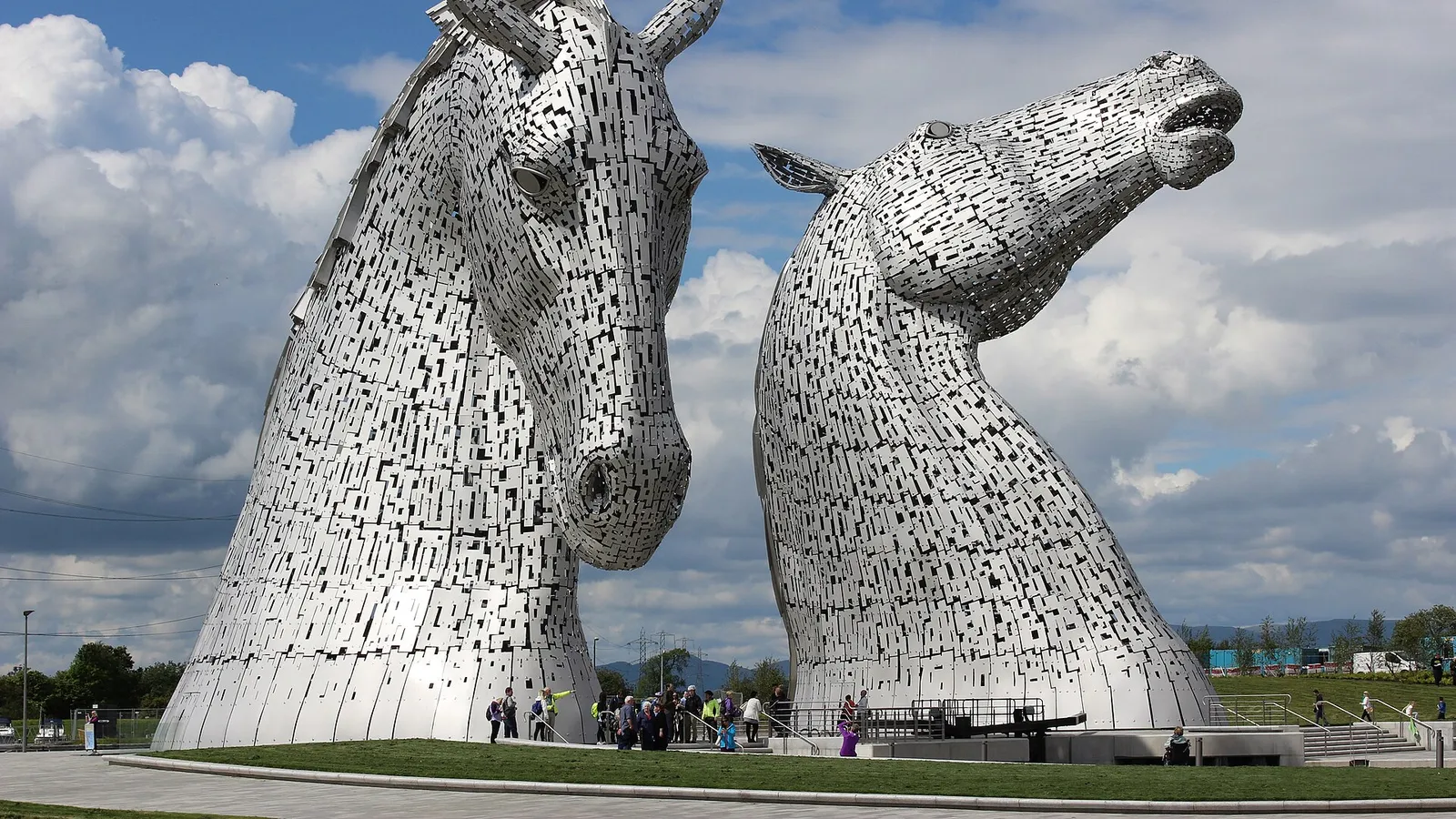

The Kelpies
Contents
A note before anything else: this card is about a sculpture, not a sea monster. The two 30-metre steel horse heads that loom over the Forth and Clyde Canal at Falkirk borrow a folkloric name — kelpie, the shape-shifting water spirit of Scottish legend — but the artist who made them has been explicit that their real subject is industrial, not supernatural. The actual kelpie myth is its own, separate story, covered elsewhere on this site; what follows is the story of a 2013 public artwork.
TL;DR
- established The Kelpies are two 30-metre-high steel horse-head sculptures by artist Andy Scott, built between June and October 2013 and formally opened in April 2014 at The Helix park near Falkirk — construction dates, dimensions, and authorship are documented by the artist, Falkirk Council, and contemporary press coverage.
- established Each sculpture weighs around 300 tonnes and is built from a structural steel frame clad in stainless steel plate — this is an engineering fact confirmed by the project's structural engineers and steelwork trade bodies.
- traditional The horses are widely understood to primarily commemorate Clydesdale heavy horses, which historically towed barges and powered industry along the Forth and Clyde Canal, rather than to retell the kelpie myth directly — this reflects Andy Scott's own stated intent, though public reception of the name "Kelpies" inevitably still carries mythological connotations for many visitors.
- disputed How much weight the design actually places on myth versus industrial history is a genuine point of interpretive disagreement: Scott has described a deliberate shift "from mythological references towards a socio-historical monument," yet the project's own branding and the choice of the name "Kelpies" keep the folkloric association firmly in play, so the two readings coexist rather than one simply replacing the other.
- established The sculptures sit within The Helix, a wider land regeneration and parkland project connecting Falkirk and Grangemouth, and are owned and maintained by Falkirk Council — ownership and the Helix context are matters of public record.
Key Facts
- Official name
- The Kelpies
- Artist
- Andy Scott
- Height
- Approximately 30 metres (98 ft) per sculpture
- Weight
- Around 300 tonnes each
- Materials
- Structural steel frame, stainless steel cladding
- Built
- June–October 2013
- Opened
- April 2014
- Location
- The Helix, between Falkirk and Grangemouth, Scotland
- Owner/operator
- Falkirk Council
- Subject
- Clydesdale heavy horses / symbolic reference to the kelpie myth
- Project context
- Part of the wider Helix regeneration and canal-reconnection project
Scottish Impact Index (SI Score)
- Cultural Impact
- 9/10
- Enduring Relevance
- 9/10
- Artistic / Cultural Contribution
- 9/10
- Artistic Originality
- 9/10
- Artistic Legacy
- 9/10
- Recognition
- 10/10
55/60
Ranked =29th of 50 in Arts
A Note on Claims and Evidence
Because The Kelpies are a recent (2013–2014), publicly commissioned, extensively photographed and reported project, the factual record around dimensions, dates, materials, and authorship is unusually solid and not seriously contested. The genuinely debatable territory is interpretive: what the sculptures "mean," how the mythological name sits against the artist's stated industrial-heritage intent, and how critics have judged the work aesthetically. Those are matters of reasonable disagreement rather than unresolved fact, and this article treats them accordingly — distinguishing hard data (confirmed by the artist, the council, and engineering bodies) from matters of interpretation and critical opinion.
Timeline
The Helix project is conceived as a major land regeneration scheme to reconnect Falkirk and Grangemouth communities with the Forth and Clyde Canal and surrounding parkland.
Andy Scott's "Kelpies" concept, developed from his long-standing interest in equine sculpture, is selected as the centrepiece public artwork for The Helix.
Construction of the two sculptures begins on site.
The sculptures are substantially completed and raised into their final upright position.
The Kelpies are officially unveiled and opened to the public.
The sculptures draw close to one million visitors in their first year, becoming one of Scotland's most visited free attractions.
The Kelpies become a widely used symbol of Falkirk and central Scotland in tourism marketing and media.
Details
A sculptor's long-running fascination with horses
Andy Scott, a Glasgow-trained sculptor, had worked with equine and other animal forms in public art for years before The Kelpies, including earlier horse-head sculptures on a smaller scale. The Helix commission gave him the opportunity to scale that fascination up dramatically, producing what are, by height, among the largest equine sculptures in the world. The brief for The Helix called for a landmark artwork capable of anchoring a large new public park and signalling the area's regeneration — a tall order that the final sculptures, visible from the nearby M9 motorway, were explicitly designed to meet.
Naming a modern sculpture after an old legend
The choice of name is the single most discussed aspect of the piece, and it deserves care. Kelpies, in Scottish folklore, are shape-shifting water spirits said to haunt lochs and rivers, often appearing as horses to lure the unwary to their deaths — a genuinely dark legend with no credible historical basis, the subject of its own separate treatment on this site. Scott's sculptures borrow that evocative name and the equine form, but he has been explicit in interviews that his working intent moved away from retelling the myth and toward a "socio-historical monument" to a very different kind of horse: the Clydesdale draught horses that, for roughly two centuries, towed barges along the Forth and Clyde Canal and powered agriculture and heavy haulage across central Scotland before mechanisation displaced them. The sculptures' musculature, posture, and scale are modelled on these working animals, not on any folkloric description of a kelpie's appearance — folklore, after all, offers no consistent physical description to sculpt from in the first place.
Reading two meanings at once
This produces a genuine interpretive tension rather than a simple either/or answer. On one hand, the artist's stated intent and the horses' physical design point toward industrial commemoration — a tribute to the unglamorous animal labour that built the region's canal economy. On the other hand, the name "Kelpies," the works' siting at the mouth of the canal (traditionally kelpie territory in folklore), and the public's instinctive association of monumental horse heads with myth mean that most visitors encounter the sculptures with both readings active simultaneously, whether or not that was the primary design intent. Treating this as settled in either direction — pure myth-retelling, or pure industrial history with the name as incidental branding — oversimplifies what is, by the artist's own account, a deliberately layered reference.
Engineering and construction
The practical achievement of The Kelpies is considerable and under-discussed next to the symbolism. Each head-and-neck structure stands roughly 30 metres tall and weighs around 300 tonnes, built on a structural steel skeleton clad in stainless steel plates that catch and reflect light differently through the day, giving the sculptures a shifting, almost liquid appearance that nods, intentionally or not, back toward the water associations of the kelpie name. The structural engineering drew recognition from steelwork trade bodies for the complexity of achieving such dynamic, naturalistic equine forms — heads tilted mid-motion, as though rearing — at monumental scale using rigid steel sections.
The Helix project and public reception
The Kelpies were conceived as the centrepiece of The Helix, a broader regeneration scheme intended to reconnect the communities of Falkirk and Grangemouth with green space and the historic canal network, which had fallen into disuse and disrepair over the twentieth century. Since opening in 2014, the sculptures have drawn large and sustained visitor numbers — close to a million in their first year alone — and have become one of the most recognisable modern symbols of Falkirk and, more broadly, of contemporary Scottish public art. Critical reception has been largely positive, though not unanimous: at least one prominent critic dismissed the work as kitsch, a reminder that monumental figurative public art of this kind tends to divide professional art criticism even when it succeeds unambiguously with the public.
Public art versus public monument
It is worth distinguishing The Kelpies from a traditional civic monument commemorating a specific historical event or person. The sculptures function instead as a form of landscape-scale public art — closer in spirit to large-scale contemporary sculpture parks than to a war memorial or statue of a named figure — commissioned primarily to give a redeveloped landscape an identity and a destination, with historical and mythological reference woven in as content rather than as the sculptures' primary civic function.
Part of a wider wave of Scottish landmark public art
The Kelpies should also be understood within a broader pattern of large-scale, landmark-driven public art commissioned across Scotland and the wider UK since the late twentieth century, in which a single striking sculpture is used deliberately to anchor tourism, civic identity, and regeneration funding for a specific place — a strategy visible in comparable landmark works elsewhere in Britain. This is a genuinely different model of public sculpture from the statues of named historical figures that dominated civic art through most of the nineteenth and early twentieth centuries: the commissioning logic behind The Kelpies was explicitly about creating a modern, internationally recognisable visual identity for Falkirk and the Helix area, not primarily about commemorating a specific event in the way a war memorial or a statue of a named individual would.
Funding, cost, and value for money
As with many large public art commissions, The Kelpies' construction involved a mix of public and other funding channelled through the Helix project, reflecting the scale of ambition involved in building two 300-tonne steel structures to such precise engineering tolerances. Discussions of value for money inevitably followed, as they do for most expensive public art commissions, though the sustained, very high visitor numbers recorded since 2014 have generally been cited by supporters as evidence that the investment achieved its stated regeneration and tourism goals, even if assessing the full economic return of any single piece of public infrastructure precisely is inherently difficult.
Did You Know?
- Each Kelpie head stands roughly as tall as a ten-storey building.
- The sculptures are visible from the M9 motorway, which was a deliberate siting decision to maximise their landmark effect.
- Andy Scott had made smaller equine public sculptures before The Kelpies, developing the form over years.
- The stainless steel cladding changes appearance with the light and weather throughout the day.
- The Kelpies drew close to a million visitors in their first year open to the public.
- The name references Scottish water-spirit folklore, but the sculptures' physical design is based on Clydesdale draught horses, not any folkloric description.
- The Forth and Clyde Canal, which the sculptures flank, was itself undergoing active regeneration when The Helix project was conceived.
- At least one prominent art critic publicly dismissed the sculptures as "kitsch," a reminder that popular success and critical acclaim don't always align.
FAQ
1Are The Kelpies about the kelpie myth?
Only in name and evocative association. The artist, Andy Scott, has said his design intent shifted toward commemorating real Clydesdale draught horses and their industrial role, rather than retelling the kelpie legend directly.
2What is a kelpie, in the original folklore?
A shape-shifting Scottish water spirit, often appearing as a horse, said to lure people to drown — a legend with no historical basis, covered separately on this site.
3Who made The Kelpies?
Scottish sculptor Andy Scott, who designed and oversaw the project.
4How tall are they?
Approximately 30 metres each.
5When were they built?
Constructed on site between June and October 2013, officially opened in April 2014.
6What are they made of?
A structural steel frame clad in stainless steel plate.
7Where are they located?
At The Helix, a parkland area between Falkirk and Grangemouth in central Scotland, near the Forth and Clyde Canal.
8Who owns and maintains The Kelpies?
Falkirk Council.
9Why were they built?
As the centrepiece public artwork of The Helix, a land regeneration project reconnecting local communities with canal-side green space.
10Have they been well received?
Largely yes, with strong visitor numbers since opening, though some art critics have been more dismissive of the work's artistic merit.
11Are The Kelpies the largest equine sculptures in the world?
They are among the largest, frequently cited in that context, though claims of an absolute global record should be treated with some caution given how such superlatives are tracked.
12Is there a separate Scottish Inventions card about the kelpie legend itself?
Yes — the mythological kelpie is covered as a distinct Legends & Folklore topic; this card concerns only the modern sculpture.
Sources and Further Reading
Primary/Institutional
- Falkirk Council / The Helix — official project information
- Andy Scott — artist's own statements on design intent (as reported in press interviews)
Scholarly/Critical
- Art UK — "Andy Scott's The Kelpies" — https://artuk.org/discover/stories/andy-scotts-the-kelpies
- Canmore (Historic Environment Scotland database) — site record — https://canmore.org.uk/site/345044
General
- Wikipedia — "The Kelpies" — https://en.wikipedia.org/wiki/The_Kelpies
- Wikipedia — "The Helix (Falkirk)" — https://en.wikipedia.org/wiki/The_Helix_(Falkirk)
Caveats: Myths and Disputed Claims
The most common misunderstanding is treating The Kelpies as a straightforward retelling of the kelpie legend in sculptural form; the artist's own account instead describes a deliberate pivot toward industrial and social history, with the mythological name retained for its evocative power rather than as a literal subject. A second point of caution: this card should not be read as a substitute for the actual kelpie folklore, which has its own separate, much older history covered elsewhere on this site — conflating the modern artwork with the myth it borrows its name from is the single easiest mistake to make with this subject. Finally, claims about the sculptures' ranking among "the world's largest" equine artworks are repeated frequently in tourism material but are not independently adjudicated by any single verifying body, so they are best treated as a strong, frequently repeated claim rather than a certified record.
Card 022 · Arts