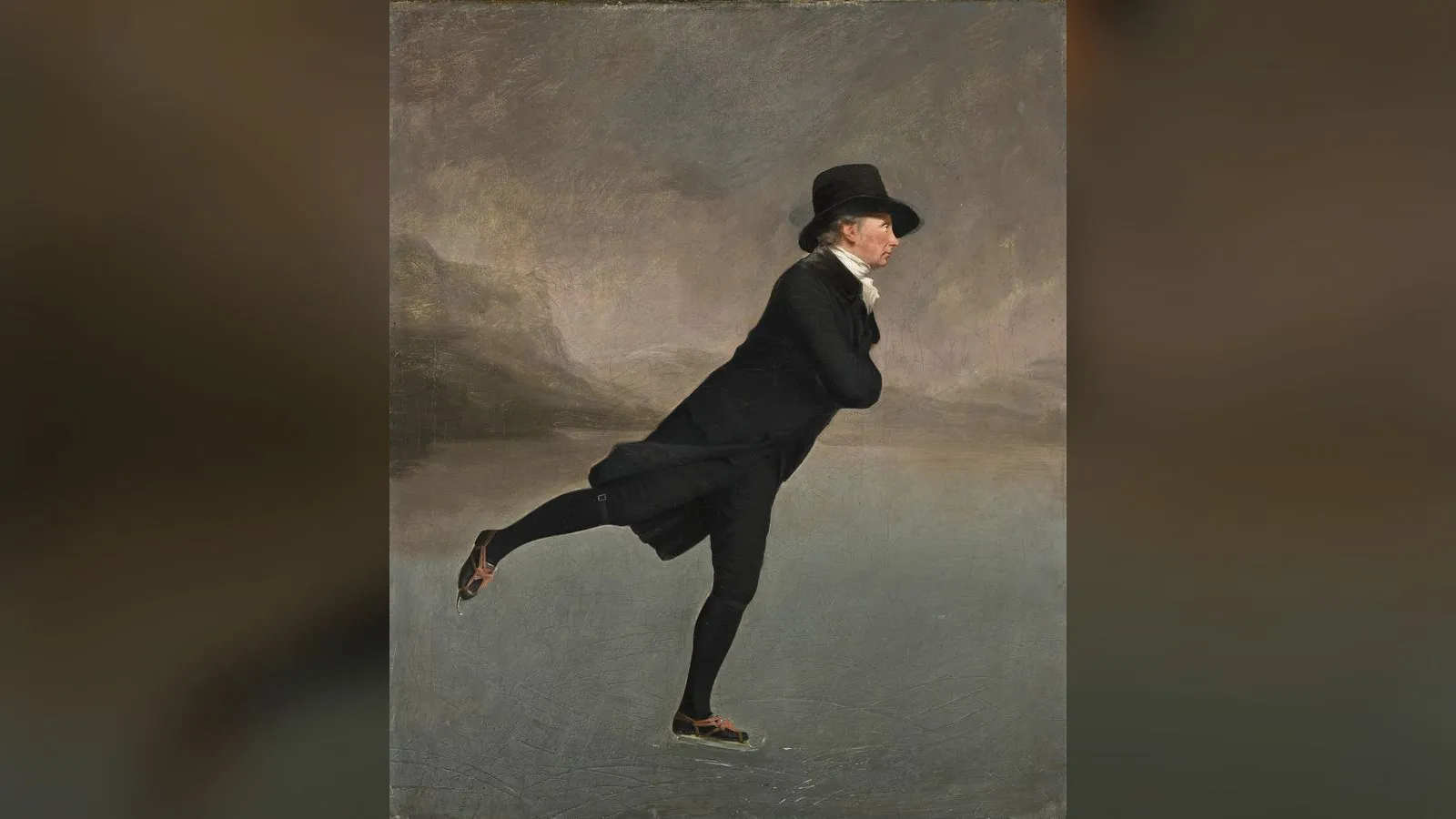

The Skating Minister: Scotland's Most Famous Painting, and Its Most Disputed Signature
Contents
Legend vs Myth
For nearly two centuries, "The Skating Minister" was simply a Raeburn — reproduced on tea towels, biscuit tins, and Scotland's own passport pages as a byword for Henry Raeburn's genius. Since 2005, that attribution has been openly, seriously questioned by scholars, with a rival candidate proposed. The painting's fame has not dimmed, but its authorship is, at the time of writing, a live scholarly dispute rather than a settled fact — and this article treats it as such.
TL;DR
- established The painting formally titled The Reverend Robert Walker Skating on Duddingston Loch depicts a real historical figure, the Reverend Robert Walker (1755–1808), a minister of the Canongate Kirk in Edinburgh and a keen member of the Edinburgh Skating Club — his identity and the painting's existence are not in question.
- established The painting has long been held by the National Galleries of Scotland and is one of the most reproduced and recognisable images in Scottish art, used widely in tourism, publishing, and official branding — this institutional and cultural status is well documented.
- disputed The painting's attribution to the portraitist Henry Raeburn, accepted for most of its known history, was publicly challenged from 2005 onward by curatorial and scholarly research proposing the French émigré painter Henri-Pierre Danloux as a possible alternative author; this is a genuine, ongoing scholarly disagreement, not a settled reattribution.
- traditional The painting is traditionally dated to around 1795, based on stylistic grounds and Walker's presumed age in the image, since no contemporary documentary record definitively fixes the date of execution.
- established Technical and scientific examination (including X-ray and pigment analysis) has been conducted on the painting as part of the attribution debate, and has been cited by both sides of the argument without producing a universally accepted resolution — the existence and inconclusiveness of this technical work is itself documented.
Key Facts
- Formal title
- The Reverend Robert Walker Skating on Duddingston Loch
- Traditional attribution
- Henry Raeburn (1756–1823)
- Disputed alternative attribution
- Henri-Pierre Danloux (proposed from 2005)
- Subject
- Rev. Robert Walker (1755–1808), minister and skater
- Traditional date
- c. 1795 (stylistic estimate, not documented)
- Medium
- Oil on canvas
- Collection
- National Galleries of Scotland, Edinburgh
- Cultural status
- One of the most widely reproduced images in Scottish art; used on Scottish passports and extensively in tourism material
Scottish Impact Index (SI Score)
- Cultural Impact
- 8/10
- Enduring Relevance
- 9/10
- Artistic / Cultural Contribution
- 8/10
- Artistic Originality
- 9/10
- Artistic Legacy
- 9/10
- Recognition
- 10/10
53/60
Ranked =39th of 50 in Arts
A Note on Claims and Evidence
The painting's existence, subject, and long institutional history are not contested. Its authorship, however, is the subject of a genuine and unresolved scholarly dispute that began in earnest in 2005, when curatorial research raised the possibility that it was painted not by Raeburn but by the French portraitist Henri-Pierre Danloux, who is documented as having been in Edinburgh in the relevant period. Both the traditional Raeburn attribution and the Danloux hypothesis have been argued by credentialled scholars and gallery professionals, with technical analysis (X-ray imaging, examination of underdrawing and technique) invoked by both sides without producing a consensus. This article presents the attribution as disputed rather than settled in either direction, reflecting the current, unresolved state of the debate.
Timeline
Birth of Robert Walker, the painting's subject, who would become minister of the Canongate Kirk, Edinburgh.
Walker is active as a member of the Edinburgh Skating Club, known for its figure-skating traditions on frozen lochs including Duddingston Loch.
The painting is traditionally believed to have been executed around this time, attributed to Henry Raeburn.
Robert Walker dies.
The painting passes through private hands within Walker's family and associated collections before entering public ownership.
The painting is acquired by the National Gallery of Scotland (now part of the National Galleries of Scotland).
The image becomes widely reproduced, used on Scottish tourism material and, notably, on UK/Scottish passport pages as a symbol of Scottish culture.
A curator raises the possibility that the painting may not be by Raeburn but by Henri-Pierre Danloux, prompting the National Galleries to amend the painting's label to note the disputed attribution.
Further research, including technical/scientific examination, continues on both sides of the attribution question without full scholarly consensus; some gallery leadership figures have expressed continued confidence in the Raeburn attribution.
Details
A minister, a loch, and a pose
The painting shows a man in clerical black, arms folded across his chest, gliding in profile on ice, with a wintry Edinburgh-area landscape (identified as Duddingston Loch, beneath Arthur's Seat) behind him. The subject, Robert Walker, was a real historical figure: a Church of Scotland minister at the Canongate Kirk and a documented member of the Edinburgh Skating Club, an organisation whose members practised a disciplined, almost balletic style of figure skating distinct from recreational skating. The image's enduring appeal lies in this collision of registers — the severe, black-clad authority of a Presbyterian minister combined with the playful, graceful physicality of ice skating — an unusual and immediately engaging subject for late 18th-century Scottish portraiture, which more typically depicted sitters standing or seated in conventional poses.
The Raeburn attribution and its long acceptance
For most of its documented history, the painting was attributed to Henry Raeburn (1756–1823), Scotland's leading portrait painter of the period and the obvious default attribution for an accomplished Scottish portrait of this type and era. Raeburn was known for a distinctive, confident brushwork style and for an unusually direct, informal approach to portraiture compared to some contemporaries. Proponents of the Raeburn attribution have pointed to his documented early training and background — including an apprenticeship with a jeweller and goldsmith before he turned to painting — as plausible explanation for the fine, precise rendering of small details in the painting, such as the skate blade and the binding of the skate to the boot. Senior figures at Scottish galleries, including former directors, have publicly maintained confidence in the Raeburn attribution even after the 2005 challenge.
The 2005 challenge and the Danloux hypothesis
In March 2005, curatorial research associated with the Scottish National Portrait Gallery proposed an alternative: that the painting might instead be the work of Henri-Pierre Danloux, a French portrait painter who fled the French Revolution and is documented as having worked in Edinburgh and London during the 1790s. This was not a casual suggestion but a formally researched attribution proposal, serious enough that the National Galleries of Scotland altered the painting's wall label to acknowledge that "recent research has suggested" the alternative authorship. Arguments advanced for the Danloux hypothesis have included observations about the canvas's dimensions and format (said by some to be more characteristic of French portrait conventions of the period than of Raeburn's typical practice) and stylistic comparisons to Danloux's documented work from his time in Britain.
Technical examination: inconclusive on both sides
The attribution dispute has prompted scientific examination of the painting, including X-ray imaging intended to reveal underdrawing, compositional changes, and technical handling that might favour one artist's documented working methods over another's. Such technical work has been cited by commentators on both sides of the debate — as supporting evidence for Raeburn's authorship by some, and as consistent with or even favouring the Danloux hypothesis by others — without producing a conclusive, broadly accepted resolution either way. This is a genuinely unusual situation for such a famous image: a painting this well known and this heavily reproduced remains, at the level of connoisseurship and technical art history, formally contested.
A national icon regardless of authorship
Whatever the eventual scholarly resolution, the painting's cultural status in Scotland is not in question. It has functioned for decades as a kind of visual shorthand for Scottish art and for a certain idea of Scottish character — solemnity and playfulness combined, religious seriousness undercut by very human enjoyment. It has been reproduced on official Scottish passport pages, used extensively by national and cultural tourism bodies, and remains one of the National Galleries of Scotland's single most recognised and most frequently requested images for licensing and reproduction. This popular status developed almost entirely under the assumption of Raeburn's authorship, and the ongoing attribution dispute, while significant to art historians, has had little visible effect on the public's affection for or recognition of the image.
Why the dispute matters, and why it's unresolved
The attribution question matters for reasons beyond academic pedantry: it affects how the painting is catalogued, valued, and discussed within the broader history of Scottish portraiture, and it bears on how scholars understand Raeburn's range and development as an artist if the painting is removed from his documented body of work, or conversely on how Danloux's brief but documented presence in Scotland is understood if it is added to his. The dispute remains unresolved because the painting lacks the kind of clear documentary trail — a signed and dated commission record, a contemporary letter describing its creation — that would settle the matter definitively; both attributions currently rest on stylistic judgement, technical examination, and circumstantial historical plausibility rather than direct documentary proof.
Did You Know?
- The painting's subject, Robert Walker, was a real Church of Scotland minister and a documented member of the Edinburgh Skating Club, a group known for a disciplined, formal style of figure skating.
- The painting was only acquired by the National Gallery of Scotland in 1949, despite depicting a scene from roughly 150 years earlier.
- The attribution challenge to Henry Raeburn was formally raised in 2005, prompting the National Galleries of Scotland to change the painting's wall label.
- The rival attribution proposes French émigré painter Henri-Pierre Danloux, who is documented as having worked in Edinburgh in the 1790s after fleeing revolutionary France.
- X-ray and technical examination of the painting has been conducted as part of the attribution research, but has not produced a universally accepted resolution.
- The image has been used on official Scottish passport pages as a symbol of national cultural identity.
- No contemporary document is known to definitively record either the date of the painting's execution or its original commission.
- Despite the authorship dispute, the painting remains one of the single most reproduced and recognised works in Scottish art.
FAQ
1Who is the man skating in the painting?
The Reverend Robert Walker (1755–1808), a Church of Scotland minister at the Canongate Kirk in Edinburgh and a documented member of the Edinburgh Skating Club.
2Is the painting definitely by Henry Raeburn?
It is traditionally attributed to Raeburn and many scholars and gallery professionals continue to support that attribution, but this has been seriously disputed since 2005, with Henri-Pierre Danloux proposed as an alternative author. The question remains genuinely open rather than settled.
3When was the painting made?
It is traditionally dated to around 1795 on stylistic grounds, but no documentary record definitively fixes the date.
4Where is the painting kept?
It is held by the National Galleries of Scotland in Edinburgh.
5Why is the attribution disputed?
Because no contemporary documentation records the painting's commission or authorship with certainty; the attribution rests on stylistic analysis and circumstantial evidence, which different experts read differently.
6Has scientific testing resolved the dispute?
No — X-ray and technical examination has been carried out and cited by both sides of the debate, but has not produced a conclusive, broadly accepted answer.
7Who is Henri-Pierre Danloux?
A French portrait painter who fled the French Revolution and is documented as having worked in Britain, including Edinburgh, during the 1790s; he is the main alternative candidate proposed for the painting's authorship.
8Is the painting well known outside Scotland?
It is one of the most recognisable works of Scottish art internationally, frequently reproduced in publishing, tourism material, and museum merchandise.
9Why does a minister appear skating in formal dress?
Edinburgh Skating Club members, including clergy, practised figure skating as a genteel recreational and social activity in the late 18th century; the painting reflects this real historical pastime rather than an unusual or comic juxtaposition invented by the artist.
10Has the National Galleries of Scotland settled on one attribution?
No official, final resolution has been publicly announced; the gallery has acknowledged the alternative Danloux attribution on its labelling since 2005 while some senior figures have continued to express confidence in Raeburn's authorship.
11Is the subject's identity also disputed?
No — Robert Walker's identity as the subject is well established and not part of the current scholarly dispute, which concerns authorship (who painted it), not subject matter (who is depicted).
12Does the attribution dispute affect the painting's value or display?
It affects scholarly cataloguing and discussion of the artist's body of work, but the painting continues to be displayed and reproduced as one of the National Galleries of Scotland's signature works regardless of the unresolved authorship question.
Sources and Further Reading
Primary/Institutional
- National Galleries of Scotland — collection entry and curatorial notes on The Reverend Robert Walker Skating on Duddingston Loch
- National Galleries of Scotland — press and label materials relating to the 2005 attribution research
Scholarly/Critical
- Thomson, Duncan, Raeburn: The Art of Sir Henry Raeburn (1756–1823) — exhibition catalogue discussing Raeburn's documented body of work
- Scholarly and curatorial commentary on the Danloux attribution hypothesis, as reported in Scottish art history journals and gallery research publications since 2005
General
- Contemporary press coverage of the 2005 attribution controversy (The Scotsman and other Scottish press)
- General surveys of Scottish 18th-century portraiture discussing the painting's context and reception
Caveats: Myths and Disputed Claims
The single most important caveat for this painting is that its attribution to Henry Raeburn, though traditional and still defended by credible scholars, is not settled fact: a serious, formally researched alternative attribution to Henri-Pierre Danloux has been live since 2005 and has not been resolved by subsequent technical examination. Popular and tourism-oriented material frequently states the Raeburn attribution as unqualified fact; this article deliberately avoids doing so. The painting's traditional date of around 1795 is also an estimate based on style and context rather than a documented fact.
Card 014 · Arts