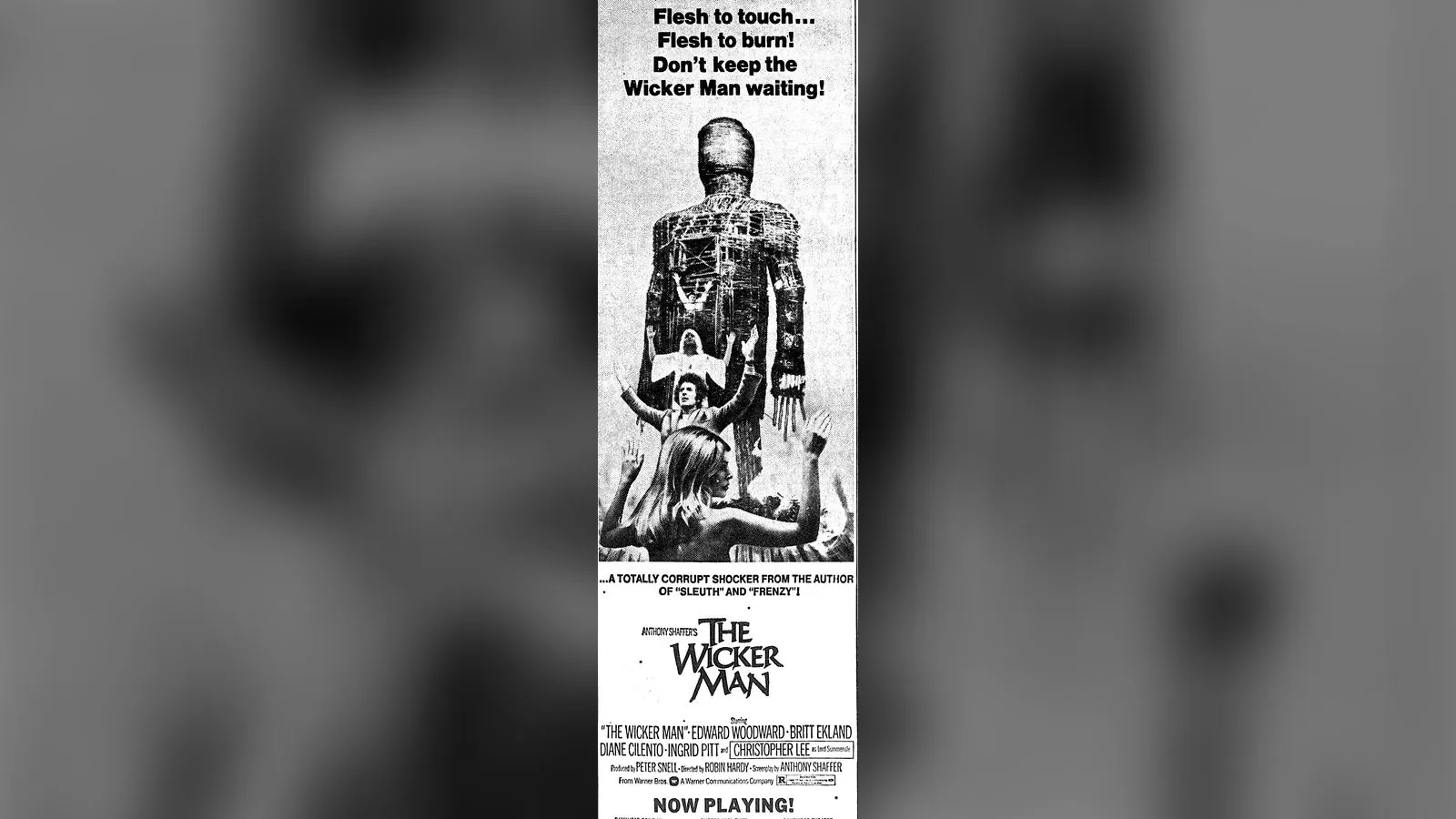

The Wicker Man
Contents
Legend vs Myth: The film depicts a fictional pagan cult on an invented Scottish island, "Summerisle" — not a real historical community, sect, or surviving pre-Christian practice. Its vivid rituals (the May Day procession, animal masks, the final wicker effigy) are the invention of its screenwriter, drawing loosely and selectively on real folklore studies, not a documented record of actual Scottish pagan religion.
TL;DR
- established The Wicker Man is a 1973 British horror film directed by Robin Hardy, written by Anthony Shaffer, starring Edward Woodward and Christopher Lee — confirmed by release and production records.
- established The film's distributor, British Lion, cut the film and released it as a shorter B-feature on a double bill, and much of the excised original footage was later lost — this production and distribution history is well documented.
- established The island of "Summerisle" and its pagan community are entirely fictional; the film is not a documentary or dramatisation of any real historical Scottish religious practice.
- traditional The film is very widely regarded by critics as one of the greatest British horror films ever made, sometimes called "the Citizen Kane of horror films" — this is a critical reputation built over decades, not a claim the filmmakers made about the film at release, when it was poorly marketed and distributed.
- disputed The exact original "director's cut" running order and content remain genuinely disputed among historians of the film, since the complete original negative has never been definitively recovered; several different cuts exist and claims about the "true" original version should be treated cautiously.
Key Facts
- Title
- The Wicker Man
- Release year
- 1973
- Director
- Robin Hardy
- Writer
- Anthony Shaffer
- Lead cast
- Edward Woodward, Christopher Lee, Diane Cilento, Britt Ekland
- Setting
- Fictional Scottish island of "Summerisle"
- Genre
- Folk horror
- Distributor (UK)
- British Lion Films
- Notable later cuts
- Original theatrical cut; "Director's Cut" and "Final Cut" restorations (released decades later)
- Critical nickname
- Sometimes called "the Citizen Kane of horror films"
Scottish Impact Index (SI Score)
- Cultural Impact
- 10/10
- Enduring Relevance
- 10/10
- Artistic / Cultural Contribution
- 10/10
- Artistic Originality
- 10/10
- Artistic Legacy
- 10/10
- Recognition
- 10/10
60/60
Ranked =1st of 50 in Arts
A Note on Claims and Evidence
The film's cast, crew, release, and its well-documented troubled distribution history (cuts, lost footage, later restorations) are established through film-industry records, interviews with surviving cast and crew, and detailed studies by film historians. Claims about the "definitive" original cut remain genuinely contested, since reels of the original negative were lost for decades and different reconstructions rely on differing surviving materials; this article flags that uncertainty rather than presenting any single cut as unambiguously authoritative. The film's folk-horror content is fiction, and this article treats it as such throughout.
Timeline
The Wicker Man is filmed in Scotland, largely in Galloway, standing in for the fictional island of Summerisle.
British Lion Films, under new management following a studio takeover, cuts the film and releases it as the lower half of a double bill with Don't Look Now.
Significant footage from the original cut is lost, reportedly discarded or destroyed, fuelling decades of uncertainty about the film's "true" original form.
The film gains cult recognition in the United States following festival and repertory screenings.
Cinefantastique magazine runs an influential feature describing the film as "the Citizen Kane of horror movies," a phrase that becomes closely associated with its critical reputation.
A "Director's Cut," assembled from surviving materials, is released, restoring some previously missing footage.
A "Final Cut," overseen by Robin Hardy using newly rediscovered print materials, is released to mark the film's 40th anniversary.
Details
A troubled production and distribution
The Wicker Man was made on a modest budget in 1973, filmed largely around Galloway in south-west Scotland. Its path to audiences, however, was unusually troubled. British Lion Films, the distributor, underwent a change of ownership and management around the time of the film's completion, and the new management reportedly had little enthusiasm for it; the film was cut down and released as the supporting feature on a double bill beneath Nicolas Roeg's Don't Look Now, a release strategy widely seen by film historians as having severely undersold the film at the time. Significant reels of footage from the fuller original cut were subsequently lost — some accounts suggest they were used as landfill during roadworks, though the precise fate of the missing material has never been fully confirmed — meaning no complete, verified "original" cut survives today, only partial reconstructions made decades later from surviving prints.
The story: a fictional pagan island
The plot follows Police Sergeant Neil Howie (Edward Woodward), a devout and sexually conservative mainland Scottish policeman, who travels to the fictional Hebridean island of Summerisle to investigate the disappearance of a young girl. He finds an isolated community that has abandoned Christianity in favour of a revived pre-Christian pagan religion overseen by the island's landowner, Lord Summerisle (Christopher Lee), involving fertility rites, animal masks, and (as Howie eventually discovers, to his horror) human sacrifice tied to the May Day festival. It is important to state plainly: Summerisle, its specific religious practices, and its community are entirely fictional inventions for the film. Screenwriter Anthony Shaffer drew loosely on real academic folklore studies (notably ideas associated with the (now largely discredited as literal history) work of writers like Margaret Murray on supposed surviving witch-cults) for inspiration, but the film is not a record of any verified historical Scottish pagan practice, surviving or otherwise.
Folk horror and tone
The film is now considered a foundational and defining work of the "folk horror" genre — a loose critical category describing horror stories rooted in rural isolation, pre-modern or revived pagan belief systems, and the clash between an outsider's rationalist (often religious or urban) worldview and an insular community's alien value system. Unlike more conventional horror films of its era, The Wicker Man builds dread gradually through unsettling strangeness, folk-music interludes, and sustained ambiguity about whether Howie (and the audience) are witnessing something genuinely sinister or merely an unfamiliar culture, before its notorious, bleak final-act revelation.
Critical reappraisal
On release, the film attracted limited attention given its poor distribution, but it steadily built a cult reputation through the later 1970s, particularly via American repertory and festival screenings. The turning point in its critical standing is often traced to a 1979 feature in Cinefantastique magazine, which dubbed it "the Citizen Kane of horror movies" — a phrase that, while clearly intended as enthusiastic hyperbole rather than literal equivalence, has stuck and is still widely quoted in discussions of the film's reputation. Since then, The Wicker Man has been consistently ranked among the greatest British and horror films by critics' polls, and is credited with substantially shaping the subsequent folk-horror genre, including later films explicitly influenced by it.
Restorations and the search for the "true" cut
Because so much original footage was lost or scattered, reconstructing an authoritative version of the film became a long-running project among film historians and Hardy himself. A "Director's Cut" was assembled in 2001 using surviving print materials, restoring some previously missing scenes. A further "Final Cut," overseen personally by Robin Hardy, followed in 2013 using a newly rediscovered print believed closer to his original intentions, timed to the film's 40th anniversary. No version, however, can be stated with full confidence to exactly replicate the film Hardy originally delivered to British Lion in 1973, and claims to the contrary should be treated with appropriate caution — this remains a point of genuine disagreement among film historians rather than a settled matter.
Legacy
The Wicker Man is now widely regarded as a landmark of British horror cinema and the definitive example of the folk-horror genre, frequently discussed alongside Witchfinder General (1968) and Blood on Satan's Claw (1971) as part of a loosely defined "unholy trinity" of British folk horror. Its influence is visible in a long line of later films dealing with isolated communities and revived pagan belief. A widely panned 2006 American remake, unrelated creatively to Hardy's original beyond its basic premise, is generally treated by critics as a separate and much lesser work, and should not be confused with the original when assessing the 1973 film's reputation.
Music and atmosphere
A further distinctive element of the film is its extensive use of original folk music, composed and arranged by Paul Giovanni and performed by the band Magnet, which is woven directly into the narrative rather than functioning as a conventional background score — islanders are repeatedly shown singing and performing the songs as part of their depicted rituals and daily life. This integration of diegetic folk music is widely credited by film historians as a major contributor to the film's unsettling, immersive atmosphere, distinguishing it from the more orchestral scoring conventions of contemporary horror cinema and reinforcing the sense of a coherent, self-contained (if entirely fictional) island culture. The soundtrack has itself developed a dedicated following independent of the film, with reissues and reinterpretations of its songs continuing to appear in later decades, a further sign of the project's unusual afterlife relative to its troubled initial release.
Did You Know?
- The island of Summerisle is entirely fictional; the film was shot on location around Galloway in south-west Scotland, standing in for the invented island.
- Large sections of the original 1973 cut were lost, reportedly as a result of poor archival practice by the distributor, and have never been definitively recovered.
- The phrase "the Citizen Kane of horror films," closely associated with the film's reputation, originated in a 1979 Cinefantastique magazine feature.
- The film was originally released as the lower half of a double bill, beneath Nicolas Roeg's Don't Look Now.
- Christopher Lee, who plays Lord Summerisle, reportedly considered it among the best roles of his career and worked for a reduced fee to support the production.
- A "Director's Cut" (2001) and a "Final Cut" (2013) have both attempted reconstructions of the film's fuller original form, but neither is universally agreed to be definitive.
- The film is a foundational text of the "folk horror" genre, a category that did not have that name at the time of the film's release.
- A 2006 American remake starring Nicolas Cage is widely regarded by critics as unsuccessful and creatively unrelated to the original's reputation.
FAQ
1Is Summerisle a real place?
No — it is entirely fictional, though the film was shot on location in Galloway, Scotland.
2Was the pagan religion shown in the film ever real?
No specific version of what is depicted — including human sacrifice tied to a May Day harvest ritual — is documented as a real historical Scottish practice; it is a fictional invention loosely inspired by broader folklore scholarship.
3Why was so much footage lost?
The film's distributor cut it down for release and reportedly did not preserve the removed footage carefully; its exact fate has never been fully confirmed, and no complete original negative survives.
4Is there a "true" original version of the film?
No single surviving version can be confirmed as exactly matching Robin Hardy's original cut; later "Director's Cut" and "Final Cut" versions are historians' best reconstructions from surviving materials, not guaranteed replicas of the lost original.
5Who starred in the film?
Edward Woodward as Sergeant Howie and Christopher Lee as Lord Summerisle, among others.
6Is this considered a classic horror film?
Yes — it is very widely ranked among the greatest British and horror films by critics, despite its poor initial distribution and limited release.
7What is "folk horror"?
A loosely defined horror subgenre involving rural isolation, pagan or pre-modern belief systems, and conflict with an outsider's worldview; The Wicker Man is considered one of its defining and most influential examples.
8Is the 2006 remake connected to the original?
Only in basic premise — the remake, starring Nicolas Cage, is a separate American production widely regarded by critics as much weaker than the original and is not treated as part of its critical legacy.
9Why is it compared to Citizen Kane?
This comparison originates from a 1979 magazine feature using the phrase as enthusiastic praise for the film's standing within its genre, not a literal claim of equivalence to Orson Welles's film.
10Did the film do well at the box office on release?
No — its poor distribution (released as a supporting feature on a double bill) meant it did not perform strongly on initial release; its reputation grew later through cult and critical rediscovery.
11Is the story meant to reflect real Scottish folk religion?
No — while it draws loosely on general folklore scholarship and imagery, the specific community, rituals, and events depicted are fictional constructions for the film, not a documentary record.
12Where can audiences see a restored version?
Later restorations, including the 2001 "Director's Cut" and 2013 "Final Cut," have been released on home media and occasionally in cinemas, incorporating recovered footage where available.
Sources and Further Reading
Primary / Institutional
- British Board of Film Classification (BBFC), case study page on The Wicker Man
- StudioCanal's public appeal and statements regarding missing original film materials
Scholarly / Critical
- Academic and critical writing on British folk horror as a genre, situating The Wicker Man within it
- Retrospective critical features marking the film's 40th and 50th anniversaries (Dead Northern, FilmInk, and similar film-history outlets)
General
- Cinefantastique magazine's 1979 feature coining "the Citizen Kane of horror movies"
- Interviews with surviving cast and crew on the film's production and lost-footage history
Caveats: Myths and Disputed Claims
- The island, its community, and its pagan religion are entirely fictional and should never be presented as a real historical Scottish place or practice.
- Claims that any currently available cut is the "definitive" or complete original version of the film are disputed among historians, given the loss of the original negative; this article treats such claims with caution.
- The specific fate of the lost footage (commonly described anecdotally as having been used as landfill) is widely repeated but not fully verified, and should be presented as an unconfirmed account rather than established fact.
Card 046 · Arts